The most popular advice about a chemical peel for uneven skin tone is also the most misleading. It says pick a stronger peel and you'll get a more even complexion. That logic skips the step that matters most. You need to match the peel depth and acid to the cause and depth of your discoloration first, because the same treatment can lighten one patch and trigger new pigment in another through inflammation. A peel isn't a universal brightener. It's a controlled exfoliation, and it only helps when it reaches the pigment without provoking more of it.
Table of Contents
- Peel Depths That Match Your Uneven Tone
- Pigment Types That Respond Best to Peels
- Who Should Peel and Who Should Wait
- Preparing, Aftercare and Warning Signs
- What Results to Expect and When
- Treatments That Extend Peel Results
- Confirm the Right Peel Before You Book
Peel Depths That Match Your Uneven Tone
A chemical peel improves uneven tone by removing skin layers in a controlled way. As pigmented surface cells shed, blotchy areas can look more uniform. What a peel can't do is reach pigment that sits deeper than the peel penetrates, or stop your skin from making new pigment afterward. That's why depth is the first decision, not the brand name on the bottle.
Think of it in layers. A superficial peel works in the epidermis, the top layer where much visible discoloration collects. A medium peel reaches the upper dermis below it. A deep peel goes into the deeper dermis and carries a very different recovery and risk profile. The deeper you go, the more pigment you can reach, but the more inflammation and downtime you accept.
| Peel depth | Typical agents | Skin layer treated | Downtime | Typical sessions |
|---|---|---|---|---|
| Superficial, lunchtime or refreshing | Glycolic, lactic or salicylic acid | Epidermis | About 1 day | Series of 3 to 5 sessions |
| Medium | Trichloroacetic acid (TCA) | Upper dermis | Several days to about a week | One session, then reassess before repeating |
| Deep | Phenol or high-strength TCA | Deeper dermis | 14 days or longer | One session, repeat only after prolonged healing |
What the downtime numbers mean
The American Academy of Dermatology chemical peel guide notes that healing may take about 1 day after a superficial peel, while a deep peel can require 14 days or longer. It also explains that a refreshing or lunchtime result usually takes a series of 3 to 5 treatments rather than one session. So a superficial peel trades a single dramatic shed for gradual change spread across visits. That's a feature for pigment concerns, not a flaw, because gentler repeated treatment gives your clinician chances to check how your skin reacts before going further.
Why the acid name doesn't tell you the depth
Patients often ask for a specific acid by name, assuming glycolic always means light and TCA always means strong. Depth doesn't work that way. Concentration, the number of applications, and how long the solution stays on your skin all affect its penetration. A carefully timed application of a familiar acid can act more aggressively than a brief pass of a supposedly stronger one. Your clinician controls those variables during treatment and watches the skin's response to decide when to stop. That's also why at-home products with high concentrations are risky. You can't see the endpoint the way a trained provider can.
Practical rule: Choose the shallowest peel that reaches your pigment. Extra depth you don't need only adds inflammation, and inflammation is a pigment trigger.
People with uneven tone often start with a superficial series. It carries the lowest risk of creating new discoloration, fits around work, and suits epidermal pigment well. Use this simple test. If your discoloration sits in the top layer and you can't take more than a few days away from your normal routine, a superficial series is the usual starting point. If pigment runs deeper, or a superficial course plateaus, a clinician needs to assess whether a medium peel is justified and whether your skin can tolerate it. Deep peels are rarely the answer for tone alone, and they demand specialist judgment.
Pigment Types That Respond Best to Peels
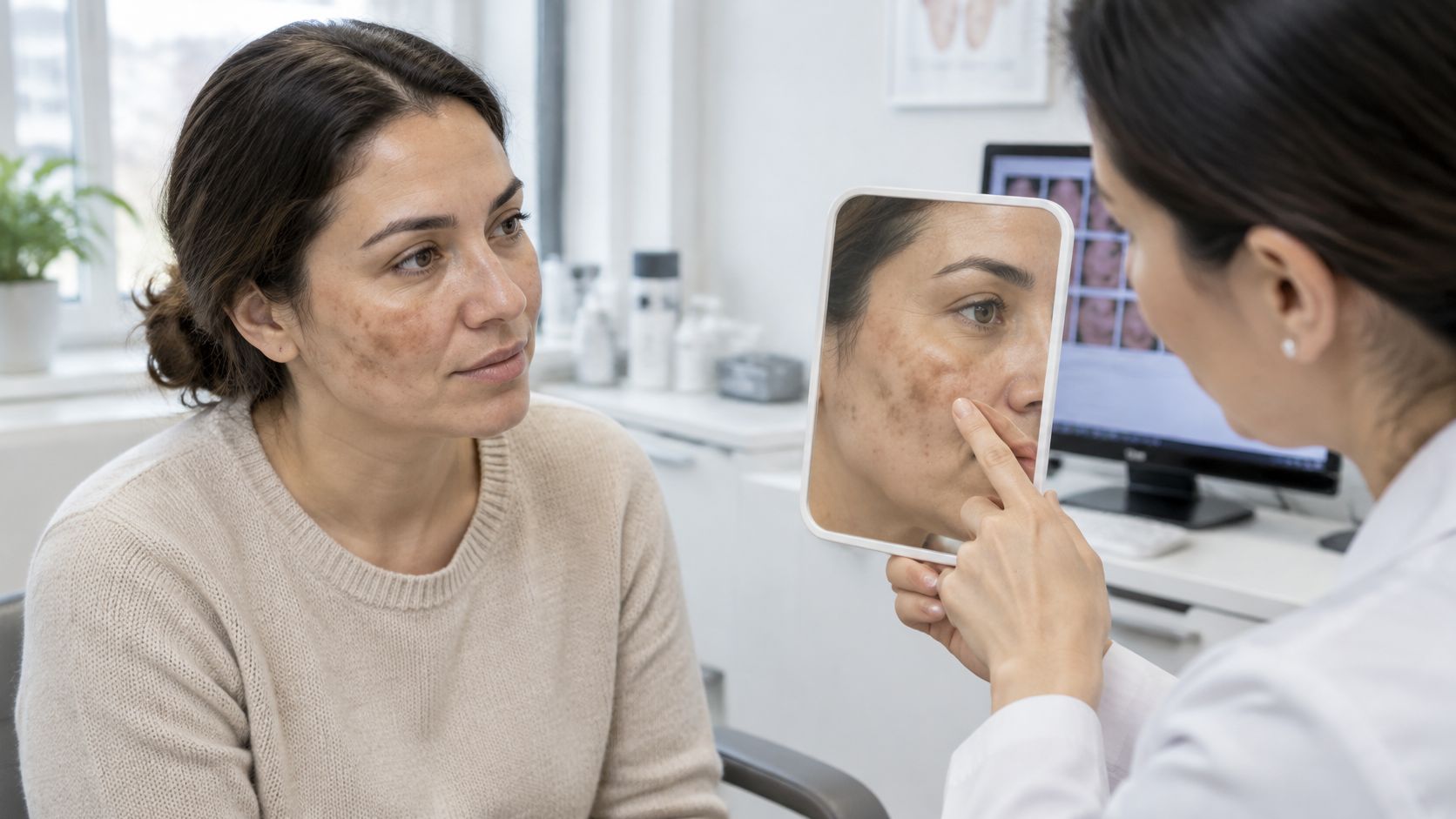
Uneven tone isn't one condition, so it doesn't respond like one. Say a 38-year-old has brown marks on both cheeks left after acne. She books one peel expecting it to fix the dark patches and the lingering redness together. Those are different problems. The brown marks are post-inflammatory hyperpigmentation, or PIH, sitting in the surface layers. The redness reflects ongoing inflammation and visible blood vessels, which a peel doesn't treat the same way. Treating both as generic discoloration is how people end up disappointed, or worse, with fresh pigment from a peel applied over still-active skin.
| Pigment concern | Peel response | Main caution | Usual first step |
|---|---|---|---|
| Epidermal melasma | Superficial glycolic-acid peels are most rational | Relapse is common after stopping treatment | Peel alongside topical therapy and daily sun protection |
| Post-inflammatory hyperpigmentation (PIH) | Partial response 33.3% with peels alone; 85.7% when combined with topical agents | Peel-triggered inflammation can create new PIH | Control the trigger, then combine peel with topicals |
| Acne-related marks | Partial response in 84.2% of participants at a median of 6.5 weeks | Active acne must be controlled first | Treat active breakouts before peeling |
| Sun-induced lentigines | Not established in the reviewed evidence | Peels do not replace sun protection | Daily broad-spectrum sunscreen |
Reading those numbers honestly
A systematic review of PIH treatments found peels alone produced only a partial response in 33.3% of PIH cases, while 66.7% had poor or no response, and combination treatment with topical agents reached an 85.7% partial-response rate. A separate systematic review of acne-induced pigmentation reported chemical peels produced a partial response in 84.2% of participants, 117 of 139 patients, assessed after a median of 6.5 weeks. Notice the word partial. That's the realistic goal for most pigment concerns, a visible softening rather than complete erasure.
Two questions sort out most cases before any acid touches your skin. First, is the color in the top layer, where a superficial peel can reach it? Second, is there active inflammation still triggering it, from acne, eczema, picking, or irritation? If the answer to the second question is yes, calming that trigger comes first. For sun-induced lentigines, the reviewed evidence doesn't establish a peel response, so the table leaves that cell as not established and the usual first step is daily broad-spectrum sun protection, not a peel.
Who Should Peel and Who Should Wait
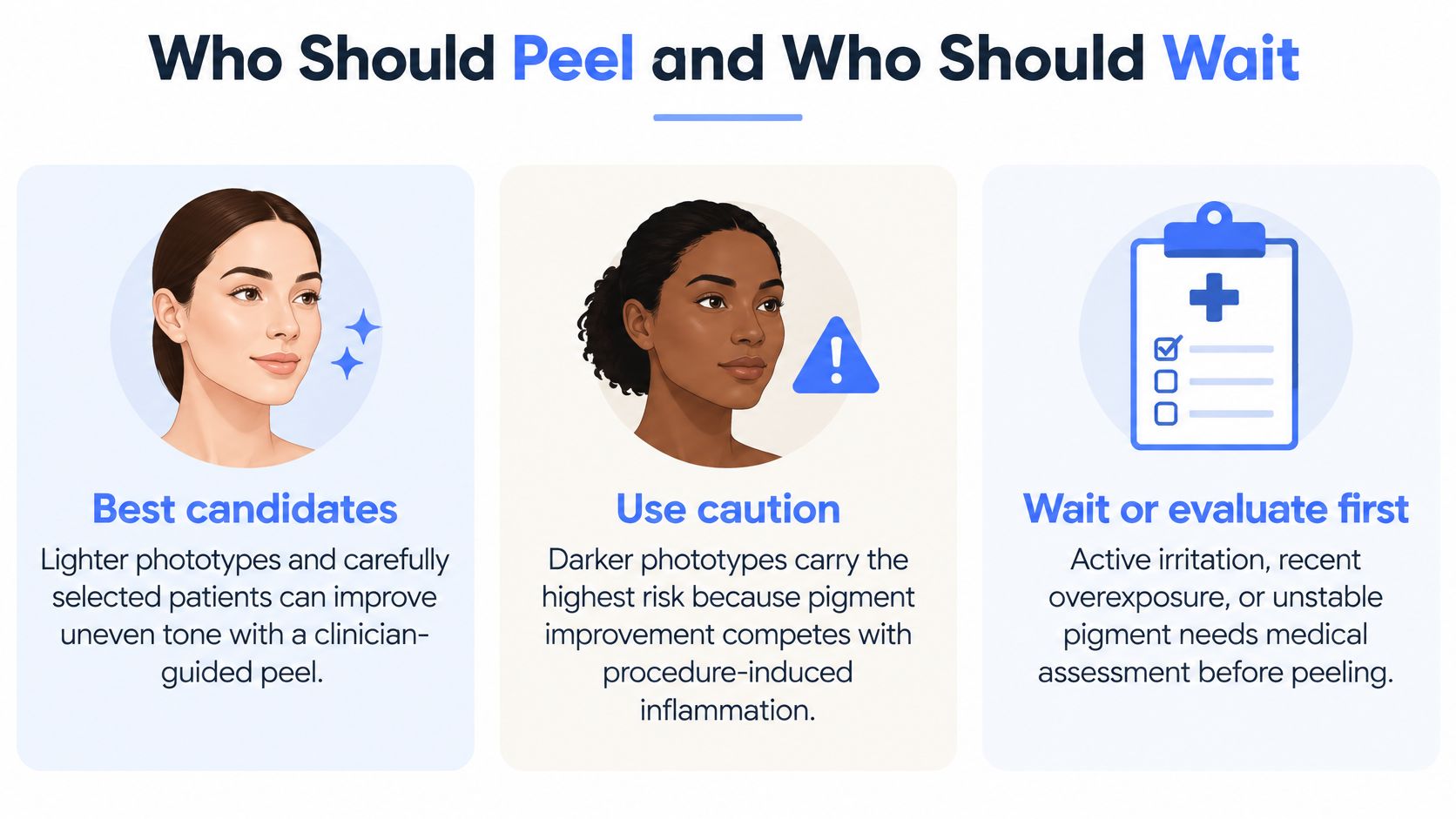
Skin type changes the math. In darker phototypes, pigment improvement competes directly with procedure-induced inflammation, because melanin-rich skin often responds to injury by making more pigment. A review of glycolic-acid and TCA peeling in Fitzpatrick V patients found significant melasma improvement at 12 weeks, but irritation occurred in 77.5%, post-peel cracking in 62.5%, and transient hyperpigmentation in 12.5%. About 70% experienced melasma recurrence within 12 weeks after stopping treatment. Those numbers don't mean darker skin can't be peeled. They mean the protocol has to be conservative, staged, and run by a clinician experienced with skin of color.
A checklist to run through before you book
- Delay the peel when skin is unsettled. Uncontrolled acne, active dermatitis or eczema, an active infection, recent tanning on the area, or a history of abnormal pigmentation all argue for waiting.
- Get the diagnosis confirmed. Ask your clinician to name the pigment type and estimate its depth before choosing an acid.
- Expect a conservative first session. If your reactivity is unknown, a gentler start with gradual increases and enough spacing for barrier recovery is the safer path.
The assumption worth challenging is that a peel should always come first. For melasma in someone prone to PIH, peels alone perform modestly, while pairing them with topical therapy performs substantially better. So a clinician may make topicals the foundation and use the peel as a supporting step, or discuss other options entirely. If you're comparing approaches for melanin-rich skin, our overview of laser treatment considerations for darker skin explains how pigment risk shapes device choices too.
You should hear about relapse before your first session, not after it. A provider who promises permanent color correction for melasma is overselling.
Before treatment, a careful provider documents your skin type, your reactivity history, including how past breakouts or injuries healed, and the assessed pigment depth. Standardized photographs belong in that record as well. If none of that happens and you're offered the same peel as everyone else, that's a reason to pause and ask questions.
Preparing, Aftercare and Warning Signs
Start with the supervision rule, because it governs everything else. The FDA warning on chemical peel products says acid concentration, number of applications, and contact time all determine how a peel penetrates. The FDA also warns that high concentrations used without professional supervision can cause chemical burns, pain, swelling, infection, pigment changes, and disfiguring scars, and it has not approved chemical peel products for consumer self-treatment. A peel belongs under a licensed, trained practitioner, full stop.
The routine step by step
- In the weeks before, protect the area. Avoid sun exposure and tanning on the treatment area so you don't arrive with already stimulated pigment.
- About seven days before, pause retinoids. Stop them roughly a week ahead as your clinician directs, since thinned, sensitized skin reacts more strongly.
- On the day, expect a short, structured visit. Your clinician cleanses your skin, applies the agent for the planned time, watches the endpoint, and neutralizes it.
- For the first days, keep it plain. Use a gentle cleanser and a simple moisturizer, don't pick or pull at flaking skin, and pause active ingredients until cleared.
- Sunscreen every morning. Apply broad-spectrum protection daily and reapply when you're outdoors, because freshly peeled skin pigments easily.
- Space your sessions. Give the barrier time to recover fully before the next peel rather than stacking treatments too closely.
While your barrier recovers, product choice matters more than product count. If you're researching soothing topicals to discuss with your provider, this guide to choosing lab-tested CBD skincare products from HempWell USA covers how to check testing and labeling before putting anything new on treated skin. Our own post chemical peel care guidance walks through the recovery days in more detail.
Call your provider promptly if you notice pain beyond what was described, blistering, warmth, swelling or discharge suggesting infection, or darkening that keeps spreading instead of settling. Irritation and PIH are the main risks with pigment-focused peeling, and early treatment of inflammation limits how much new pigment forms. The most reliable prevention is unglamorous. Start conservative, protect from sun, and don't rush the next session.
What Results to Expect and When
Follow one worked example and the timeline makes sense. Published superficial glycolic-acid protocols commonly use about 20% to 50% GA every 2 to 4 weeks, according to a review of glycolic-acid peels for pigmentary disorders. In a prospective study within that review, six fortnightly peels rising from 20% to 50% GA, alongside tretinoin, topical GA and hydroquinone, cut mean MASI from 16.56 to 3.8, approximately 75%. The same study recorded erythema in 90%, peeling in 70%, crusting in 55%, and PIH in 20% of participants. Strong results and real side effects arrived together, which is exactly the trade-off your clinician is managing.
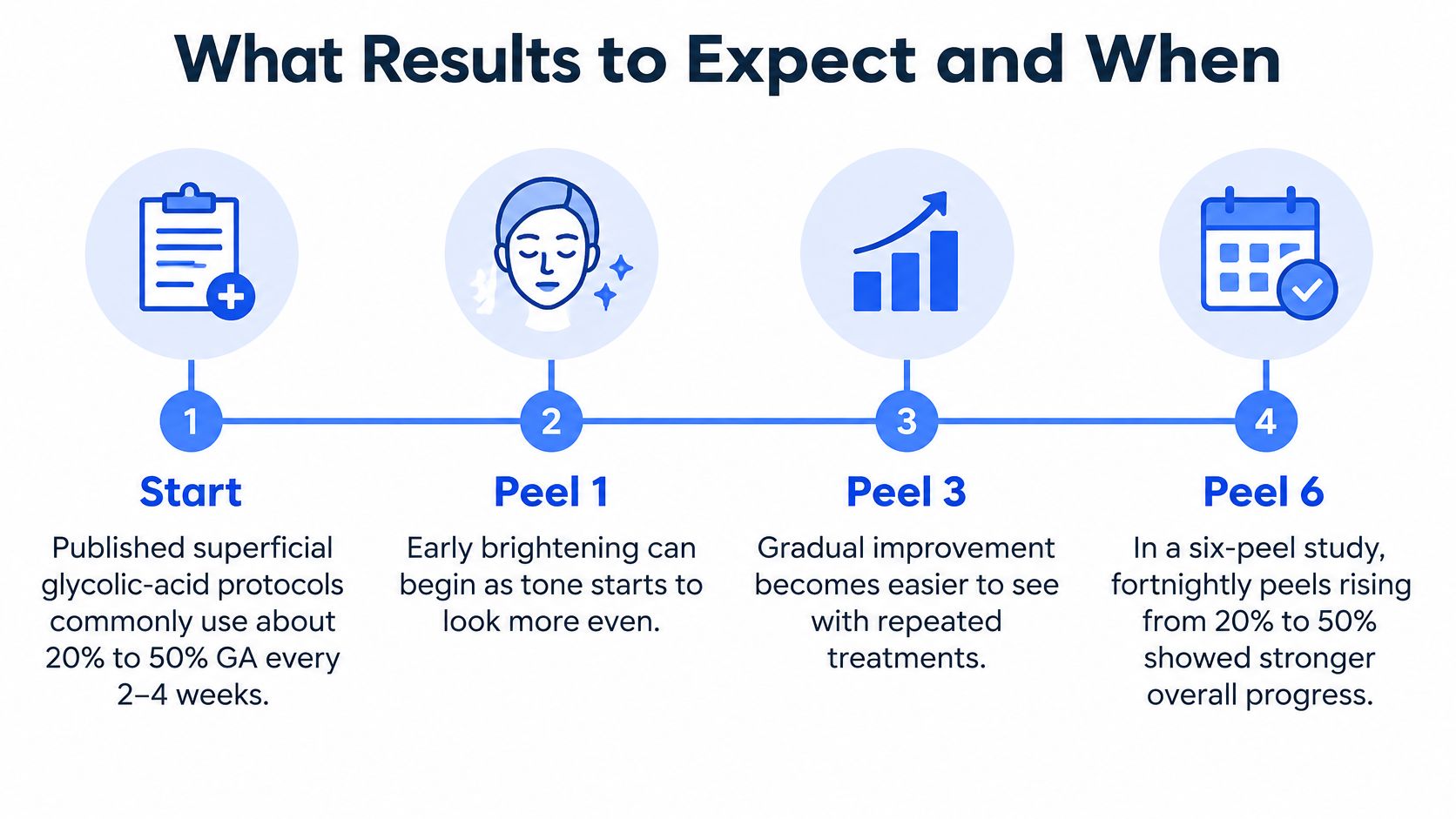
Other data points fill in the calendar. In an Indian randomized trial, serial GA peels plus topical therapy beat topical therapy alone, with more than half of participants reaching at least 50% clearance after 12 weeks. A 2024 systematic review of PIH in skin of colour reported chemical peels were used in 123 participants, representing 9% of the reviewed treatment population, and an average of approximately five sessions produced partial pigment reduction in 67% of cases where outcomes were available. That review also reported a mean resolution time of 28 days in the subset with timing data and a four-month follow-up in another subset. So judging success one week after peel one measures the wrong thing.
| Timing | What to expect | Evidence |
|---|---|---|
| Days 1 to 7 | Redness, peeling and sometimes crusting | Erythema 90%, peeling 70%, crusting 55% in a six-peel GA study |
| About week 4 | Pigment-related inflammation settles | Mean resolution 28 days in the PIH review subset with timing data |
| Week 12 | First measurable pigment review | More than half reached 50% clearance with serial GA plus topicals |
| Month 4 onward | Maintenance and recurrence watch | Four-month follow-up in another review subset |
| Ongoing | Sun protection and maintenance peels may be needed | Results are generally not permanent |
Judge progress with standardized photos taken at baseline and each visit, same lighting, same angle, no makeup. Memory flatters and then discourages you. Photos show whether patches are breaking up or just looking different on a good skin day.
Treatments That Extend Peel Results
A peel works best as one part of a plan, and it helps to see the three supporting roles separately. The first is a clinician-selected topical regimen. The strongest results in the evidence above came from pairing, whether peels alongside tretinoin, topical GA and hydroquinone, or serial GA added to topical therapy instead of topicals on their own. Topicals suppress new pigment production between visits, which a peel, as a removal step, can't do by itself.
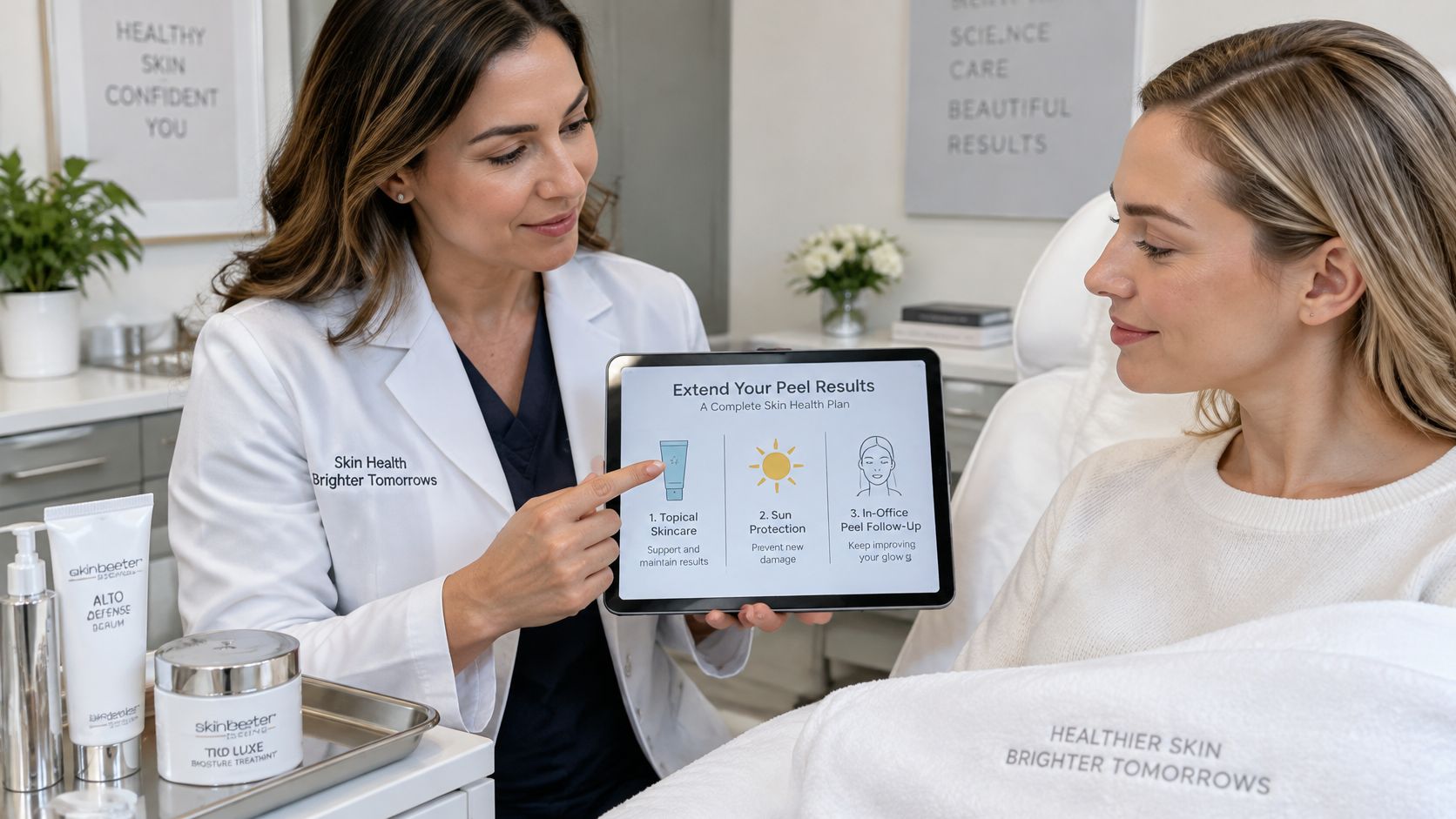
The second role is daily broad-spectrum sun protection. Ultraviolet exposure restimulates the pigment you're paying to remove, so sunscreen isn't an afterthought, it's half the treatment. If you want background reading on everyday spot care to discuss at your visit, this dark spot skincare advice from AloeCure covers common topical approaches patients ask about. The third role is maintenance, usually occasional superficial peels once tone is stable, because results are generally not permanent and skin keeps responding to sun and hormones.
Other procedures get compared with peels, including light and laser options described in our laser pigmentation treatment overview. The evidence reviewed here doesn't establish a clear ranking among them. The right choice depends on your diagnosis, pigment depth and tolerance, so ask your clinician why a peel was chosen over the alternatives for your skin specifically.
A sensible sequence
- Calm active inflammation first. Treat acne, dermatitis or irritation before any peel.
- Start topicals and sun protection. Keep both going throughout the peel series, not just after it.
- Add peels in spaced sessions. Increase strength gradually only if your skin tolerates each step.
- Reassess at fixed intervals. Compare standardized photos and adjust the plan based on what you see.
Peels remove pigment that's already there. Topicals and sunscreen slow the pigment that's coming. You usually need both halves.
Confirm the Right Peel Before You Book
Turn everything above into questions for your consultation. What is my pigment diagnosis, and how deep does it sit? What peel depth are you proposing and why? How do you assess my skin type and reactivity? How many sessions are planned, and how are they spaced? What topical and sun protection plan goes with the peels? And what happens if irritation or PIH develops? Clear answers signal a clinician who is matching treatment to your skin rather than selling a package.
At ProMD Health, chemical peels are customized to your skin concerns, and The Spa at ProMD Health offers facials, chemical peels, microdermabrasion and HydraFacial treatments delivered by licensed estheticians. The Spa by ProMD Health also offers treatments aimed at improving complexion by correcting pigmentation, fine lines and wrinkles, acne, collagen production, and moisture restoration. Service availability can vary by office, so confirm that peels, and the depth you discussed, are offered at the approved ProMD location you plan to visit, whether that's in Maryland, Virginia, Washington, DC, Florida, Texas, Colorado, or Delaware.
One practical point on cost. ProMD Health operates on a cash-pay model, so chemical peels are not covered by insurance. Ask for the full series cost up front so you can plan for the number of sessions your pigment needs.
Bring two things to your consultation. Photos showing how your discoloration has changed over time, and a written list of past skin reactions, including products that burned, breakouts that left marks, and any previous peel or laser responses. That history often decides the starting strength more than the patch itself does.
If uneven tone hasn't responded to products alone, a properly matched chemical peel at ProMD Health can be the supervised next step, chosen by pigment type, depth and your downtime tolerance rather than by strength alone. Bring your photos and reaction history, confirm peel availability at your nearest approved location, and book a consultation through ProMD Health to build a plan that pairs treatment with topicals and daily sun protection.