
You've left the clinic, looked in the mirror, and noticed skin that feels tight, warm, or more sensitive than expected. A little redness or peeling can be part of a normal response, but recovery after a chemical peel isn't identical for everyone. The depth of the peel determines how much downtime you'll need, while the way you cleanse, moisturize, protect, and monitor your skin affects how safely that recovery proceeds.
Post chemical peel care is a structured healing phase, not the time to test new products or speed up flaking. The treated barrier is temporarily compromised, so gentle handling and photoprotection matter from the first hours through the return to your regular routine.
Table of Contents
- The First 24 Hours After Your Chemical Peel
- Healing Timelines by Peel Depth
- Essential Dos and Don'ts During Recovery
- Skincare Ingredients to Use and Avoid
- Recognizing Complications and When to Seek Help
- Planning Follow-Up Care and Long-Term Results
The First 24 Hours After Your Chemical Peel
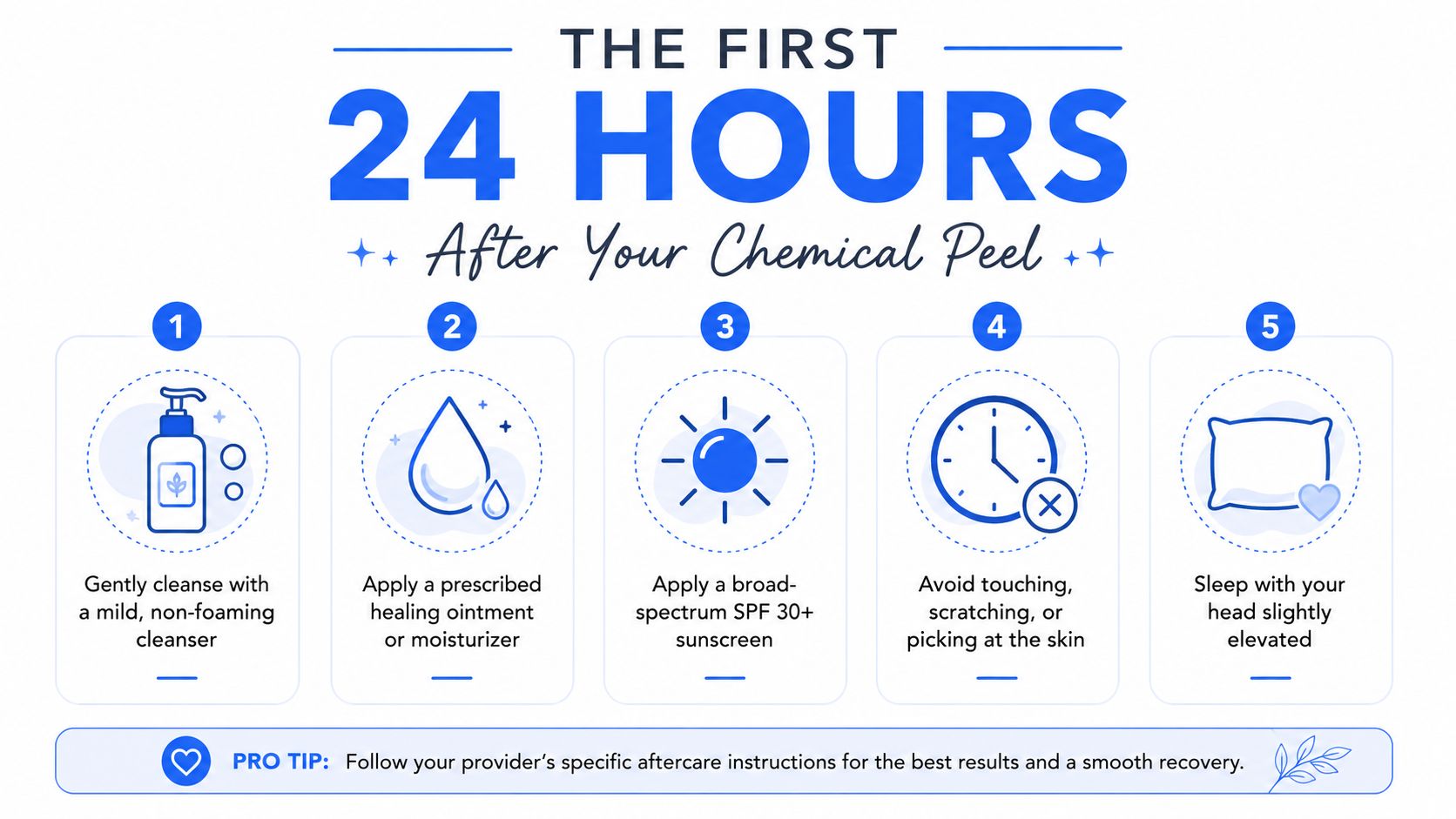
The first day is when your skin needs the least interference. You may notice tightness, warmth, mild stinging, dryness, or redness. Those sensations can be expected, but increasing pain, marked swelling, blistering, oozing, or pus should prompt a call to your provider rather than more home treatment. An NIH clinical review recommends mild soap or a non-soap cleanser, careful sun avoidance, meticulous broad-spectrum sunscreen use, and stopping glycolic acid and retinoids until desquamation is complete. The review also specifically advises against picking, scratching, rubbing, or scrubbing treated skin.
What to do when you get home
Unless your clinician gave you a different protocol, leave the skin alone for the initial period they specified. When it's time to cleanse, use cool to lukewarm water and a mild, non-foaming, fragrance-free cleanser. Hot water can intensify discomfort, while vigorous rubbing can disturb fragile surface skin.
Use clean fingertips only. Rinse thoroughly, then pat your face dry with a soft, clean towel. Don't drag the towel across the skin, use a cleansing brush, or try to remove areas that appear ready to peel.
Apply the moisturizer or healing ointment recommended for your treatment. The NIH review advises topical antibiotic ointment only if crusting develops, so don't automatically add an antibiotic product unless your clinician has told you to do so. A facial peel study found that 7 of 8 moisturized patients showed day-five skin changes consistent with more advanced healing, and the difference was statistically significant at p = 0.0325. That PubMed-indexed study provides direct support for moisturization during early recovery.
How to handle the rest of the day
Avoid direct sunlight from the moment you leave the clinic. If your provider has cleared sunscreen for immediate use, apply a broad-spectrum product as directed, and add physical protection such as a hat and shade. Mayo Clinic guidance also emphasizes following clinical directions for sun protection, cleansing, moisturizing, and protective ointments. You can review its general chemical peel aftercare guidance here.
Keep your hands off your face unless you're cleansing or applying a recommended product. Skip workouts, heat, steam, swimming, and social plans that expose you to sun or heavy sweating. For sleep, use clean bedding and prop your head up slightly if swelling is a concern. Don't sleep face-down or press the treated area into a pillow.
Practical rule: During the first day, fewer products and less touching are usually safer than trying to manage every sensation.
Healing Timelines by Peel Depth
A friend may return to work quickly after a light peel while you are still managing redness from a deeper treatment. That difference does not automatically signal a problem. Peel depth, formulation, application technique, skin condition, and individual healing all shape the recovery calendar.
| Peel Depth | Healing Duration | Visible Symptoms | Downtime |
|---|---|---|---|
| Superficial | About 1 to 4 days in one literature benchmark | Mild redness, tightness, and desquamation | Often limited, but normal activity depends on comfort and provider guidance |
| Medium-depth | About 14 to 21 days of healing | More noticeable redness, peeling, sensitivity, and possible swelling | A meaningful period of modified activity and careful wound care |
| Deep | Several weeks to months, with complete healing taking several months | Significant redness, crusting, tenderness, and prolonged sensitivity | Substantial downtime, strict sun protection, and close clinical supervision |
A superficial peel commonly causes redness and scaling for 3 to 7 days. A medium-depth peel may require 14 to 21 days of healing, while a deep peel can involve strict sun avoidance for 3 to 6 months. A separate literature benchmark places superficial-peel healing at about 1 to 4 days. These ranges differ because studies and treatment protocols do not measure recovery in exactly the same way. Use them for planning, not as promises. The clinical policy summary also discusses the depth-dependent recovery pattern.
What each depth means in daily life
After a superficial peel, mild flaking and sensitivity may appear before the skin settles. Makeup and exercise should wait until your provider confirms that the surface has recovered and irritation has eased. Downtime is often limited, but comfort and the treatment protocol still determine when normal activities are appropriate.
A medium-depth peel usually requires more planning. Visible peeling, redness, sensitivity, and possible swelling can affect work, events, and travel for longer than a light peel. Arrange your schedule around the possibility that the skin will remain visibly reactive throughout the healing period.
A deep peel requires the most patience and clinical oversight. One clinical summary describes skin remaining very red for about 3 weeks and sometimes up to 2 months, with complete healing taking several months. It also states that many people take about 2 weeks off work after a deep peel. This recovery overview outlines the potential downtime associated with deep treatment.
If you are reviewing acid categories before a consultation, best hydroxy acid peel for pharmacies can help clarify terminology, but it cannot determine whether a specific depth suits your skin. For treatment-specific planning, consult SkinMedica peel information from ProMD Health and follow the protocol provided for your procedure.
Essential Dos and Don'ts During Recovery
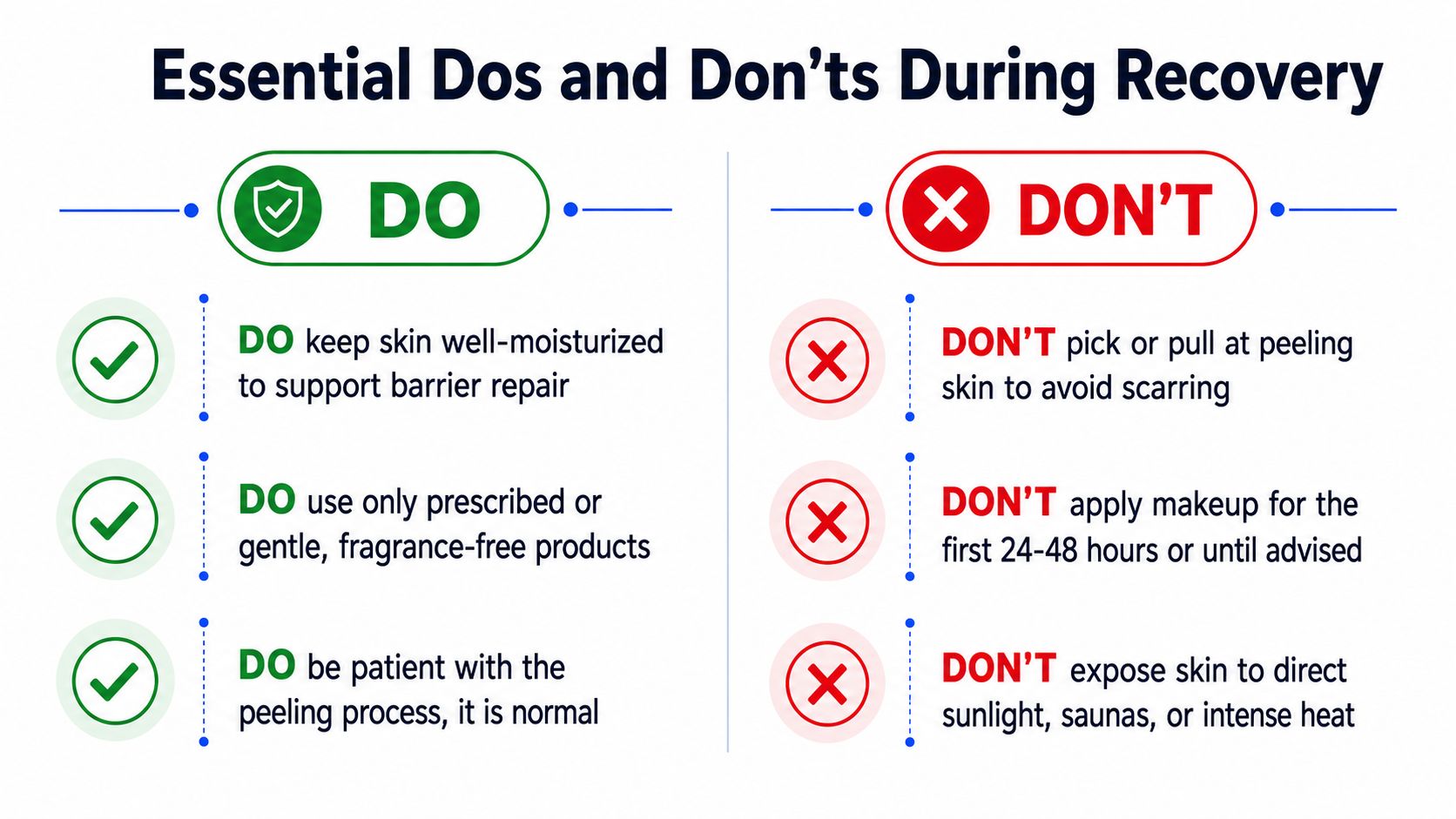
Aftercare succeeds when you protect the barrier instead of trying to force a faster peel. Moisturize consistently, cleanse gently, and allow flaking skin to detach on its own. A peel creates a temporary vulnerability, so friction, heat, sweat, and unnecessary ingredients can turn manageable irritation into prolonged redness or pigment change.
Habits that support recovery
- Keep the surface moisturized: A bland moisturizer reduces tightness and supports barrier recovery. Apply it with clean hands and press lightly rather than massaging aggressively.
- Use gentle products only: Choose fragrance-free, non-exfoliating formulas unless your provider prescribed something specific. If a product stings, stop and ask whether it belongs in your current routine.
- Protect against light: Broad-spectrum sunscreen and physical shade reduce the environmental stress that can worsen redness and pigment irregularity. Sun protection remains important even when the skin is peeling.
- Let the skin shed naturally: Flakes can look untidy, especially before an event, but pulling them away can create raw areas and increase the chance of inflammation or discoloration.
Behaviors that commonly interfere
Don't scrub, brush, scratch, or pick. Mechanical trauma doesn't improve the peel's result. It can expose skin before it's ready and make irritation harder to control.
Hold glycolic acid, retinoids, and other exfoliating products until desquamation is complete and your provider approves their return. Exercise, saunas, steam rooms, hot showers, and swimming also deserve caution because heat, sweat, and shared water environments can irritate vulnerable skin. Makeup should wait until the surface is sufficiently recovered or your clinician has cleared it.
For a broader discussion of gentle barrier care, this guide to Japanese skincare for sensitive skin can help you evaluate soothing routine principles without turning recovery into a product-collecting project.
Remember: Peeling is a process to observe, not a layer to remove.
If an event is unavoidable, keep your routine simple, avoid heavy coverage over actively peeling or open areas, and prioritize shade. A short-term cosmetic inconvenience is preferable to extending inflammation or creating pigment problems that last much longer.
Skincare Ingredients to Use and Avoid
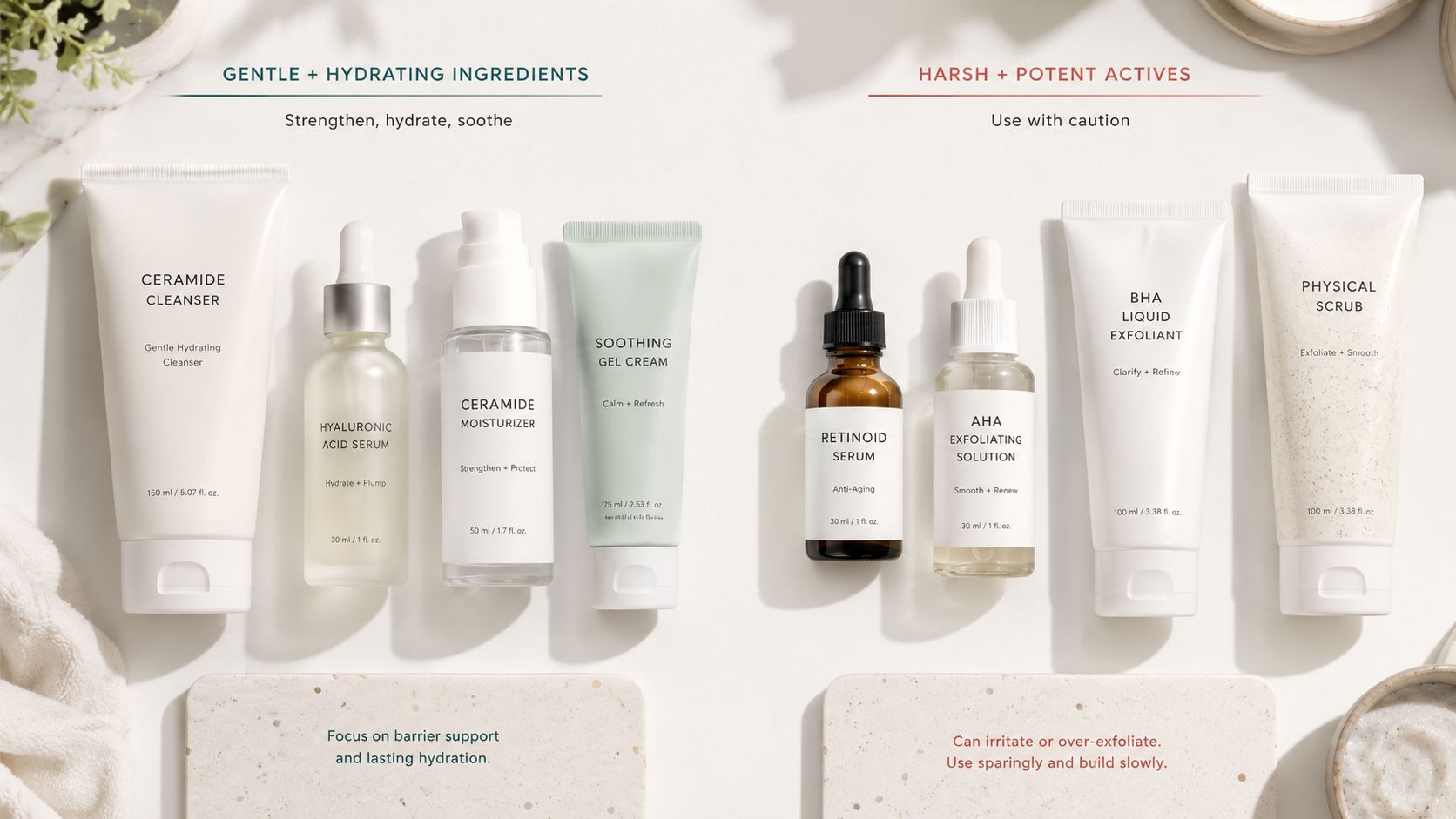
Your cabinet should become simpler after a peel. The safest early routine usually centers on hydration, barrier support, and photoprotection, rather than correction. Ceramides, hyaluronic acid, and panthenol are commonly used in bland moisturizing formulas because they support hydration and comfort without deliberately accelerating exfoliation.
What belongs in the early routine
Choose a mild cleanser, a fragrance-free moisturizer, and the healing ointment recommended by your provider. Creams and ointments often feel more protective than lightweight gels when the skin is tight, but texture should be guided by comfort and your clinician's instructions. If a formula burns on application, it isn't automatically “working.” Burning is a reason to pause and reassess.
Mineral sunscreen containing zinc oxide may be more comfortable for some patients during the vulnerable phase because it sits on the surface and provides physical protection. The most important requirement is broad-spectrum coverage and consistent use, not a complicated sunscreen rotation. Mayo Clinic guidance reinforces daily sun protection alongside cleansing and moisturizing. Its chemical peel overview offers general clinical aftercare direction.
What should stay on the shelf
Retinoids, glycolic acid, salicylic acid, other AHAs and BHAs, scrubs, cleansing devices, and strong acne treatments can all add irritation while the barrier is recovering. Vitamin C products may also sting, particularly in more acidic formulations. The right return date depends on peel depth, visible healing, and your provider's assessment, so don't use a fixed calendar as permission to restart everything at once.
Reintroduce one active product at a time only after peeling and significant sensitivity have resolved. Start with limited frequency, watch for renewed burning or redness, and stop if your skin reacts. ProMD Health's guidance on the best moisturizer after a chemical peel can help you choose a recovery-focused product approach.
The trade-off is straightforward. Stronger products may address acne, pigmentation, or texture during normal skincare, but using them too early can prolong inflammation and undermine the result you're trying to protect.
Recognizing Complications and When to Seek Help
After a chemical peel, mild redness, tightness, scaling, and sensitivity can be expected, particularly when they match the treatment depth and steadily improve. Reactions that intensify, spread, or change character need a different response. Recovery should trend gradually better, not become increasingly painful or inflamed.
Symptoms that need prompt reassessment
Contact your treating provider promptly if redness becomes excessive, swelling is substantial, burning worsens, or pain becomes significant. Crusting, oozing, pus, and blisters also warrant reassessment rather than routine home care. Fever or redness that continues spreading requires urgent medical guidance.
Severe or escalating pain is especially concerning when it occurs with swelling, blistering, drainage, or skin that looks increasingly raw. Keep the area uncovered from makeup while you arrange advice, and do not add several products in an attempt to calm the reaction. The PubMed-indexed review discusses these complication patterns and the importance of conservative care.
Pigment change deserves patience and attention
Post-inflammatory hyperpigmentation is a common concern after a peel. An expert review citing an Australian dermatologist survey reported hyperpigmentation in 67% of complication observations, persistent erythema in 52%, and edema in 37%. These figures describe reported complication observations, not the expected outcome for every patient, but they show why pigment and redness deserve follow-up.
Pigment change may last much longer than the initial peeling. One literature benchmark notes that post-inflammatory hyperpigmentation can take 3 to 24 months to resolve in some cases. Sun protection, gentle cleansing, and bland moisturizers support the recovering barrier while the pigment is monitored, but persistent or worsening discoloration should be assessed by your provider.
Do not treat a new dark patch with acids or aggressive brightening products while the skin remains reactive. Photograph it in consistent lighting, protect it from sunlight, and contact your provider so they can decide between observation and treatment.
For patients whose main concern is discoloration, ProMD Health's information on a chemical peel for hyperpigmentation provides treatment context. A new post-procedure reaction still requires individualized review, particularly after a medium or deep peel, where inflammation can remain visible longer.
Planning Follow-Up Care and Long-Term Results
A chemical peel works best as part of a plan rather than as an isolated event. Your follow-up should address how the skin healed, whether pigmentation or redness appeared, which products you tolerated, and whether the original peel depth matched your goals and downtime tolerance.
One review suggests that when a peel regimen is effective, follow-up treatments may be scheduled monthly for 6 months, followed by every 3 months, depending on season and need. The clinical review describes maintenance scheduling as individualized rather than automatic. That approach makes sense clinically. A patient with recurring pigment concerns may need a different rhythm from someone focused mainly on texture, and seasonal sun exposure can affect when treatment is sensible.
Build the next decision around your recovery
A series of lighter peels may offer a more manageable pattern of downtime, while a deeper peel may create a more substantial single recovery period. Neither option is universally better. The practical choice depends on your skin condition, history of pigment change, schedule, tolerance for visible peeling, and the provider's assessment.
Between appointments, medical-grade skincare can help maintain the treatment environment, but it should be introduced according to your recovery stage. ProMD Health's Skin Shoppe offers provider-curated skincare, and ProMD Connect provides a telehealth route for questions about an active recovery or an ongoing care plan. Availability and suitability still need confirmation with the clinical team.
If you're weighing a peel against another resurfacing approach, this overview of BotoxBarb skincare advice can provide general comparison context, but your treatment sequence should be based on your skin's current condition rather than a generic schedule. Keep a record of your peel date, products used, symptoms, and sun exposure. That information gives your provider a more useful basis for planning the next step.
ProMD Health offers chemical peels, medical-grade skincare, and clinical guidance for patients who want a structured approach to post chemical peel recovery and longer-term skin goals. Visit ProMD Health to explore available services and connect with the appropriate clinic or care team before scheduling your next treatment.


