
You've just had a chemical peel. Your skin feels tight, a little warm, and you're trying not to overthink every sensation on the drive home. Most patients are excited about the smoother, brighter skin ahead, but they're also unsure about one very practical question. What should I put on my face now?
That question matters more than people realize. The best moisturizer after a chemical peel doesn't just make skin feel better. It helps protect a temporarily vulnerable barrier, reduces unnecessary irritation, and supports a cleaner healing process so your results aren't compromised by the wrong product or the wrong timing.
This is also where generic skincare advice starts to fall apart. A light peel and a medium-depth peel don't behave the same way, and your moisturizer shouldn't either. If you enjoy learning about texture, barrier support, and layered hydration, resources on deeply hydrating Japanese skincare can be helpful for understanding why certain formulas feel more comfortable on stressed skin. For post-procedure care, though, stick with your provider's medical guidance first, especially the kind outlined in pre and post care treatment instructions.
Table of Contents
- Your Guide to Post-Peel Healing
- Why Your Skin Needs Special Care After a Peel
- Key Ingredients to Choose and Avoid
- Your Moisturizing Schedule for Different Peel Depths
- Essential Aftercare Beyond Your Moisturizer
- Partner with Your Provider for Optimal Healing
Your Guide to Post-Peel Healing
Leaving a peel appointment, individuals often expect some dryness and flaking. What catches them off guard is how quickly their usual routine stops feeling right. A moisturizer that felt perfectly fine last week can suddenly sting, feel too heavy, or seem like it's doing nothing at all.
That's normal. Post-peel skin is in a very specific healing window, and the goal is not limited to keeping it comfortable. The goal is to support recovery without interfering with the way the skin is supposed to shed and rebuild.
Some patients do best with frequent barrier support right away. Others, especially after a more superficial treatment, may need a lighter hand in the first part of recovery. That's where a lot of online advice gets confusing. One article says to moisturize constantly. Another says to let the skin peel on its own. Both can be right, depending on the peel depth and what your skin is doing in real time.
Practical rule: Don't judge a post-peel moisturizer by how rich it feels. Judge it by whether it supports healing without adding heat, sting, congestion, or friction.
The best moisturizer after a chemical peel is the one that matches the depth of your treatment, your skin type, and the stage of healing you're in. That usually means choosing fragrance-free, barrier-focused formulas and using them with restraint or frequency based on a medical plan, not a trend.
Why Your Skin Needs Special Care After a Peel
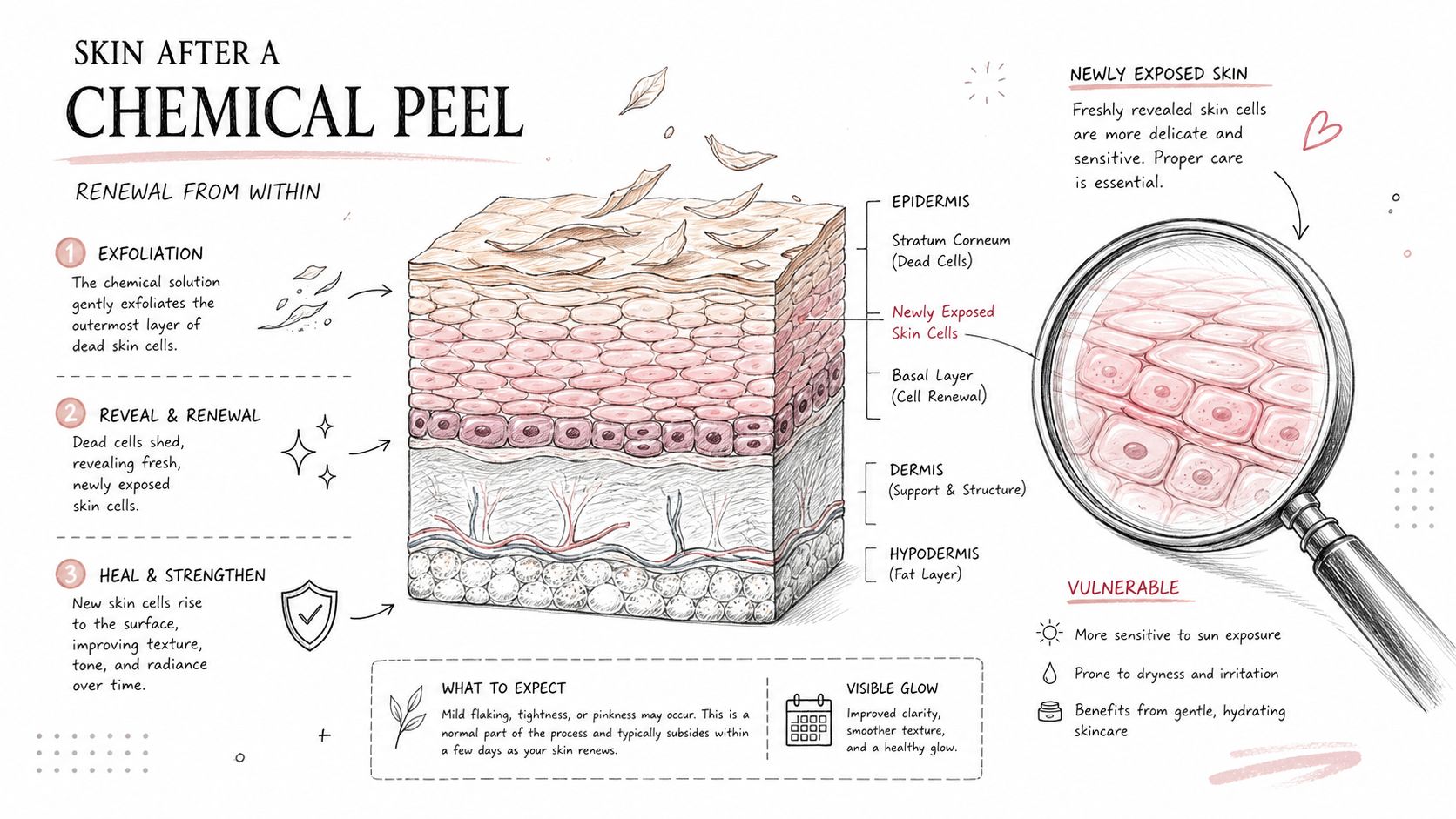
A peel changes what your skin can tolerate
The first day or two after a peel is when patients usually notice the difference. Skin that handled a normal cleanser, serum, or lotion last week may now sting on contact, flush easily, or feel tight again an hour after moisturizing.
That reaction makes sense clinically. A chemical peel speeds up exfoliation and temporarily weakens the outer barrier, so the skin loses water faster and has less protection from friction, heat, and irritating ingredients. The deeper the peel, the more pronounced that healing phase tends to be.
This is why post-peel care has to be more deliberate than routine skincare.
A standard daily moisturizer is designed for intact skin. After a peel, the job changes. The right formula needs to reduce water loss, limit irritation, and support barrier recovery without trapping excess heat or adding ingredients that increase inflammation. Guidance from the American Academy of Dermatology on chemical peel aftercare reflects that same principle: keep skin care gentle while the surface recovers.
Why ordinary lotion often falls short
Many everyday lotions are built to feel cosmetically elegant, not to support freshly peeled skin. They may include fragrance, exfoliating acids, retinoid alternatives, essential oils, or preservatives that are well tolerated under normal conditions but become irritating when the barrier is compromised.
Texture matters too. A lotion that is too light may not control post-peel dryness. One that is too heavy can feel smothering, especially on acne-prone or heat-sensitive skin. In practice, this is the trade-off I want patients to understand. More product is not always better. Better matching is better.
For patients who already know they run dry and reactive, broader skincare reading on expert advice for sensitive complexions can help explain why bland, barrier-first formulas outperform “active” moisturizers during recovery.
After a peel, the goal is not to make skin feel coated. The goal is to help it heal calmly.
Key Ingredients to Choose and Avoid
The easiest way to pick the best moisturizer after a chemical peel is to ignore branding and read the ingredient logic. You want formulas that help the skin hold water, rebuild barrier structure, and stay calm. You don't want ingredients that stimulate turnover, add fragrance, or trap too much heat when the skin is already inflamed.
What supports healing skin
Some ingredients consistently make sense after a peel because they work with the barrier instead of challenging it.
- Ceramides help replace some of the lipids your skin uses to stay sealed and resilient.
- Hyaluronic acid helps attract water to the skin, which is useful when the surface feels tight and depleted.
- Glycerin is one of the simplest and most reliable humectants for pulling moisture into the upper layers.
- Squalane adds softness and slip without feeling as greasy as heavy ointments.
- Peptides can be helpful in recovery-focused formulas because they support a skin environment centered on repair.
A practical formula often combines these rather than relying on one star ingredient. That's why many post-procedure creams feel boring on the shelf but work very well in recovery.
What usually causes trouble
The ingredient list matters just as much for what's missing.
| Post-Peel Skincare Ingredients Cheat Sheet | |
|---|---|
| Choose These (Healing & Hydrating) | Avoid These (Irritating & Counterproductive) |
| Ceramides | Fragrance |
| Hyaluronic acid | Alcohol-heavy formulas |
| Glycerin | Retinoids |
| Squalane | Brightening creams during early healing |
| Peptides | Harsh cleansers |
| Shea butter in a bland formula | Exfoliating acids and scrubs |
Patients also need to be careful with “clean” or botanical products. Natural doesn't always mean gentle. Essential oils, plant fragrance, and acid-rich extracts can all sting compromised skin.
Clinical reminder: If a product tingles, burns, or makes the skin feel hotter after application, stop using it and go back to the simplest option your provider recommended.
Barrier creams versus occlusives
Much confusion arises because a barrier repair cream and an occlusive ointment aren't the same thing, even if both reduce dryness.
Barrier creams usually focus on skin-mimicking support, often with ceramides and fatty acids. Occlusives, such as petrolatum-based products, create more of a seal. That seal can be useful on selected dry or scaling areas, especially at night, but it's not automatically the best answer for every peel and every skin type.
Clinical advice emphasizes avoiding heavy, greasy formulas that might clog pores or trap heat, particularly for acne-prone skin, which often does better with non-comedogenic, gel-based options. The same discussion also highlights the move toward biomimetic barrier repair with ceramides and fatty acids rather than simple occlusion, and explains why heavy ointments may be a poor fit for light peels where the goal is controlled exfoliation, as discussed in this post-peel occlusive versus barrier cream review.
That doesn't mean ointments are always wrong. In some aftercare plans, areas of thick scaling are treated with plain petrolatum or a white soft paraffin blend at night. The key is selective use, not coating the entire face by default.
Here's the practical difference:
- Choose a barrier cream when the skin feels tight, fragile, and diffusely dry.
- Use a small amount of occlusive when there's a stubborn patch that needs extra protection.
- Avoid blanket heavy ointment use if you're acne-prone, heat-reactive, or healing from a lighter peel that needs to shed naturally.
Your Moisturizing Schedule for Different Peel Depths
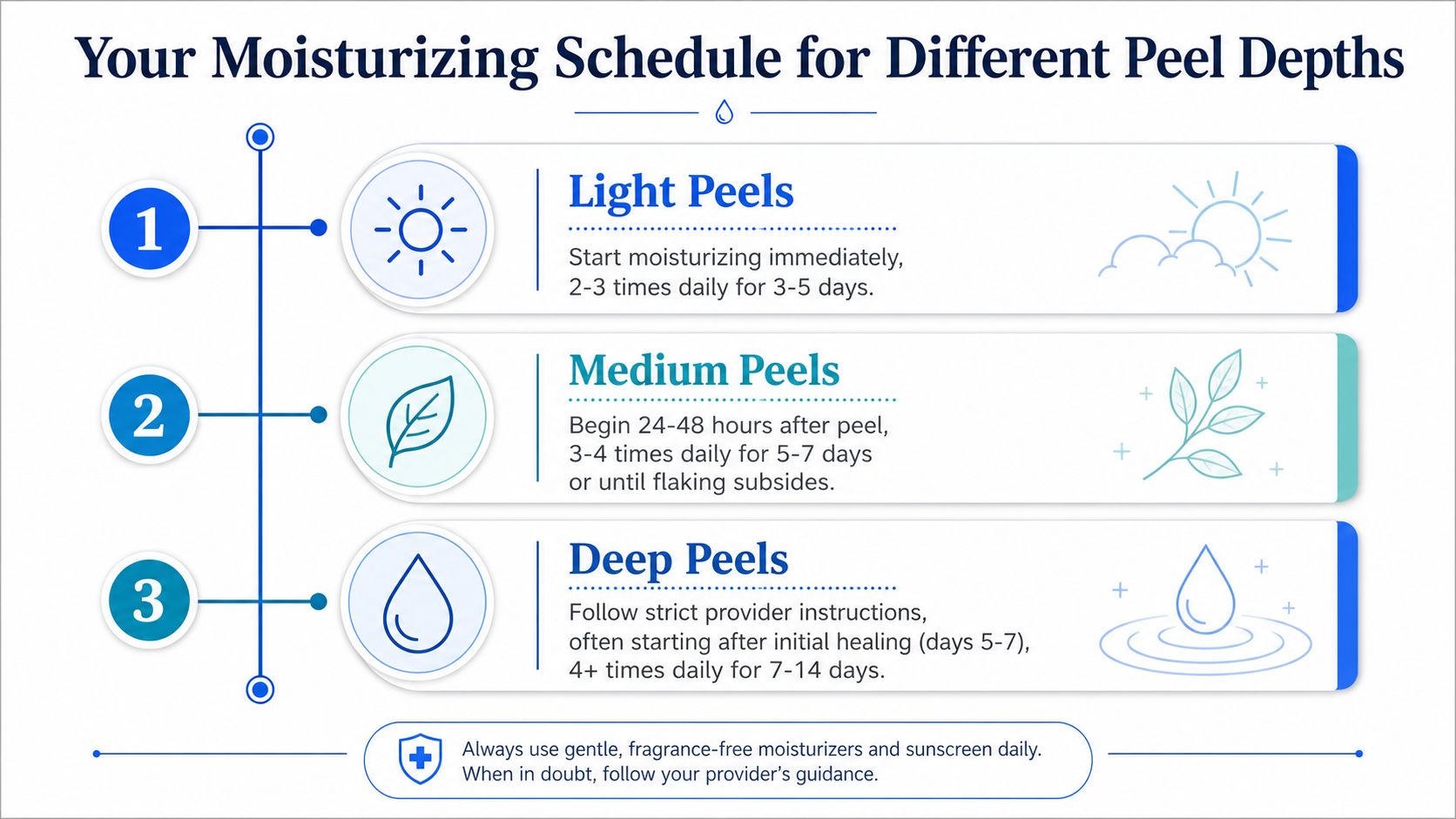
A patient can follow every skincare trend online and still slow their healing by using the right moisturizer on the wrong schedule. After a chemical peel, timing matters as much as product choice. The depth of the peel changes how much support the skin needs, how often to reapply, and when extra product starts to get in the way.
Superficial peels need a light touch
With lighter peels, more moisturizer is not always better. Skin often does best with a thin layer only when it feels tight or uncomfortable, rather than repeated heavy application throughout the day. If you keep the surface overly damp or greasy, peeling can become uneven and irritation may linger longer than expected.
This is the trade-off I explain to patients most often. You want enough comfort to protect the barrier, but not so much product that you interfere with the controlled shedding your treatment was designed to create.
A practical plan for a superficial peel usually looks like this:
- First day: Use only the post-procedure products your provider approved.
- Next few days: Apply a small amount of bland moisturizer when the skin feels tight, stings, or looks ashy.
- If flaking starts: Add another thin layer, not a thick coat.
- If you are acne-prone or heat-reactive: Stay with lighter, non-greasy textures unless your provider tells you otherwise.
Medium-depth peels need scheduled barrier support
A medium-depth peel creates a more noticeable barrier injury. Tightness, warmth, and visible flaking are more common, so waiting until the skin feels very dry is usually not the best approach. Moisturizer works better here when it is used on a schedule early in recovery.
Clinical guidance from the American Society of Plastic Surgeons describes keeping the treated skin moist with a protective ointment or moisturizer during healing after a chemical peel, with aftercare adjusted to peel depth and the treating clinician's protocol, as outlined in this chemical peel recovery guidance from ASPS.
For many patients, that means starting soon after treatment and reapplying several times a day. The exact frequency varies, but the pattern is consistent. Do not wait until the skin is cracking, burning, or heavily peeling before you reapply.
A reasonable framework looks like this:
- Right after treatment: Use only what your provider cleared for that peel.
- Morning: Apply a thin, even layer after gentle cleansing or rinsing.
- Midday: Reapply if the skin starts to feel tight, rough, or uncomfortable.
- Evening: Apply another layer before bed.
- Localized scaling: Add a small amount of occlusive only to the areas that are splitting or crusting more than the rest.
Patients recovering from stronger treatments usually do best with a written plan tied to the details of their chemical peel treatment options at ProMD Health, not a one-size-fits-all routine pulled from a general skincare article.
Deep peels require close provider guidance
Deep peels are different. The skin is more vulnerable, the recovery period is longer, and the margin for error is smaller. In that setting, moisturizer is part of a medical aftercare plan, not a casual skincare step.
Patients may need more frequent application, more occlusive support, and more follow-up based on redness, drainage, crusting, or areas that are healing unevenly. If you have had a deep peel, follow your provider's instructions exactly, even if they differ from what you have used after lighter peels in the past.
How to apply without disrupting healing
Application technique affects comfort and healing. Use clean hands. Spread a thin layer between your fingertips, then press it onto the skin gently. Rubbing back and forth can increase redness and lift skin that is not ready to shed.
One even layer is usually enough.
Do not keep adding product every time you see a flake. Treat the feeling of tightness and the degree of irritation, not the urge to make peeling disappear. The best schedule is the one that keeps the skin protected without turning recovery into constant friction.
Essential Aftercare Beyond Your Moisturizer
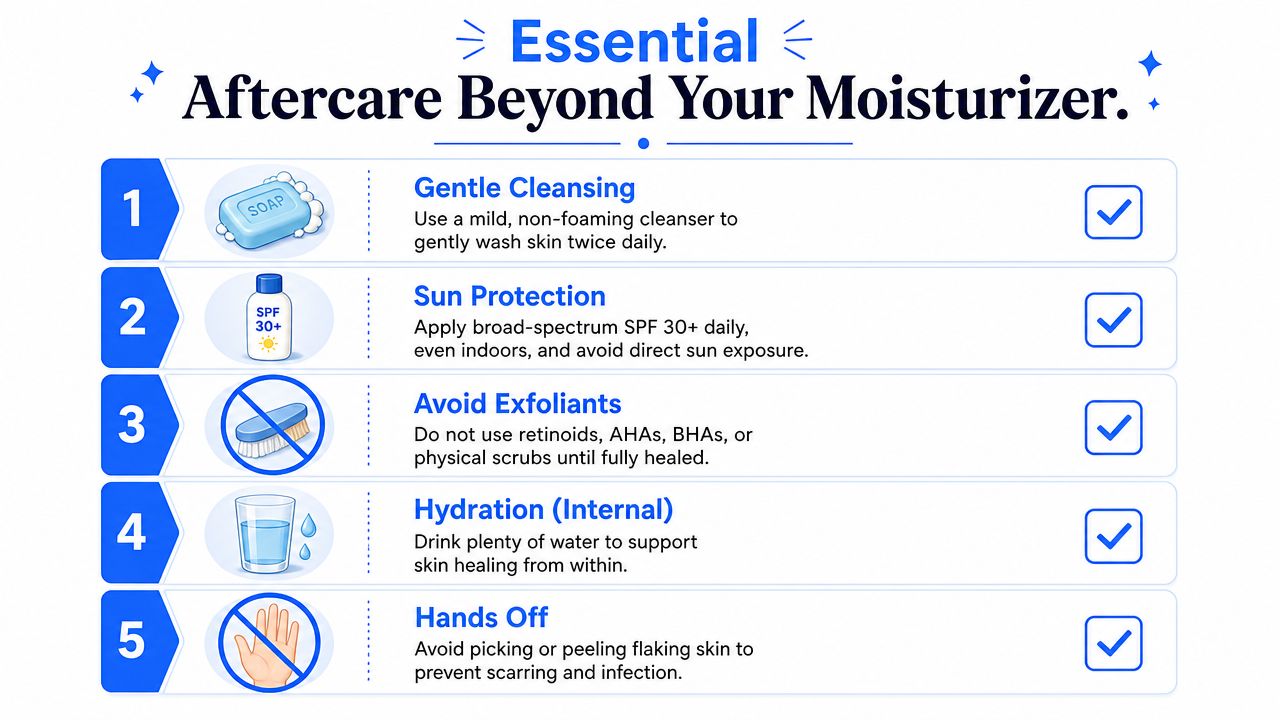
A moisturizer can't rescue a poor aftercare routine. It works best inside a larger system that protects the barrier, limits inflammation, and prevents avoidable setbacks.
Sun protection is the step that preserves your result
Post-peel skin can be up to 100% more sensitive to UV rays, which is why broad-spectrum SPF 30+ should be applied daily and reapplied every 2 hours for at least 6 weeks to help prevent hyperpigmentation and inflammation, according to this post-peel sun care guidance.
That's the step patients underestimate most often. They focus on flaking and redness, but unprotected sun exposure is what can prolong redness and trigger unwanted pigment changes. Mineral sunscreen is often the easiest option for reactive skin, especially formulas using zinc oxide or titanium dioxide.
A simple aftercare system works best
Keep the rest of your routine plain.
- Gentle cleansing: Use a mild cleanser and wash with lukewarm, not hot, water.
- Hands off: Don't pick, rub, or pull peeling skin. That raises the risk of irritation and can affect how evenly the skin heals.
- Pause your actives: Retinoids, acids, scrubs, and brightening products can wait until your provider says the barrier has recovered.
- Watch heat exposure: Saunas, heavy sweating, and very hot showers can make freshly peeled skin angrier.
- Support dryness thoughtfully: If your skin tends to get dehydrated in general, broader guidance on dehydrated facial skin can help you understand the difference between oiliness, dryness, and true water loss.
Patients often ask how often they should moisturize once peeling starts. One clinical recommendation is 2 to 4 times daily, using a plain fragrance-free moisturizer at bedtime and a moisturizer with sunscreen during the day, especially while active peeling is present, as explained in this chemical peel aftercare product guide.
That advice works best when it's interpreted through your peel depth. A stronger peel may need more support. A lighter one may need less interference.
The simplest routine usually heals the best. Cleanse gently, moisturize appropriately, protect from sun, and leave the peeling skin alone.
Partner with Your Provider for Optimal Healing
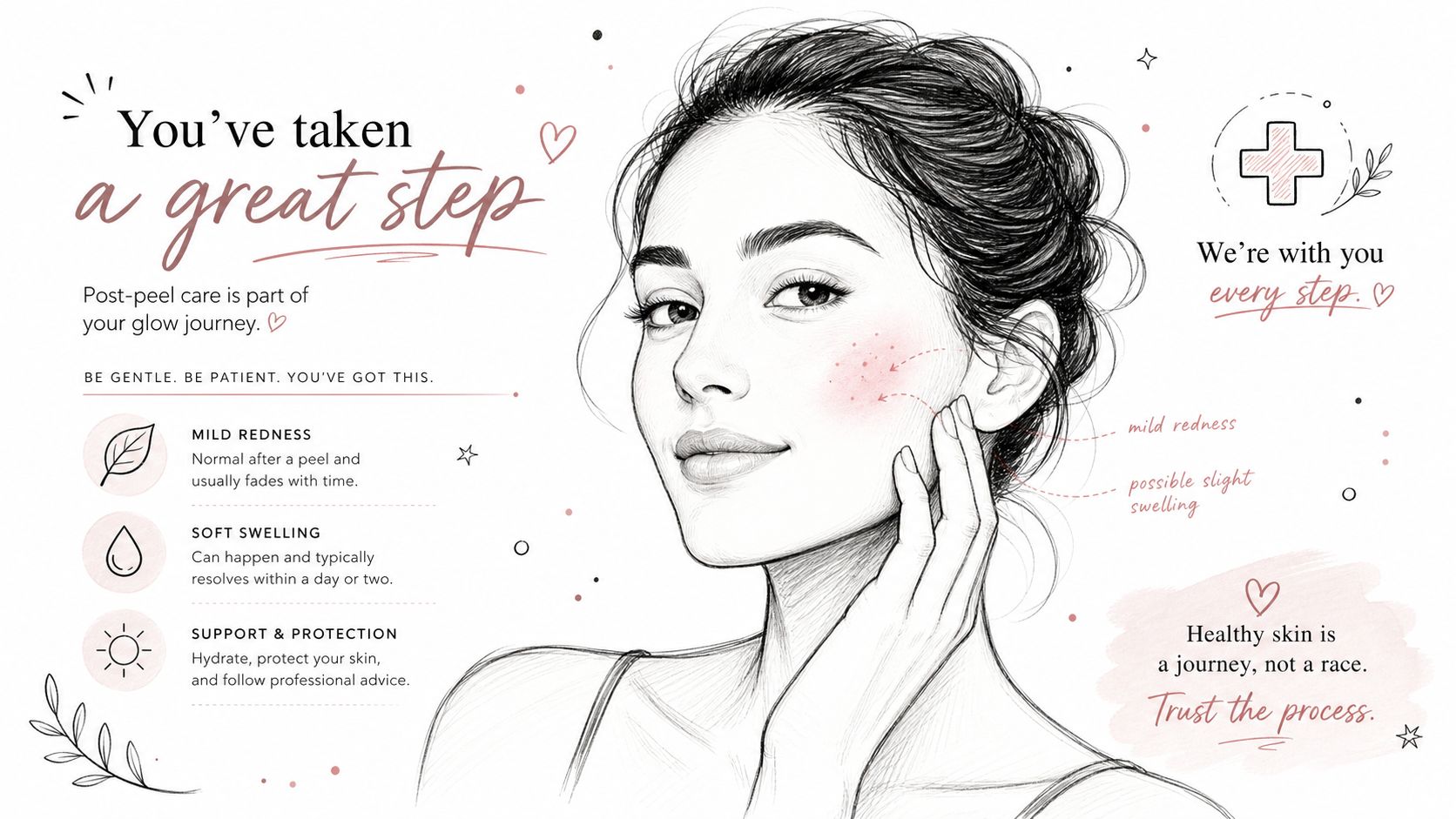
Most post-peel symptoms are expected. Tightness, mild redness, flaking, and temporary sensitivity are common parts of the process. The problem starts when patients try to self-correct with too many products instead of checking in with their provider.
When to stop guessing and call
Reach out if the skin starts looking worse instead of gradually calmer. A provider should know if you develop unusual swelling, increasing pain, drainage, crusting that seems excessive, or redness that feels severe rather than steadily improving. Those signs deserve real guidance, not experimentation.
If you're unsure whether something is normal, ask. That's especially important if you've layered on multiple products and can't tell whether the reaction is from healing, irritation, or an ingredient that doesn't belong in your routine right now.
Why curated post-procedure skincare helps
Patients often think they need a long list of products after a peel. Usually, they need fewer products and better ones. A curated medical-grade moisturizer removes guesswork around fragrance, actives, and textures that don't belong on compromised skin.
That matters because healing skin is easy to over-treat. People reach for exfoliants to “speed things up,” rich ointments to force comfort, or trendy brighteners before the barrier is ready. Those choices can drag out recovery and blur the result they paid for in the first place.
A provider-guided routine gives you a tighter margin of safety. You know what to use, when to use it, and what to stop. That's how most peel recoveries go smoothly. Not through complicated layering, but through disciplined restraint and the right barrier support at the right moment.
The best moisturizer after a chemical peel is rarely the most expensive or the most talked about. It's the one chosen for your peel depth, your skin behavior, and your healing phase, then used exactly as directed.
If you're planning a peel or need help choosing post-procedure skincare, ProMD Health can help you build a simple, medically guided routine that supports healing and protects your results.


