You've been doing the right things, and the scale still won't budge. That's the moment you might start blaming yourself, cutting meals harder, adding more cardio, and getting more frustrated by the day. A weight loss plateau usually isn't a moral failure. It's a sign that your current deficit no longer matches your body's current needs, which is exactly why a new plan has to look at intake, training, recovery, hormones, and sometimes medication or body composition together.
Table of Contents
- When the Scale Stalls and Nothing Seems to Help
- Diagnose the Plateau Before You Change Anything
- Reset Nutrition Without Crash Dieting
- Train Smarter to Break Through and Keep the Muscle
- Sleep, Stress, and the Hormones Behind the Stall
- When the Plateau Is a Medication or Hormone Problem
- Body Composition Tools That Move the Needle
When the Scale Stalls and Nothing Seems to Help
A patient comes in ten pounds down, feeling sharp, motivated, and finally in control. Then the scale sits still for three weeks. Meals haven't changed much, workouts still happen, and now every morning starts with the same question, “What did I do wrong?”
That pattern is familiar because plateaus are common, not rare. StatPearls reports that weight loss plateaus affect approximately 85% of dieters, and that many diets produce similar short-term losses over 8 to 12 weeks, while long-term maintenance beyond 24 weeks succeeds in only about 10% to 20% of individuals (StatPearls). In other words, the stall is often part of the process, not proof that the process failed.
Practical rule: if your weight has been stable for 3 or more weeks while your habits are truly consistent, treat that as a plateau, not just random day-to-day noise.
The next step is not automatically to slash calories. The first move is to figure out whether the old deficit still exists, because a plateau means calorie expenditure has caught up to calorie intake over time (NASM). That can happen after lifestyle changes, after the body adapts to medication, or after lean mass drops and daily energy needs fall.
What works now is layered, not brute force. A real plateau plan usually includes nutrition recalibration, resistance training, sleep and stress repair, and sometimes medical or in-clinic support when the stall is being driven by hormones, medication response, or body composition changes. The problem is rarely willpower. It's usually outdated data.
Diagnose the Plateau Before You Change Anything
Start with the simplest question. Are you still in the same deficit you were in before? Many people are surprised by how often the answer is no. Intake drifts upward through sauces, drinks, small bites, weekend meals, and portions that are larger than they seem, so a strict food log matters before the plan changes.
Use a short reset instead of guesswork. Weigh food for a week, log everything, and compare the trend, not one day, with the prior two or three weeks. The literature also warns that under-reporting is common, so a food scale is more useful than memory when the scale stops cooperating. That is a practical point, not a moral one (AJOL).
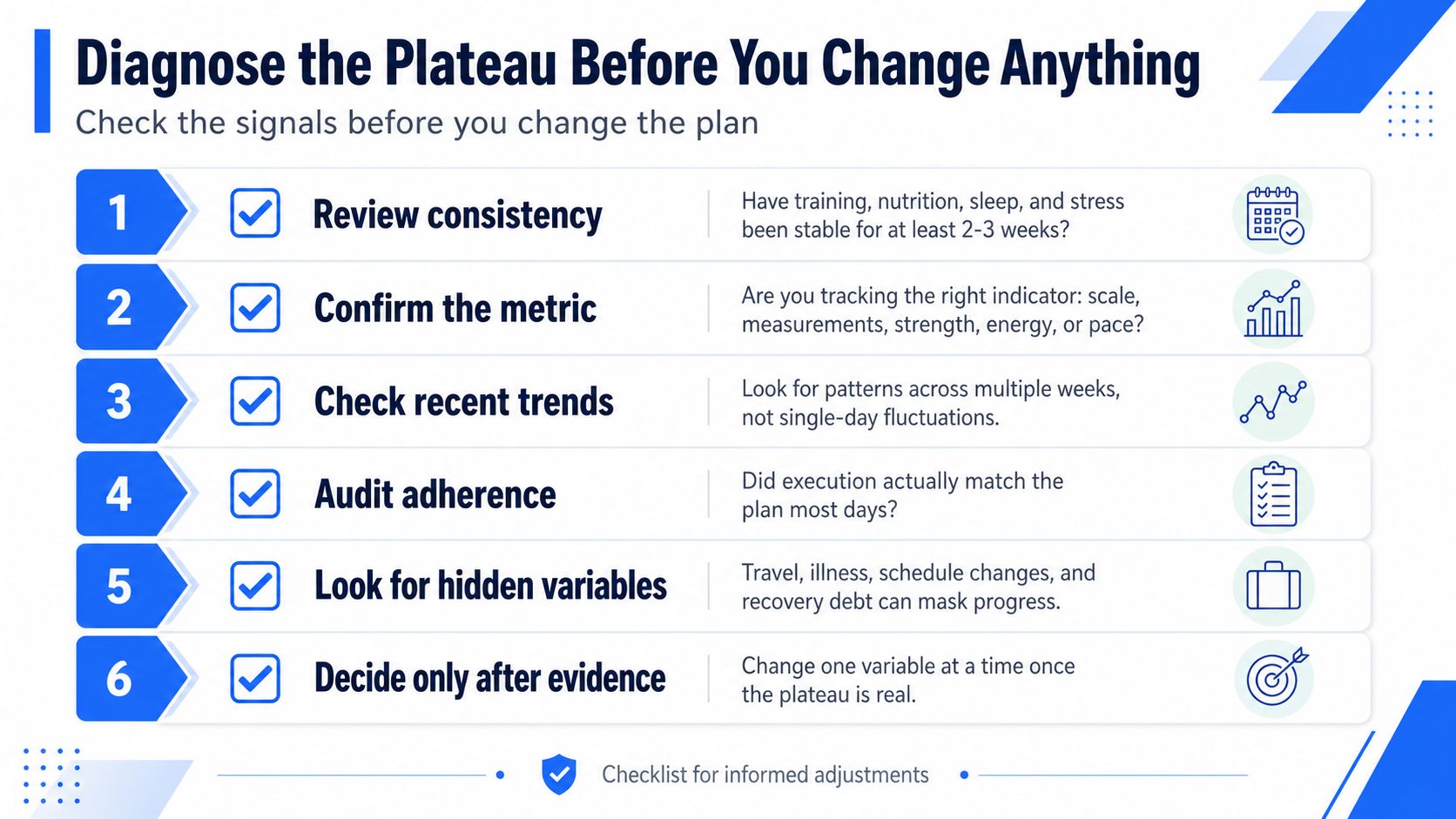
What to verify first
- Trend weight, not single weigh-ins: daily water shifts hide the pattern, so look at the direction across weeks.
- Portion accuracy: weigh calorie-dense foods for a short window before changing the prescription.
- Cycle timing and hydration: menstrual-cycle changes and fluid swings can mask fat loss.
- Alcohol and snack creep: these are common places where the deficit disappears.
- Medication changes: new prescriptions, dose changes, or appetite shifts can alter intake and hunger.
- Body-composition clues: if clothing fits differently but the scale stalls, the issue may be tissue balance, not fat gain.
In clinic, I usually wait for 4 to 6 weeks without movement before forcing an immediate cut. That gives enough time to see whether the pattern is real or just normal fluctuation. It also avoids the common mistake of overcorrecting a problem that was never about calories alone.
Best diagnostic habit: measure before you punish. A tight log often reveals the fix faster than another round of restriction.
If the log is clean, the next question is whether recovery, training, hormones, or medication response is flattening the result. The scale only tells part of the story, and body composition can shift even when body weight looks stuck.
Reset Nutrition Without Crash Dieting
The first nutritional mistake is almost always the same, cutting harder when the body is already adapting. That approach can make the scale move briefly, but it also increases the odds of hunger, fatigue, and lean-mass loss. If the goal is sustainable fat loss, the target is a controlled pace, not a desperate one, and the benchmark often used in practice is about 0.5 to 1.0% of body weight per week (AJOL).
Rebuild the deficit, don't bury it
Start with protein. When intake is high enough, satiety is better and muscle retention is easier, which matters because losing lean mass lowers the energy cost of staying active. Then bring fiber up with vegetables, legumes, fruit, and whole grains so meals feel complete instead of stripped down.
Meal timing can help too. If training is part of the plan, put more of your carbs around workouts so performance doesn't collapse during the day. That's especially useful when the stall came from under-fueling rather than true metabolic resistance.
A short, structured refeed can be smarter than another cut if the diet has been tight for a long stretch. The point isn't to “cheat,” it's to restore adherence, reduce diet fatigue, and keep training quality from sliding. One clean week of accurate weighing can show whether hidden calories are wiping out the intended deficit.
| Nutritional lever | Why it helps a plateau |
|---|---|
| Protein floor | Supports satiety and lean mass |
| Fiber | Improves fullness and meal control |
| Carb timing | Protects training output |
| Food scale | Exposes hidden intake |
| Structured refeed | Helps when fatigue is driving inconsistency |
The common trap is to keep slashing calories without checking whether the plan is already too aggressive. That usually backfires, because the body responds by reducing output, not just by dropping weight. For a practical starting point, one of the clearest consumer-facing guides to a balanced eating pattern is the healthy dietary plan, especially when the issue is not knowledge but execution.
Clinician's rule: if the plan is strict and the body feels flat, hungry, and slower in the gym, the answer is often better structure, not fewer calories.
Train Smarter to Break Through and Keep the Muscle
A stall in weight loss is the moment to examine training, not just calories. If the body is already adapting, piling on more cardio can blunt recovery and make strength fade faster, which is the opposite of what you want in a body-composition plateau. Training has to do three jobs at once, protect lean mass, keep daily energy use from falling, and give the body a new enough stimulus to respond.
Build the week around resistance, not punishment
Two to four resistance sessions a week is a strong practical anchor. Use compound movements, because they recruit more muscle and help preserve the tissue that keeps energy expenditure from dropping further. If lifting has been inconsistent, stabilize that first before adding more intensity anywhere else.
Daily movement matters too. Walking, standing, and general activity raise non-exercise energy expenditure, which is often the quiet difference between a plateau and a restart. If you already run, a practical endurance framework can help keep volume purposeful without turning every session into a recovery problem, and the article on endurance tips for recreational runners is a useful reference point for that balance.
Brief high-intensity intervals can work, but only if recovery is holding up. If sleep is poor, strength is dropping, or soreness is lingering, more intensity is the wrong move. That is not laziness, it is a workload problem.
Watch for the signs that training is too much:
- Sleep quality drops
- Strength stalls
- Resting heart rate rises
- Motivation tanks
- You feel worn down before the workout starts
When those signs show up, the answer is usually to improve the training dose, not add another hard session. Muscle retention is the lever that keeps the body from becoming more energy-efficient at the wrong time, which is why a solid resistance plan usually beats a week of extra cardio that leaves someone exhausted.
For people who need a body-composition-focused complement to training, Emsculpt NEO can sit alongside lifting and walking as an in-clinic option. It does not replace training, but it can support muscle-building and fat-reduction goals when a plateau is tied to limited training capacity or a need for extra body-composition support. Learn more about how Emsculpt NEO works and what to expect.
Sleep, Stress, and the Hormones Behind the Stall
A plateau that looks like a food problem can be a sleep problem in disguise. Short sleep, chronic stress, and the resulting appetite changes can push hunger up and recovery down at the same time. When that happens, people often think they need tighter discipline, when what they really need is a more stable nervous system.
The hormonal pattern is straightforward. Poor sleep and chronic stress can raise cortisol, which can worsen insulin sensitivity and make fat loss harder to see. Sleep loss also shifts appetite control, with leptin and ghrelin moving in the wrong direction, so the body feels less satisfied after meals and more interested in late-night snacking.
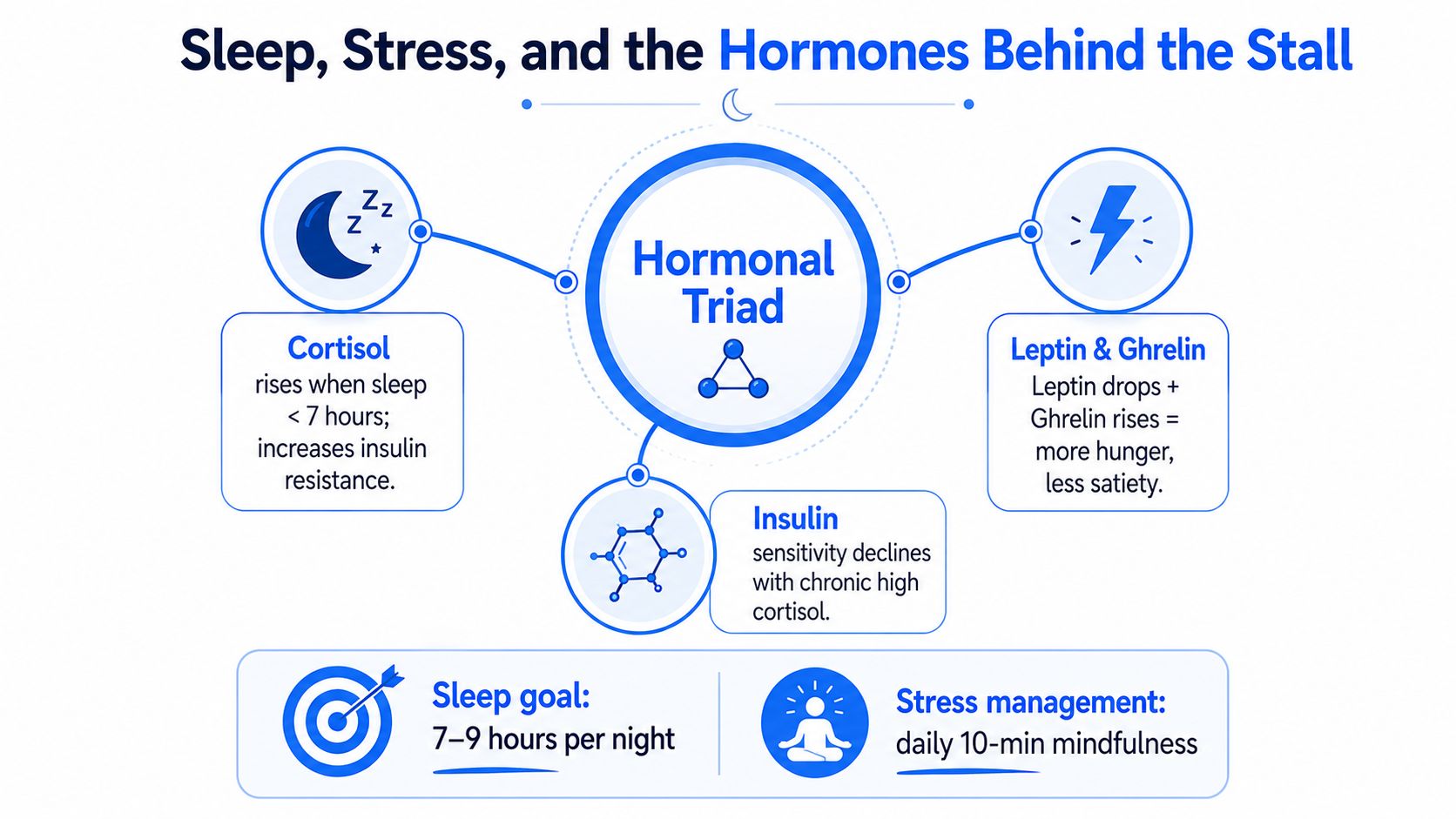
The signs stress is driving the stall
- Afternoon crashes
- Late-night hunger
- Waking around 3 a.m.
- Feeling wired but tired
- Cravings that show up after a hard day, not after hard training
A realistic sleep target is seven to nine hours a night. That sounds basic because it is, but most plateau plans skip it and go straight to food restriction. A consistent wind-down window and morning light exposure are usually more useful than a perfect supplement stack.
For a practical routine, the guide on how to wind down before bed is a good example of how a simple evening reset can support a better recovery pattern without adding complexity.
Practical rule: if sleep has been poor for two weeks, fix that before you cut calories again.
The reason this matters is simple. Better sleep often improves hunger control, workout quality, and water balance at the same time. That's why some stalls respond faster to recovery work than to another week of dieting.
When the Plateau Is a Medication or Hormone Problem
Some plateaus aren't really lifestyle stalls. They're biology stalls. That's especially true when someone is using GLP-1, GIP, or other medically supervised weight-loss care and the early drop has slowed despite good adherence.
The pattern can be easy to miss. Appetite adaptation changes over time, dose needs can shift, lean mass can fall if protein is too low, and people can drift into under-eating in a way that makes them tired without improving fat loss. In that setting, the problem is not motivation. It's that the body has changed the response.
Important trigger: if the stall comes with fatigue, muscle loss, or a clear change in how the medication feels, that's a reason for a medication review, not self-blame.
Hormone symptoms deserve the same kind of attention. Thyroid issues, sex-hormone changes, and menopause-related shifts can all affect energy, body composition, and how hard the scale is to move. Those patterns don't always show up as dramatic weight gain. Sometimes they look like a stubborn plateau plus fatigue, poor sleep, and a body that feels less responsive than before.
What to bring to a provider:
- Your intake log
- Training frequency and recovery notes
- Sleep pattern
- Medication list and dose timing
- Menstrual or menopausal changes
- Whether strength or muscle has fallen
A body-composition scan can change the conversation fast. If the scale hasn't moved but fat is dropping and muscle is holding, that is not failure. It means the metric you were using was too narrow. For patients who need remote follow-up or medication oversight, ProMD Connect can fit into that process alongside labs and reassessment, especially when the question is whether the plateau is medication-related, hormone-related, or both. The broader managing hormones for weight loss resource fits naturally here because it addresses the same biology from a different angle.
Body Composition Tools That Move the Needle
A stagnant scale can hide real progress, and it can also hide real problems. That's why body composition matters. If a person loses fat while holding or building muscle, the mirror, the tape measure, and how clothes fit often tell a better story than the bathroom scale does.
That distinction changes behavior. A “no progress” week can stop looking like failure and start looking like a data problem. It can also show when the issue is the opposite, when weight is dropping but muscle is dropping too, which usually calls for more protein, better resistance training, or a medication review rather than more restriction.
Emsculpt NEO is useful in that framework because it complements the work already being done with nutrition and training. It's not a replacement for the basics, but it can support muscle-building and fat-reduction goals when a plateau is being driven by metabolic adaptation, limited training capacity, or the need for a more structured body-composition approach. That's why it belongs in a real plateau conversation, not as a gimmick, but as one tool inside a broader plan.
A practical 14-day reset looks like this. First, run a clean diagnostic week with honest logging and food weighing. Second, reset nutrition around protein, fiber, and meal timing. Third, stabilize resistance training and daily movement while protecting recovery. Fourth, tighten sleep and stress routines long enough to see whether appetite and energy improve.
Then decide whether the plateau needs clinical escalation. Book a consultation if you've had three to four weeks of stalled trend weight despite accurate logging, if fatigue and muscle loss are showing up, if the plateau began during medication treatment, or if hormone symptoms are stacking on top of weight resistance. That's the point where weight management, hormone optimization, and telehealth follow-up become part of the answer, not an afterthought.
ProMD Health brings those pieces together through medically supervised weight management, hormone care, ProMD Connect, and in-clinic body-composition support across approved locations. If your scale has been stuck and your effort hasn't changed, don't just cut harder, get the biology checked and the plan recalibrated through ProMD Health.