
You're standing between two booking links. One promises a device-led treatment with cleansing, exfoliation, extraction, and serum infusion. The other offers a quiet room, warm towels, hands-on extractions, massage, and a custom mask. Both can leave your skin looking fresher, but they aren't interchangeable.
The right choice in a HydraFacial vs regular facial decision depends on what your skin needs this month. Are you dealing with congestion, dehydration, sensitivity, uneven tone, or overdue maintenance? The treatment that creates the most impressive appointment experience may not be the treatment that best fits your skin.
HydraFacial has a limited published evidence base compared with a standard manual facial. A small, open-label clinical study of adults with mild-to-moderate acne found meaningful short-term changes after a structured series, but there still isn't a randomized trial directly comparing HydraFacial with a manual facial or sham treatment. That distinction matters when you're deciding whether the premium pays for a real improvement or just a more polished experience. Read this practical guide to professional facials before you book.
Table of Contents
- A Patient's First Choice Between Hydrafacial and a Regular Facial
- How Each Treatment Actually Works on the Skin
- Side-by-Side Comparison of the Treatment Experience
- Matching Each Treatment to Specific Skin Concerns
- Who Is Better Served by a Regular Facial
- Cost, Frequency, and Complementary Treatments
- Choosing the Right Starting Point for Your Skin
A Patient's First Choice Between Hydrafacial and a Regular Facial
A patient in her 30s scrolls through two appointment pages after noticing more congestion around her nose and a duller overall complexion. One appointment is a device-based HydraFacial. The other is a classic facial at a lower price. She wants clearer pores and better hydration, but she also wants to relax. The question isn't which treatment is more fashionable. It's which one earns its place on her skin that day.
In the HydraFacial room, she hears the soft whir of the handpiece. The provider moves a sealed tip across the skin, using a controlled vortex process to cleanse, exfoliate, extract, and deliver serum. The sensation is usually wet, cool, and gently suctioning rather than forceful. The appointment feels clinical and efficient, with each step built into a repeatable protocol.
A regular facial creates a different experience. The provider cleanses the skin with foam or cream, may use warmth or steam, performs exfoliation and selected extractions, then applies a mask. Massage, warm towels, and product choice become central parts of the appointment. The treatment can feel more personal because the provider adjusts pressure and products by touch and observation.
Practical rule: Choose the treatment that matches your current skin condition, not the treatment with the more impressive menu description.
| Decision point | HydraFacial | Regular facial |
|---|---|---|
| Main approach | Device-led cleansing, exfoliation, extraction, and infusion | Hands-on cleansing, exfoliation, massage, masking, and selected extractions |
| Best practical fit | Congestion, surface dehydration, and a predictable glow | Maintenance, relaxation, customization, and cautious care |
| Evidence position | Small clinical evidence base, with short-term findings | Less standardized in research because protocols vary |
| Main trade-off | Costs more because of the device and protocol | Results depend more heavily on provider technique and product selection |
The most honest answer is that neither treatment automatically creates lasting structural change. HydraFacial is not a substitute for acne management, pigment treatment, resurfacing, or a well-built home routine. A regular facial isn't a cure for persistent congestion either. The useful decision is narrower: which appointment can address the immediate problem without irritating the skin or overselling the result?
How Each Treatment Actually Works on the Skin
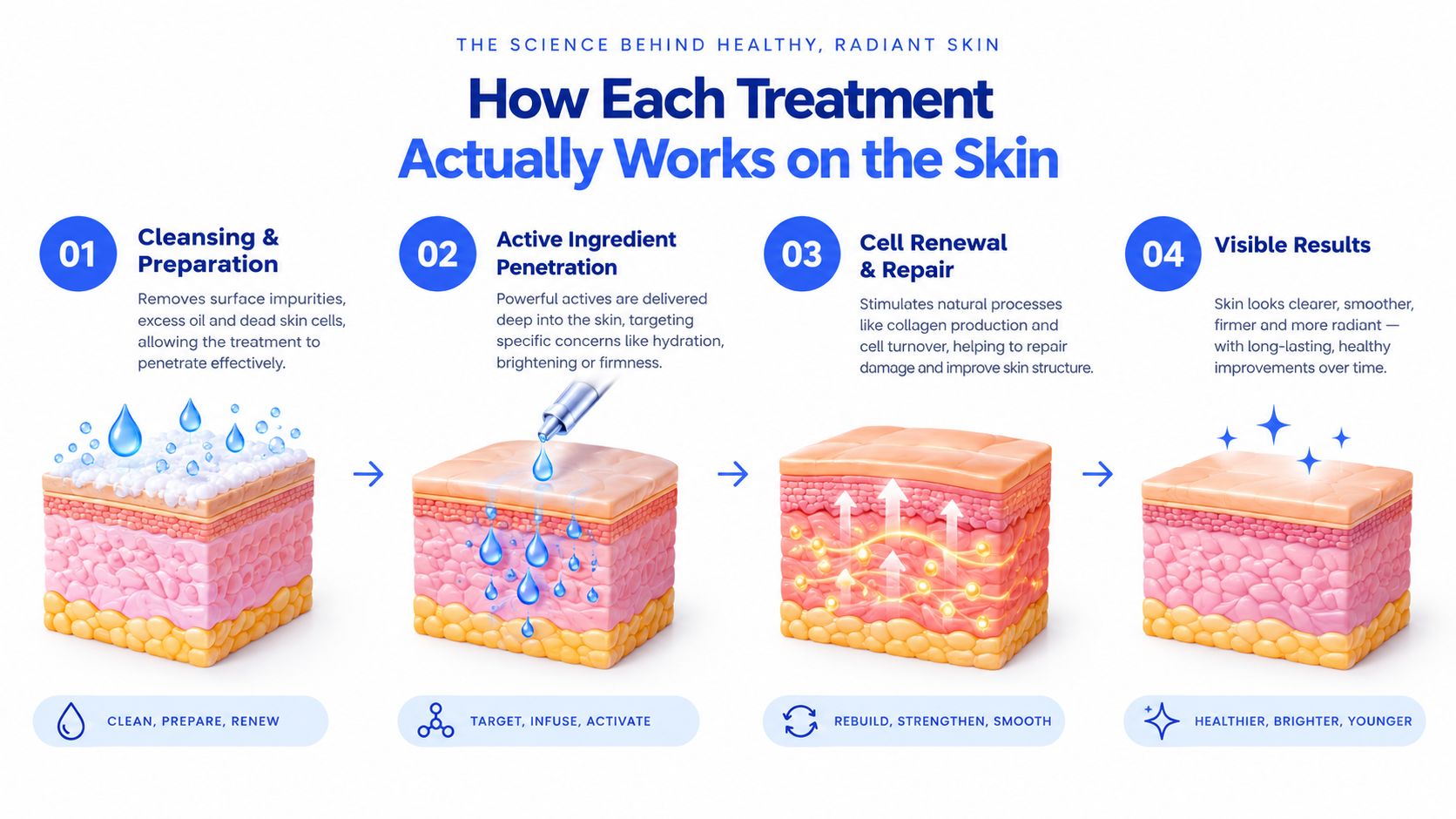
HydraFacial uses a patented Vortex-Fusion delivery system. The technology uses pneumatic, vortex-based action to cleanse, exfoliate, extract, and hydrate the skin. Its value is a controlled sequence that targets surface buildup and dehydration in one appointment, rather than a treatment built mainly around massage or manual product application. See how the HydraFacial treatment is described by the manufacturer
The device-led sequence
The provider moves the handpiece across the face while the system performs several connected steps:
- Cleansing and exfoliation lift surface debris and loosen dead skin cells.
- Vacuum-assisted extraction draws impurities from pores with controlled suction instead of concentrated finger pressure.
- Serum infusion applies selected solutions during treatment, leaving the surface more hydrated and smooth.
- Finishing care supports the skin after the active steps.
Learn more about what a Hydrafacial treatment involves before booking, especially if your goal is clearer pores, temporary hydration, or a polished finish. The main advantage is repeatability. Device-controlled suction can be adjusted and repeated more consistently between appointments, while results from a manual facial depend more on pressure, timing, products, and extraction technique. Details about the technology also appear in the registered treatment study.
The hands-on protocol
A regular facial gives the provider more freedom to change the sequence according to the skin in front of them:
- Cleansing removes makeup, sunscreen, oil, and surface debris.
- Exfoliation may use an enzyme, mild abrasive, or another manually applied product.
- Warmth or steam can soften the surface before extractions.
- Extractions are performed selectively when the provider considers them appropriate.
- Massage and masking support comfort and product application.
- Finishing products follow the provider's assessment.
Warmth, steam, or a warm compress may prepare skin for manual extraction. Review the manual extraction process if you want to understand why technique matters. Choose this route when customization, cautious extraction, or relaxation matters more than a standardized device sequence.
HydraFacial usually leaves a hydrated, polished surface. A regular facial can create a similar fresh appearance, but the result varies more with the aesthetician's technique and product selection. Neither should cause significant downtime when performed appropriately, although exfoliation or extractions can produce temporary redness or sensitivity.
Side-by-Side Comparison of the Treatment Experience
If you need predictable polish before an event, HydraFacial is usually the clearer choice. If your skin is reactive, congested in specific areas, or needs careful hands-on judgment, a regular facial earns its place. Comfort matters, but the real decision is whether you value repeatability or active customization.
| Criteria | HydraFacial | Regular facial |
|---|---|---|
| Process | Device-led cleansing, exfoliation, suction extraction, and serum delivery | Manual cleansing, exfoliation, optional warmth, extractions, massage, mask, and finishing care |
| Sensation | Cool solution and gentle suction | Massage, warmth, product application, and possible pressure during extractions |
| Customization | Solutions and settings can be adjusted | Pressure, products, massage, and extraction choices can change throughout |
| Immediate result | Smoother, cleaner, more hydrated-looking skin | Fresher, softer, and more relaxed-looking skin |
| Longer-term evidence | Short-term surface benefits are clearer than durable structural change | Results are harder to compare because protocols vary |
| Downtime | Usually minimal, though sensitivity can occur | Usually minimal, with possible redness after extractions |
| Best use | Congestion, surface dehydration, and a predictable pre-event finish | Maintenance, relaxation, and cautious customized care |
HydraFacial's extraction step uses gentle suction designed to avoid forceful squeezing. See the treatment's extraction description. That does not make the strongest setting appropriate for every face. Recently irritated or sensitive skin needs a conservative protocol, regardless of the treatment selected.
Choose a regular facial when the appointment requires repeated clinical decisions. An experienced aesthetician can stop an extraction, reduce stimulation, change the mask, or focus entirely on calming the skin. That flexibility matters for reactive skin and for anyone whose concerns do not fit a fixed sequence.
HydraFacial offers consistent delivery and a reliably hydrated finish. A regular facial can produce a similarly fresh appearance, but the outcome depends more on the provider's technique, product choices, and judgment. Pay for HydraFacial when predictable surface improvement is the priority. Pay for a regular facial when adaptation, comfort, or selective extraction matters more.
Arrive with calm skin rather than a freshly over-exfoliated face. Review this facial preparation guide with your provider, especially if you recently changed products or had another treatment.
If you are also comparing home-care products, use this resource to compare affordable skincare by the outcome you need, not by the length of the ingredient list. The same rule applies in the treatment room.
Matching Each Treatment to Specific Skin Concerns
The strongest choice changes with the concern. A treatment that works well for a congested, dehydrated face may be a poor choice for a sensitized or pigment-prone face.
A small clinical study provides the clearest HydraFacial-specific acne benchmark currently available. Over a 12-week period, 20 adults with mild-to-moderate acne received six Clarifying Treatments, one every two weeks. The share rated clear or almost clear increased from 20% to 65% by investigator assessment and from 5% to 55% by patient self-report. Mean investigator acne scores fell 37%, mean patient scores fell 34%, and 18 of 20 participants completed the series. These findings are useful, but the study was open-label and had no manual-facial comparison. Review the published acne study.
| Skin concern | HydraFacial | Regular facial | Winner |
|---|---|---|---|
| Congested pores and mild acne | Controlled suction can support a structured cleansing protocol | Manual extractions can be selected and limited | HydraFacial for repeatable extraction |
| Surface dehydration | Infusion supports a hydrated finish | Masks and moisturizers can improve comfort and softness | HydraFacial for delivery, regular facial for customization |
| Dull texture | Consistent exfoliation can create a smoother surface | Exfoliation can be adjusted to tolerance | Depends on sensitivity |
| Fine lines and mild aging concerns | Can improve temporary smoothness and hydration | Can support surface maintenance and relaxation | Neither replaces a targeted rejuvenation plan |
| Uneven tone or pigment-prone skin | Exfoliation may be useful, but intensity must be controlled | Product selection and treatment intensity can be tailored | Regular facial when customization is the priority |
| Post-procedure maintenance | May be inappropriate until the skin barrier is ready | A gentle protocol can be adapted more easily | Regular facial, after provider clearance |
The evidence supports short-term improvement in hydration, exfoliation, pore appearance, and smoothness more clearly than collagen remodeling or durable structural change. If your goal is deep rejuvenation, neither option should be sold as an equivalent to a resurfacing or regenerative treatment.
Who Is Better Served by a Regular Facial
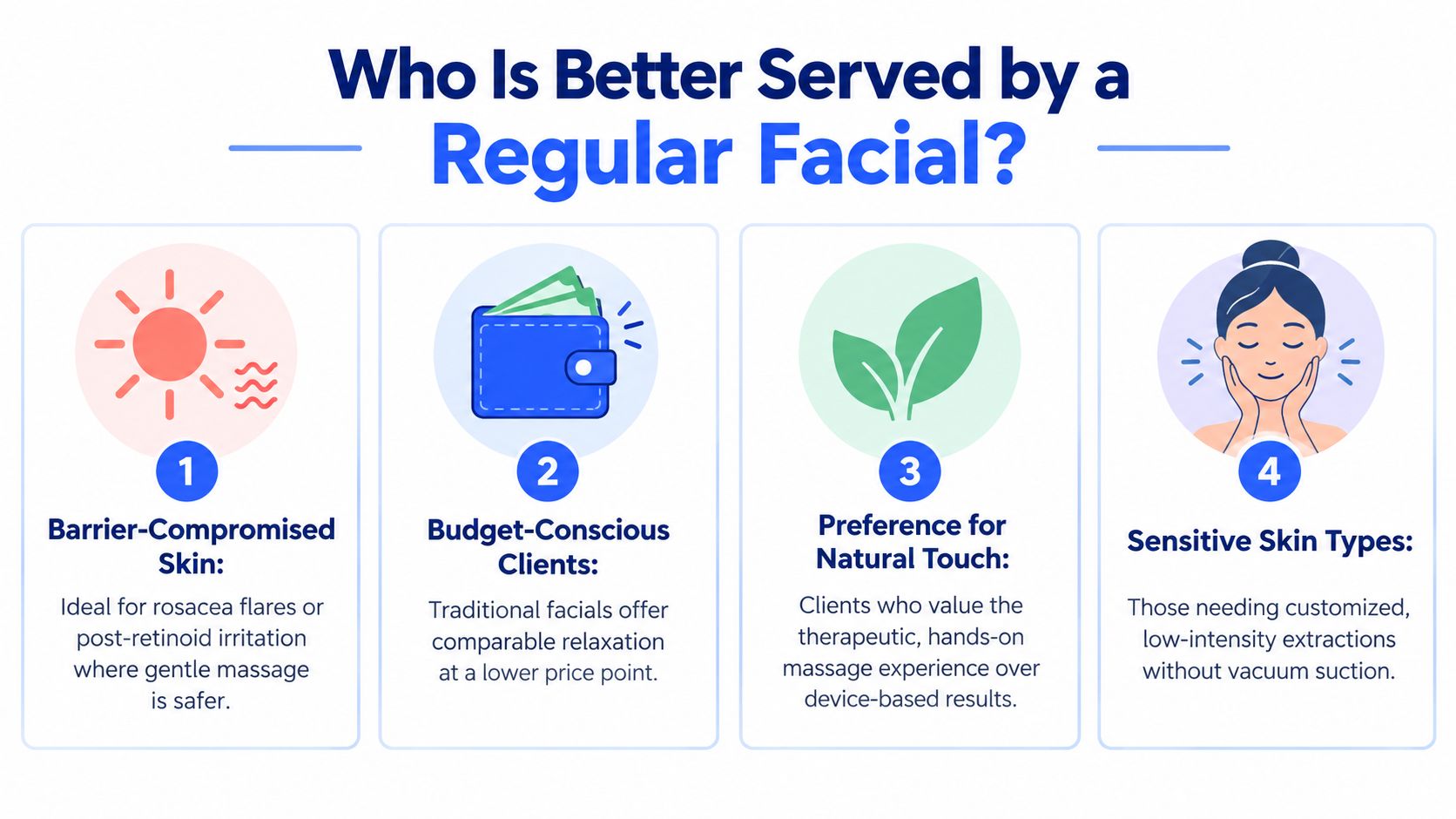
A regular facial is often the smarter choice when your skin needs restraint. Device-based suction and exfoliation can be useful, but more stimulation isn't automatically better. The provider needs room to reduce pressure, skip extractions, change products, or focus on barrier comfort.
When control matters more than device consistency
If your skin is reactive, recently irritated, or unusually dry, a hands-on facial may offer more useful flexibility. The provider can keep the appointment focused on cleansing, a gentle mask, hydration, and calming products rather than pushing through every active step.
Pigment-prone skin also deserves a conservative plan. Exfoliation can be helpful for some people, but irritation can make uneven tone harder to manage. A provider should assess your current skin condition, recent sun exposure, active products, and history of sensitivity before choosing suction or aggressive exfoliation.
A regular facial may also suit someone who wants professional maintenance without committing to a device-led protocol. The value is not only the extraction. It's the ability to build a relationship with an aesthetician who recognizes how your skin responds over time.
Who should ask for a modified appointment
Tell the provider before treatment if you're experiencing:
- Active irritation: Ask whether the appointment should focus on cleansing and barrier support.
- Recent strong skincare use: Discuss retinoids, exfoliating acids, and other products before choosing mechanical exfoliation.
- Pigment concerns: Request a conservative plan and clear aftercare instructions.
- Ingredient sensitivity: Ask for fragrance-controlled and simplified product choices.
- Pregnancy or nursing: Review every planned ingredient with a qualified provider instead of assuming a standard protocol is appropriate.
- A limited budget: Choose the service you can maintain consistently, rather than paying a premium for an occasional appointment that doesn't fit your routine.
A regular facial isn't automatically safer, and HydraFacial isn't automatically harsh. The provider's assessment and treatment settings matter more than the label alone.
Cost, Frequency, and Complementary Treatments
Price is one area where online comparisons often become misleading. Local pricing varies, and add-ons can change the total quickly. HydraFacial generally commands a premium because it requires a branded device, treatment solutions, consumable tips, and a standardized protocol. A classic facial usually has a broader range because the menu can include anything from basic cleansing and masking to extensive massage and extractions.
| Treatment | Per session | Recommended frequency | Estimated annual cost |
|---|---|---|---|
| HydraFacial | Premium device-based pricing, with add-ons potentially increasing the fee | Often scheduled as part of a recurring maintenance plan | Depends on the clinic, selected protocol, and number of visits |
| Regular facial | Usually lower-cost and more variable by treatment length and customization | Often repeated when the skin needs maintenance or the patient values the experience | Depends on visit frequency, upgrades, and local pricing |
Don't treat either service as a replacement for daily skincare. Sunscreen, appropriate moisturization, and a carefully selected active routine usually determine how long an in-office result remains visible. A professional treatment can reset the surface, but it can't compensate for repeated irritation, inconsistent sun protection, or products that don't suit your skin.
Complementary treatments may include LED light therapy, dermaplaning, chemical peels, microneedling, or laser services. The correct sequence depends on the treatment intensity and your skin's recovery. Avoid stacking exfoliating procedures merely because they're available on the same menu. Ask the provider how long to pause active products and whether a facial should be scheduled before or after another procedure.
Budget test: If you can afford only one appointment, choose the service that addresses your primary concern. If your concern is persistent acne, invest in assessment and an evidence-based plan rather than repeating glow-focused treatments indefinitely.
HydraFacial can make sense as an occasional extraction and hydration appointment. A regular facial can fit more naturally between higher-intensity services or during periods when the skin needs calming. The annual cost isn't just the fee per visit. It includes products, add-ons, travel, aftercare, and the opportunity cost of choosing one treatment instead of a more targeted option.
Choosing the Right Starting Point for Your Skin
Don't choose between HydraFacial and a regular facial as if you're selecting a permanent identity. Choose a starting point based on three questions: What are you trying to improve? What condition is your skin in today? What can you maintain realistically?
| Primary goal and skin status | Recommended starting treatment | Why it fits |
|---|---|---|
| Congestion with an intact barrier | HydraFacial with conservative settings | Controlled extraction and hydration address the immediate surface concern |
| Dehydration and dullness without irritation | Either, with HydraFacial favored for repeatable infusion | Both can improve surface freshness, while the device offers a more standardized process |
| Sensitized or barrier-compromised skin | Regular facial with a calming protocol | The provider can reduce stimulation and customize products directly |
| Pigment-prone or melasma-prone skin | Regular facial or a provider-led pigment plan | Conservative customization is preferable to automatic exfoliation |
| Fine lines and mild texture concerns | HydraFacial for short-term smoothness, followed by a broader plan | It can improve the surface, but it isn't a substitute for targeted rejuvenation |
| Maintenance and relaxation | Regular facial | The hands-on experience and flexible care may offer better value |
| Unclear concern or first professional treatment | Skin analysis before choosing | Assessment prevents you from paying for a protocol that doesn't match your skin |
For oil-prone skin with visible congestion, I'd start with a HydraFacial only if the barrier is intact and the provider can explain the planned settings and solutions. For reactive skin, recent irritation, or pigment instability, I'd start with a regular facial and keep the appointment deliberately gentle. For aging concerns, I'd treat either facial as maintenance, not as the central rejuvenation strategy.
Some patients can alternate the two. A device-led treatment may address periodic congestion and hydration, while a regular facial provides calmer maintenance between appointments. That combination is reasonable only when both treatments fit the skin's tolerance and the overall plan isn't built around constant exfoliation.
Before booking, ask for a skin analysis. If you react easily, request a patch test or a conservative first protocol. Ask the provider to document the device settings, products, and your response. Reassess after a small number of appointments before committing to a long-term schedule, and stop if your skin becomes persistently irritated, unusually dry, or more reactive.
ProMD Health offers both facials and HydraFacial as part of its spa services, including options designed around cleansing, exfoliation, extraction, and hydration. Visit ProMD Health to review the available facial treatments and request an appointment that starts with your skin goals, sensitivity, and current routine.


