Is the closest clinic the right clinic, or is your double chin loose skin, neck bands, or chin shape that an injection can't change? That question matters more than distance when you're searching for Kybella treatments near me. Kybella is a non-surgical treatment for one specific problem, submental fat, the fat beneath your chin. It doesn't tighten skin, move a chin, or treat fullness everywhere else.
Start by diagnosing what you're seeing, then compare providers. A good consultation confirms the cause first and talks about product, sessions, and price second.
Table of Contents
- Who Qualifies for Kybella and Who Should Look Elsewhere
- Kybella Cost Range and What One Session Really Costs
- How a Kybella Session Works, Step by Step
- What Results Look Like and When They Appear
- Downtime, Swelling and Warning Signs to Know
- Choosing a Kybella Provider Near You
- Questions to Ask and Your Next Step
Who Qualifies for Kybella and Who Should Look Elsewhere
| What you see | Likely cause | Is Kybella a fit? |
|---|---|---|
| Fullness under the chin, skin firm and snug | Submental fat | Usually a candidate, confirmed in person |
| Loose skin under the chin that sags when lifted | Skin laxity | Not a primary fit; Kybella does not tighten skin |
| Prominent vertical neck bands when clenching | Platysmal bands | Assess separately before any plan |
| Small or recessed chin that looks like a double chin | Chin structure | Not a fit; Kybella does not reposition the chin |
| Fullness extending beyond the under-chin area | Fat outside the submental region | Outside approved use; safety not established |
| Neck or chin surgery in the past | Altered anatomy | Needs an in-person examination first |
Reading the Table in Plain Language
Soft fat under firm skin is the profile Kybella is designed for. It's an injection that reduces submental fullness and corrects the appearance of a double chin by destroying fat cells in the fatty tissue beneath the chin, and it's the only injectable FDA-approved to correct double chin.
Loose, sagging skin is a different problem. Removing fat underneath it won't make it snug, and it can look worse. Vertical bands that pop out when you clench your jaw come from the platysma muscle, not fat, so they need their own assessment.
A small or recessed chin can make normal tissue look like excess fat. Kybella doesn't build or reposition the chin. Fullness beyond the under-chin area is outside the approved use, and prior neck or chin surgery can change where tissue and nerves sit, which is why an exam comes first. If fat isn't the main issue, it helps to review other non-surgical approaches to a double chin before you commit to injections.
The FDA review memorandum for Kybella describes it as a cytolytic treatment for adults with moderate-to-severe submental fullness caused primarily by excess subcutaneous fat, and it advises caution when laxity or anatomical distortion could produce an unfavorable result. In that principal trial, 66.5% of treated participants achieved at least a one-grade improvement compared with 22.2% receiving placebo, and 85.7% of adverse events in the active group were localized to the injection area.
No one can estimate how much product you need from chin size or a photo alone. Skin elasticity, fat distribution, muscle anatomy, and prior procedures change the plan.
Three Self-Check Questions
- Where exactly is it? Is the fullness centered under your chin, or does it spread into your jaw or neck?
- What moves? When you lift your chin, does loose skin sag, or does firm fullness stay put?
- What's your history? Have you had neck or chin procedures before?
A provider will also screen for active infection, bleeding risk or anticoagulant use, swallowing difficulty, allergies, and pregnancy or breastfeeding. Answer those questions openly, even if you think they'll delay treatment.
Kybella Cost Range and What One Session Really Costs
Kybella pricing is easiest to understand in two layers: the cost of one session and the cost of the full course that produces the change you want. Insurance generally does not cover Kybella when it is used for cosmetic purposes, so confirm payment terms with each office before you schedule. A low session price can also hide the total if the plan requires several visits.
For a national reference point, CareCredit's Kybella cost guide reported in 2025 that the U.S. national average price for one Kybella treatment was $1,640, with a reported range of $1,267 to $3,215, based on pricing research conducted in 2024 by ASQ360° across the 50 states and Washington, DC.
Kybella Cost by Session Count
| Scenario | Sessions | Estimated cost |
|---|---|---|
| Lowest reported single session | 1 | $1,267 |
| One session at the national average | 1 | $1,640 |
| Highest reported single session | 1 | $3,215 |
| Two-session course at the average | 2 | $3,280 |
| Four-session course at the average | 4 | $6,560 |
The two course totals are estimates built by multiplying the national average. They are not a quote for your chin or any specific office.
What Moves Your Price
Session count drives the total more than anything else. Most Kybella patients need 2 to 4 sessions spaced about 4 to 6 weeks apart, and each visit carries its own product cost and visit fee. That schedule spreads cost over time, which matters if you pay per visit rather than for a package.
Within a session, price reflects how much product your treatment area needs, the injector's experience, and whether follow-up visits are included or billed separately. A single-session quote usually bundles the drug, the injector's time, and the office visit. Ask whether numbing, a follow-up check, and any touch-up are inside that number. A larger treatment field needs more injection points spread across it. The same amount of product squeezed into fewer spots does not cover the area the way a mapped plan does.
Provider fit belongs in the cost comparison. A quote from an injector who skips candidacy screening is not comparable to one from a provider who maps your treatment field and explains the expected number of sessions.
Planning rule: Use national figures to set a rough budget, then ask for the office's written, itemized quote for your own anatomy.
Ask whether that quote covers the expected number of sessions, the product per session, and follow-ups. If it prices only session one, you do not yet know the cost of the result you are picturing.
How a Kybella Session Works, Step by Step
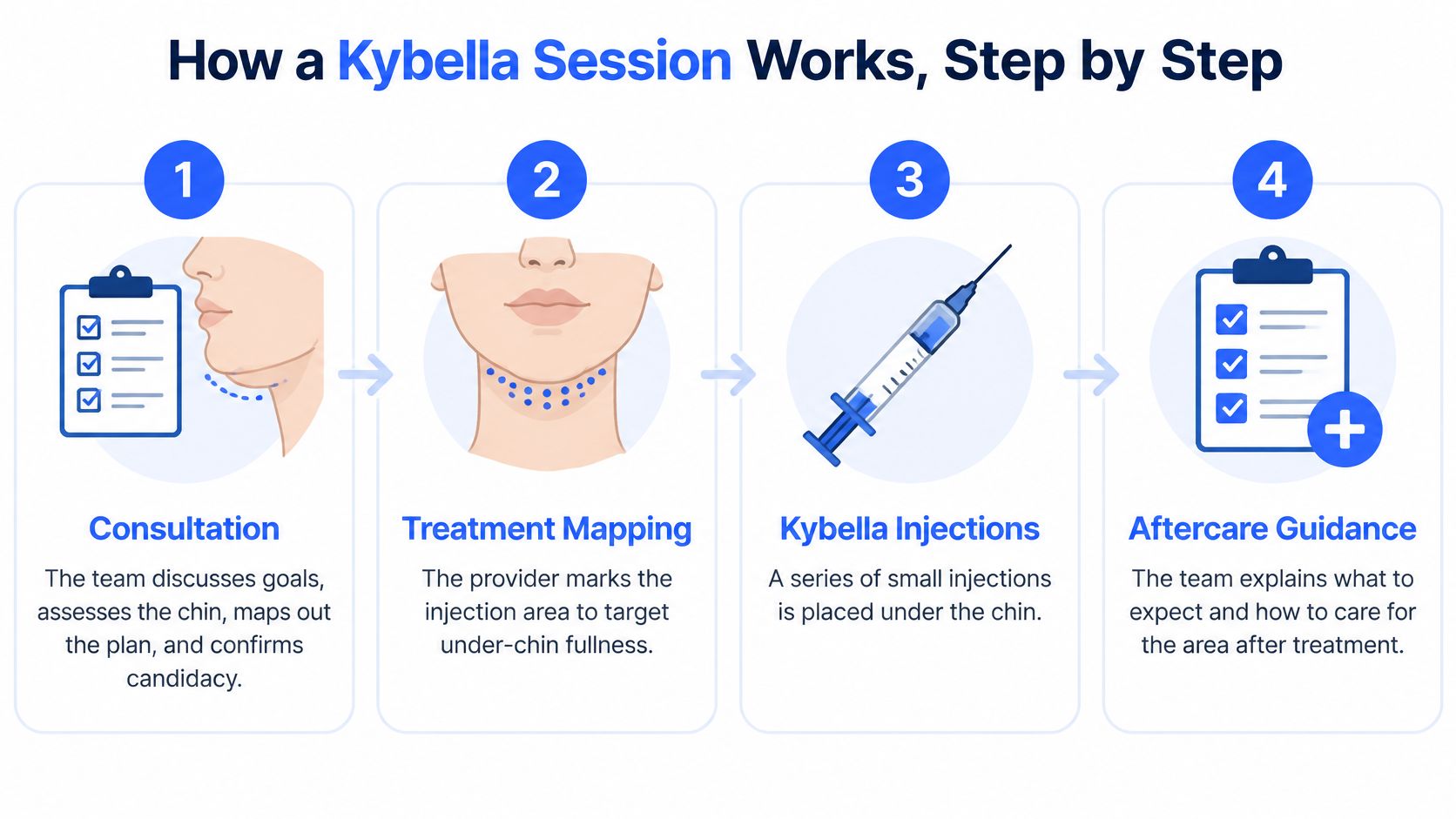
A Kybella visit follows a fixed sequence, and each step answers a different question. Candidacy gets settled first. The injection map comes next. The label numbers describe the outer limits of what one session can include.
Consultation comes first. The team discusses your goals, assesses your chin area, and maps out a treatment plan. Candidacy is confirmed or declined before any product is prepared. Bring your medication list and a history of prior neck or chin procedures. The consultation should answer whether the fullness under your chin comes from fat Kybella can treat or from another structure that changes the plan, and it should settle that question before you compare drive times.
Numbing is applied. A topical numbing cream is applied before injections to keep you comfortable during the session. Allow the cream time to take effect; injections do not begin the moment you sit down.
The injector maps the area. Points are marked across the fat under your chin. Spacing controls how evenly the drug covers the treatment field.
Injections follow the map. Skilled providers use advanced techniques to place Kybella where it is needed, staying within the under-chin fat. Placement matters because nerves, muscle, and skin sit close to that fat layer.
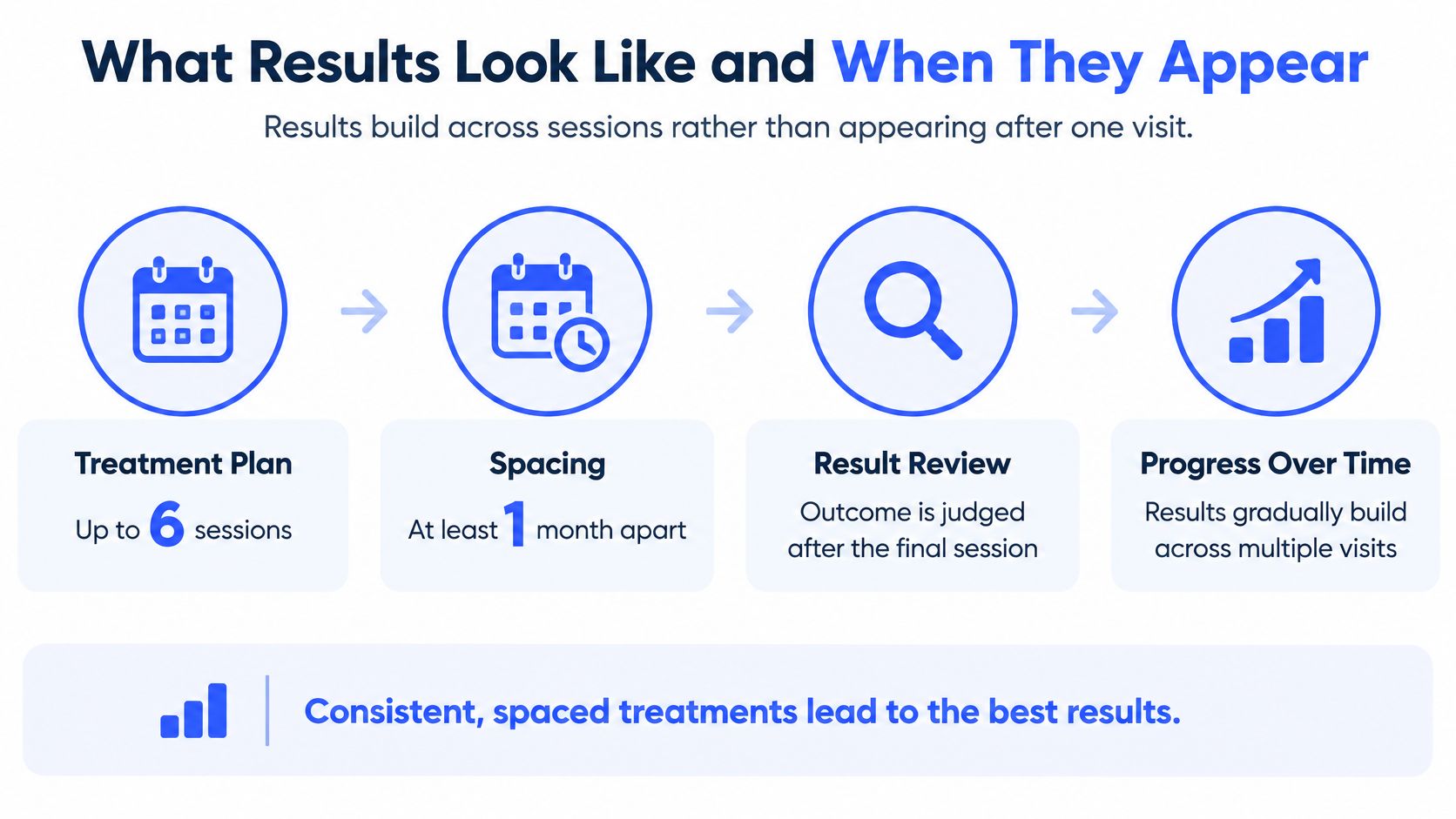
The FDA-approved Kybella label specifies 2 mg/cm² injected into submental subcutaneous fat, using 0.2 mL per site with injection points spaced 1 cm apart, up to 50 injections, 100 mg total, or 10 mL in one session. Sessions must be separated by at least one month, and no more than six treatments may be administered.
That required month gives local inflammation and tissue remodeling time to settle. Your provider can then judge what fullness remains. Treating again too soon means judging swollen tissue.
Aftercare is explained before you leave. Ask for written instructions that name the swelling, firmness, and numbness to expect, when swelling should peak, and which symptoms warrant a call. Know who to contact after hours before you leave the office.
The next session is scheduled later. You will wait at least a month, reassess, and decide whether another session is warranted. The follow-up visit is also where your provider compares the current contour with the plan set at consultation.
What Results Look Like and When They Appear
Results build across sessions. They don't appear after one visit, and your outcome is judged after your final session once the tissue has settled. Most of our Kybella patients achieve their results in 2-4 sessions, spaced about 4-6 weeks apart, though your plan may differ.
Response Tiers in the FDA-Reviewed Trials
| Response measure | Kybella-treated | Placebo |
|---|---|---|
| At least two-grade improvement on both scales | 13% to 19% | 3% |
| At least one-grade improvement | At least 70% | Not stated for this threshold |
A Medscape summary of the FDA-reviewed trials reports that at 12 weeks after the final treatment, 13% to 19% of Kybella-treated participants achieved at least a two-grade improvement on both clinician and patient rating scales, compared with 3% of placebo-treated participants. At least 70% achieved at least a one-grade improvement, across a combined population of 513 Kybella-treated subjects and 506 placebo-treated subjects.
Read that correctly. A modest but visible change is the common outcome, and the most dramatic two-grade response happened for a minority. Before-and-after photos often show the strongest responders, not the typical one.
Say you have moderate, firm fullness and complete three sessions. A clear one-grade change, a softer angle under your chin in profile, is a realistic target. Say instead that loose skin is your main issue. You may lose some fat and still see little contour change, because the skin was the problem.
Fat cells destroyed by Kybella don't return. That doesn't freeze your chin forever. Weight gain can enlarge the fat cells that remain, and aging changes skin over time.
Ask your injector to describe a realistic target for your own chin, in grades and in photos of similar cases, before your first session.
Downtime, Swelling and Warning Signs to Know
What does recovery after Kybella feel like, and when should you call the office? Kybella involves minimal downtime, and some minor swelling or redness after treatment is normal. Your chin may look fuller before it looks smaller, so leave room in your calendar before photos or a major event. Plan on returning to work or your normal routine within a day, with visible swelling as the main reason to schedule around it.
Expected Reactions and Warning Signs After Kybella
The prolonged-reaction rates below come from a Medscape summary of the FDA-reviewed trials.
| Reaction or sign | Typical or serious | What to do |
|---|---|---|
| Swelling or redness | Typical, minimal downtime | Expect it; ask at follow-up if it worsens |
| Injection-site numbness (42% of treated subjects, over 30 days) | Typical but prolonged in some | Report at follow-up if it persists |
| Pain (16% of treated subjects, over 30 days) | Typical | Discuss pain management with the office |
| Firmness or induration (13% of treated subjects, over 30 days) | Typical | Report at follow-up |
| Difficulty swallowing | Serious warning sign | Seek medical care promptly |
| Uneven smile or facial weakness | Serious warning sign | Seek medical care promptly |
| Blurred or reduced vision | Serious warning sign | Seek medical care immediately |
The trial rates in the table describe reactions lasting more than 30 days. Numbness was the most common prolonged reaction, followed by swelling, pain, and firmness. A reaction that stretches beyond a month is a known recovery pattern, but you should know before treatment that recovery can extend past a long weekend. Put it on your follow-up list rather than assuming it will fade on your preferred timeline.
Serious signs are a different category. MedlinePlus guidance on deoxycholic acid injection states that deoxycholic acid should be injected only into the submental region, and that injections outside the area beneath the chin have been associated with blurred or reduced vision, facial muscle weakness or loss of movement, facial tingling, burning or numbness, and nodules or masses that may persist. Symptoms requiring medical attention can also include difficulty swallowing, an uneven smile, face or neck tightness, and significant injection-site pain, redness, bleeding, sores, or drainage.
Accurate placement by a trained injector is the main prevention. The drug destroys cells where it is placed, so the injector's map of your submental anatomy determines both the result and the safety margin. That is why candidacy and injector skill matter more than how close an office happens to be.
Confirm your follow-up appointment before you leave the office. Call sooner if a symptom worsens, spreads, or lasts longer than your provider described, and don't wait for the follow-up if you notice swallowing trouble, an uneven smile, or vision changes.
Choosing a Kybella Provider Near You
Distance is easy to compare, so it often gets more weight than it deserves. A clinic ten minutes away can still be the wrong choice if the injector lacks submental training or skips the exam that confirms you're a candidate.
Start with three filters:
- Qualified injector: A medical injector trained in submental anatomy and emergency management. Ask who will hold the needle and how many under-chin treatments they have performed.
- Candidacy exam first: A hands-on assessment of fat, skin, muscle bands, and chin structure before product is ordered or paid for.
- A plan built for your face: Every Kybella treatment should be customized to your unique facial structure and goals, including a realistic session estimate and target.
The consultation is where the plan takes shape. The team should discuss your goals, assess the chin area, and map out a treatment plan before any product is ordered. A realistic plan includes a session estimate of 2-4 sessions, spaced about 4-6 weeks apart, and a target for what changes you should expect.
Red Flags Worth Walking Away From
Be cautious if a provider promises to dissolve fat on your arms, thighs, or elsewhere. The approved indication is under the chin only. Packages that require payment for many sessions before any exam put the sale ahead of the diagnosis.
No clear discussion of swelling, numbness, or nerve risk is another warning. A provider who only shows best-case photos hasn't prepared you for the common case. The same filter applies to any facial aesthetic search. If you want to find Botox near you in Miami, use credentials and an examination as your first filters.
Checking the Specific Office
ProMD Health offers Kybella as part of its non-surgical aesthetic services. Service availability can vary by office, so confirm that the location you plan to visit offers Kybella before you travel there. Use the clinic locator and call the office directly. Compare two or three options with the same questions, so each answer is judged on the same criteria.
Questions to Ask and Your Next Step
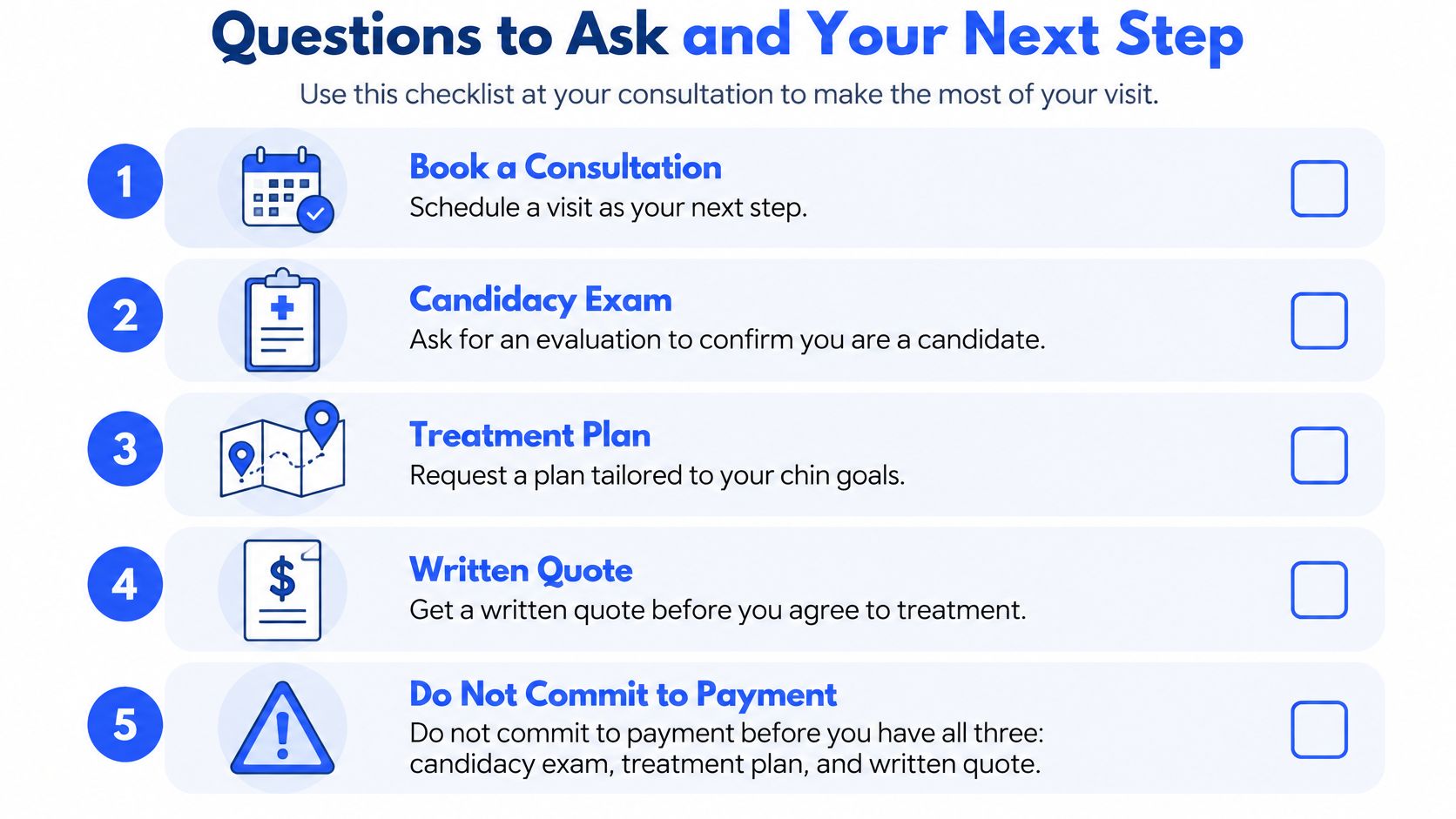
What should you leave a Kybella consultation knowing? You should understand whether the fullness is caused by fat, what your treatment plan involves, and what happens after each session. ProMD Health offers a complimentary consultation you can book on its website. The overview of non-surgical neck rejuvenation treatments can help you consider other approaches if Kybella does not match your needs.
Your Consultation Checklist
- Is my fullness caused by fat, skin, or facial structure? Ask the provider to explain what they see during the assessment.
- How many sessions does the plan include, and what is the total cost, including follow-ups? Ask for the expected course total, not only the price of the first session.
- Who will perform the injections, and what experience do they have treating submental fullness? The provider should be able to answer directly.
- How is my plan based on the examination, and who should I contact if I have a concern afterward? Ask how follow-up support works.
- What swelling, numbness, or pain might I experience, and when should I call? Find out whom to contact outside regular office hours.
- Is Kybella available at this location, and when are payments due for each session? Clarify the payment schedule before booking.
Bring a list of your current medications and any past neck or chin procedures. Jot down the answers so you can compare them with your goals after the visit.
Deciding After the Visit
Take time to consider the written quote and treatment plan before deciding. If the assessment suggests your fullness is mainly related to skin or facial structure, that information can help you ask about other options rather than proceed with a treatment that targets fat.
ProMD Health customizes each Kybella treatment to the client's facial structure and goals, beginning with a consultation and assessment. If you're considering treatment, use your questions to guide the conversation and confirm that the location offers Kybella.