
Kybella is the only FDA-approved injection for moderate-to-severe fat beneath the chin, and clinical trials have found that roughly two-thirds to 70% of treated patients achieved at least a one-grade improvement in submental fullness. A 2026 pooled analysis also found an overall responder rate of about 70.8% across nonsurgical treatments, although the right choice depends on whether fat, loose skin, or chin structure is creating the appearance.
You may notice your double chin most in photos taken from below, during video calls, or when you tilt your head forward. Diet and exercise may have improved other areas while the fullness under your chin barely changes, which can make online promises of creams, gadgets, and quick fixes especially frustrating.
The practical answer to how to get rid of a double chin without surgery starts with diagnosis, not with choosing a device. Submental fullness can involve a fat pad, reduced skin elasticity, a recessed chin, or platysma muscle banding. A qualified medical provider should identify the dominant cause before recommending injections, cooling, energy-based treatment, or a surgical referral.
Table of Contents
- Why Most Double Chin Advice Misses the Point
- Evidence-Based Non-Surgical Options for Submental Fat
- Consultation Checklist Before Choosing a Provider
- What Results Look Like and How Long They Last
- At-Home Measures and When to Consider Surgery Anyway
Why Most Double Chin Advice Misses the Point
Consider someone who has already lost weight, tried facial exercises, bought a tightening cream, and used an at-home massage tool. The person sees little change because those methods may not address the main reason the jawline looks soft. If the issue is loose skin or a recessed chin rather than a substantial fat pad, repeatedly targeting fat won't create the definition they expect.
The phrase “double chin” describes an appearance, not a single diagnosis. A provider assesses the amount and position of submental fat, the skin's ability to contract, the projection of the chin, and the presence of platysma banding. These features can overlap, but they don't respond equally to the same treatment.
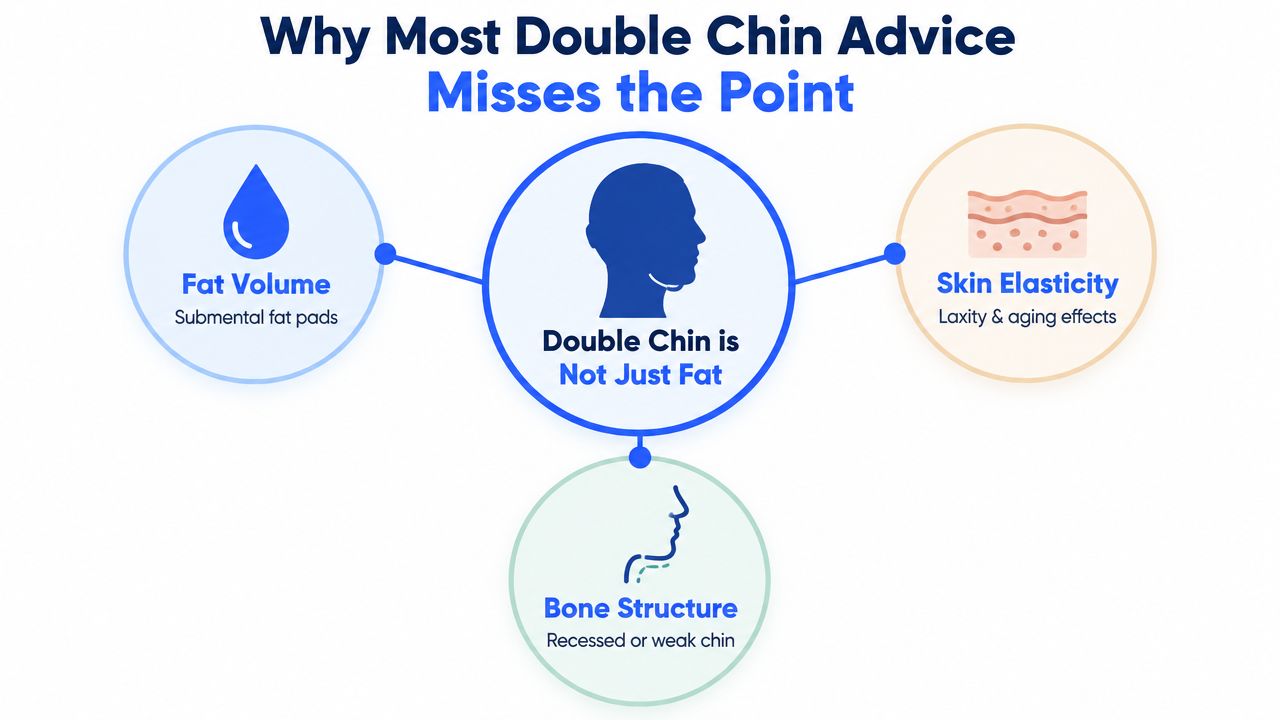
The four questions that change the plan
Fat volume is the clearest target for deoxycholic acid injections and some cooling or energy-based approaches. It creates fullness beneath the chin even when the skin remains reasonably firm.
Skin laxity changes the treatment priority. If the skin hangs after fat volume is reduced, a fat-reduction procedure alone may leave the patient dissatisfied. Energy-based tightening can be considered when laxity is mild, but significant excess skin may require a surgical opinion.
Chin projection affects the shadow beneath the jaw. A smaller or recessed chin can make a modest fat pad appear more prominent. In that situation, reducing fat may help, but restoring facial balance may require a separate discussion about structural correction.
Muscle and posture can influence the contour as well. Platysma banding and a forward-head posture can make the neck look less defined, although correcting posture won't remove a true fat pad.
Practical rule: Treat the feature that creates the appearance, not the label people use for it.
A diagnosis-first consultation may include an examination from several angles, review of weight history, assessment of skin recoil, and discussion of medications and medical conditions. Some people also use body-composition testing to understand broader changes in fat and lean mass. For readers seeking that kind of assessment, DEXA body composition testing in Liverpool offers context about what this type of testing can and can't measure. It doesn't replace a focused facial examination, but it can support a wider weight-management conversation.
Weight management can be relevant when overall body fat contributes to facial fullness, but it shouldn't be used as a substitute for evaluating localized anatomy. Medically supervised programs may help patients address weight in a structured way, while a focused assessment determines whether the area beneath the chin remains a separate contour concern. ProMD's medically supervised weight loss program is one example of a service that can fit into that broader discussion.
The main benefit of this approach is restraint. A provider may recommend treating only the fat, combining contouring with tightening, discussing chin projection, or advising against treatment when the expected improvement would be limited. That answer can feel less exciting than a package of procedures, but it reduces the risk of paying for a treatment that cannot solve the actual problem.
Evidence-Based Non-Surgical Options for Submental Fat
A double chin rarely comes from one cause. A provider may find a localized fat pad, loose skin, a recessed chin, platysma banding, or a combination of these factors. Treatment works best when the dominant cause is identified first, rather than choosing a device because it is widely advertised.
Nonsurgical treatment has its clearest evidence for submental fullness caused by fat. Deoxycholic acid became an FDA-approved option in 2015 for adults with moderate-to-severe fat below the chin. Its development program included two randomized clinical trials with 1,022 adults. In those studies, 66.5% to 70.0% of treated patients achieved at least a one-grade improvement, compared with 18.6% to 22.2% with placebo. MRI also found at least a 10% reduction in submental fat volume in 43% of treated patients versus 5% with placebo. The clinical background and trial results are summarized here.
Those results define the treatment's target. They do not mean every patient needs injections. Cryolipolysis, energy-based tightening, or muscle-focused contouring may be more appropriate when skin quality, treatment tolerance, or the underlying anatomy points elsewhere.
A practical comparison
| Treatment | Mechanism | Sessions | Downtime | Best For |
|---|---|---|---|---|
| Deoxycholic acid injection | Breaks down fat-cell membranes in the submental area | Commonly 2 to 4 sessions, spaced about a month apart | Swelling, tenderness, bruising, and temporary firmness may occur | Adults with moderate-to-severe submental fat and adequate skin quality |
| Cryolipolysis | Uses controlled cooling to target localized fat | Often more than one session may be discussed | Temporary numbness, swelling, or sensitivity can occur | A pinchable fat pad with relatively good skin elasticity |
| Radiofrequency or ultrasound tightening | Delivers energy intended to support contraction and contour improvement | Usually planned as a series rather than a single guaranteed treatment | Often limited, but depends on the device and settings | Mild laxity or patients prioritizing gradual tightening |
| Energy-based fat and muscle contouring | Combines energy approaches to influence fat and muscle in a treatment corridor | Treatment plans vary by anatomy and device | Usually limited, with temporary treatment sensations possible | Selected patients needing broader contour support |
| At-home creams, massage, or exercises | May improve skin feel, fluid movement, or posture awareness | Ongoing use | None or minimal | Supporting habits, not removing a substantial fat pad |
Deoxycholic acid is the only FDA-approved nonsurgical treatment specifically indicated for submental fullness. In a prospective series of 100 patients, 88% achieved at least a one-grade improvement. Most responders did so after 1 to 2 sessions, and nearly all responders improved by 4 sessions. The published treatment approach used 2 mg/cm², with sessions spaced about a month apart. The prospective study is available through the National Library of Medicine.
Why Kybella is not a universal answer
Kybella works when the examination confirms a treatable fat pad beneath the chin. It does not tighten substantial excess skin, move a recessed chin forward, or correct every reason a jawline may appear blurred. The main practical drawback is inflammation. Swelling can be noticeable, so patients should account for work, travel, and social commitments when scheduling treatment.
Appointments are generally brief, but exact timing depends on the number of injection points and the provider's assessment. Patients can review Kybella treatment for double chin before a consultation, then ask how the proposed injection pattern fits their anatomy. The number of sessions should be based on the fat volume, response, and treatment goals rather than a standard package.
ProMD Health offers Kybella for reduction of submental fullness. Candidacy, dosing, injection placement, and follow-up still require assessment by the treating provider.
Where cooling and tightening fit
Cryolipolysis may suit someone with a distinct, pinchable fat pad and enough elasticity for the skin to follow the reduction. The change develops gradually. This approach is not designed to correct significant laxity or alter skeletal structure.
General facial puffiness can also reflect fluid retention, sleep, diet, or other lifestyle factors. Lila tackles facial bloating, but advice for generalized bloating should not be confused with treatment for a fixed submental fat pad.
Radiofrequency and ultrasound approaches are more relevant when mild laxity contributes to the concern. They may produce gradual tightening, but they are not equivalent to removing excess skin. Energy-based contouring can be considered for selected patients when fat reduction and muscle support are both part of the treatment goal. The device's indication, settings, and availability must be verified at the individual clinic.
What weak options can and can't do
Massage, facial exercises, posture work, and topical skincare may support the appearance of the neck. They can improve comfort, skin hydration, or awareness of head position, but they do not reliably remove a substantial fat collection. A cream that temporarily makes skin feel tighter should not be presented as a substitute for medical contouring.
The strongest plan usually matches the least invasive suitable treatment to the dominant anatomical problem. Fat with mild laxity may require sequencing. A recessed chin may call for a facial-balance discussion instead of further fat reduction. If bone structure is the main limitation, reducing fat alone may produce little visible improvement.
The device name matters less than the diagnosis. A careful examination determines whether the treatment's mechanism fits the fat, skin, or structure creating the double chin.
Consultation Checklist Before Choosing a Provider
A consultation should feel like an assessment, not a sales presentation. Before booking, confirm that a licensed medical provider evaluates the area and can explain why the recommended treatment fits your anatomy. Credentials, relevant experience, and a willingness to discuss alternatives matter more than a polished advertisement.
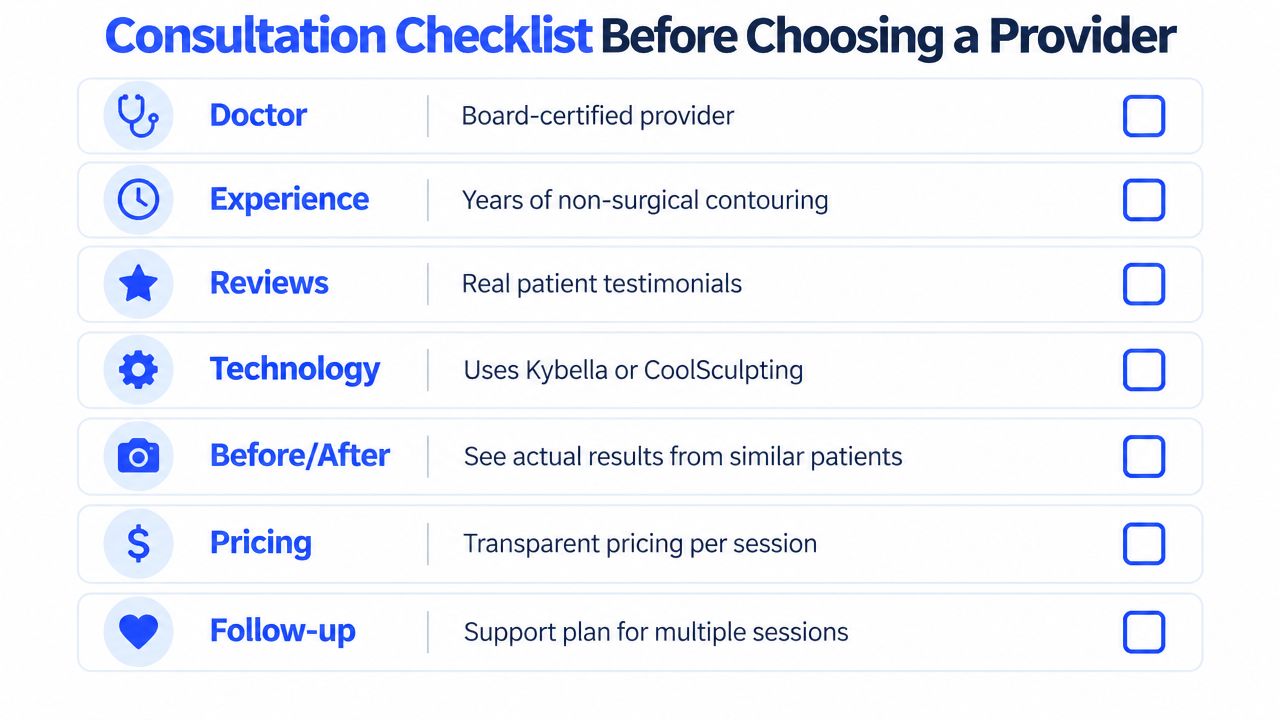
Questions worth asking
Who will assess and perform the treatment? Ask about the provider's license, clinical training, and experience with submental contouring. You should know whether a physician, nurse practitioner, physician assistant, or another qualified professional will perform the procedure and who oversees care.
What is causing my appearance? Ask the provider to distinguish fat from laxity, chin recession, and platysma banding. A clear explanation should connect the examination findings to the proposed treatment.
What alternatives fit my anatomy? If the recommendation is an injection, ask why cooling or energy-based tightening isn't more appropriate, or why a surgical referral isn't warranted. A provider who can't explain the trade-off isn't giving you enough information to consent intelligently.
Can I see comparable results? Request before-and-after photographs of real patients with similar skin quality, fat distribution, and chin projection. One dramatic image doesn't predict your outcome.
What will recovery look like? Ask about swelling, bruising, tenderness, numbness, activity restrictions, and the point at which the provider evaluates progress. Don't schedule treatment without understanding how visible the recovery may be.
How will multiple sessions be handled? Some plans require a series. Ask how the provider decides whether to continue, stop, change modalities, or address another cause after the initial response.
What happens if I'm not a candidate? A responsible practice should be comfortable recommending no treatment or referring you elsewhere when the likely benefit is limited.
Red flags during the appointment
Be cautious if a provider guarantees a permanent jawline, promises a single session will solve every concern, or recommends the same treatment to everyone. Pressure to buy a large package before the diagnosis is clear is another reason to pause.
Bring a complete medication and medical history, including previous aesthetic treatments and any history of trouble swallowing, nerve symptoms, or skin healing problems. The provider needs that information to assess safety and to identify whether the visible contour reflects something other than routine submental fullness.
A good consultation gives you a diagnosis, a range of reasonable options, and a way to judge progress. It shouldn't require you to accept the most expensive option immediately.
Ask how the practice handles follow-up and complications. You should leave knowing who to contact, when the result will be reviewed, and what symptoms require prompt medical attention.
What Results Look Like and How Long They Last
A treated double chin can look fuller before it looks better. Swelling, tenderness, firmness, and temporary numbness are common early effects, and they can obscure the actual contour change. Comparing a swollen treatment area with an older photograph taken in different lighting makes the result even harder to judge.
Use consistent photographs and review them with the provider at planned intervals. Deoxycholic acid treatment commonly involves 2 to 4 sessions spaced about a month apart, with improvement developing gradually across the course. That schedule is one reason an early assessment should not determine whether treatment has worked.
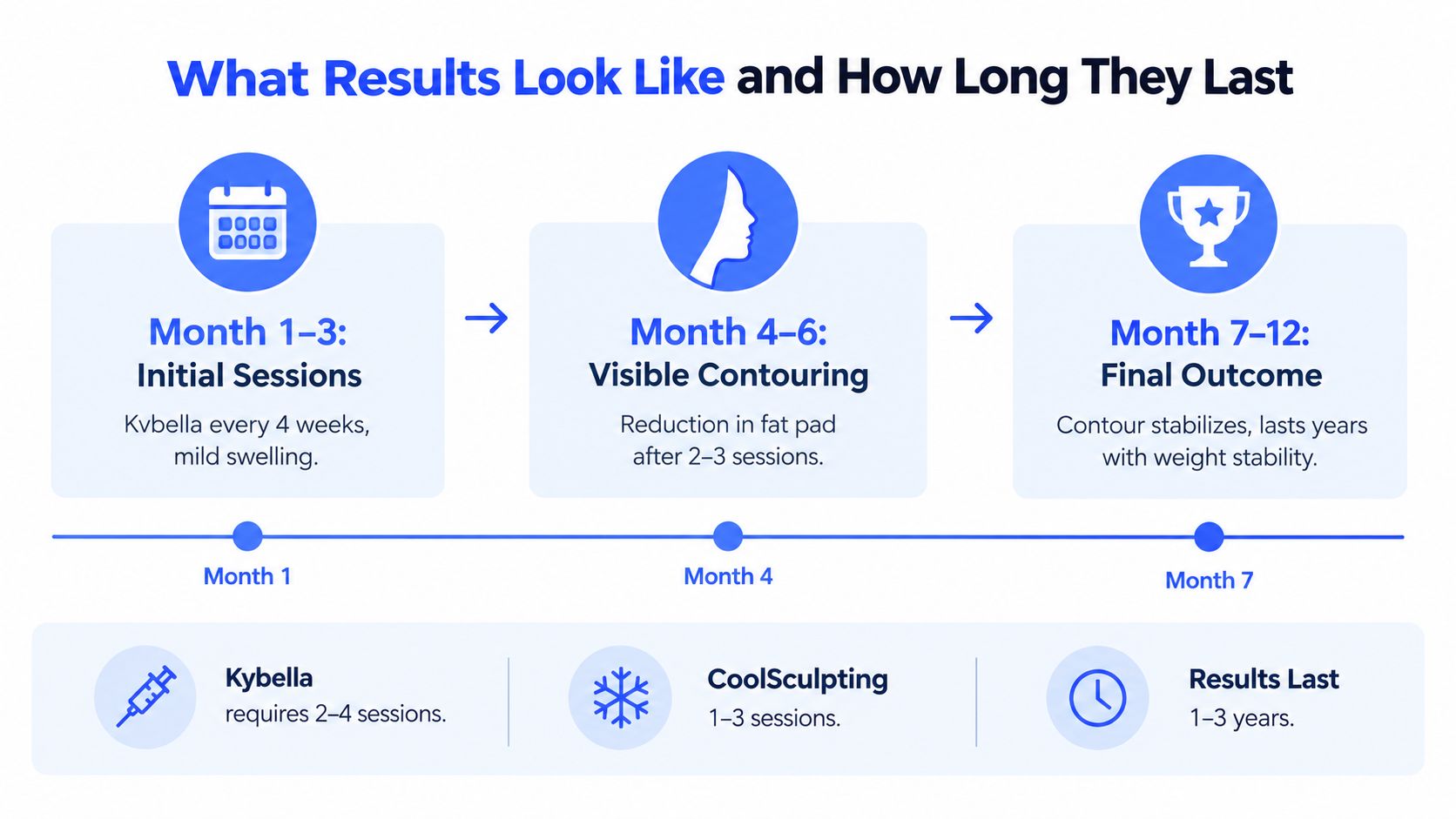
A realistic patient path
A patient with a defined fat pad and firm skin may develop swelling after the first appointment, then see gradual improvement as the treated fat is cleared. At review, the provider may find the response sufficient or recommend another session if fullness remains across a broader area.
A different patient may have little excess fat but visible laxity. Repeating fat reduction will not correct skin that is now the limiting factor. A tightening approach may be discussed, although the expected change should be gradual rather than a sharply lifted neck.
A third patient may lose weight and still dislike the profile because chin projection is limited. Further fat reduction may not create the desired balance. A structural consultation may be more appropriate than another injection.
The 2026 systematic review and pooled analysis found an overall responder rate of about 70.8%, with a 95% confidence interval of 60.2% to 79.5%, across clinical trials of nonsurgical options. It reported a pooled improvement rate of about 70% for deoxycholic acid, while emphasizing that outcomes vary by modality. The pooled analysis is published in the Journal of Cosmetic Dermatology.
Durability needs a realistic definition
Reducing or destroying treated fat cells does not prevent future changes elsewhere. Weight gain can enlarge remaining fat cells, aging can reduce skin elasticity, and chin position or posture can continue to affect the profile. Nonsurgical contouring is therefore best described as durable improvement, not a promise that the appearance will never change.
Patient satisfaction belongs in the assessment alongside photographs and measurements. The clinical results page reports that 68.2% of subjects were at least one-grade composite responders and 79% reported improved satisfaction with the appearance beneath the chin 12 weeks after the last treatment. The Kybella clinical results page provides the source for these figures. The findings also show why a meaningful review should consider both visible contour and the patient's own assessment.
Long-term planning may include stable weight, skincare, posture awareness, and reassessment if laxity develops. Before treatment begins, ask whether follow-up care or additional treatment is likely. A diagnosis-first plan should also explain what would change if the result reveals that fat was not the only cause of the profile.
At-Home Measures and When to Consider Surgery Anyway
Home habits can support a better neck contour, but they have clear limits. Weight management may reduce generalized fullness, posture correction can improve the way the neck sits in profile, and skincare can support hydration and surface texture. None of these reliably removes a discrete submental fat pad or repairs significant loose skin.
If you use meal-replacement products as part of a calorie-deficit plan, this guide to using bars for a calorie deficit may provide general planning context. It shouldn't replace individualized medical guidance, especially for people with health conditions or prescribed medications.
Avoid aggressive self-injection, unregulated dissolving products, intense suction devices, and protocols that promise dramatic anatomical change without an examination. The risks include injury, irregular contour, infection, and delayed care for a problem that needs a different diagnosis.
Surgery may deserve consideration when there is substantial skin excess, pronounced skeletal recession, or persistent dissatisfaction after appropriately selected nonsurgical treatment. That doesn't mean surgery is the automatic next step. It means a surgical consultation can clarify whether skin removal, fat removal, or structural correction would address the limitation that nonsurgical care can't overcome.
For patients whose primary concern is laxity, a discussion of neck skin tightening treatments can help define whether an energy-based approach is reasonable. Choose a medically supervised plan, track progress over time, and stop if the proposed treatment doesn't match the finding your provider identified.
ProMD Health offers Kybella for submental fullness and provides consultations to match nonsurgical aesthetic options to individual anatomy. Visit ProMD Health to review the available services and request a consultation focused on your chin, neck, skin quality, and realistic treatment goals.


