
The FDA-labeled dose of BOTOX Cosmetic for moderate-to-severe frown lines is 20 units total, given as five intramuscular injections of 4 units each. That's a reference point, not a universal prescription: a clinician considers your muscles, facial anatomy, treatment history, and goals before choosing your dose.
The number can sound like a simple answer, but units only make sense when you know which product they refer to and how the treatment is planned. The key question isn't just how many units of Botox for frown lines, but how to balance line softening, natural movement, and the possibility of unwanted muscle weakening.
Table of Contents
- The Standard Botox Dose for Frown Lines
- Personal Factors That Shift the Unit Count
- What Higher and Lower Doses Actually Change
- How a Clinician Sets Your Dose Step by Step
- Safety Limits and Side Effects to Discuss
- Book a Personal Dose Assessment at ProMD Health
The Standard Botox Dose for Frown Lines
The FDA-labeled regimen for moderate-to-severe glabellar lines, commonly called frown lines, is 20 units total of BOTOX Cosmetic. The prescribed pattern uses five injection sites, with 4 units in 0.1 mL at each site, according to the FDA prescribing information for BOTOX Cosmetic.
The injection pattern follows the muscles that draw the eyebrows together: one site in the procerus between the brows, and two in each corrugator supercilii, the muscles that pull the brows inward.
| Injection site | Injection points | Units | Volume |
|---|---|---|---|
| Procerus, center of brow | 1 | 4 | 0.1 mL |
| Left corrugator supercilii | 2 | 8 | 0.2 mL total |
| Right corrugator supercilii | 2 | 8 | 0.2 mL total |
| Total | 5 | 20 | 0.5 mL total |
This labeled use aims for temporary improvement in moderate-to-severe glabellar lines linked to corrugator and/or procerus muscle activity. The effect wears off over several months. In clinical studies of healthy adults ages 18 to 75 with at least moderate lines when frowning maximally, improvement compared with placebo was observed for up to 120 days, or about four months, as reported in the FDA label.
The 20-unit figure is a labeled reference, not an automatic dose for every patient. It describes one specific product and injection pattern. Units are product-specific, so the number cannot be transferred one for one to other neuromodulators. Each additional unit is a trade-off: changing the dose may affect how much movement is softened and how long the effect lasts, while also changing the chance of unwanted muscle weakening. A clinician uses the labeled map as a reference, then considers whether that pattern suits the individual treatment plan.
Personal Factors That Shift the Unit Count
A patient with a mild frown who wants to keep visible movement may discuss a lower dose. Someone with stronger muscle activity and deeper lines may prefer more smoothing. The labeled 20-unit reference is a starting point, while the right amount depends on the person's muscles, anatomy, treatment history, and goals.
| Factor | How it may affect the dose | What the clinician checks |
|---|---|---|
| Muscle strength | A forceful frown may call for a different amount than a faint one | Movement at rest and strength when frowning |
| Age | Age alone does not set the dose | Skin laxity, line depth, and facial changes |
| Sex | Muscle size can differ between individuals, so the clinician assesses it directly | Muscle size and brow position |
| Prior treatment | A patient's past response can help guide a returning patient's plan | Previous dose, duration of effect, and side effects |
| Anatomy | Brow shape and eyelid position inform treatment planning | Brow height, lid position, and line depth |
An average from a study can help describe a group, but it cannot prescribe a dose for an individual. The FDA labeling and clinical study information provides context for interpreting reported averages. Age alone can't determine a dose; the clinician needs to assess facial structure and muscle movement.
A first-time patient may ask about “baby Botox,” a term for a lower-dose approach, not a separate labeled product. A lower total may provide less effect or wear off sooner when lines are moderate to severe. Each added unit is a trade-off: it may support a stronger or longer-lasting effect, while also affecting how much movement remains and the chance of side effects. The fewest possible units are not automatically the safest or most suitable choice.
For instance, a patient with a mild frown who values movement may discuss a conservative plan. A patient with a forceful frown and deeper lines may place more value on smoothing. The clinician weighs those goals alongside the patient's anatomy and prior response, then discusses a dose that fits the individual rather than treating 20 units as a rule for every face.
What Higher and Lower Doses Actually Change
The labeled reference for frown lines is 20 units. That gives patients and clinicians a starting point for discussion, not a dose that fits every face. A seven-trial meta-analysis of 1,474 participants found a higher investigator-assessed response with 20 units than with placebo, with no significant difference in adverse-event frequency. Its findings support the reference dose, while personalized treatment still depends on the patient's goals and clinical assessment.
Studies comparing doses show how the trade-off can work. In a randomized study of 80 women with moderate-to-severe glabellar lines, 20, 30, and 40 units were more effective than 10 units. A Japanese randomized study reported that 88.6% of patients rated their response at week 8 with 20 units, compared with 70.5% with 10 units. Earlier research found mean time to relapse of 17.6 weeks with 20 units and 24.2 weeks with 80 units. Another randomized study found longer response and higher satisfaction above 20 units, without an apparent safety difference in that study. These results do not make 80 units a routine cosmetic dose.

| Total dose | What the evidence shows | Trade-off |
|---|---|---|
| 10 units | Less effective than 20, 30, or 40 units in one study | May leave more movement or provide a shorter response |
| 20 units | Labeled reference for frown lines | A reference point to discuss, adjusted to the patient's goals |
| 30 to 40 units | More effective than 10 units in the same study | More product may increase the chance of heaviness or an overly still appearance |
| 80 units | Longer mean time to relapse than 20 units in earlier research | Not established for routine cosmetic use, with greater concern about unwanted weakening or spread |
Each additional unit is a trade-off. A higher dose may extend the response, while also increasing the chance of weakening muscles beyond the desired level or affecting nearby movement. For example, a patient who values longer-lasting smoothing may weigh that benefit against the possibility of a heavier or less expressive result. The right balance depends on the patient's priorities, not on choosing the highest studied number.
For practical ideas on maintaining results between appointments, read this guide on how to prolong Botox results. A clinician can also explain how long Botox results may last in relation to an individual treatment plan.
How a Clinician Sets Your Dose Step by Step
The labeled reference for frown lines is 20 units, but your clinician still needs to assess your movement and goals before choosing a dose. That reference is a starting point for discussion, not a prescription for every face. Each step below helps turn the number into an individualized plan.
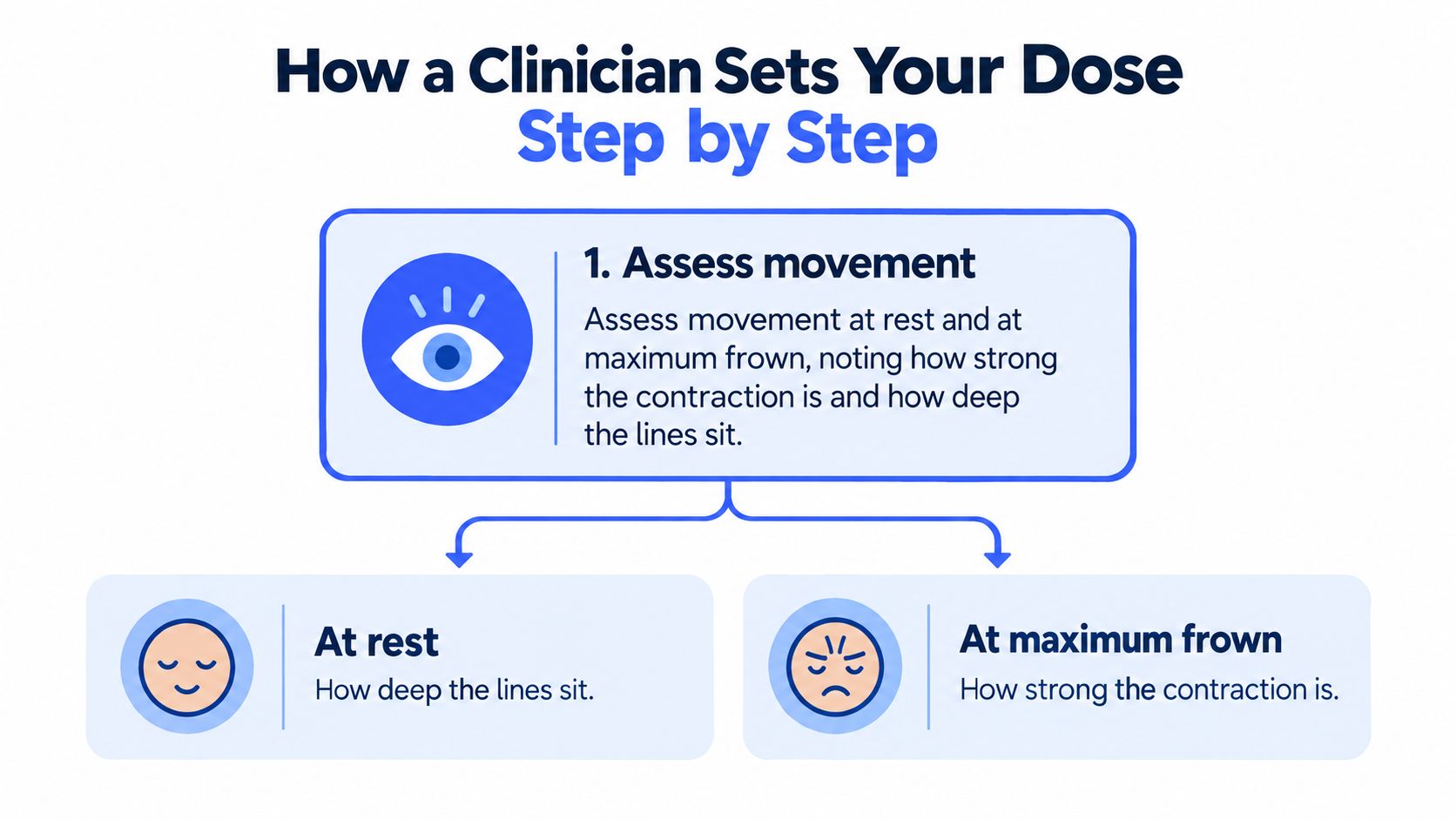
Assess movement. The clinician observes your brows at rest and during a maximum frown, noting how strongly the muscles contract and how lines appear. A still photo captures one moment; watching your face move shows how the muscles work.
Take standardized photographs. Images from consistent angles record your starting point, making later comparisons more useful. They provide a shared reference instead of relying on either person's memory of your initial movement.
Review your history. Share relevant medical history, current medications, and prior neurotoxin treatment results, including any brow or eyelid heaviness. A past side effect can affect how the clinician approaches your plan.
Choose the total to match your goal. You may want softer lines while keeping some movement, or prefer a smoother appearance. If you are new to treatment, the labeled 20-unit reference can anchor the conversation. The clinician can discuss whether that amount fits your goals and what adding units might change: potentially longer-lasting results, with more chance of weakening muscles beyond your preference.
Plan the injection sites. The clinician considers the labeled five-site pattern and may adjust placement for your anatomy, while confirming the product and dilution. The total and placement are determined by your facial anatomy and the formulation used.
Reassess the result. At about two weeks, the clinician can compare your movement and any side effects with the baseline photographs. This follow-up helps clarify whether the response matches your goal or whether a future adjustment may be appropriate.
Record the details. Notes on units per site, response, duration, and adverse effects give future appointments a useful reference. Each recorded visit makes it easier to judge changes over time.
Accurate placement, anatomy, dilution, and formulation all affect results. Units for Botox should not be transferred one for one to other neurotoxin products, because formulations differ. For an overview of what to expect from first-time Botox, review the appointment process before discussing your dose with a clinician.
Safety Limits and Side Effects to Discuss
A dose beyond what your goals require can weaken more muscle than you want. Uneven placement or spread may also affect balance between the brows, so the plan should account for both the total and where each injection goes.
Before treatment, ask your clinician about possible effects and what to watch for:
- Brow or eyelid drooping: Ask how your brow and eyelid position affect the plan.
- Asymmetry: Uneven spread or differences in muscle response can change how the brows move.
- Weaker or delayed response: The result may not match your expectations immediately or fully.
- Temporary bruising or soreness: Injection sites can be tender or bruised.
Tell your provider if you're pregnant or breastfeeding, have a neuromuscular condition, or have a known allergy to any ingredient. These situations call for a medical screen before treatment. If you're exploring toxin use for a different purpose, such as off-label Botox use for TMD, make sure the clinician explains how that use differs from the labeled cosmetic indication.
The effect is temporary, and repeat treatment should be a considered decision rather than a rush. Contact a medical professional promptly if drooping spreads beyond the brow, or if you develop trouble swallowing or breathing, or vision changes. Follow your clinician's aftercare instructions; they may include staying upright and avoiding rubbing the treated area for a few hours. Review the ProMD Botox safety information before your appointment and raise any concerns directly with your provider.
Book a Personal Dose Assessment at ProMD Health
“How many units would you recommend for me?” At an in-person assessment, the clinician can explain how the labeled 20-unit reference relates to your own facial movement. It is a starting point, not a dose that suits everyone. Your goals matter too: preserving natural brow movement may call for a different approach than seeking stronger smoothing.
Bring photos of your frown, notes about prior neurotoxin treatment, and any details you recall about the dose and how long its effect lasted. List your current medications and mention past brow or eyelid heaviness. These details help the clinician weigh your treatment history alongside the movement they observe.
Each neurotoxin treatment has its own unit scale, so units cannot be treated as interchangeable across products. ProMD Health's medical providers can explain which treatment they use and how they determine its dose. Each additional unit is a trade-off: it may affect the degree or duration of muscle relaxation, while also changing the risk of unwanted weakness or heaviness. The goal is a dose suited to your features, not more units for their own sake.
ProMD Health operates on a cash-pay model, and treatments are not covered by insurance. Confirm pricing during your consultation and check the ProMD locations page for a clinic. To discuss a frown-line treatment plan in person, visit ProMD Health and book a consultation.


