
You've noticed the same lines in photos, looked at your face while raising your eyebrows, and wondered whether Botox would help. Then the questions start: Will it hurt? Will you still look like yourself? What happens if you don't like the result?
If you're searching for “first time Botox what to expect,” the most useful answer starts before the injections. Your first visit should help you decide whether treatment fits your goals, understand the trade-offs, and know who to contact afterward. You don't need to arrive knowing the right dose or the right terminology. You need room to ask questions.
Table of Contents
- What Your First Botox Appointment Actually Looks Like
- The Consultation and Candidacy Conversation
- How the Injection Itself Feels and What Happens Step by Step
- When Botox Starts Working and How Long It Lasts
- Aftercare in the First 24 Hours and First Week
- Recognizing When a Side Effect Needs Attention
- Your Two-Week Follow-Up and Maintenance Plan
- Booking Your First Visit with Confidence
What Your First Botox Appointment Actually Looks Like
Think of arriving with a specific concern, such as the crease between your eyebrows, rather than a treatment plan you've already chosen. At check-in, you'll complete health information and explain what brought you in. That paperwork starts a medical conversation, not just a cosmetic transaction.

Your provider should review your concerns before discussing injections. For example, wanting to look less tense between your eyebrows is different from wanting no visible movement there. Those preferences deserve a conversation because less movement and the right amount of movement aren't necessarily the same goal.
Expect a conversation before a procedure
The appointment has distinct parts: consultation, assessment, a treatment decision, and, if appropriate, injections followed by aftercare. Ask the office how much time to reserve, especially if you want a consultation without committing to treatment that day. Don't assume the booking automatically requires you to proceed.
Useful questions include:
- Who will treat me? Ask about the medical professional's qualifications and experience with facial injections.
- What happens before I consent? Request an explanation of the proposed areas, expected changes, limitations, and risks.
- Can I think about it? You should feel comfortable choosing another appointment or declining treatment.
For anyone who feels calmer after understanding a procedure's stages, the Paul L. Gregory veneers process from Paul L. Gregory, DDS, is a separate cosmetic-care resource to explore. Dental treatment and Botox aren't interchangeable, but you can bring the same practical habit to either consultation: ask what happens before, during, and after care.
Before leaving, you should have more than an appointment receipt. You should know what was treated, what instructions to follow, and how to reach the clinical team. A clear plan matters as much as a comfortable treatment experience.
The Consultation and Candidacy Conversation
Start with your health history, not your preferred dose. Your provider needs to understand your medical background before deciding whether treatment is appropriate. Bring a written medication and supplement list so you don't have to remember everything while you're nervous.
Mention pregnancy, plans for pregnancy, breastfeeding, neuromuscular conditions, previous facial procedures, and any unusual reaction to an injectable. These aren't details to filter yourself. Let the clinician decide which information changes the recommendation.
What to bring up yourself
Use your consultation to make the less obvious details visible:
- Recent medications: Mention antibiotics, muscle relaxants, and any medication you've recently started or stopped.
- Blood thinners and supplements: Share what you take, including nonprescription products. Don't stop prescribed medication just to prepare for a cosmetic appointment without guidance from your prescribing clinician.
- Previous reactions: Describe what happened, even if you don't know whether it was an allergy.
- Existing differences: Point out a brow that naturally sits higher or an eyelid that already feels heavy.
Next, explain your goal in ordinary language. “I want this area to look softer, but I'm worried about losing expression” gives the provider something concrete to discuss. You don't need to request a particular injection pattern.
Ask what Botox can realistically change
Botox temporarily reduces movement in targeted muscles. That makes the distinction between expression-related lines and your broader skin concerns important: ask which part of your concern the proposed treatment addresses and which part it doesn't.
Age alone shouldn't substitute for this assessment. The discussion in what is the best age for getting Botox can help you prepare questions, but your consultation still needs to focus on your health, facial movement, and preferences.
A useful question: What would make you recommend that I wait or choose not to have treatment?
A thoughtful answer should explain candidacy, not just move you toward an injection. You should leave this conversation understanding both the recommendation and its limits.
How the Injection Itself Feels and What Happens Step by Step
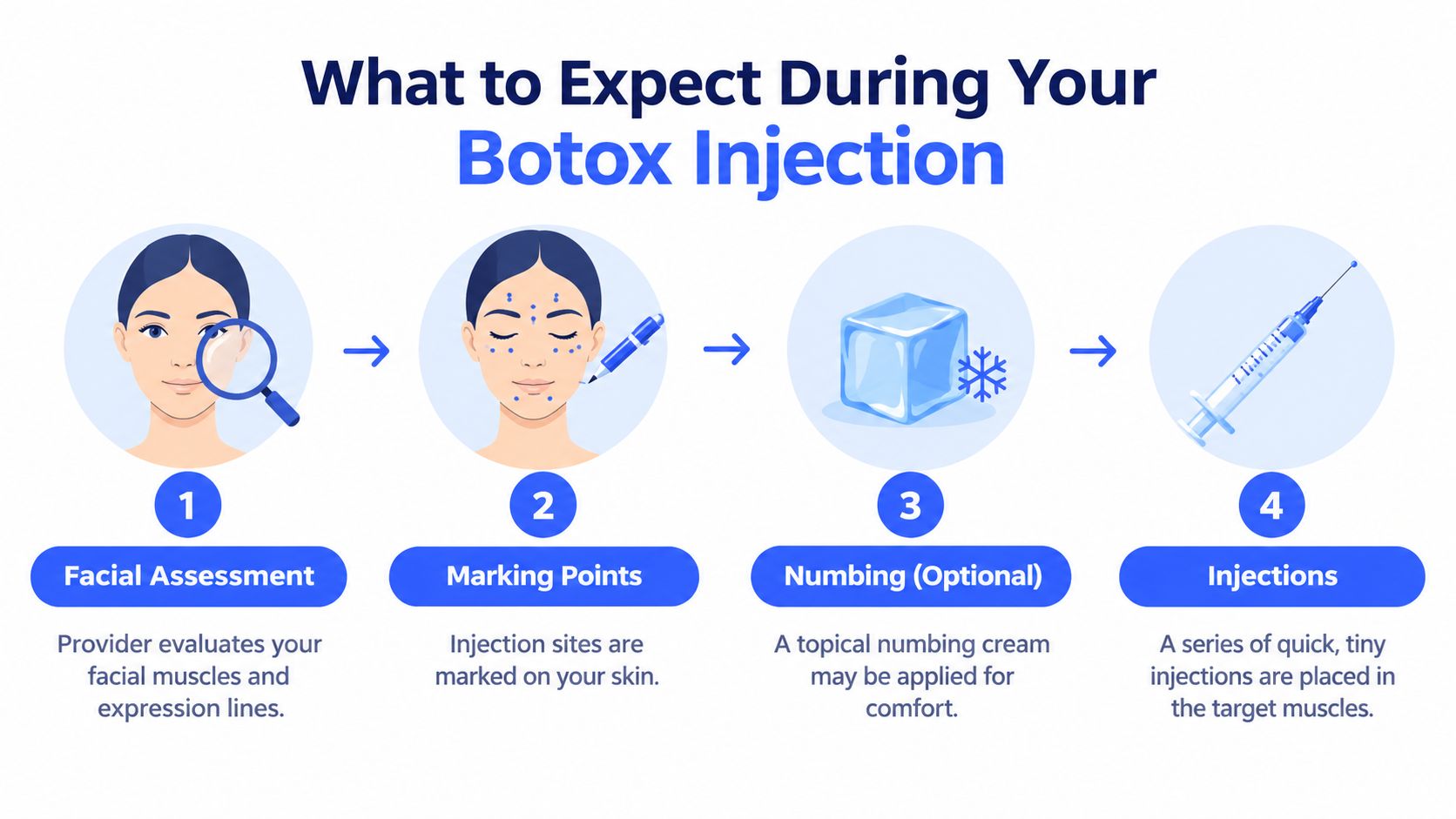
Once you've agreed on a plan, ask your provider to describe what they're about to do. Knowing when to expect touch, cleansing, or an injection can make the experience feel less unpredictable.
From facial movement to injection points
Your provider may ask you to frown, raise your eyebrows, or smile while examining how your face moves. This is a good time to point out the exact expression that bothers you, rather than relying only on a still photograph.
The treatment area is prepared, and the clinician may mark planned injection sites. If you're worried about discomfort, ask whether topical numbing is an option and what the office recommends. Don't assume you need to tolerate anxiety.
During the injections, you may feel a brief pinch or sting. Comfort varies, so it's better to prepare for a noticeable sensation than to expect a completely sensation-free experience. Tell the injector if you need a pause, feel faint, or experience unexpected pain.
Understand the dose before treatment
There isn't a universal first-time dose that fits every forehead or every set of frown lines. Ask the provider to explain the proposed units and how they relate to your assessment.
- Ask about the goal: Is the plan intended to soften movement or reduce it more substantially?
- Ask about balance: How does treating the proposed area affect the overall expression you want?
- Ask about restraint: If a conservative starting plan is suggested, what change should you expect to notice?
The injection portion may feel brief compared with the discussion and preparation, but don't use speed as a measure of quality. Ask the office for its scheduling estimate rather than relying on a universal visit length.
You can agree to treatment and still ask the clinician to pause. Consent doesn't mean giving up your ability to speak.
Before you get up to leave, confirm that you've received the written aftercare instructions and the clinic's contact details.
When Botox Starts Working and How Long It Lasts
You leave the clinic, check your reflection in the car mirror, and see the same face you brought in. That is expected. Botox relaxes the connection between nerve and muscle over days, so what you see in the first hour tells you almost nothing about the result.
According to NHS patient guidance on botulinum toxin treatment, the effects may become noticeable after 3–5 days, while the full effect can take about 2 weeks. Two milestones, two different meanings. The day you first spot softening is too early to decide whether you are happy.
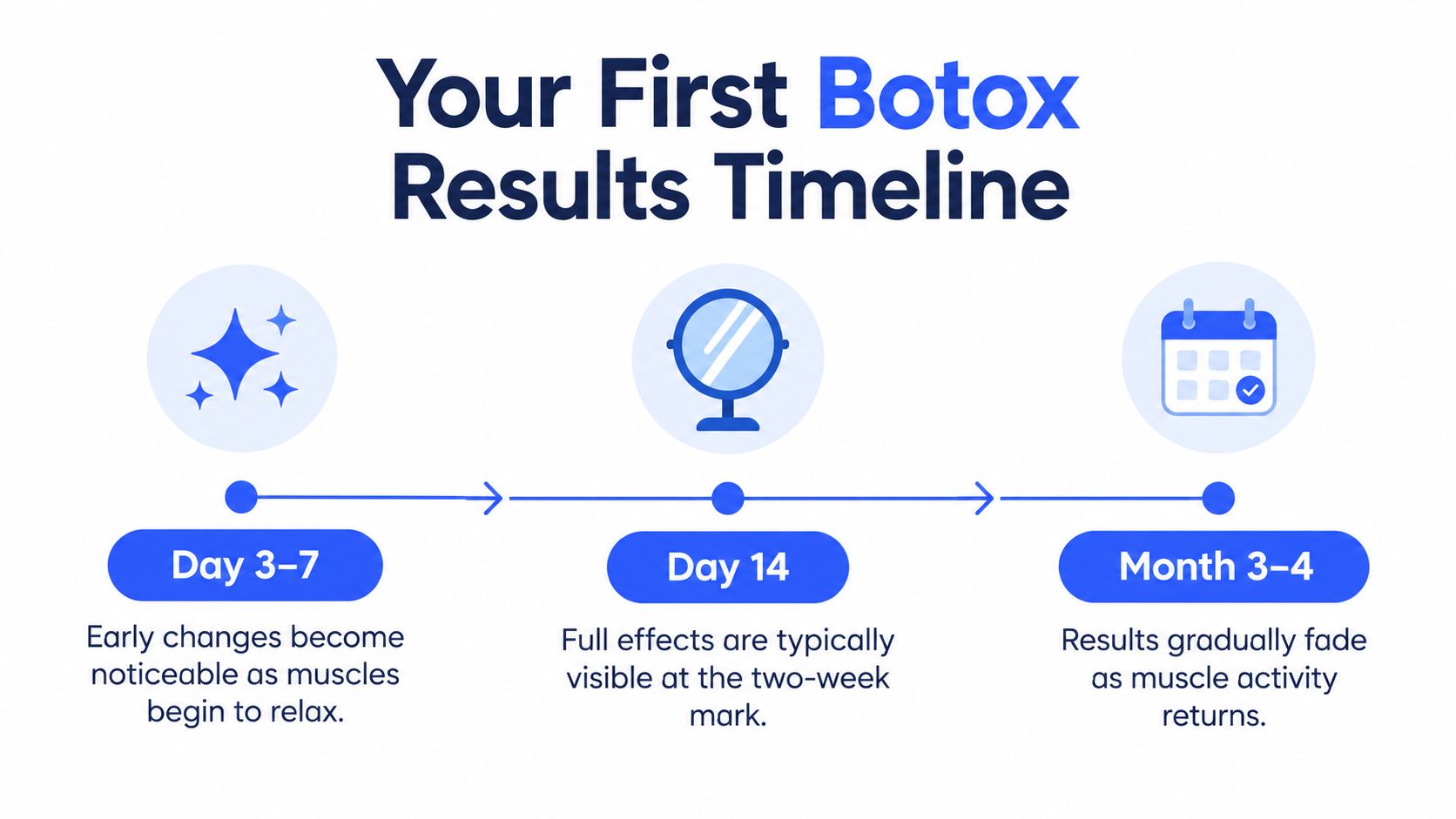
Here is one way to read the weeks ahead:
| Stage | What you may notice | What it means for you |
|---|---|---|
| First 1–2 days | Your usual expressions, plus possible small marks where the needle went in | Too early to evaluate anything |
| Days 3–5 | You can still frown or raise your brows, but the lines look softer | The treatment is starting to take effect |
| Around 2 weeks | The settled result | The right moment to judge symmetry and satisfaction |
| Around 3 months | Movement gradually returns | A signal to talk with your injector about timing the next visit |
The NHS guidance describes results lasting about 3 months, with repeat injections commonly scheduled every 3–4 months. Treat those figures as planning ranges. Your own calendar depends on how quickly movement returns for you, which varies between people and between treated areas.
One habit to drop during the wait: frowning at yourself under different lighting to test whether it is “working yet.” Each forced expression hands you a new angle to worry about. A better use of the two weeks is one photo in consistent light and a short list of what you like and what feels off. Bring that to your review appointment, and the waiting period becomes preparation instead of guesswork.
Skincare sits in a separate lane. Botox acts on muscle movement, while a cream works on the skin itself, so no topical product replicates or extends the treatment. If you want to support your skin between visits, REVETIX's guide to Q10 for maturing skin is a reasonable starting point to raise with your provider.
The longevity question that matters is personal: when does returning movement stop matching the look you want? Reading about how long Botox tends to last gives you a reference point, and your follow-up conversation is where your own pattern gets established.
Aftercare in the First 24 Hours and First Week
The most useful aftercare conversation happens before you leave the chair. Ask your injector to translate the written precautions into the choices already on your calendar: "Can I return to work today?" "Should tonight's workout move?" "When can I cleanse, wear makeup, or use my usual skincare?" Clear answers turn a generic sheet into a plan you can follow.
The American Academy of Dermatology's botulinum toxin FAQs state that everyday activities can resume immediately and that bruising, when it occurs, typically lasts about 1 week. Your clinician's specific instructions remain the deciding voice, particularly if they differ for the area treated or your health history.

Describe your ordinary week rather than asking whether one accidental touch will undo the result. Mention an exercise session, a facial or massage appointment, plans that involve bending or lying face-down, and any skincare step requiring pressure. Your injector can then tell you which plans need new timing and which can continue normally. If soreness develops, ask what is appropriate for your health history rather than selecting a pain remedy automatically.
A practical question to take home: “Here is what I have planned for the next week. Which parts should I move, and when can each safely resume?”
During the first days, redness, swelling, soreness, and bruising may appear around the injection areas. An occasional mild headache can occur too. Notice whether each change seems to be settling, when it started, and whether the clinic asked you to report it. This gives the treating team useful detail without asking you to diagnose the cause.
Before you leave, confirm who answers questions outside office hours and which contact method the clinic prefers. Good aftercare names the next action and the person responsible for helping with it.
Recognizing When a Side Effect Needs Attention
The safest response depends on what you're experiencing, not how recently you were treated. An appearance concern and a breathing problem belong in entirely different categories.
The FDA prescribing information for Botox Cosmetic identifies injection-related reactions and the possibility of unwanted muscle weakness, including eyelid or brow drooping. It also warns about symptoms suggesting effects beyond the injection area.
Use symptoms to choose your next step
| What you notice | What to do |
|---|---|
| A mild local reaction that's settling | Follow your aftercare instructions and monitor it. |
| An uneven appearance while the result is developing | Document the change and ask the clinic when it should be assessed. |
| A new droopy brow or eyelid, or an effect that feels too strong | Contact your injector for clinical assessment rather than trying to correct it yourself. |
| Difficulty breathing, swallowing, or speaking, generalized weakness, or visual changes | Seek urgent medical attention rather than waiting for a cosmetic follow-up. |
Serious effects are uncommon, but the FDA warning notes that symptoms can appear hours to weeks after injection. Don't dismiss a concerning symptom because it didn't start immediately.
Don't diagnose the cause from a photograph
An uneven look early on doesn't automatically mean the dose was wrong. Equally, reassurance that treatment is still developing shouldn't replace an assessment when you report a new functional problem.
When you contact the clinic, describe what changed, when you noticed it, whether it's progressing, and whether it affects daily activities. A photograph may help, but it doesn't replace medical evaluation when that's needed.
You can use the practice's Botox safety information to prepare questions before treatment. Ask how the team handles concerns, who assesses unexpected symptoms, and what to do if you can't reach the office.
You don't need to decide whether a symptom is definitely caused by Botox before seeking help. The symptom itself determines the urgency.
Your Two-Week Follow-Up and Maintenance Plan
Arrive with a record, not a verdict. In the days before the visit, note when movement returned, which lines still bother you, and whether any expression feels harder to make than expected.
Professional guidance from the American Society of Plastic Surgeons supports reassessment at roughly two weeks to determine whether an adjustment is appropriate. Use that visit to compare the settled result with the plan from your consultation, then decide whether to leave it alone, adjust a small area, or schedule a later review.
Describe the result in terms your injector can act on
Specific details beat general disappointment. If the change feels too light, show the exact crease and demonstrate the expression that still creates it. If movement feels too limited, name the task or expression that feels awkward, such as raising the brows evenly or squinting in bright light. If one side looks different, compare it with your baseline photos and say when you first noticed the gap. If you like the outcome, say which part you want repeated.
Botulinum toxin cannot be dissolved the way filler can. When an effect feels too strong, the safer path is usually time plus assessment, so resist pressure to chase every imperfection with more units the same day.
Let your preference set the maintenance rhythm
Before leaving, ask for the charted pattern: areas treated, approximate response, and what would be changed next time. Then choose the next step based on when returning movement starts to bother you, using the earlier timeline as a guide rather than a deadline. Continuing, waiting, and stopping are all legitimate outcomes.
The follow-up is successful when you leave with a clearer decision and enough information to choose what happens next.
Booking Your First Visit with Confidence
You don't have to feel completely relaxed before booking. You do need a setting where your questions are welcome and where the clinician explains the plan without promising a perfect outcome.
The strongest preparation is straightforward: know what bothers you, be honest about your health, and be ready to discuss what amount of change would feel comfortable. You're not expected to arrive as an expert.
Keep this checklist with your appointment details
- Your goal: Identify the area or expression you want to discuss, along with anything you don't want changed.
- Your health information: Bring your medication list and relevant medical history.
- Your expectations: Be prepared for gradual change rather than an immediate reveal.
- Your follow-up plan: Know how the result will be reviewed and whom you'll contact with concerns.
- Your remaining questions: Write them down, especially anything you've felt embarrassed to ask.
When choosing an office, confirm the appointment type, the treating professional, and whether you can book consultation-only if you're still deciding. Ask what information you should bring and whether the office has any preparation instructions specific to you.
You can leave a consultation feeling informed even if you don't proceed that day. The right first step is an assessment you understand, not a treatment you feel pressured to accept.
Choose a convenient approved office, ask for a first-time Botox consultation, and tell the team that you'd like time to discuss your goals before deciding.
ProMD Health offers Botox consultations and treatment planning for expression-related facial lines. Visit ProMD Health to choose an office and request a consultation, bringing your medication list, your questions, and a clear description of the change you're considering.


