
A brown spot on your cheek, a broad patch across your forehead, and a mark left after acne can look like the same problem in the mirror. It's natural to hope one laser can clear them all. But pigment has different causes, depths, and tendencies to return, so treatment needs to start with what the discoloration is, not with a device name.
Laser pigmentation treatment can improve some concerns, but complete clearance isn't guaranteed. The safest plan matches the diagnosis and skin tone, and includes care to reduce the chance that pigment comes back.
Table of Contents
- Why Pigment Needs More Than One Laser
- How Laser Energy Targets Melanin
- Matching Lasers to Each Pigment Problem
- Safer Choices for Darker Skin Tones
- What Results Look Like by Diagnosis
- Care That Keeps Pigment From Returning
- How to Plan Laser Pigmentation Treatment
Why Pigment Needs More Than One Laser
A small, distinct sun spot may be a lentigo, a localized area of pigment. Melasma usually appears as broader, recurring patches. A brown mark left after acne is post-inflammatory pigmentation, created when irritation or inflammation prompts the skin to produce extra pigment. These concerns can look similar, but treating them as though they're interchangeable may lead to the wrong approach.
The technology has a long history. The first working laser, built by physicist Theodore H. Maiman in 1960, used a synthetic ruby crystal. Dermatologist Leon Goldman later demonstrated that ruby laser energy could target pigmented structures in skin, helping establish the principle of selective treatment. A history of lasers in dermatology traces the early development of this approach.
Diagnose before choosing a device
A consultation should establish what the pigment is, how deep it appears to be, and whether it's stable. The clinician also needs to consider skin phototype, recent tanning, irritation, and conditions that may keep triggering pigment, such as acne or melasma. A new or changing spot may need medical assessment before anyone considers a cosmetic procedure.
That distinction matters because removing a visible spot doesn't prevent another one from forming. A discrete lentigo and recurrent melasma may both look brown, but they call for different expectations and may not respond to the same settings.
Start with the pigment, not the platform. A device name can't tell you whether the treatment suits your diagnosis or your skin.
The practical questions come in order: How does light find melanin? Which approach fits the type and depth of pigment? Is the skin ready for treatment? What do the results show for this diagnosis, and what daily care helps protect the outcome? The central expectation is straightforward: improvement may be partial, and some forms of pigmentation can return.
How Laser Energy Targets Melanin
Laser treatment relies on selective photothermolysis. In plain language, the clinician chooses light that pigment absorbs more readily than surrounding targets such as hemoglobin or water. The absorbed energy creates an effect in the pigment while the treatment is designed to limit unwanted injury to nearby skin.
Pulse duration matters as much as wavelength. A pulse that lasts too long can allow heat to spread beyond the targeted pigment. Effective pigment targeting generally uses a pulse shorter than the melanosome's thermal relaxation time, often below 100 nanoseconds. The aim is to deliver energy quickly enough to affect the pigment without broadly heating the surrounding tissue. An overview of laser wavelengths and pigment treatment explains how wavelength and pulse characteristics shape targeting.
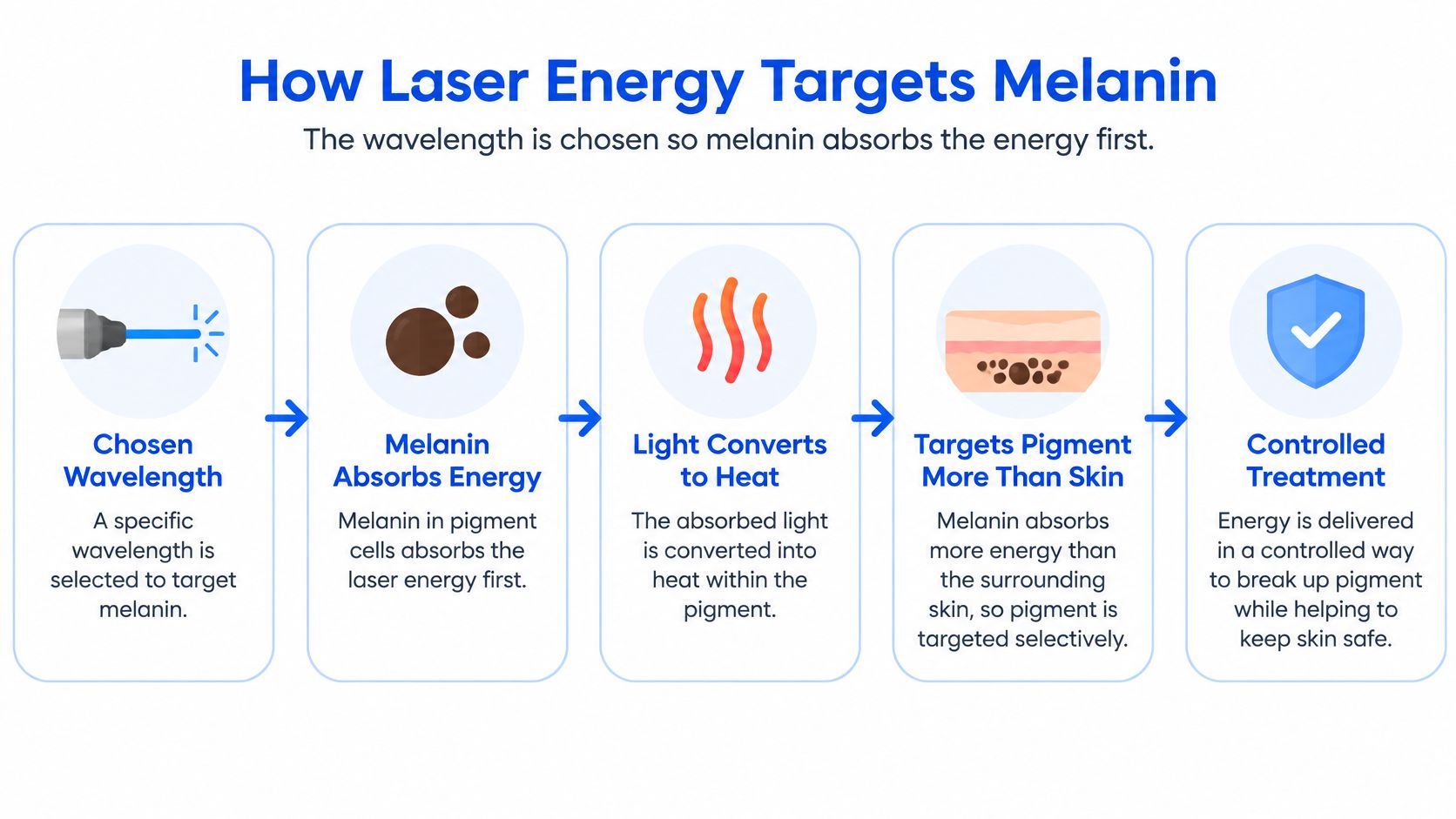
Depth and device terms
Wavelength affects how far light penetrates into the skin and how much epidermal melanin absorbs it. A 1064-nanometer Q-switched Nd:YAG laser reaches deeper and is commonly considered for dermal pigment and darker skin. Shorter wavelengths, including 532-nanometer frequency-doubled Nd:YAG and 694-nanometer ruby, are more suited to superficial epidermal pigment but can carry greater risk of post-inflammatory hyperpigmentation. The 755-nanometer alexandrite wavelength has intermediate penetration and may address pigment at different depths.
The device labels describe different ways of delivering or distributing energy, not interchangeable promises. Q-switched lasers deliver very short pulses; picosecond lasers deliver pulses in picoseconds. Fractional devices treat a pattern of microscopic zones rather than the entire surface uniformly. Intense pulsed light, also called broadband light, emits a range of wavelengths rather than one laser wavelength.
When a treatment is proposed, ask whether it's intended for epidermal or dermal pigment, how the pulse duration affects the surrounding skin, and why that approach fits your phototype. Those answers are more useful than choosing a device by name alone.
Matching Lasers to Each Pigment Problem
For a well-defined, benign spot, a clinician may consider a treatment that targets localized pigment. Melasma is different: it's diffuse and recurrent, so aggressive spot-style treatment may irritate skin without addressing why pigment keeps returning. Post-inflammatory hyperpigmentation also needs attention to its trigger. If acne continues, new marks can appear even after existing ones fade. For practical guidance on managing marks associated with breakouts, see this resource on dark spot advice for acne-prone skin.
| Approach | Best-fit concern | Main caution |
|---|---|---|
| Q-switched nanosecond lasers | Selected discrete pigment; low-fluence 1064-nm protocols may be considered for melasma | Settings and wavelength matter, and inflammation can worsen pigment |
| Picosecond lasers | Selected endogenous pigmentation | Evidence on safety varies across skin types and populations |
| Fractional lasers | Pigment concerns assessed alongside skin texture | Treating a broader pattern can still provoke irritation |
| IPL or BBL | Selected superficial, sun-related discoloration | These are pulsed-light approaches, not single-wavelength lasers; pigmentary risk can be higher in darker skin |
Evidence doesn't support treating all devices as equally effective for melasma. A meta-analysis found a significant reduction in melasma severity with low-fluence 1064-nanometer Q-switched Nd:YAG, while pooled lasers overall, picosecond lasers, and fractional lasers didn't significantly outperform control groups. A meta-analysis of laser approaches for melasma supports matching the intervention to the diagnosis rather than assuming a newer device will work better.
ProMD Health provides medically delivered laser treatments for pigmentation, resurfacing, and vascular concerns. Device availability can differ by office, so confirm what's offered at the location you plan to visit. A clinician may also consider chemical peels, Hydrafacial, or provider-selected medical-grade skincare if the skin is calm enough. To understand how light-based and laser treatments differ, review IPL versus laser treatment.
Safer Choices for Darker Skin Tones
A newer device isn't automatically a safer device. In Fitzpatrick IV–VI skin, more epidermal melanin can compete with the pigment being targeted. Shorter wavelengths and intense pulsed light can be absorbed more readily by surface pigment, which may increase the chance of dark or light patches after treatment. A review of laser safety considerations for darker skin discusses why wavelength, fluence, and treatment technique matter.
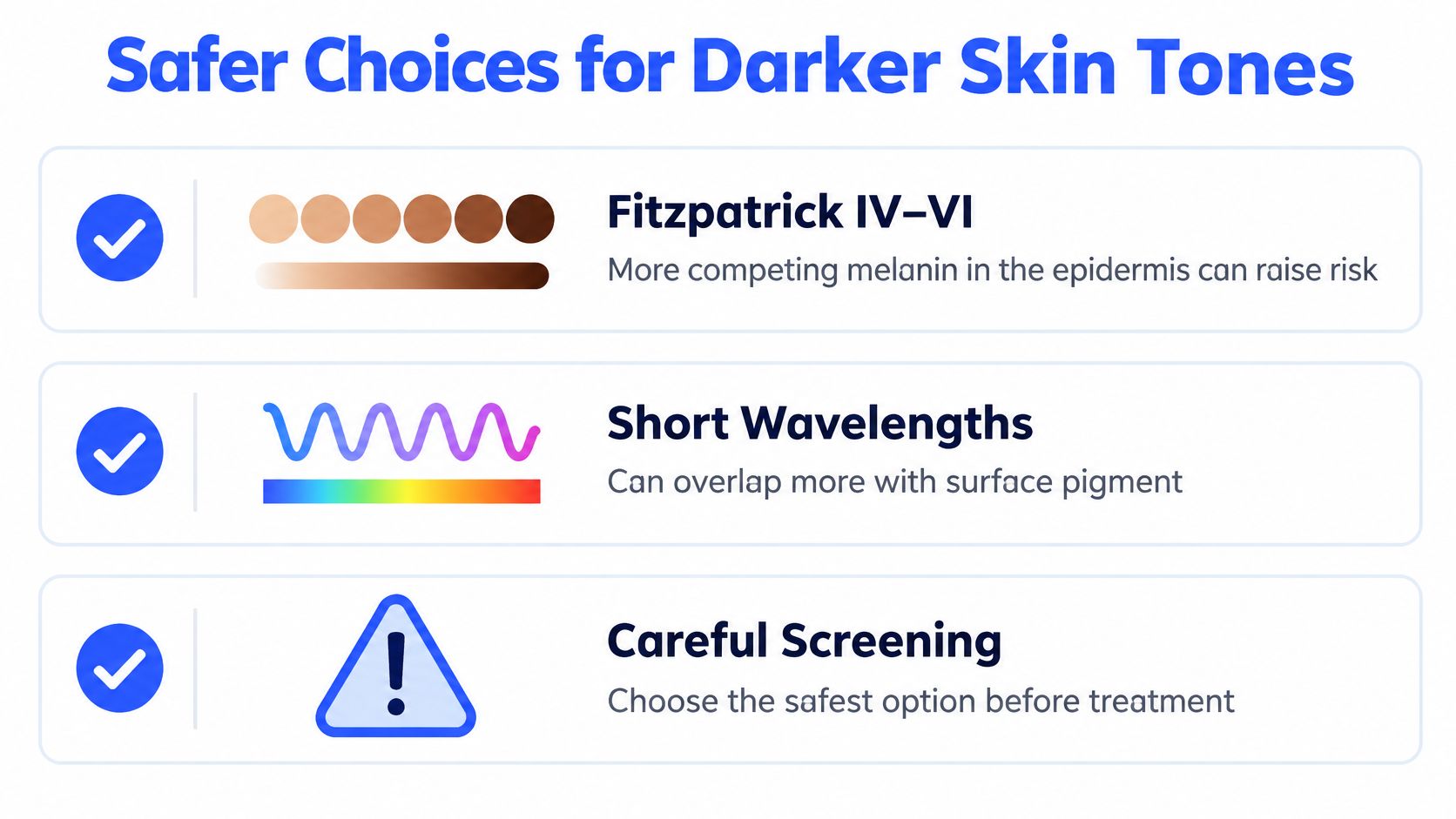
A 2025 scoping review of 77 studies identified recurrence, post-inflammatory hyperpigmentation, and hypopigmentation as recurring concerns, particularly in darker skin tones. It also summarized evidence that picosecond and nanosecond lasers had broadly comparable efficacy for endogenous hyperpigmentation, while picosecond devices showed lower pigmentary side effects. However, the strongest safety evidence came from Asian cohorts, so it doesn't establish equal safety for every phototype. The scoping review on laser treatment and skin of colour highlights the limits of generalizing across populations.
When it may be safer to wait
Active tanning, recent irritation, uncontrolled acne, an eczema flare, or melasma without consistent photoprotection and topical control can change the risk-benefit calculation. A clinician may recommend delaying a procedure until the skin is calmer and the underlying trigger is better managed.
Practical precautions can include a test spot, conservative energy settings, staged treatments, and avoiding unnecessary overlap. Ask which wavelength and pulse duration are being considered, how a test spot will be assessed, and whether topical care should come first. A guide to laser treatment considerations for darker skin can help you prepare questions for your consultation.
What Results Look Like by Diagnosis
For melasma, treatment protocols are often conservative and repeated rather than aggressive. In a study of 40 patients with Fitzpatrick skin types II–III, low-fluence 1064-nanometer Q-switched Nd:YAG treatment used a 6–8-millimeter spot, 1.7–3.2 J/cm² fluence, 2–8 passes, and nine sessions. Both melanin-index and modified Melasma Area and Severity Index scores improved significantly, with p < 0.0001 for each measure. A systematic review of low-fluence Q-switched Nd:YAG for melasma also cautions that too much accumulated energy can raise adverse-event risk and recurrence can occur within months.
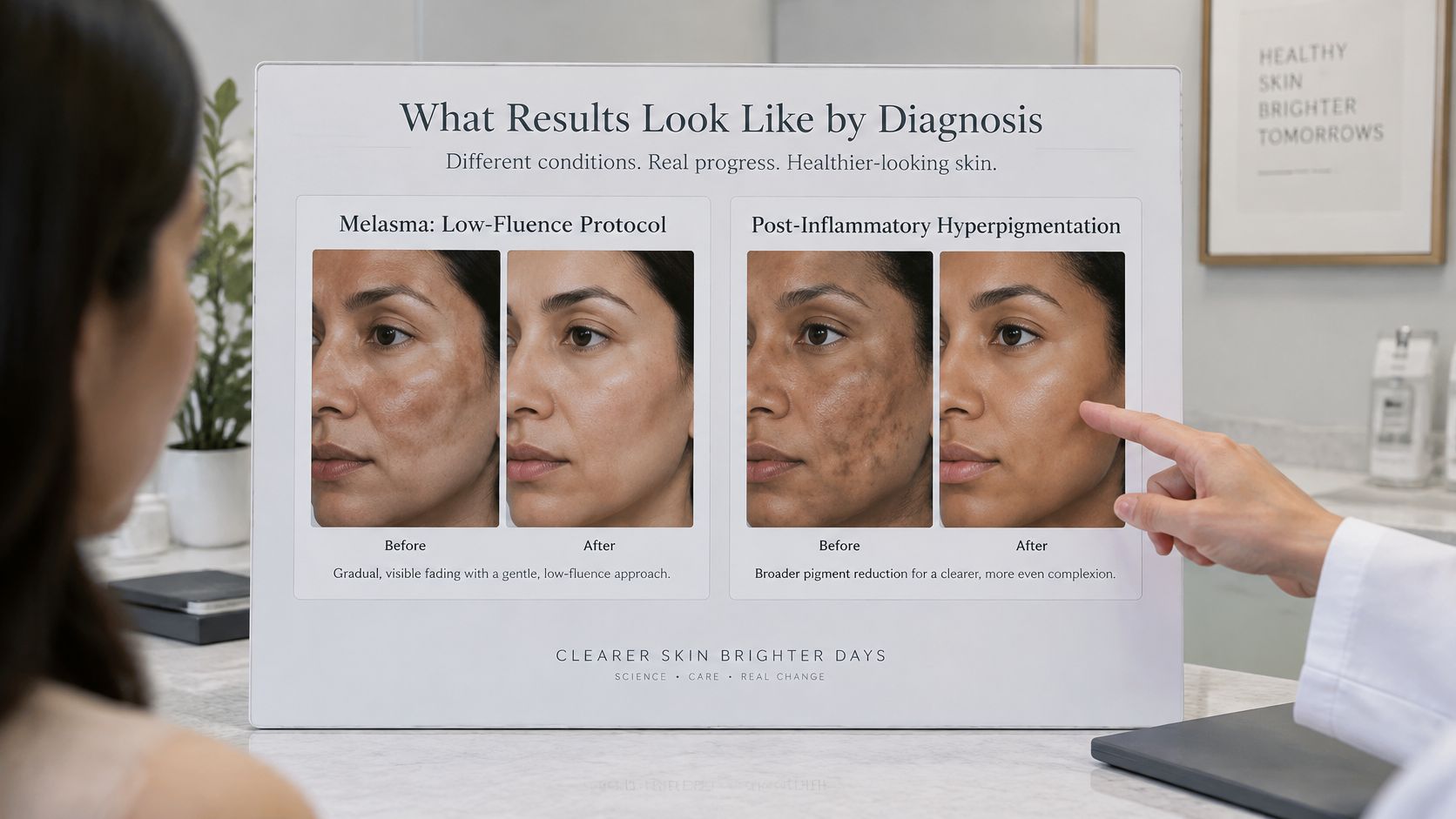
Post-inflammatory pigmentation shows why patients shouldn't assume that a series of sessions guarantees full clearance. A 2024 review of 48 studies involving 1,356 people reported that, among 227 who completed laser therapy, the average course was about four sessions. Among 165 with response data, 26% had complete pigment reduction, 66% partial reduction, and 33% no response; these categories can overlap because of study reporting and subgroup differences. The review of post-inflammatory hyperpigmentation treatments in skin of colour reported an average resolution time of about 140 days and average follow-up of eight months.
A separate review of 41 studies comprising 877 patients found complete response in 18.1% of 309 patients treated with laser or other energy-based devices. Poor or no response was also reported in 18.1%, while pigmentation worsened in 2.6%. These findings support an expectation of possible partial improvement, follow-up, and maintenance rather than a promise of complete clearance. For context on discoloration around the mouth, see this guide to hyperpigmentation around the mouth.
Care That Keeps Pigment From Returning
Laser treatment may address visible pigment, but it doesn't necessarily remove the conditions that made it appear. Melasma can recur, and post-inflammatory marks can form again if acne or dermatitis remains active. That's why daily care isn't just a finishing touch.
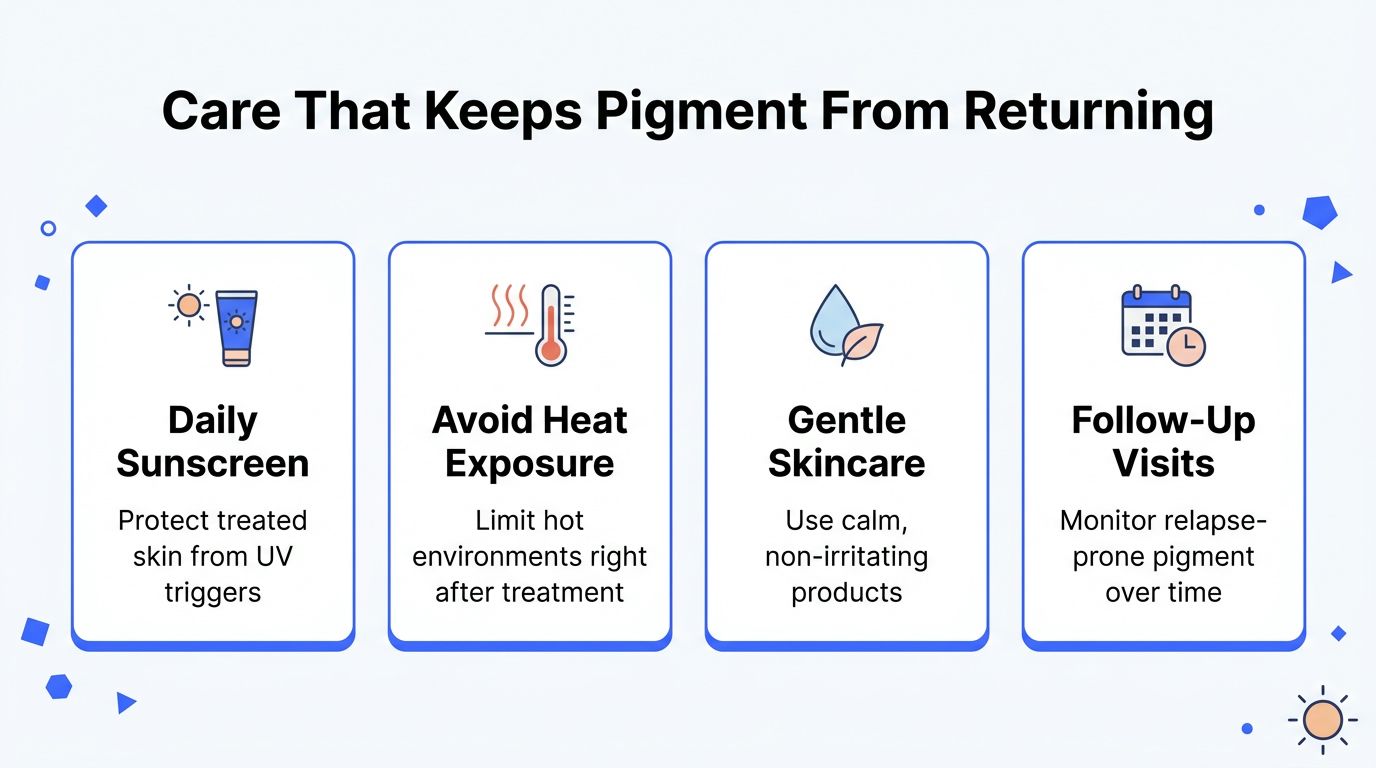
A 2025 clinical study in 100 Indian patients found that broad-spectrum sunscreen alone significantly improved melasma severity over 12 weeks. Sun protection can therefore be part of active care, not merely an aftercare note. For melasma, ask whether a tinted sunscreen containing iron oxides makes sense for visible-light protection, and follow the clinician's guidance on daily application and reapplication.
Build a routine around the cause
Avoiding excess heat and friction may help reduce avoidable irritation, especially soon after treatment. Use gentle products and ask when to restart pigment-suppressing topicals; irritating actives immediately before or after a procedure may not suit every plan. If acne or dermatitis triggered the marks, treating that condition is part of reducing the chance of new pigmentation.
A calm pre-treatment period matters, too. Don't arrive with a fresh tan, and tell the clinician about recent irritation or products that have caused a reaction. Agree on when topical treatments pause and resume, and when the skin should be reassessed.
Maintenance may include follow-up visits, topical care, or repeat treatment if pigment returns. A 2025 systematic review reported lower pigmentary adverse events with picosecond devices compared with nanosecond devices, while noting that evidence remains limited outside Asian populations. That finding doesn't make any one device a guarantee; diagnosis, phototype, and the maintenance plan still matter. Provider-directed skincare or peels may support ongoing care when appropriate.
How to Plan Laser Pigmentation Treatment
Before a consultation, identify the concern as clearly as you can: a distinct lentigo, melasma, or post-inflammatory pigment. Bring up your skin phototype, recent sun exposure or self-tanner, acne, eczema, and any prior reactions to lasers. This context helps the clinician decide whether treatment is appropriate now or whether the skin needs to be stabilized first.
Ask which wavelength and pulse duration are proposed, what pigment depth the treatment is intended to reach, and whether a test spot or staged sessions make sense. You can also ask what signs would prompt the clinician to pause or change the plan. If you're weighing aesthetic care alongside broader wellness options, this overview helps you compare medical wellness retreats.
ProMD Health offers laser treatment for pigmentation within a cash-pay model. Services aren't covered by insurance, so don't expect insurance coverage or reimbursement. Laser and light devices can vary by office, and availability should be confirmed for your location before booking.
To arrange a consultation, visit promdhealth.com and ask about pigmentation laser options, whether your skin is ready, and whether a peel, Hydrafacial, or provider-selected Skin Shoppe product belongs in your plan. Choose a diagnosis-matched, conservative approach with a maintenance routine, not simply the newest or most aggressive device.
ProMD Health offers medically delivered laser care for pigmentation, with treatment recommendations based on the concern and your skin. Visit ProMD Health to request a consultation and confirm which options are available at your location.


