You booked a laser package because you were tired of razor bumps, shadow, or stubborn discoloration. Then the machine was set up like every other skin type in the room, and your skin came home angry. That's the core issue with laser for darker skin, not that darker skin is “bad” for lasers, but that melanin-rich skin needs a different wavelength, a different endpoint, and a different level of restraint.
Table of Contents
- Why Darker Skin Needs a Different Laser Approach
- The Fitzpatrick Scale and What It Means for Treatment
- Which Laser Wavelengths Are Safest for Darker Skin
- Hair Removal and Pigmentation Treatment Protocols
- Tattoo Removal and Resurfacing on Darker Skin
- Understanding Pigment Risks and How to Manage Them
- Choosing a Qualified Provider for Skin of Color
- Key Takeaways and Common Questions
Why Darker Skin Needs a Different Laser Approach
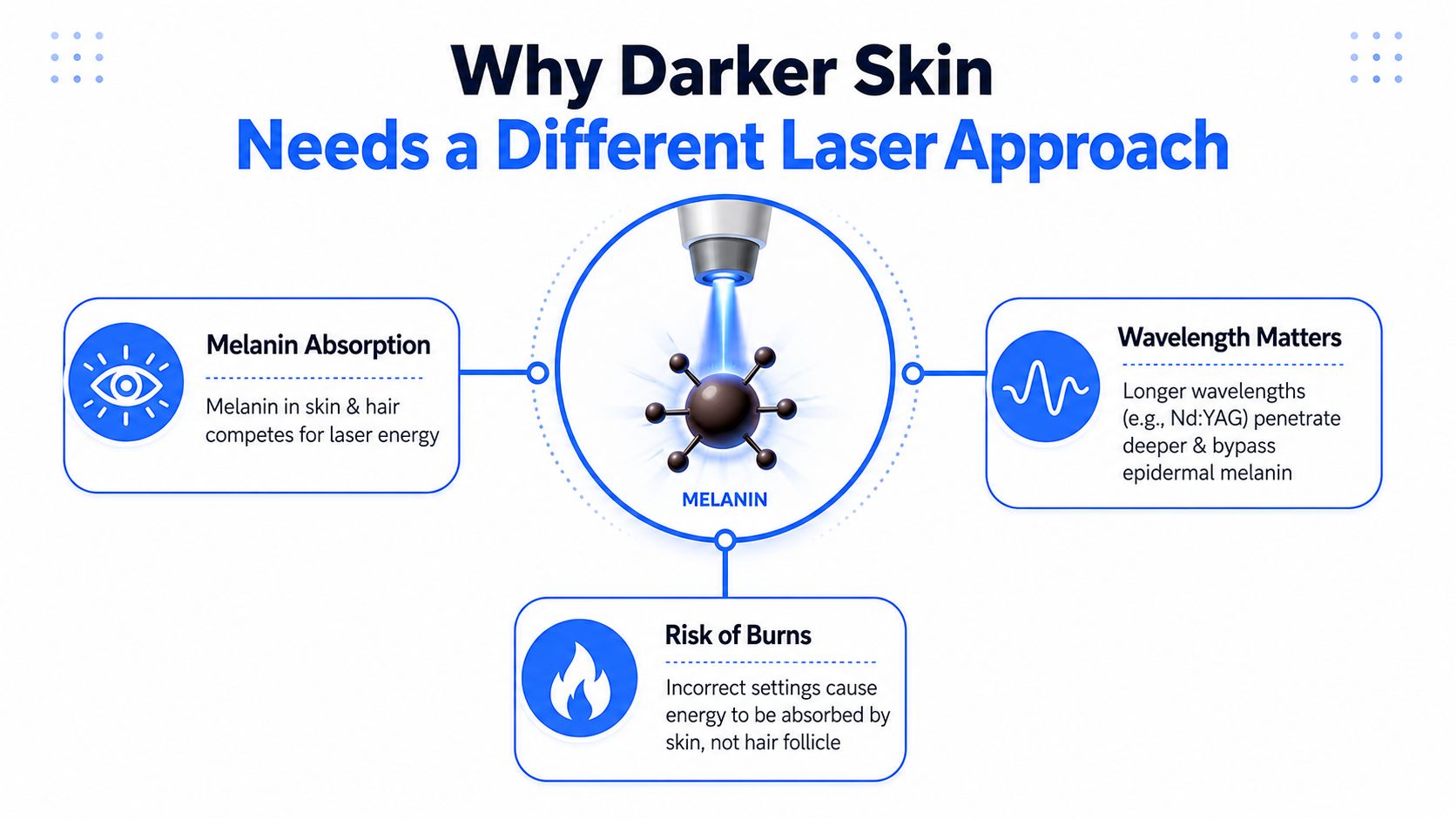
A patient with skin type V comes in for hair removal, gets treated with a shallow-targeting device, and leaves with a blistered patch that darkens for weeks. That outcome is usually a parameter mismatch, not a surprise. In darker skin, epidermal melanin competes with the intended target for laser energy, so the beam can heat the skin before it heats the follicle or pigment you wanted to treat PMC review on ethnic-skin laser practice.
Why the beam behaves differently
Shorter wavelengths are absorbed more strongly by epidermal melanin, which raises burn and dyspigmentation risk. That is why reviews of ethnic-skin laser practice identify 810 nm diode and 1064 nm Nd:YAG as the safer wavelength range for Fitzpatrick IV–VI skin PMC review on ethnic-skin laser practice. The deeper penetration of longer wavelengths improves the balance of heat delivered to the follicle versus the epidermis, so treatment can destroy the follicle with more epidermal sparing.
Practical rule: In darker skin, the device label matters less than whether the wavelength, pulse duration, cooling, and fluence are matched to the skin in front of you.
That is also why a one-size-fits-all approach fails. A setting that works cleanly on lighter skin can push melanin-rich skin past the threshold into excessive epidermal heating, and that is when you see blistering, scarring, and permanent dyspigmentation. The shift in safer practice has been toward longer wavelengths, lower-energy settings, epidermal cooling, and patch testing because conservative protocols reduce those risks PMC review on ethnic-skin laser practice.
For patients who are considering skin treatments beyond hair removal, ProMD Health face rejuvenation laser treatment follows the same principle, matching settings to skin response instead of relying on a single standard protocol.
The Fitzpatrick Scale and What It Means for Treatment
The Fitzpatrick scale is a practical way to think about how skin is likely to respond to laser energy. It isn't a label for race, and it isn't just about tone, it's about how much melanin sits in the skin and how reactive that skin tends to be under heat and light. Two people from the same background can land in different categories, which is why careful evaluation matters more than assumptions.
Reading your skin type in everyday terms
Types I and II usually burn easily and tan poorly or lightly. Types III and IV sit in the middle, with a mix of burn and tan behavior. Types V and VI have more baseline pigment, tan thoroughly, and need the most conservative approach because melanin can absorb treatment energy before the target does.
A good consultation should feel specific. The provider should ask about previous burns, pigment changes, scars, and how your skin healed after waxing, peels, or other procedures. If you've ever had a dark mark linger after irritation, that history matters because it signals post-inflammatory hyperpigmentation risk, even when the laser itself is technically appropriate.
Why the scale changes the consultation
A test spot isn't a delay tactic, it's the safest way to see how your skin responds before committing to a full area.
That's the true value of the scale in practice. It helps a provider decide whether to use longer wavelengths, how aggressive to make the settings, how much cooling to use, and how long to wait between sessions. It also helps separate “safe enough in theory” from “safe for your actual skin once it's under stress.”
The key point is simple, honest skin typing leads to safer dosing. When a clinic rushes past the consultation and talks only in package terms, it's usually skipping the most important part of treatment planning.
Which Laser Wavelengths Are Safest for Darker Skin
A patient with darker skin can be a good laser candidate when the wavelength and protocol fit the skin, but the wrong setup can create avoidable pigment trouble. The safer conversation starts with melanin absorption, not with a device brand. Reviews focused on ethnic skin state that the 800 to 810 nm diode and especially the 1064 nm Nd:YAG sit at the safest end of the range for Fitzpatrick IV–VI, while IPL is not recommended for hair removal in types V–VI because of hyperpigmentation risk British Journal of Dermatology review. That is the practical hierarchy I use in clinic.
The device families at a glance
| Laser Wavelengths and Darker Skin Compatibility | Best For | Skin Types IV–VI Safety |
|---|---|---|
| 1064 nm Nd:YAG | Hair removal, some pigment concerns | Preferred first-line choice |
| 810 nm diode | Hair removal | Strong safety record |
| IPL | Broad cosmetic use in lighter skin | Not recommended for hair removal in V–VI |
| Q-switched lasers | Tattoo and selected pigment treatment | Useful with strict limits |
| Non-ablative fractional lasers | Texture and resurfacing | Favorable with caution |
The reason 1064 nm Nd:YAG stays at the top is straightforward. The longer wavelength passes through more of the epidermal melanin and reaches deeper targets with less competition from surface pigment. In darker skin, that makes it the workhorse for laser hair removal, and it is also why clinicians often choose it for carefully selected pigment work.
The 810 nm diode is a solid alternative when the operator understands conservative settings and cooling. IPL is the one I approach most cautiously in deeper skin, especially for hair removal, because broad-spectrum light creates too much overlap with epidermal melanin. Q-switched lasers can have a role for tattoos and selected pigment problems, but only with strict control of energy delivery. Non-ablative fractional lasers can help with texture and acne scarring, and reviews describe them as a favorable option for Fitzpatrick IV to VI, though the evidence is thinner in types V and VI fractional resurfacing review.
For a general skin-rejuvenation discussion, a clinic's face rejuvenation laser treatment overview can help show how different wavelengths are used in cosmetic practice. Even so, the safety question in darker skin still comes back to wavelength, heat, and the treatment endpoint. A device can be technically excellent and still be the wrong choice for a melanin-rich patient if the protocol is too aggressive.
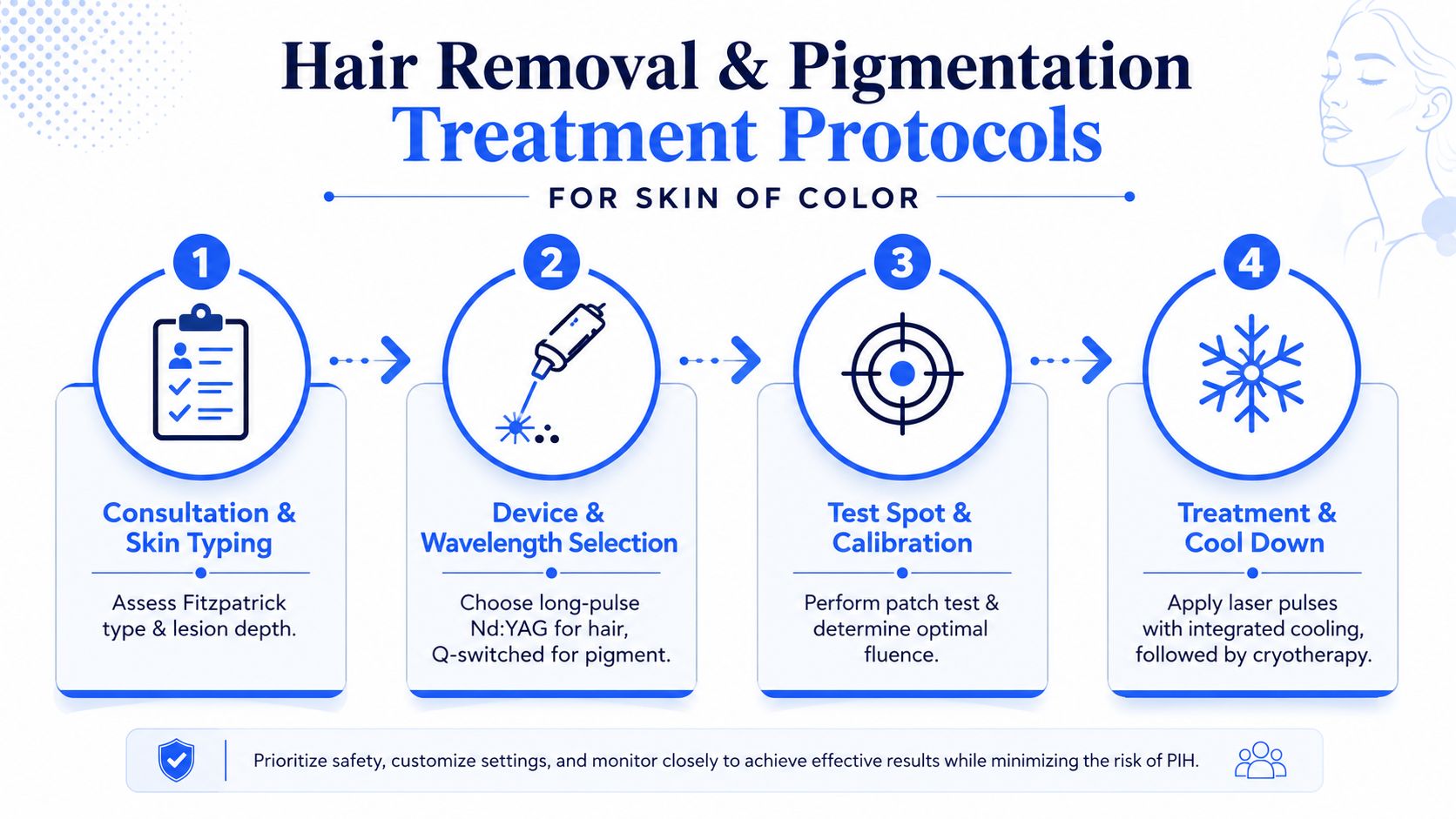
Hair Removal and Pigmentation Treatment Protocols
For darker skin, protocol matters as much as device choice. A hair-removal session starts with the right wavelength, but the result depends on how the clinician sets the pulse, fluence, spot size, and cooling. The preferred first-line option for laser hair removal is the 1064 nm long-pulsed Nd:YAG, used with longer pulse durations, lower fluence, larger spot sizes, and continuous cooling Nd:YAG hair removal protocol. The safety endpoint is immediate perifollicular edema and erythema, not epidermal whitening or graying, which usually means the skin has been overheated.
What a conservative hair removal visit looks like
A good session often begins with a test spot or a careful calibration pass. If the skin responds well, the clinician may increase fluence at later visits, but only after prior treatments settle without excess redness, blistering, or pigment change. That slower progression is part of the protocol, not a sign that the treatment is weak.
Preparation also matters. Patients who are planning treatment should review how to prepare for laser hair removal before the first visit, because shaving habits, sun exposure, and recent irritation can change how the skin reacts on treatment day.
For pigmentation problems, the target is different. The literature on darker-skin PIH shows that laser can be effective, and in some included cases it was the only option that achieved complete clearance, but repeated procedures can also induce PIH at a rate of 11% to 17% 2024 PIH systematic review. That is why low-fluence, carefully selected approaches are standard. Faster treatment usually means more heat, and more heat means more pigment risk.
Older expert guidance also noted 4% hydroquinone plus 0.1% tretinoin for at least 6 weeks before resurfacing in dark-skinned patients, which shows how long clinicians have tried to lower pigment risk before introducing heat-based devices 2024 PIH systematic review.
Provider rule: If the skin turns chalky, white, or gray during a hair-removal pass, the setting is too hot for that patient.
For pigmentation work, the treatment goal is controlled inflammation, not aggressive resurfacing. In practice, that means the device choice, the fluence, the pulse duration, and the number of passes all have to match the patient's Fitzpatrick type and their tendency to form post-inflammatory change. In darker skin, the right protocol is often the difference between clearing pigment and creating a new problem.
Tattoo Removal and Resurfacing on Darker Skin
A patient with darker skin who wants a tattoo removed often needs a different plan than someone with lighter skin. Q-switched Nd:YAG at 1064 nm remains the main workhorse because the longer wavelength reduces competition with epidermal melanin while still targeting ink effectively. Even with that advantage, conservative fluence and wider spacing between sessions matter, because the skin still has to recover from each inflammatory hit.
Why resurfacing needs a different lens
Resurfacing falls into two broad categories. Ablative fractional lasers create more thermal injury and carry more pigment risk, especially in types V and VI. Non-ablative fractional lasers are the safer resurfacing option in darker skin, and reviews have described them as favorable for Fitzpatrick IV to VI, with acne-scarring use reported as safe and effective in that range nonablative fractional resurfacing review.
That does not mean resurfacing is low stakes. It means the treatment has to be chosen for the person, not the marketing headline. A stronger setting is not a better one if the skin is likely to respond by making more pigment.
The practical question is depth and inflammation. Tattoo ink sits deeper than many pigment problems, so the device has to reach it without heating the surrounding skin too aggressively. Texture work, by contrast, may be better handled with fractional non-ablative energy that stimulates remodeling without stripping the surface.
For patients comparing options, a direct question helps keep the discussion honest, “How much pigment risk am I accepting for how much visible change?” That keeps the conversation grounded, and it also makes it easier to judge whether a clinic is trying to deliver durable results or just chasing a quick response. For broader planning around discoloration, treating hyperpigmentation in darker skin often starts with the same principle, matching the energy source to the skin's tolerance rather than pushing for the fastest endpoint.
A patient asking about correction for a bad tattoo may also be trying to decide how much improvement is realistic before committing to repeated sessions. In those cases, the Denver's think tank tattoo cover-up guide can be a useful reference point for thinking through options before laser is chosen.
Understanding Pigment Risks and How to Manage Them
A patient can do everything “right” and still end up with a pigment change after laser. In darker skin, that risk is real, and the main complications are post-inflammatory hyperpigmentation, hypopigmentation, burns, blistering, scarring, and rebound of melasma or other dyschromias. The goal is to lower the odds with the right device, the right interval, and aftercare that does not keep the skin irritated.
What causes the problem
The problem is usually cumulative irritation. Skin that is treated too often, or pushed too hard each time, has less time to settle before the next thermal hit. Reviews of darker-skin laser practice warn against high energy settings, pulse stacking, short wavelengths, and short treatment intervals, and they also caution against overly frequent low-fluence Q-switched sessions, including weekly-style overuse patterns pigment-complication prevention review. In practice, the risk rises when the endpoint is too aggressive for the amount of melanin in the skin.
What actually helps
- Sun protection matters most: UV exposure after treatment can turn a manageable recovery into a pigment problem.
- Gentle aftercare matters too: Harsh scrubs, active irritation, and over-exfoliation can keep the skin inflamed.
- Patch testing gives real information: A small trial area often shows whether the skin can tolerate the plan.
- Spacing sessions well reduces risk: The skin needs time to settle before the next thermal stimulus.
The best aftercare is boring. Calm skin, sunscreen, no picking, no rushing back to the next session too soon.
If pigment does flare, it usually needs a structured response rather than panic. That can mean topical support, tighter sun protection, and pausing further energy-based treatment until the skin quiets down. For a patient-friendly companion piece on camouflage and correction strategies, Denver's think tank tattoo cover-up guide is a helpful resource for understanding how people think through unwanted ink before choosing a removal plan Think Tank Tattoo guide.
A practical medical reference for discoloration management is treating hyperpigmentation in darker skin, especially when the skin has already shown that it responds by making more pigment. The conversation shifts from “Can I do laser?” to “How do I keep laser from becoming the trigger?”
Choosing a Qualified Provider for Skin of Color
A patient with darker skin can walk into two clinics and hear the same promise, “We do laser here.” That tells you almost nothing. The provider who is prepared for skin of color can explain which wavelength, which fluence, which pulse duration, which cooling method, and how those choices change the risk of PIH, blistering, or undertreatment.
The first consultation should sound practical, not promotional. If the explanation stays vague, the protocol is probably vague too, and darker skin pays for that vagueness.
Questions that should get real answers
- Which device will you use? Ask for the actual wavelength, not a general “laser” answer.
- How do you adjust settings for Fitzpatrick IV–VI? The answer should mention conservative fluence, pulse timing, and cooling.
- Do you patch test darker skin? If not, that is a red flag.
- How do you space treatments? Skin of color usually does better with more caution, not faster cycling.
- What happens if pigment changes after treatment? A qualified provider should have a plan before the first pulse is fired.
Green flags and red flags
A board-certified medical director and clinicians who routinely treat melanin-rich skin are strong green flags. Before-and-after photos that match your skin tone and your concern are another. If a clinic only shows light-skin results, you are being asked to trust extrapolation instead of experience.
The red flags are just as clear. One-size-fits-all packages, refusal to do a test spot, and claims that every skin tone can tolerate the same settings usually point to a clinic that has not built a real protocol for darker skin. In laser work, the consultation is part of the safety mechanism, because the right plan depends on the skin in front of the provider, not on a generic menu.
If you are comparing options for pigment concerns, the discussion should include treating hyperpigmentation on melanin-rich skin in plain language before any device is turned on. One option in a multi-service practice, ProMD Health, includes laser hair removal and other laser-based aesthetic care, but the deciding factor is still the protocol used on your skin.
Key Takeaways and Common Questions
The safest laser for darker skin is rarely about the most powerful machine. It's about longer wavelengths, lower energy, careful cooling, and a provider who respects pigment biology. For hair removal, 1064 nm Nd:YAG is the first-line choice in darker skin, and for many pigment or resurfacing concerns, the safer path is a conservative protocol rather than an aggressive one.
Quick answers patients usually still want
How many sessions will I need?
That depends on the target, the body area, hormone status, and how your skin responds. The more pigment-sensitive the skin, the more important it is to pace the plan rather than rush it.
Is the result permanent?
Laser hair removal usually produces long-term reduction, not a one-and-done cure. Some people need maintenance, especially when hormones, body area, or hair thickness keep driving regrowth.
What if I get darker after treatment?
Pause further sessions, protect the area from sun, and contact the provider who treated you. In darker skin, PIH can happen, and early response matters.
Can melasma flare after laser?
Yes, and that's why melasma needs careful selection, conservative dosing, and realistic expectations. It's not a simple yes-or-no treatment decision.
What's the safest mindset going in?
Ask about the wavelength, the endpoint, and the recovery plan. If the clinic can't answer those clearly, keep looking.
For patients who want a medically supervised, skin-of-color-aware starting point, contact ProMD Health to ask about consultation options, laser hair removal, and whether your skin is a good match for treatment.