You catch it in regular light first. The skin around your mouth looks a little more etched in. Makeup doesn't sit the same way on your cheeks. Old acne marks seem more obvious, and the brightness you used to get from a good night's sleep doesn't fully come back anymore.
That's usually the moment people start searching for a face rejuvenation laser treatment. Not because they want to look like someone else, but because they want their skin to reflect how they still feel.
Topicals matter, and good skincare absolutely helps. But there's a point where creams can only do so much on the surface. If you're already thinking about addressing signs of aging for firmer skin, the next question is whether laser treatment can do something deeper. In many cases, it can. The reason is simple. Laser treatments work by deliberately triggering repair inside the skin, where collagen structure and texture change happen.
A good laser plan isn't just about one appointment. It's about matching the right device, depth, timing, and recovery to your skin goals. It's also about knowing when laser should stand alone and when it should be combined with injectables, regenerative treatments, or a stronger home routine.
Table of Contents
- Introduction The Modern Answer to Timeless Skin
- How Laser Skin Rejuvenation Works
- Types of Lasers and What They Treat
- Your Laser Treatment Journey From Consultation to Recovery
- Are You a Good Candidate for Laser Rejuvenation
- Maximizing Your Results with an Integrated Approach
- How to Choose Your Laser Treatment Provider
Introduction The Modern Answer to Timeless Skin
Individuals rarely inquire about lasers because of one wrinkle. They ask because several things start happening at once. Skin feels rougher. Pores look more visible. Fine lines turn into lines that stay even when your face is resting. Sun damage, redness, or old scars seem to sit on top of everything else.
That mix of concerns is exactly why face rejuvenation laser treatment has become such an important option in aesthetic medicine. It doesn't just coat the skin or briefly tighten it. It creates a controlled injury so the skin repairs itself in a more organized, healthier way. That's the key idea. The skin isn't being fooled. It's being prompted to rebuild.
Why people often feel stuck before they consider laser
Many patients arrive after trying serums, facials, peels, or at-home devices. Those can be useful, but they often fall short when the main problem is deeper texture change, etched lines, visible pore changes, or acne scarring.
A laser can target those concerns more directly because it reaches beyond the very top layer of skin. Some systems remove damaged surface tissue. Others heat deeper layers while keeping the surface more intact. The treatment plan depends on what bothers you most and how much downtime fits your life.
Healthy-looking skin isn't just about brightness. It's about smoother texture, more even tone, and stronger support underneath the surface.
What a thoughtful plan looks like
A smart rejuvenation strategy starts with diagnosis, not device shopping. Two people can both say, “I want younger-looking skin,” while needing very different plans. One may need resurfacing for crepey texture. Another may need pigment treatment, volume support, and stronger home care.
That's why a laser discussion should always include these questions:
- What is the dominant issue: texture, pigment, laxity, scars, or lines?
- How much recovery can you realistically manage: a few days, or longer social downtime?
- Are there risk factors for pigment change: especially if your skin is prone to post-inflammatory discoloration?
- Will laser be enough on its own: or will the result look more natural if it's paired with other treatments?
Patients usually feel more comfortable once they understand that laser isn't random heat. It's targeted skin remodeling with a purpose.
How Laser Skin Rejuvenation Works
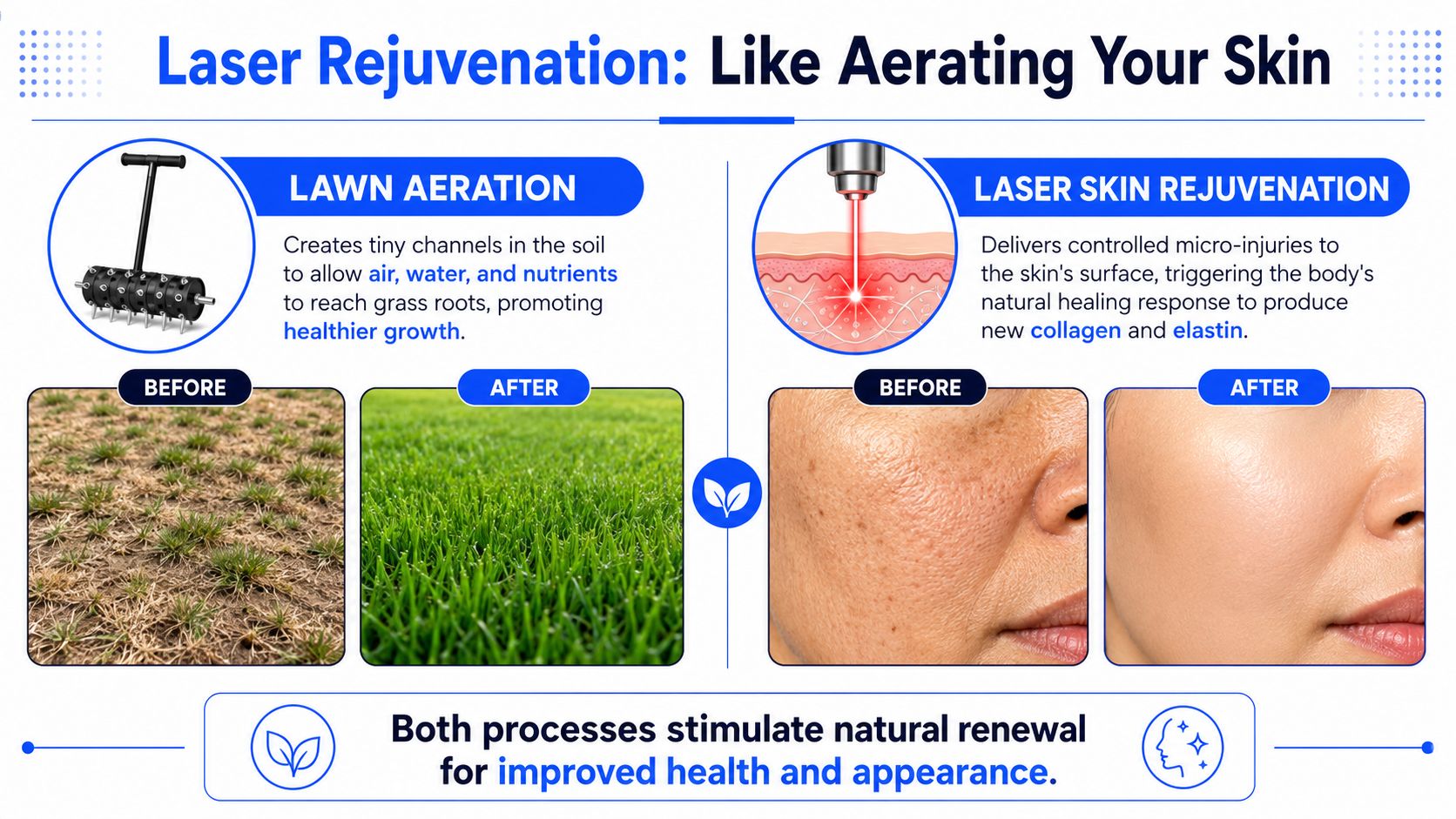
The easiest way to understand laser rejuvenation is to think about lawn aeration. When a lawn is compacted and dull, you don't paint it green. You create small channels so the grass can regrow in a healthier way. Laser treatment works on a similar principle. It creates controlled zones of injury so the skin can replace damaged tissue and produce fresher support fibers.
Here's a visual way to think about that process.
Why collagen matters
Collagen is part of the skin's structural framework. When that framework weakens, the surface starts showing it. Lines look deeper, texture looks looser, and scars appear more noticeable because the skin doesn't reflect light evenly.
Lasers use focused energy to trigger a repair response. That response tells the skin to remodel. Over time, the treated area can look smoother and firmer because the underlying support has changed, not just the surface shine.
A common point of confusion is that the glow you see early isn't the whole result. Some improvement can appear fairly quickly, but the more meaningful change comes from remodeling that continues after the appointment.
Ablative and nonablative in plain English
The most important distinction is between ablative and nonablative treatments. Clinical guidance explains that ablative lasers such as CO2 and Er:YAG remove epidermal tissue and heat the dermis to stimulate new collagen, while nonablative systems heat tissue without destroying the surface, usually with less downtime and more gradual results that often require 4 to 6 sessions according to this clinical review of ablative and nonablative resurfacing.
A simple comparison helps:
| Treatment type | What it does | Best fit | Tradeoff |
|---|---|---|---|
| Ablative | Removes surface tissue and remodels deeper skin | Deeper lines, acne scars, stronger texture change | More recovery |
| Nonablative | Heats deeper skin while preserving the surface | Mild wrinkles, pigment concerns, maintenance | Results are subtler and build gradually |
Practical rule: The more dramatic the resurfacing, the more recovery planning matters.
Neither category is automatically “better.” The right choice depends on your skin problem, skin tone, risk profile, and schedule. Someone treating etched acne scars may accept more downtime for stronger change. Someone preparing for a busy month may choose a gentler series instead.
Types of Lasers and What They Treat
Patients often ask for “the best laser,” but that isn't really the right question. The better question is, “Best for what?” A laser chosen for deep wrinkles won't necessarily be the best match for pigment maintenance or early texture changes.
This diagram helps map common concerns to laser-based strategies.
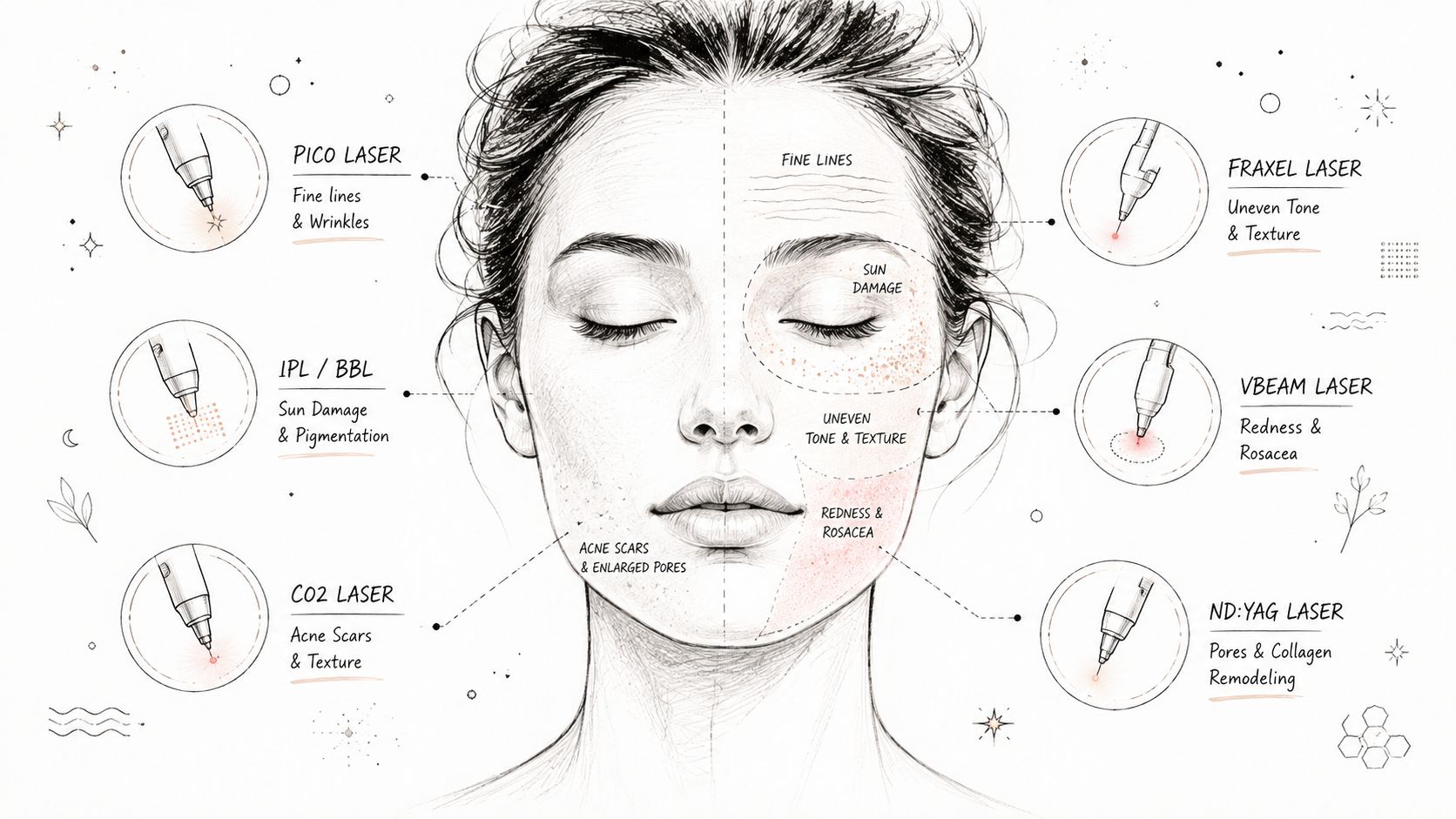
When the main problem is texture and lines
If your biggest complaint is etched-in texture, acne scarring, or visible wrinkling, stronger resurfacing devices usually make the most sense. Fractional CO2 is one of the best-known examples in this category. Clinical data summarized in this fractional CO2 outcomes overview reports 70% to 85% reduction in fine-line depth after three sessions and 30% to 40% increases in dermal collagen density.
That doesn't mean every patient needs CO2. It means CO2 sits in the category of treatments used when you want a more meaningful structural reset.
If you're curious how clinics think about platform capabilities and treatment design, this overview of advanced CO2 laser solutions for clinics gives useful context on why certain systems are selected for resurfacing work.
When the main problem is tone or maintenance
Not every aging concern comes from deep textural damage. Some people mainly see uneven tone, diffuse redness, enlarged pores, or a tired overall look. In those cases, lower-downtime resurfacing or hybrid approaches may fit better than aggressive full resurfacing.
A practical example is a patient whose skin looks blotchy and rough but who can't take extended time away from work. That patient often does better with a staged approach. Improvement builds over a series rather than from one intense treatment.
For readers comparing options, Halo laser skin resurfacing is one example of a resurfacing category used for patients who want rejuvenation while balancing improvement with recovery.
Why the same face may need more than one approach
Faces don't age in one pattern. The cheeks may have sun damage, the upper lip may have fine lines, and the jawline may be showing early volume change. That's why a full-face plan often mixes strategies instead of relying on a single device.
Consider this concern-to-treatment logic:
- Deep acne scars or stronger wrinkling: A more aggressive resurfacing tool is often considered because the skin needs visible remodeling.
- Milder texture and maintenance goals: Lower-intensity or staged treatments are often more realistic.
- Uneven pigment or mixed concerns: The provider may prioritize safer, gradual correction rather than chasing one dramatic session.
The right laser is the one that matches the biology of your problem, not the one with the most impressive name.
Your Laser Treatment Journey From Consultation to Recovery
Many people delay treatment because the unknown feels bigger than the procedure itself. Once the process is broken down, it usually feels much more manageable.
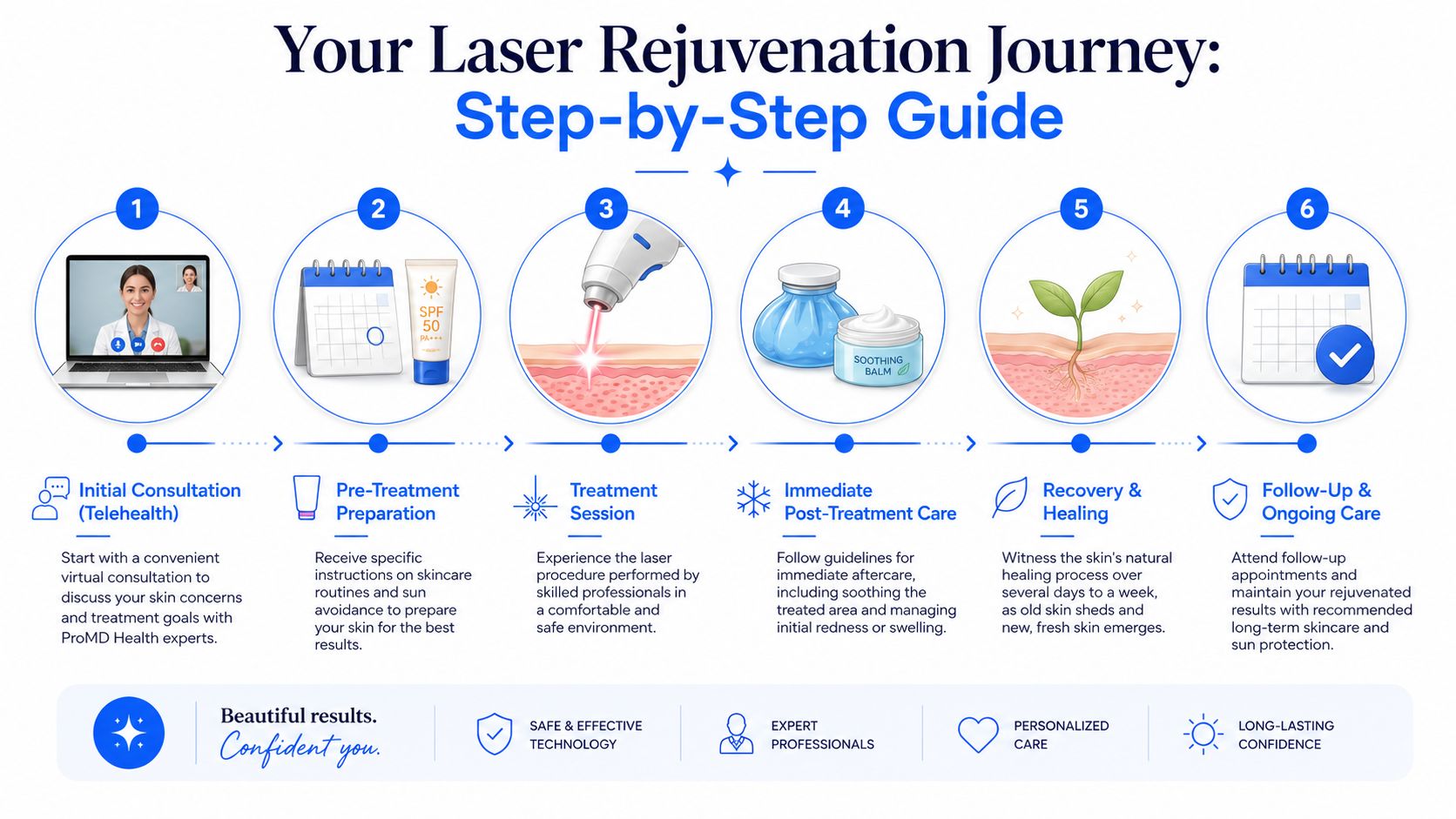
What happens before treatment day
The first visit should focus on your skin history, goals, recent sun exposure, and whether you've had pigment changes after past treatments or inflammation. A careful consultation also looks at your schedule. There's no point choosing a treatment with visible downtime if you have important events right after.
Pre-treatment instructions matter because they reduce avoidable irritation. Patients are often told to simplify their skincare, avoid unnecessary sun exposure, and follow a specific plan before treatment. The details vary, so it helps to review formal pre and post care treatment instructions before your appointment.
What treatment day feels like
Cleveland Clinic reports that a partial-face laserabrasion typically takes 30 to 45 minutes, while a full-face treatment takes about 1.5 to 2 hours. Healing commonly ranges from 5 to 21 days depending on the laser and condition treated, and nonablative treatments often allow patients to resume usual activities right away, as outlined in this laser resurfacing procedural guide.
Patients often ask whether it hurts. The honest answer is that it feels different depending on the device and depth. Some treatments feel warm and prickly. Others feel more intense and require stronger comfort measures. During the visit, the skin is typically cleansed, protected, treated in zones, and then covered with soothing post-care products.
What recovery really looks like
Recovery has two parts. The first is the visible phase, when skin may look red, swollen, bronzed, or flaky. The second is the quieter remodeling phase, when the skin continues rebuilding after you already look presentable again.
A simple way to think about early aftercare:
- Protect the barrier. Use the products and cleansing routine you were given.
- Avoid friction. Don't scrub, pick, or “help” peeling skin come off.
- Respect the sun. Freshly treated skin is more vulnerable to pigment issues.
- Be patient with timing. Improvement rarely arrives all at once.
Most laser anxiety comes from not knowing what's normal. Redness, swelling, shedding, and sensitivity can all be part of a normal recovery pattern when they match the expected plan for your treatment.
Are You a Good Candidate for Laser Rejuvenation
The best candidates usually have a clear complaint and realistic expectations. They aren't chasing perfection. They want healthier-looking skin, smoother texture, softer lines, more even tone, or improvement in scars and sun damage.
Signs you may be a strong candidate
You may be a good fit if your concerns are primarily skin quality issues rather than only sagging or facial volume loss. Laser is especially useful when the skin surface itself needs help. Think roughness, crepiness, fine wrinkling, acne scar texture, or visible photodamage.
The right candidate also understands tradeoffs. If you want more correction, you may need more recovery. If you want minimal downtime, results may build more gradually.
A helpful self-check:
- You want texture improvement. Laser tends to help more than products alone when the issue is structural.
- You can follow aftercare. Healing goes better when patients are consistent.
- You can avoid unnecessary sun exposure. This is one of the most important parts of protecting the result.
- You're open to a staged plan. Some skin responds best to several sessions or combination treatment.
When caution matters more than enthusiasm
This is where honesty matters. Not every patient should jump into the strongest resurfacing option. Mayo Clinic notes that the ASPS specifically warns patients with darker skin to be cautious because the wrong device or settings can worsen pigmentation. That's why candidate selection, test spots, and lower-energy or nonablative protocols can be so important for safety, as explained in this guidance on laser resurfacing and pigmentation risk.
That point gets overlooked online. “Laser for everyone” sounds simple, but it isn't responsible advice. If your skin is prone to melasma, post-inflammatory hyperpigmentation, or prolonged discoloration after irritation, your plan should be more conservative and much more personalized.
Sometimes the safest recommendation is to delay treatment, prep the skin first, or choose a different category of rejuvenation altogether. A careful provider should be willing to say that.
Maximizing Your Results with an Integrated Approach
Laser can improve skin quality beautifully, but it doesn't solve every part of facial aging. If hollowing, muscle-driven expression lines, or chronic inflammation are also part of the picture, the best outcome usually comes from treating those issues directly instead of expecting one procedure to carry the whole result.
This visual captures that bigger-picture approach.
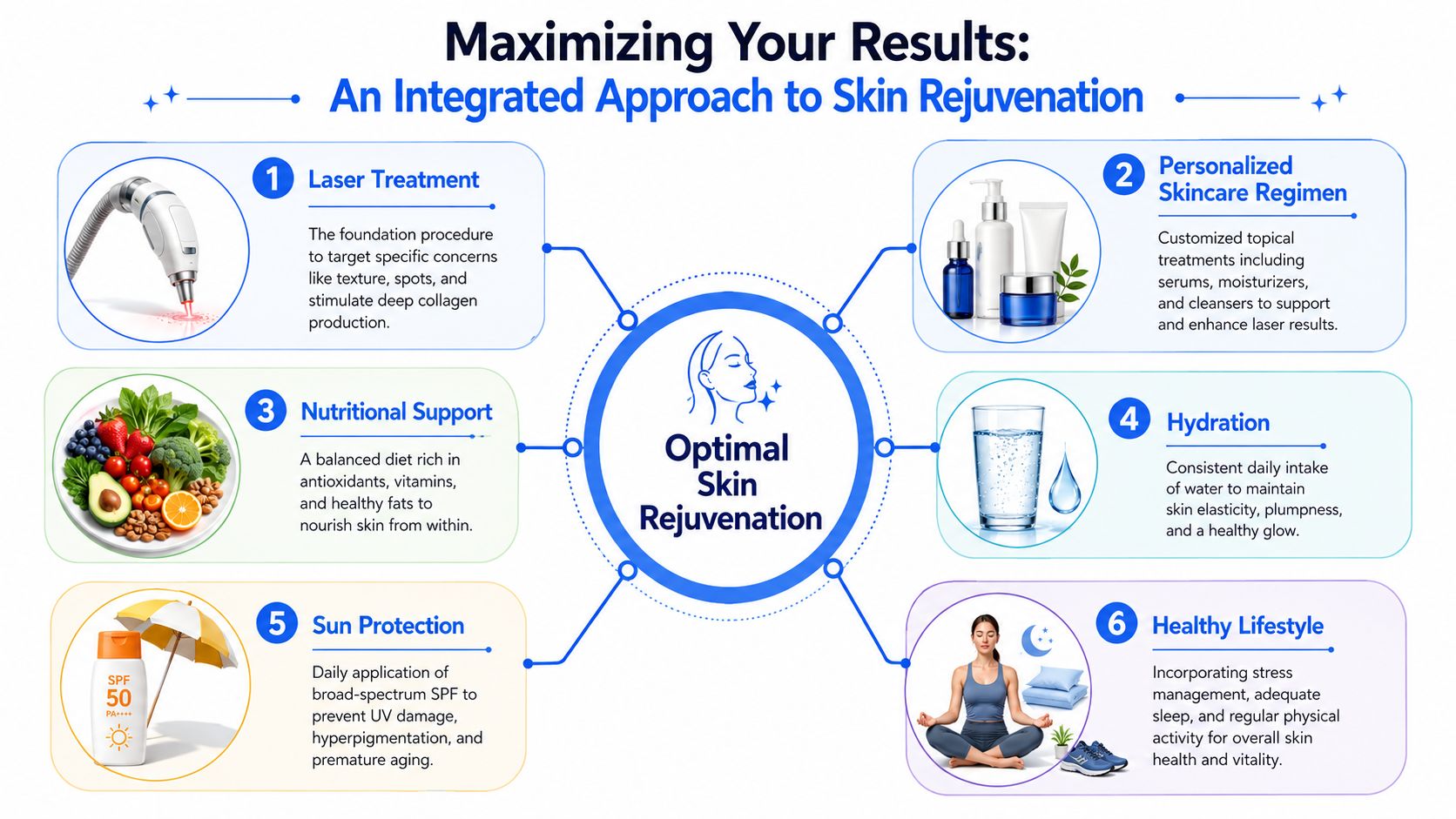
What laser can fix and what it can't
Laser is strongest when the problem lives in the skin itself. It can help with texture, surface irregularity, certain fine lines, and visible photodamage. It is not the main answer for every age-related change.
A simple example makes this easier to understand. If your skin is smoother after laser but your cheeks still look deflated, the face may still read as tired. If your forehead lines are caused by movement, resurfacing alone may not soften them the way a neuromodulator plan would. If healing support is the priority, regenerative options may have a role.
Building a complete rejuvenation plan
An integrated plan often combines several layers of care:
- Laser for resurfacing: used when the surface needs remodeling.
- Injectables for shape or movement: helpful when volume loss or expression lines are part of the concern.
- Regenerative support: sometimes used when improving healing response and collagen support is part of the strategy.
- Daily skincare: essential for maintaining gains between office treatments.
- Sun protection: non-negotiable if you want the result to last.
For readers interested in how regenerative care can fit into a broader skin plan, this guide to PRP microneedling and skin rejuvenation is a useful reference point.
A refreshed face usually comes from layering the right treatments in the right order, not from pushing one treatment too far.
This is also where a coordinated practice model can help. ProMD Health offers laser treatments alongside injectables, regenerative options, and provider-curated skincare, which makes it possible to build one plan around skin quality, volume, movement, and maintenance instead of treating each concern in isolation.
How to Choose Your Laser Treatment Provider
Choosing the provider matters as much as choosing the laser. The device doesn't make the plan. The clinician does. A good outcome depends on diagnosis, settings, candidacy, aftercare, and the judgment to know when not to overtreat.
Questions worth asking in consultation
A strong consultation should feel specific to you, not like a generic menu review. If you're evaluating a provider, ask questions that reveal how they think.
Consider asking:
- How do you decide which laser fits my skin concern? You want reasoning, not just a brand name.
- How do you assess pigment risk? This matters even more if you've ever darkened after inflammation.
- What does recovery look like for this exact plan? Not “laser in general.”
- What will laser improve, and what will it not improve? Honest limitations are a good sign.
- What does aftercare involve? Good practices take recovery seriously.
- Do you recommend a standalone treatment or a combination plan? The answer should match your anatomy and goals.
If the consultation skips over skin type, history of discoloration, or recent sun exposure, that's a problem. Those details aren't optional.
How to think about cost and value
Price matters, but it shouldn't be the first filter. According to the American Society of Plastic Surgeons, the average cost for ablative laser skin resurfacing is about $2,509 and non-ablative resurfacing averages $1,445, with variation based on geography, technology, and treatment area. These procedures are generally not covered by insurance, as summarized in this cost overview of laser skin resurfacing.
The lowest price can become expensive if the treatment is poorly matched, underpowered, or followed by inadequate support. Value comes from proper evaluation, appropriate treatment selection, safe technique, and a realistic maintenance plan.
A good provider should help you answer three final questions:
| Question | Why it matters |
|---|---|
| Is this the right treatment for my actual concern? | It prevents paying for the wrong solution. |
| Is the risk profile appropriate for my skin? | Safety comes before intensity. |
| Does the plan include maintenance? | Rejuvenation lasts longer when you support it properly. |
If you're considering a face rejuvenation laser treatment, take the next step with a clinical team that can evaluate skin quality, recovery tolerance, pigmentation risk, and combination options in one plan. Explore care options through ProMD Health and start with a consultation that matches the treatment to your skin, not the other way around.