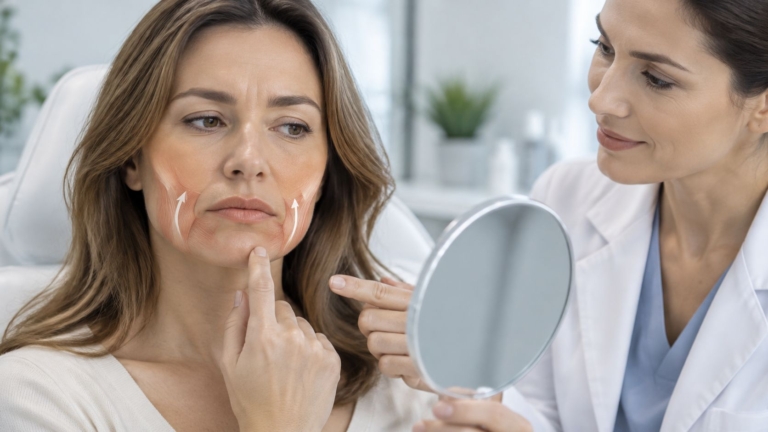
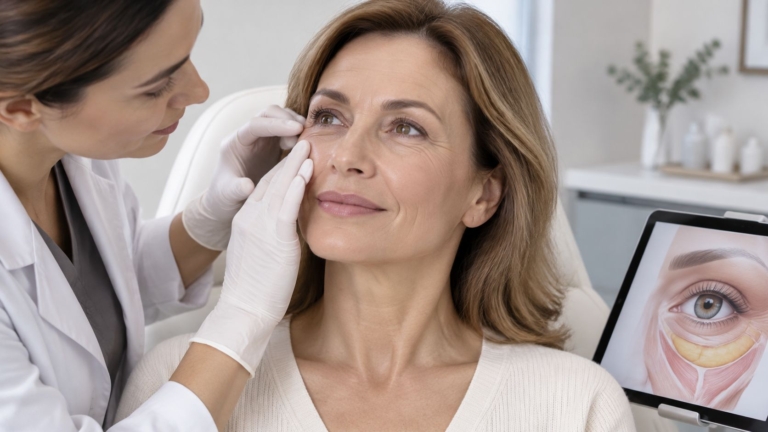
You like your lips, but in photos the center of your upper lip looks softer than you'd like. You want the paired peaks to read more clearly, not a uniformly bigger mouth, and you're wondering whether Cupid's bow lip filler can make that small change.
The useful starting point isn't a syringe size or a reference photo. It's deciding whether you want a clearer outline, more forward projection, or better balance. Those changes involve different parts of the lip, and sometimes waiting is the better choice.
Table of Contents
- The Anatomy Behind a Defined Cupid's Bow
- Filler Amounts That Shape the Upper Lip
- What a Measured Cupid's Bow Change Looks Like
- How a Cupid's Bow Filler Visit Unfolds
- Swelling, Bruising, and How Long Filler Lasts
- Lip Vascular Risks and When to Wait
- When Filler Is Not the Best Lip Option
- Book a ProMD Health Lip Filler Consult
The Anatomy Behind a Defined Cupid's Bow
Say your upper lip already has enough fullness, but one central peak looks flatter than the other. Adding gel evenly across the lip could make your mouth larger without addressing that difference. A shape-focused assessment starts by mapping the structures you already have.
The Cupid's bow is the paired peaks and midline dip along the upper lip. The philtral columns extend upward from the peaks, while the central tubercle creates the forward prominence beneath the middle of the bow. An anatomy review in the Journal of Cutaneous and Aesthetic Surgery distinguishes these structures and explains why border definition, lip-body volume, and central projection require different placement decisions.
The illustration helps separate the outline you see from the structures supporting it.
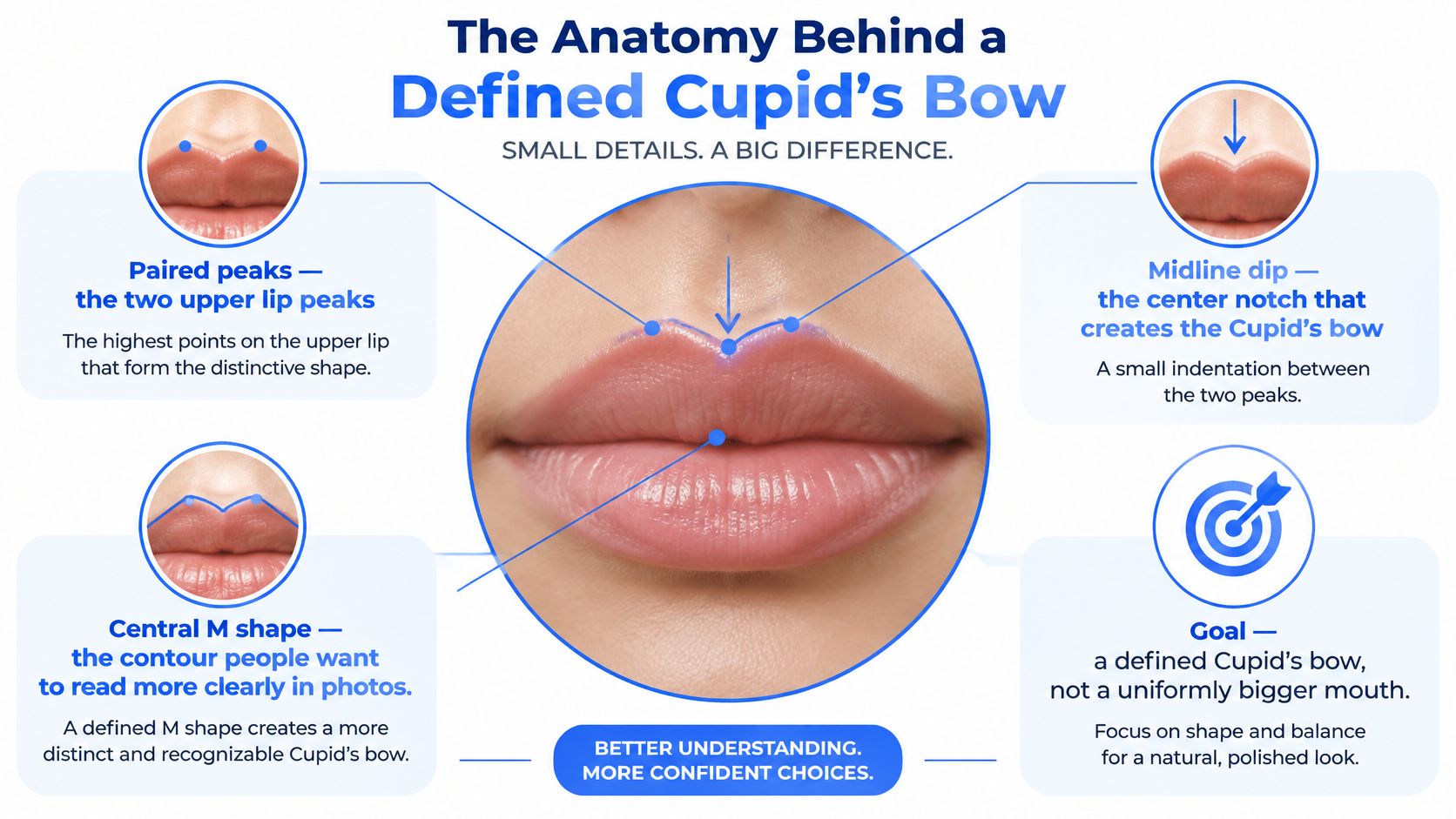
The boundaries people confuse
The philtrum is the groove between the raised philtral columns, not the entire area above the mouth. The vermilion border separates colored lip from facial skin. The red line is farther inward, where the dry vermilion transitions to wet oral mucosa.
These distinctions matter during a consultation. Pointing to the outer edge and asking for definition is different from asking for more pink lip to show or more fullness in profile.
Upper-lip landmarks and what filler can change
| Landmark | What it does | Filler aim |
|---|---|---|
| Philtral columns | Rise from the peaks toward the nose | Support the two high points of the M |
| Philtrum | Groove between the columns | Usually left alone so the dip stays readable |
| Cupid's bow peaks | Paired high points of the upper vermilion | Sharpen or balance left and right height |
| Central tubercle | Forward bump in the midline upper lip | Add modest central projection |
| Vermilion border | Line between lip color and facial skin | Define the edge without blurring it |
| Lip body | Colored vermilion between border and wet mucosa | Add volume only if the lip is thin |
Think of tracing a handwritten M rather than filling the entire letter with ink. The tracing should preserve the spaces and turns that make the letter recognizable. More ink isn't automatically a clearer outline.
Look at movement as well as shape
Your injector should also assess philtral length, existing pink-lip visibility, and how the upper lip relates to the lower lip. A sharp central contour can look disconnected if the rest of the mouth doesn't support it.
At home, look in a mirror with your lips relaxed, then say a word with an E sound. Notice whether a peak looks flatter only during movement, whether the middle projects forward, and whether your concern is outline, projection, or both. Bring those observations to the consultation rather than trying to diagnose the injection site yourself.
Filler Amounts That Shape the Upper Lip
Planning volumes for Cupid's bow filler
| Plan | Amount | Where it goes | Shape job |
|---|---|---|---|
| Typical first treatment | 0.5–1.0 mL per lip | Border, tubercle, and only needed body | Definition with modest fullness |
| Larger-volume case | Up to 1.5 mL per lip | Broader lip body plus contour | Reserved for a genuinely thin lip |
| Border micro-trace | About 0.01–0.02 mL per pass | Vermilion–cutaneous border, superficial to muscle | Sharpen peaks without bulk |
| Overfill warning | Beyond what the border can hold | Even fill across the whole lip | Can flatten the M and blur the edge |
The per-lip planning amounts come from a 2025 clinical review available through the National Center for Biotechnology Information, which describes typical volumes of 0.5–1 mL per lip and a maximum of 1.5 mL per lip in larger-volume cases. These aren't mandatory starting doses, and a bow-only correction shouldn't automatically receive the amount used for broader augmentation.
An anatomy-based technique review describes adaptable, low-elasticity hyaluronic acid gel placed in retrograde traces of approximately 0.01–0.02 mL, superficial to the orbicularis oris, using a 30-gauge needle. Those details describe a published clinical technique, not instructions for self-injection or a dose prescription for every patient.
Assign each placement a job
For border definition, the clinician follows selected portions of the edge rather than building the whole lip outward. For central projection, the target is the tubercle. Lip-body filler addresses insufficient fullness, which is a separate concern from an indistinct bow.
This distinction explains why a small amount can still be too much in the wrong place. If the dip is already shallow, adding gel indiscriminately through the center may make the outline rounder rather than clearer. Chasing a filtered reference by stacking volume can obscure the border and create a continuous, tube-like contour.
Dose principle: Ask what each placement is meant to change, not simply how much product comes in the syringe.
Product selection also matters. A gel's adaptability and structural properties influence how it behaves in moving lip tissue, so the injector must match the material to the intended job rather than choose by brand familiarity alone.
Agree on a stopping point
Published approaches use different tissue planes. Border tracing can be superficial to the lip muscle, while a structured augmentation method discussed below uses a deeper submucosal approach. Neither description means there's a universal safe depth or that patients should select their own technique.
A conservative first treatment leaves room to reassess once swelling has settled. It also prevents the clinician from treating temporary puffiness as evidence that another area needs balancing.
Write down an agreed volume ceiling before treatment, along with the intended treatment sites. Ask which areas will remain untreated and what finding would make the injector stop early. An agreed ceiling is a maximum, not a commitment to use every available drop.
What a Measured Cupid's Bow Change Looks Like
A sharper Cupid's bow should be assessed as a change in geometry, not just a larger before-and-after image. Useful observations include the relationship between the peaks, the depth of the central dip, and how far the tubercle projects in profile.
A 2025 retrospective analysis of 67 consecutive women undergoing primary lip augmentation reported an increase in average labial-tubercle area from 228.5 ± 169.6 mm² to 297.0 ± 157.3 mm², with p = 0.039. The analysis also found significant angular changes associated with central projection, vertical height, and contour definition.
The treatment wasn't an isolated injection into the bow. The structured sequence addressed the upper lip's lateral and medial segments, the central tubercle, the lower lip, and the oral commissures. That scope matters when interpreting the result.
What the measurements mean
In plain language, the measured central region became larger, and the surrounding angles changed. This supports the idea that targeted filler can alter central lip shape, rather than only adding uniform fullness.
The wide spread around the average measurements also shows that the participants' starting anatomy differed substantially. An average change isn't a template for your mouth, and statistical significance doesn't tell you whether a particular contour will suit your face.
The study used a 30-gauge, 13-mm needle in the deep submucosal plane. That was the method evaluated, not proof that all Cupid's bow treatments should use the same depth, device, or sequence.
A meaningful before-and-after comparison asks whether the intended structure changed, not whether the after photo looks bigger.
Judge the whole smile
A successful shape-focused result preserves a recognizable dip, improves the balance of the peaks, and avoids an abrupt ledge in profile. Exact mirror-image symmetry isn't a realistic requirement for a moving face.
Teeth and smile position also affect how people perceive the upper lip. The Prosth & Co. smile makeover gallery can help you notice how dental appearance and lip framing interact, but it isn't evidence of filler outcomes or a guide to choosing a lip shape.
Prior filler can make assessment harder, especially when product above the vermilion obscures the true border. In that situation, a clinician may recommend less additional product, further assessment, or consideration of dissolving existing hyaluronic acid filler before attempting refinement.
Bring the consultation back to a specific question: Which feature of my own lip are you trying to change, the peaks, the tubercle, or overall height? The answer should be visible in the proposed plan.
How a Cupid's Bow Filler Visit Unfolds
A useful consultation includes more than choosing a shape from a photograph. You should understand what the injector is assessing, how you can pause treatment, and how to reach the clinic afterward.
Bring an unfiltered, no-makeup photograph that represents your usual appearance. Our explanation of what lip filler is provides background terminology, while Dental Professionals of Fair Lawn's guide to what to know before lip fillers offers another patient-oriented introduction to preparing for the discussion.
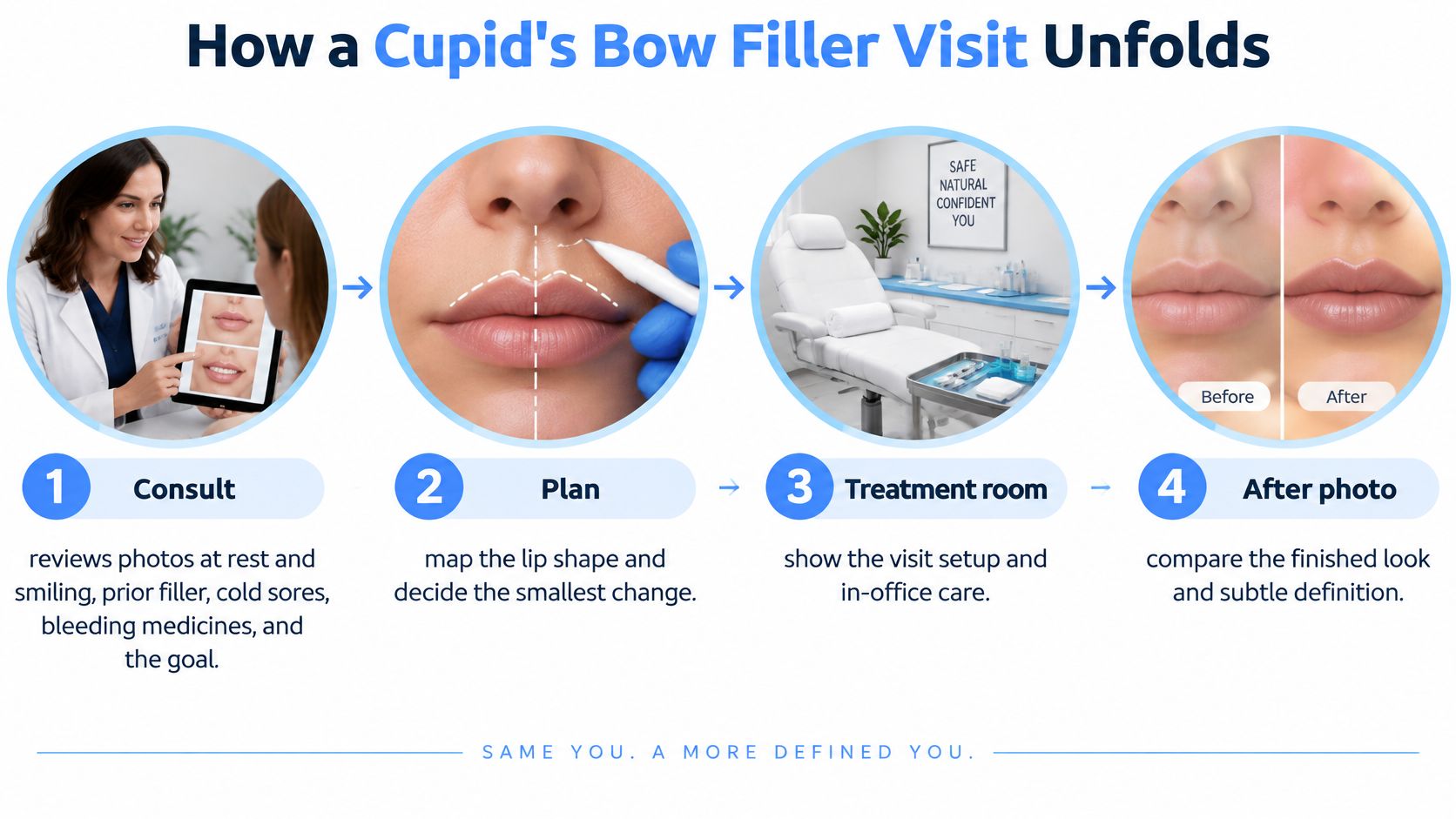
The consultation and treatment sequence
Review the goal and medical history. The clinician compares your lips at rest and smiling, asks about prior filler and cold sores, and reviews medicines that affect bleeding. Explain whether you want clearer peaks, more visible lip, or a change in tooth show, because those aren't interchangeable requests.
Map the existing anatomy. The injector assesses asymmetry, philtral length, and tubercle position rather than drawing an unrelated mouth onto your face. Markings should connect the proposed placements to your stated concern.
Prepare the skin and manage discomfort. The lips are cleaned, and topical anesthetic may be used; some hyaluronic acid gels also contain lidocaine. Disclose previous reactions to anesthetics before treatment begins.
Place small amounts and observe the tissue. The clinician selects a needle or cannula according to the plan, delivers product slowly with controlled pressure, and pauses to assess skin response. No device removes vascular risk.
Check progress before continuing. A mirror check gives you a chance to discuss the emerging appearance, but immediate swelling limits what anyone can judge. You can say stop without needing to justify using less product than originally discussed.
Leave with clear aftercare and contact instructions. The clinic should distinguish expected tenderness from concerning pain or color changes. You should know whom to contact urgently, including outside routine office hours.
The infographic summarizes the main stages of the visit.
Make consent practical
A limited definition treatment may involve fewer placements than broader augmentation, but consultation, preparation, and safety checks still matter. Don't choose an appointment based only on how quickly someone promises to finish.
Before the procedure starts, agree on how you'll signal discomfort or request a pause. Ask the clinician to explain any proposed change to the plan before proceeding, especially if it involves treating an area you hadn't discussed.
Swelling, Bruising, and How Long Filler Lasts
After a Cupid's bow treatment, the first look in the mirror can be misleading. Swelling may temporarily make the upper lip appear taller, rounder, or less even, obscuring the vermilion border and the shape of the philtral peaks. The tubercle may also look more prominent than it will once the tissue settles. Treat the early appearance as a snapshot of recovery, not a final judgment about the architecture.
A clinical review summarizing lip-filler adverse events reports meta-analysis rates of 88.8% for tenderness, 74.3% for injection-site swelling, and 39.5% for bruising; most events were mild or moderate. The review also found that augmentation benefit generally persisted for at least six months. These figures describe treated patients overall, not rates established specifically for bow-only micro-corrections.
Follow recovery rather than a perfect calendar
Tenderness, swelling, and bruising can overlap, and they do not necessarily resolve in step with one another. Swelling can blur the dip between the peaks; bruising may change color as it fades. One side may settle sooner than the other, so temporary unevenness alone does not establish that filler was placed unevenly.
For a day-by-day overview of common recovery changes, see this lip filler day-by-day guide. Use it to organize questions, while following your injector's instructions for your own treatment. The extent of treatment, medical history, and individual tissue response can all affect aftercare.
- Protect the treated edge. Avoid pressing, kneading, or trying to sculpt the peaks yourself unless your clinician specifically directs you.
- Clarify activity restrictions. Ask for written guidance about strenuous exercise, alcohol, heat exposure, and when to resume your usual routine.
- Keep products simple. Confirm when you can reapply lip cosmetics and which gentle products are appropriate while the skin recovers.
- Report cold-sore symptoms. Tingling, blistering, or a familiar outbreak pattern warrants clinical advice rather than being dismissed as ordinary swelling.
Separate settling from maintenance
Hyaluronic acid filler is temporary, but how long a visible change remains varies. Product properties, the amount placed, lip movement, and individual differences all matter. A maintenance decision should follow the current shape and your goal, rather than an automatic schedule. If the vermilion border looks defined but the peaks seem too prominent, waiting may be the smaller change. If the tissue has settled and the border still lacks definition, reassessment can clarify whether any adjustment fits.
Photograph your lips periodically in the same light, at the same angle, and with a relaxed expression. Consistent images make gradual changes easier to compare than close-up selfies taken under changing lighting.
Recovery check: Discuss a persistent contour concern after the tissue has settled. Unusual pain or color change needs prompt assessment.
Arrange a review interval with your clinician before leaving. If a peak still looks uneven after swelling resolves, reassessment is the next step, not necessarily more gel. The clinician can consider residual swelling, baseline asymmetry, and placement before recommending correction.
Lip Vascular Risks and When to Wait
A sharply defined Cupid's bow depends on small, controlled changes to the vermilion border, philtral peaks, or central tubercle. Before adding filler, consider which goal matters most: definition, projection, or waiting until existing swelling settles. Even a small treatment remains a vascular-risk procedure, because filler can accidentally obstruct blood flow.
An FDA review of filler-related vascular events recorded 157 of 411 reported events, or 38%, in the lips and perioral area, compared with 75 events, or 18%, in the nasolabial folds and 39 events, or 10%, in the nose. The same document summarizes a review of 1.7 million syringes over 10 years by 370 dermatologists, which estimated vascular occlusion at approximately 1 in 5,000 injections, alongside a separate hyaluronic acid estimate of approximately 1 in 6,600 injections.
These figures come from different datasets and methods, so they do not estimate your personal risk. The share of reported events in the lips and perioral area also describes where reported events occurred, not the percentage of lip treatments that cause complications.
Recognize the signs that need action
The FDA's dermal filler safety guidance warns that accidental injection into a blood vessel can cause tissue necrosis, visual abnormalities including blindness, or stroke. A clinician's anatomical knowledge, controlled delivery, observation, and readiness to respond all matter.
- White or dusky skin. Blanching, mottling, or unusual darkening requires immediate contact with the injector.
- Increasing or disproportionate pain. Severe or worsening pain should not be assumed to be the numbing medicine wearing off.
- Cool tissue or impaired circulation. Seek professional assessment rather than trying home massage or watchful waiting.
- Visual or neurological symptoms. For vision changes or stroke-like symptoms, seek emergency medical care immediately and alert the treating clinic.
Read more about dermal filler side effects, but do not wait on an online comparison if urgent symptoms appear. Contact the injector immediately if you suspect a vascular problem. If they are unavailable, seek urgent medical assessment.
Postponing can be the safer decision
Defer elective filler during pregnancy. Tell the clinician about an active cold sore, skin infection, previous filler complication, or significant medical concern so they can assess whether treatment should wait.
Blood-thinning medication calls for an individualized discussion. Never stop a prescribed anticoagulant or antiplatelet medicine on your own to reduce bruising. The prescriber and injector should help determine whether proceeding makes sense.
Hyaluronic acid can be dissolved with hyaluronidase, but that option does not remove the risk or guarantee that every complication can be reversed. Choose a qualified medical injector who can explain the vascular emergency protocol and access to treatment. The possibility of dissolving filler later is not a reason to place more than the goal requires now.
When Filler Is Not the Best Lip Option
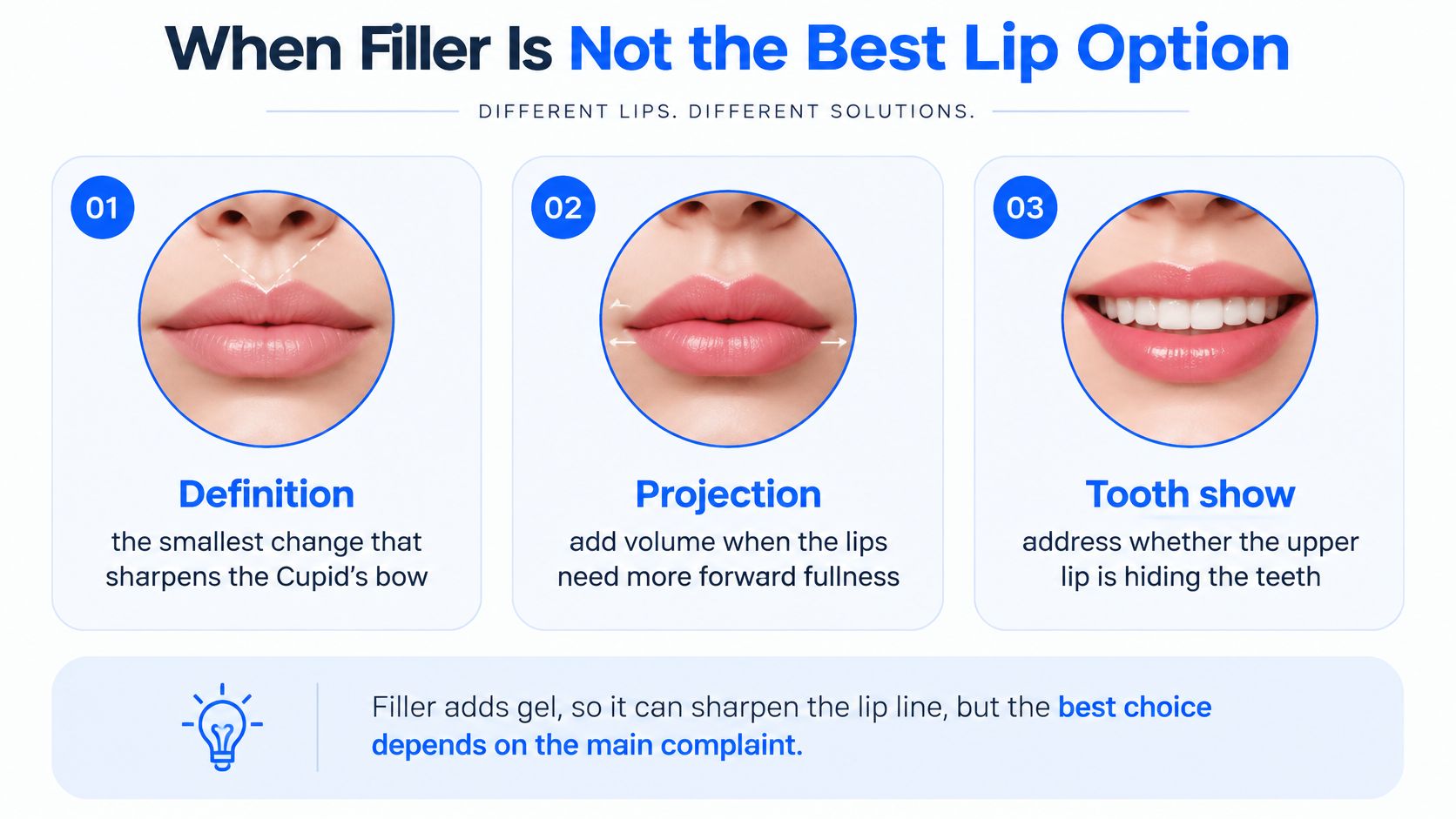
Start with the concern you want to change. If it is dryness or lipstick feathering, reshaping the central lip may add volume without addressing the surface issue. The smallest useful step may be a lip-hydration routine, a dermatologist assessment, or waiting.
A clinical discussion of lip-enhancement choices distinguishes adding volume with filler from changing upper-lip eversion with a lip flip. The vermilion border frames the pink lip, the philtral peaks form the bow, and the central tubercle contributes projection. More visible pink lip, more tooth show, and sharper definition are separate goals, so identify which one matters before choosing a treatment.
Match the lip goal to the smaller treatment
| Goal | Filler | Skincare or assessment | Better to wait |
|---|---|---|---|
| Sharper peaks and central M | Small, precise placement may define the border | A surface routine will not reshape the bow | If old filler has blurred the edge |
| More pink show without bulk | May help if limited lip volume is the concern | A routine will not evert the lip | If tooth show is already enough at rest |
| Central projection | A small tubercle treatment may add projection | A surface routine will not change shape | If the philtrum is very short |
| Fix a flat side | Staged filler may address the contour | Assessment can clarify structural asymmetry | If recent filler swelling remains |
| Color, dryness, or lipstick bleed | Filler does not treat pigment or dryness | Try a lip-hydration routine; seek a dermatologist assessment for persistent irritation or an unexplained lesion | If the cause is unclear |
Shape problems and surface problems differ
If the border is already crisp, adding filler just to hold lipstick in place may create unnecessary volume. Dryness, irritation, and fine surface lines call for attention to the lip surface first, rather than an automatic injection plan.
A simple hydration routine is a sensible first step for dryness without other concerning changes. Persistent irritation, an unexplained lesion, or a concern about skin texture is better assessed by a dermatologist before choosing a procedure. The decision map separates the outcome you want from the tool used to pursue it.
Don't force a sharper bow onto every lip
A naturally soft bow may suit the surrounding face. Dramatically angular peaks can look drawn on when the new outline conflicts with the original anatomy or crowds the space beneath the nose. Definition is one design choice; more projection is another, and neither is required because filler is available.
Mild asymmetry also does not have to be corrected in one appointment. Staging gives the clinician a chance to assess the response before considering further additions.
Observation can be the smallest change that fits. Choose it when your concern shifts from photo to photo, recent treatment has not settled, or you cannot yet describe the result you want. Choosing observation is a valid plan.
Book a ProMD Health Lip Filler Consult
If your goal is a more defined Cupid's bow, decide what you want to change and what you want to keep. A sharper vermilion border, more projection, and improved symmetry are different aims, much like adjusting the outline, depth, or balance of a small structure. Bring an unfiltered photograph and describe your priorities.
ProMD Health offers dermal fillers for subtle enhancement through more substantial contour changes, including a little lift or fuller facial contour. Its filler options include Voluma, Restylane, and Restylane Lyft. Product suitability for lips varies, so confirm the specific product at a ProMD Health office that offers lip filler.
Bring a decision checklist
A consultation can turn your goal into a measured plan, with room to adjust the approach to your anatomy and preferences.
- Anatomical assessment. Ask the clinician to assess the lip at rest and while smiling, including the Cupid's bow peaks and the central tubercle.
- Relevant history. Share previous filler, suspected migration, cold sores, medicines, and past reactions.
- Written dose ceiling. Agree on a maximum amount and when the injector may use less. The planned amount should suit the intended change, not dictate it.
- Safety responsibility. Confirm who will inject, how suspected vascular events are handled, and how to seek urgent advice afterward.
- Review arrangements. Ask when the clinician wants to assess the settled result and how to report a concern before then.
Confirm the practical details
Ask the office about current pricing before committing. Fees and product availability should be confirmed directly rather than assumed from a practice-wide list.
Choose a ProMD Health office that offers lip filler, and confirm that the service is currently available there. Product selection can also vary by office, so ask which option may suit your lips and treatment goal.
If assessment suggests that a surface concern, recent swelling, or an anatomical limitation is shaping the look, discuss whether waiting or another approach better fits your goal. The consultation should help you decide whether definition, projection, or no immediate change is the smallest useful step.
ProMD Health offers dermal filler consultations for people considering changes to lip definition, fullness, and balance. Visit ProMD Health to request a lip filler consultation, confirm availability at your preferred office, and discuss whether a more defined Cupid's bow suits your anatomy.