
Lip filler is most commonly a reversible hyaluronic acid gel injected into the lips to add volume, shape, and hydration, with results lasting months and requiring maintenance. Modern lip filler became closely associated with the FDA approval of Restylane in 2003, the first hyaluronic acid filler approved in the United States specifically for lip and perioral augmentation, with typical longevity of about 8 to 12 months (FDA documentation).
You may be considering it after noticing that your lips look less defined in photos, or you may want a little more shape without changing your whole appearance. A first consultation usually starts with a deceptively simple question: do you want more volume, a clearer border, better symmetry, or a hydrated, smoother look? The answer influences where a provider places the gel, how much is used, and whether filler is even the right option.
Table of Contents
- Introduction to What Lip Filler Really Is
- How Hyaluronic Acid Lip Filler Works in Your Lips
- Types of Lip Filler and How They Compare
- What Happens During a Lip Filler Appointment
- Risks Side Effects and Safety Facts You Should Know
- Results Longevity and Maintenance Timeline
- Is Lip Filler Right for You and Next Steps at ProMD Health
Introduction to What Lip Filler Really Is
You notice your lips look less defined in photos, or you want a little more shape without changing your overall appearance. The question “what is lip filler?” usually includes more than what comes in the syringe. You also want to know how the treatment may affect your facial balance, whether the result can look natural, and how much control you have over the outcome.
In plain language, lip filler is a soft injectable gel placed strategically within the lips to influence shape, fullness, and definition. Most modern lip filler uses hyaluronic acid, often shortened to HA. HA is a water-binding substance naturally found in the body. A selected HA gel can support the vermilion, the visible red portion of the lip, while contributing hydration and soft volume.
The change may be subtle. It could create a more visible Cupid's bow, a clearer lip border, improved balance between the upper and lower lip, or gentle fullness in the center. The aim is to match the gel placement and amount to your anatomy, rather than pursue a fixed volume or social-media trend.
The goal should be a result that fits your anatomy, not a fixed volume or social-media trend.
Lips are highly mobile tissue. They move as you speak, eat, smile, and make expressions, and their blood-vessel anatomy varies from person to person. For that reason, product characteristics, injection depth, placement, and restraint all affect the result. A qualified medical provider should assess your natural proportions instead of copying another person's shape.
Lip filler is temporary. HA gradually breaks down, so the visible effect fades and may require maintenance. The shift toward HA gave providers a more adjustable approach to soft-tissue volume restoration, with reversibility as one consideration (FDA documentation).
By the end of the decision process, you should be able to distinguish whether your priority is subtle definition, added volume, or another way to address your concern, including whether filler fits your goals and ProMD Health's cash-pay services.
How Hyaluronic Acid Lip Filler Works in Your Lips
During an appointment, a provider may place a small amount of gel along the lip border, within the lip body, or in selected central areas. Each location changes the outcome. Border placement can sharpen definition, while carefully placed product in the body can create fullness. Central placement may emphasize vertical height. The same material behaves differently according to its depth, distribution, and relationship to your natural anatomy.
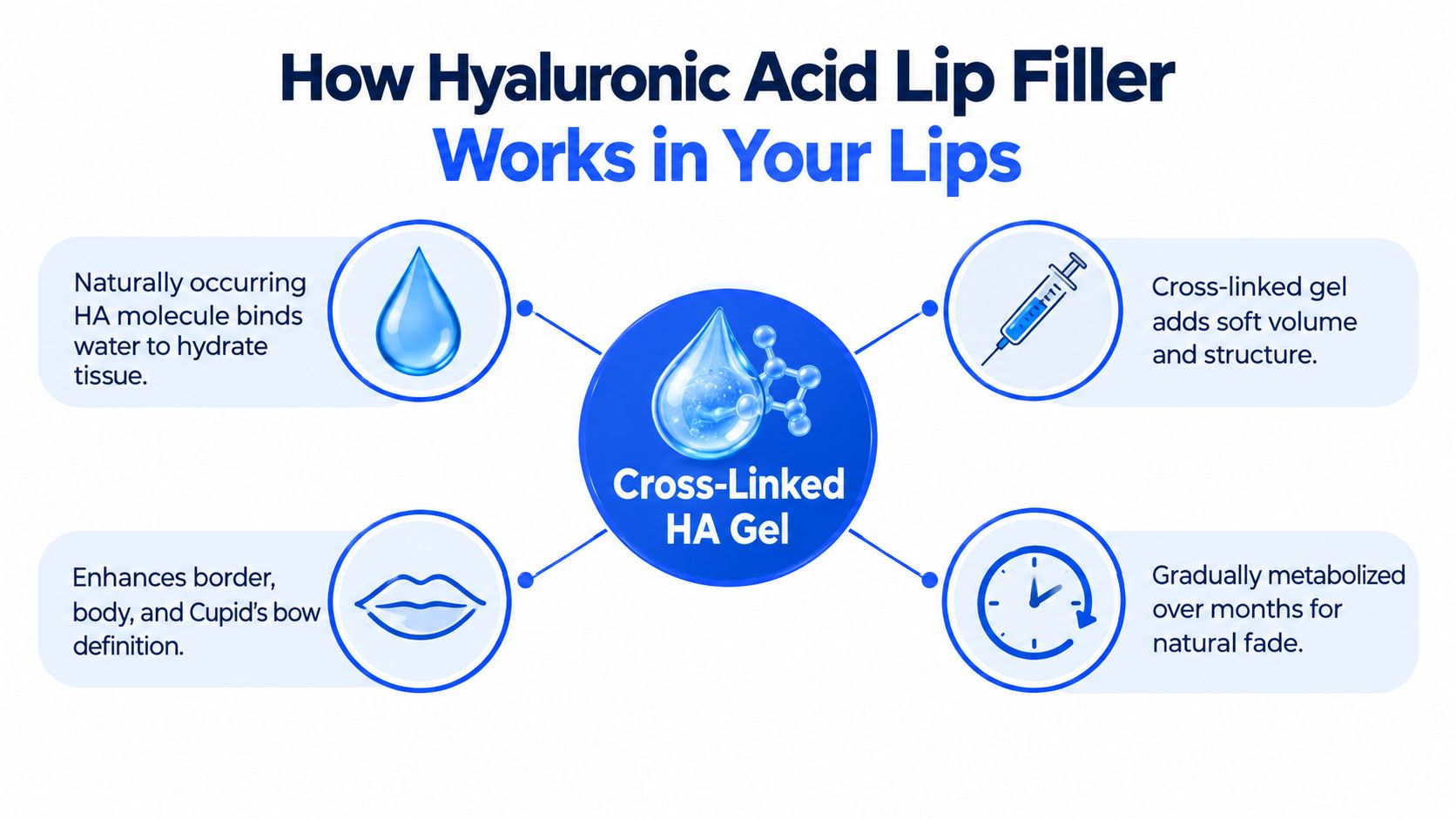
The gel and the tissue
HA filler is a water-attracting gel. It draws in and holds water around the injected material, so the visible change comes from both the gel itself and the hydration it supports in the surrounding tissue. This helps explain why lip filler can contribute to a softer, fuller appearance without functioning like a permanent implant.
HA used in fillers is commonly cross-linked. The HA molecules are joined to give the gel more structure and persistence than free HA alone. A softer formulation may blend into mobile lip tissue with a supple feel. A more structured formulation may provide firmer support for definition. These products are not interchangeable. Formulation, dose, injection depth, and placement all influence projection, softness, and how long the result remains visible.
The lips move constantly as you speak, eat, smile, and make expressions. They are living tissue, not a fixed container. That movement is why a provider must choose placement with both anatomy and motion in mind. The goal may be subtle definition, added volume, or improved balance, and each priority calls for a different distribution of product.
Why conservative placement matters
A small amount spread thoughtfully can look very different from the same amount concentrated in one area. Conservative aliquots, or small portions of product, let the provider check symmetry and tissue response during treatment. Placing too much filler can raise the chance of stiffness, visible irregularity, or an unbalanced shape.
Movement, individual metabolism, product characteristics, dose, and placement all affect how quickly HA filler fades. A meta-analysis found that lip fullness improvement persisted for at least 6 months in most patients, and almost half of patients still had significantly increased lip volume at 1 year (clinical meta-analysis of HA lip filler).
Why HA is often selected
HA's practical advantage is reversibility. If a clinician decides that an HA filler should be reduced, an enzyme-based treatment can break it down. This does not replace careful technique, but it gives HA useful adjustability in a highly visible, constantly moving area such as the lips. At ProMD Health, that choice can be discussed in relation to your preferred degree of definition or volume and the practice's cash-pay services.
Types of Lip Filler and How They Compare
Not every facial volume treatment belongs in the lips. Patients often hear about biostimulatory products or fat-based restoration and assume that all options work the same way. They don't. Some treatments add immediate gel volume, some encourage collagen support over time, and some use transferred tissue.
HA filler is generally the most direct option for lip augmentation because it can provide shape and volume in a controlled way while offering reversibility. That makes it useful for goals such as border definition, Cupid's bow refinement, hydration, or modest body augmentation. Product selection still matters, since a formulation designed for one facial area may not feel appropriate in mobile lip tissue.
Sculptra is a biostimulatory treatment that supports collagen production rather than acting as a conventional, immediately sculptable lip gel. It may be discussed for broader facial volume or skin-quality goals, but it isn't the same tool as a lip-specific HA filler. Fat grafting, including approaches such as Vital Cell Volume Restoration, uses transferred fat tissue and follows a different treatment model, with its own assessment and outcome considerations.
| Option | Best For Lips | Reversible | Typical Longevity |
|---|---|---|---|
| Hyaluronic acid filler | Definition, hydration, symmetry, and controlled fullness | Yes, when clinically appropriate | Months, varying by product and patient |
| Biostimulatory treatment | Broader collagen-support goals rather than precise immediate lip shaping | Not in the same way as HA | Varies by treatment and patient |
| Fat-based volume restoration | Selected patients seeking tissue-based facial volume restoration | Not in the same way as HA | Varies by graft retention and patient |
Your desired shape deserves a specific conversation. A guide to different lip filler shapes can help you describe whether you prefer a softer, more defined, or fuller appearance, but a provider still needs to determine what suits your anatomy.
ProMD Health's stated service themes include dermal fillers and fat-based volume restoration, but treatment availability can vary by office. Confirm that the specific lip treatment and provider are available at your chosen location before booking.
What Happens During a Lip Filler Appointment
A well-run appointment begins before any injection. If you want fuller lips, the provider first clarifies whether your priority is border definition, vertical height, central fullness, hydration, or symmetry. That distinction guides where HA gel belongs and how much change your mobile lip tissue can support.
Consultation and preparation
Bring photos of your own lips in different expressions. They show your natural movement more accurately than a heavily edited reference image. The provider should also review your medical history, previous filler, allergies, medications, active skin concerns, and any history of herpes outbreaks. Do not stop prescribed medication without medical guidance. Share what you take so the provider can discuss bruising and safety considerations.
Before treatment, the lips and nearby skin are cleansed. A topical numbing product may be used, and some HA formulations contain a local anesthetic. Pressure, pinching, or brief stinging is common. A continuous sensation is less typical.
Injection and assessment
The provider places small amounts of gel in selected areas with a needle, cannula, or combination of both. The choice depends on your anatomy and goal. Because the lips contain dense, variable blood vessels, precise placement and conservative dosing help keep the result controlled. No instrument removes vascular risk, so technique, anatomy, and monitoring all matter.
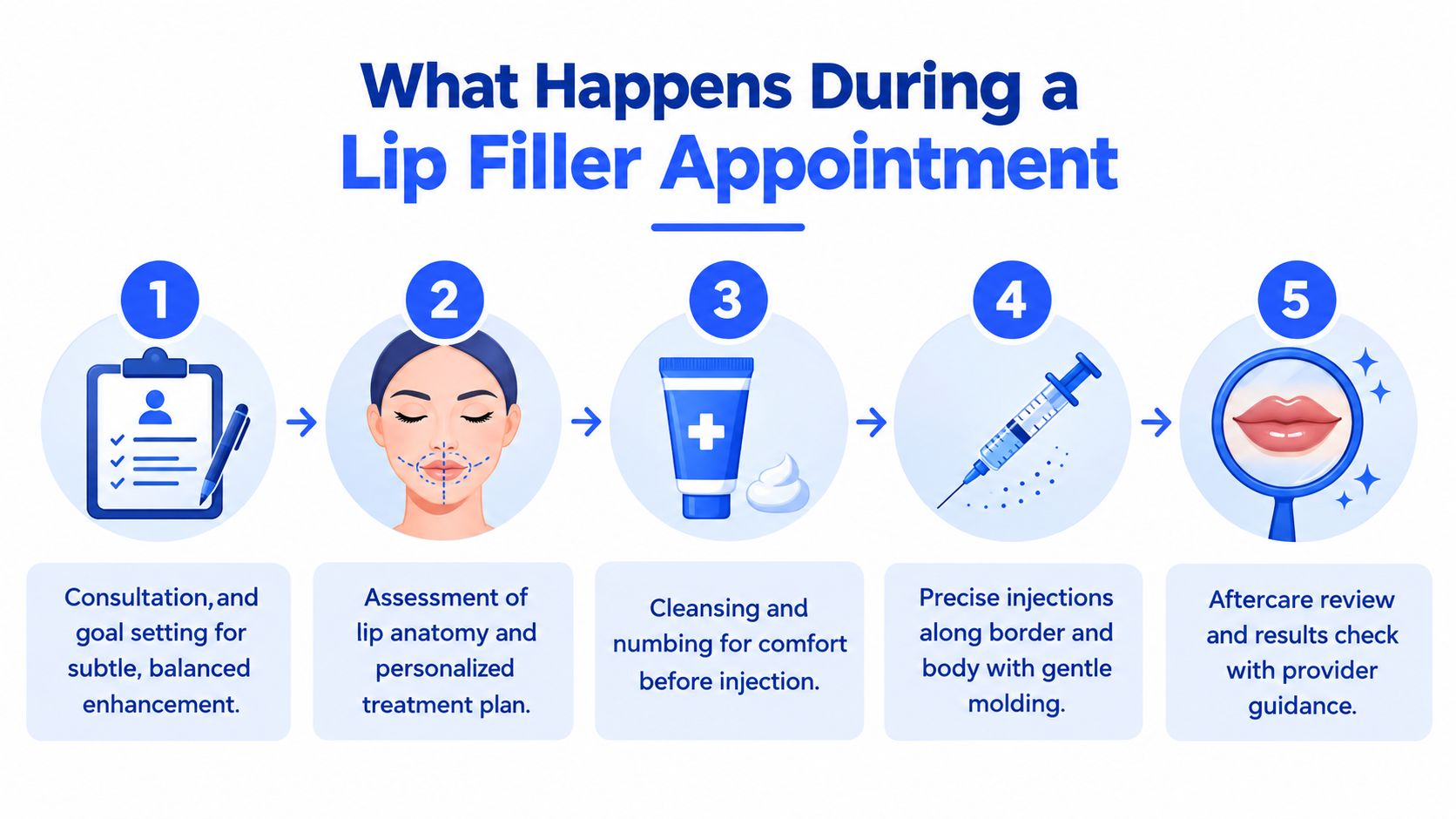
A careful injector pauses to check balance as treatment progresses. The goal may be a sharper border, more central volume, or a small correction in symmetry, rather than making the lips larger. Gentle molding can help distribute gel, while aggressive manipulation cannot correct poor placement. Immediate fullness may exceed the settled result because early swelling adds temporary volume.
Before you leave
Your provider should explain recovery, warning signs, and how to contact the practice. Ask:
- Product: Which HA formulation is being used, and why does it suit my goal?
- Placement: Will treatment focus on the border, body, Cupid's bow, or several areas?
- Safety: Which symptoms require an urgent call, and who should I contact outside normal hours?
- Availability: Is this exact treatment offered at the location where I am scheduling?
- Follow-up: When will the provider assess the settled result?
ProMD Health's cash-pay model means you should confirm the treatment plan, fee, provider, and location before booking. Availability can vary by office.
The best appointment is not the one promising the biggest change. It gives you a realistic target, a measured plan for your anatomy, and a clear safety pathway.
Risks Side Effects and Safety Facts You Should Know
After lip filler, the mirror may show more swelling or unevenness than you expected. Swelling, firmness, bruising, and tenderness are common short-term injection responses, and they usually change as the tissue settles. A systematic review of randomized trials reported adverse events in 50% of patients, including swelling in 78%, firmness in 48%, bruising in 34%, and tenderness in 33%. Serious adverse events were rare at 1.1%.
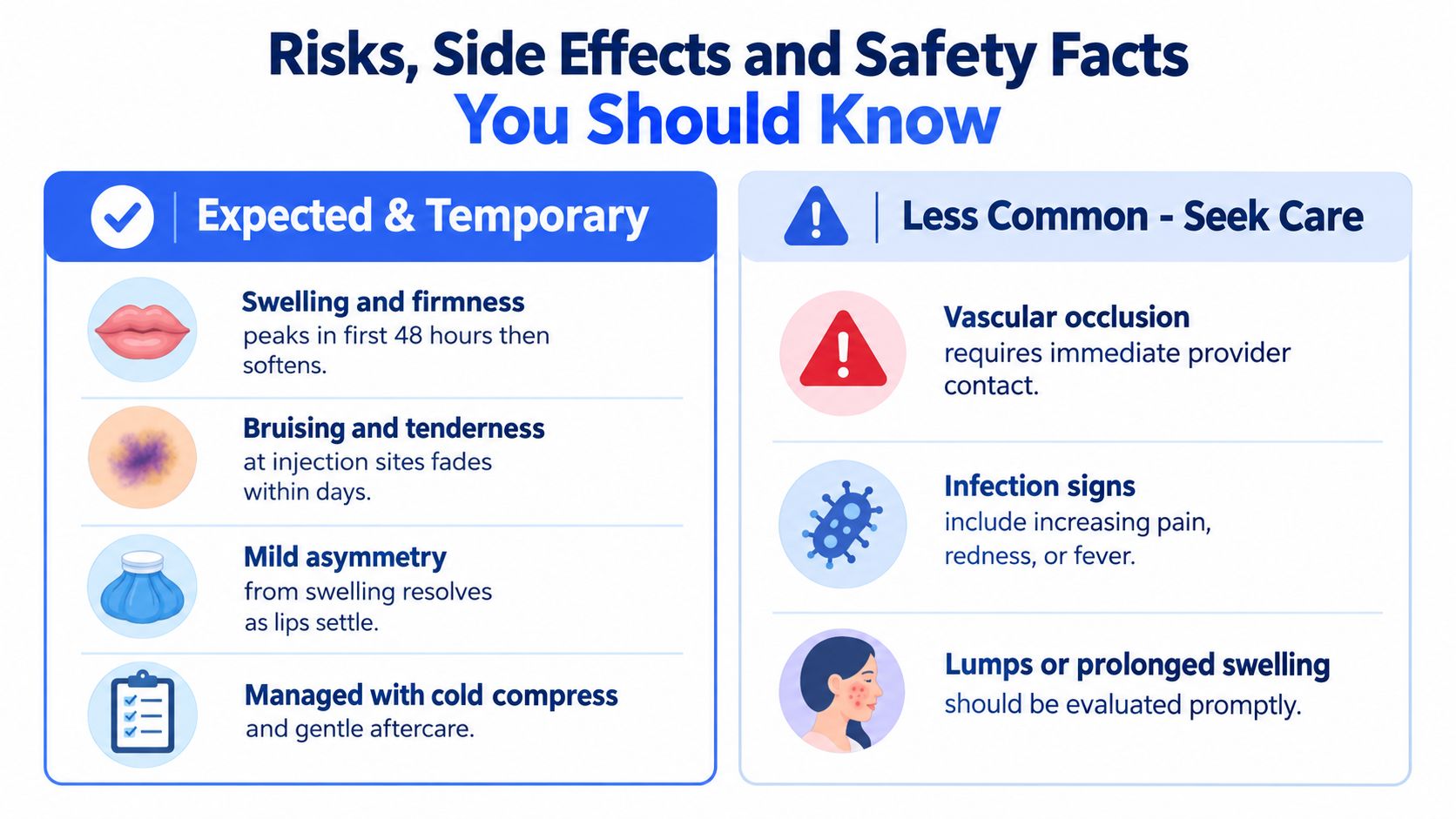
Expected reactions
Early swelling can make one lip appear fuller or shift the apparent balance between the two sides. Firmness near injection points may feel like small ridges while the gel integrates with mobile lip tissue. Bruising and tenderness generally ease as the initial inflammatory response fades, but your provider should give aftercare instructions based on your treatment and medical history.
Cold compresses and gentle care may improve comfort. Avoid pressing, massaging, or otherwise manipulating the lips unless your provider specifically recommends it.
Uncommon problems that deserve attention
The most time-sensitive complication is vascular occlusion, in which filler obstructs or compresses a blood vessel. The lips are commonly affected because they contain a dense, complex blood supply. FDA safety information on dermal filler vascular occlusion estimates this complication at about 1 in 6,000 syringes and identifies the lips as a commonly occluded area.
Contact your provider urgently for persistent or escalating pain, blanching, unusual pale or blue color, or asymmetric discoloration. These symptoms require prompt assessment rather than waiting to see whether they improve.
Other concerns can appear later or relate to product placement and tissue response. They include nodules, migration, discoloration, and herpes reactivation. A review involving 3,965 patients identified swelling, bruising, papules, redness, and itching among reported complications. Another review found nodule formation was the most common complication across filler types and also documented migration and herpetic outbreaks (review of lip filler complications).
Persistent lumps, prolonged swelling, increasing redness, fever, or worsening pain need clinical evaluation, not guesswork.
Ultrasound may help a qualified clinician locate nodules or migrated product when a visual examination does not provide enough information. If a concern develops weeks or months later, share when the filler was placed, the product used if known, and any recent illness or dental treatment.
Before treatment, review dermal filler side effects with a medical provider, including which reactions are expected and which require urgent contact.
Results Longevity and Maintenance Timeline
Lip filler changes over time, so the first look in the mirror isn't the final result. Early swelling can exaggerate fullness, and one side may settle before the other. Most patients need a settling period before deciding whether they want any adjustment.
A practical timeline
Immediately after treatment, the lips may appear fuller and feel firm or tender. The first several days are mainly about comfort and observation, not judging the final shape.
By approximately two weeks, the early swelling should have reduced enough for the provider and patient to evaluate the result more clearly. A prospective study of an HA lip filler described visible effects for about 4 to 6 months after the first augmentation procedure, while broader filler literature reports observed or labeled durations ranging from roughly 3 to 24 months, depending on the product and setting (prospective lip filler study).
A multicenter real-world study of an HA dermal filler used in the lips found treatment remained effective and well tolerated through 12 months, with no new adverse events reported between 6 and 12 months (multicenter real-world study). These findings don't create a promise for an individual patient. They show why a provider should discuss a range rather than guarantee a date when every trace of filler will disappear.
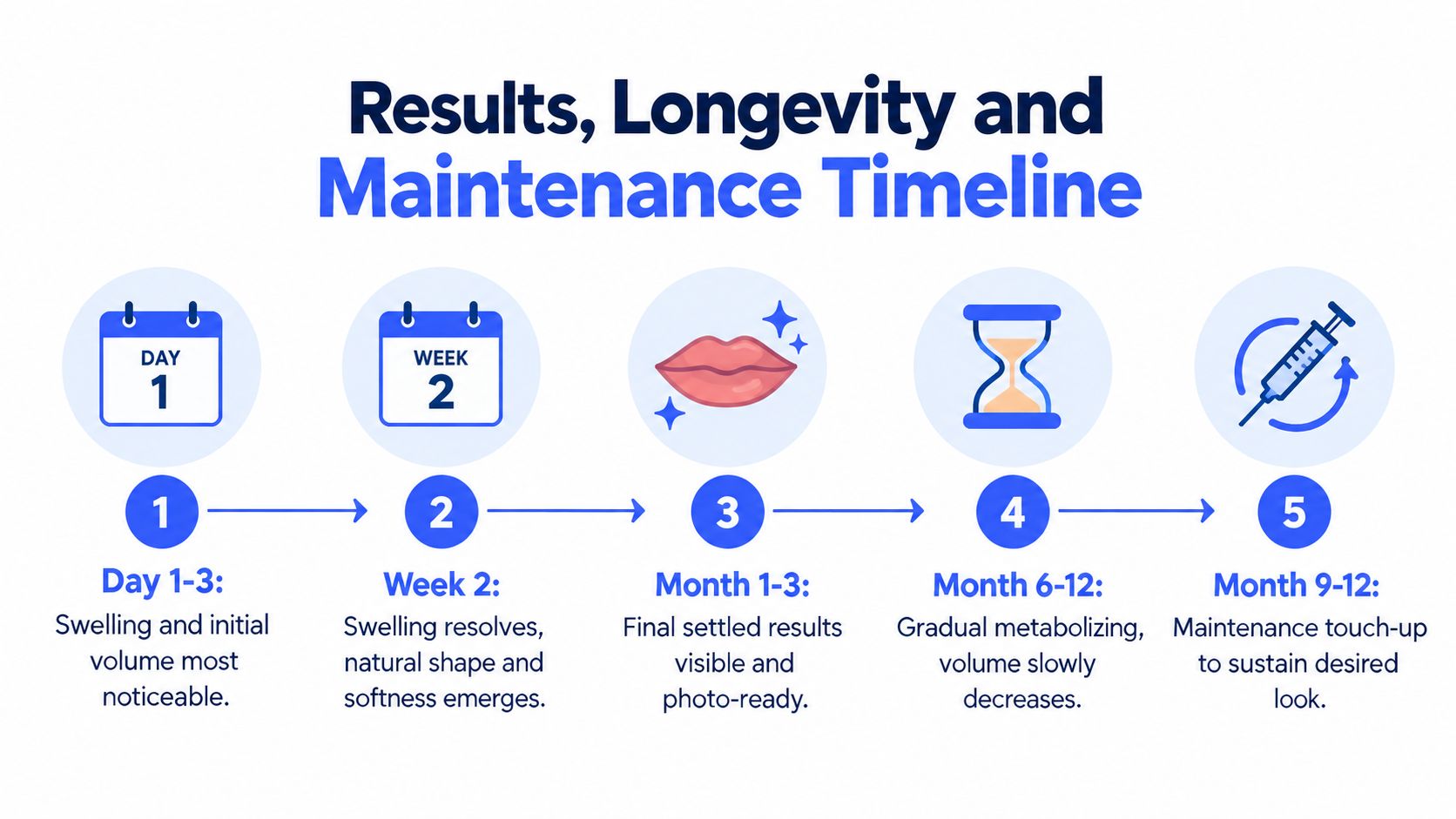
Why maintenance varies
Lip movement, metabolism, product formulation, placement, and the amount injected all affect duration. A patient seeking subtle definition may choose a different maintenance pattern from someone seeking more visible volume. Repeated treatment doesn't mean you should automatically add more product each time. Your provider should reassess the tissue, shape, and remaining volume before recommending another appointment.
Take photos in consistent lighting and at similar angles, but avoid evaluating the result through heavily filtered images. Your lip filler day-by-day guide can help you understand the changing appearance during recovery.
At ProMD Health, aesthetic services follow a cash-pay model, so lip filler isn't covered by insurance. Ask for current pricing and the maintenance approach during your consultation so you can plan without assuming reimbursement.
Is Lip Filler Right for You and Next Steps at ProMD Health
Lip filler may suit an adult who wants modest enhancement, clearer definition, improved symmetry, or added fullness and understands that the result is temporary. It may be wise to pause if you have an active infection, unexplained inflammation, a current herpes outbreak, or uncertainty about the goal itself. A consultation can clarify whether the issue is volume, shape, skin texture, or an expectation that filler can't realistically meet.
Use this checklist when choosing a treatment plan:
- Define the outcome: Decide whether you want border definition, hydration, symmetry, or volume.
- Review the material: Ask why an HA formulation is appropriate for your lips and goals.
- Discuss safety: Confirm how the provider handles urgent symptoms and delayed concerns.
- Verify availability: Check that the treatment and qualified injector are available at your selected ProMD Health office.
- Understand payment: Remember that ProMD Health uses a cash-pay model, and services aren't covered by insurance.
- Plan conservatively: Agree on a staged approach if you're a first-time patient or unsure about fullness.
If filler doesn't feel right, alternatives may include medical-grade skincare, Hydrafacial, chemical peels, or another service directed at texture and overall facial appearance. Those options won't replicate injectable volume, but they may better match a patient whose primary concern is dryness, surface texture, or skin quality.
A consultation should help you make a decision, not pressure you into one. Bring your questions, describe the look you want in ordinary language, and ask the provider to explain what they'd change, where they'd place product, and why.
ProMD Health offers dermal filler consultations for patients considering lip definition, hydration, symmetry, or volume, with treatment availability confirmed by location. Visit ProMD Health to review aesthetic services and request a consultation at an approved office.


