
Emsculpt NEO is a noninvasive body-contouring device that combines radiofrequency (RF) heating with high-intensity focused electromagnetic (HIFEM) muscle contractions in one applicator, and it's FDA-cleared for increasing muscle tone and reducing fat. If a device reduces fat, doesn't that mean the scale should drop? That assumption is where most explanations of what Emsculpt NEO is go wrong. Fat thickness in one zone and the number on a scale are different measurements. A tailor can take in a seam without changing how much fabric is in the closet. Contouring works more like that seam than like a diet.
The device, introduced in 2020, pairs heat with muscle stimulation so one session can address localized fat and muscle tone together. It isn't surgery, and it isn't a weight-loss program. The useful question is narrower. Which tissue changes, in which area, and how would you even notice?
Table of Contents
- What Emsculpt NEO Is at a Glance
- How RF Heating and HIFEM Work Together
- Who Emsculpt NEO Suits and Who Should Skip It
- How an Emsculpt NEO Treatment Series Runs
- Expected Results and When They Appear
- Side Effects, Evidence Limits and Common Myths
- Decide Whether Emsculpt NEO Fits and Book a Consultation
What Emsculpt NEO Is at a Glance
What can a body-contouring treatment change that a scale may not show? Emsculpt NEO is designed to refine a localized area by addressing muscle tone and fat in that zone. The distinction matters: a measurable change in tissue does not guarantee an obvious change in body shape, and treatment is not a method for weight loss.
The regulatory history helps clarify what the device is intended to do. A 2023 clinical review of the technology reports that electromagnetic devices received FDA clearance in 2017 for strengthening, firming, and toning areas including the abdomen, buttocks, thighs, arms, and calves. The earlier Emsculpt device received 510(k) clearance for noninvasive abdominal lipolysis in 2019. The combined RF-HIFEM platform was introduced in 2020. Wolters Kluwer's summary of the abdominal research describes the combined treatment as FDA-cleared for noninvasive body contouring.
| Feature | What It Means |
|---|---|
| Technology | Radiofrequency (RF) heating and high-intensity focused electromagnetic (HIFEM) energy delivered in one applicator |
| Primary goals | Muscle toning and definition, with localized fat reduction |
| Introduced | 2020, as a combined RF-HIFEM platform |
| Regulatory status | FDA clearance for noninvasive abdominal lipolysis for the earlier Emsculpt device in 2019; the combined RF-HIFEM platform is cleared for noninvasive body contouring |
| Typical protocol | Four sessions over 2 to 4 weeks; published protocols range from 3 to 8 |
| Follow-up window | Results assessed 1 to 6 months after treatment |
| Invasiveness | No incisions; studies report temporary redness and muscle soreness |
| Best way to track results | Standardized photos, circumference, and imaging, rather than scale weight |
These measures answer different questions. Imaging and circumference can help track tissue changes, while photos show whether those changes alter visible contours. The evidence remains limited, with small studies and short follow-up, so expectations should stay measured: Emsculpt NEO may offer modest refinement and muscle tone in a treated area, not a substantial change in overall body weight.
How RF Heating and HIFEM Work Together
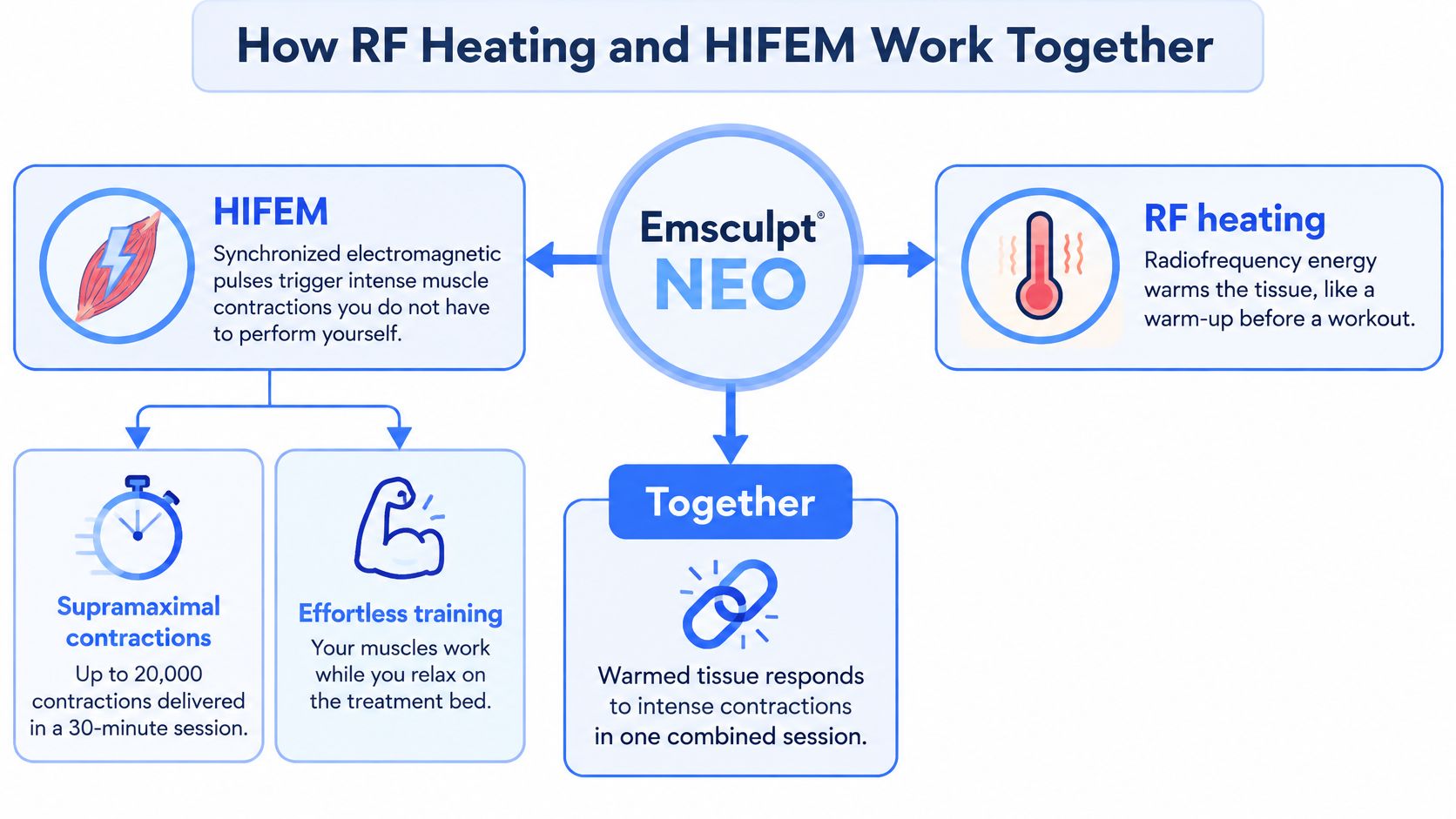
RF delivers heat to the treated area, while HIFEM prompts the muscles beneath it to contract. Each energy has a distinct target: RF acts on fat tissue, and HIFEM creates a muscle-training stimulus. The combined applicator delivers both during the same session.
HIFEM triggers strong, involuntary contractions. You do not choose to flex; the applicator signals the muscle to contract while you lie still. Repeated contractions can stimulate changes in muscle thickness over a treatment series. The effect is local, so it does not replace ongoing exercise or build strength throughout the body.
RF is the warm-up. It heats tissue in the same region, with the aim of reducing localized fat. A systematic review of electromagnetic body contouring describes RF and electromagnetic stimulation as complementary: one targets adipose tissue, while the other activates muscle. This is intended to refine a specific area, not produce weight loss.
Why one applicator changes the plan
Because both energies reach the same zone in one session, the treatment addresses fat and muscle together. That does not mean the changes are identical or that either one guarantees a visible difference. A scan can measure tissue thickness; how noticeable the area looks depends on the person and the treated site.
The review found only two Emsculpt NEO clinical studies that met its criteria, and several reports were industry funded. That makes the findings preliminary: they suggest possible localized tissue changes, but they do not establish how reliably those changes translate into a visible contour difference or how long they last.
A protocol described in the review used four sessions over 2 to 4 weeks. Published protocols ranged from three to eight treatments, with follow-up from one to six months. Since fat and muscle are different tissues, their changes need to be assessed separately. A firmer-looking area may reflect muscle, fat, or both, and the mirror cannot distinguish between them.
Practical rule: Track contour with standardized photos, circumference, or imaging. Scale weight measures a different outcome.
Who Emsculpt NEO Suits and Who Should Skip It
Is your goal a more defined local area, or a lower number on the scale? Emsculpt NEO is designed for body contouring: its cleared uses include muscle strengthening and toning, along with fat reduction. It is not a treatment for obesity or broad weight loss. That distinction matters because a measurable change in muscle or fat thickness does not guarantee a dramatic visible change in body shape.
The evidence is limited. A review of the gluteal RF-plus-HIFEM work describes a 67-person study in which no adverse events occurred; participants' BMI ranged from 16.0–34.0 kg/m². Those study participants do not represent every body type, and the findings do not establish that the same results apply to everyone.
The clearest fit is an adult near a stable weight who wants modest refinement in a specific area, such as the abdomen, thighs, or buttocks. This kind of non-invasive body contouring may suit someone with localized stubborn fat or a goal of improving muscle tone. Regular exercise still matters: the device is not a substitute for strength training.
Muscle changes on imaging and functional strength are different outcomes. A thicker-looking muscle does not show, by itself, that a person can lift more or that a painful or weak area has been rehabilitated. People seeking treatment for a medical or functional problem should discuss that goal with a qualified provider rather than assume contouring will address it.
For excess body weight, medically supervised weight management is usually the more appropriate starting point. Contouring may be considered later, once weight is steadier. Weight changes can also alter local shape, so results may not remain the same over time.
Screening flags a consult checks
A systematic review of gluteal RF-plus-HIFEM research reported no adverse events in the 67-person study, but a small study cannot establish safety for every patient or condition. A provider should review medical history and the treatment area before deciding whether to proceed.
| Goal or condition | Typically a good fit | Screen carefully or choose another path |
|---|---|---|
| Localized stubborn fat | A defined concern on the abdomen, thighs, or buttocks, with weight near stable | Excess body weight; medically supervised weight management is usually the starting point |
| Muscle tone and definition | Someone seeking a firmer look who continues regular exercise | Anyone expecting treatment to replace strength training |
| Pregnancy | Not a typical candidate | Treatment is generally deferred pending provider review |
| Recent surgery | Timing depends on individual recovery | The provider determines whether and when treatment is suitable |
| Implanted electronic devices | Requires individual assessment | A full device review is needed before treatment; treatment may be excluded |
| Abdominal hernia | Treatment of another area may still be discussed | Abdominal treatment requires provider screening |
| Pain conditions or changing weight | Most appropriate when the person is comfortable and weight is stable | Active pain or weight changes call for reassessment |
The practical distinction is simple: this treatment may refine a localized area and support muscle tone, but it is not a weight-loss plan. Eligibility depends on the goal, health history, and area being considered, not on a single measurement alone.
How an Emsculpt NEO Treatment Series Runs
A series is a comparison project as much as a set of appointments. If the before-record and the after-record don't match, you can't tell what changed.
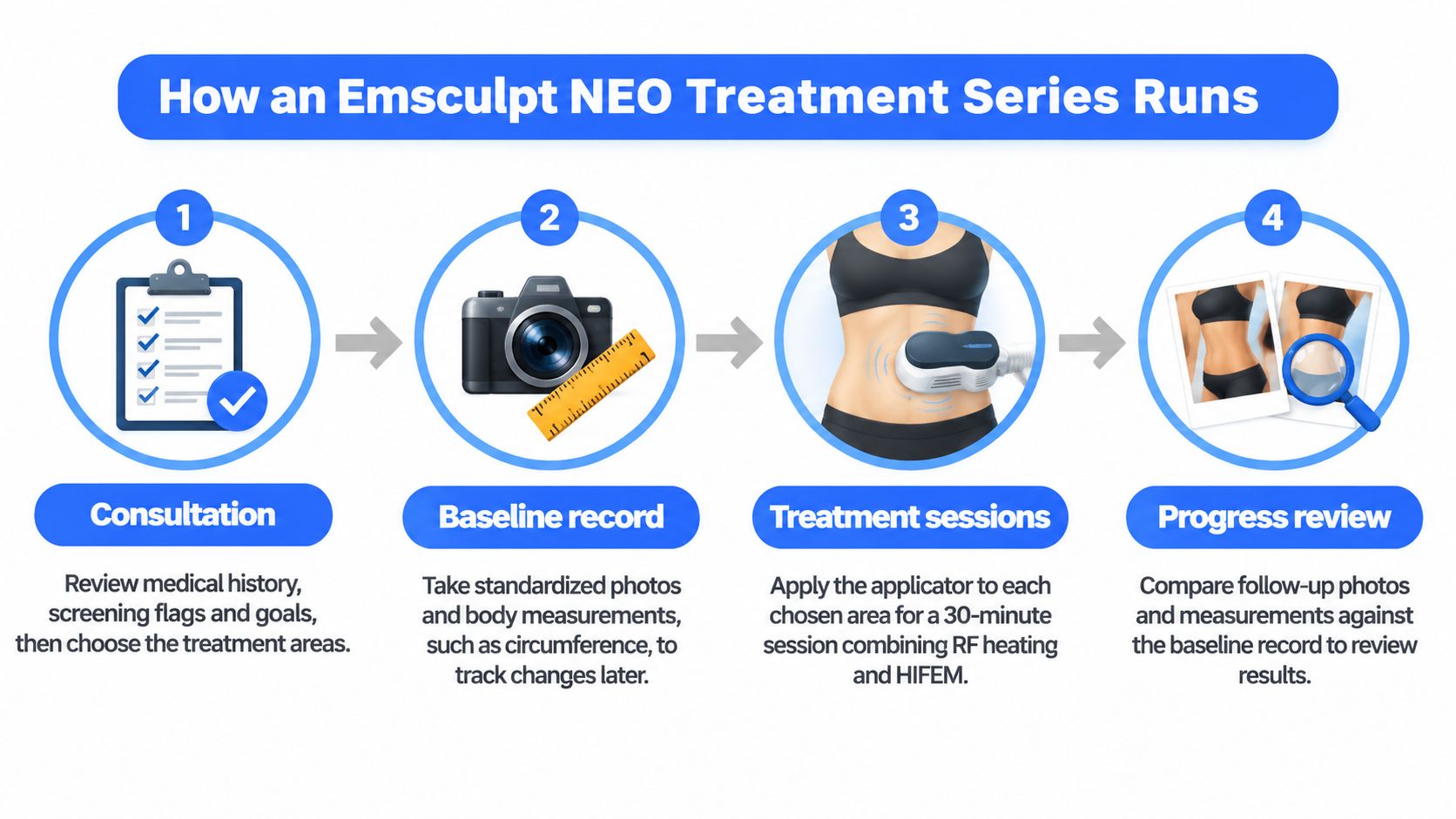
- Consultation. A provider reviews medical history, the screening flags above, and the goal, then chooses areas. This step exists so the wrong goal, such as whole-body weight loss, doesn't get booked as contouring.
- Baseline record. Standardized photos and measurements, including circumference and imaging where it's used, are taken before the first session. Later visits only mean something if they repeat the same method.
- Positioning. The applicator sits over each marked area. Sessions in published protocols are often about 30 minutes. Your clinic confirms the exact time. Marking the zone keeps the energy on the tissue you want treated.
- During the session. Expect warmth plus rhythmic, forceful contractions, closer to intense tightening than to a massage. Staff check comfort while the applicator stays in place. You aren't exercising. The muscle is contracting because of the field.
- Aftercare. Patients usually return to ordinary activity the same day. Follow your provider's advice on training after a session, especially if the treated muscles feel worked.
- The series. Plans commonly follow the four-session pattern over two to four weeks, often one visit a week. Spacing gives the tissue repeated stimuli instead of a single exposure.
- Between-visit check-ins. Questions about soreness, timing, or whether a session should move can go through ProMD Connect telehealth, so you aren't waiting until the next chair time to flag a problem.
- Reassessment. The same photos and measurements are repeated at about one to three months. Structural change can still be developing in that window, so an early peek isn't the full picture.
Sensations after treatment, and what the studies recorded as side effects, belong with the evidence limits rather than with the appointment steps.
Expected Results and When They Appear
What can a scan measure, and what might you see in the mirror? Emsculpt NEO studies report changes in muscle and fat thickness in selected treatment areas. Those measurements describe local tissue, not pounds lost or a guaranteed change in body shape. The available evidence is based on relatively small studies with short follow-up.
Controlled and prospective data summarized in an open-forum surgical journal includes findings from the abdomen, inner thighs, and buttocks. Results differ by area, and imaging measurements do not translate directly into how clothing fits or how noticeable a contour change will be.
| Study Setting | Target Area | Muscle Change | Fat Change | Timepoint |
|---|---|---|---|---|
| Randomized trial, active vs sham | Abdomen | +21.5% at 1 month; +24.2% at 3 months | −20.5% at 1 month; −28.3% at 3 months | 1 and 3 months |
| Prospective study, four weekly sessions | Inner thigh | +23.2% | −27.4% mean fat-thickness reduction | After the series |
| Prospective gluteal study | Buttocks | +31.3% at 1 month; +35.6% at 3 months | No significant change in subcutaneous fat | 1 and 3 months |
How to read a row without overreading it
In the abdominal randomized trial, the active group's imaging showed a 20.5% decrease in fat thickness and a 21.5% increase in muscle thickness after one month. At three months, the reported changes were 28.3% and 24.2%, respectively. These figures are linked to the study summary above. A percentage describes a change relative to the measured tissue layer. For a thin layer, even a sizable percentage may amount to only a small change in millimeters. It does not mean the same percentage of body weight was lost.
The inner-thigh study followed four 30-minute bilateral treatments at weekly intervals. It reported a mean 27.4% reduction in fat thickness and a 23.2% increase in muscle tissue. People considering inner-thigh treatment options should read those as tissue measurements, not as a prediction of a particular clothing size or visible result.
In the gluteal study, muscle thickness increased 31.3% at one month and 35.6% at three months, while subcutaneous fat showed no significant change. Muscle thickness accounts for the lift reported in this study. That distinction matters: a firmer or more defined appearance can come from muscle change without a measurable reduction in fat.
Changes may continue to develop between one and three months, so an early mirror check may not show the eventual result.
For a clearer comparison, use your own baseline photos and measurements at follow-up. Imaging can show a tissue change that is subtle in a photograph, while lighting and posture can make a photograph look different without confirming a structural change. A realistic aim is modest contour refinement and improved muscle tone in a localized area. Emsculpt NEO is not a weight-loss treatment, and the small, short-term studies cannot guarantee how much of a measured change will be visible or how long it will last.
Side Effects, Evidence Limits and Common Myths
Could a treatment produce measurable tissue changes without a dramatic visible difference? Yes. The distinction matters when weighing possible benefits against temporary side effects and the limits of the evidence.
In News-Medical's account of that randomized study, participants experienced temporary redness and muscle soreness. A systematic review of non-invasive body-contouring procedures reported no complications in the studies it included (systematic review). That finding describes those studies, not every patient or device. Screening and a device-specific review of contraindications still matter.
What the studies can't yet say
The review found only two studies of the NEO device in the literature it examined, and the published work evaluated one U.S. device. Results may not apply to every clinic, body, or future version of the technology. The earlier gluteal study also had a limited BMI range, so its findings should be read in that context. Follow-up in many protocols lasted one to six months; longer-term durability remains uncertain.
Different measurements answer different questions. Circumference can change while a photograph looks much the same, and imaging may show thicker muscle without a change on the scale. A measurable tissue change does not guarantee a noticeable change in body shape.
Myth corrections:
- Treatment works on defined areas without surgical fat removal. It uses no incision or procedure-room removal of fat. Any fat change is a gradual tissue response.
- Treatment is for contouring, not weight loss. It may refine a localized bulge, while weight management addresses body weight. These are different goals from non-invasive fat reduction.
- Muscle contractions provide a local stimulus. They can support muscle tone, while regular activity and eating habits remain part of maintaining overall body shape.
- Visible results can change with body weight. Weight gain or loss may alter the treated area's contour, so maintenance habits can affect how long a result remains noticeable.
Emsculpt NEO may offer modest contour refinement and muscle tone in a localized area. The research remains small and short-term, so discuss likely side effects, evidence for the area you want treated, and how to judge your outcome with a qualified provider.
Decide Whether Emsculpt NEO Fits and Book a Consultation
Would a measurable change in one area meet your goal, even if your body weight stays the same? Emsculpt NEO is intended for localized contour refinement and muscle tone, not weight loss. Because the supporting evidence remains small and short-term, a consultation should clarify what can be assessed for your treatment area and what remains uncertain.
ProMD Health provides in-clinic sessions at locations in Maryland, Virginia, Washington, DC, Florida, Texas, Colorado, and Delaware. Check whether the device is available at your chosen office before booking, since treatment options can vary by location. Check-ins between visits and at reassessment are available through ProMD Connect.
What the visit will and won't assume about payment
ProMD Health operates on a cash-pay model, and services aren't covered by insurance. Pricing is discussed during the consultation, rather than estimated from a national average or social media post.
Prepare materials that help you and the provider judge the same change. Photos taken in similar lighting can show visible shape; measurements can track circumference. These are different measures, like checking both a map and the distance traveled. Bring relevant medical history, including surgeries, hernias, implants, and pregnancy status, along with your current medication list. Ask how your treatment area will be measured and when it will be reassessed.
Book a consultation and request a reassessment date before leaving. A result that is never remeasured is difficult to distinguish from an impression.
If your goal is a modest change in a specific area, a consultation can help determine whether treatment is appropriate and how progress could be assessed. Visit ProMD Health to check location availability and book a conversation.


