
You've probably noticed the same thing in the mirror a dozen times. Your thighs look fine in one pair of pants, then rub together in a skirt, a dress, or shorts and suddenly that small inner-thigh fold feels like the only thing you can see. Diet and exercise can improve overall shape, but they don't let you “choose” where the body gives up fat first, and that's why coolsculpting inner thighs has become such a common question for people who want a quieter, more precise change.
The treatment idea is simple. CoolSculpting uses controlled cooling to target subcutaneous fat in a specific pocket, much like an ice pack applied with exact timing and placement rather than a casual chill. The goal isn't to freeze the whole area, it's to stress fat cells enough that the body clears them over time, which is why this is a contouring treatment, not a weight-loss shortcut. For the inner thighs, that distinction matters because this zone often behaves differently from the abdomen or flanks.
Table of Contents
- Why Inner Thighs Are a Common Stubborn-Fat Problem
- Who Makes a Good Candidate for CoolSculpting Inner Thighs
- What Happens During a CoolSculpting Inner Thigh Appointment
- Results Timeline and How Many Sessions to Expect
- Risks, Side Effects, and What Can Go Wrong
- CoolSculpting vs Emsculpt NEO, Liposuction, and Other Options
- Cost Considerations in a Cash-Pay Model
- Your Next Step With ProMD Health
Why Inner Thighs Are a Common Stubborn-Fat Problem
A lot of people notice the inner thighs only after a very ordinary annoyance. The skin and soft tissue rub in jeans, catch in a dress, or make shorts feel tighter than the rest of the outfit should allow. That is usually when the pinch test starts. You grab a small fold of tissue, feel that it is soft and localized, and then realize that walking, squats, or cleaner eating do not change that exact spot.
Why this zone resists easy change
Inner-thigh fullness is usually subcutaneous fat, the layer under the skin rather than around the organs. That matters because body fat does not shrink in one local area just because you train the muscles underneath it. Exercise can strengthen the legs, but it cannot tell the body to burn only that little inside-thigh pocket.
Practical rule: If the concern is a pinchable fat roll, the conversation is about contour. If the concern is surface dimpling, the conversation is different.
CoolSculpting uses targeted cooling on the fat pocket so the treated fat cells are gradually cleared by the body. The idea is similar to an ice pack, but with medical precision, not a cold compress you would use after a workout. At the thigh, the challenge is not only getting cold to the right place, it is matching the applicator to curved anatomy so the treatment contacts the tissue evenly. That fit question matters a lot, because a pocket that can be grabbed cleanly and treated on both sides of the body often behaves differently from a flatter or uneven area.
That is one reason the thighs became a common body-contouring area after the device's use expanded beyond the original flank indication. For people comparing options across the lower body, ProMD Health's non-surgical body contouring for hips follows the same basic planning logic. The question is not whether a device can cool fat in general, it is whether the applicator fits the tissue, whether the fat is easy to grab, and whether both inner thighs need matching treatment for symmetry.
The most useful thing to know right away is this. CoolSculpting inner thighs is meant for a discrete fat pocket, not a body-shape overhaul. If that is your situation, the rest of the process becomes much easier to evaluate.
Who Makes a Good Candidate for CoolSculpting Inner Thighs
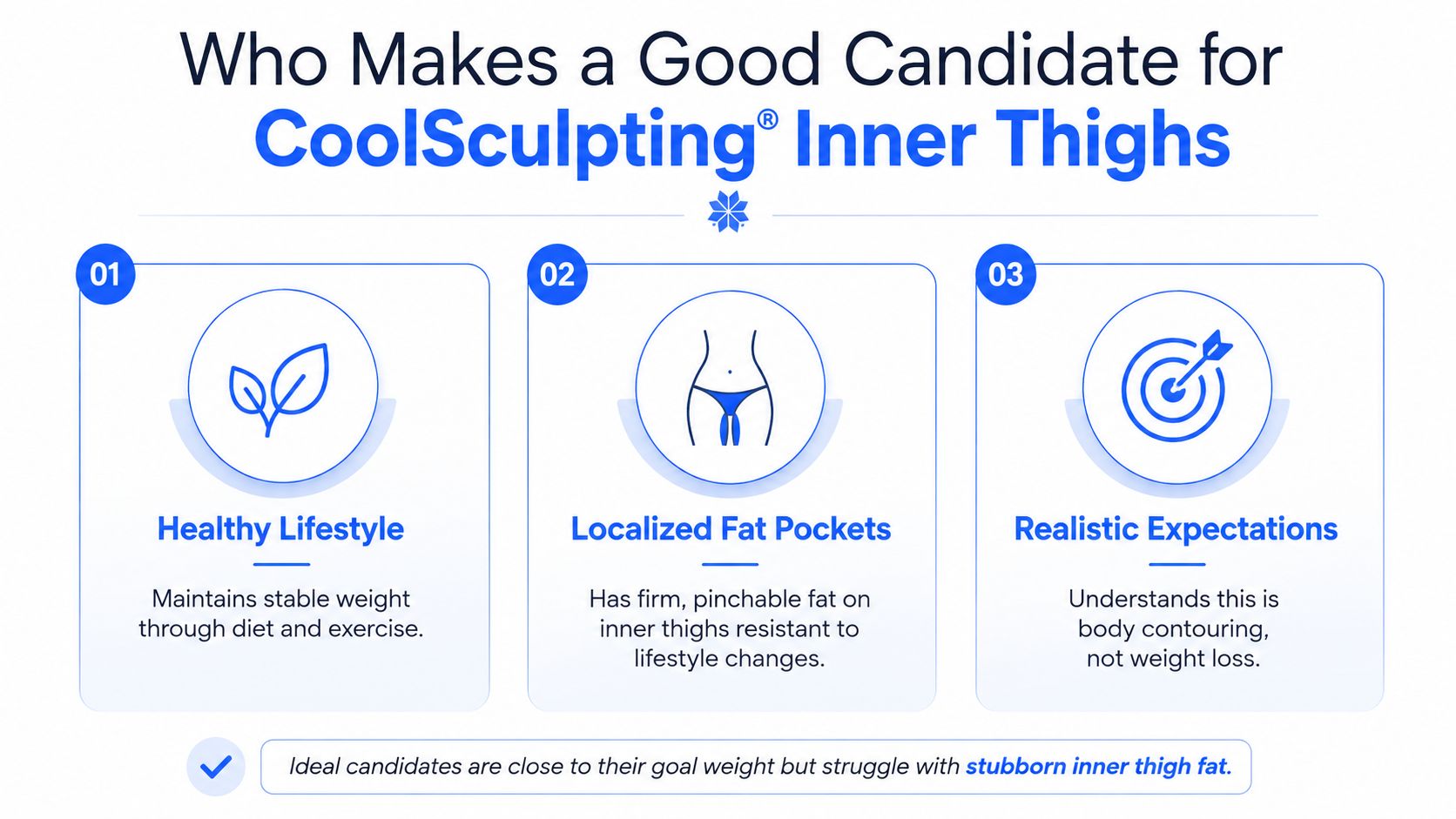
The best way to screen candidacy is to stop thinking about the whole body and look at the inner thigh itself. If the area is soft, pinchable, and locally persistent, that's very different from generalized weight gain or loose skin. A good candidate usually has a specific pocket that still behaves like fat, not skin laxity or diffuse fullness.
The pinch-and-grab test
A provider looks for tissue that can be pulled into the applicator cup. That's the practical version of candidacy, and it matters more than any single number on a scale. If the tissue can be lifted into the cup with a stable shape, the device has a better chance of treating it evenly.
Here's the self-check I'd use in plain language.
- Stable body weight: You're close to goal and not in the middle of major weight loss or gain.
- Pinchable tissue: The inner thigh has a distinct fold that can be grasped, not just soft diffuse fullness.
- Realistic expectations: You want contour improvement, not a complete reshaping of your legs.
- Medical fit: You don't have a cold-related condition such as cryoglobulinemia or cold agglutinin disease, and you're not pregnant.
The wrong fit is just as important to identify. If cellulite dimpling is the main problem, CoolSculpting isn't designed for that. The manufacturer says it can reduce stubborn thigh fat, but it does not target the connective tissue bands that create cellulite official thigh treatment page. That means a patient can have a smaller fat layer and still see texture on the skin surface if cellulite is the issue.
A consultation is the only reliable way to sort those differences out. Some people look like candidates in photos but turn out to have tissue that's too diffuse, too soft, or too close to the skin surface for a predictable result. Others are excellent candidates once the provider pinches and maps the zone. A virtual visit can start that process, but the final call usually comes from examining how the tissue sits, moves, and fits the applicator.
What Happens During a CoolSculpting Inner Thigh Appointment
A CoolSculpting inner thigh visit starts with planning, not cooling. The clinician looks at how the tissue sits, checks whether the left and right sides match, and marks the area so the applicator can contact the skin in the right place. That setup matters on the inner thigh because the area curves, changes shape with position, and often behaves differently from one side to the other.
The next question is whether the tissue can be pulled into the cup. The applicator needs a fold of fat it can grab evenly, almost like fitting a lid to a container with the right shape. If the fold is too small, too soft, or too spread out, the device may not sit well enough to give a predictable result, which is one reason the exam is more useful than photos alone.
The cold phase and the “freeze and squeeze” moment
Once the applicator is placed, suction draws the tissue into the cup and the cooling cycle begins. Patients usually describe the first part as pulling, pressure, tingling, or intense cold, rather than sharp pain. After the cycle ends, the area is often massaged briefly. That massage is a memorable part of the visit, and it helps break up the treated fat before the body begins clearing it.
The first few minutes are usually the oddest. After that, numbness takes over and many patients settle into reading, answering email, or just waiting it out.
The inner-thigh cryolipolysis study in clinical study reported no device- or procedure-related serious adverse events. That does not make the treatment feel trivial. It does give patients a documented safety profile for a non-surgical option that uses controlled cooling rather than incisions or anesthesia.
Why bilateral planning matters
Inner thighs are rarely treated as a single, uniform pocket. One side may hold a little more tissue, or the fold may sit higher or lower, so the clinician often plans both sides before starting. Symmetry matters because the goal is a balanced contour, not one thigh looking flatter while the other still bulges.
That planning also helps decide whether one cycle is enough or whether more than one pass will be needed. The best predictor is not a slogan about fat reduction. It is how well the tissue fits the applicator, how grabable the fat is, and whether the two sides can be treated to match each other.
The in-room part of the appointment is long enough that it is not a quick errand, but it is not a recovery visit either. Common short-term effects include temporary redness, swelling, numbness, and tenderness. Many patients leave and return to normal activities without special downtime, although the treated area can feel odd for a while because the nerves are temporarily dulled.
ProMD Health frames CoolSculpting as one part of a broader non-surgical body contouring plan, which can also include Emsculpt NEO, Kybella, ProMD Connect telehealth, and the AI Simulator when a patient needs help choosing the right path. The appointment itself still follows the same basic sequence, marking, fitting, cooling, massage, then waiting for the body to process the treated fat over the next several weeks.
Results Timeline and How Many Sessions to Expect
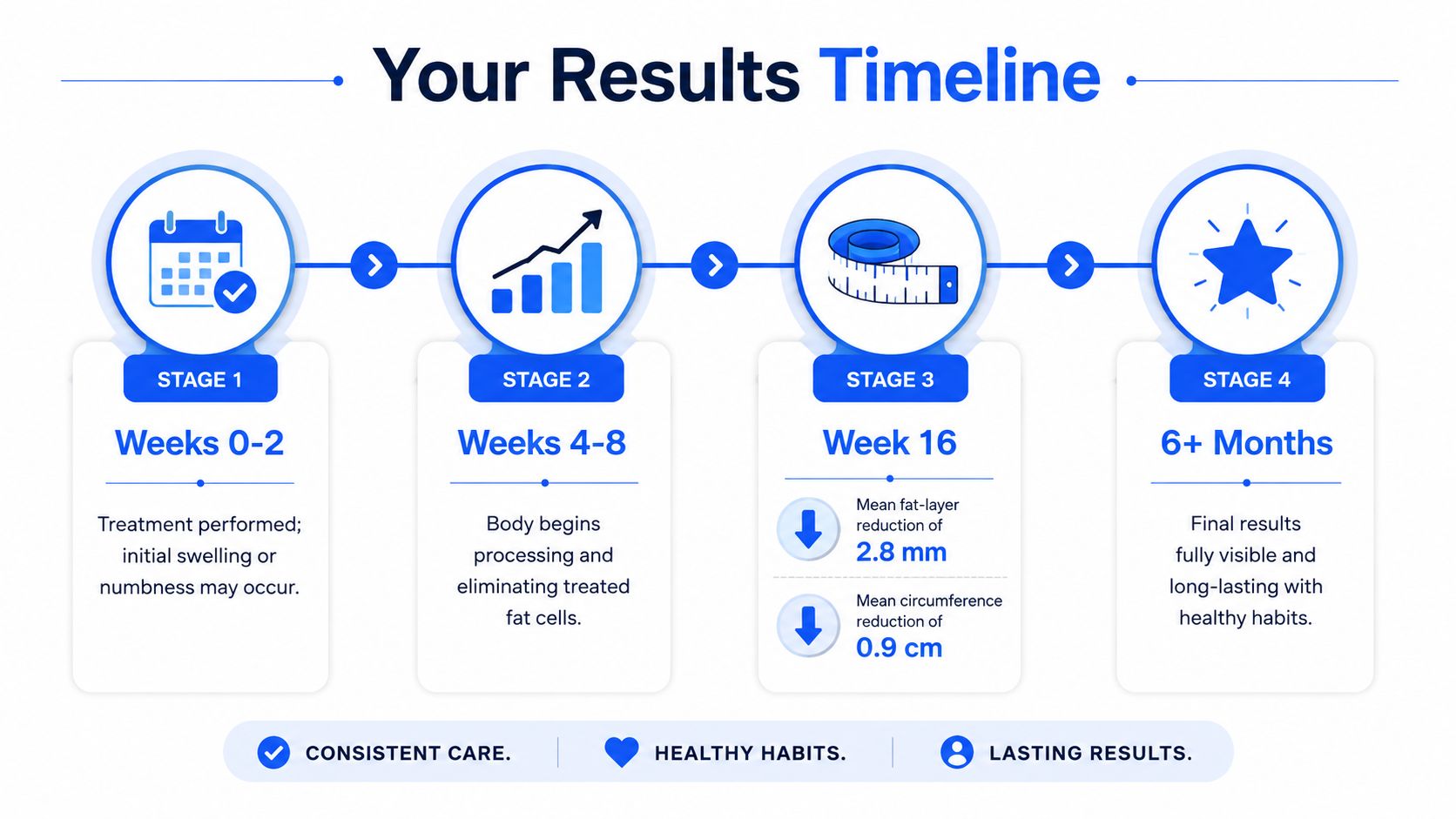
The first numbers can look small on paper, but they make more sense once you connect them to fit and contour. In a peer-reviewed inner-thigh study, ultrasound showed a mean fat-layer reduction of 2.8 mm with a 95% CI of 2.23 to 3.27, and tape measurements showed a mean circumference reduction of 0.9 cm at 16 weeks clinical study. That is not a dramatic ruler change, yet on a fitted leg opening or in the way the thighs meet, it can still be visible.
Why the timeline feels slower than people expect
The body clears treated fat over time, not all at once. Early swelling and numbness can hide the change, so the mirror may not show much in the first couple of weeks. The contour usually becomes easier to judge later, after the area settles and the treated fat has been processed.
A systematic review of inner-thigh data reported that 84% of patients noticed visible fat reduction, 93% were satisfied, 89% would recommend the treatment to a friend, and 91% were likely to return for a second treatment systematic review. Those numbers do not promise the same result for every person, but they do show that patients often recognize a real, gradual change.
Why more than one cycle is common
The inner thigh is harder to treat than flatter areas because the applicator has to fit the pocket of fat well. A clinical and commercial review found that inner thighs averaged 2.23 cycles per treatment site, while outer thighs averaged 2.18 cycles and flanks averaged 1.06 cycles clinical/commercial review. In plain language, the thighs often need more planning and more passes than many first-time patients expect.
Applicator fit, fat grabability, and bilateral symmetry usually matter more than a generic promise about fat reduction. If one side holds tissue differently, or if the fold sits higher on one thigh, a clinician may plan an extra cycle so the two sides match more closely. That is the same reason ProMD Health may pair CoolSculpting with other non-surgical body contouring options, including Emsculpt NEO, Kybella, ProMD Connect telehealth, and the AI Simulator, when a patient needs help deciding which route fits the anatomy.
Clinical takeaway: If the first cycle covers only part of the pocket, the plan is not a failure. It usually means the anatomy needed more than one pass for symmetry.
The broad up to 25% fat-reduction figure from general cryolipolysis reviews is better understood as a ceiling than a promise clinical review. The amount of visible change depends on how diffuse the fat is, how soft the tissue feels, and whether the applicator can capture the area evenly. A thigh that is easy to grab and fit tends to behave differently from one that is flatter, tighter, or more uneven from side to side.
Results build over weeks, not days, and the inner thigh often asks for more patience than other areas.
Risks, Side Effects, and What Can Go Wrong
A good consult should prepare you for the ordinary recovery window, not just the ideal outcome. After CoolSculpting on the inner thighs, the usual short-term effects are redness, swelling, bruising, tenderness, and numbness. Those reactions often feel more noticeable in the first few days, then settle as the tissue calms down.
The practical way to think about it is simple. The treated area has been chilled like an ice pack around fat cells, so the skin and the layer underneath can feel irritated for a while even when the procedure itself went as planned.
The rare-but-real problems
One inner-thigh study documented 1 case of mild numbness lasting 132 days systematic review. That is long enough to be annoying, but it is still a sensory issue rather than a sign that the leg was injured. Most numbness fades on its own, although a small patch can linger much longer than patients expect.
The other issue patients should know about is paradoxical adipose hyperplasia, or PAH. In PAH, the treated area enlarges instead of shrinking. It is uncommon, but because it changes the contour in the wrong direction, it needs a direct explanation rather than a brief mention.
When to call the clinic
- Increasing swelling: If the area looks more swollen instead of more settled as time passes.
- Hardening or a firm lump: Especially if it shows up around the healing window after treatment.
- New asymmetry: If one side seems to bulk out instead of smooth down.
- Persistent pain or unusual texture: More than the ordinary soreness or numbness people expect.
No device- or procedure-related serious adverse events were reported in the inner-thigh study cohort, which is reassuring, but it does not mean every recovery looks the same. Some people have a straightforward course with temporary numbness. Others notice a longer sensory tail or a contour change that needs a follow-up exam. If you are comparing options for body contouring, ProMD Health's Emsculpt NEO body contouring overview can also help you understand how a muscle-focused treatment fits alongside fat reduction.
The cleanest mindset is straightforward. Give the first few weeks time for swelling and numbness to settle, then judge the contour once the area has quieted down. If the shape seems to be going the wrong way, call the clinic instead of waiting it out.
CoolSculpting vs Emsculpt NEO, Liposuction, and Other Options
The right choice depends on what you want to change. If your goal is fat reduction only, CoolSculpting is a non-surgical option. If you want fat reduction plus muscle building, a different device makes more sense. If you want a larger-volume change in one procedure and you're open to surgery, liposuction enters the conversation.
| Option | Mechanism | Sessions | Downtime | Best Fit |
|---|---|---|---|---|
| CoolSculpting | Controlled cooling to reduce subcutaneous fat | Often more than one cycle for thighs | Minimal | Pinchable inner-thigh fat with gradual contour goals |
| Emsculpt NEO | Fat reduction plus muscle building | Multiple sessions | Minimal | People who want body composition change and tone |
| Surgical liposuction | Surgical fat removal | One procedure | Real recovery and anesthesia considerations | Larger-volume fat removal or faster change |
| Kybella | Injectable fat reduction in small, specific zones | Series of treatments | Temporary swelling | Submental fullness, not a standard inner-thigh option |
How to think through the decision
CoolSculpting fits best when the concern is a small, stubborn pocket and the patient wants to avoid surgery. It's gradual, non-surgical, and focused on fat, not muscle. Emsculpt NEO is the better fit when muscle tone matters too, because fat reduction alone doesn't always create the overall leg shape a patient has in mind.
Surgery changes the equation because liposuction can remove more volume in a single session, but the tradeoff is obvious. You're choosing anesthesia, recovery, and a much higher procedural commitment. For someone whose inner thigh problem is modest and well-defined, that extra burden may not be necessary.
The most common mistake is choosing based on the fastest promise instead of the anatomy in front of you. The leg doesn't care about marketing language, it responds to the right tool for the right pocket.
For patients who want a non-surgical plan that still considers muscle tone, Emsculpt NEO body contouring is often part of the discussion Emsculpt NEO overview. The practical question isn't which treatment sounds more advanced. It's whether the main problem is fat, tone, or both.
Cost Considerations in a Cash-Pay Model
The financial part is easier to understand once you stop looking for a single flat price. Inner-thigh CoolSculpting is typically priced per cycle, and the total changes based on how many cycles each leg needs, whether the treatment is staged, and whether symmetry calls for an added pass. That means the quote usually reflects a plan, not a one-size-fits-all number.
What drives the total
- Number of cycles per thigh: More cycles usually means a larger treatment plan.
- Applicator fit and size: The more precisely the device matches the tissue, the more efficient the plan can be.
- Single visit versus staged visits: Some thighs are better treated in phases.
- Retreatment for symmetry: One side sometimes needs refinement after the first round.
- Combination planning: A patient may pair thigh treatment with other body-contouring work.
ProMD Health operates on a cash-pay model, so these services are not billed to insurance. That makes the conversation straightforward, but it also means patients should ask about package pricing, financing options, and how the quote changes if more than one cycle is needed.
A helpful way to frame the estimate is to ask what's included, not just what the headline price is. Does the quote cover one cycle, both thighs, a follow-up visit, or only the initial applicator time? If the answer is vague, the final bill can surprise you later.
For a broader look at how non-surgical fat reduction is typically planned, the same cash-pay logic applies across body-contouring visits non-invasive fat reduction overview. The goal is to understand the plan before you commit, not after you've already started.
Your Next Step With ProMD Health
The smartest next move is a consultation that matches your anatomy to the right treatment path. At that visit, a clinician can decide whether the inner thigh pocket is a CoolSculpting problem, a cellulite problem, a muscle-tone problem, or some combination of all three. That distinction matters because the wrong treatment can make a person feel like they “tried everything” when the issue was the wrong tool.
ProMD Health also uses a broader non-surgical framework for planning, including ProMD Connect telehealth and the AI Simulator from Entity Med for pre-treatment visualization. That doesn't replace the exam, but it can help patients see how a contouring plan might look before they start. In some cases, a clinician may also discuss combining body contouring with weight management or hormone optimization when the body-shape concern is part of a larger wellness picture.
If you're comparing your options in person, the approved locations are Annapolis, MD, Arlington, VA, Ashburn, VA, Bel Air, MD, Bethesda, MD, Columbia, MD, Easton, MD, Fort Lauderdale, FL, Hutto, TX, Lafayette, CO, Lewes, DE, Timonium, MD, Tox Bar, Baltimore City, MD, Tysons Corner, VA, Washington, DC, Wellington, FL, and Westminster, MD. Pick the nearest clinic, then use that visit to confirm whether your inner thighs are a good match for cooling, muscle building, or another contouring route.

Schedule a consultation if your inner thighs still bother you when you sit, walk, or shop for clothes, because that's usually where the answer starts. Visit ProMD Health to explore body contouring, telehealth support, and a treatment plan built around your actual anatomy, not a generic promise.
If you're ready to talk through coolsculpting inner thighs with a medical team, ProMD Health can help you sort out candidacy, timeline, and next steps. Book a consultation, compare your options, and see whether a non-surgical contouring plan fits your goals at ProMD Health.


