
You can do the workouts. You can keep your nutrition consistent. You can still look at the side of your hips and feel like nothing changes. That's a common reason people start looking into non surgical body contouring for hips.
The usual complaint isn't overall weight. It's shape. A little fullness at the outer hips, a stubborn pocket near the flanks, or a silhouette that doesn't match how healthy and active you feel. For many adults, that area resists the usual strategies because body contour concerns are often local, not global.
That's where non-surgical treatment has changed the conversation. Instead of surgery, anesthesia, scars, and recovery, body contouring now gives the right candidate a way to refine shape with targeted technology and realistic downtime. It's also not a niche category anymore. Nonsurgical fat reduction ranks among the five most popular nonsurgical cosmetic procedures globally, trailing only botulinum toxin, hyaluronic acid, hair removal, and chemical peels, a trend that has held steady for over a decade according to the Journal of Clinical and Aesthetic Dermatology.
Table of Contents
- Redefining Your Shape Without Surgery
- The Science Behind Non-Invasive Fat Reduction
- Why We Trust Emsculpt NEO for Hips
- Determining Your Candidacy for Hip Contouring
- What to Expect Before During and After
- Understanding Results Risks and Long-Term Success
- Planning Your Investment in Body Contouring
Redefining Your Shape Without Surgery
A patient sits down and says some version of the same thing: “My weight is fairly stable, but my hips still hold fullness I can't seem to change.” Sometimes they call it saddlebags. Sometimes they're talking about the outer hip area next to the buttocks. Sometimes the frustration is more about proportion than size.
That distinction matters. Hip contouring isn't about making a person smaller overall. It's about changing how one area blends into the next. When the goal is improved shape rather than major weight loss, non-surgical treatment becomes a practical option.
Why people choose body contouring instead of surgery
The appeal is straightforward. People want visible change without the disruption that comes with liposuction or another invasive procedure. They want to go back to work, family life, and exercise quickly. They also want the result to look like a refined version of their own shape, not a dramatic transformation that feels disconnected from the rest of the body.
That's why interest in non-invasive body contouring keeps growing. For the right patient, treatment can target localized fullness while preserving a natural-looking transition through the waist, hips, and glute area.
Non-surgical hip contouring works best when the concern is localized fat or limited definition, not when someone is looking for a weight-loss solution.
What a good result actually looks like
The best outcomes usually don't scream “I had something done.” They look balanced. Clothing fits more cleanly at the hip line. Leggings and jeans sit better. The side profile looks smoother. The person often notices it first in photos or in how their body looks from the back and side.
A good consultation focuses on that goal. Not just reducing fullness, but deciding whether reducing that area will improve proportion or create a hollowed look. That clinical judgment is what separates a thoughtful contouring plan from a rushed one.
The Science Behind Non-Invasive Fat Reduction
Non-invasive fat reduction sounds simple from the outside, but the biology is very specific. The treatment isn't “melting” fat in a vague sense. It's creating controlled stress in fat cells so the body can gradually clear them.
The central mechanism is apoptosis, which means programmed cell death. In practical terms, the device delivers energy to the subcutaneous fat layer, and the treated fat cells become damaged in a way the body recognizes and removes over time. Clinical literature notes that non-invasive body contouring procedures can achieve a statistically significant circumferential reduction of 2 cm or more by inducing apoptosis in subcutaneous adipose tissue, and that these modalities spare skin, muscle, and neural structures by precisely targeting the 1–3 cm depth of subcutaneous fat in the Journal of the European Academy of Dermatology and Venereology abstract.
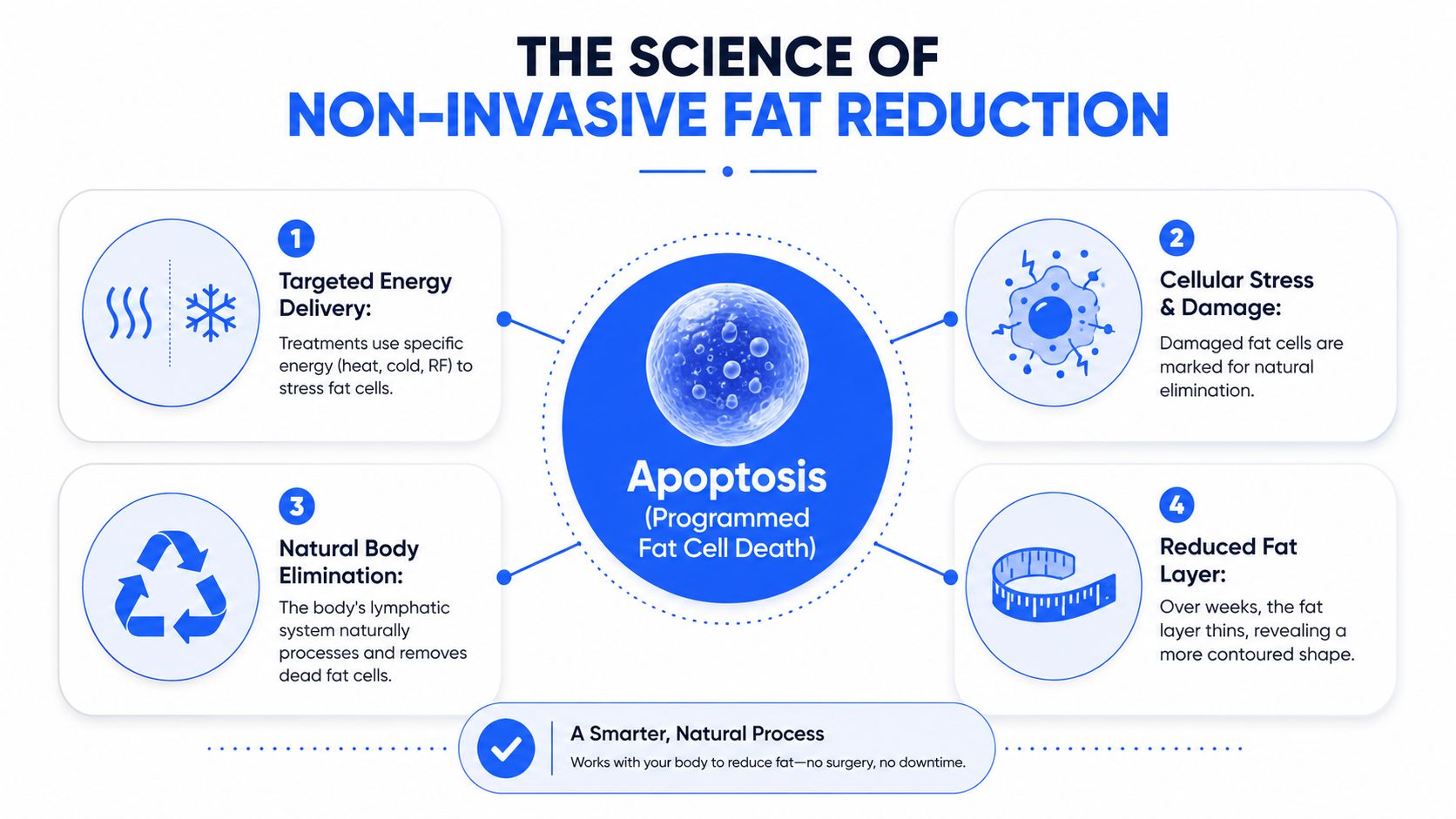
The process in plain language
Think of it as a targeted cleanup process:
- Energy reaches the fat layer and stresses adipocytes without broadly injuring surrounding tissue.
- The treated fat cells are flagged for removal.
- Your body processes the debris naturally through normal clearance pathways.
- The treated area slowly thins as that fat layer becomes smaller.
This is why results aren't immediate in the way a surgical procedure is immediate. The body still has work to do after the session ends.
Why precision matters
Hip contouring only works well when the treatment depth matches the tissue you're trying to change. Treat too superficially and you don't meaningfully affect the fat layer. Treat too broadly and you risk irritation without enough contour benefit. Good body contouring depends on selecting the right area, the right patient, and the right endpoint.
That's also why movement and muscle matter in the bigger conversation. Some patients who spend much of the day sitting are already thinking about body support, activation, and posture, not just fat reduction. If you want extra context on how electrical muscle stimulation fits into a sedentary lifestyle, this overview on EMS for sedentary professionals is a useful general read.
Practical rule: Fat reduction technology should target the problem tissue, not chase a vague promise of “overall slimming.”
For patients exploring non-invasive fat reduction, the key takeaway is that the science is selective. These treatments are designed for localized contour change, not total-body weight reduction.
Why We Trust Emsculpt NEO for Hips
The hip area is tricky because the visual issue often isn't just fat. It's shape. If you only reduce fullness and ignore the underlying support of the surrounding musculature, the area can look flatter without looking better.
That's why a dual-action approach makes sense here. Emsculpt NEO delivers simultaneous high-intensity focused electromagnetic (HIFEM) energy and radiofrequency (RF) heating, which has been clinically shown to reduce fat by an average of 28% and increase muscle mass by 25% in the treated area after a course of treatments on the ProMD locations page.
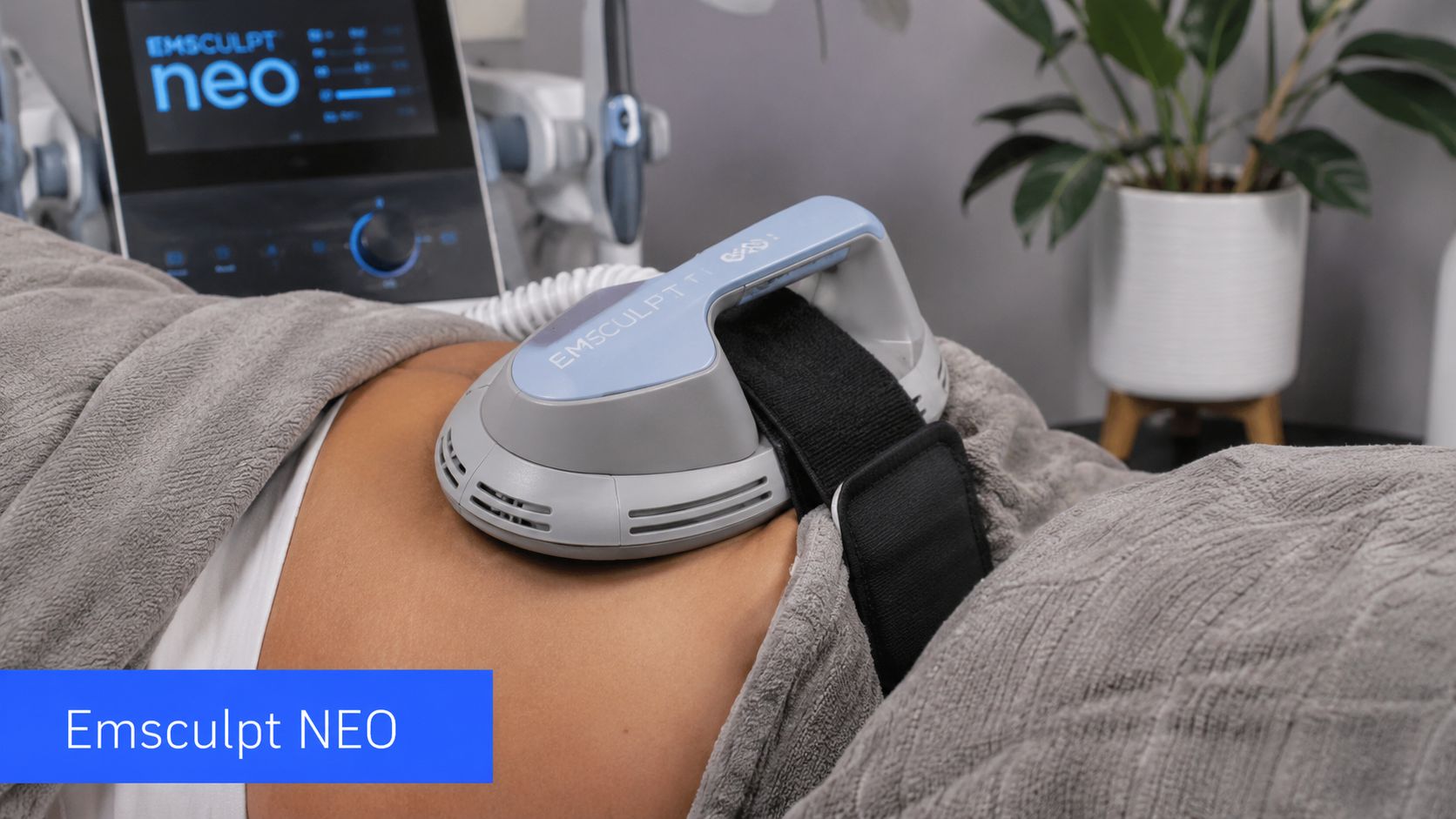
Why fat-only treatment can miss the mark
On the hips and adjacent glute area, contour comes from the relationship between tissues. Reduce one zone without improving tone nearby and you may get less fullness, but not the smoother, lifted silhouette that is typically desired.
That's the practical difference with a device that addresses fat and muscle in the same treatment plan. RF heating supports fat reduction. HIFEM drives intense muscle contractions in the treated area. For some patients, that creates a more athletic contour than a fat-only strategy.
Where this approach fits best
This type of treatment is especially relevant when the person wants one or more of these changes:
- Less outer-hip fullness with better side contour
- More definition through the glute-hip transition
- A firmer look rather than a smaller one alone
- A non-surgical option that doesn't interrupt normal routines
The point isn't to chase an artificially sharp silhouette. It's to refine the area so the body looks more balanced in motion, in fitted clothing, and from multiple angles.
Why the integrated model matters
In practice, body contouring decisions get better when they aren't made in isolation. A patient may also be working on weight management, exercise consistency, or broader wellness goals. That context affects both candidacy and maintenance.
One option used in that setting is Emsculpt NEO body contouring, which combines HIFEM and RF for patients who want contouring support without surgery. For hip-focused treatment, that matters because you're not only asking, “Can we reduce this area?” You're asking, “Can we improve how this entire region looks?”
Good hip contouring doesn't just subtract volume. It improves the relationship between the hips, flanks, and buttocks.
Determining Your Candidacy for Hip Contouring
The right candidate usually already knows the problem area. They can point to it. It's the outer hip, the upper flank, or the zone where the hip meets the buttock. What they often need help with is deciding whether treatment will improve proportion or shrink tissue.
Clinical research on body contouring technologies commonly supports use in patients with BMI under 30 kg/m² and localized fat rather than generalized obesity, as noted in the earlier clinical discussion. The FDA also makes an important distinction in the earlier source from the Journal of Clinical and Aesthetic Dermatology discussion. Non-invasive body contouring is meant to alter contours, not treat obesity or improve overall health.
A useful self-check before consultation
You may be a strong candidate if several of these sound like you:
- Your weight is relatively stable: You're not in the middle of major gain or loss.
- The issue is localized: One area bothers you more than your body as a whole.
- Your skin still has decent elasticity: The skin can adapt more smoothly after volume changes.
- Your expectations are shape-based: You want refinement, not a dramatic reduction in total body size.
- You'll maintain the result: You're prepared to support outcomes with routine habits.
If several of those don't fit, treatment may still be possible, but the conversation needs to be more careful and individualized.
When a consult matters most
The patients who benefit most from consultation are often the ones who are unsure whether the concern is hip fat, poor tone, adjacent fullness, or skin quality. Those are different problems. They don't all respond the same way.
That's where in-person assessment helps, and telehealth can help too. Virtual visits through ProMD Connect can be useful for an early candidacy discussion, reviewing goals, and deciding whether an office visit for mapping and treatment planning makes sense. It's a practical way to start when someone wants guidance before committing to an in-person appointment.
What to Expect Before During and After
Individuals often feel more comfortable once they know the sequence. Hip contouring is easier to say yes to when you understand what happens in the consult, what the treatment feels like, and how the results unfold.
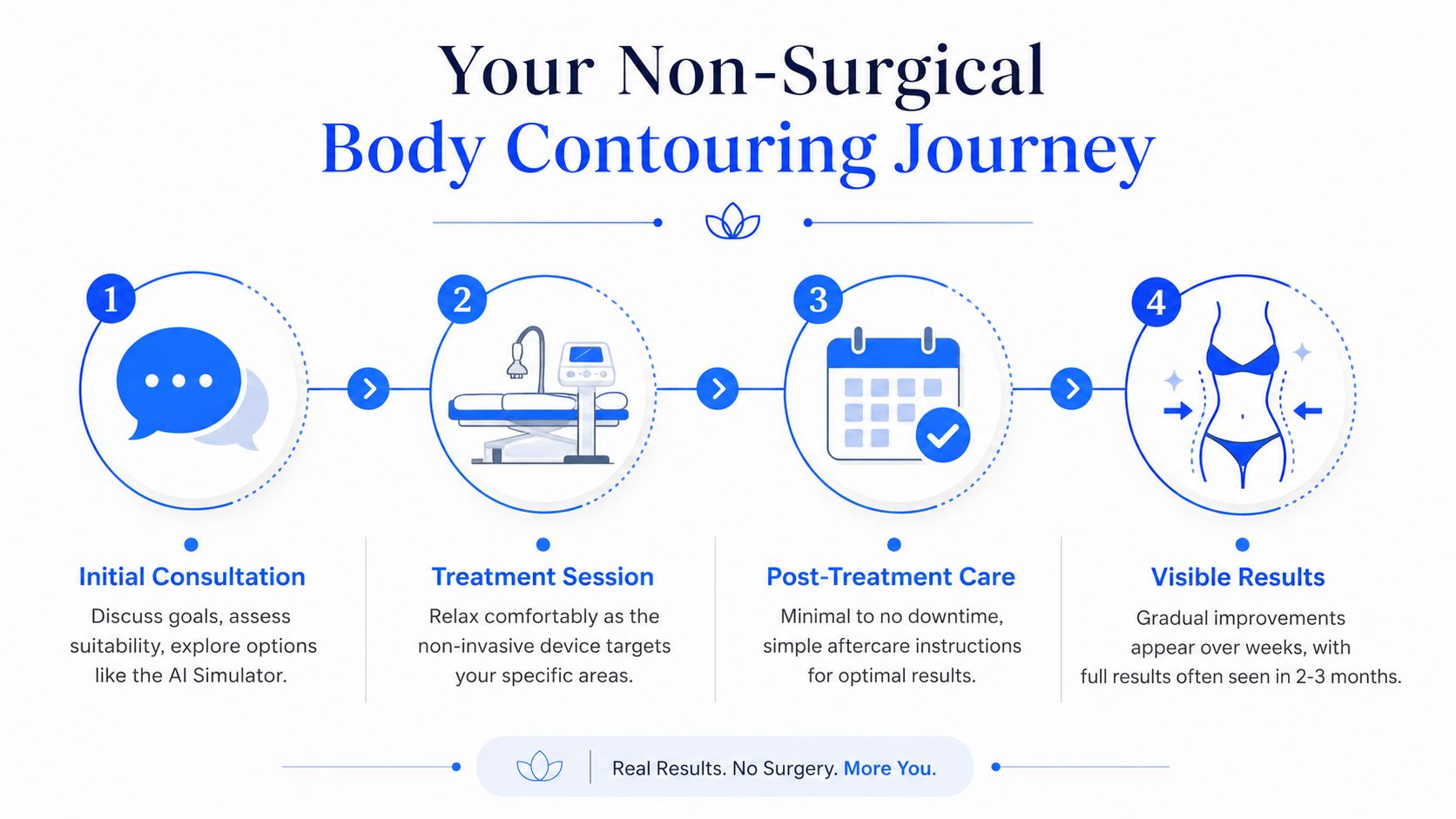
Before treatment
The first step is goal-setting, not device-setting. That means discussing what bothers you, which angles matter most to you, whether the concern is volume, tone, or both, and whether adjacent areas should be part of the plan.
Some practices also use visualization tools to support that discussion. ProMD Connect and in-office consultations may include planning support such as the AI Simulator to help frame realistic outcome goals. That doesn't replace clinical judgment, but it can make the conversation more concrete.
During treatment
For Emsculpt NEO, sessions are brief and structured. The device is positioned over the treatment area while the patient rests. The feeling is a combination of warmth and strong muscle contractions. It's unusual the first time, but it's not the same experience as surgery, needles, or downtime-heavy procedures.
A common question is whether one visit is enough. In most non-invasive body contouring protocols, most patients require 2 to 4 sessions, and visible thinning generally begins within 1 to 2 weeks post-treatment, becomes progressively evident over the next 3 to 4 months as the lymphatic system clears destroyed adipocytes, and stabilizes by 6 to 12 weeks, according to this PubMed review of noninvasive body contouring.
After treatment
Individuals typically return to normal activity quickly. Depending on the treatment approach, you may notice temporary soreness, a worked-muscle feeling, or mild sensitivity. That's usually easier for patients to tolerate than recovery from an invasive procedure.
Results don't arrive all at once. They tend to show up in stages:
| Stage | What patients often notice |
|---|---|
| Early | The area may feel firmer or more activated |
| Gradual | Clothing fit changes and side contours look smoother |
| Mature | The treated area looks more refined as shape settles |
The timeline matters. If you expect same-day reshaping, you'll be disappointed. If you expect a gradual contour change, the process makes sense.
Understanding Results Risks and Long-Term Success
A balanced discussion matters here. Non surgical body contouring for hips can create meaningful improvement, but it isn't magic and it isn't one-size-fits-all.
The strongest outcomes usually happen when the patient is already close to their target weight, the concern is localized, and the treatment plan respects the surrounding anatomy. In the broader clinical literature already noted earlier, non-surgical contouring technologies commonly produce measurable circumferential change and are considered a reasonable alternative for localized fat reduction in appropriate candidates.
What works
Patients tend to do well when they approach treatment as a finishing tool. They already exercise. They already eat reasonably well. They aren't asking the device to do all the work. They're using it to improve an area that hasn't responded proportionally to their effort.
These patients also tend to accept the actual endpoint. Better contour. Better balance. Better fit in clothing. Not perfection.
What needs caution
One of the most important risks in hip contouring isn't a dramatic complication. It's an aesthetic misstep. The FDA notes a fat redistribution risk, meaning that reducing hip fat without addressing adjacent areas like the buttocks or lower back can disrupt the body's natural proportions, as described on the FDA page on non-invasive body contouring technologies.
That point gets overlooked in marketing, but it matters in real practice.
- If the hips are reduced alone: the silhouette can look overly concave.
- If skin elasticity is limited: the area may not tighten as smoothly as the patient expects.
- If the glute area lacks support: reducing side fullness can make the buttocks appear flatter by contrast.
A technically successful treatment can still be an aesthetic disappointment if the surrounding areas aren't considered.
How to protect your result
Long-term success depends less on “maintenance hacks” and more on consistency.
- Keep your weight stable: Major weight changes can alter the contour you created.
- Stay active: Movement supports muscle tone and overall body composition.
- Follow the actual plan: If your provider recommends treating adjacent areas or completing a full series, that recommendation usually reflects proportion, not upselling.
- Be honest about goals: If you want a surgical-level change, non-surgical treatment may not match that expectation.
Planning Your Investment in Body Contouring
Cost is usually one of the last questions people ask out loud, but one of the first questions they think about. That's reasonable. Body contouring is cosmetic care, and treatment plans vary based on the area being treated, the goals, and the number of sessions needed.
Pricing also depends on whether the treatment plan is focused narrowly on one hip-adjacent zone or whether it needs a broader approach for better balance. In many cases, a more thoughtful plan includes nearby contour considerations rather than treating a single pocket in isolation.
What affects pricing
A personalized quote usually reflects a few practical variables:
- Treatment area size: A small focal concern is different from a broader flank-and-hip plan.
- Number of sessions: Some patients need a shorter course, while others need a more complete series.
- Treatment goals: Fat reduction alone and fat-plus-muscle contouring aren't always the same plan.
- Combination planning: Some patients may benefit from pairing body contouring with broader wellness support.
Insurance and payment expectations
This is cosmetic treatment. It isn't covered by insurance through ProMD Health's care model. Patients should expect a cash-pay structure for body contouring services.
That doesn't mean the decision should be rushed or reduced to shopping by headline price. The more useful question is whether the plan fits your actual goal and whether the treatment is likely to create a visible, proportionate change. A consultation is the best place to get a precise recommendation and a clear quote based on your anatomy and priorities.
If you're considering ProMD Health for hip contouring, the smartest next step is a consultation that looks at shape, muscle tone, adjacent areas, and lifestyle support together. That kind of planning helps you decide whether treatment makes sense, what result is realistic, and how to build a contouring plan that fits your body and your goals.


