You woke up, checked the mirror, and the skin beside one eye looks worse than it did in the chair. A small purple mark sits where the needle went in for crow's feet, and you're trying to decide if that's ordinary healing or a reason to call. Most bruising after Botox crow's feet follows a short, readable path. Color, size, and pain tell you which day you're on, and which change means you should stop waiting.
Table of Contents
- How Long Crow's Feet Bruising Lasts
- What to Do in the First 24 to 48 Hours
- When Bruising Needs a Medical Visit
- Why the Eye Area Bruises and Who Is at Higher Risk
- Lowering Bruising Risk at Your Next Treatment
How Long Crow's Feet Bruising Lasts
Check today's mark against this window, not against a friend's photo from last month.
| Window after injection | What is normal | When to contact your injector |
|---|---|---|
| Day 0 to 1 | Small red or purple marks at injection points, mild tenderness | Swelling that tightens or pain that keeps increasing |
| Days 2 to 3 | Color deepens to blue, purple, or green; often the most visible stage | Bruise spreading beyond the injection points or feeling firm and enlarging |
| Days 4 to 7 | Fading toward yellow-brown; most adverse reactions have appeared by the end of week one | Darkening or new pain after day four |
| Week 2 | Faint yellow tint or light residual discoloration | Bruise not clearly improving by about two weeks |
| Beyond 2 weeks | Uncommon; larger bruises may remain up to 1 to 2 weeks | Any bruise that is still changing, painful, or spreading |
The bruise is blood trapped under the skin; the toxin itself does not show as color. Crow's feet treatment places onabotulinumtoxinA into the orbicularis oculi, the thin muscle that rings the eye. That skin is thin and webbed with tiny vessels, so even correct placement can graze one and leave a visible pool.
Color change is chemistry, not spreading damage. Hemoglobin breaks down in stages, which is why a mark often looks darkest on days 2 to 3 before it thins to green, then yellow-brown. Think of those middle days as the stain developing fully before cleaners arrive.
The FDA BOTOX Cosmetic labeling lists bleeding and bruising, along with pain, tenderness, swelling, and redness, as effects tied to the injection. It also states that adverse reactions generally occur within the first week and are usually transient, though some effects can last longer. The same labeling recognizes BOTOX Cosmetic for adults with lateral canthal lines, the lines people call crow's feet.
Use the table above as your day-by-day check. If a color, size, or pain change worries you, compare it to the right-hand column first.
What to Do in the First 24 to 48 Hours
A tiny vessel under the skin has been nicked, and the first 48 hours are about keeping that leak from spreading. The goal is a mark that behaves predictably, not a perfectly clear eyelid by morning.
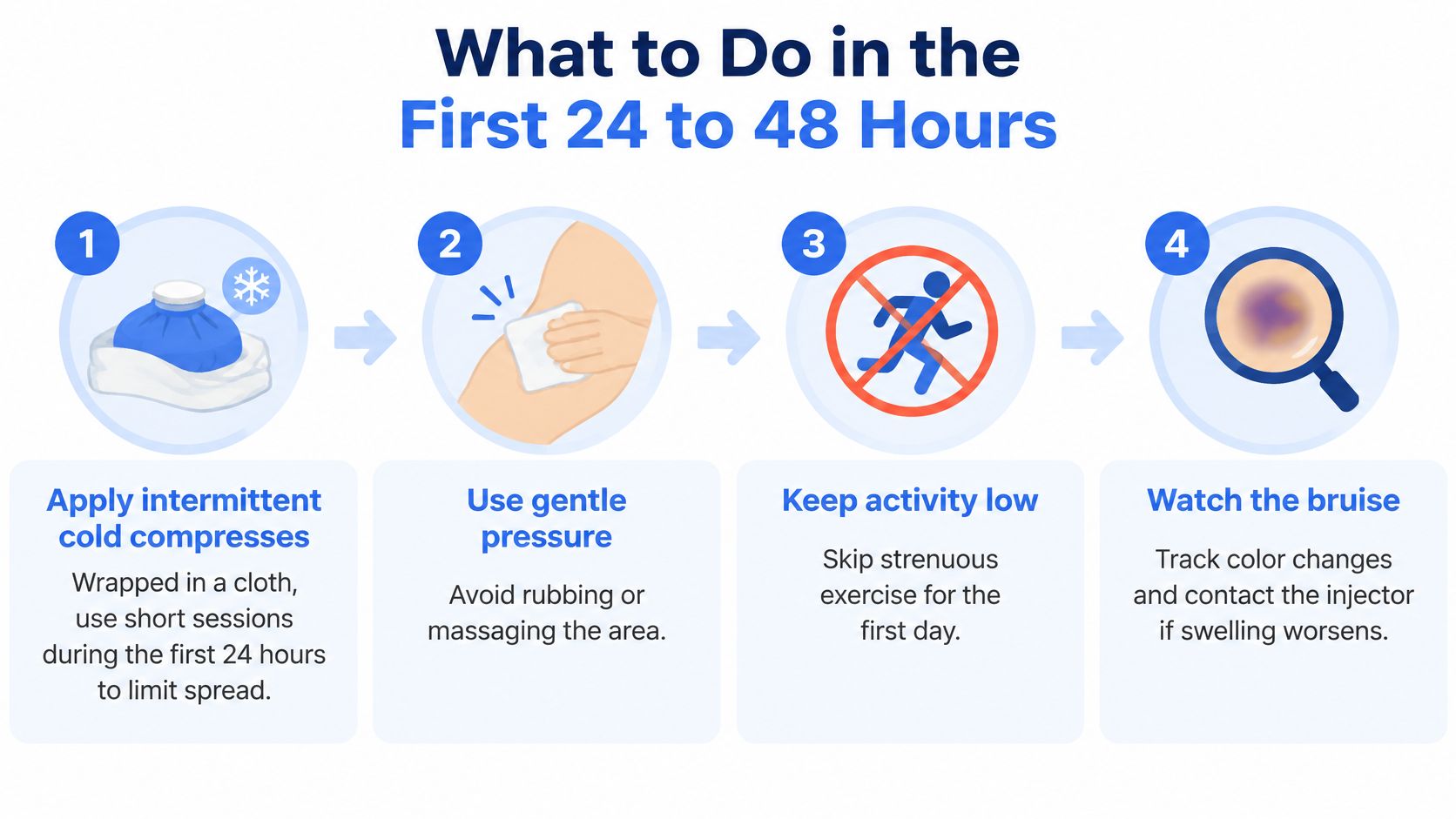
- Cold in short sessions. Wrap a cold compress in a thin cloth and hold it on for a few minutes at a time during the first 24 hours. Cold narrows vessels while a tiny bleed can still spread. Ice directly on the eyelid is too harsh for this skin.
- Gentle pressure, not a rub. If a spot is tender, press with a clean fingertip. Rubbing or massage can push blood farther under the skin and blur the edges of the mark.
- Keep the day quiet. Skip strenuous exercise, long bending, and sleeping face-down in this early stretch. Extra blood flow and pressure on the face can feed a bruise that was already settling.
- Stay upright the way the clinic asked. If you sleep on your side, an extra pillow keeps the treated side off the mattress. Follow the clinic's instructions for remaining upright rather than inventing a new position.
- Photograph it once a day. Same window, same angle, same light. A photo beats memory when you are deciding whether green is fading or the patch is wider.
- Ask before you take a pain reliever. Some people reach for aspirin or an NSAID out of habit. Those medicines can affect clotting, so ask the injector which option is reasonable for you. Prescribed blood thinners are a separate medication question, covered in the medical-visit guidance below.
- Makeup waits for a yes. Camouflage is useful once the skin is closed, and a clinic can confirm you are ready. Our guide on how to conceal a bruise on the face covers placement without tugging the eyelid.
Two exceptions in this early window deserve a same-day call rather than a wait: a bruise that swells and feels firm or tense, and pain that rises instead of settling. The escalation table below covers the rest.
A published note on periorbital care describes most of these bruises as self-limited: intermittent cold and gentle pressure in the first 24 hours, no rubbing, and a pause on hard exercise, prolonged bending, and face-down sleep, with bruises commonly clearing in about one week and larger ecchymoses sometimes visible for up to 1 to 2 weeks, according to that periorbital technique report. By the end of day two, the benchmark is simple: the mark is stable or a touch lighter, not bigger and not more painful.
When Bruising Needs a Medical Visit
Flat purple color on the expected timeline is a bruise. The symptoms below need a different response, and the response depends on what you see.
Match the symptom to the response
| Symptom | Possible meaning | Action |
|---|---|---|
| Blurred or double vision | Possible toxin effect beyond the injection area | Seek urgent medical care now |
| Eyelid drooping that worsens and affects vision | Needs urgent evaluation | Seek urgent medical care now |
| Trouble swallowing, breathing, or speaking clearly | Serious warning sign | Call emergency services |
| Bruise that expands quickly and feels firm or tense | Possible hematoma | Contact injector the same day |
| Severe or increasing pain, fever, or spreading redness | Possible complication or infection | Contact injector or clinic promptly |
| Bruise not improving by about two weeks | Atypical persistence | Schedule an injector review |
The color itself usually comes from the needle, not the toxin. A meta-analysis of 32 randomized trials involving 9,669 patients found injection-site bruising, hematoma, or hemorrhage at nearly the same rate with botulinum toxin and placebo (risk ratio 0.99; 95% confidence interval 0.66 to 1.49). That pattern fits a small vessel nicked during injection. The top three rows are the exception. They describe neurologic and airway warning signs, and they need emergency assessment, not a wait-and-see approach.
A bruise that expands quickly and feels firm or tense is the same-day call. That texture suggests a hematoma, a pocket of blood, rather than a flat ecchymosis that is already breaking down. Pain that rises, fever, and redness that spreads also move you from watching to contacting the clinic. Marked asymmetry belongs in that group because it can signal swelling or a collection that needs a look.
Time alone is the trigger for a scheduled review. If your daily photos show no clear improvement by about two weeks, book an injector review. It is not an emergency, and it is not a mark to keep covering for another month.
Do not stop a prescribed blood thinner because a cosmetic mark appeared. Call the injector and the prescribing clinician together so they can weigh the bruise against the reason you take the medicine. For a clear look at what belongs in a visit versus what can wait, see Botox safety at ProMD.
Why the Eye Area Bruises and Who Is at Higher Risk
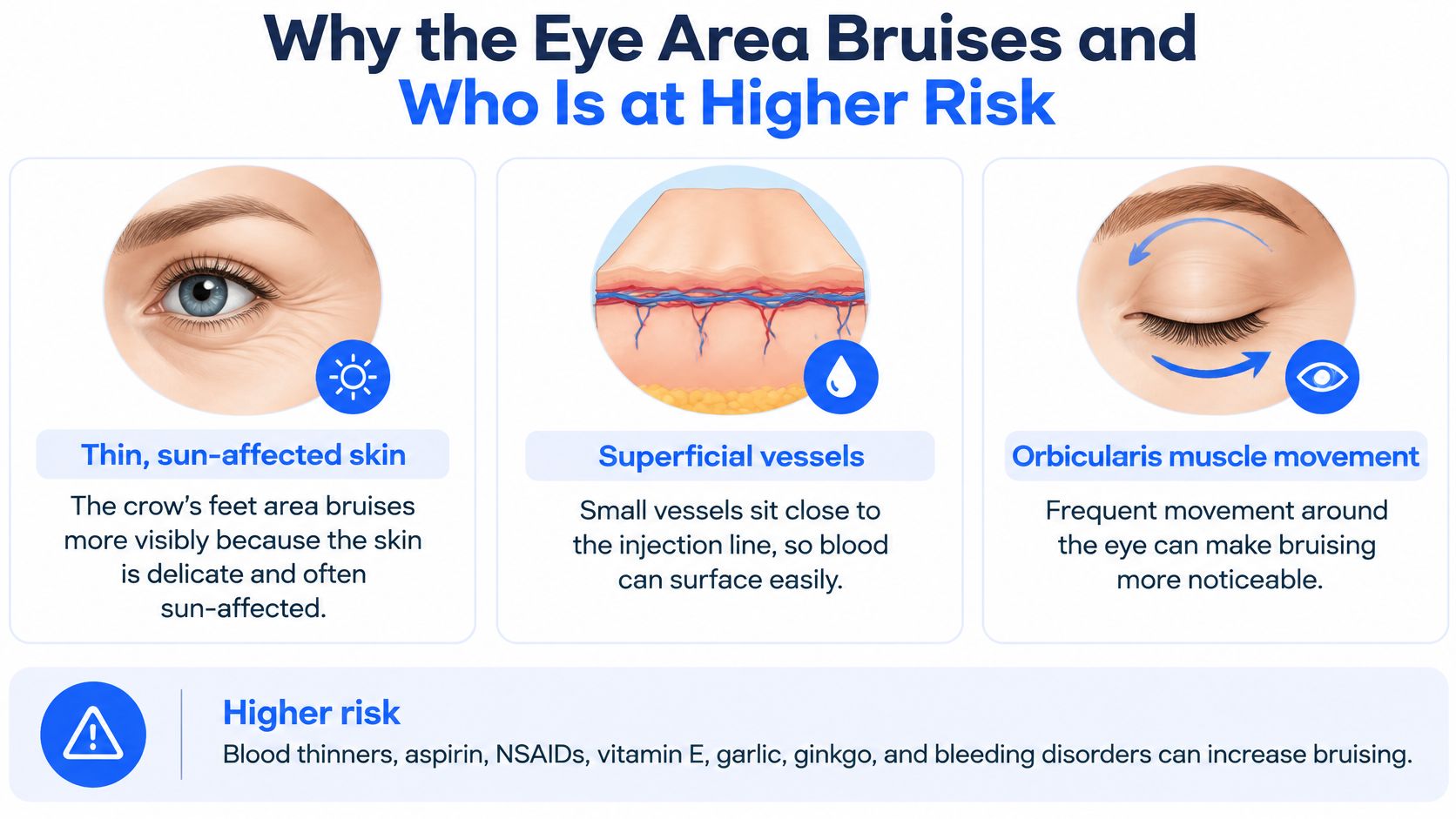
You notice a spot near the outer eye first because the skin hides almost nothing. The layer is thin and often sun thinned, tiny veins sit close to the surface, and the orbicularis muscle moves with every blink and smile. A needle that touches one small vessel leaves blood with nowhere to hide, so the color looks darker than the same nick would look on a cheek.
Cleveland Clinic describes the mechanism as minor bleeding under the skin after the needle contacts a small vein, and it names small, light bruises among the most common Botox side effects. Thin periorbital skin explains why that small amount of blood shows so clearly.
Why the percentages don't match
| Source or study | Reported figure | What it actually measures |
|---|---|---|
| General clinical references | About 11 to 25 percent | Mild bruising after botulinum toxin across studies |
| Retrospective series of 945 patients | 1.25 percent | Mild bruising across 4,103 abobotulinumtoxinA cycles |
| Periorbital single-point observation | Small marks seen in a few cases | Small unilateral ecchymosis in an uncontrolled design |
| Aesthetic botulinum review | 12 to 16 percent | All complications combined, not bruising alone |
A clinical reference on botulinum toxin places mild bruising at about 11% to 25% of patients, while a retrospective review of 945 patients and 4,103 abobotulinumtoxinA cycles in that same discussion reported mild bruising in 1.25%. A separate clinical review of aesthetic botulinum procedures puts overall complication rates in the approximate range of 12% to 16%, and that combined figure includes many events, not bruising alone. Product, body site, study design, and how a bruise was counted all change the number. The single-point periorbital observation was uncontrolled, so it cannot show that one technique bruises less.
That difference matters for your own check. Expect variation.
Bring this list to the injector as a checklist, not as a plan to quit a prescription:
- Blood thinners, aspirin, and NSAIDs: these change how quickly a small vessel seals.
- Vitamin E, garlic, and ginkgo: supplements can affect clotting even when they feel harmless.
- Alcohol near treatment and a history of easy bruising: both raise the chance you will see color.
- A known bleeding tendency: this belongs in the chart before anyone chooses a plan.
Bruising is common in this zone, and one mark does not indicate a poor result. If you are also weighing treatment under the eye, unit planning is a separate conversation from bruise care, and how many units of Botox for under eyes is the place to start that question with a clinician.
Lowering Bruising Risk at Your Next Treatment
A bruise starts with a capillary the eye cannot plan around. Good preparation makes that contact less likely and gives you a buffer if color still appears.

Before you book the chair
Arrive with the written checklist covered earlier, with prescriptions, over the counter products, supplements, bleeding history, and any past injection bruise plus the date of your next event. Bringing that same list avoids a repeat review and lets the injector spot an interaction before the skin is cleaned.
Two small habits help on the day. Skip alcohol if you are advised to, usually for a day or two beforehand, because alcohol can leave vessels wider when a needle passes. Arrive with a clean face. Makeup covers the faint blue lines an injector uses to choose an entry point.
Timing counts as prevention. If your week looks like the schedule of the businessman behind the Lord Sugar name, with cameras and meetings stacked back to back, leave a full week before photos. Never stop a prescribed blood thinner to chase a cleaner result. That choice stays between the injector and the prescriber. Botox treatments at ProMD Health are customized to each patient's individual aesthetic needs, which includes this medication review.
Questions worth asking in the room
Ask how the injector plans fewer punctures, steady head position, strong light, and a gentle skin stretch so surface vessels show. Finer equipment helps only if placement avoids those vessels, so vessel avoidance and a steady hand matter more than needle size. Technique lowers the risk of a bruise, but it cannot rule one out.
Also ask what happens if a vessel is visible, and what they do if bleeding starts. The practical response is immediate firm digital pressure and a cold pack, then clear aftercare you can repeat at home.
Bring three things to the next visit: your completed list, a note of your event date, and one question about how crow's feet will be approached if a vessel shows.
Pair that list with a daily photo plan for the first week, then book the consultation before the treatment so medicines, timing, and a follow-up are settled while the calendar is still flexible.
ProMD Health customizes neurotoxin care for crow's feet and other expression lines, including a medication review and aftercare so a bruise has a plan before it shows up. If you're weighing timing around an event, or you want a clinician to look at a mark that isn't fading, visit ProMD Health and book a consultation.