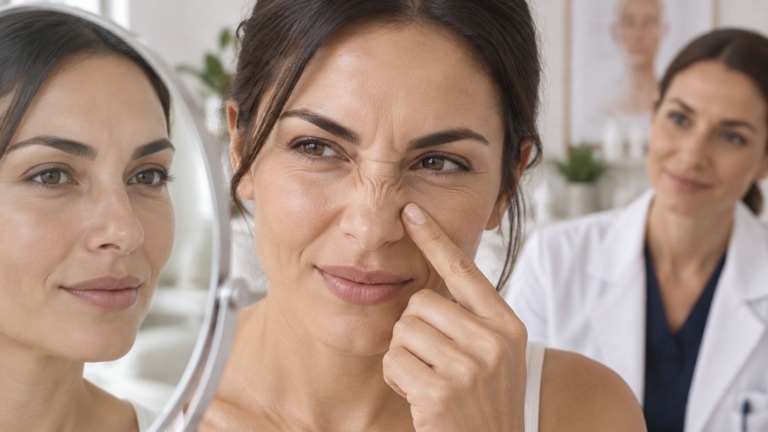
One under-eye number can blur two different treatments. The FDA-labeled crow's-feet dose is 24 units total, given as 12 units per side across three sites on each side, according to the FDA prescribing information. Lower-lid injections are off-label; a 2024 clinical study used about 2 to 3 units per side. Those figures apply to different areas and should not be treated as interchangeable.
If you squint in bright sunlight and lines fan out at the outer corners, that pattern matches the labeled crow's-feet treatment. A small crease or roll that gathers beneath the lashes when you smile raises a separate lower-lid question. The muscles and injection sites differ, so the crow's-feet dose should not be directly copied under the eye.
Fewer units do not automatically mean lower risk. A low dose may still be unsuitable if the concern is related to fat, fluid, or a weak eyelid. The appropriate approach and final dose depend on a clinician's examination.
Table of Contents
- FDA-Labeled Botox Units for Crow's-Feet
- Why the Lower Eyelid Needs a Different Approach
- How a Clinician Assesses the Under-Eye Area
- Side Effects and Eye Risks to Know
- Confirm Product Units and Book a Consultation
FDA-Labeled Botox Units for Crow's-Feet
A crow's-feet dose is not an under-eye dose. For Botox Cosmetic treatment of lateral canthal lines, the FDA prescribing information specifies 4 Units at each of 3 sites on each side of the outer eye. That totals 12 Units per side, or 24 Units across 6 injection points. Each site is 0.1 mL, for 0.6 mL across all six sites.
Where those units actually go
The labeled sites target the lateral orbicularis oculi, the muscle around the outer corner of the eye that contributes to crow's-feet. The label's dose map is for outer-corner lines. Lower-lid treatment uses a different placement and is off-label, so the outer-corner total should not be transferred to the area beneath the lashes.
The unit count also changes by treatment area. One side of the crow's-feet pattern accounts for half the labeled total. Glabellar lines between the brows have a separate labeled dose of 20 Units, given as 4 Units at each of five sites. Treating both areas at the same visit gives a combined labeled dose of 44 Units.
| Treatment Area | Units | Injection Points | Basis |
|---|---|---|---|
| Crow's-feet, both sides | 24 Units | 6 sites (4 Units each) | FDA-labeled total for lateral canthal lines |
| Crow's-feet, one side | 12 Units | 3 sites (4 Units each) | Half of the FDA-labeled total |
| Glabellar lines between brows | 20 Units | 5 sites (4 Units each) | FDA-labeled dose for this separate area |
| Crow's-feet plus glabellar, same visit | 44 Units | 11 sites (6 plus 5) | Combined labeled dose (24 + 20) |
| Lower eyelid, both eyes | 4 to 6 Units | Rugae zone about 2 mm from lash margin | Off-label protocol in a clinical study |
Benchmark: The labeled crow's-feet dose is 12 Units per side. A forehead wrinkle Botox unit guide shows why doses are tied to specific treatment areas rather than to a general facial label.
Why the Lower Eyelid Needs a Different Approach
The labeled crow's-feet dose and lower-lid treatment answer different questions. Crow's-feet injections target the muscle at the outer corner; lower-eyelid injections are off-label and require a separate assessment of lid position, muscle tone, and the cause of the visible line.
The lower lid works like a narrow support band: weakening the wrong part can affect how snugly the lid sits against the eye. The 2024 clinical study used a specific lower-lid protocol, but a study method is not a standard dose for every patient. The study's dose and placement details, along with its follow-up findings, are covered in the side-effects section.
What the visit actually checks
A careful injector begins with the eye and lid, not a target number. The exam usually includes:
- Checking lower-lid tone, scleral show (white of the eye visible below the iris), tear-trough shape, dry-eye symptoms, and fat prolapse.
- If toxin is appropriate, choosing a conservative superficial placement rather than injecting deep or across the whole lid.
- Reassessing later instead of adding units at the same visit just because a faint line remains.
Three ways this goes wrong
Treating a bag as if it were a wrinkle. A fat pad that sits forward at rest will not be removed by toxin. Relaxing the muscle that helps support the lower lid can make the bag look fuller.
Sitting too close to the lid margin. The pretarsal orbicularis is the thin band that helps keep the lid snug. An injection placed on that band instead of in the intended rugae zone can weaken closure, even when the dose is small.
Adding units because the first pass looked subtle. The review linked in this clinical review of botulinum-toxin complications discusses overinjection and spread into the lateral-inferior orbicularis as risks for paralytic ectropion or scleral show. A misplaced injection near the lid-supporting muscle can therefore matter more than a low unit count suggests.
There is no fixed under-eye dose that suits every patient. The practical distinction is the treatment site: outer-corner lines follow the labeled crow's-feet approach, while lower-lid treatment needs an individual exam and a site-specific plan.
How a Clinician Assesses the Under-Eye Area
Assessment starts with the eye's function and the source of the visible line. The lower lid has little room for error: a small amount of toxin can affect blinking or lid support if the placement or treatment target is unsuitable.
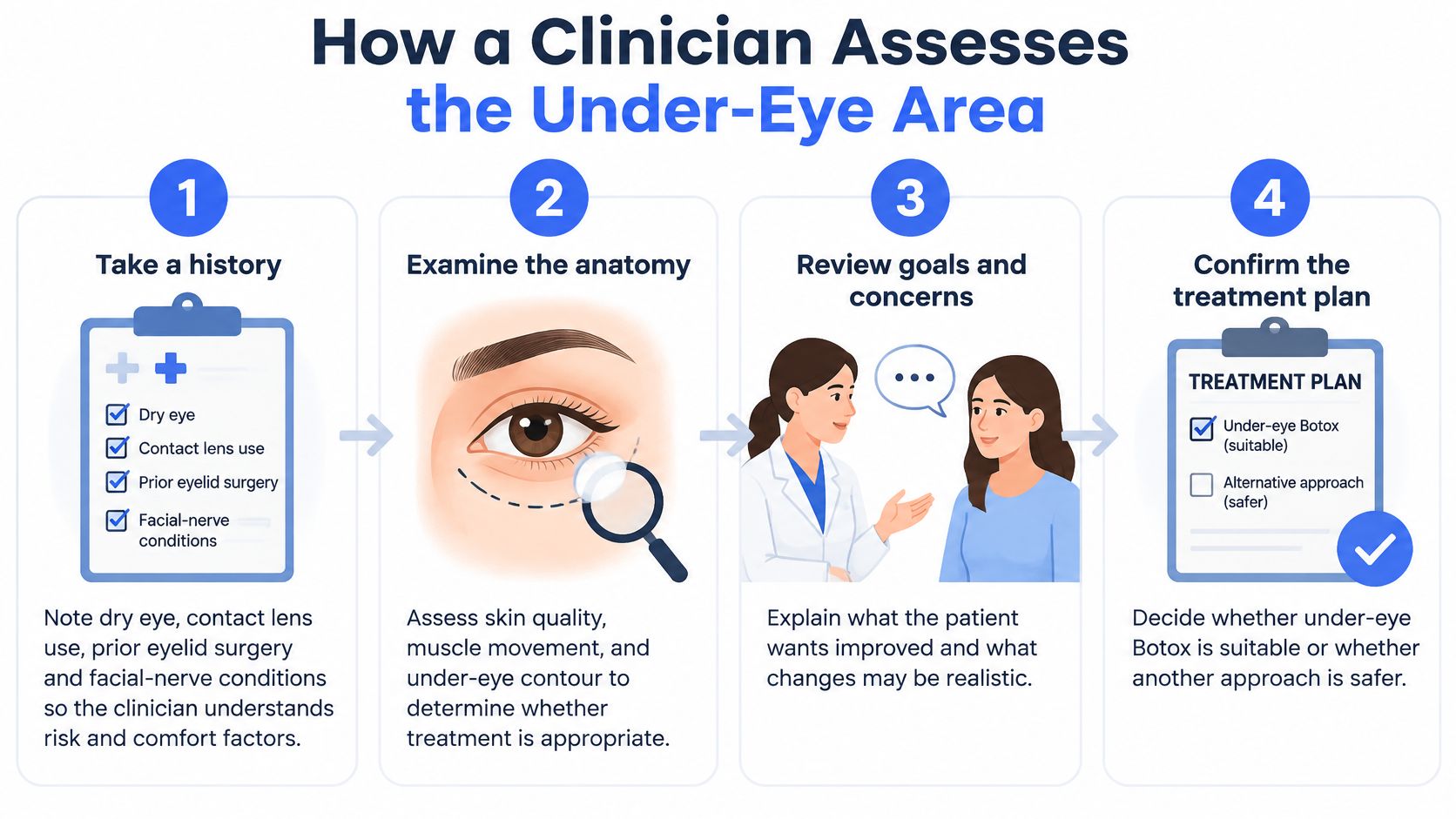
FDA labeling warns that reduced blinking after injections in or near the orbicularis oculi can expose the cornea and lead to persistent epithelial defects or ulceration, particularly in people with facial-nerve disorders. Periocular toxin treatment can also involve dry eye, blurred vision, tearing, bruising, or ptosis. A 2025 cohort of lower-eyelid treatment reported transient skin mounds in every patient and one delayed pseudo-bag; no cases of dry eye or double vision were reported. A review of periocular botulinum toxin describes scleral exposure, photophobia, and lower-eyelid edema among effects associated with higher doses.
Seven steps before any units
- Take the history first. Dry eye, contact lens wear, prior eyelid surgery, and facial-nerve conditions can affect blinking and help determine whether treatment is appropriate.
- Check the blink and tear film. The clinician assesses lid position, whether the eye closes fully, and how well the surface stays wet. A weaker blink can leave the cornea exposed.
- Identify what creates the under-eye contour. A line caused by muscle movement differs from a hollow caused by volume loss or a bulge from fat. Toxin relaxes the muscle; it does not replace lost volume or remove a fat pad. Under-eye rejuvenation options may involve approaches beyond toxin alone.
- Ask you to squeeze, smile, and look up. These movements show which muscle fibers create the crease and whether it appears only with expression or remains at rest.
- Plan the site and depth. If lower-lid treatment is appropriate, points are kept about 2 mm from the lash margin, placed superficially, and limited to the moving fold rather than spread across the lid.
- Choose a conservative dose for that target. The clinician records units at each site, not only the total, so the placement can be reviewed at a later visit.
- Reassess before considering more. A faint line at one week is not, by itself, a reason to add units at the same visit.
A low dose can still be unsuitable if the eye's function or the treatment target makes the lower lid vulnerable. Findings that may prompt a clinician to pause and reassess include:
- Pre-existing dry eye: the eye surface may already be short on tears.
- Poor blinking or incomplete closure: further weakening may raise the risk of corneal exposure.
- Eyelid laxity: the lid may not spring back firmly against the eye.
- Prior eyelid surgery: changes in support or scarring may not be clear from a photo.
- Facial-nerve disease: blinking may already be impaired.
- Baseline asymmetry: treating both sides alike may make an uneven lid more noticeable.
- Prominent lower-eyelid fat or edema: relaxing nearby muscle may make puffiness more apparent.
An in-person periocular examination is particularly important when these findings are present or when treatment is planned on the lower lid itself. A photo or video visit can help address questions, but it cannot test lid tone.
Side Effects and Eye Risks to Know
A lower-lid injection can use fewer units than a crow's-feet treatment and still affect blinking, lid position, or eye closure. The outer-corner dose and the under-eye risk are different questions: the lower lid has a smaller margin for unwanted muscle weakening.
| Risk | Reported Frequency | Why It Happens | Warning Sign |
|---|---|---|---|
| Bruising | 18.75% (3 of 16) in a 2024 lower-lid study | Needle trauma at the injection site | Bruise still present after one week |
| Delayed swelling | 25% (4 of 16) in the same study, resolving within five days | Local tissue response near thin lid skin | Puffiness lasting beyond five days |
| Eyelid ptosis | 3.39% in cited aesthetic literature, according to a peer-reviewed review | Weakening of muscles that support eyelid position | Heavy or drooping upper or lower lid |
| Ectropion and scleral show | No rate reported in the cited review | Weakening of the lower-lid muscle may let the lid turn outward | Lid turned outward or white visible below the iris |
| Dry eye and corneal exposure | No rate reported in the cited review | Reduced blinking or incomplete eye closure | Gritty, watery, or painful eye |
| Double vision (diplopia) | No rate reported in the cited review | Muscle imbalance around the eye | Any double vision |
What usually fades
In the 2024 study, bruising and swelling were temporary: bruising settled within one week, and swelling within five days. The study reported no eye-bag formation, lower-eyelid-margin laxity, double vision, or dry eye at follow-up. These findings describe the participants studied; they do not rule out those risks for other patients.
What should not be waited out
The review identifies eyelid ptosis as the most common adverse effect in the aesthetic literature it cites, with a reported rate of 3.39%. It also describes possible ectropion, in which the lower lid turns outward and can expose the cornea, allowing tears to evaporate. Other listed effects include double vision, lagophthalmos (incomplete closure), dry eye, and swelling around the eye.
Seek prompt guidance for a new vision symptom or a change in eye closure. Watch for:
- Vision change or eye pain, including new blur that does not clear with a blink.
- Inability to close the eye fully, which can leave the eye surface exposed.
- A drooping upper or lower lid that changes the eye's position.
- Persistent gritty, watery, or painful irritation.
A sudden change in one eye differs from ordinary post-injection puffiness. If one eye suddenly becomes blurry, treat it as an eye symptom that needs prompt attention, not as a cosmetic effect to photograph. Call the treating clinic the same day for vision change, eye pain, inability to close the eye, a drooping lid, or irritation that does not ease. Review these Botox safety precautions before treatment.
Confirm Product Units and Book a Consultation
Units are preparation- and assay-specific, so a number written for one toxin brand is not automatically the number for another. FDA-approved BOTOX Cosmetic labeling identifies moderate-to-severe lateral canthal lines as an approved area of orbicularis oculi treatment, and it does not set a universally approved unit count for injections directly beneath the lower eyelid. The labeled crow's-feet figure belongs to BOTOX Cosmetic. Botox, Dysport, and Daxxify units should not be swapped from memory or from a blog table.
Don't convert products yourself. Ask the injector to name the vial and the units per site.
A clear chart note should list the product name, units per site, total units per eye, and the date. ProMD Health offers neurotoxins including Botox, Dysport, and Daxxify, so the consultation is where the product is matched to the target, not where a visitor picks a brand off a chart.

What to bring to the visit
- List eye history. Include dry eye, contact lens use, prior eyelid or eye surgery, and any facial-nerve problems. The injector can't see a past surgery on today's skin alone.
- Name the goal in one sentence. Outer-corner lines and lower-lid creases change both the dose and the exam. "I want my eyes to look less tired" is too broad to dose.
- Ask for an in-person periocular exam if lower-lid treatment is on the table. Lid support, skin laxity, muscle movement, and the eye surface have to be seen in person.
- Ask three product questions. Which product, how many units at each site, and what finding would change or cancel the plan.
- Confirm the service at that office. Neurotoxin availability is broad, but lasers and some other treatments differ by location, so verify the menu before you book travel.
- Confirm cost before treatment. These services are cash-pay and are not covered by insurance, so ask for the fee for the planned product and area before you sit for injections.
The final number comes from the clinician who examines you, not from any article, including this one.
ProMD Health provides neurotoxin treatment for dynamic lines around the eyes, including crow's-feet, with the dose set after an exam rather than from a single online number. If you are weighing outer-corner lines against a true lower-lid crease, book a consultation and bring the checklist above. Visit ProMD Health to choose a clinic and schedule that visit.