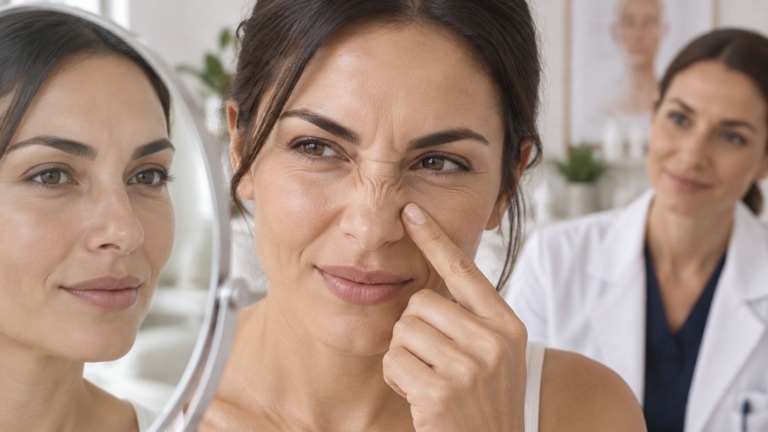
Why do your mouth corners turn down even when you're not sad, tired, or annoyed? Many people assume the answer is aging skin alone, so they book a treatment for a fold when the problem is a small muscle pulling downward, or they ask for Botox when lost volume is doing most of the work.
That distinction decides whether Botox for mouth frown treatment helps. Botox relaxes muscle pull. It doesn't replace missing support, tighten loose skin, or permanently erase a deep marionette line. Once you separate those causes, the dose, timing, risks, and alternatives become much easier to judge.
Table of Contents
- Typical Dose and Results at a Glance
- Why Mouth Corners Droop and How Botox Helps
- Side Effects and Asymmetry Risks to Know
- Combining Botox With Fillers and Other Options
- Cash-Pay Pricing and Booking a Consultation
- Who Should Choose Botox for a Mouth Frown
Typical Dose and Results at a Glance
Start with the numbers, then read them carefully. These are reference values, not a prescription for your face. Your anatomy, muscle strength, and the product your provider uses can change the final plan.
| Parameter | Reference value | Practical meaning |
|---|---|---|
| Total dose per treatment | 4 to 10 units | Reference range; anatomy, muscle strength and product affect the final plan |
| Dose per side | 2 to 5 units | Usually one injection per side, about 1 cm lateral and inferior to the commissure |
| Mouth-corner height at 30 days | 5.22% increase | 3 units per side in 34 volunteers (2024 study, secondary summary by FaceYoga Plus) |
| Duration of visible lift | 6 to 9 months | Small uncontrolled study; botulinum effects commonly described as lasting 3 to 4 months |
| Onset | Gradual over weeks | Effect builds gradually; maximal effect is delayed rather than immediate |
How to Read the Dose Range
A total of 4 to 10 units sounds precise, but it's a starting frame for a clinical conversation. A provider still has to watch how strongly each side pulls when you frown, speak, and smile. If one corner sits lower at rest, the two sides may not get identical treatment.
Don't compare units across products without asking how they convert. Don't assume more units mean a better lift, either. In the lower face, a conservative first dose protects lip movement and leaves room for adjustment at follow-up.
What the Results Evidence Actually Shows
A secondary summary by FaceYoga Plus of a 2024 study of 34 volunteers reported that injecting 3 units of onabotulinumtoxinA per side increased mouth-corner height by an average of 5.22% after 30 days. That's an average photographed change, not a promise that you'll see the same rise.
A systematic review in Aesthetic Surgery Journal describes a study of 36 patients with a statistically significant improvement in oral-commissure angle and a visible lift maintained for approximately 6 to 9 months, while also noting botulinum-toxin effects are commonly believed to wear off after about 3 to 4 months. The review calls that evidence weak because the study was noncontrolled and nonblinded.
Practical rule: Plan around the shorter, more common duration and treat longer results as a possibility, not a guarantee.
That gap matters for timing. You won't walk out with the final result, because the effect builds gradually. If you're preparing for photos or an event, ask how the delayed onset fits your date and read about how long Botox results typically last before you schedule.
Bring the table questions to consultation. Ask what total dose is proposed, how much goes on each side, where it will be placed, and when you'll return to judge symmetry. A clear answer tells you more than a unit count alone.
Why Mouth Corners Droop and How Botox Helps
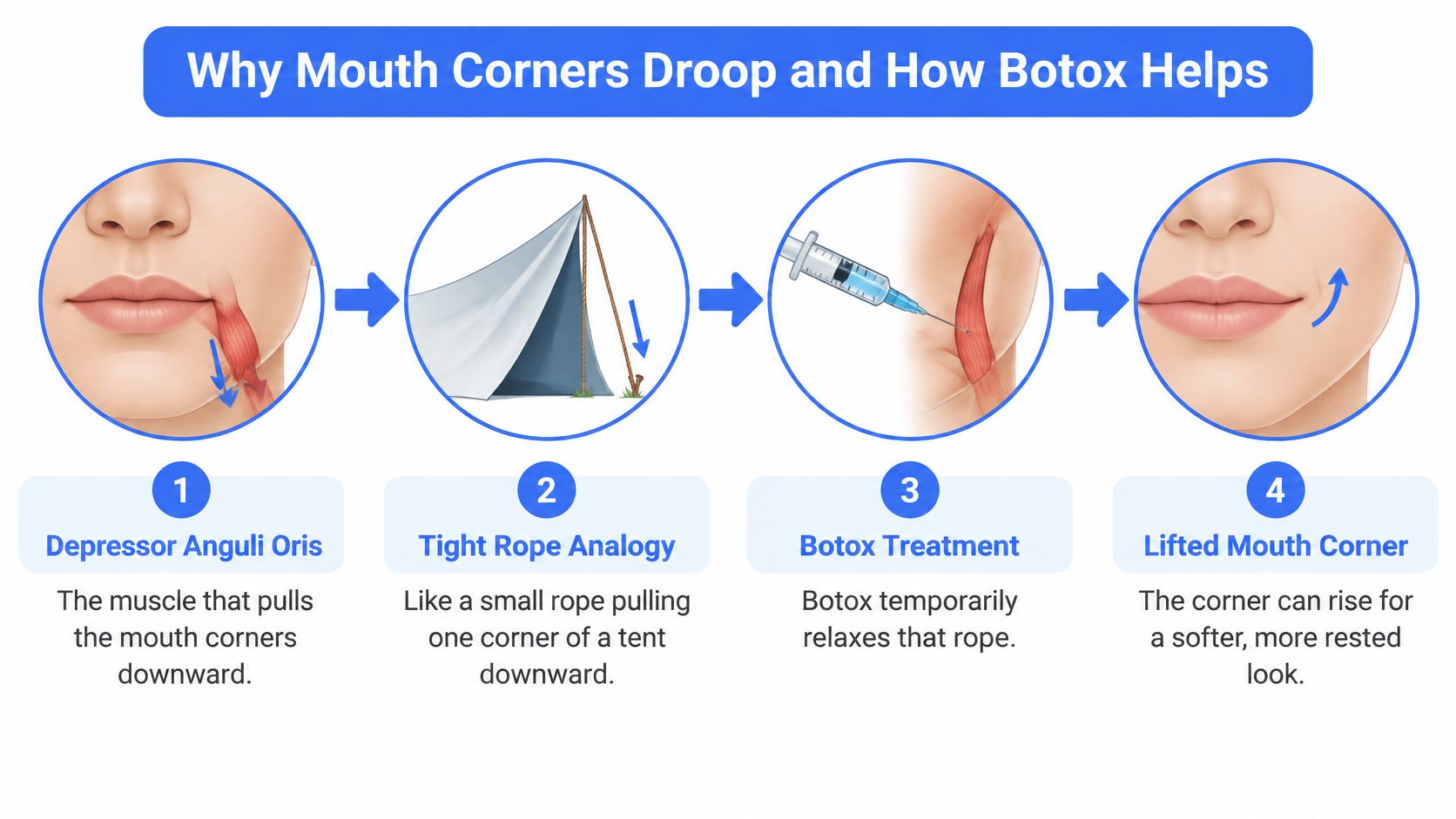
Think of the depressor anguli oris, or DAO, as a small rope pulling one corner of a tent downward. Botox temporarily relaxes that rope. The corner isn't surgically lifted, but it can sit slightly higher because the downward pull is weaker.
The Muscle Behind the Downturn
The DAO starts along the oblique line of the mandible and inserts at the mouth corner. When it contracts, it pulls the oral commissure down. Years of frowning, concentrating, and speaking can make that resting pull look like disappointment, even when you feel neutral.
A 2023 peer-reviewed review in PMC on botulinum toxin in the oral and lower-face region lists drooping oral commissures as an injection indication for the DAO and notes this mouth-corner use is generally considered off-label, because the FDA's 2002 cosmetic approval covered moderate-to-severe glabellar lines. Off-label doesn't mean experimental or forbidden. It means your clinician should explain that this specific use sits outside the original cosmetic approval.
The goal is selective weakening, not paralysis. You still need nearby muscles for smiling, speech, drinking, and lower-lip movement. That's why placement matters so much here, a point also worth understanding when you compare lower-face work with broader Kettering Dental & Implant Clinic wrinkle treatments that focus on expression lines elsewhere.
Muscle Pull Is Only One Cause
Not every downturned corner is a DAO problem. Skin can loosen and settle. Fat and support beside the mouth can deflate. A crease can become etched into the skin after years of movement and volume change.
- Muscle-driven downturn: The corners pull down at rest or worsen when you make an exaggerated frown. This is the part Botox can soften.
- Volume-driven downturn: The area beside or below the corner looks hollow, so the corner loses support. Relaxing a muscle won't refill it.
- Laxity-driven downturn: Lower-face tissue has loosened and descended. Botox won't lift that tissue back into place.
Try a simple check in a mirror. Relax your face completely, then drag your mouth corners toward your chin and feel the band tighten just outside and below each corner. That band gives you a sense of the DAO's role, though only an in-person exam can separate muscle activity from skin and volume changes.
Botox can address the downward pull from an overactive DAO. It cannot fix the part of the downturn caused by missing volume, loose skin, or a structural marionette fold.
Side Effects and Asymmetry Risks to Know
Most effects after lower-face injections are local and short term. The concern in this area is function, because a small spread of product can change how your smile or lower lip moves. That's a different risk profile from treating the forehead, where a slight imbalance usually doesn't affect speech or drinking.
| Effect | Typical timing | Action |
|---|---|---|
| Injection-site bruising, pain, redness or swelling | Soon after treatment | Expect short-term signs; ask the provider about aftercare |
| Headache | Shortly after treatment | Report if it persists or worsens |
| Transient facial weakness or drooping | Temporary | Avoid rubbing or massaging the treated area; contact the provider |
| Uneven smile or asymmetry | Temporary; as the product takes effect | Compare both sides at the follow-up visit |
| Lip weakness or difficulty drinking, whistling or articulating | As the product takes effect | Report promptly to the provider |
| Generalized weakness, trouble swallowing, slurred speech or breathing difficulty | Rare | Seek emergency care immediately |
Common Effects and Why Asymmetry Happens
The American Society of Plastic Surgeons botulinum toxin safety page lists injection-site bruising, pain, redness, swelling, headache, and transient facial weakness or drooping, and advises avoiding rubbing or massaging treated areas because migration may cause temporary facial weakness. Those local signs usually settle, but you should still report anything that keeps getting worse instead of better.
An uneven smile has a mechanical explanation. If product reaches a muscle that lowers the lip or shapes the mouth, one side can move less than the other. Risk rises with an excessive dose, a large injection volume, placement too close to the commissure or mental fold, or anatomy that wasn't mapped during animation.
An uneven result while the product is taking effect doesn't automatically mean you need more product right away. Let your provider see both sides moving before anyone decides on a correction.
Pay attention to everyday function. Can you seal your lips around a straw, whistle, and say sounds that need lip control? If drinking, whistling, or articulating feels harder, contact the provider promptly rather than waiting for your routine follow-up.
Rare Symptoms That Need Urgent Care
Rare, serious spread-related symptoms include generalized weakness, trouble swallowing, slurred speech, or breathing difficulty. Those symptoms require emergency care immediately, not a message to the clinic the next morning.
Before you book, ask four direct questions. How often does the provider treat the DAO? Will the first dose be conservative? Will symmetry be checked while you animate, not just at rest? When is the follow-up to judge the result?
You can also review the broader ProMD Botox safety information and bring specific concerns to your consultation. A qualified medical professional should welcome those questions, explain the lower-face tradeoffs in plain language, and tell you when the safer answer is not to inject.
Combining Botox With Fillers and Other Options
Botox and filler don't do the same job, so choosing between them starts with naming the cause. Botox weakens a downward pull. Filler adds volume and support. When both problems are present, using only one tool can leave the other problem untouched.
| Option | What it targets | Best when | Note |
|---|---|---|---|
| Botox alone | Downward DAO pull | Corners droop mainly from muscle activity | Repeat treatment needed to keep the lift |
| Botox with filler | DAO pull plus volume loss | Marionette folds or deflation are visible | Sequence set by the provider after examination |
| Filler alone | Volume and fold depth | Muscle pull is minimal at rest | Adds structure rather than relaxing muscle |
| Dysport or Daxxify | Same DAO pull as Botox | Preference or availability favours another neurotoxin | Ask how the product units compare |
When a Combined Plan Makes Sense
Say your corners look downturned at rest and there's a visible fold running toward the jaw. Relaxing the DAO may soften the pull, but the fold can remain because support is still missing. A provider might treat the muscle first, let the result settle, then reassess whether filler would improve the fold without making the lower face look heavy.
That staged approach has a practical advantage. You learn how much of your concern was muscle-driven before adding volume. It also makes the follow-up conversation concrete, since you and your provider can compare resting photos and expression photos instead of guessing.
Ask for the reasoning in writing. Which part is muscle pull? Which part is deflation or fold depth? Why that sequence?
Choosing Between Neurotoxin Products
Dysport and Daxxify target the same muscle problem as Botox, but they're different products with different dosing units. A unit count from one product doesn't transfer directly to another. Ask which product is proposed, how its units compare, and why it's being chosen for your lower face.
For a broader comparison of relaxing muscle versus restoring structure, see Botox versus dermal fillers explained. The key question isn't which product sounds stronger. It's whether the plan matches the cause you have.
- Botox alone fits best when the corner moves down strongly but the surrounding tissue still looks supported.
- Filler alone fits best when the muscle pull is quiet at rest and hollowing or fold depth drives the appearance.
- A combined plan fits best when both pull and deflation are visible and your provider can explain each product's separate job.
Confirm available options at the office visit, because service availability can vary by location. A good plan also respects lip function. If you sing, play a wind instrument, or speak publicly, say so before anyone treats the muscle, not after.
Cash-Pay Pricing and Booking a Consultation
ProMD Health operates on a cash-pay model, so these services are not covered by insurance. Don't budget around reimbursement or assume a medical-necessity claim will apply. Ask for the full out-of-pocket quote before treatment.
For a general reference point, Drugs.com reporting the American Society of Plastic Surgeons average put the average botulinum toxin treatment cost at $435 in 2026, as an all-area average rather than a mouth-frown-specific price. Your quote can differ because it reflects your total units, number of areas, any combined filler plan, and follow-up care.
If you're comparing elective treatment budgets more broadly, the All Stars Dental cosmetic cost guide is a useful reminder to separate the headline procedure price from consultations, follow-up, and maintenance. For mouth corners, maintenance matters because repeat treatment is part of the plan.
A Short Booking Checklist
Choose an approved ProMD location, including offices in Annapolis, MD, Arlington, VA, Ashburn, VA, Bel Air, MD, Bethesda, MD, Columbia, MD, Easton, MD, Fort Lauderdale, FL, Hutto, TX, Lafayette, CO, Lewes, DE, Timonium, MD, Tox Bar in Baltimore City, MD, Tysons Corner, VA, Washington, DC, Wellington, FL, and Westminster, MD. Confirm mouth-corner treatment availability at your chosen office before booking, since availability can vary.
Bring resting and expression photos, a medication list, and your medical history. At consultation, confirm the dose and placement plan, expected timeline, price, and retreatment schedule. If filler is also proposed, ask for each product's cost and purpose as separate line items.
Who Should Choose Botox for a Mouth Frown
Not everyone with a downturned mouth is a good candidate. The strongest fit is a resting downturn driven by visible DAO activity, in someone who wants a temporary, low-dose change and accepts repeat treatment. If you want a permanent structural correction from a few units, you'll likely be disappointed.
Three Readers, Three Different Answers
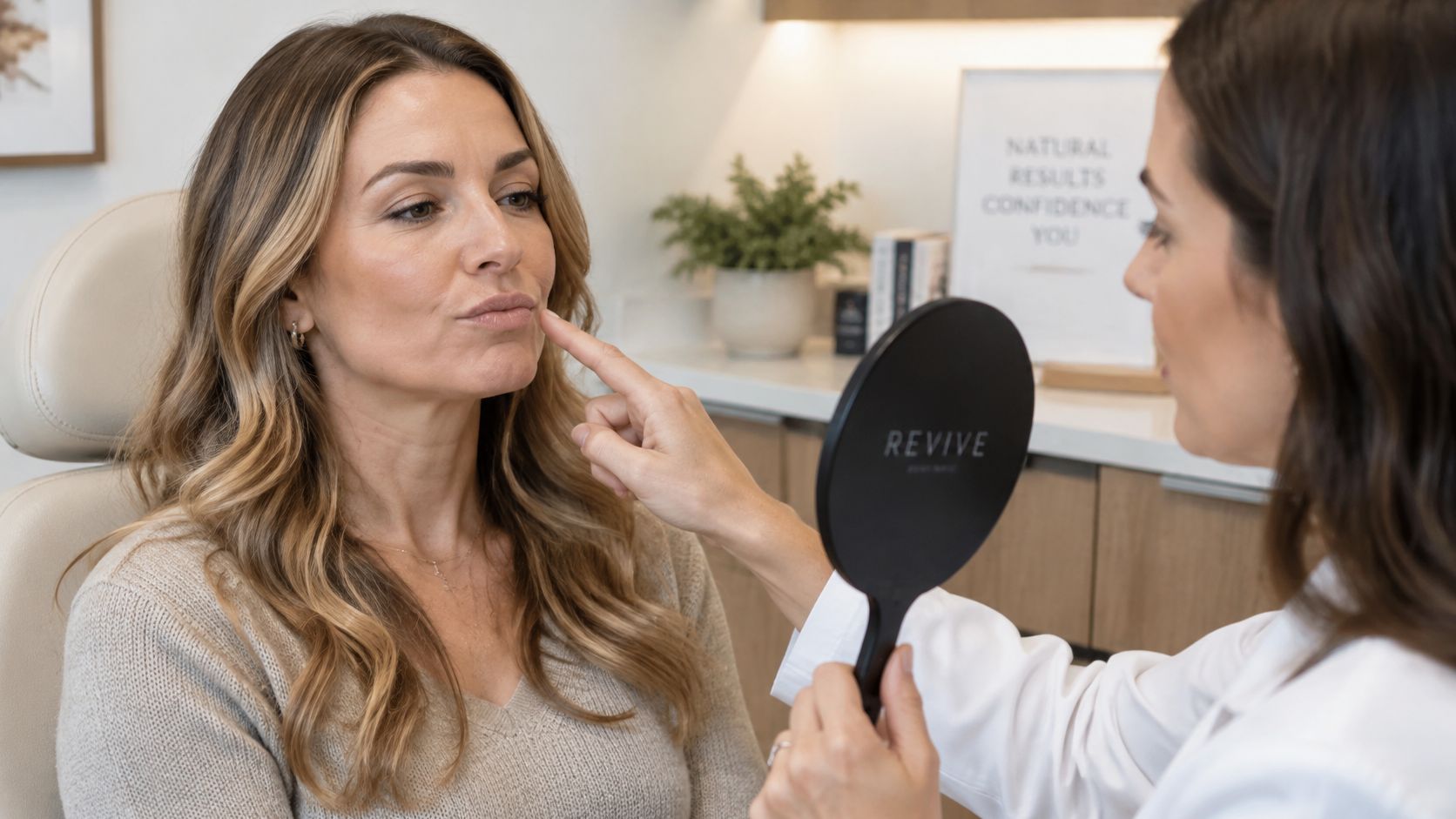
The muscle-driven case. Your corners look sad at rest, your lower face still looks full, and an exaggerated frown makes the downward band obvious. You're the clearest candidate for a targeted muscle approach, provided a clinician confirms the anatomy in person.
The volume-loss case. Your folds are deep, the area below the corners looks hollow, and the downturn barely changes when you try to relax the muscle. Relaxing the DAO alone won't restore missing support. You may need filler, a combined plan, or a different conversation entirely.
The high lip-function case. You're a singer, wind musician, teacher, broadcaster, or public speaker. Your lip seal and articulation aren't minor details, they're part of your work. You need especially conservative selection and dosing, and you should state that priority at the start of consultation.
Three questions sort most consultations quickly. Is the droop visible at rest? Is there a fold or volume loss? Does your job depend on precise lip function?
Signs and History to Discuss
Bring up asymmetry at rest, one corner pulled lower than the other, and a downturn that worsens with expression. Those details help your provider compare sides during animation instead of treating a still photograph. Mention previous lower-face injections, filler, dental work, or any episode of uneven smiling.
Some situations need clinician review before treatment, including a neuromuscular disorder, pregnancy or breastfeeding, and active infection at the injection site. Don't treat that list as a self-screening shortcut. Give your full medical history and medication list, then let the clinician decide whether treatment should proceed, change, or wait.
Your Next Steps Before Booking
Take clear photos at rest, smiling, and making an exaggerated frown in the same light. Write down whether your concern is the resting expression, the fold, one uneven corner, or all three. That distinction keeps the consultation focused.
Ask for the dose and placement plan in writing. Compare the delayed onset with any upcoming event, and ask when symmetry will be checked. Confirm the cash-pay price, what follow-up includes, and the likely retreatment interval.
If the answers point mainly to muscle pull, Botox for mouth frown treatment can be a modest, sensible option. If they point mainly to deflation or laxity, the honest answer may be filler, a staged combination, or no injection until the underlying cause is addressed. Book a ProMD consultation to confirm which category you fall into, verify availability at your chosen approved office, and leave with a written plan rather than a guess based on a mirror check.
ProMD Health offers neurotoxin treatments including Botox, Dysport, and Daxxify, along with dermal fillers for cases where volume loss contributes to downturned mouth corners. If you're unsure whether your mouth frown is driven by muscle pull, deflation, or both, book a consultation to confirm your dose, placement plan, cash-pay price, and retreatment schedule at an approved location through ProMD Health.