
Many approach Botox vs dermal fillers as though they're choosing between two competing versions of the same treatment. That advice is too simplistic. Botox-style neurotoxins and dermal fillers work on different layers of the face, so the right choice depends less on popularity or marketing and more on what's creating the change you see.
If muscle movement creates the problem, a neurotoxin usually makes more sense. If lost volume or structural support creates it, filler is the more logical tool. Many faces show both patterns, which is why a thoughtful combination plan can produce a more natural result than forcing one product to do everything.
The practical question isn't “Which product is better?” It's “Which layer of aging am I treating, and what's the smallest effective intervention?”
Table of Contents
- Why This Isn't Really an Either-Or Question
- How Botox and Dermal Fillers Actually Work
- Side-by-Side Comparison of the Two Treatments
- Safety Profiles and Risk Asymmetry
- Real-World Scenarios for Each Option
- The Overfilling Problem and Why Less Often Wins
- How to Decide and What to Ask at Your Consultation
Why This Isn't Really an Either-Or Question
Botox and dermal fillers should not be chosen as competing versions of the same treatment. They address different anatomical problems, and the better decision starts with identifying which layer of aging has changed.
Neurotoxins reduce targeted muscle activity. They suit dynamic wrinkles, which become more visible as you frown, raise your brows, or squint. Historical utilization data reflects this pattern: a survey reported 72% of Botox users treating glabellar lines, while 63% of filler users targeted nasolabial folds. The long-term utilization study also reported more neurotoxin visits than filler visits during part of its study period, while filler use expanded as products and indications developed.
Muscle treatment has a specific limitation. If repeated folding has etched a crease into relaxed skin, reducing movement can limit further creasing but may not erase the resting line by itself.
Fillers restore or reshape structure. They can replace some volume and support lost in the cheeks, lips, temples, chin, or jawline. They fit static folds, hollowing, and contour deficits that remain visible while the face is relaxed.
The layer-of-aging model
Assess the face in layers:
- Muscle layer: Repeated contraction creates expression lines. Neurotoxin is the relevant tool.
- Volume and support layer: Loss of fat, collagen, and structural support alters contours. Filler or a biostimulatory approach may be appropriate.
- Skin layer: Texture, pigmentation, and fine surface changes may need skincare, peels, microneedling, or laser-based treatment instead of either injectable.
A patient with strong forehead movement and a patient with hollow cheeks may both want to look refreshed. Their treatment plans should differ because the underlying anatomy differs.
Combination treatment is common because facial aging rarely stays within one layer. A neurotoxin may reduce upper-face movement while carefully placed filler restores midface support. The mistake is using filler for every line or adding volume to every facial change. That can create heaviness, puffiness, or an unnatural contour.
A sound consultation examines whether the concern appears during movement, remains at rest, reflects volume loss, or combines several mechanisms. Start with anatomy, then choose the smallest intervention that addresses the actual cause.
How Botox and Dermal Fillers Actually Work
The simplest distinction is this: neurotoxins change movement, while fillers change structure.
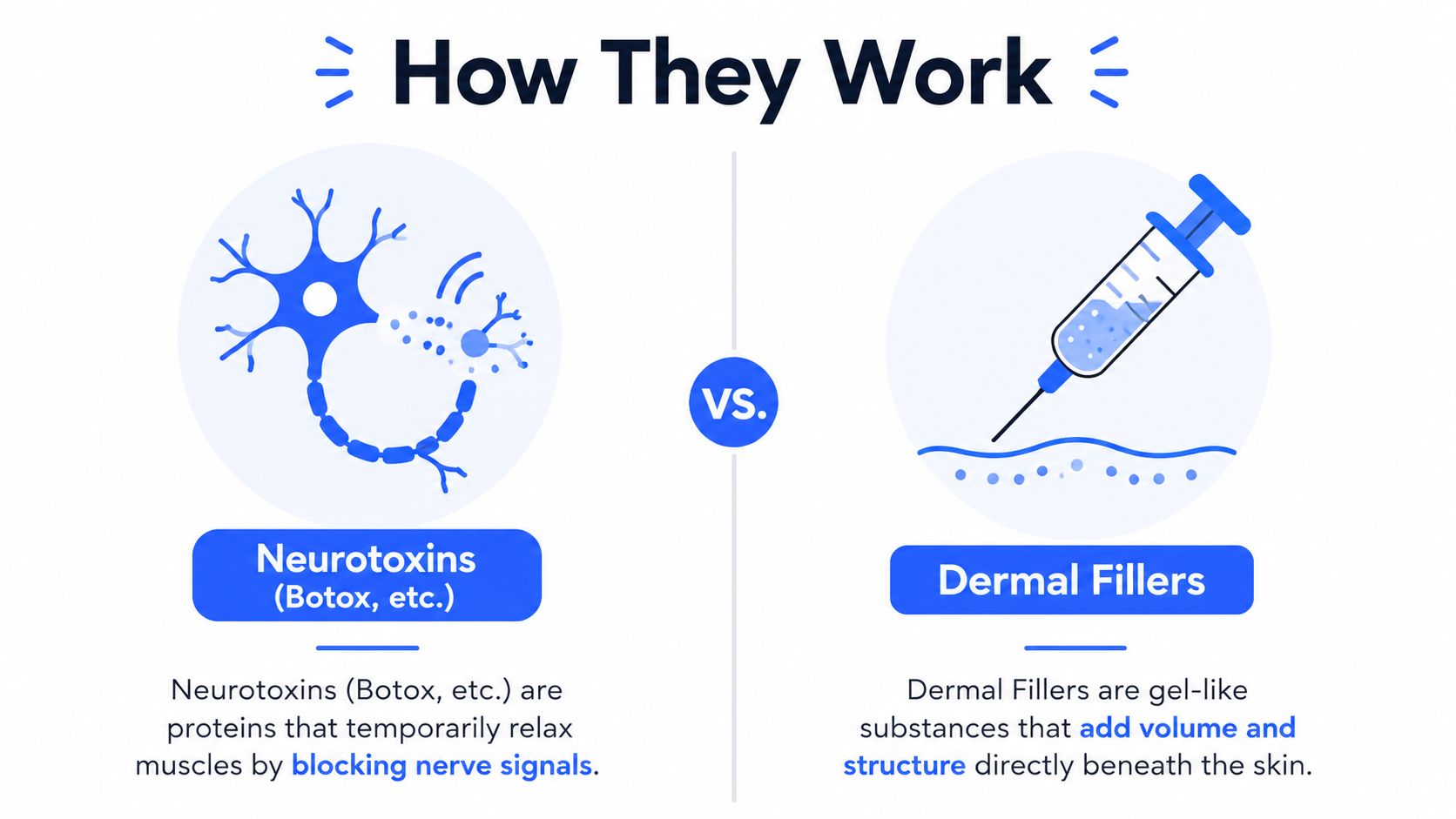
Botox, Dysport, Daxxify, and related neurotoxins are purified proteins that temporarily reduce the nerve signal responsible for targeted muscle contraction. The muscle still exists, but it contracts less forcefully. The skin above it then creases less intensely, which softens expression lines over time.
That's why neurotoxins work well for glabellar lines, forehead movement, and crow's-feet. They don't add volume beneath the skin, and they won't rebuild a hollow cheek or replace a lost contour. If a crease has become etched into relaxed skin, reducing muscle activity may help prevent further folding, but it may not erase the resting line on its own.
Fillers replace support beneath the skin
Dermal fillers are gel-like materials placed beneath the skin to restore volume, soften folds, or refine contours. Hyaluronic acid fillers are commonly selected because providers can choose different consistencies for different facial zones. A thinner gel may suit delicate correction, while a more substantial product may provide cheek, chin, or jawline support.
The placement matters as much as the product. A provider may use filler in a deeper plane to support a contour, a more superficial placement to soften a line, or a carefully controlled amount in the lips to improve proportion without creating unnecessary fullness. The goal isn't to “fill” whatever looks empty.
You can review the fundamentals in what dermal fillers do, but the key clinical point is straightforward: filler changes the physical relationship between tissue layers.
Biostimulators follow a different path
Biostimulators such as Sculptra and Radiesse don't function exactly like traditional hyaluronic acid gels. They're used to encourage collagen support over time rather than placing a defined gel volume in one location.
That difference doesn't change the central decision framework. The provider still needs to identify whether the concern is driven by movement, volume loss, skin quality, or a combination. Treating the wrong layer can produce a technically active treatment with a disappointing aesthetic result.
Side-by-Side Comparison of the Two Treatments
A useful comparison needs to cover more than a treatment name. It should address what the product does, when you'll see the change, how long it may last, and what kind of maintenance it creates.
Botox vs Dermal Fillers at a Glance
| Criteria | Botox / Neurotoxins | Dermal Fillers |
|---|---|---|
| Primary mechanism | Temporarily reduces targeted muscle activity | Adds volume or structural support beneath the skin |
| Best suited to | Dynamic expression lines | Static folds, hollowing, and contour changes |
| Common areas | Forehead, glabella, and crow's-feet | Cheeks, lips, nasolabial folds, chin, and other contour areas |
| Visible results | Develop over days and are assessed after the effect has settled | Often visible immediately, with the final appearance assessed after swelling improves |
| Typical durability | Approximately 3 to 4 months for glabellar lines with labeled treatment | Varies by material and area. Some fillers last approximately 6 to 12 months, while collagen-based fillers may last approximately 2 to 3 months |
| Maintenance pattern | Repeat treatments are usually part of the plan | Touch-up timing depends on product, tissue plane, area, and metabolism |
| Downtime | Usually limited, though bruising or localized effects can occur | Swelling, bruising, tenderness, or temporary asymmetry can be more noticeable |
| Cost structure | Commonly based on units or treated areas | Commonly based on syringes or product volume |
| Main risk category | Temporary muscle-related effects, such as brow or eyelid malposition | Rare but serious vascular complications, in addition to common swelling and bruising |
The FDA-approved labeling for BOTOX Cosmetic describes results for glabellar lines as lasting approximately 3 to 4 months. The FDA labeling explains why neurotoxin maintenance is usually scheduled repeatedly rather than treated as a one-time correction.
Fillers don't have one universal duration. The FDA notes that some fillers last approximately 6 to 12 months, while collagen-based fillers may last approximately 2 to 3 months, depending on the material and treatment area. The FDA's dermal filler overview is a better reference than a blanket promise printed in an advertisement.
What the comparison means financially
I won't give you a fake universal “average cost.” Cash-pay pricing varies by provider, product, treatment area, and the amount needed. Neurotoxins are often priced by units or area, while fillers are commonly priced by syringe and product type.
Compare the annual treatment plan, not the first appointment. A lower sticker price can still become expensive if the product doesn't address the actual problem, if a corrective visit becomes necessary, or if repeated filler is used where a neurotoxin or skin treatment would have been more appropriate.
Filler may require fewer visits, but each visit can involve more product and a more complex anatomical decision. Neurotoxin may require more regular maintenance because the effect is temporary. Transparent pricing should make those differences easy to understand before treatment.
Safety Profiles and Risk Asymmetry
Both treatment classes have favorable safety records when appropriately selected and administered by qualified medical professionals. They still don't carry identical risks, and patients deserve a clear separation between common temporary effects and rare serious complications.
A large retrospective cohort reported overall complication incidence of 0.065% for BoNT-A treatments and 0.106% for hyaluronic acid filler treatments. The same dataset reported filler-related vascular adverse events at 0.014%. The retrospective safety analysis provides useful context, but low overall rates shouldn't obscure the difference in severity.
Common effects are usually manageable
After neurotoxin injections, patients may experience bruising, headache, or temporary eyelid or eyebrow malposition. These effects relate to the product's influence on muscle activity and usually improve as the treatment settles or wears off.
Filler commonly causes swelling, bruising, redness, tenderness, itching, or temporary asymmetry. Some patients can develop visible bluish discoloration from superficial placement, nodules, delayed inflammatory reactions, or infection. Those possibilities make follow-up and a clear aftercare plan important.
Rare complications demand serious preparation
The FDA warns that accidental dermal filler injection into a blood vessel can cause skin necrosis, stroke, or blindness. Its filler safety information also lists common reactions such as swelling, bruising, redness, pain, and itching.
Systematic review evidence describes irreversible vascular compromise as very uncommon but clinically important. One review summarized intra-arterial injection with necrosis at approximately 0.1% to 0.3% of filler cases in high-risk areas such as the lips, forehead, and nasolabial fold. The complication is anatomy-dependent, which is why facial mapping, injection technique, and emergency readiness matter.
Hyaluronic acid filler can often be treated with hyaluronidase when a problem is recognized, but that doesn't make the procedure risk-free. Reversal isn't a substitute for prevention, rapid recognition, or a provider who knows how to respond.
The injector is your primary safety decision. Product selection matters, but anatomical knowledge, conservative judgment, and emergency protocols matter more.
Before booking, review ProMD Health's Botox safety information and ask who performs the injections, what complications they discuss, and how they handle urgent concerns.
Real-World Scenarios for Each Option
The right answer becomes clearer when you stop comparing product names and look at the facial pattern.
Strong glabellar movement with a resting crease
A 34-year-old with pronounced lines between the eyebrows may have a strong dynamic component, even if the lines remain partly visible at rest. A neurotoxin can reduce the repeated muscle folding that deepens the area. Filler would be the wrong first move if the primary driver is muscle activity, particularly when adding volume could create unnecessary fullness in a high-risk area.
At two weeks, success means a softer, less tense appearance while preserving natural expression. It doesn't mean making the forehead or brow completely immobile.
Midface volume loss without major expression lines
A 52-year-old with hollowing through the cheeks and minimal dynamic wrinkling has a structural problem. Cheek filler may restore support and improve the transition between the lower eyelid and midface, while neurotoxin would contribute little because muscle contraction isn't the main source of the concern.
At two weeks, the result should look like improved balance and support, not an obvious mound of product. A conservative plan may use less volume than the patient initially expects.
Upper-face lines and lower-face folds together
A 47-year-old with forehead lines and nasolabial folds has two different concerns. Neurotoxin addresses the movement-driven upper-face lines, while filler may address structural support in the lower or midface if the provider determines that volume loss is contributing.
The treatments may be sequenced across visits rather than performed all at once. That allows the provider to assess the first result and avoid correcting one area by over-treating another. At two weeks, success means the face looks rested and proportionate, not uniformly smooth.
Thin lips with perioral lines
A 60-year-old with reduced lip volume and lines around the mouth may benefit from carefully placed lip filler, sometimes paired with a very light neurotoxin approach around selected muscles. The mouth is an area where overcorrection shows quickly, so preserving movement and function is essential.
At two weeks, the lips should look more supported and balanced, while speech, drinking, smiling, and expression remain natural. If your concern resembles this pattern, an assessment of whether fillers may suit you is more useful than choosing a product from a menu.
The Overfilling Problem and Why Less Often Wins
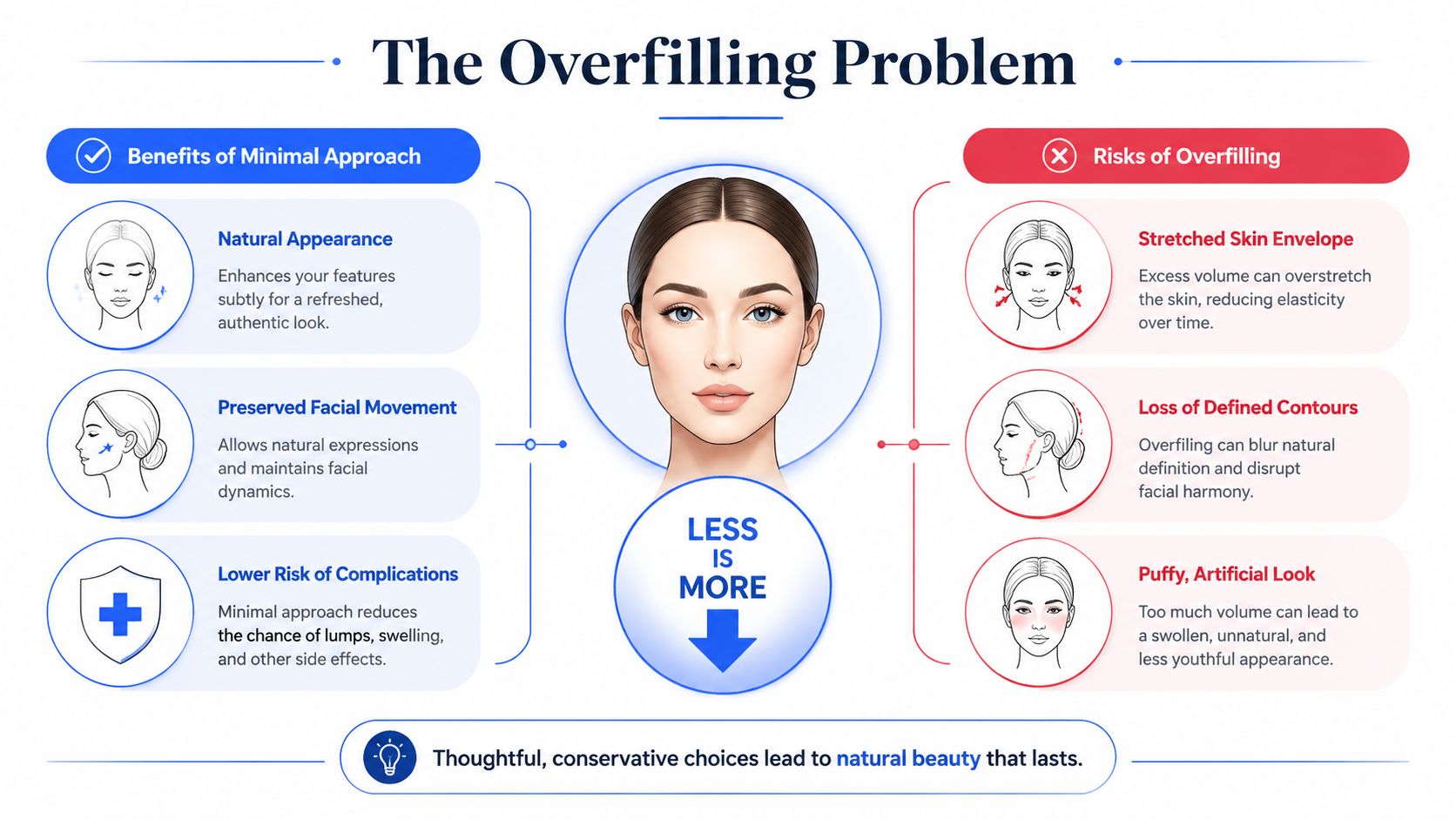
Overfilling begins when repeated volume placement replaces targeted correction. The face may develop heavy cheeks, a blurred cheek-lid junction, altered temple-to-jawline proportions, or a puffy appearance that reduces definition.
Filler is not the only issue. The larger mistake is using volume to chase every shadow, fold, or sign of descent. Aging changes facial structure and support over time. A visible line may reflect deeper shifts, so injecting directly into that line can miss the anatomical cause.
Why repeated volume changes the aesthetic baseline
Repeated volumization can stretch the skin envelope and make further product seem necessary to preserve the new appearance. Over time, a patient may see a normal untreated face as “deflated,” even when the original concern was limited.
Previous filler does not automatically mean a face is overfilled. Each session needs a defined purpose, a measured endpoint, and reassessment before more product is placed. Supporting deeper anatomical compartments is often more rational than layering filler along every visible line.
The best filler result is the one people notice as improved balance, not as filler.
Neurotoxin overuse creates a different problem. Excessive treatment can leave the upper face frozen or expressionless, especially during conversation, video calls, or photographs. The aim is controlled relaxation, preserving enough movement for natural expression.
A conservative provider should be willing to decline treatment. Skin care, skin treatments, improved structural support, or observation may address the concern more appropriately. More injectable product is not automatically the answer, and under-treating the actual source of aging can be as unhelpful as adding volume where support is not missing.
How to Decide and What to Ask at Your Consultation
Start with five questions. Your answers won't replace an examination, but they'll help you describe the problem accurately.

- Is the concern dynamic or static? Does it appear mainly when you move, or does it remain visible at rest?
- Which area bothers you most? Forehead, glabella, eyes, cheeks, lips, chin, jawline, or mouth lines point toward different anatomical decisions.
- How much downtime can you accommodate? Both treatments can cause bruising, but filler-related swelling may be more noticeable in certain areas.
- What budget range fits the full plan? Ask about the expected treatment pattern, not just the initial appointment.
- Have you had injectables before? Bring details about product type, treatment areas, timing, and any prior reactions.
Questions worth asking before an injection
Ask the provider to explain:
- Credentials and experience: Who performs the treatment, and how often do they treat the area you're concerned about?
- Product rationale: Why is this formulation appropriate for your anatomy and goal?
- Dose reasoning: How are units or syringe amounts determined?
- Injection method: Would the provider use a needle, cannula, or both, and why?
- Anatomical safety: How do they map higher-risk vascular areas?
- Emergency readiness: For filler, is an appropriate reversal agent available when relevant?
- Follow-up standards: What counts as a normal touch-up, and what symptoms require urgent contact?
Understand the cash-pay structure
ProMD Health operates on a cash-pay model, so its services aren't covered by insurance. Ask for the written pricing structure before treatment. Neurotoxins may be organized by units or treated areas, while fillers may be priced per syringe and product tier.
ProMD Health offers neurotoxin treatments and dermal filler services as separate facial aesthetic options. A consultation should connect the service to your anatomy rather than push you toward a preset package.
For your appointment, arrive prepared to discuss medications, allergies, previous injectables, and your desired level of change. Take consistent photographs in the same lighting and facial expression before treatment, then repeat them after the provider's recommended review period. Don't judge a result from one swollen selfie taken under unfamiliar lighting.
Visit ProMD Health to explore Botox, Dysport, Daxxify, dermal filler, and related aesthetic services. Book a consultation to have your facial concerns assessed by layer, so your plan addresses movement, volume, or both without defaulting to more product than you need.


