
Most cheek fillers deliver visible correction for roughly 9 to 18 months, with the exact window depending on the product type, placement depth, and your tissue response. That's a planning range, not a date when every trace of filler disappears.
You might be comparing treatment options, or noticing that your cheeks look less defined than they did after your last appointment. The useful question isn't just how long the treatment lasts. It's whether your current contour still meets your goals, and what a sensible maintenance plan would look like.
Table of Contents
- What to Expect from Cheek Filler Longevity
- How Cheek Filler Duration Is Actually Measured
- Comparing HA Fillers, Sculptra, and Fat Grafting
- What the Cheek HA Studies Actually Show Over Time
- Factors That Change One Patient's Timeline from Another's
- Building Your Cheek Filler Touch-Up Schedule
- Why Some Patients Retain Filler Longer Than They Realize
- Planning Your Cheek Filler Journey
What to Expect from Cheek Filler Longevity
Duration means useful cosmetic correction, not necessarily complete absorption. A cheek can lose some projection while still containing filler, and a patient can remain satisfied even after a measured result has declined. Those outcomes shouldn't be treated as interchangeable.
For hyaluronic acid, or HA, cheek filler, an 18-month multicenter French study supports reassessment around 9 to 12 months, while showing that a subset of injections retained objective improvement at 18 months. The study involved eight centers, and investigators prohibited additional cheek injections during follow-up after the initial treatment and permitted early touch-up. That design makes the durability findings more useful than observations from patients receiving repeated maintenance.
Decide what you want to maintain
At a consultation, separate your desired result into something a provider can assess:
- Projection: Do you want a more defined cheekbone profile?
- Fullness: Is your main concern a hollow or depleted-looking midface?
- Balance: Are you trying to improve a difference between the cheeks?
- Maintenance: Would you rather accept gradual softening or preserve a more consistent contour?
These distinctions matter because a small change may be acceptable to someone seeking subtle restoration but disappointing to someone seeking pronounced definition.
Different materials need different expectations
HA fillers, biostimulators such as Sculptra, and fat grafting shouldn't share one expiration date. HA treatment adds gel-based volume. Biostimulation aims to develop tissue support gradually, while fat grafting transfers your own tissue and introduces a different procedural commitment.
A practical consultation should establish which category suits your goal before discussing a calendar. Don't select a treatment solely because it's described as longer-lasting. The ability to adjust the result, the pace of improvement, and the uncertainty involved can matter just as much as duration.
How Cheek Filler Duration Is Actually Measured
A photograph, a volume measurement, and an imaging scan answer different questions. Confusion starts when a result measured by one method is presented as though it proves another.
Visible correction is the contour you and your provider can recognize. Three-dimensional volumetric measurement evaluates changes in volume. Ultrasound or MRI can identify material that may no longer produce the original cosmetic effect.
Read the outcome before reading the number
A systematic review of HA filler persistence analyzed 24 studies from 13 countries involving 1,410 patients. In studies using three-dimensional measurements, retained volume ranged from 60% to 86.4% at 12 months and 50% to 86% at 24 months.
Those are retained-volume findings, not percentages of patients guaranteed to look unchanged. The distinction is clinically important: remaining material can contribute to volume without preserving the same projection, symmetry, or overall appearance.
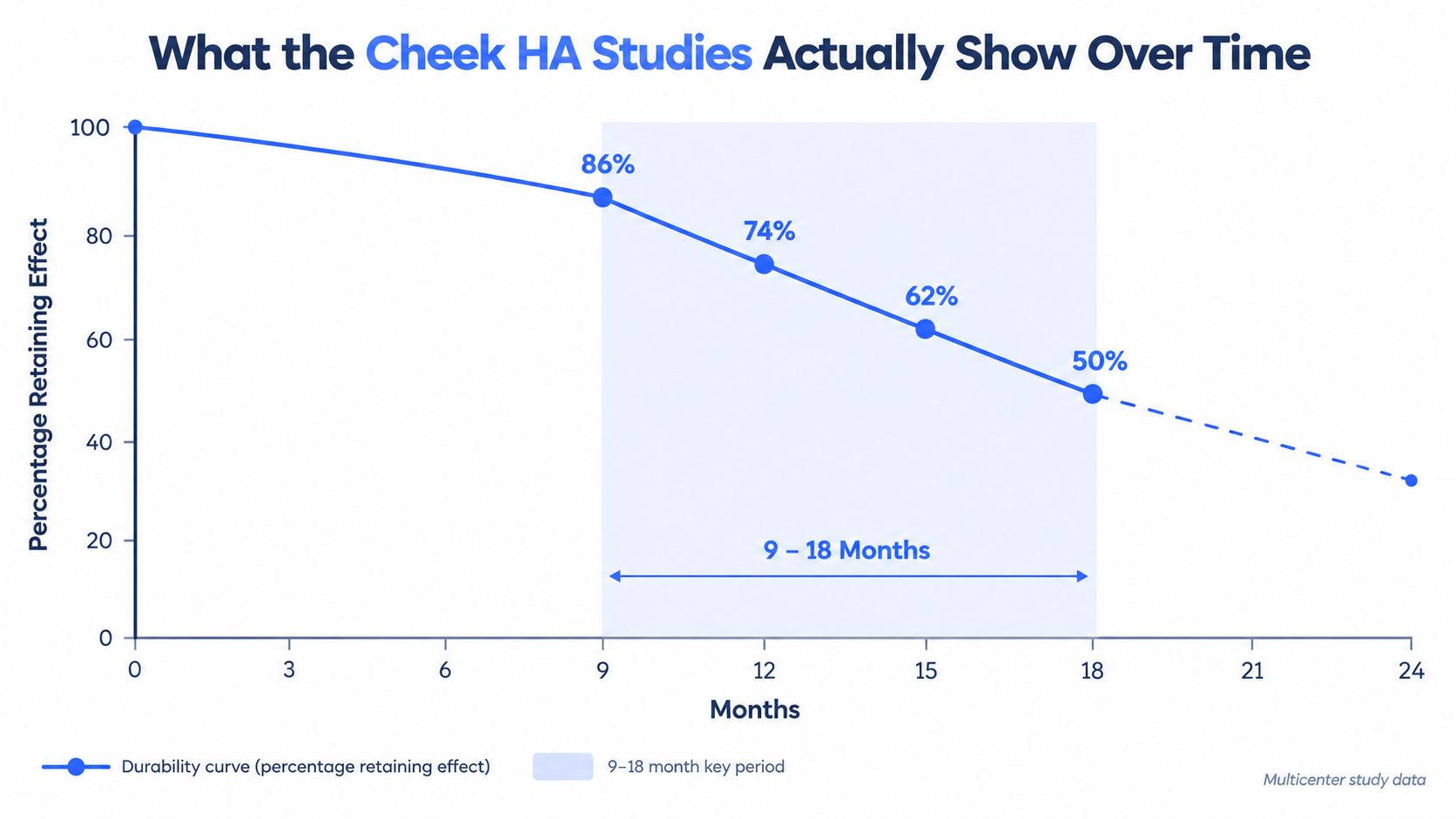
Interpretation caution: The plotted percentages in this illustration shouldn't be used as clinical estimates. They don't match the multicenter study outcomes reported below, and they shouldn't be confused with retained-volume measurements.
Use comparable photographs
For follow-up, a useful approach is to compare standardized photographs, examine the cheeks, and ask what has changed from the patient's perspective. The publisher's examples of dermal filler results can help frame a conversation about visible contour, although photographs alone can't establish an individual treatment's lifespan.
The cheeks also shouldn't be judged by lip-filler expectations. The American Society of Plastic Surgeons' dermal filler educational material describes effects lasting as little as 6 months in the lips but more than 2 years in the cheeks, attributing variation to the injected area's dynamic activity and the particular HA product.
Practical rule: Ask whether a longevity claim describes visible improvement, retained volume, or detectable material before using it to plan treatment.
Comparing HA Fillers, Sculptra, and Fat Grafting
Choosing a material means choosing how the result develops and how it can be managed afterward. The longest potential duration isn't automatically the most appropriate treatment.
HA fillers offer product-specific planning
HA fillers provide gel-based correction, but the formulation matters. The FDA's review of approved filler characteristics and durations reports durations ranging from approximately 6 months for some products to 24 months for Juvéderm Voluma, a product approved for cheek augmentation.
That upper duration isn't a promise that every patient will retain the same appearance throughout. A provider should connect the selected formulation to your anatomy and desired correction rather than quote the longest available label duration.
HA also offers an adjustment pathway through dissolution, unlike collagen-based correction or transferred fat. That doesn't make treatment risk-free or guarantee effortless correction. It does make adjustability a worthwhile part of the discussion.
Biostimulation and transferred tissue involve different commitments
Sculptra is a biostimulator, not another HA gel. Its role is gradual collagen support, so the consultation should address a treatment series, the pace of change, and when the provider will judge the completed result. The Sculptra facial treatment information provides a starting point for discussing that approach.
A fixed cheek-specific duration or automatic annual maintenance schedule shouldn't be borrowed from HA research. Ask for evidence relevant to the proposed treatment and a written reassessment plan.
Fat grafting transfers your own fat rather than placing manufactured filler. Its appeal is longer-horizon tissue restoration, balanced against procedural involvement and variable retention. It shouldn't be presented as a guaranteed permanent contour or assigned an HA-style syringe schedule.
Cheek Filler Materials at a Glance
| Material | Typical Visible Correction | Maintenance Pattern | Best Fit |
|---|---|---|---|
| HA filler | Product-dependent correction, with an established reassessment window | Review residual contour before adding more | Targeted volume and patients who value adjustability |
| Sculptra | Gradually developing tissue support | Assess the completed series before planning maintenance | Patients comfortable with a slower treatment process |
| Fat grafting | Potentially longer-horizon restoration, with variable retention | Procedural follow-up and individualized revision decisions | Patients willing to consider tissue transfer and its commitments |
For readers sorting out treatment terminology, Amanda Family Dental's resource to compare Botox and Juvederm offers a related comparison. It isn't evidence for cheek-filler longevity and shouldn't replace a material-specific consultation.
The practical trade-off is control versus commitment. Discuss how readily the provider can refine the result, how long you're willing to wait for improvement, and what happens if the outcome doesn't match your expectations.
What the Cheek HA Studies Actually Show Over Time
The cheek study's findings describe a decline in the proportion of treated cases meeting a defined benefit threshold. They don't describe a uniform rate of gel disappearance.
In the published multicenter cheek-volume study, the reported proportion retaining predefined objective benefit without retreatment was 86% at 6 months, 75% at 9 months, 62% at 12 months, 22% at 15 months, and 18% at 18 months. A separate injection-level durability result reported 22% at 18 months without touch-up versus 33% after a day-21 touch-up.
Keep the outcome definitions separate
The differing final percentages shouldn't be combined into one curve. They represent differently reported outcomes and require their original definitions for interpretation.
| Reported outcome | What it helps explain |
|---|---|
| Predefined objective benefit over follow-up | How many treated cases continued to meet the study's correction threshold |
| Injection-level persistence with or without early touch-up | How initial correction and permitted early refinement affected reported durability |
| Product detectable on imaging | Whether material remained, not whether the original result was preserved |
The steep decline in maintained objective benefit between the study's later assessments is relevant to counseling. It suggests that a provider should expect more patients to fall below the study's threshold as time passes, rather than assume everyone's correction remains stable until a final expiration date.
It doesn't prove that every patient needs treatment at that point. A research threshold and an individual aesthetic preference aren't identical.
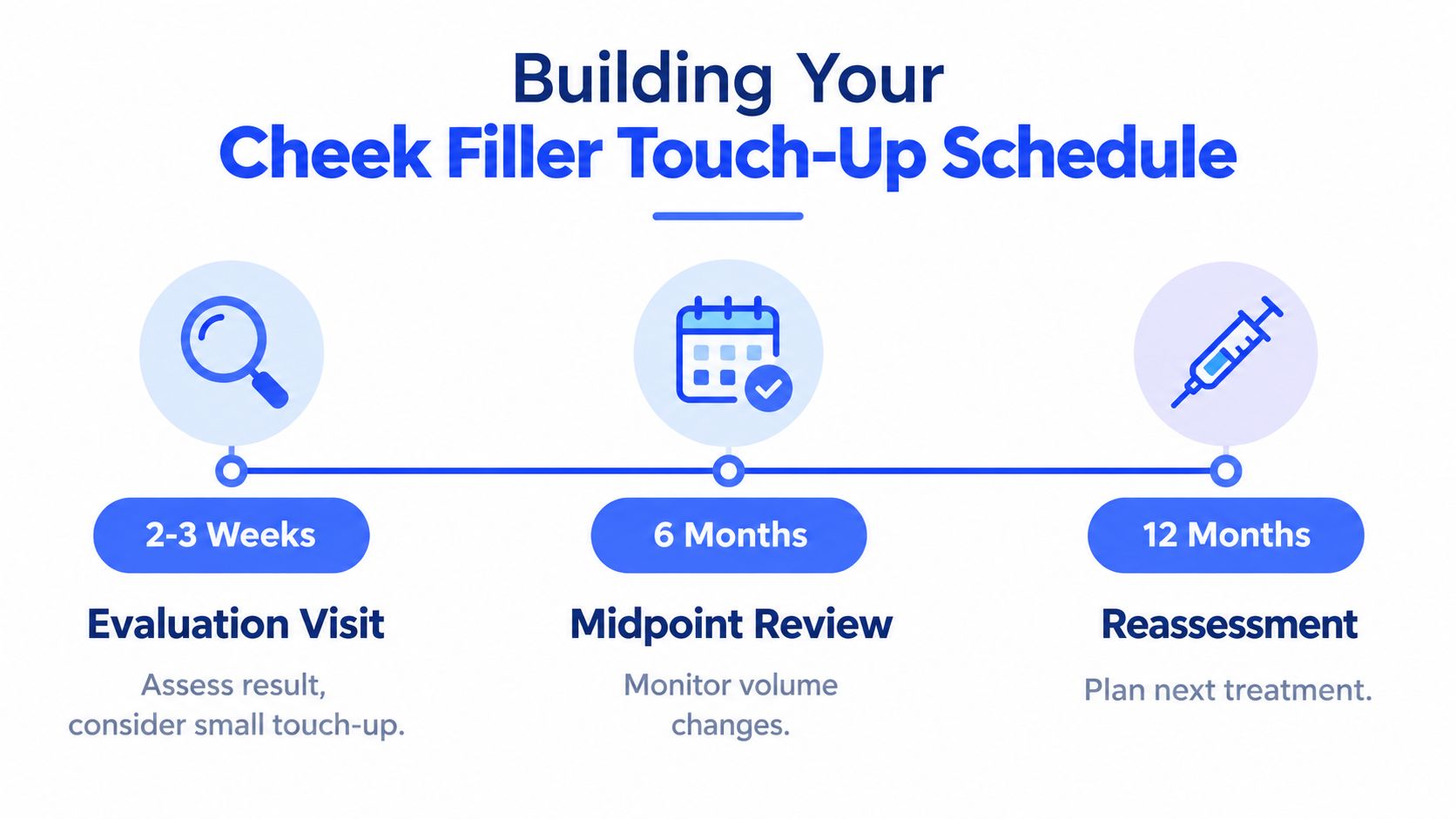
An early review isn't an automatic injection
The touch-up finding supports checking whether the initial treatment achieved adequate correction. It doesn't support routinely adding filler to every patient or claiming that more product always lasts longer.
A follow-up appointment should establish whether treatment is needed. It shouldn't exist simply to deliver the next injection.
The timeline illustration is therefore best understood as a set of review opportunities. A provider may examine the result and recommend no additional treatment, especially when the desired contour remains present.
Factors That Change One Patient's Timeline from Another's
Two patients receiving the same formulation can still reach different maintenance decisions. Product persistence, visible effect, and satisfaction depend on overlapping variables.
The most useful consultation order is to assess material and anatomy first, then placement and initial correction, then individual response and preferences. That's a clinical planning framework, not a research-proven ranking of how much each variable changes longevity.
Start with what the provider can choose
Product characteristics include HA molecular weight, crosslinking, and formulation. Placement depth and technique determine where the correction is created. These factors should be considered together rather than treating a firmer product or deeper injection as an automatic route to a better result.
The FDA product information and cheek studies discussed earlier identify these as relevant durability considerations. They don't establish a universal formula that predicts an individual patient's lifespan.
- Material and formulation: Ask why the selected product suits the correction you want.
- Anatomical placement: Ask where the provider intends to place it and what that placement is intended to achieve.
- Initial correction: Establish whether the goal is subtle restoration or more pronounced projection.
- Individual response: Discuss previous filler results, including products, treatment dates, and any unexpected changes.
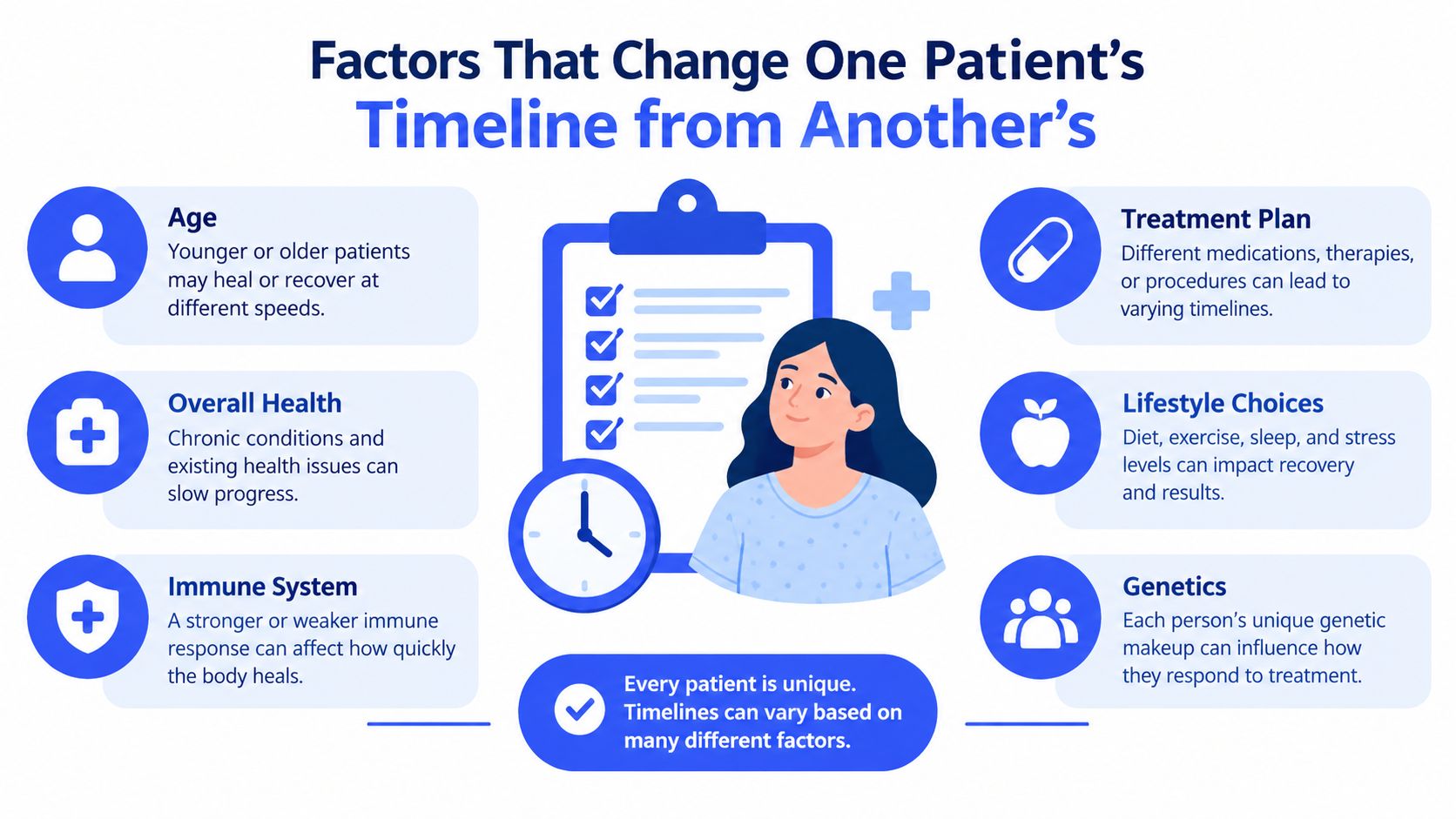
Recovery and longevity are separate: Factors affecting early swelling or bruising shouldn't automatically be interpreted as predictors of long-term correction.
Don't turn lifestyle assumptions into certainty
Metabolism and facial movement can contribute to variability, but they don't provide a reliable personal countdown. A patient shouldn't be told that an active lifestyle guarantees rapid loss of correction without evidence specific to that claim.
Your desired appearance also changes the maintenance decision. Someone who accepts gradual softening may wait longer than someone who wants a consistently defined profile, even if their biological response is similar.
Bring focused questions to the consultation: What result are we trying to preserve? How will we document it? What would justify another treatment? Which changes would prompt an examination rather than a routine top-up?
Building Your Cheek Filler Touch-Up Schedule
Build a review calendar, not a standing order for injections. The distinction protects against treating a date instead of treating an observed need.
A useful plan starts with an early assessment, moves to a review of maintained correction, and leaves room for longer follow-up when the result remains satisfactory. The multicenter study's early touch-up and maintenance evaluation windows provide a reasonable basis for discussing those visits, but not for imposing them on every patient.
Early assessment
Ask your provider when they want to examine the settled result. The purpose is to check contour, symmetry, and whether the original goal was achieved.
If correction is adequate, another injection may add nothing useful. If under-correction is present, a small refinement may be appropriate after examination and discussion.
Maintenance reassessment
At the maintenance review, compare the current appearance with baseline and settled-result photographs. Don't compare only with the fullest early photograph, which may include swelling.
- Contour remains satisfactory: Continue observation rather than refill automatically.
- A specific feature has softened: Discuss targeted correction instead of repeating the entire initial treatment.
- The cheeks look full but less balanced: Reassess the cause before adding volume.
- There's an unexplained lump or persistent swelling: Arrange clinical evaluation, not a routine maintenance session.
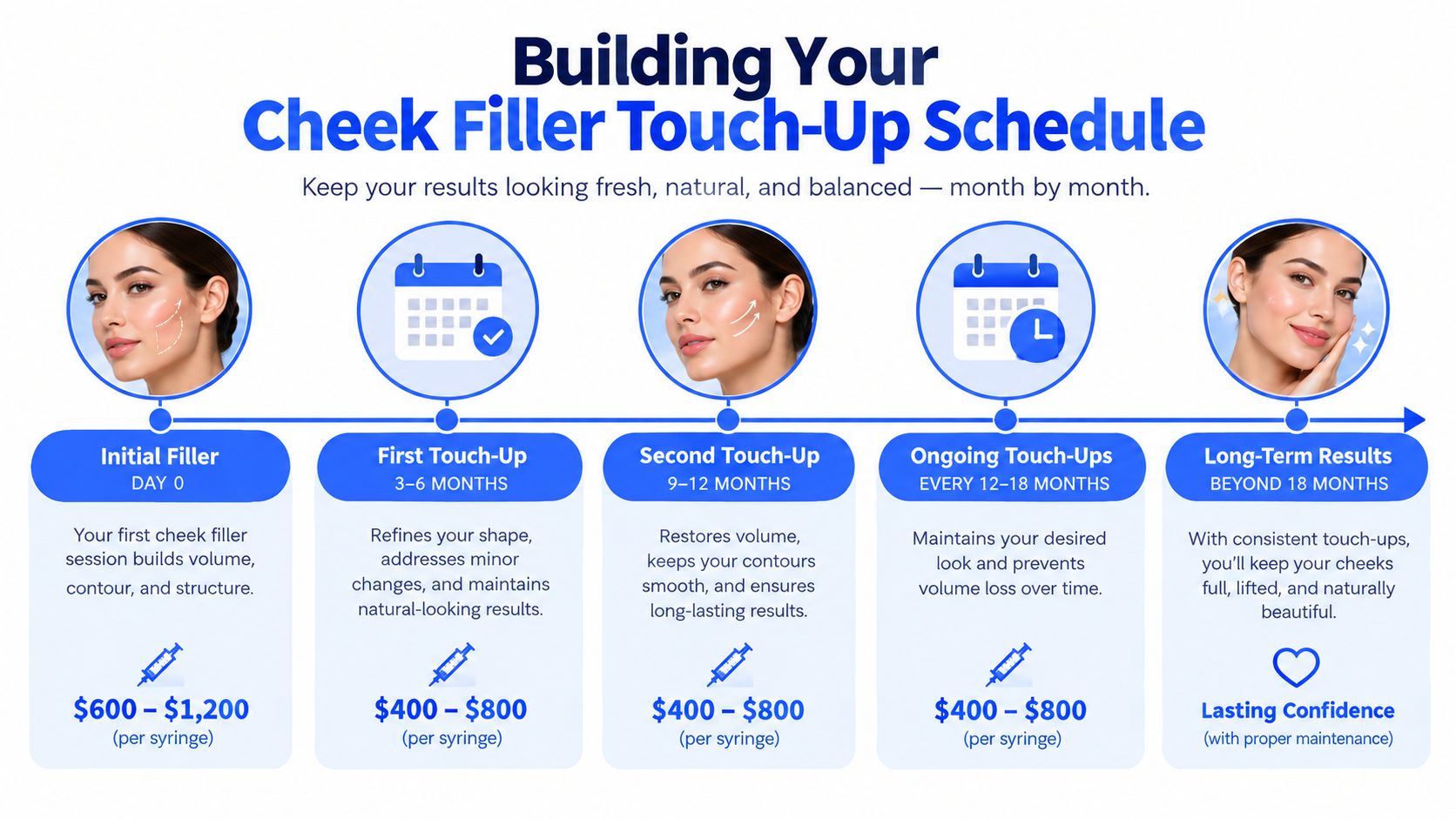
Use this as a scheduling illustration, not a price quotation. Treatment fees and payment arrangements should be confirmed directly. The practice operates on a cash-pay model, and its services aren't covered by insurance.
Adapt the calendar to the material
For Sculptra, organize follow-up around the planned series and subsequent assessment of tissue response. Don't assume an HA touch-up calendar applies.
For fat grafting, follow the procedural provider's assessment schedule and discuss revision only after they can evaluate the retained result. Longer-horizon reviews should also consider whether your goals have changed, not merely whether the original treatment has declined.
Why Some Patients Retain Filler Longer Than They Realize
The assumption that all filler disappears after about a year is too simple. Imaging can identify residual HA in facial compartments long after a patient believes the cosmetic effect has faded.
A published MRI follow-up case demonstrated persistent filler in lateral facial and midface fat compartments at 27 months, while chin filler had nearly degraded by 19 months. The systematic review discussed earlier also documented ultrasound persistence extending beyond conventional cosmetic expectations.
Compartment matters, but a case isn't a guarantee
The MRI observation shows why location deserves attention. Deep midface compartments can expose material to different movement, mechanical stress, vascularity, and enzyme activity than other facial regions.
It doesn't establish that every cheek injection will behave the same way. A single case can demonstrate possibility without defining a typical patient outcome.
Residual material may also be fragmented, redistributed within its intended compartment, or insufficient to preserve the original visible correction. That explains how both statements can be true: filler remains, but the cheeks no longer look as defined.
Maintenance safeguard: Never assume the previous treatment is gone simply because the visible result has softened.
Examine before adding more
A patient returning after a long gap may still have useful residual volume. The provider should review treatment history, examine the cheeks, and consider current symmetry before deciding how much correction is appropriate.
- Previous records: Product names, dates, and treated areas help establish what may remain.
- Current examination: Photographs and palpation help distinguish loss of projection from persistent fullness.
- Imaging when warranted: Uncertain anatomy, persistent nodules, or suspected complications may justify further investigation.
Imaging isn't generally necessary just to check routine longevity. Its value is greatest when the examination leaves a clinically important question unanswered.
The practical consequence is conservative planning. Repeat the assessment, not automatically the original volume.
Planning Your Cheek Filler Journey
A productive consultation should connect your desired contour to a material, an assessment method, and a follow-up plan. Bring previous treatment records and explain whether adjustability, gradual improvement, or longer-horizon restoration matters most.
If you're considering tissue transfer, review facial volume restoration with fat transfer and ask about candidacy, procedural recovery, and revision decisions.
The FDA's dermal filler patient guidance notes that repeat injections may be needed to maintain effects and that swelling and bruising often resolve within days to weeks. It also warns that rare blood-vessel complications can cause tissue necrosis, stroke, or blindness.
Longevity shouldn't outrank safety. Ask how the provider evaluates residual correction, handles complications, and decides when no further treatment is the right choice.
ProMD Health offers dermal fillers, Sculptra, and facial volume-restoration services that can be discussed as different approaches to cheek treatment. Schedule a consultation to review your existing correction, compare suitable materials, and establish a maintenance plan, with treatment availability confirmed at your selected office.


