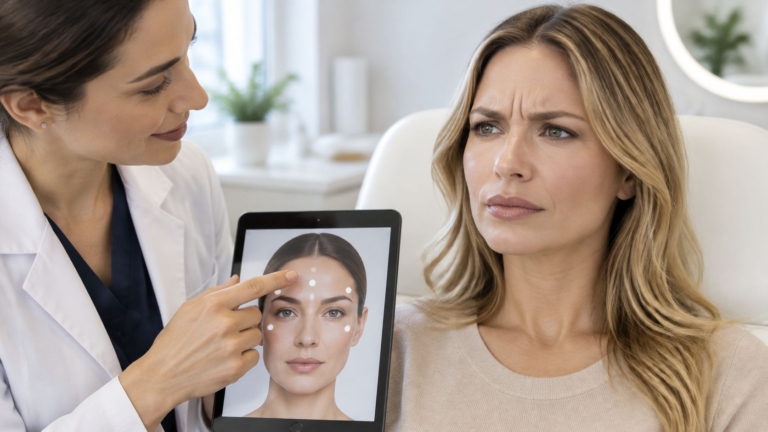
In two randomized, multicenter, double-blind, placebo-controlled Phase 3 studies described in the FDA prescribing information for Botox Cosmetic, 83% of 405 participants, or 334 people, rated their appearance moderately or substantially improved by day 7. That result shows that many participants noticed a change; it does not mean every facial area carries the same risk.
The FDA safety dataset included healthy adults aged 18 to 75, according to the same prescribing information. At labeled cosmetic doses, Botox is generally well tolerated, but treatment effects depend on the muscle injected and the dose used. Temporary changes in muscle movement, such as a heavier-looking brow, are different from evidence of cumulative medical harm. A less-mobile look after years of treatment is an aesthetic outcome, not proof of toxicity.
Table of Contents
- How Safe Botox Is for Wrinkles
- How a Wrinkle Neurotoxin Actually Works
- Side Effects You Can Expect and When to Act
- Who Should Wait or Skip Treatment
- Choices That Lower Injection Risk
- What Years of Treatment and Other Options Change
- Decide Whether Botox Fits Your Face
How Safe Botox Is for Wrinkles
The risk of a cosmetic Botox treatment depends on the area injected and the dose used there. At labeled cosmetic doses, treatment is generally well tolerated, and serious complications are uncommon. A single safety rating for the whole face would miss important differences between sites.
| Treatment area | Reaction | Reported rate | How to read it |
|---|---|---|---|
| Glabellar frown lines | Eyelid ptosis | 3% | A labeled rate for drooping eyelid |
| Glabellar frown lines | Blepharoptosis across trials | 0% to 5.4% | The range reported in the review below |
| Lateral canthal lines | Eyelid edema | 1% | Swelling near the outer eye |
| Forehead lines | Headache | 9% | A labeled rate for this treatment area |
| Forehead lines | Brow ptosis | 2% | A labeled rate for brow droop |
What the wider trials add
A systematic review in the British Dental Journal reported no severe adverse effects in the randomized trials it included. For glabellar-line treatment, eyelid drooping ranged from 0% to 5.4%. The review also notes that technique and injection into nearby muscles can affect the risk.
A meta-analysis of 16 facial-rejuvenation trials involving 42,405 participants found more adverse events with botulinum toxin than with placebo, with a relative risk of 1.24 (95% confidence interval, 1.07 to 1.43). For frown-line treatment, the relative risk was 1.47 (95% confidence interval, 1.23 to 1.77). Reported effects included headache, eye-related symptoms, eyelid drooping, and heavy eyelids, generally described as mild to moderate.
Practical rule: Ask which area is being treated and what risks apply there. A forehead treatment and a frown-line treatment have different site-specific rates.
The FDA labeling for Botox Cosmetic reports eyelid ptosis in 3% of patients treated for glabellar lines, lateral-canthal edema in 1%, headache in 9% of patients treated for forehead lines, and brow ptosis in 2%. Approval applies to specific indications, so ask whether the area you are considering is on-label or off-label. Around the eyes and forehead, the injection site and dose matter because nearby muscles help control the position of the lids and brows.
How a Wrinkle Neurotoxin Actually Works
Think of a dynamic wrinkle as a crease from a muscle that keeps rehearsing the same expression. Frown, squint, lift the brows, and the skin folds in the same place until the fold lingers. A cosmetic neurotoxin is a temporary dimmer on that nerve signal. It is not a filler that props the skin up, and it is not a peel that resurfaces it.
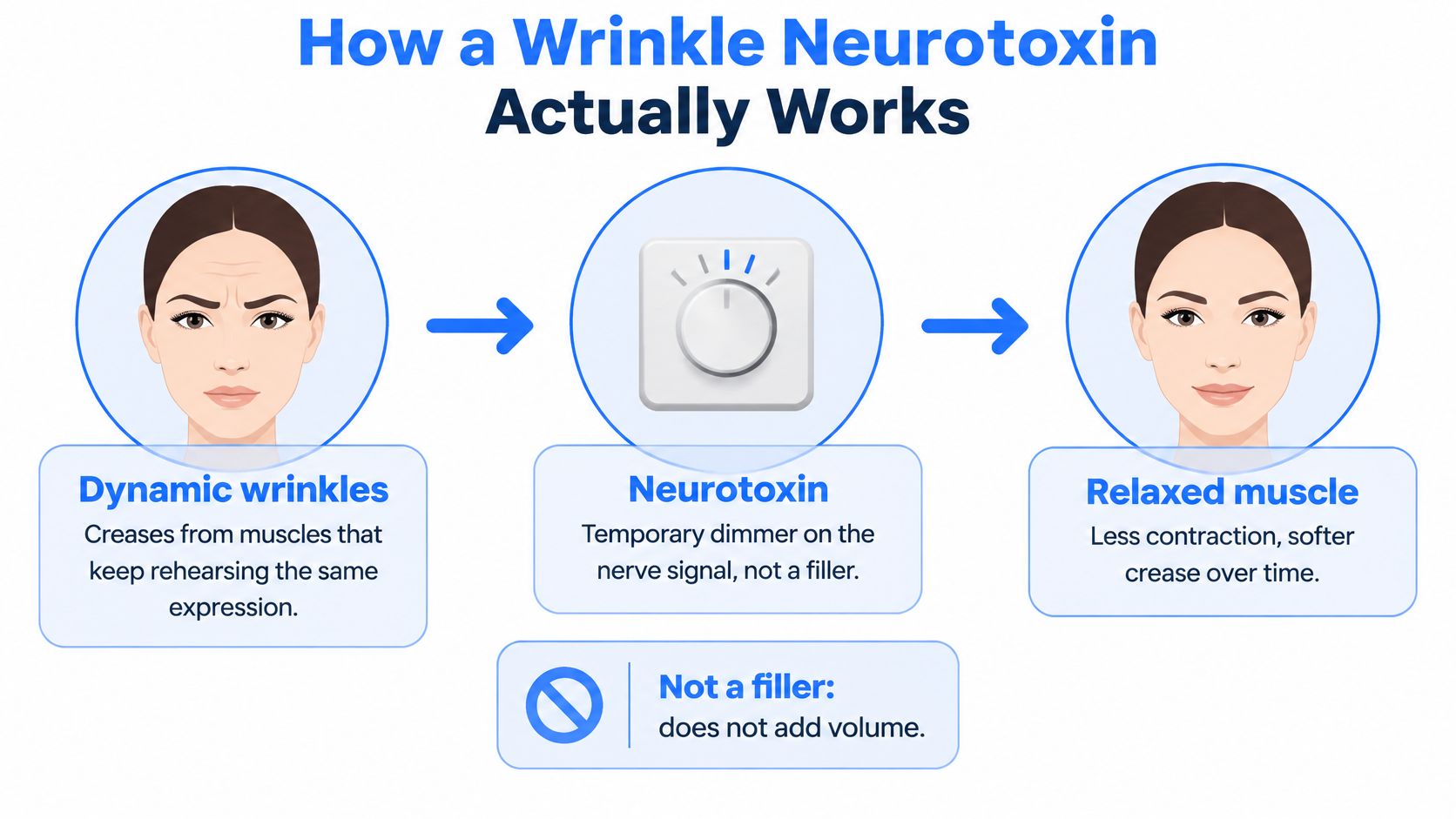
Botulinum toxin blocks acetylcholine release at the neuromuscular junction. The treated muscle contracts less, the overlying line softens, and the nerve ending recovers over the following months. Movement comes back because the effect is temporary, not because the skin was rebuilt.
Where the dimmer usually goes
The usual cosmetic targets are small and specific.
- Corrugator and procerus: These pull the brows together and down, which draws the vertical frown lines.
- Frontalis: This lifts the brows and writes the horizontal forehead lines. Weaken it too far and the brow can feel heavy.
- Orbicularis oculi: This squints the crow's feet. The dose here is smaller because the muscle sits next to the lid.
- Muscles around the mouth: Smaller doses are sometimes used for lip lines or a gummy smile, with a higher chance of an uneven smile if the map is off.
The FDA-approved BOTOX Cosmetic label specifies a standard dose of 20 Units for moderate-to-severe glabellar lines: 0.1 mL into each of five sites, 4 Units per site. That pattern is for temporary improvement in adults 65 or younger, when the lines come from the corrugator and/or procerus.
A Unit is product-specific. A Botox Unit is not a Dysport Unit and not a Daxxify Unit. Copying a number from another brand is a dosing error, not a shortcut.
Say you treat only the frown on a first visit. Effect often starts within a few days, is judged around two weeks, and fades over about three to four months. That is why an early "booster" is a risk topic, not a routine step. You wait until the dimmer has finished turning down before you decide anything was missed.
Toxin changes lines that come from movement. It does not correct pigment, rough texture, or lost volume. Those need a different tool.
Side Effects You Can Expect and When to Act
Most side effects are mild and temporary, but their location and severity matter. A small bruise calls for aftercare; symptoms that affect swallowing or breathing need urgent assessment.
Everyday effects
The American Academy of Dermatology's botulinum-toxin FAQ describes common effects such as swelling, redness, soreness, bruising, and a mild headache. Bruising, when it occurs, generally lasts about one week. Thin eyelid skin can make it more visible, as can medicines or supplements that thin the blood. Ice, patience, and avoiding rubbing the area are usually enough. Contact a clinician if a bruise spreads or the skin looks infected.
Uncommon local effects
If the toxin affects a nearby muscle, the result may be a temporarily heavy brow, droopy eyelid, uneven smile, or stiff forehead. These effects reflect how the dose interacts with local anatomy, and they fade as the toxin wears off. A bothersome but stable droop is a reason to contact the injector for review. Avoid a quick top-up before the result has settled, since adding more toxin can worsen an effect that is still developing.
Distant spread
Serious complications are rare at labeled cosmetic doses, but the effect can spread beyond the injection area. The FDA labeling warns that distant spread may cause generalized weakness, double vision, drooping eyelids, difficulty swallowing or speaking, or breathing difficulty. Symptoms may begin hours to weeks after injection and require urgent medical assessment.
The FDA-approved BOTOX Cosmetic label specifies a 20-unit dose for glabellar lines and reports no definitive serious distant-spread events with dermatologic use at that labeled dose. Some higher-risk or anatomically atypical patients were excluded from key trials, so those findings do not establish the same risk for every person or injection pattern.
Difficulty swallowing, speaking, or breathing, progressive generalized weakness, or vision changes need urgent care. These symptoms are different from a small, localized bruise.
Total dose, timing between treatments, injection placement, product handling, and the injector's knowledge of facial anatomy all affect risk. Before treatment, tell the clinician about neuromuscular disorders and medicines that may strengthen neuromuscular blockade.
Who Should Wait or Skip Treatment
The same dose can be reasonable for one person and unsuitable for another. The decision depends on the treatment area, the planned muscle effect, and the patient's health and facial anatomy.
| Situation | Why it changes safety | Practical action |
|---|---|---|
| Allergy to toxin or formula ingredients | Hypersensitivity risk | Do not inject that product |
| Infection or cold sore at the site | Local problem can worsen | Delay until the skin is clear |
| Pregnancy or breastfeeding | Cosmetic safety not established | Defer treatment |
| Myasthenia, ALS, or similar weakness | Blockade can add to existing weakness | Disclose; often avoid cosmetic toxin |
| Drugs that affect nerve-to-muscle signaling | May strengthen the toxin effect | List them before dosing |
| Prior droopy lid or heavy brow | Nearby muscles are easy to over-treat | Smaller dose, different site, or skip |
| Lines present when the face is at rest | Toxin only relaxes movement | Consider a different treatment |
Allergy, active skin problems, pregnancy, and breastfeeding can change whether treatment should proceed at all. For other health conditions or medications, the clinician weighs how an added muscle-relaxing effect could affect the individual patient.
Facial anatomy also shapes the decision. A brow that already feels heavy or a history of eyelid droop may leave less room for weakening nearby muscles without changing expression. Lines visible when the face is relaxed may need a different approach, because a movement-relaxing treatment addresses muscle activity rather than the crease itself.
The FDA label describes the cosmetic indication for adults 65 or younger, while its safety data included adults up to 75. The best age for getting Botox is therefore a planning question, not a birthday rule. Older patients should have an individual consultation before treatment is planned.
Bring your diagnosis and medication lists, along with notes about prior treatments or eyelid concerns. A useful consultation matches the dose and injection sites to the person, and may narrow or defer the plan.
Choices That Lower Injection Risk
Risk here is mostly cause and effect. You can check the causes in the order you would use them, starting before anyone draws up a syringe.
A cosmetic neurotoxin works like a dimmer on one muscle group, not a single switch for the whole face. The unit count that softens a frown can drop a brow that already sits low if those units land in frontalis. Safety is a site decision and a dose decision, made one zone at a time. A less-mobile look years later is an aesthetic outcome of dose and muscle habit. It is not, by itself, proof that the drug has piled up as a toxin.
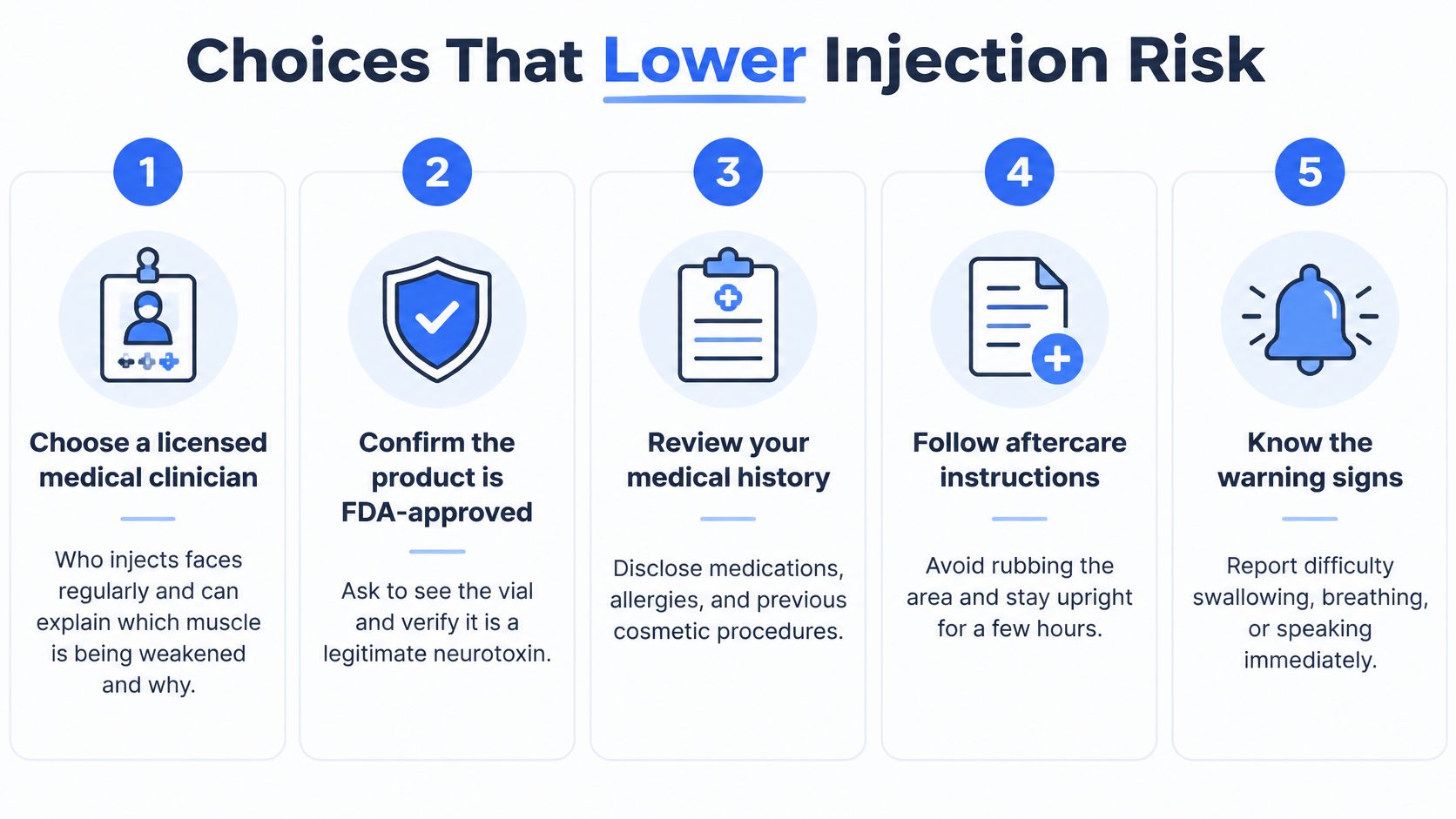
- Choose a licensed medical clinician who injects faces regularly and can name the muscle being weakened and why. Practices that are adding injectables to your clinic still need structured facial-anatomy training before a new injector treats patients. That training is muscle maps and product handling. A smooth sales conversation is not.
- Choose a provider who verifies the product and its lot before treatment. Confirm the vial is an FDA-approved product such as Botox Cosmetic, Dysport, or Daxxify, and that lot information is available. In 2025, the FDA reported issuing 18 warning letters to websites marketing unapproved or misbranded botulinum-toxin products, and adverse events included symptoms of botulism.
- Ask for the product name and the unit count in that product's units. Keep the plan on one product's scale. Botox Cosmetic, Dysport, and Daxxify each count units differently, so a number copied from another brand is the wrong map.
- Treat the labeled frown pattern as a reference point, not a quota every forehead must receive. A smaller frontalis, or a brow that already sits low, may need less than a standard pattern. That smaller map is a safety choice for that face.
- Wait until the effect has declared itself before any added dose. A same-week booster stacks units onto a result you cannot see yet, which is a known way to overshoot. Temporary weakness in the intended muscle is the planned effect. Extra units in the wrong spot are what turn that plan into an unwanted freeze.
- After treatment, follow the activity limits the clinician sets, usually skipping rubbing, intense workouts, and face-down pressure for the rest of that day. Those first hours are about keeping the dose where it was placed.
- A first visit is easier to judge when you already know what to expect from first-time Botox. If something later feels urgent, use the symptom list in the Side Effects section and seek urgent care rather than a touch-up.
Choose a setting where you can see the vial and hear which muscle is being treated. Product handling and anatomy still decide the outcome. If either is hard to confirm, waiting is the lower-risk choice.
What Years of Treatment and Other Options Change
Short-term tolerability does not answer what repeated treatment does over years. A review of long-term cosmetic use reports no evidence of cumulative adverse events and notes that event rates may decline in later treatment cycles. The same review describes the possibility of lasting changes in facial expression, or a mask-like appearance, with prolonged cosmetic use.
That less-mobile look is a change in muscle habit and dose. It is an aesthetic outcome, not proof of cumulative toxicity. The levers are wider spacing, smaller doses, a skipped cycle, and a fresh look at whether the line still moves or has become a resting crease.
Say someone is treated three times a year for frown lines and still raises the brows normally. That is the expected course. Say someone else's brows feel frozen, the lids feel heavy, or the smile looks flat. That person needs less product or a pause, not an automatic repeat of the last map.
Match the problem to the tool
Botox does not replace sun protection, skincare, or treatments aimed at pigment, texture, or volume loss. Combining neurotoxin with filler, laser, or peels is judged by sequence and by the total plan, not by the toxin alone. Laser availability can differ by office, so confirm the device before you book that part of the plan.
| Option | Best matched problem | Main safety trade-off | Typical downtime |
|---|---|---|---|
| Botox, Dysport, or Daxxify | Lines that appear with expression | Temporary weakness, rare spread, product-specific units | Bruising about a week; no wound care |
| Hyaluronic acid filler | Folds and lost volume | Bruising, lumps, rare vessel blockage | Swelling for several days |
| Laser treatment | Pigment, redness, fine sun damage | Heat, pigment change if settings mismatch skin | Redness; varies by device and office |
| Peels, Hydrafacial, medical-grade skincare | Texture and maintenance between visits | Irritation or sensitivity, not muscle effects | None to a few days of flaking |
Filler is not a gentler Botox. It occupies space. Its serious rare risk is vessel blockage, which is a different emergency from toxin spread. The side-by-side choice is laid out in Botox versus dermal fillers. Peels, Hydrafacial, and medical-grade Skin Shoppe skincare keep texture between visits. They do not relax a frown muscle, and toxin does not stop new sun damage.
Decide Whether Botox Fits Your Face
A frown line between the brows and a crease at the mouth are not one safety question. Each site has its own dose, its own nearby muscles, and its own trade-off if that dose stills an expression you wanted to keep.
Safety works like separate dimmers, not one switch for the whole face. Lowering the brow does not decide the eyes or the mouth. A less mobile look after years of treatment is the look of muscles kept quieter on purpose. That quieter look is an aesthetic result. It is not proof that the medicine has built into cumulative toxicity.
Decide in order, and use the detail you already have.
Choose neurotoxin when the lines you dislike show up as you frown, squint, or lift the brows, and you can share your full medical and medication history. For those movement lines, Botox, Dysport, and Daxxify are customized to the individual face rather than copied from one map.
Wait or decline when a stop from the screening rules applies. An allergy, an active cold sore, pregnancy, breastfeeding, or a neuromuscular disease belongs in the plan before a syringe is drawn.
Choose another tool when the complaint is hollow cheeks, a crease that stays at rest, brown spots, or dull texture. The match of problem to treatment is already set out beside neurotoxin. More units will not fix a problem muscle relaxation was never meant to treat.
Schedule a medical consult at a current ProMD location. Ask for the product name, the unit count in that product's units, the muscles to be treated, and what a heavy brow would look like on your face. Bring your medicines and prior treatment dates, confirm the vial, and leave with a written dose.
ProMD Health plans Botox, Dysport, and Daxxify around the muscles that crease the brow, eyes, and mouth, with screening and dosing matched to your history. If you want a clinician to separate a true safety stop from a dosing choice, visit ProMD Health and book a consult at a current location. Bring your medication list so the plan can be sized, or declined, before treatment day.