Menopause is a single point in time, confirmed after 12 consecutive months without a period. The transition leading up to it can take years, and symptoms may continue afterward.
Why can menopause feel as though it has been going on for years? People asking how long is menopause often want to know when disrupted sleep, unpredictable periods, or sudden heat will stop, rather than when they meet the clinical definition.
Those are different timelines. Knowing the difference helps you understand your experience without measuring it against one average.
Table of Contents
- How Long Menopause Lasts, Stage by Stage
- Perimenopause Length and How Menopause Is Confirmed
- Symptoms That Can Outlast Your Last Period
- What Changes Your Timeline and Why
- Managing Symptoms at Each Stage
- What to Track Before a Clinical Review
How Long Menopause Lasts, Stage by Stage
Menopause is a milestone, while the transition and symptoms surrounding it can continue for years. The distinction matters because the end of menstrual periods doesn't necessarily mean the end of symptoms.
Menopause stages and typical timing
| Stage | Typical timing | Defining marker | Typical length |
|---|---|---|---|
| Perimenopause (transition) | Often begins in the mid-to-late 40s | Irregular cycles, hot flashes, sleep changes | About 4 years on average; from a few months to 8 years, according to Cleveland Clinic, with longer transitions also reported |
| Menopause (single point) | Final period on average around age 51 to 52 | 12 consecutive months without a period | One day, confirmed looking back |
| Postmenopause | From the final period onward | No menstrual periods; some symptoms may continue | Lifelong |
The World Health Organization places natural menopause generally between ages 45 and 55 and defines perimenopause as beginning with transition signs and ending after 12 consecutive months without menstruation. The average final-period age of about 51 is also described by the American College of Obstetricians and Gynecologists; an average isn't a deadline.
Use the stages as a planning guide
Your symptoms don't have to appear in a particular order. You might first notice interrupted sleep, while someone else notices longer gaps between periods without much change in sleep or mood.
The emotional adjustment can also deserve attention independently of physical symptoms. For support with changing identity, relationships, or routines, Be Your Best Self & Thrive Counseling, PLLC's guide to St. Petersburg life transition counseling offers context on counseling during major life changes.
Start by finding the date of your last period and noting when your cycles first changed. That creates a personal timeline rather than an expectation that your body should match every row.
Planning summary: Think in terms of a transition measured in years, followed by permanent postmenopause, not a temporary condition with a predictable finish date.
Perimenopause Length and How Menopause Is Confirmed
A Harvard-affiliated review published in 2024 describes the menopause transition as lasting 4 to 10 years, beginning at an average age of 47. That broader range helps explain why a person can experience recognizable changes well before their periods finally stop.
Different estimates don't necessarily contradict each other. Researchers may measure from the first noticeable cycle change, the onset of symptoms, or another transition marker. An average describes the people studied; it can't tell you how much time remains in your own transition.
Why the transition feels uneven
Perimenopause often feels more like a dimmer switch than an on-off switch. Hormone levels fluctuate rather than declining smoothly, so a difficult stretch may be followed by a relatively settled one.
Cycles may shorten, lengthen, or include skipped periods. Flow can become lighter or heavier, and symptoms may appear even when periods still seem fairly regular.
A useful record separates menstrual changes from other symptoms:
- Cycle pattern: Note when bleeding begins and whether the interval feels different from your usual pattern.
- Flow and spotting: Record heavier bleeding, bleeding between periods, or a pattern that's new for you.
- Symptoms: Track heat episodes, sleep interruption, mood changes, and vaginal discomfort separately.
- Medical context: Include medications, hormonal contraception, surgery, or cancer treatment that could affect the interpretation.
Don't assume every change is perimenopause. Pregnancy, thyroid conditions, medications, and other causes can affect bleeding or produce overlapping symptoms. Your clinician should consider the whole picture rather than assigning a diagnosis from age alone.
The confirmation happens afterward
The NHS menopause guidance distinguishes perimenopause from menopause, which is identified after 12 consecutive months without a period. This is a retrospective diagnosis: you recognize the final period only after enough time has passed without another.
For example, say your last period occurs in March. The following March becomes the confirmation point if no period has returned and no other cause explains the absence of menstruation. A period returning during the intervening months means that earlier period wasn't the final one.
The confirmation date and the final-period date aren't the same thing. That's why people can become confused when comparing a calendar milestone with symptoms that began much earlier.
Don't use the disappearance of hot flashes, better sleep, or a quieter month as proof that the transition has ended.
Exceptions need a different assessment
Removal of both ovaries and certain cancer treatments can bring on menopause abruptly rather than through a gradual transition. A menstrual calendar alone may not describe what's happening in those circumstances.
The National Institutes of Health's menopause guidance supports individualized assessment for early or abrupt menopause and medical evaluation for bleeding after 12 months without menstruation. New bleeding shouldn't be dismissed as one more hormonal fluctuation.
You also don't have to wait for the formal milestone to ask for help. A clinician can assess disruptive symptoms during the transition while considering other explanations and appropriate treatment choices.
Symptoms That Can Outlast Your Last Period
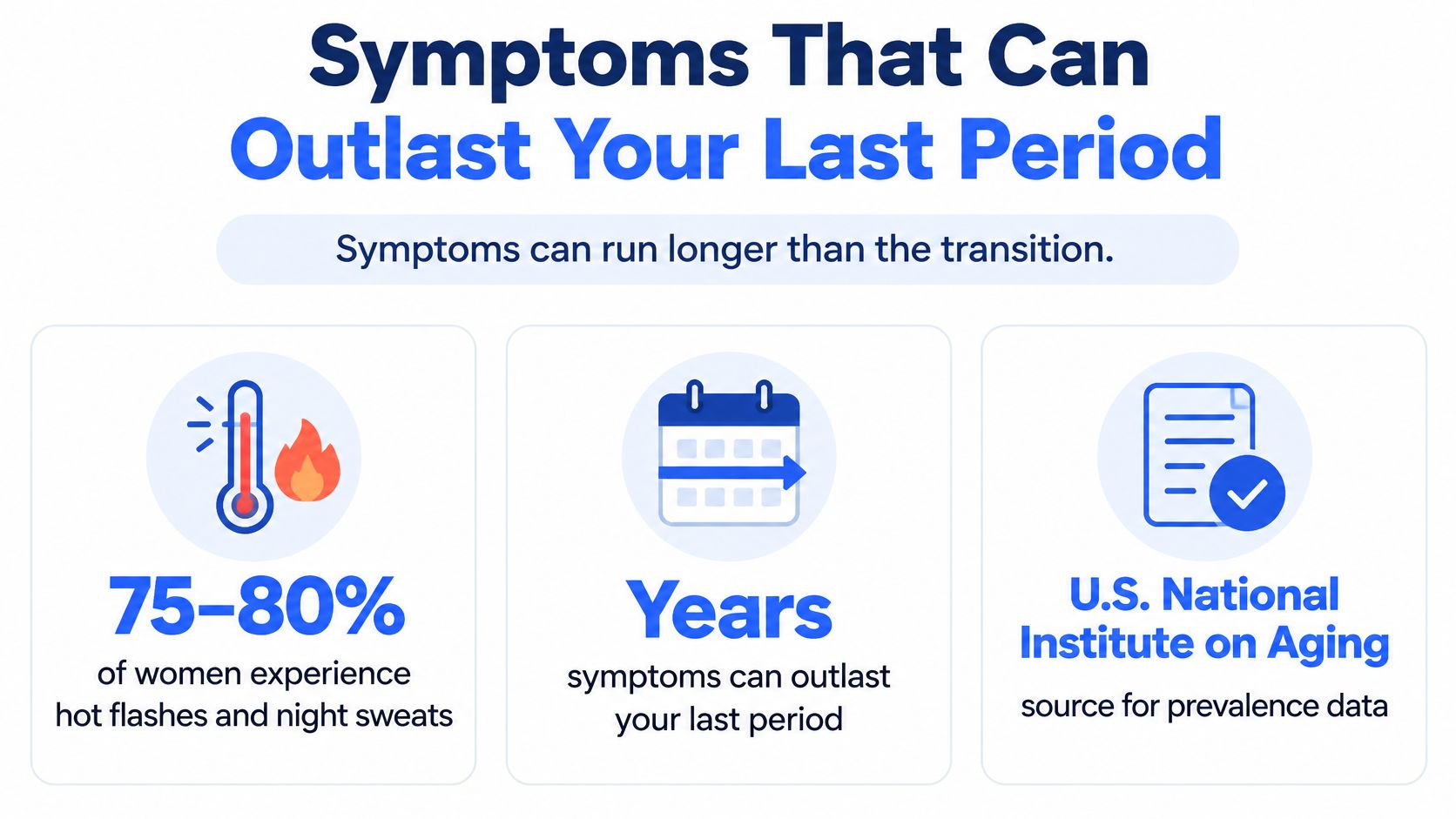
Hot flashes and night sweats can continue after periods stop. They are called vasomotor symptoms, and their duration varies: some people find they ease, while others have symptoms for years.
An NIH-indexed clinical review reports that about 75–80% of women experience hot flashes or night sweats. In the studies it summarizes, these symptoms often began before the final period, and some continued for more than 10 years. The review reports an average duration of about 5.2 years in one longitudinal analysis and roughly 4 years in a meta-analysis of 35,445 women.
Match the timeline to the symptom
The U.S. National Institute on Aging describes menopause-related symptoms lasting approximately 2–8 years. In the prospective Study of Women's Health Across the Nation analysis discussed in its evidence base, frequent hot flashes or night sweats lasted a median of 7.4 years overall and 4.5 years after the final period. These study results describe common patterns, not a deadline for an individual.
How long common menopause symptoms last
| Symptom | Typical duration | What usually happens next |
|---|---|---|
| Hot flashes and night sweats | May continue through the transition and into postmenopause | Often ease over time; some people continue to have disruptive symptoms |
| Sleep disruption | Can accompany night sweats over the same extended period | May improve as sweats ease; persistent sleep problems deserve separate assessment |
| Mood changes | Can fluctuate during the transition; there is no single year count | Seek assessment for depression rather than waiting it out |
| Vaginal dryness and urinary symptoms | Can continue into postmenopause | May persist without treatment |
| Sexual discomfort | Can persist alongside vaginal and urinary symptoms | Address the discomfort based on its cause and effect on daily life |
| Bleeding changes | Usually stop at or near the final period | Bleeding after confirmed menopause requires evaluation |
Australia's Department of Health and Aged Care reports that symptoms average 4 to 6 years, and that 1 in 10 women experience symptoms for years into postmenopause. Estimates differ partly because studies may track different symptoms and define duration differently.
Separate overlapping problems
Night sweats can wake you, but they do not explain every sleep problem. Persistent insomnia or low mood may have other causes and deserves its own assessment.
Learn about symptoms associated with low estrogen and progesterone to help prepare questions for a clinician, without assuming hormones explain every symptom.
For example, someone whose final period was at 52 may continue having night sweats for years. Menopause has a defined point in time, while symptom relief follows its own course. Track each symptom's frequency, severity, and effect on daily life rather than judging progress only by how long it has been since the last period.
What Changes Your Timeline and Why
Factors that change the menopause timeline
| Factor | Effect on the timeline | Basis or note |
|---|---|---|
| Earlier symptom onset | Can mean a longer transition and symptom course | Longitudinal studies identify different symptom trajectories |
| Smoking | Menopause tends to arrive earlier | An association, not a personal prediction |
| Surgical removal of both ovaries | Menopause occurs abruptly without the usual gradual transition | Needs individual assessment |
| Certain cancer treatments | Can cause early or abrupt menopause | The treatment and patient's circumstances matter |
| Symptom severity and other health conditions | Persistent symptoms may need ongoing reassessment | Review the individual health history |
Earlier symptoms don't necessarily mean an earlier finish. A longitudinal review of symptom patterns describes distinct courses, including symptoms beginning early and continuing longer, and symptoms developing later and persisting after menopause.
Your clinician should also distinguish when menopause happens from how long symptoms last. A factor associated with an earlier final period doesn't automatically predict a shorter or longer period of sleep disruption, vaginal discomfort, or hot flashes.
Group averages aren't individual forecasts
The 2025 Women's Health and Education Initiative factsheet reports vasomotor-symptom durations of approximately 10 years among African American women, 8.9 years among Hispanic women, and 6.5 years among non-Hispanic White women, while Japanese and Chinese American women report fewer symptoms and lower overall severity. These are population findings, not a schedule for an individual patient.
Age at symptom onset, underlying conditions, treatment access, and study design all affect how such comparisons should be interpreted. Race or ethnicity alone can't determine what your experience will be.
The useful question is whether your symptoms are being recognized and treated appropriately. If someone describes your experience as normal, clarify whether they mean common or something you're expected to tolerate without help.
Common doesn't mean you have to accept untreated symptoms. Explain what you can't comfortably do, rather than reporting only that symptoms are still present.
Treatment duration is another separate decision
NICE guidance doesn't set a single appropriate duration for hormone therapy. The reason for treatment, medical history, age, symptoms, and periodic review should guide decisions, and symptoms can recur after stopping.
That makes reassessment more useful than an automatic stop date. A treatment review should ask whether the approach still helps, whether your risks or preferences have changed, and whether another option would fit better.
Bring up symptoms that have become easier to overlook, too. Avoiding intimacy or planning work around poor sleep may indicate an ongoing problem even if you've become accustomed to it.
Managing Symptoms at Each Stage
Management options by symptom and key consideration
| Management option | Symptoms or risks it targets | Key consideration |
|---|---|---|
| Menopausal hormone therapy | Hot flashes, night sweats, bone protection | Individualized and reassessed periodically; symptoms can return after stopping |
| Low-dose vaginal estrogen | Vaginal dryness and urinary symptoms | Local treatment with lower systemic exposure |
| Non-hormonal prescription options | Hot flashes when hormones aren't suitable | Medical history and other medications guide selection |
| Cognitive behavioral therapy and sleep care | Sleep disruption, mood, and distress | Can work alongside medical options |
| Lifestyle measures | Mild hot flashes and sleep disruption | Modest effects; useful alone or in combination |
| Bone and heart risk review | Long-term bone and cardiovascular health | Relevant regardless of symptom severity |
Treat the symptoms, not the number of years. Someone struggling during perimenopause may need active treatment, while someone well into postmenopause may need care focused on vaginal discomfort rather than hot flashes.
The options aren't interchangeable. Local vaginal treatment addresses a different problem from systemic therapy, which acts throughout the body. A clinician should match the treatment to the complaint and review relevant contraindications before prescribing.
Build a plan around daily life
For milder symptoms, try layered clothing, a cooler bedroom, regular exercise, and limiting alcohol or caffeine near bedtime. Note whether these changes help rather than assuming every suggested habit will work for you.
Mood concerns deserve particular care. Refresh Psychiatry & Therapy's Perimenopause and depression symptoms explained offers context for distinguishing transition-related changes from concerns that need mental health evaluation.
ProMD Health offers Menopause Management as part of our wellness services. For hormone imbalance, our providers order detailed lab work to identify specific imbalances and build a targeted treatment plan; that process is distinct from using a blood test to predict exactly when symptoms will end.
Our overview of menopause hormone therapy options provides background for a treatment conversation. Testing, symptoms, history, and your preferences should be considered together rather than allowing any single result to dictate care.
Questions worth bringing
- Which symptoms are most disruptive? Name the effect on your sleep, work, comfort, or relationships so treatment priorities are clear.
- What's my personal risk profile? Discuss your medical history, current medications, and bone and cardiovascular health.
- When will we review treatment? Agree on what improvement should look like and which changes should prompt earlier contact.
A useful plan includes what to do if treatment doesn't help. You shouldn't have to wait for symptoms to become unbearable before discussing an adjustment.
What to Track Before a Clinical Review
A short record can make it easier to explain how symptoms affect daily life. A phone note or paper calendar is enough. Focus on details that add context to a clinical conversation:
- Menstrual changes: Note your last period, skipped cycles, spotting, and changes in flow. Mark uncertain dates as approximate.
- Bloating: Record when it happens and whether it coincides with other symptoms. The guide to water retention and menopause can help you prepare questions.
- Changes that need assessment: New bleeding after menopause has been confirmed warrants medical evaluation. Symptoms affecting work, sleep, or relationships are also reasons to seek clinical advice.
- Practical questions: Ask whether lab work could affect the care plan, and bring a list of medications and supplements. If you're considering remote care, ask whether your concern is suitable for a virtual visit or needs an in-person examination.
Confirm the practical details
Treatment availability can vary by office, so confirm that the service you're seeking is offered at your chosen location. ProMD Connect provides virtual wellness support, with prescription options shipped directly to patients' doors.
ProMD Health offers menopause management and hormone optimization. Visit ProMD Health to discuss care for your current symptoms and confirm service availability.