Nasolabial fold filler cost is commonly about $650 to $950 per syringe for hyaluronic-acid filler, with most sessions using one to two syringes, putting a first session near $650 to $1,900. Your actual bill depends on the treatment plan, not just the advertised syringe price.
The most revealing comparison is the spread in posted prices: a 370-practice U.S. pricing analysis found typical prices of $600–$750 per 1-mL syringe, but an observed range of about $300–$1,300. That spread makes a single advertised price a weak basis for choosing treatment.
For a useful comparison, separate product price, planned volume, included care, and maintenance. A cheaper syringe doesn't necessarily produce a cheaper treatment plan, and a smaller first invoice doesn't necessarily mean a lower long-term expense.
Table of Contents
- Nasolabial Fold Filler Cost Ranges at a Glance
- How Many Syringes Your Treatment Plan Needs
- Filler Types and What Drives Each Price
- Annualized Cost and Maintenance Over Time
- Hidden Risks Behind an Unusually Low Price
- Verify Every Line of a Filler Quote Before You Book
Nasolabial Fold Filler Cost Ranges at a Glance
Hyaluronic-acid filler is commonly quoted at about $650–$950 per syringe, but published estimates measure different things. Some describe a unit price; others describe an entire appointment, a local clinic's treatment package, or a physician-reported average.
Those distinctions matter when you're comparing quotes. A session price may include several syringes, while an attractive advertised price may cover only the first syringe.
Reported nasolabial fold and hyaluronic-acid filler prices
| Source | What it measures | Reported price | Year |
|---|---|---|---|
| 370 U.S. aesthetic practices | Hyaluronic-acid filler, per 1-mL syringe | $600–$750 typical; $300–$1,300 observed | Not specified |
| RealSelf | Physician-reported average, hyaluronic-acid filler | $715 per syringe | 2024 |
| The Zoe Report | Hyaluronic-acid filler | $550–$850 per syringe | 2024 |
| Slimming Solutions Spa | Nasolabial-fold filler | $600–$1,500 per syringe; typical total $700–$1,400 | 2024 |
| Unify MedCare in California | Nasolabial-fold treatment, one to two syringes | About $1,150 | 2025 |
| Commonly cited U.S. estimates | Hyaluronic-acid filler, per syringe | $650–$950 | Not specified |
These are reference points, not a current clinic price list. The reporting years, geographic markets, and collection methods aren't identical, so combining them into a new average would suggest more precision than the sources support.
The California session estimate, for example, is useful as a local treatment reference. It isn't evidence that every clinic should charge that amount, or that every patient needs the same volume.
Compare the same unit before comparing prices
Start by labeling each quote per syringe, per treatment, or per treatment package. Then check whether the product and volume match. Without those details, you can't tell whether a price difference reflects a higher unit charge or a more extensive plan.
A written quote should distinguish the proposed treatment from optional additions. If cheek support is presented as a separate recommendation, you should be able to see what the fold-only plan costs and why the injector recommends expanding it.
Our complete guide to dermal filler costs provides broader context for comparing filler pricing across treatment areas. For nasolabial folds specifically, keep the comparison tied to the same clinical objective rather than choosing whichever advertisement lists the smallest number.
Practical rule: Compare complete plans with complete plans. A syringe advertisement and an itemized treatment estimate aren't equivalent offers.
Also distinguish a quote from a budget ceiling. Tell the injector what you're comfortable spending, then ask what degree of improvement is realistic within that amount. A clear discussion of limits is more useful than a low starting price followed by additions you weren't expecting.
How Many Syringes Your Treatment Plan Needs
Suppose an injector recommends a syringe for each cheek plus another for the folds. That's a hypothetical treatment plan, not a recommendation for your face, but it illustrates how quickly a unit price becomes a larger bill.
Using the $650–$950 per-syringe estimates summarized by Aesthetic Med Guide, that hypothetical three-syringe plan would total $1,950–$2,850 before separately charged services. The same guide describes many initial sessions as one to two syringes, or roughly $650–$1,900, and gives an independent combined fold-and-midface estimate of two to three syringes and $1,600–$2,600.
Those totals aren't contradictory. They use different treatment assumptions and potentially different unit prices. You shouldn't expect every combined treatment to equal the same syringe count multiplied by a universal rate.
Session cost by treatment scenario
| Scenario | Syringes | Estimated cost | What it assumes |
|---|---|---|---|
| Single syringe for mild folds | 1 | $650–$950 | Direct fold correction using the cited U.S. per-syringe estimates |
| Typical nasolabial-fold session | 1–2 | $650–$1,900 | Common initial-session range |
| Fold plus midface support | 2–3 | $1,600–$2,600 | Independent estimate combining cheek support and fold treatment |
| Staged bilateral correction over two visits | Assessed total split between visits | Total syringes × quoted unit price, plus separately charged visits | Provider assessment determines volume and allocation |
The mild-fold scenario is a budgeting illustration, not a rule that mild folds always require a full syringe. Likewise, staging treatment doesn't establish the total volume in advance.
Why the injector may recommend adjacent areas
The visible crease isn't always the only treatment target. Underlying tissue structure, facial volume loss, and the planned placement of filler influence how the injector approaches correction.
A plan that restores cheek or midface support is materially different from a plan that injects the crease directly. Ask the injector to explain which anatomical problem each placement addresses, rather than accepting extra syringes without an explanation.
Use these questions to make the volume decision understandable:
- Treatment map: Where will the product go, and what improvement is expected from each area?
- Total volume: Is the estimate for the entire face being treated, both folds, or only part of the proposed plan?
- Staging: Is a later appointment already anticipated, or would it be optional after reassessment?
- Additional charges: Does correcting asymmetry or adding product at a later visit create a separate bill?
A volume-based estimate is useful only when the injector connects that volume to your anatomy and goals. More product isn't automatically better value. The relevant question is whether each proposed placement contributes to the result you're trying to achieve.
Filler Types and What Drives Each Price
Hyaluronic acid is the main starting point for facial-filler price comparisons. FDA materials citing the American Society of Plastic Surgeons report 5,331,426 hyaluronic-acid filler procedures in 2023, compared with 932,861 non-hyaluronic-acid procedures, making HA roughly 85% of those combined categories, according to the FDA's filler documentation.
That share describes the broader procedural market, not nasolabial-fold pricing specifically. It helps explain why so many published estimates use HA syringes as their reference unit.
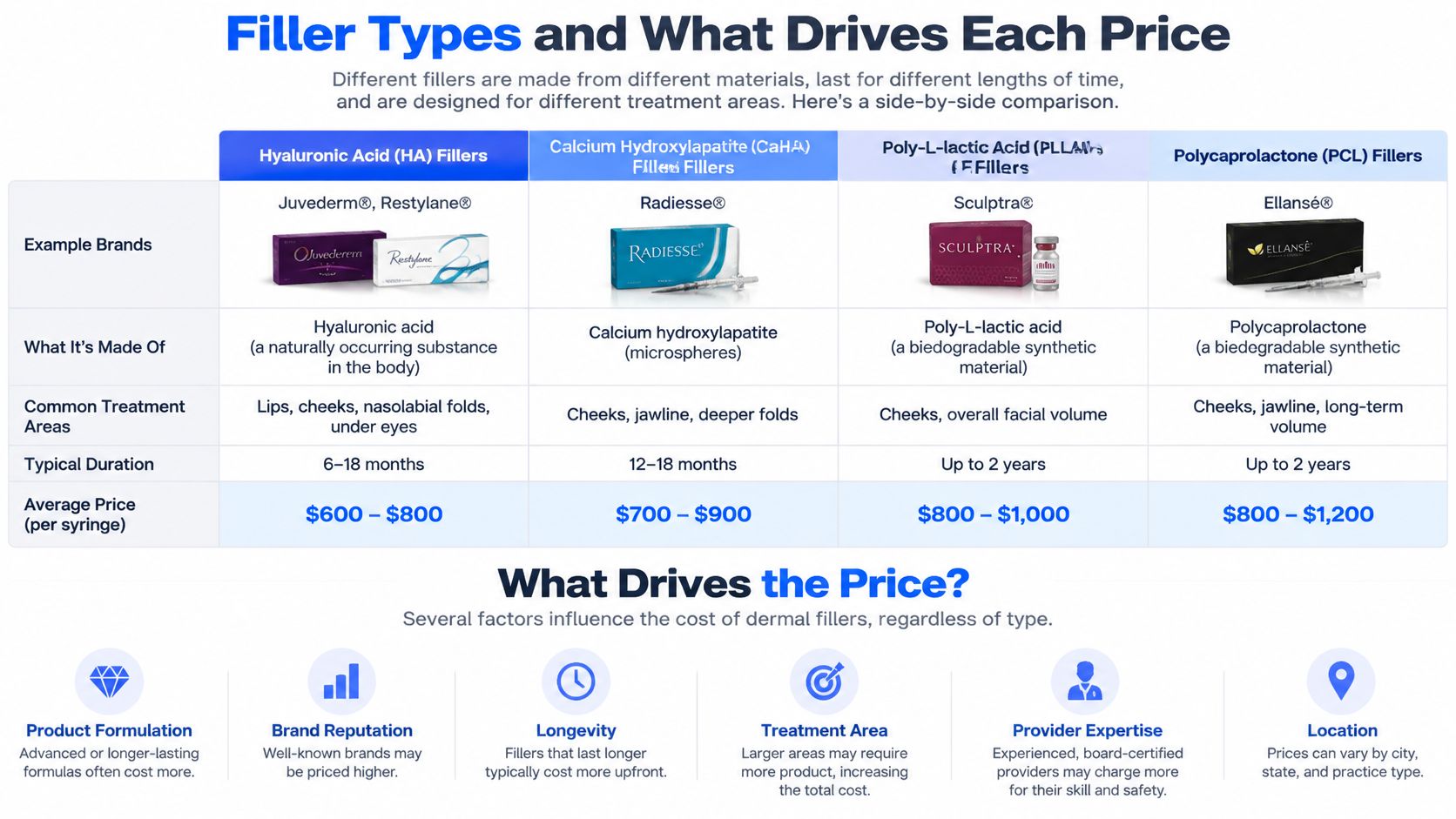
Filler types compared by duration and price driver
| Filler type | Typical duration | Main price driver | Note |
|---|---|---|---|
| Hyaluronic acid, including Voluma, Restylane, and Restylane Lyft | Approximately 6–12 months as a category-level reference, not a guarantee for each product | Syringe price and injected volume | Dominant category for facial folds |
| Collagen filler | Approximately 2–3 months in historical FDA descriptions | Frequent repeat visits | Shorter duration increases maintenance frequency |
| Sculptra, a biostimulator | Gradual results designed to last for years | Overall treatment course and planned sessions | Stimulates the body's own collagen |
| Fat transfer | Individualized estimate required | Harvesting and injection procedure | Uses the patient's own fat |
The duration references for HA and historical collagen fillers describe categories, not interchangeable promises. Sculptra's description reflects our service information; a fat-transfer estimate requires its own assessment rather than an assumed syringe-based schedule.
Product specifications matter more than the category label
FDA documentation describes Restylane Defyne as a crosslinked HA gel containing 20 mg/mL hyaluronic acid and 3 mg/mL lidocaine, approved for smile-line improvement in adults over 21. That specificity matters: an exact product name tells you more than the broad phrase “premium filler.”
Gel concentration alone doesn't establish value or durability. A clinical review of resilient hyaluronic-acid fillers describes how gel architecture, cross-linking, tissue mobility, placement depth, and patient factors influence performance.
At ProMD Health, we offer Voluma, Restylane, and Restylane Lyft. Product selection should follow the intended treatment area and clinical assessment, not the assumption that every product in a brand family has the same indication.
We also offer Sculptra, designed to gradually rebuild collagen for natural-looking results that last for years, and fat transfer, which uses your own body fat to fill in lax skin. These approaches require different treatment and pricing discussions from a straightforward HA syringe quote.
Our guide to choosing a dermal filler for nasolabial folds can help frame that discussion. Compare the exact product, intended placement, total treatment course, and expected maintenance rather than treating every option as a substitute with a different price tag.
Annualized Cost and Maintenance Over Time
The first invoice isn't the full cost of maintaining a result. The FDA's guide to approved dermal fillers describes hyaluronic-acid effects as typically lasting approximately 6–12 months; illustratively, a $700 treatment lasting six months implies about $1,400 annually, while the same treatment lasting 12 months implies about $700 annually.
That's a budgeting calculation, not an FDA price benchmark. The agency doesn't set consumer charges, and an individual result doesn't follow a guaranteed replacement date.
Illustrative annual cost by treatment price and duration
| Price per treatment | Duration of result | Treatments per year | Annualized cost |
|---|---|---|---|
| $700 | 6 months | 2 | $1,400 |
| $700 | 12 months | 1 | $700 |
| $700 | 15 months | 0.8 as a long-run average | $560 |
| $1,100 | 12 months | 1 | $1,100 |
The longer-duration row and higher-price row are hypothetical arithmetic scenarios, not market price claims or promises of longevity. Annualized cost equals treatment price multiplied by months in a year, divided by the assumed duration.
A fractional treatment frequency is an accounting average. You don't purchase part of an appointment; actual payments occur when you receive treatment, so your cash outlay in a particular year may differ from the long-run average.
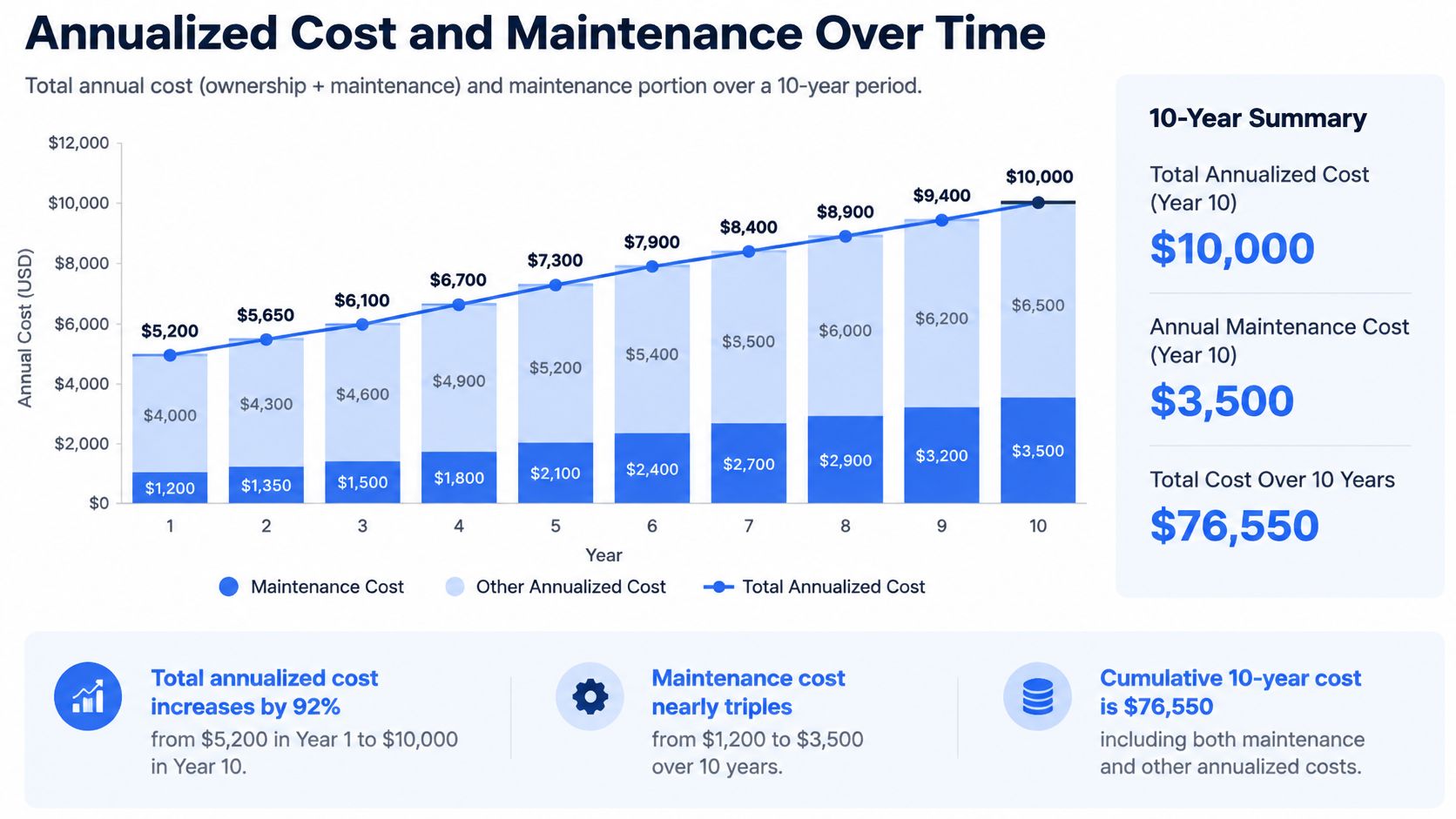
Build a maintenance budget rather than a replacement promise
Separate initial correction, early reassessment, and later maintenance in the estimate. Don't assume that every later appointment requires the same product volume as the first, or that an early adjustment is equivalent to replacing the whole treatment.
For a three-year budget, use the appointment schedule your clinician considers realistic. Add the initial session, anticipated maintenance, and separately charged follow-up care, then divide the total by the budget period to compare average yearly spending.
At ProMD Health, we provide free touch-ups in most cases to help patients achieve youthful-looking results. Confirm how that policy applies to your proposed treatment, including the distinction between a touch-up and additional treatment.
A free touch-up can reduce an early adjustment cost. It shouldn't be interpreted as unlimited product or free long-term maintenance.
Ask for a realistic range of maintenance timing rather than the longest duration mentioned in marketing. If your budget depends on reaching the longest possible interval, you haven't allowed room for an earlier reassessment.
Keep the written budget separate from the clinical decision to retreat. An accounting schedule helps you plan spending; it shouldn't pressure you into injections before the clinician considers them appropriate.
Hidden Risks Behind an Unusually Low Price
The lowest sticker price isn't necessarily the least expensive choice over the life of a treatment plan. It also doesn't tell you whether the clinic has priced in reassessment, access to the treating clinician, or management of an unwanted outcome.
The FDA's dermal filler safety guidance states that common effects such as swelling and bruising generally resolve within days to weeks, while uncommon inadvertent injection into a blood vessel can cause tissue necrosis, vision loss, or stroke, with potentially permanent consequences. These risks deserve attention before price becomes the deciding factor.
Separate normal follow-up from complication care
A clinic's routine touch-up policy isn't necessarily its complication-management policy. Ask what happens if the clinician recommends dissolving HA filler, arranging urgent assessment, or referring you for additional care.
For example, a lower quote that excludes a subsequently needed appointment could end up costing more than a higher all-inclusive quote. That's a scenario to clarify in writing, not evidence that inexpensive treatment always causes problems.
- Verify credentials: Confirm the injector's professional license and relevant training in facial anatomy and filler treatment.
- Discuss emergency readiness: Ask how the clinic recognizes and responds to a suspected vascular complication.
- Clarify corrective care: Establish whether hyaluronidase, reassessment, and referrals are included or separately charged.
- Obtain contact instructions: Know whom to contact after treatment and what symptoms require immediate evaluation.
Our guide to dermal filler side effects provides additional context for that conversation. If you experience vision changes, stroke symptoms, or signs of compromised skin circulation after injection, seek emergency medical attention rather than waiting for a routine follow-up.
Longer-lasting isn't automatically lower-risk value
A permanent or longer-lasting material may appear attractive when you spread its cost over time. But difficulty correcting or removing a product changes the decision, and it isn't captured by a low annualized figure.
Decision standard: Compare cost only after you've established that the proposed product, injector, and safety arrangements are appropriate.
A high price doesn't prove competence, either. Evaluate the actual qualifications, product identity, follow-up arrangements, and emergency plan instead of using price as a proxy for safety.
Verify Every Line of a Filler Quote Before You Book
A useful quote connects your goal, the selected product, the planned volume, and the follow-up schedule. Dermal fillers can be used for anything from a subtle enhancement or a little lift to a more substantial facial contour, so the desired degree of change belongs in the discussion before you approve a budget.
Duration evidence should also be product-specific. An FDA-reviewed RHA Dynamic Volume study reported smoothing effects lasting 12 months in 87% of evaluated patients, 67 of 77, under its study conditions; that's evidence for a particular treatment context, not a guarantee for another product or patient.
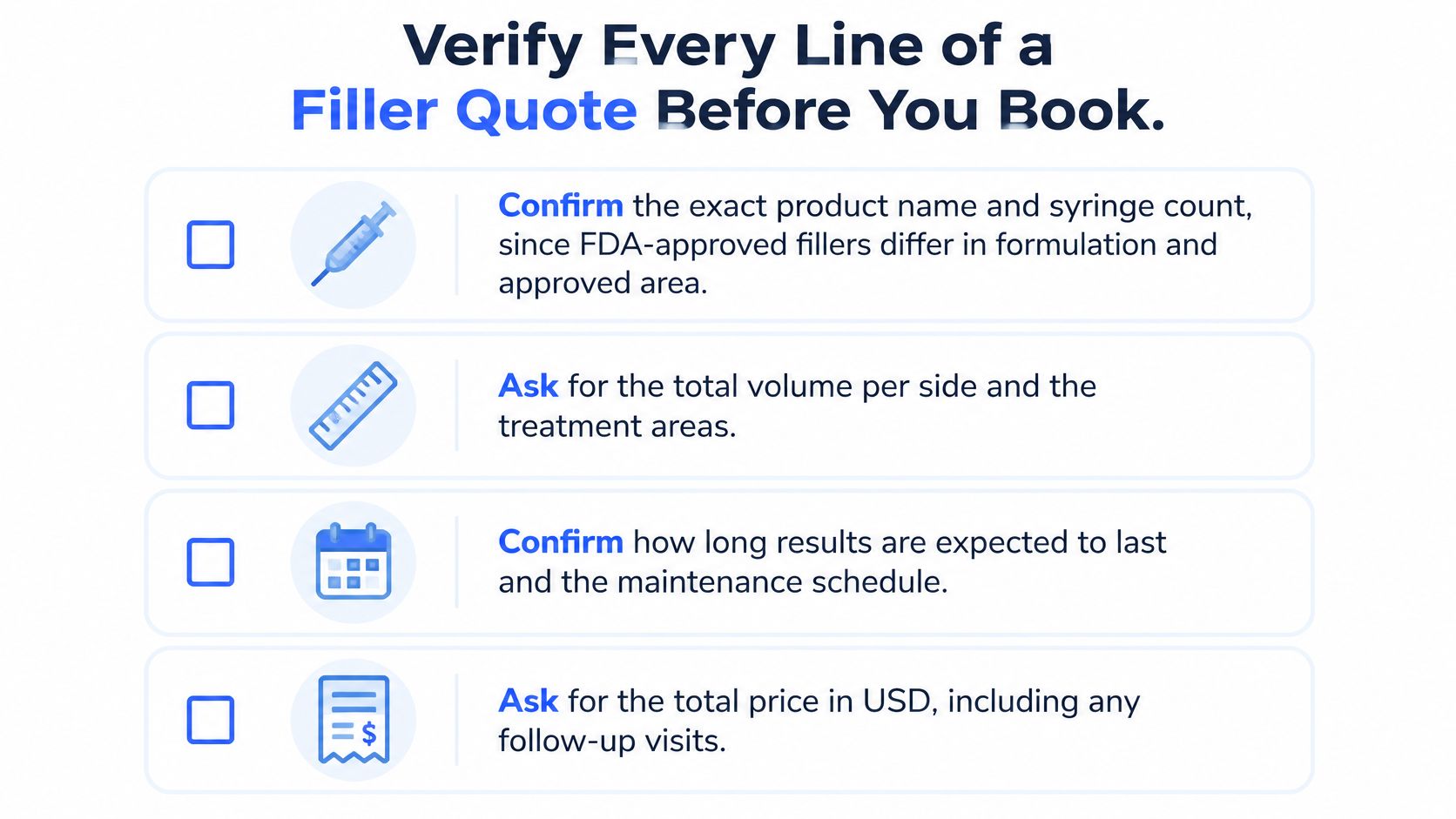
Check the clinical plan and included care
Confirm the exact product and syringe count. The quote should identify what will be injected, not list facial filler as a generic service.
Request total volume and treatment areas. Have the injector distinguish direct fold treatment from cheek or midface support, including the planned allocation on each side.
Separate consultation and follow-up charges. We offer a complimentary aesthetic consultation; confirm the terms of any later appointments before treatment.
Clarify touch-ups and asymmetry adjustments. Establish what counts as an included adjustment and when additional product would be a new charge.
Request an expected maintenance schedule in months. Ask the clinician to distinguish a reasonable planning interval from the longest documented product result.
Discuss complication management explicitly. Find out whether assessment, hyaluronidase when clinically appropriate, and any external referral costs are included.
Verify the injector's credentials. Review the professional license, relevant training, and who takes responsibility for clinical follow-up.
Confirm payment before agreeing to treatment
ProMD Health operates on a cash-pay model, so our services aren't covered by insurance. Your budget shouldn't assume reimbursement or medical-necessity coverage.
If you want to explore payment plans or third-party financing, confirm whether an option is currently available rather than assuming it is. Review interest, fees, payment timing, and cancellation terms before agreeing; this guide doesn't establish any financing offer.
Request a written, itemized estimate that includes the initial plan and a realistic longer-term budget. Keep optional additions separate, and ask how the clinic would obtain your approval if the treatment plan changes.
Make the consultation a decision point
Use the consultation to assess whether the proposed improvement is worth the total cost to you. You should leave understanding the product choice, placement strategy, limits of the expected result, and circumstances that could change the estimate.
Confirm service availability with the office you plan to visit, since treatment availability can differ by location. Don't commit to a larger plan because you're already at the appointment.
The right nasolabial fold filler cost isn't the smallest number you can find. It's the amount attached to a clearly explained treatment that fits your goals, clinical needs, and maintenance budget.
We offer dermal fillers and a complimentary aesthetic consultation to help you evaluate a plan for nasolabial folds and facial volume concerns. Visit ProMD Health to book a consultation and request an itemized estimate covering the proposed product, volume, treatment areas, and expected maintenance.