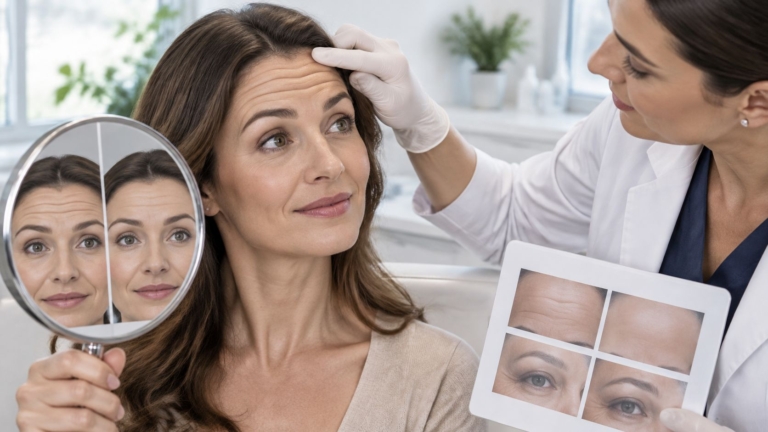
If fat grafting for facial rejuvenation swapped lost padding for your own tissue and then stayed put, the choice would be simple. It doesn't work that way.
The graft that takes can look like you, and it can last for years. A large share of what was placed is often gone within the first year, and the share that remains is different from one person to the next. Early swelling hides that fact. Calling the result permanent skips the part you have to plan around, which is a range, not a fixed number.
Say the cheeks look flatter, the temples look hollow, and makeup settles into the folds beside the mouth. A hyaluronic acid filler can add a measured gel today and be adjusted later. Fat grafting asks a harder question. How much of this living graft will still be there after the swelling leaves, and are you willing to refine it in stages?
Table of Contents
- What Fat Grafting Does for the Face
- Protocols Compared, From Standard Fat to Cell-Enriched Grafts
- How Micro and Nano Fat Grafting Works Step by Step
- How Much Volume Stays and Why Results Vary
- Recovery Timeline From the First Week to Final Shape
- Risks to Weigh and How Providers Manage Them
- Fat Grafting Versus Fillers, Sculptra and Neurotoxins
- Candidacy, Cost and Questions to Ask
What Fat Grafting Does for the Face
Think of the fat pads in your face as the padding under upholstery. When that padding thins, the cover sags and hollows even if the skin itself is still in good shape. Fat grafting for facial rejuvenation puts living fat back under the surface instead of a synthetic gel.
A provider takes fat from a donor area, usually the abdomen, thighs, or flanks, then places it where the face has lost support. Micro fat grafting uses larger parcels to rebuild structure in the deeper layers. Nano fat grafting uses a finer, emulsified fat aimed at skin quality and fine lines, not at deep bulk.
Temples, cheeks, tear troughs, and nasolabial folds are common targets, along with overall skin quality. Picture someone whose midface flattened after weight loss. Micro fat can round the cheek again, while a thin pass of nano fat is used where the skin looks crepey rather than empty.
Vital Cell Volume Restoration is our micro and nano protocol, and it also includes adipose-derived stem cell grafting (ADSCG) and stromal vascular fraction (SVF). That add-on is a preparation choice. It is not proof that every grafted drop will stay.
A 2026 systematic review and meta-analysis in the European Journal of Plastic Surgery found pooled patient satisfaction of 82.8% across 17 studies of autologous facial fat grafting for rejuvenation. That figure records how people felt about the result. It does not count remaining milliliters, and it does not make the procedure permanent or right for every face.
Fat grafting is a real volume option with trade-offs. You gain living tissue. You also accept partial loss, a recovery curve, and the chance of a later session.
Protocols Compared, From Standard Fat to Cell-Enriched Grafts
Four preparations can share the name "fat grafting" and still be different procedures. What is in the syringe changes how much evidence you have, and it changes what to confirm before you agree.
| Approach | What is injected | Evidence status | What to confirm |
|---|---|---|---|
| Standard micro fat grafting | Non-enriched autologous fat in small aliquots | Most studied of the four; the mean retention figure is in the review cited below | Volume injected and injection planes |
| Nano fat grafting | Finer emulsified fat for superficial skin and fine lines | Limited facial-specific trials | Preparation method and target layer |
| SVF-enriched grafting (includes ProMD Vital Cell Volume Restoration) | Fat plus freshly isolated stromal vascular fraction | No consistent extra retention is established from study to study | Exact SVF processing and cell characterization |
| Culture-expanded ADSC grafting | Lab-expanded adipose-derived stem cells | Investigational for facial use in many settings; approval rules differ by country | Approval status and quality control records |
Standard micro fat
Non-enriched fat in small aliquots is the reference procedure for structure. The parcels are spread through chosen planes instead of sitting as one deposit, so the map of those planes is part of the result. A 2018 systematic review found that non-enriched grafts retained a mean weighted volume of 41.63% at a mean follow-up of 13.9 months, as detailed in the PMC full text. Ask for the volume and the planes. Those two numbers shape the contour you see and how much of the graft is still there at follow-up.
Nano fat
Nano fat is emulsified until it is fine enough for superficial placement, where the aim is texture and fine lines. Trials that study this preparation on the face alone are still limited. Confirm how it was emulsified and which layer it will enter.
SVF-enriched grafts
Stromal vascular fraction is a freshly isolated mix, not a purified cell drug. An expert review on PubMed Central describes it as containing about 1% to 10% adipose-derived stem or stromal cells, plus endothelial cells, pericytes, immune cells, and matrix. ProMD Health's Vital Cell Volume Restoration uses micro and nano fat grafting with adipose-derived stem cell grafting (ADSCG) and this kind of SVF enrichment. Endothelial cells and pericytes in that mix are cells associated with small vessels. The review does not turn that mix into a standardized facial protocol, and an SVF product is not the same as purified, culture-expanded ADSCs. Read more on adipose-derived stem cells before you treat the two preparations as interchangeable. Confirm the exact processing method and how the cells were characterized.
Culture-expanded ADSCs
These cells are grown in a lab into a more uniform population. Protocols still differ in harvest, enzymatic or mechanical processing, dose, viability checks, and how results are measured. In many places facial use remains investigational, so approval status and quality-control records belong in the chart.
Practical rule: Have the clinic write down the processing method, cell characterization, injected volume, injection planes, adverse-event tracking, and objective photographs. The broad label "stem-cell fat grafting" does not, by itself, prove a benefit.
How Micro and Nano Fat Grafting Works Step by Step
How does a fat-grafting plan move from a map of the face to carefully placed grafts? Each step helps shape the contour or protect the harvested fat. The sequence is shown below.
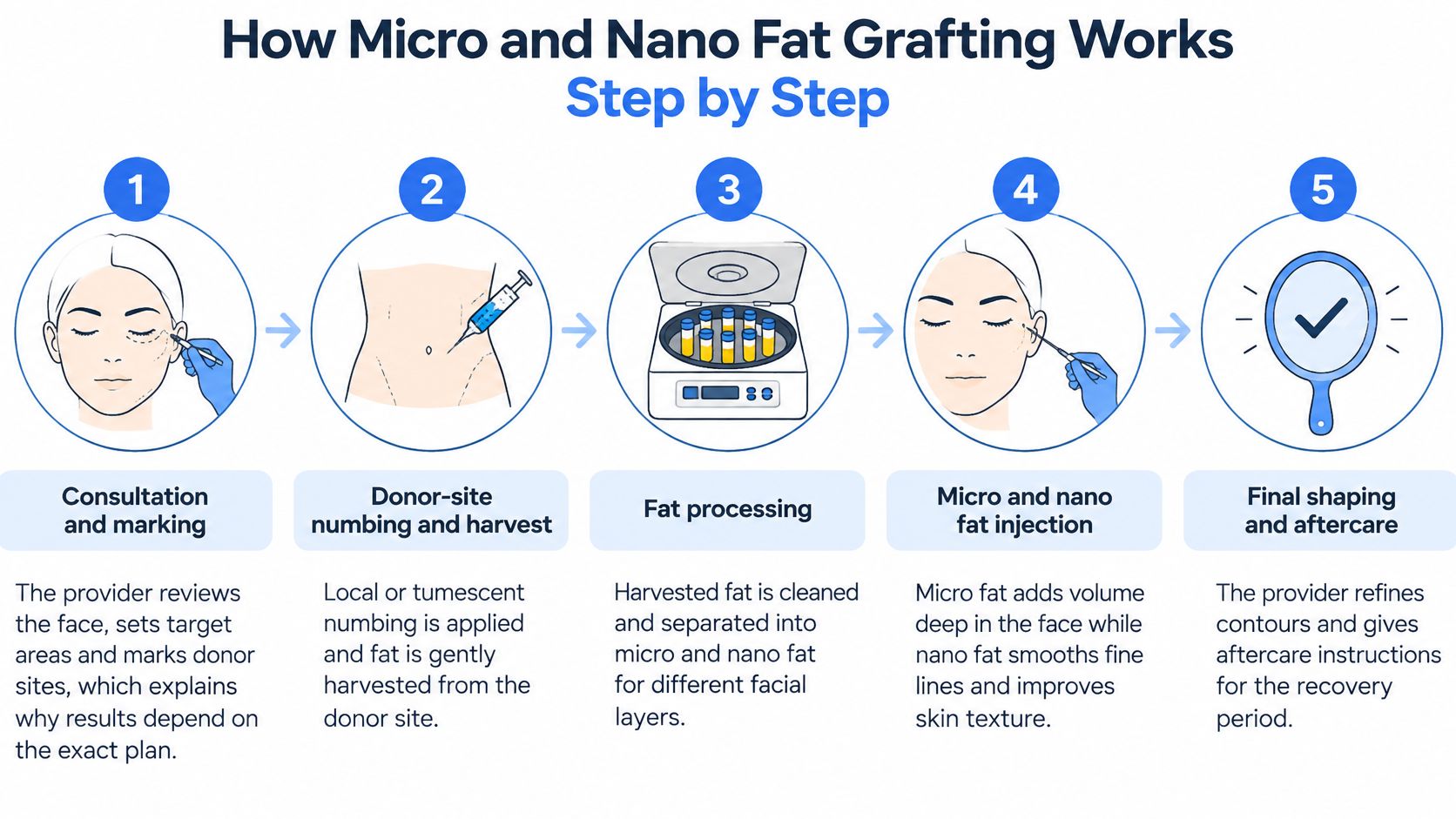
The six steps
- Consultation and marking. The provider examines the face, identifies target areas, and marks donor sites. Two people seeking cheek grafting may need different plans because facial contours and goals differ.
- Donor-site numbing and harvest. Local or tumescent anesthesia numbs the abdomen, thigh, or flank. A small cannula collects fat; gentle handling matters because damaged fat may be less likely to survive transfer.
- Processing. The harvested fat is rinsed and separated from oil, blood, and debris through filtration or centrifugation. Processing varies by protocol, so ask what method will be used and have it recorded.
- Optional enrichment. If the plan includes SVF or an ADSC preparation, enrichment takes place after cleaning. Ask for the specific method to be documented before injection.
- Injection in small aliquots. Fine cannulas place small amounts of fat across several layers, often in well-vascularized planes. Spreading the graft helps avoid a large parcel whose center may struggle to receive a blood supply, which can contribute to lumps.
- Closure and dressings. Small entry points may be closed or left to seal. A dressing or light compression and written aftercare instructions may follow. Before leaving, confirm which symptoms warrant a call.
What Day One Looks Like
The face may look fuller than the eventual contour; the recovery timeline explains how the appearance changes as healing progresses. Donor-site bruising can also occur, but its duration varies, so ask the provider what to expect for your procedure.
The forehead and temples require particular anatomical care because vessels in those areas connect toward the eye and brain. Placement decisions should account for that anatomy, while the risks section explains warning signs to watch for.
How Much Volume Stays and Why Results Vary
A systematic review and meta-analysis of 27 studies and 1,011 patients found facial fat-graft volume retention from 26% to 83%, with a pooled average of 47% (95% CI, 41% to 53%) over 3 to 24 months, according to Aesthetic Plastic Surgery. That same review found that the way volume was measured changed the reported rate. A single "it lasts" percentage is not a promise you can take to the mirror.
Why one clinic's number is not another's
A 2025 review of 10 studies and 1,245 patients reported 50% to 75% volume retention at 6 to 12 months, summarized by Medigraphic. That band sits inside the wider 26% to 83% spread, which is what you would expect when follow-up windows and measuring tools differ. Photos, 3D scans, and clinical estimates do not count the same thing.
Processing changes the number too, and only for the method tested. In a 2024 low-volume study with a mean follow-up of 7.1 months, power-assisted water-jet aspiration retained 73.1% versus 46.1% for osmotic filtration (P < .01), with no infections, hematomas, seromas, wound openings, or facial-nerve palsies in that series, as reported in Plastic and Reconstructive Surgery Global Open. Treat that gap as technique-specific, not as the retention rate for every face.
What pushes your result up or down
Retention moves with the blood supply at the recipient site, how big each parcel is, how roughly the fat was handled, which plane it entered, and the mechanical forces on that part of the face. Smoking and later weight change matter as well. A graft is living tissue, so a large gain or loss in body weight can change the face after the procedure looks "done."
Early swelling makes the face look larger than the durable result. Edema and some transient graft expansion fade, which is why week-two photos are a poor verdict.
A meta-analysis of 52 studies and 1,568 patients found that people needed an average of 1.5 treatment sessions (95% CI, 1.3 to 1.7), and that about 50% to 60% of injected volume remained at one year, reported in JAMA Facial Plastic Surgery. Staged refinement is part of the method, not a sign the first session failed. In most cases, we provide free touch-ups so the contour can be brought in line with the youthful look you were aiming for. Hyaluronic acid in the cheek is a different bet, with dosing you can see in a syringe, which is why people compare it with how long cheek fillers last.
Plan for a range, expect a possible second visit, and keep photographs at the same angles and lighting. That record is more useful than a memory of how puffy you looked on day three.
Recovery Timeline From the First Week to Final Shape
During the first few days after facial fat grafting, swelling and bruising can make the face look fuller than it will later. By the second weekend, bruising often begins to fade, and light errands may be manageable. Around a month, the contour can be assessed at an early check. The shape continues to settle over the following months, with longer-term retention assessed later in the year. A touch-up may be discussed if one area still looks underfilled.
These are approximate windows, not promises. Healing and activity restrictions vary with the procedure and the individual. Follow the written instructions from your provider.
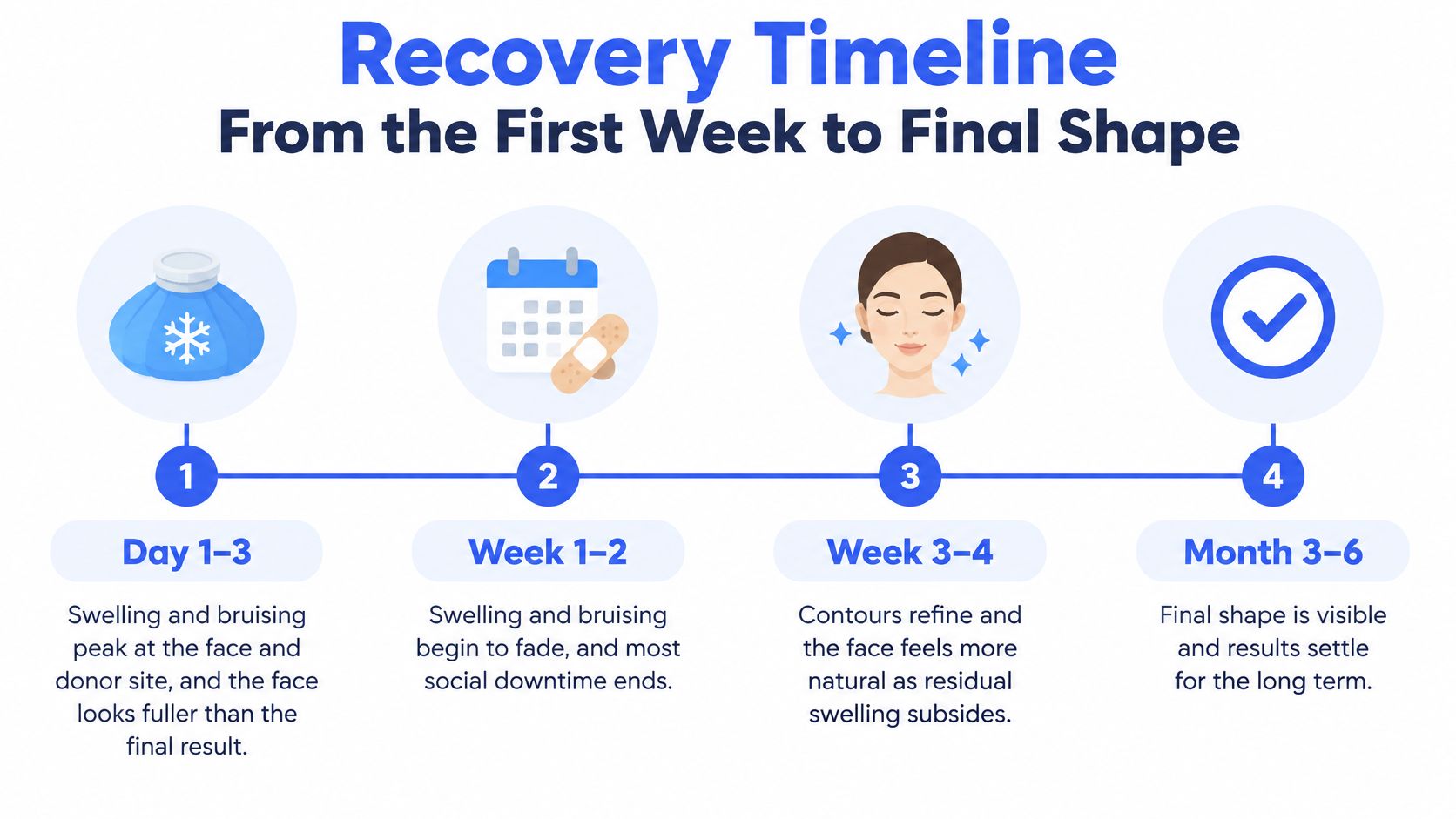
| Window | What to expect | Activity guidance | Result signal |
|---|---|---|---|
| Day 1 to 3 | Swelling and bruising at the face and donor site | Rest and follow dressing care | Face looks fuller than final |
| Week 1 to 2 | Swelling and bruising fading | Keep to light daily activity | Contours begin to settle |
| Weeks 3 to 6 | Most swelling resolved | Avoid strenuous exercise until at least week 6 | Early contour check |
| Months 3 to 6 | Graft volume stabilizing | Resume normal activity if healing is on track | Final shape starts to show |
| Months 6 to 12 | Retention assessed | Normal activity | Long-term outcome visible |
Care and activity during recovery
Keep the donor-site dressing or compression in place as directed, and sleep with your head raised to help limit fluid buildup. Avoid heavy exercise and smoking while healing, and protect treated skin from sun exposure so bruised areas are less likely to develop pigment changes.
Use consistent photos to compare the contour over time. Pay attention to whether swelling is subsiding and whether new symptoms appear. A fever, spreading redness, or a sudden change in vision warrants prompt medical attention rather than waiting for a scheduled follow-up.
Risks to Weigh and How Providers Manage Them
The common story is not blindness. It is a slightly uneven contour. A 2018 systematic review of 43 studies and 4,577 patients recorded 104 complications, 2.27% of that treated population, and asymmetry plus skin irregularities accounted for 84.61% of those events, with no mortality or significant embolic complications in the included studies, according to this PMC review. Most of what goes wrong on paper is a shape problem, and shape problems are why conservative placement and a later touch-up exist.
Rare events are a different category, and case reports are how they reach the literature. A 2024 review of 22 articles identified 58 complications after facial autologous fat grafting. Of these, 32 (55%) were severe or permanent, including 11 cases of hemiplegia, 7 of vision loss, and 3 of skin necrosis, with 26 events after forehead injection and 21 in the temporal region, as compiled in this case-report review. Case reports cannot give you the routine risk for an ordinary cheek graft, because they collect unusual events. They do show why intravascular injection is the hazard that changes consent, and why anatomical knowledge and small aliquots are part of safe technique.
| Risk | How common or serious | Warning sign | How it is managed |
|---|---|---|---|
| Asymmetry or contour irregularity | Most frequent reported event | Uneven face or visible lumps | Staged refinement and conservative injection |
| Nodules or graft hypertrophy | Less common | Firm bumps that persist or grow | Provider assessment and a written management plan |
| Prolonged swelling | Less common | Swelling beyond the expected window | Monitoring and follow-up visit |
| Fat necrosis or infection | Uncommon | Pain, redness, warmth, or fever | Prompt clinical evaluation |
| Vascular occlusion from intravascular injection | Rare, but can be severe | Vision change, weakness, or skin color change | Immediate emergency care |
Sudden vision change, one-sided weakness, or a patch of skin that turns pale, dusky, or blotchy needs emergency care now, not a next-week message.
Before treatment, confirm the injector's experience with facial fat, the emergency plan if a vessel is entered, and who follows delayed nodules or infection after you go home. A polished gallery does not answer those three questions.
Fat Grafting Versus Fillers, Sculptra and Neurotoxins
Compare these options on four things: how tightly volume can be controlled, whether the result can be reversed, whether donor tissue is required, and how the change shows up. Fat is your own living tissue, so it can last, but you cannot dial it back the way you can dissolve a gel. The other treatments either add an adjustable gel, ask your skin to build collagen, or relax muscle without adding volume at all.
| Option | Best for | Volume control | Reversibility | Donor tissue needed |
|---|---|---|---|---|
| Fat grafting | Volume and contour using living tissue | Variable; partial resorption expected | Not reversible | Yes |
| Hyaluronic acid fillers | Precise contour and lift | Dosed and adjustable | Can be dissolved with hyaluronidase | No |
| Sculptra | Gradual collagen-based volume | Builds over sessions | Not dissolved on demand | No |
| Neurotoxins (Botox, Dysport, Daxxify) | Dynamic lines on brow, eyes, and mouth | Relaxes muscle; does not add volume | Wears off over months | No |
A verdict by situation
Choose fat grafting when you want your own tissue and you can accept variable retention plus a possible second session. Choose hyaluronic acid fillers when you want a precise, adjustable contour that can be dissolved. If you are sorting muscle-relaxing injections from gels, Botox versus dermal fillers explained is a clear walk-through of those two jobs. Choose Sculptra when you want gradual, collagen-based volume that builds over sessions rather than appearing in one visit. Choose Botox, Dysport, or Daxxify when the lines come from movement at the brow, eyes, or mouth, because those products do not restore lost fat pads.
Combined plans are common. The exam should set the mix, not a single product name on a menu.
Candidacy, Cost and Questions to Ask
Enough donor fat, a stable weight, and a goal that still looks right after some of the graft is gone: those three filters decide whether facial fat grafting is a fit. The graft works like seedlings in a bed. Some take hold, some do not, and the face is often finished across more than one visit rather than in one lasting fill.
A reasonable candidate can stop smoking, has no active skin infection, and does not have an untreated bleeding disorder. The plan should name the donor site and the zones the fat is meant to support. If weight is still swinging, facial volume can change with the body, so the graft is timed after weight has settled.
What the plan places
Micro and nano fat grafting uses your own fat to shape contours and support skin quality. Vital Cell Volume Restoration pairs that micro or nano graft with adipose-derived stem cell grafting (ADSCG) and stromal vascular fraction (SVF). The exact preparation belongs in the written plan. ProMD Health's providers specialize in regenerative and aesthetic medicine, and Dr. George Gavrila is a member of AMMG (Age Management Medicine Group), A4M (American Academy of Anti-Aging Medicine), and AAAM (American Academy of Aesthetic Medicine). Ask for the emergency plan and the follow-up path in writing before you book.
Questions worth asking out loud
- Processing: Which method cleans the fat, and is SVF or an ADSC preparation part of this visit?
- Map: Which planes and volumes are planned for each zone?
- Range: What retention range are you using for my face, not a single best-case percent?
- If it falls short: How are touch-ups handled, and when are they judged?
- If something goes wrong: Who evaluates nodules, prolonged swelling, or signs of infection?
Payment, in plain terms
Ask for a written cost estimate before you book, including what a later session would involve. In most cases, ProMD Health provides free touch-ups to give patients youthful-looking results. Confirm whether that applies to your graft and when a touch-up is judged, so a shortfall is a scheduled decision.
Is it permanent? No. Expect partial resorption, and possibly another session. When will I see the result? Swelling settles over weeks to months, and the lasting shape starts to show around months three to six. Is it painful? Comfort is managed with anesthesia and the aftercare your provider sets, not with a promise of zero soreness at the donor site.
Bring earlier photographs to a consultation and leave with a written plan that covers timing, the expected range, and follow-up.
ProMD Health offers micro and nano fat grafting, including Vital Cell Volume Restoration with ADSCG and SVF, for adults who want living facial volume and can plan around partial retention. If hollow cheeks, temples, or folds are the issue, and you want a plan that spells out processing, planes, and follow-up, start with a consultation. Visit ProMD Health to book and bring the photos that show the change you hope to make.