
You're probably reading this in the same place many people start. You had filler, you're looking in the mirror, and you're wondering whether what you see today is the result or just the beginning of it.
That question matters because dermal fillers results aren't one single moment. They change. The look right after treatment includes product, swelling, and your tissue's short-term response. The look two weeks later is closer to the true correction. The look months later depends on the type of filler, where it was placed, and how your own face moves.
A lot of confusion comes from comparing your day-one face to someone else's polished after photo. That skips the most useful part, which is the timeline. If you understand settling first and longevity second, your results make much more sense.
Table of Contents
- Introduction to Dermal Fillers Results and What They Really Mean
- How Dermal Fillers Settle From Immediate Fullness to Final Look
- How Long Dermal Fillers Last by Type and Treatment Area
- Factors That Influence How Your Results Look and How Long They Last
- Swelling Bruising and Settling Timeline After Fillers
- Maintenance Planning and When to Consider Touch Ups or Dissolving
- Choosing ProMD Health Services and Locations for Your Filler Journey
Introduction to Dermal Fillers Results and What They Really Mean
On treatment day, many patients leave happy and slightly unsure at the same time. Their cheeks look lifted, their lips look fuller, or a fold looks softer, but everything also looks a little more dramatic than expected. That's normal. Freshly injected filler often creates immediate fullness, but that early look isn't the final answer.
Results are more than volume
When people say they want better dermal fillers results, they usually don't mean “more.” They often mean softer shadows, smoother transitions, or a face that looks less tired when light hits it. Filler changes contour, support, and reflection, not just size.
For example, a small amount placed in the mid-face can make the under-eye area look less hollow even if the under-eye itself wasn't directly filled. A lip treatment can improve border definition as much as overall fullness. Those details explain why good results can look subtle in person but still make the whole face seem more refreshed.
If you want a foundation before thinking about timelines, ProMD's overview of what dermal fillers are is a helpful starting point.
Immediate result versus settled result
Think of day-one filler like fluffing a pillow right after you've placed it. It looks fuller at first. Then it settles into the shape it's meant to hold.
That's why a single before-and-after image can be misleading. It may capture the first stage, not the settled one. What many care about is how the area looks after the early puffiness fades and the product sits more naturally within the tissue.
Practical rule: Don't judge filler on the same day you get it. Early fullness often includes swelling, not just correction.
This is also where expectations need to stay realistic. Results vary by area, product, anatomy, and treatment goal. The most useful way to evaluate filler isn't “Did I look different immediately?” It's “How did the treatment settle, how long did the improvement hold, and what maintenance plan fits my face?”
How Dermal Fillers Settle From Immediate Fullness to Final Look
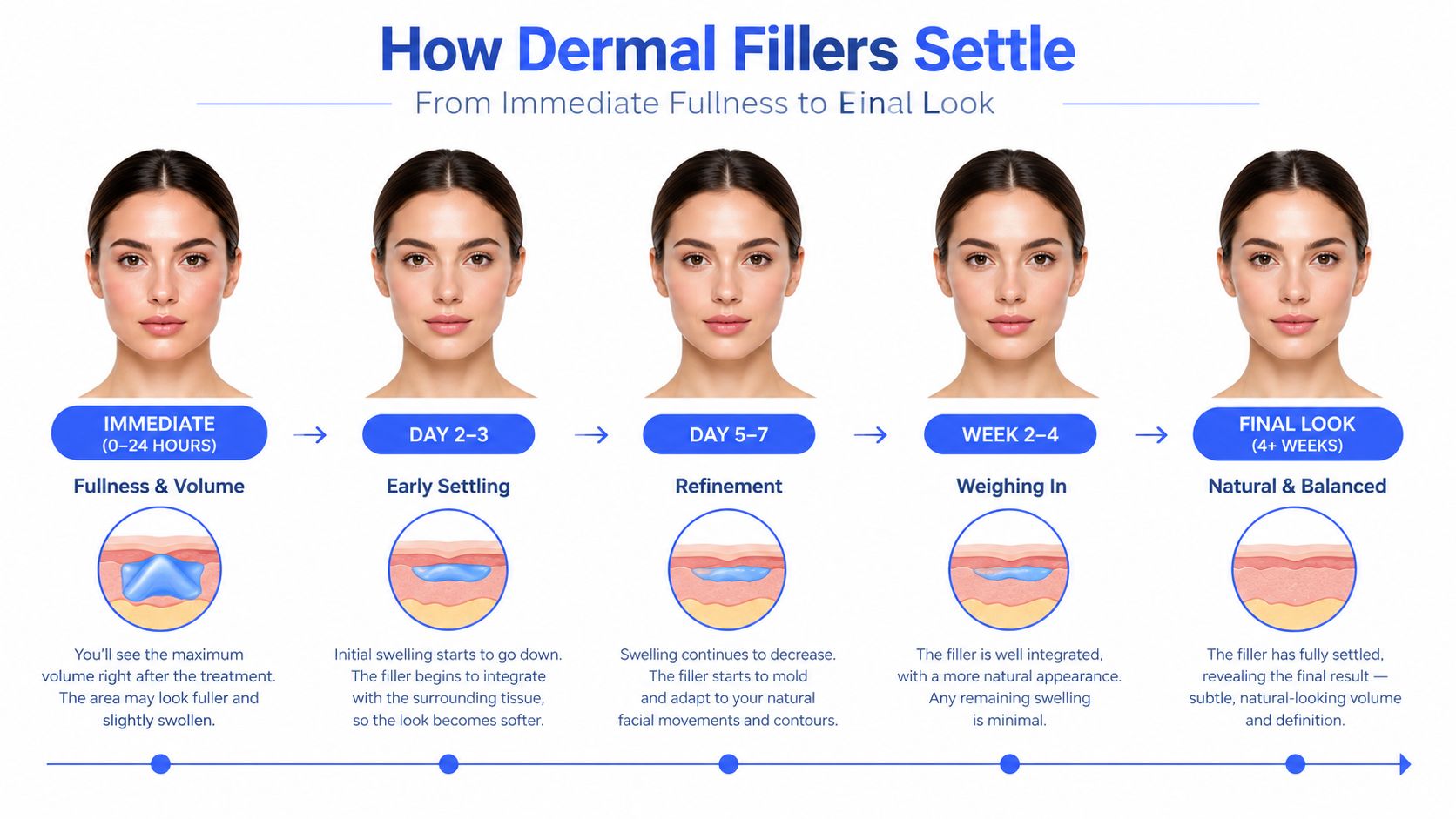
Fresh filler behaves a bit like a soft gel cushion placed under the skin. It doesn't instantly look the way it will look after your tissue calms down around it. The product needs time to hydrate, spread appropriately within the intended plane, and visually blend into the surrounding contours.
What the first hours can look like
Right after treatment, the area may look fuller, firmer, and slightly uneven. That doesn't automatically mean anything went wrong. Injection itself creates trauma at a very small scale, and your body responds with temporary inflammation.
Lips and under-eyes tend to confuse patients the most because both areas show swelling easily. Lips move constantly, and under-eye skin is thin, so early puffiness can make the result look larger or less smooth than expected.
In the first day or two, the main question isn't “Is this perfect?” It's “Is this behaving like early healing?”
What changes over the first two weeks
Over the next several days, swelling starts to ease and the filler becomes easier to read visually. The shape usually softens. Edges can look less obvious. Small asymmetries often improve as each side settles.
A good mental timeline looks like this:
- Same day: You see correction, but you also see fresh swelling.
- Early days: Puffiness, firmness, and bruising can distract from the actual result.
- Around the two-week mark: The treatment is usually much easier to evaluate for shape, balance, and whether any refinement is needed.
That's one reason providers often book follow-up around two weeks instead of the next day. Too-early judgment can lead to overcorrection.
The best time to assess symmetry is after the tissue has had time to calm down, not when it's still reacting to treatment.
Why one area settles faster than another
Not every part of the face settles at the same pace. Areas with more movement usually announce themselves more during healing. Areas with deeper placement may look smoother sooner, while very delicate areas can seem slower to “blend.”
Placement depth matters too. A filler placed in a deeper structural compartment behaves differently from one placed more superficially for fine contour adjustment. Tissue mobility matters just as much. A calm area of the face often holds a cleaner shape early on than a high-movement area like the lips.
That's why natural-looking dermal fillers results come from patience as much as product choice. The face needs a little time before the final look becomes clear.
How Long Dermal Fillers Last by Type and Treatment Area
The simplest answer to longevity is that there isn't one single filler clock. Different filler families break down differently, and different facial areas “use up” correction at different rates.
A useful place to start is the broad range recognized by the FDA. Their clinical overview notes that approved filler effects range from about 6 months to 24 months depending on the product, with examples including Belotero Balance at 6 months and Juvederm Voluma at 24 months. The same overview notes that Sculptra results last up to 2 years in most patients and Radiesse results last about 1 year, according to the FDA clinical overview of dermal fillers.
Typical longevity ranges by filler family and area
A later review reported mean effective duration of about 9.4 months for hyaluronic acid fillers, 12.6 months for calcium hydroxylapatite, and 14.2 months for poly-L-lactic acid, as summarized in this review of dermal filler safety, efficacy, and long-term outcomes.
| Filler Family | Mean Effective Duration | Area Notes |
|---|---|---|
| Hyaluronic acid | About 9.4 months | Often used across lips, folds, cheeks, and contour work. High-movement areas may fade faster than deeper support areas. |
| Calcium hydroxylapatite | About 12.6 months | Often chosen when more structure is needed. Can hold longer than standard HA in some treatment plans. |
| Poly-L-lactic acid | About 14.2 months | Works differently from a simple gel fill and is often used with a longer-view correction plan. |
If you're specifically comparing HA options, ProMD's guide on how long Juvederm lasts helps connect product choice to treatment goals.
Why the lips and cheeks don't age the same way
The lips are a classic example of a fast-moving area. They compress, stretch, talk, eat, and kiss. That constant motion can shorten how long visible fullness lasts.
Cheeks and the lateral face often keep visible improvement longer because the filler may be placed more and the area isn't under the same repetitive movement. That doesn't mean every cheek treatment outlasts every lip treatment, but it explains why “How long do fillers last?” needs an area-specific answer.
Visible result and detectable filler are not the same
One of the biggest misunderstandings in aesthetic medicine is assuming that if the visual effect has softened, the filler must be completely gone. Imaging studies show that isn't always true.
MRI follow-up has found hyaluronic acid filler still detectable at 27 months in the lateral face and mid-face, with nearly complete degradation in the chin at 19 months, according to this MRI study on filler persistence by facial compartment. In plain language, your visible correction may fade before every trace of product disappears.
That's why maintenance planning should be based on appearance, feel, and treatment goals, not on the assumption that every syringe vanishes on a fixed schedule.
Factors That Influence How Your Results Look and How Long They Last
Two people can get the same amount of filler in the same general area and still have different dermal fillers results. That isn't unusual. Product matters, but it's only one part of the story.
The five variables that change the outcome
Here are the factors that most often shape both appearance and longevity:
- Your anatomy: Bone structure, skin thickness, tissue support, and baseline volume loss all affect how filler shows.
- Placement depth: Deeper placement often behaves differently from superficial placement, both visually and over time.
- Product properties: Some formulas diffuse more, while others hold shape more firmly.
- Movement in the area: A high-motion zone usually won't behave like a stable one.
- How much correction is being attempted: Replacing subtle loss is different from trying to build a strong contour in one session.
These variables overlap. A soft filler placed in a very mobile area can look beautiful, but it may not hold the same way a firmer product would in a deeper compartment.
Product design changes performance
Not all fillers spread or degrade at the same rate. A clinical follow-up study of hyaluronic acid fillers found that at 48 weeks after injection, dermal thickness remained measurably increased, and the product with less diffusion and degradation showed greater longevity, according to this clinical follow-up study on HA filler persistence.
That matters because patients often ask for a brand name when the question should be, “What behavior do we want in this area?” In some parts of the face, you want softness and flexibility. In others, you want support and shape retention.
What to ask in consultation: “Why is this product a fit for this area on my face?” That question usually gets you a better answer than “Which filler lasts longest?”
Compartment and movement can matter more than people expect
A filler placed into a deeper facial compartment may persist differently from one placed in a more superficial layer. A low-movement area can also keep a cleaner contour over time than a zone that folds or compresses constantly.
That's why one syringe isn't one experience. Technique, site selection, and treatment design shape the result just as much as the material in the syringe. If you're exploring options across ProMD Health locations, it makes sense to confirm that the specific filler service you want is available at your office and discuss the plan area by area rather than assuming every injector uses the same approach.
Swelling Bruising and Settling Timeline After Fillers
Most healing after filler is ordinary, but ordinary doesn't always feel reassuring when it's happening on your own face. A timeline helps because it gives you something more reliable than mirror-checking every few hours.
What's usually normal
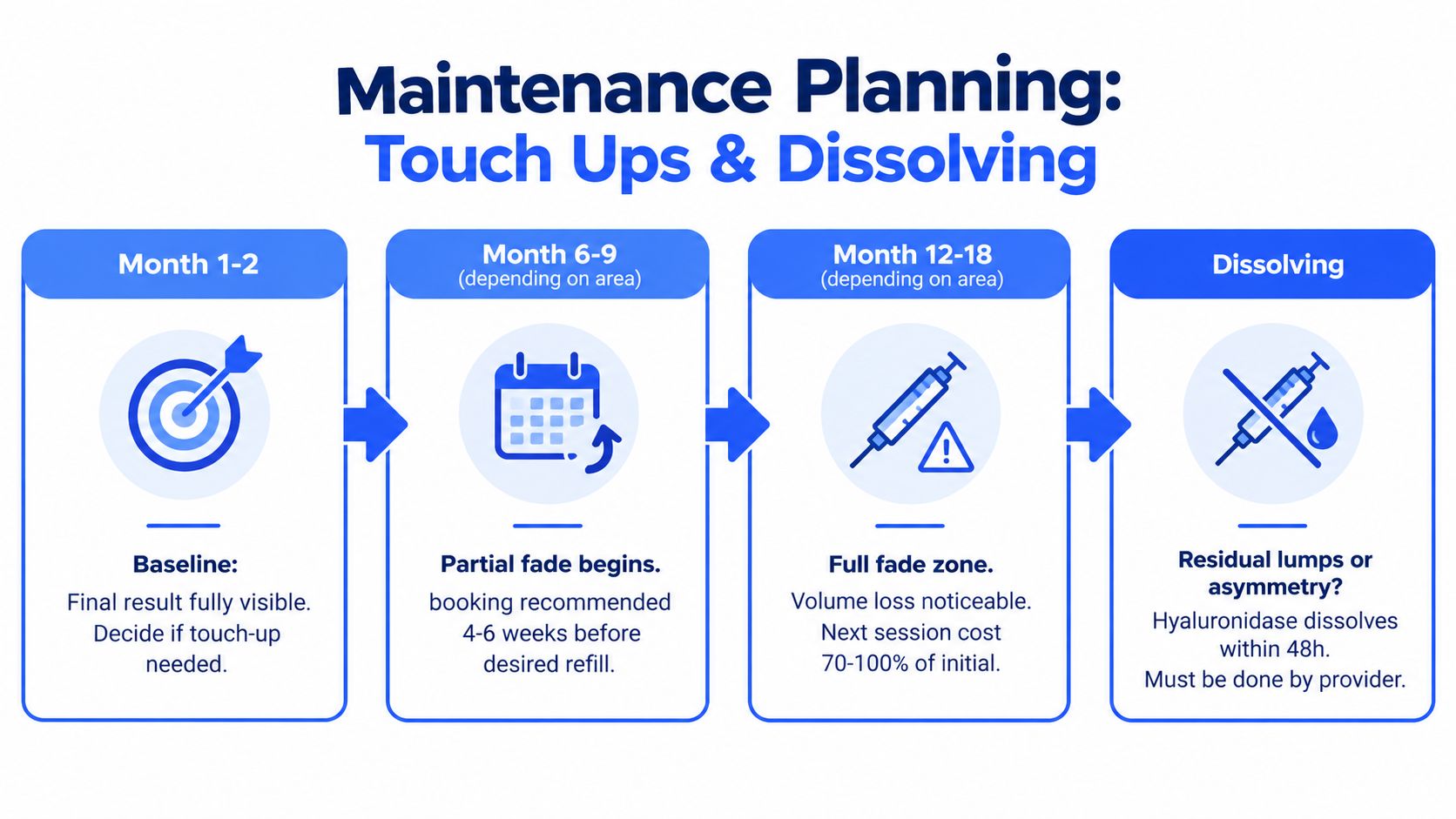
The first phase is mostly about inflammation and minor trauma from the injection process. You may notice tenderness, puffiness, or firmness early on. Bruising can become more visible over the following days before it fades.
A practical way to consider it:
- First day or two: Swelling and tenderness may be most noticeable.
- Middle part of the first week: Bruising often looks more obvious before it improves.
- Around two weeks: The result is usually much easier to judge.
If you want a visual walk-through focused on lips, ProMD's lip filler day by day guide can help you compare what you're seeing with a more typical recovery pattern.
What deserves a call to your provider
Not every concern is an emergency, but some symptoms should never be brushed off. Contact your injector promptly if you notice severe pain, skin blanching, unusual color change, rapidly worsening asymmetry, or a problem that feels more inflammatory than swollen.
A 2026 retrospective study of dermal injectables found that the most common complications were biofilm formation and chronic immune reactions, followed by abscesses, Tyndall effect, vascular occlusion, and filler migration, as detailed in this retrospective study on delayed and visible filler complications. The practical takeaway is important. A result that looked fine at first can still change later, and late changes aren't always about poor technique.
A simple aftercare mindset
You don't need to micromanage healing. You do need to pay attention.
Use this checklist:
- Be gentle early: Avoid pressing, massaging, or testing the area unless your provider specifically told you to.
- Watch trends, not hourly changes: A little fluctuation is common. Worsening pain or color change is different.
- Save judgment for the settled phase: Small bumps or asymmetry may improve as swelling drops.
- Reach out if something feels off: Delayed lumpiness, puffiness, or persistent asymmetry deserves follow-up.
Healing should move in a calming direction. If the area seems to be getting more angry instead of more settled, ask to be seen.
Maintenance Planning and When to Consider Touch Ups or Dissolving
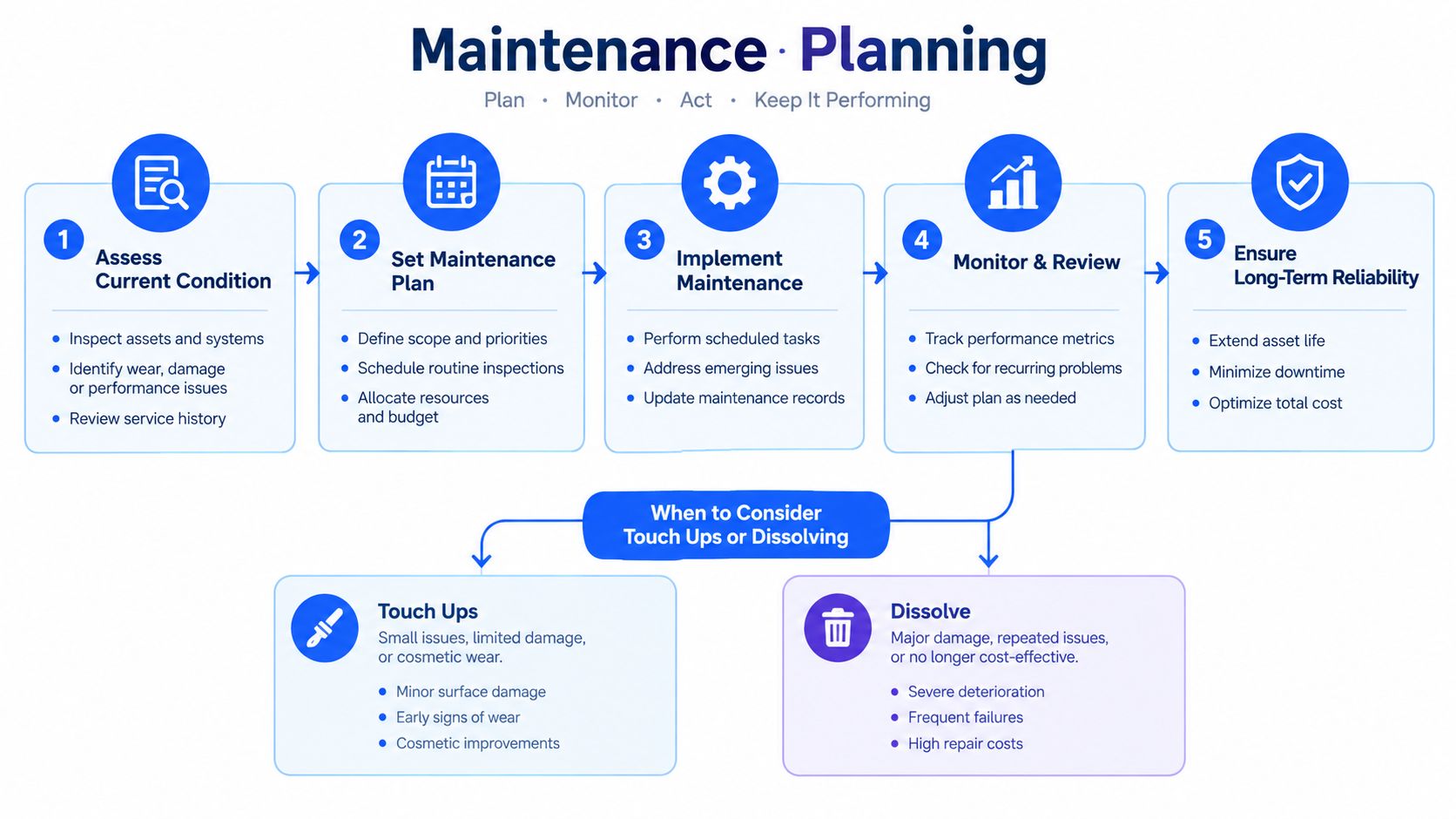
The best maintenance plans don't chase the moment when filler has completely disappeared. They look for the point where your result has softened enough that a small refresh makes sense, but not so late that you feel like you're starting over.
Why gradual maintenance often looks better
Lip filler gives a good example of how visible improvement changes over time. A meta-analysis of hyaluronic acid lip fillers found a 91% responder rate at 2 months, defined as at least a one-point increase in lip fullness, with response rates at 74% at 6 months and 46% at 12 months, according to this meta-analysis of HA lip filler durability.
That pattern helps explain why touch-ups are often most natural when they're timed to softening, not total fade. You're maintaining shape rather than trying to rebuild it all at once.
Monitor, refresh, or revise
A simple decision framework can make planning easier:
| Situation | Best next step | Why |
|---|---|---|
| You still like the shape and the area looks balanced | Monitor | No need to add product just because time has passed |
| The result has softened and you want the same look back | Refresh | A small maintenance treatment may restore the prior effect |
| The area looks puffy, migrated, uneven, or oddly tinted | Revise | You may need assessment rather than more filler |
When dissolving enters the conversation
Dissolving usually applies to hyaluronic acid fillers, not every filler type. It may be discussed when a result looks overfilled, when product appears to have migrated, when the under-eye has a bluish cast known as Tyndall effect, or when persistent lumps don't improve with time and clinical evaluation.
A 2024 systematic literature review reported that the most frequently encountered filler complications included inflammation (16.0%), swelling (14.1%), infection (13.4%), pain (7.9%), and erythema (5.5%). It also found that necrosis accounted for 3.5% of adverse events and that 92.11% of studied fillers were temporary products lasting 6 to 18 months, according to this systematic review of filler complications and duration.
That's one reason “wait it out” isn't always the right answer. Sometimes monitoring is correct. Sometimes a touch-up is appropriate. Sometimes the better move is to revise the plan instead of adding more.
Choosing ProMD Health Services and Locations for Your Filler Journey
Good filler planning starts with the right service and the right office. If you're booking through ProMD Health, stay within confirmed service lines such as dermal fillers and lip filler, and book only in approved markets: Annapolis, Maryland; Arlington, Virginia; Ashburn, Virginia; Bel Air, Maryland; Bethesda, Maryland; Columbia, Maryland; Easton, Maryland; Fort Lauderdale, Florida; Hutto, Texas; Lafayette, Colorado; Lewes, Delaware; Timonium, Maryland; Tox Bar in Baltimore City, Maryland; Tysons Corner, Virginia; Washington, DC; Wellington, Florida; and Westminster, Maryland.
That matters because not every aesthetic treatment is appropriate to describe as available everywhere, and office-level verification is especially important for services whose availability can vary by location. ProMD also operates on a cash-pay model, so it's important not to assume insurance coverage for filler treatment or related cosmetic services.
If you're thinking beyond the treatment itself and want perspective on how med spas organize trustworthy educational content and patient communication, this overview of how med spas partner with Helbling Digital Media offers useful context on content quality and brand consistency.
One final practical point. Filler decisions are better when the consultation focuses on your anatomy, your timeline, and your maintenance preferences, not just on a trend or a product name. Choose the service you want, confirm the location where it's offered, and use the consult to build a plan that matches how you want your results to settle and age.
ProMD Health offers dermal fillers, lip filler, and other non-surgical aesthetic services that can be adapted to different facial areas and maintenance goals. If you want help understanding what your current result means or planning your next treatment, visit ProMD Health to explore services and book a consultation through the appropriate location.


