One Sculptra session produces early, partial, and gradual change, not an immediate full correction. You'll judge it best at 6 to 12 weeks, after temporary fullness fades and new collagen has had time to show.
People often treat the mirror on the way out of the clinic as the verdict. That early look is mostly fluid and tissue hydration, and it isn't the collagen result. A single visit can still be a useful decision point: you learn how your face responds, then you choose more sessions or a different plan. A limited-session rating from older cosmetic data is a variable benchmark, not a promise for your face.
Table of Contents
- What One Sculptra Session Realistically Delivers
- Collagen Timeline From Injection Through Month Three
- Side Effects and When to Call Your Injector
- Visible Changes Versus Cumulative Benefits
- How ProMD Pairs Sculptra With Other Treatments
- Follow-Up Schedule and Your Next Decision
What One Sculptra Session Realistically Delivers
Sculptra after one treatment starts a collagen response. It rarely matches the full correction measured when people complete a series.
Poly-L-lactic acid (PLLA), the material in Sculptra, doesn't park in the tissue like a gel. It prompts fibroblasts to lay down collagen as the polymer is metabolized. The first thing many people notice is mild fullness from the reconstituted suspension and local hydration. That look recedes as the vehicle is absorbed. Collagen-driven change starts weeks later, and after one visit it stays incomplete.
A 2010 retrospective study of 130 patients examined cosmetic PLLA, including facial volume loss. Overall, 55% rated their correction good to excellent. Among those who had only one or two sessions, 48% rated the correction good to excellent. Treat 48% as a benchmark for limited exposure, not your personal odds. The same study reported that 18% of 65 patients were lost to follow-up, which lowers certainty about longer outcomes. The design was retrospective and the group was mixed, so one person can land well above or below those ratings. Where additional PLLA injections were given, correction was reported to remain durable for up to 3 years. The stronger durability record belongs to repeat sessions.
How the two paths differ
| Outcome | One session | Full course (2 to 4 sessions) |
|---|---|---|
| Appearance right after injection | Mild, often temporary fullness | Same early fullness, repeated after each visit |
| Collagen-driven improvement | Begins weeks later and is partial | Builds with each session toward the target correction |
| Patient rating of good to excellent | 48% in the 2010 study (one or two sessions) | 55% overall across all patients in that study |
| Who it suits | Patients testing their response or wanting a light refresh | Patients with moderate volume loss seeking a planned correction |
| Durability evidence | Not established from one session alone | Multi-session trials report benefit lasting into the second year |
One session is a partial course you reassess, not a finished result.
Say you wanted a light cheek refresh and you stop after visit one. A slightly softer contour later can be a real response. It isn't the endpoint of a planned series for moderate deflation. Bring baseline photos to the reassessment and decide from those, not from the fullness you saw on day one.
Collagen Timeline From Injection Through Month Three
On day 0 the injector places a reconstituted PLLA suspension in the planned plane. Puffiness can appear before you leave. What shows that afternoon is fluid and swelling, and it behaves more like a placeholder than a result.
The first three weeks follow a predictable dip. Swelling and the carrier fluid resolve, fullness regresses, and the face can drift back toward baseline. That dip is the expected handoff between the fluid phase and the collagen phase, so a quieter face at week 2 says more about the calendar than about the outcome. Reserve judgment for weeks 6 to 12, when the early fluid is gone and remodeling has had time to declare itself.
A concrete example helps. Take one nasolabial fold photographed in the same seat, same lighting, same expression. At week 3 the fold can look identical to your baseline shot, which is normal for that phase. By week 6 the same fold may cast a slightly shallower shadow along its deepest line while the rest of the crease reads unchanged. A small, localized shift like that is what a partial response to one session looks like, and it gives you something specific to weigh at the reassessment.
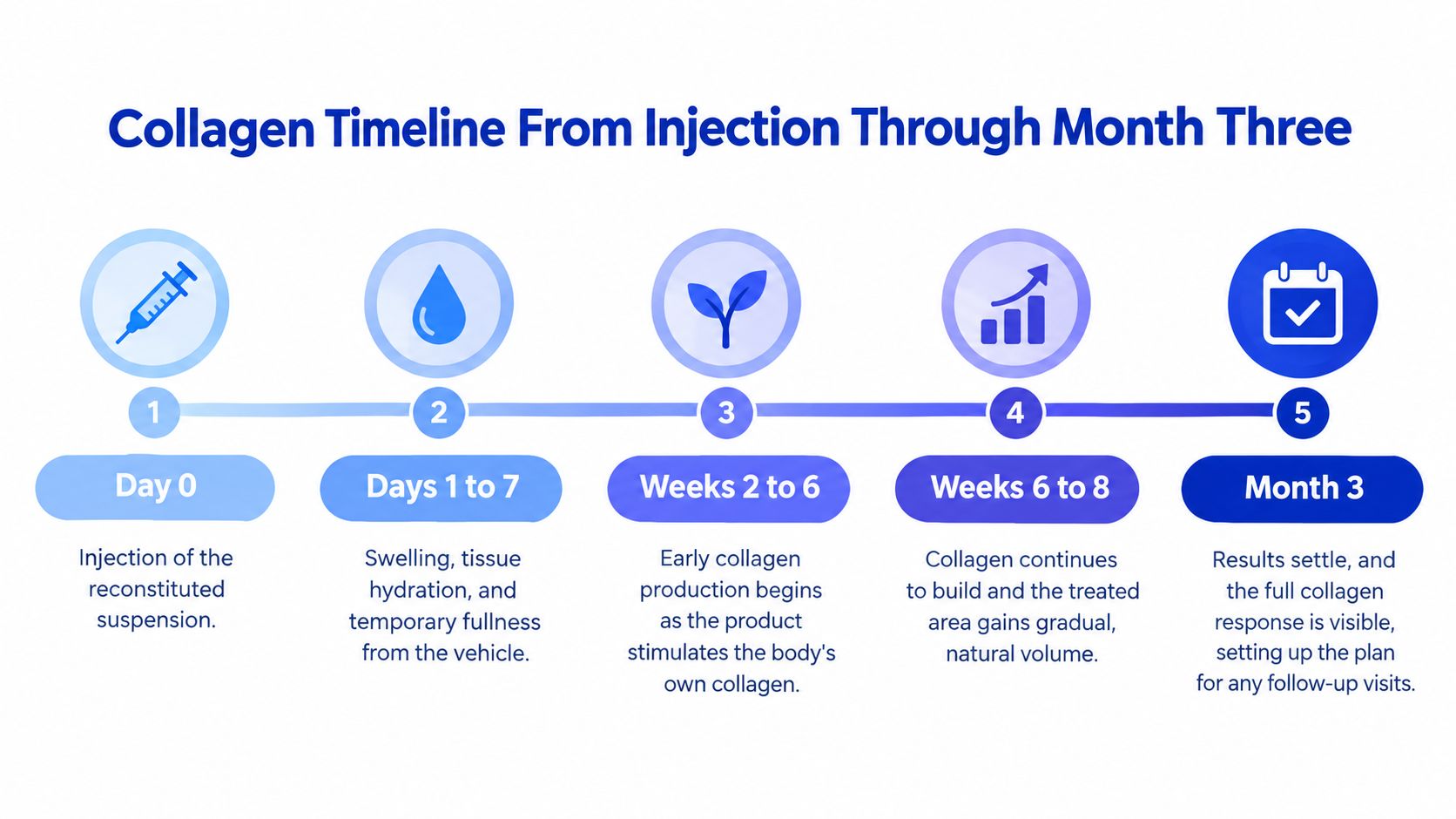
A multicenter randomized, evaluator-blinded study of 233 patients compared PLLA for nasolabial-fold wrinkles with injectable collagen. People could receive one to four sessions at 3-week intervals, so these figures describe a course rather than one appointment. Wrinkle-assessment scores became statistically significant beginning 3 weeks after the final treatment and continued through 13 months. The PLLA effect was maintained for up to 13 months, while the collagen comparator lasted about 3 months. At 13 months, 49% of PLLA-treated patients had no wrinkle or only a barely perceptible wrinkle, compared with 4% of collagen-treated patients. Read that durability as evidence for the series, and weigh your own response inside the 6-to-12-week window.
What you'll notice, phase by phase
| Phase | Timing | What the patient notices |
|---|---|---|
| Injection | Day 0 | Puffiness possible before leaving; the visible fullness is fluid |
| Early swelling | Days 1 to 7 | Swelling, tissue hydration and temporary fullness from the vehicle |
| Vehicle resolves | Weeks 1 to 3 | Fullness regresses as the carrier fluid resolves |
| Collagen remodeling | Weeks 3 to 6 | A fold or hollow begins to soften subtly in matched lighting |
| Reassessment window | Weeks 6 to 12 | Best window to judge the response against baseline photos |
| Long-term follow-up | Up to month 13 | PLLA effect maintained in the multicenter study |
Baseline volume loss, treatment area, skin quality, and injection technique shift this calendar. A mild cheek hollow can show a small change inside the window. Deeper deflation often needs more product before the same photo looks different. If the week-12 comparison shows a genuine but partial shift, that is the moment to choose between another session and a different approach.
Side Effects and When to Call Your Injector
Most reactions in the first days are mild and self-limiting: swelling, tenderness, and bruising. They fit the early phase of healing, and they aren't the collagen result you're waiting on.
Papules and nodules are the adverse events worth understanding. A consensus review in the Journal of Cosmetic Dermatology reports nodule rates ranging from 0.4% to 6.9%, with lower rates associated with higher reconstitution volumes such as 8 mL compared with 5 mL. Reported nodules are usually localized, and many are mild and self-limiting. Reviews of PLLA used on the body describe late, noninfectious nodules appearing in a small minority of subjects, so the risk is real but uncommon. The same consensus recommendations point to dilution, injection plane, product distribution, and post-treatment massage as the levers that shape that risk.
A small firm area isn't automatically an emergency. A painful, red, warm, enlarging, or draining lesion needs prompt assessment so the clinician can separate an inflammatory nodule from infection or granuloma.
Gentle massage is part of many aftercare plans. It isn't a complete safety strategy. Preparation and injection technique matter at least as much, and the evidence doesn't crown one protocol as universally best. If you don't have a second visit booked, ask whether the clinic has a documented pathway for treating Sculptra nodules. That question matters most when nobody is scheduled to see you again, and the six-to-twelve-week reassessment visit is where your injector checks tissue texture, not just photos.
Symptom, timing and action
| Symptom | Usual timing | What to do |
|---|---|---|
| Mild swelling, tenderness or bruising | First few days | Expected; follow the aftercare instructions |
| Small firm bump or papule | Days to weeks | Note its size and location; tell your injector |
| Lump that persists or grows | Weeks after treatment | Contact your injector for assessment |
| Painful, red, warm or enlarging area | Any time, often early | Seek prompt medical assessment |
| Drainage or fever | Any time | Seek urgent same-day medical care |
A firm spot you can describe in one sentence is a message to your injector. A hot, growing, or draining area is a same-day medical visit.
Don't massage aggressively on your own, and don't assume early swelling equals the final shape. Follow the injector's aftercare, keep a short note of size and day, and call if a lump persists or worsens.
Visible Changes Versus Cumulative Benefits
Visible change is what you can see in the mirror and in matched photos. Cumulative benefit is the correction, skin quality, and longer hold that build across sessions and months. After one session, visible change is usually modest: a softer fold, a little more cheek support, or a slightly smoother line against your baseline.
Here's a clearly hypothetical week-by-week split. At week 2, swelling is fading and the person feels disappointed because the face looks almost like the "before." At week 10, the same angle and the same expression show a softer cheek contour. Nothing dramatic happened overnight. The early photo was fluid. The later photo is a partial collagen response.
A 2026 randomized study measured dermal thickness at baseline, 60 days, and 120 days after a single PLLA treatment. Thickness increased over time. Visible improvement scores were positive at 60 days but declined by 120 days in some groups. The caliper and the mirror can disagree. A thicker dermis doesn't always read as a bigger change in photos, and a softer look at two months can look quieter by four.
How to compare fairly
- Match the light: Use the same window or lamp, not a bright bathroom one day and a dim car the next.
- Match the angle: Stand at the same distance, camera at eye level, face square to the lens.
- Match the expression: One set at rest, one with a small smile, so movement lines aren't confused with volume.
- Note how it feels: Write whether the area feels firmer at rest than it looks in motion.
- Date the set: Label week 2, week 6, and week 10 so a partial look isn't judged against day-of swelling.
A result that looks unfinished at week 2 isn't a verdict. If photos at 6 to 12 weeks show only a hint of change, that can mean the collagen response is light, or that the concern needs structural volume, skin treatment, or steadier weight rather than more biostimulator alone. Cheek concerns sometimes overlap with gel fillers, and the stay-time of those gels is a separate question from collagen remodeling, which is why people compare how long cheek fillers last before they pick a second step.
How ProMD Pairs Sculptra With Other Treatments
Think of Sculptra as the slow builder. Other treatments handle what needs to change now, or what you maintain between visits. The builder doesn't erase a frown line made by muscle, and a peel doesn't replace lost cheek structure.
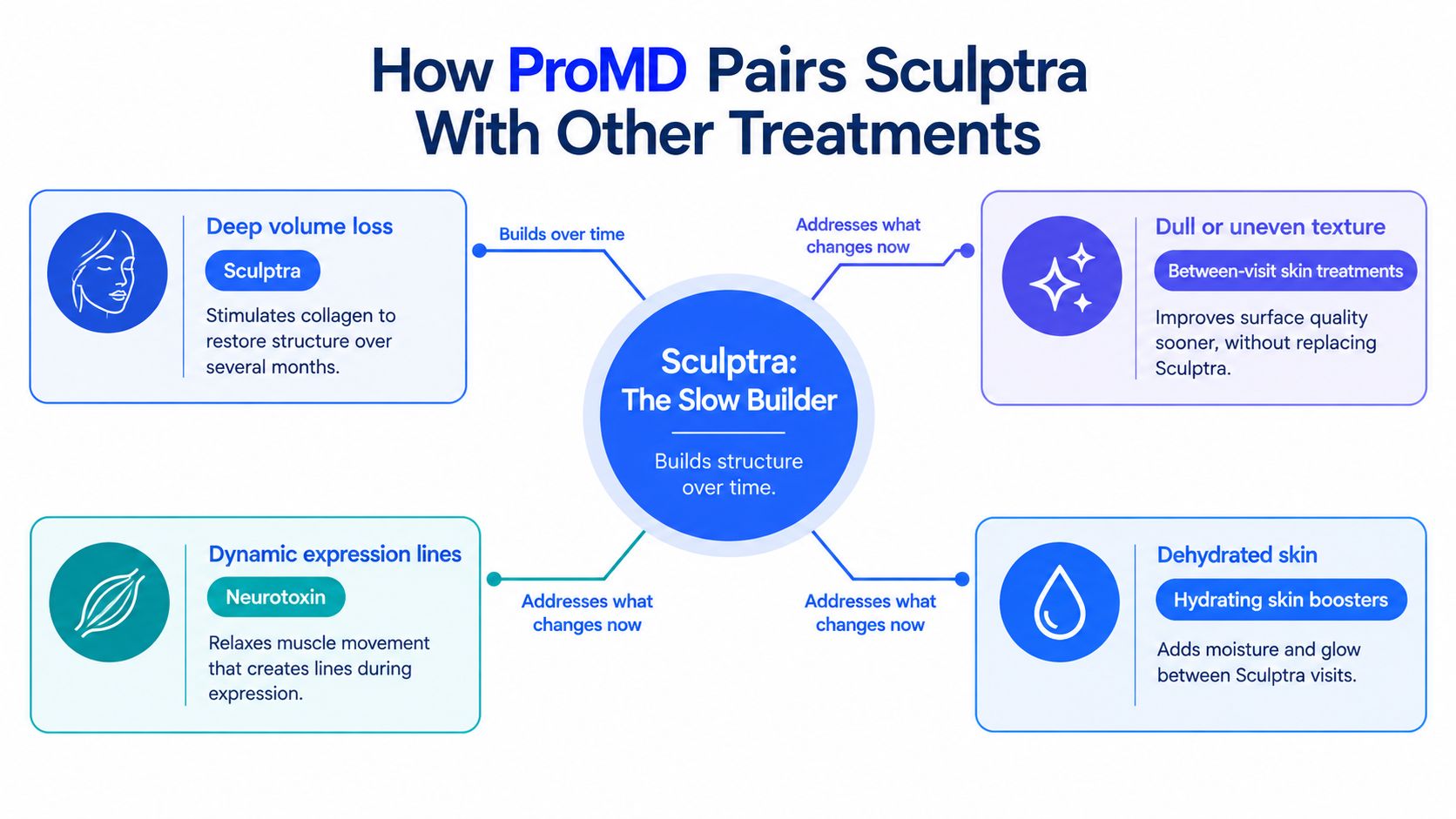
ProMD Health plans these pairings at consultation, not from a menu you assemble alone. Sequence and spacing are set for your anatomy. Some devices and injectables aren't offered the same way at every office, so confirm what that location provides before you book.
| Concern | Pairing with Sculptra | Role in the plan |
|---|---|---|
| Dynamic lines on the brow, eyes or mouth | Neurotoxins (Botox, Dysport, Daxxify) | Relax movement while collagen builds |
| Need for faster visible volume | Dermal fillers | Give immediate volume; Sculptra builds gradually |
| Skin quality and texture | Lasers, microneedling or chemical peels | Work on surface and tone alongside collagen |
| Results between visits | Medical-grade skincare (The Skin Shoppe) | Support maintenance and skin health |
| Overall plan | Provider-designed sequence and spacing | Confirmed at consultation, not assumed |
A neurotoxin quiets expression lines Sculptra doesn't treat. A hyaluronic acid or calcium-based filler can supply volume you want to see sooner, while collagen catches up. If you're weighing a collagen stimulator against a different injectable, start with a side-by-side of Radiesse versus Sculptra so the mechanism matches the goal. Lasers, microneedling, or chemical peels work on tone and texture. Some people also look at skin rejuvenation through PRP microneedling when surface quality is the gap between visits. Medical-grade skincare from The Skin Shoppe supports the skin you already have. It doesn't replace sessions.
Sculptra at ProMD Health is cash-pay and isn't covered by insurance. Cost follows the written plan, including how many sessions are proposed, so ask for that plan before you book. Kybella and body contouring treat different areas and need their own assessment. They aren't add-ons you assume belong on a facial collagen plan.
Follow-Up Schedule and Your Next Decision
One session is allowed. It is not the typical course for optimal correction. FDA labeling for the controlled study planned one to four injection sessions, generally spaced three weeks apart, and Sculptra patients averaged 3.2 sessions before the target wrinkle score was reached or four sessions were done. The studied interval was about three weeks; later visits are often spaced at least four weeks when your injector wants a clearer read between visits. Your face sets the calendar, and the reassessment turns that calendar into a decision.
Visit by visit
| Visit | Typical timing | Purpose |
|---|---|---|
| Consultation and baseline photos | Before session 1 | Set goals, treatment areas and a comparison baseline |
| Session 1 | Treatment day | Begin collagen stimulation |
| Early check-in | 1 to 2 weeks | Review swelling and any firm areas |
| Reassessment | 6 to 8 weeks, window to 12 weeks | Judge progress and decide whether more sessions are needed |
| Session 2 | Commonly week 8 to 12, once reassessment supports it | Continue correction if the assessment supports it |
| Session 3 and beyond | Typically at least 4 weeks after the prior session | Complete the course as planned |
| Periodic review | Around 12 months | Decide whether a touch-up course is needed |
At reassessment, three branches cover almost every outcome.
- You're satisfied with a natural, light change. Move to maintenance and a periodic review instead of adding product you don't want.
- The result is partial, which is common after one session. Talk through more sessions, a structural filler, or a complementary skin treatment. A partial result is a mid-course finding.
- Something is firm, painful, or enlarging at any point. Contact the injector promptly. Don't wait for the 6-week date.
If you stop after one session, ask for that choice to be written in the chart. Bring dated notes on swelling or lumps, your current skincare, any other treatments, and the goal in one sentence. "Softer cheeks, not a different face" is more useful than "I want to look refreshed."
Before you leave the clinic
- Confirm the office: Ask whether Sculptra is offered at the location you want, because availability can differ by site.
- Confirm cash-pay cost: Get the fee for the proposed sessions in writing. Don't assume insurance will pay.
- Get the session count: A written plan should say how many visits are proposed and why.
- Lock the reassessment: Schedule the 6 to 8 week check before you walk out, even if you might stop at one.
Session 2 only makes sense if the photos and the exam support more correction. Session 3 and later follow the same rule, typically spaced at least four weeks after the prior visit. Around 12 months, a review decides whether a touch-up course is useful or whether the face is holding. That visit has a job: confirm durability, then choose the next step deliberately.
ProMD Health offers Sculptra as a gradual, cash-pay collagen treatment and can pair it with neurotoxins, fillers, lasers, peels, microneedling, and medical-grade skincare when a single session leaves a partial result. Bring your photos and ask for a written session count, a reassessment date, and a clear price before you commit to more visits. Schedule a consultation at ProMD Health to review what one treatment showed and what the next step should be.