
You're washing your face weeks or months after treatment, and your fingertip catches something firm under the skin. It wasn't there during the bruising and swelling phase. It's not painful, exactly, but it's definitely a lump. Your first instinct is probably to press it, massage it hard, or search for a dissolver. Don't decide on Sculptra nodules treatment until you know what kind of lump you're dealing with. The category determines the right move, and getting that wrong can delay the help you need.
Table of Contents
- What Sculptra Nodules Are and Why They Appear Late
- How Common Sculptra Nodules Really Are
- Sorting a Lump Into the Right Category Before You Act
- How Providers Actually Treat Sculptra Nodules
- What Actually Lowers the Risk of Nodules Next Time
- When to See a Provider and What to Bring to That Visit
What Sculptra Nodules Are and Why They Appear Late
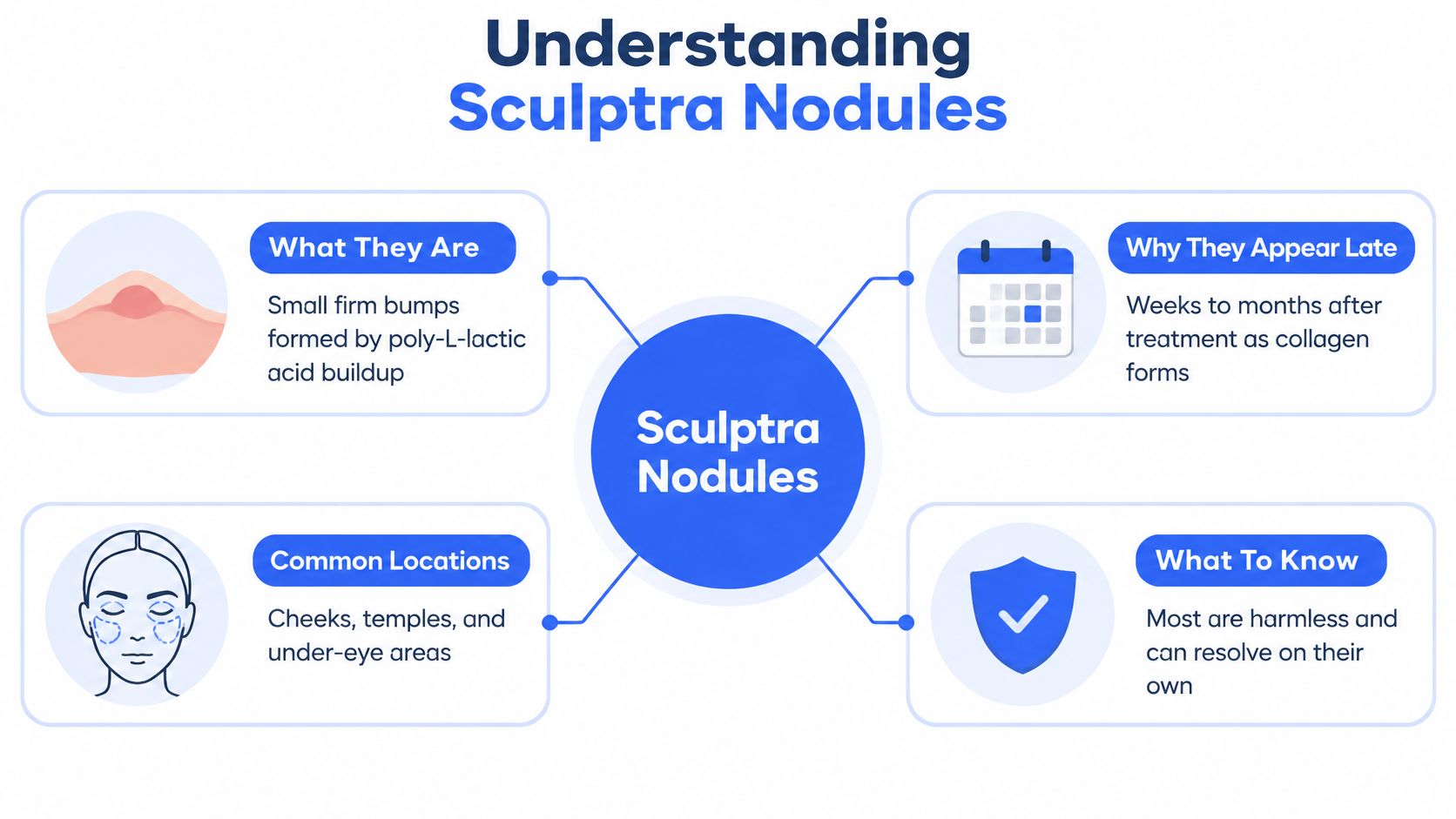
Sculptra is made of poly-L-lactic acid, or PLLA, and it works as a collagen biostimulator rather than a gel that merely fills space. If you're still getting oriented, it helps to review what Sculptra treatment is before judging whether a lump is expected healing or a complication. A nodule forms when PLLA particles cluster in one area or when your tissue reacts to that cluster as collagen forms around it.
That delayed biology explains the timing that unsettles so many patients. Injection reactions can be late rather than immediate, with reported onset for nodules ranging from approximately 1 to 2 months to 14 months after the final injection according to FDA safety documentation for Sculptra Aesthetic. A lump that appears long after your series can therefore still be treatment related. It doesn't mean you did something wrong at home.
Three Terms That Aren't Interchangeable
Clinicians separate these findings because they behave differently.
- Papules: These are smaller, superficial bumps. They tend to show up earlier than deeper nodules and are often grouped with nodules in reporting, which inflates some rates.
- Nodules: These are larger, palpable, and sometimes visible lumps under the skin. An early non-inflammatory nodule is usually a concentrated product deposit, not an immune crisis.
- Granulomas: These involve an inflammatory tissue reaction. They typically require medical treatment rather than watchful waiting and massage.
First 48 hours: Don't aggressively knead a new lump, don't try to squeeze it, and don't book a dissolver meant for hyaluronic acid filler. Note when you found it, take a clear photo, and check for pain, warmth, and color change.
Product preparation, injection depth, anatomical area, and your individual collagen response all shape whether particles disperse evenly or settle together. Superficial placement and concentrated depots raise the chance that you'll feel a deposit. Deep, evenly distributed placement lowers it. That distinction matters because a quiet product deposit and an inflamed granuloma may feel similar on day one, yet they follow very different treatment paths. Palpate gently once, record what you find, and resist repeated checking throughout the day. Constant pressure irritates tissue and makes it harder to tell whether tenderness is coming from the lump itself or from your handling of it.
How Common Sculptra Nodules Really Are
You'll find rates online that seem impossible to reconcile, from less than one percent to nearly one third of patients. Both extremes can be real because studies used different dilution protocols, different follow-up lengths, and different definitions. Some counted tiny papules together with nodules. Others counted only subcutaneous nodules that needed attention.
In a controlled U.S. study summarized in the Sculptra Aesthetic patient brochure, nodules and/or papules were reported in 17.2% of Sculptra-treated subjects (20 of 116), compared with 12.8% in the control group (15 of 117). That old protocol doesn't reflect how most experienced injectors prepare and place the product now. More recent immediate-reconstitution experience looks quite different, and the table below keeps those contexts separate instead of blending them into one misleading average.
Reported Nodule and Papule Incidence by Source
| Study Type | Cohort | Reported Rate | Notes |
|---|---|---|---|
| Controlled U.S. study | 116 treated subjects | 17.2% nodules and/or papules | Older protocol, papules grouped with nodules |
| Immediate reconstitution series | 274 treatments | 1 subcutaneous nodule | Resolved within 2 weeks after saline injection |
| Contemporary patient report | 58 patients | 2 nodules, 3.44% | Both regressed after saline and massage |
| FDA post-approval, year 5 | 661 completing follow-up | 31.5% overall | Long surveillance, varies strongly by facial area |
| Consensus literature range | Multiple protocols | approximately 0.4% to 6.9% | Lower risk linked to larger reconstitution volumes |
Anatomy changes the odds as much as technique does. FDA post-approval surveillance reported incidence of 19.0% in nasolabial folds, 5.4% in cheek folds, 27.2% in marionette lines, and 3.6% in the chin crease, as detailed in the FDA post-approval study record. Mobile areas around the mouth repeatedly show higher reported rates than the chin or cheek folds. That's useful context if your lump sits in a marionette line. You're not an outlier, and your injector shouldn't quote a single universal percentage as if every zone behaved identically.
The honest takeaway is that risk isn't zero, isn't fixed, and isn't best captured by the scariest number you can find. Ask which definition a quoted rate used, how the product was diluted, and how long patients were followed. Those three questions explain most of the spread.
Sorting a Lump Into the Right Category Before You Act
Massage is the advice most patients receive first, and it's the advice most likely to be wrong when applied blindly. Mechanical pressure can help an early, quiet deposit disperse. It can irritate an inflamed lesion and spread concern when infection is possible. Triage comes before treatment, every time, and reviewing general dermal filler side effects can help you separate routine swelling from a reaction that needs assessment.
A Practical Self-Check
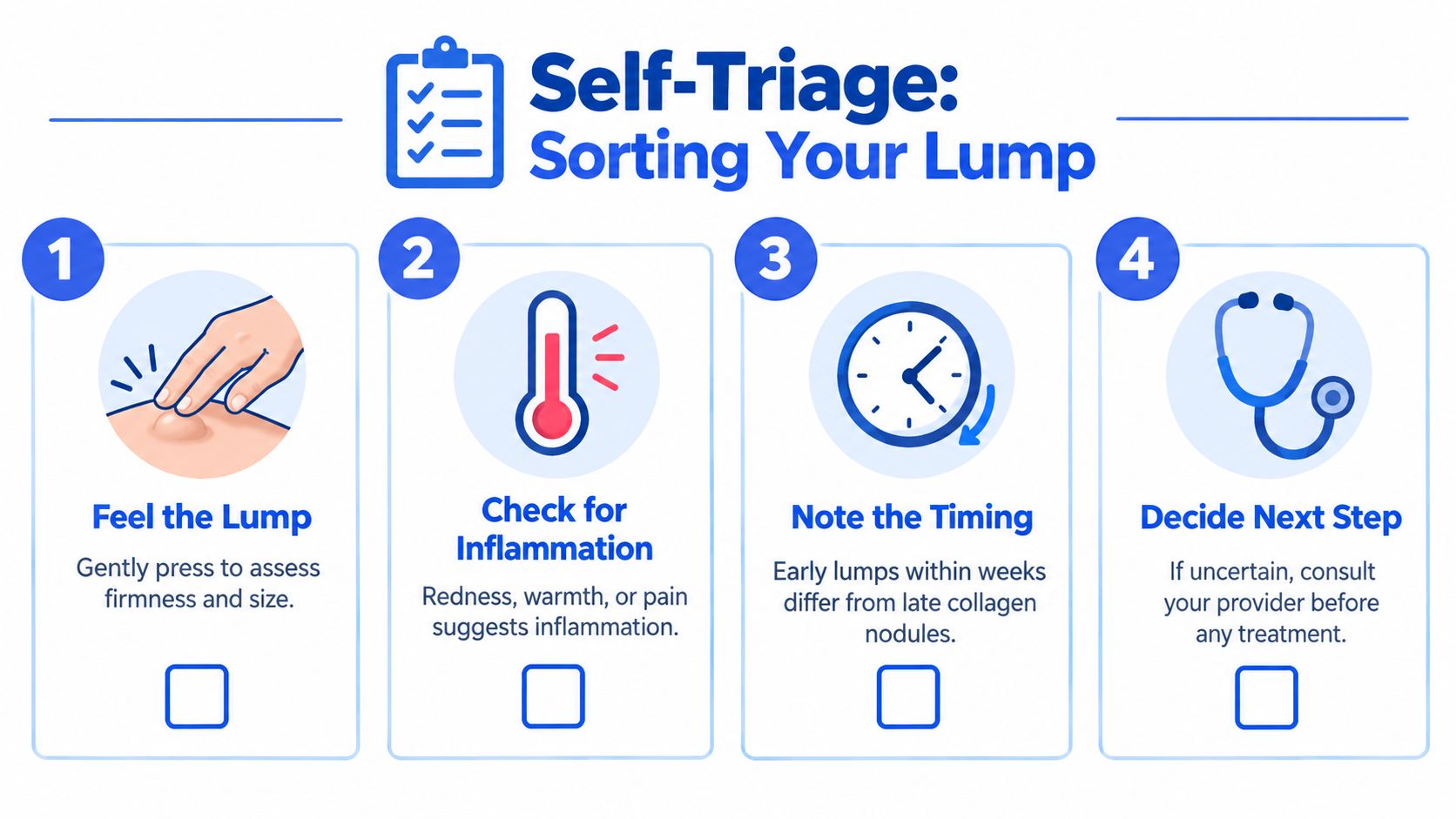
Work through these observations in order and write down your answers.
- Timing: Did the lump appear in the first weeks, or months after your last session? Early clumping points more toward product distribution. A much later, changing lesion raises the possibility of a delayed inflammatory reaction.
- Feel: Is it firm but painless, with normal skin over it? That pattern fits a non-inflammatory nodule more closely.
- Inflammation signs: Look for increasing warmth, pain, redness, swelling, or discoloration. Those features move the lump out of the self-care category.
- Infection flags: Drainage, fever, rapid growth, spreading redness, or skin breakdown need prompt medical attention. Don't massage and don't wait for your next routine appointment.
FDA materials note that some nodules are associated with inflammation or discoloration, may resolve on their own or after intralesional corticosteroids, and can persist for up to two years, as summarized in the FDA device record for Sculptra. That same record includes a useful warning from adverse-event reporting. A nodule can flatten temporarily after saline treatment and then recur, so short-term improvement doesn't prove the problem is finished.
If the area is getting warmer, more painful, or more red instead of calmer, stop manipulating it. Diagnostic assessment should come before more pressure.
Good documentation makes that assessment faster and more accurate. Clinicians who keep structured dermatology notes with PatientNotes can track onset, symptoms, and response across visits, which is exactly the timeline that distinguishes a settling deposit from a recurring inflammatory lesion. You can support that process with dated photos and a brief note on pain, warmth, and size change. You're not trying to diagnose yourself. You're giving your provider clean information instead of a vague report that something feels off.
How Providers Actually Treat Sculptra Nodules
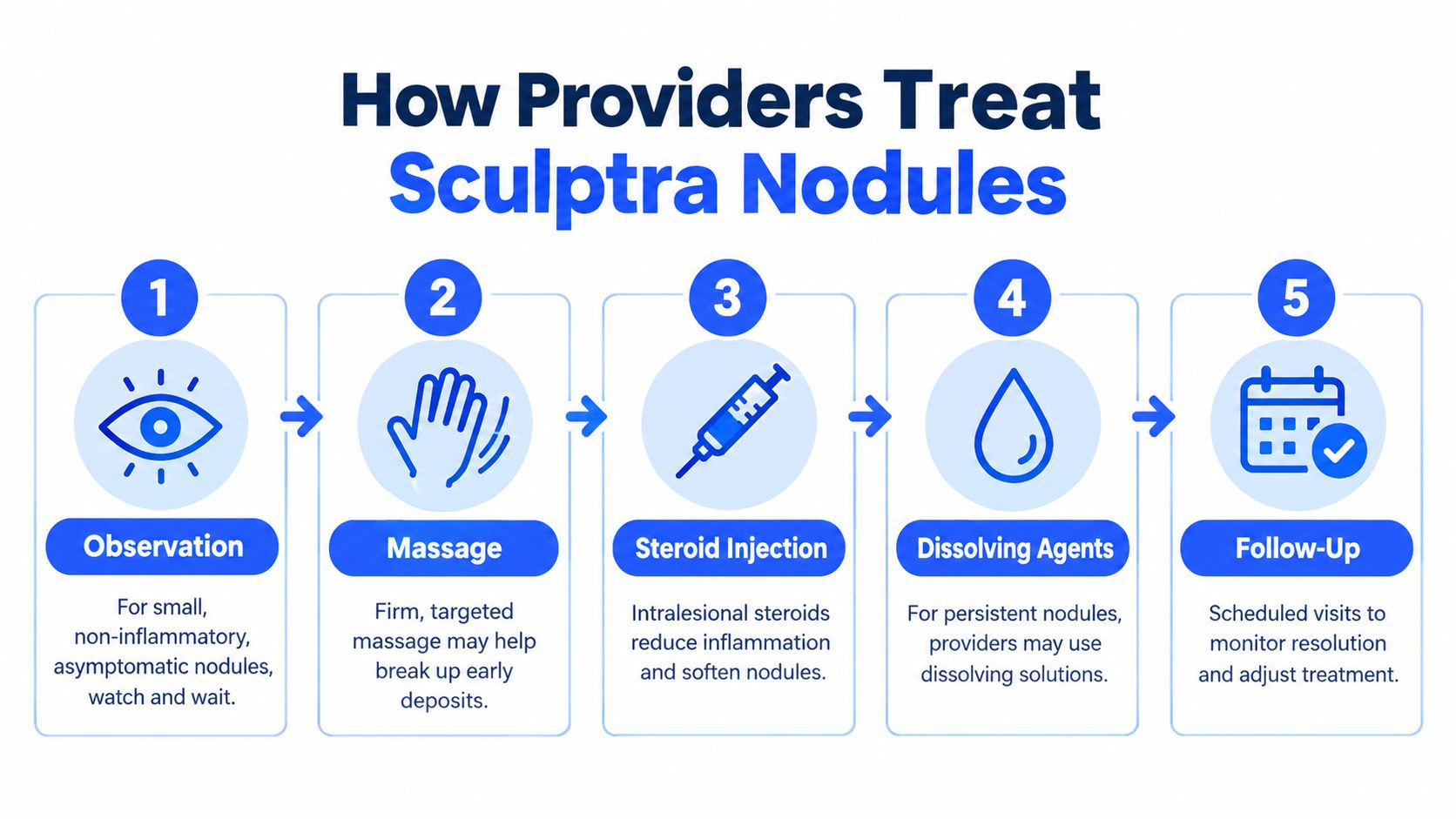
There's no single Sculptra nodules treatment that fits every lump, and a provider who reaches for the same syringe for every patient should give you pause. Management follows timing, inflammation, persistence, and depth. Conservative care comes first when it's safe, and escalation happens when the lesion's behavior justifies it.
From Observation to Mechanical Dispersion
Small, painless, non-inflammatory nodules may just be observed, particularly when they're palpable but not visible and aren't changing. Waiting isn't neglect when your provider has examined the area, documented it, and set a review point. It's a deliberate choice that avoids unnecessary injections into tissue that may settle on its own.
When a deposit needs help dispersing, a clinician can inject sterile normal saline into or around the lump with a needle or cannula, then apply local massage and observe the response. Contemporary clinical evidence describes complete regression after two 0.9% saline injections one week apart with local massage, as reported in a review of Sculptra nodule management. Saline doesn't dissolve PLLA chemically. It helps break up and redistribute a concentrated deposit mechanically, which is why it suits early product clumping far better than established granulomatous tissue.
When Treatment Escalates
Inflammatory, granulomatous, late-onset, or treatment-resistant nodules follow a different path. Published approaches may use intralesional corticosteroids, 5-fluorouracil, or combinations of those agents, and energy-based devices have been reported for selected cases. Steroids carry their own trade-offs, including possible local tissue thinning when used aggressively, so dosing and spacing matter. If infection or biofilm is in the differential, microbiological testing and culture-directed antibiotics may need to precede or accompany anti-inflammatory treatment. Suppressing inflammation before addressing infection can mask the underlying problem.
Surgery sits at the end of the pathway, not the beginning. FDA safety documentation describes cases where larger nodules, lesions in difficult locations such as the lower eyelid, or nodules that remained after corticosteroid treatment required surgical excision, as detailed in the FDA summary of safety and effectiveness. Subcision has also been used for some granulomas. These options sound drastic, but for a persistent lesion in a visible or delicate area, removing it cleanly can be safer than repeated injections that aren't working. Expect your provider to explain why each step fits your specific lesion, what success would look like, and when you'll reassess if the first approach falls short.
What Actually Lowers the Risk of Nodules Next Time
Most prevention advice starts and ends with the 5-5-5 massage rule. Massage five minutes, five times daily, for five days. It's widely taught and easy to remember. It's also not the main reason modern nodule rates are lower, and treating it as a guarantee gives patients a false sense of control. General dermal filler aftercare still matters, but preparation and placement do the heavier work.

Consensus guidance associates lower risk with larger reconstitution volumes, commonly favoring about 8 mL or more of sterile water per vial, with some protocols using 8 to 12 mL depending on the treatment area, according to consensus recommendations on PLLA reconstitution and injection. Adequate hydration and thorough resuspension matter too. Particles that aren't evenly suspended can't distribute evenly, no matter how carefully you massage afterward.
Technique Choices That Move Risk Up or Down
- Depth of placement: Product belongs in the deep dermis or preferably the deep subcutaneous plane. Superficial placement puts deposits where you can see and feel them.
- Aliquot size and pattern: Small amounts delivered with retrograde fanning or tunneling spread particles across a broader area. Large concentrated boluses do the opposite.
- Dilution discipline: Low dilution and inadequate mixing are recurring pitfalls when nodules are reviewed after the fact.
- Area selection: Thin or highly mobile zones need extra caution, conservative volumes, and realistic counseling before treatment begins.
A controlled study found no significant independent effect of post-treatment massage on nodule formation when modern dilution and injection protocols were followed. Massage supports good technique. It doesn't replace it.
Before another session, ask your injector direct questions. How many milliliters do you use to reconstitute each vial? Which plane will you inject in this area? How do you adjust volume around the mouth or under the eye? An experienced clinician will answer without defensiveness and explain the trade-offs. If the entire prevention plan is only that you'll massage diligently, keep looking. Prevention is largely decided before you leave the treatment room, in the vial preparation and in the injector's hands.
When to See a Provider and What to Bring to That Visit
Use a simple rule. Any nodule that's new and persistent, painful, warm, draining, growing, or changing color warrants an in-person evaluation rather than continued self-care. A quiet lump that hasn't changed in two to three weeks also deserves a professional look, even if it doesn't hurt. Early evaluation usually shortens the path because small deposits are easier to disperse and early inflammation is easier to characterize.
What Helps Your Provider Act on the First Visit
Bring specifics, not just concern.
- Treatment dates and areas: List every Sculptra session, the zones treated, and vial counts if you know them.
- Product details: Share reconstitution information if your treating clinic can provide it, plus any other injectables placed in the same area.
- Dated photographs: Consistent lighting and angles show growth, color change, or flattening better than memory does.
- Symptom log: Note pain, warmth, redness, drainage, fever, and anything you've applied or taken.
- Medical context: Include immune conditions, recent dental work or infections, new medications, and prior filler reactions.
Expect a hands-on examination first. Your provider will assess size, depth, mobility, tenderness, and the skin above the lesion. Depending on those findings, they may discuss imaging, culture when infection is possible, or biopsy when the diagnosis remains uncertain. Those steps aren't overreactions. They're how a clinician avoids treating an infection as simple clumping or injecting steroid into a lesion that needs drainage.
Urgency depends on trajectory. Fever, spreading redness, drainage, severe pain, or rapid enlargement should be seen promptly, the same day when possible. A stable, painless lump can usually wait for a scheduled appointment, provided you've called, described it, and been given a timeframe. Call the clinic that treated you first if you can. They know what was placed and where. If you can't reach them or symptoms are escalating, don't let loyalty delay care. Bring your records, describe the timeline plainly, and ask what category your provider thinks this lump falls into and what would change that assessment.
If you've found a lump after Sculptra or you're considering treatment and want a clear plan for prevention, evaluation, and follow-up, book a consultation with the team at ProMD Health. Their providers offer Sculptra and other non-surgical aesthetic treatments across their locations in Maryland, Virginia, Washington, DC, Florida, Texas, Colorado, and Delaware, and they can examine delayed nodules, asymmetry, or inflammation in person. Bring your treatment dates and photos, and you'll leave with a specific next step instead of generic massage advice.


