You may notice your cheeks look flatter in photos, the folds beside your mouth seem deeper, or your skin has lost the firmness it once had. The change often happens gradually, which makes it difficult to know whether you need a traditional filler, a skin-quality treatment, or a broader approach to facial rejuvenation.
Sculptra treatment for the face belongs to a different category from an instant-volume filler. It uses injectable poly-L-lactic acid to encourage your body to build collagen over time. That means the best results aren't designed to appear overnight. They develop through a carefully planned protocol, realistic expectations, and an injector who understands facial anatomy and biostimulation.
Table of Contents
- Understanding Sculptra Treatment for Face
- How Sculptra Works Through Collagen Biostimulation
- The Sculptra Treatment Timeline and What to Expect
- Sculptra vs Other Facial Treatments Making the Right Choice
- Who Is a Good Candidate for Sculptra Treatment
- Aftercare and Maintenance for Lasting Results
- Combining Sculptra with Other ProMD Services
- Making the Decision for Sculptra Patients
Understanding Sculptra Treatment for Face
A patient may arrive for consultation expecting a quick correction to a hollow cheek or a deepening nasolabial fold. After looking at older photographs, however, she may realize the change isn't one isolated wrinkle. The midface has gradually lost support, the skin looks thinner, and the lower face appears less defined. In that situation, placing a gel directly into one line may not address the broader structural change.
Sculptra offers a gradual alternative. Rather than occupying space beneath the skin, it helps stimulate the body's own collagen response. The result is a progressive improvement in facial support and skin quality, not an instant reshaping that looks fully developed when you leave the office.

A different role from immediate fillers
Traditional dermal fillers are designed to create visible volume at the time of injection. Sculptra works more like a biological remodeling treatment. The injected material starts a process that encourages connective tissue and collagen support to develop gradually.
That distinction matters if you're comparing dermal fillers and their uses. A patient who wants a precise, immediate change may prefer a traditional filler for a specific feature. Someone concerned about diffuse facial thinning may be more interested in a treatment that supports a broader, slower transformation.
The practical expectation: Sculptra may make your face look refreshed over time, but it isn't intended to provide a finished result immediately after treatment.
The approach also requires patience. Early fullness can reflect the treatment solution and normal swelling rather than the final collagen response. As that temporary effect settles, the meaningful change develops more gradually. This makes Sculptra a long-term investment in facial structure, rather than a quick fix before an event.
How Sculptra Works Through Collagen Biostimulation
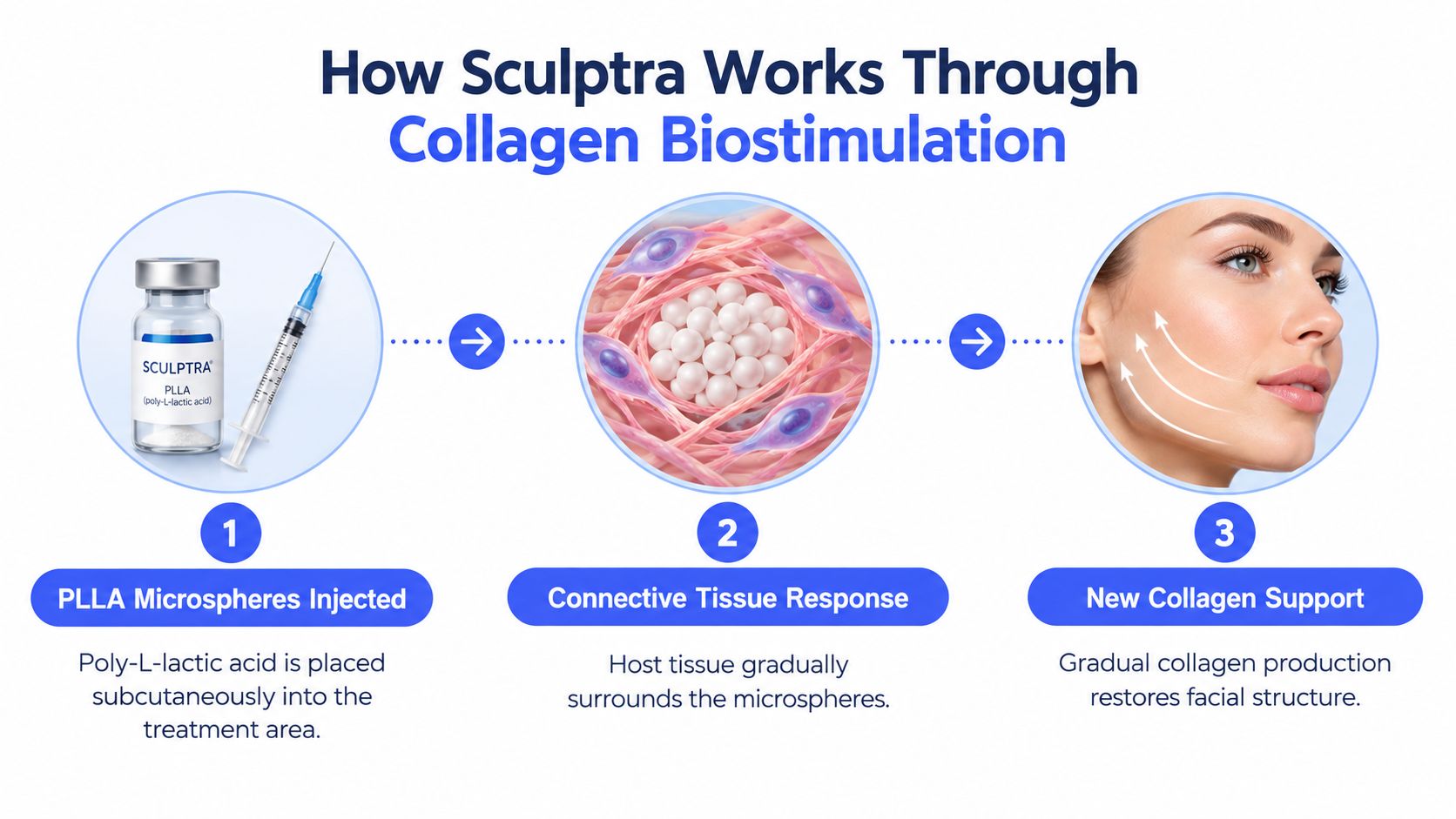
Sculptra's active material is poly-L-lactic acid, or PLLA, suspended as solid microspheres. A qualified injector places it beneath the skin, where the microspheres are gradually surrounded by the body's connective tissue. That tissue response stimulates new collagen formation, according to the product's technical instructions for use.
A useful analogy is a temporary construction signal. The PLLA isn't a permanent block of volume sitting in your face. Instead, it prompts your body to reinforce the surrounding area with its own structural protein. As collagen support develops, the treated region can look fuller, firmer, and more supported.
Why the history matters
Sculptra's clinical history helps explain why it's viewed as more than a conventional space-filling product. It was first approved in Europe in 1999 as New-Fill for soft-tissue augmentation. It then received U.S. FDA approval in 2004 for facial lipoatrophy associated with HIV, before gaining a broader U.S. facial-wrinkle indication in April 2023 for fine lines and wrinkles in the cheek region of immune-competent adults. These milestones are summarized in a clinical review of Sculptra's development and facial applications.
That progression moved Sculptra from a medical reconstructive use toward mainstream aesthetic collagen stimulation. The history doesn't mean every patient is automatically suitable. It does show that the product's role is tied to gradual facial volume restoration and tissue remodeling, not just immediate wrinkle coverage.
The biological mechanism also explains why results can look subtle. Your provider isn't trying to create a dramatic change in one injection point. The aim is to support the facial areas where collagen loss and volume depletion have altered overall balance.
The Sculptra Treatment Timeline and What to Expect
You may leave your first appointment with noticeable fullness, then see that effect soften. That early change comes partly from the injected material and fluid, so it is not the finished result. Sculptra follows a different timetable from an immediate-volume treatment: the visible change develops as your skin builds and remodels collagen.
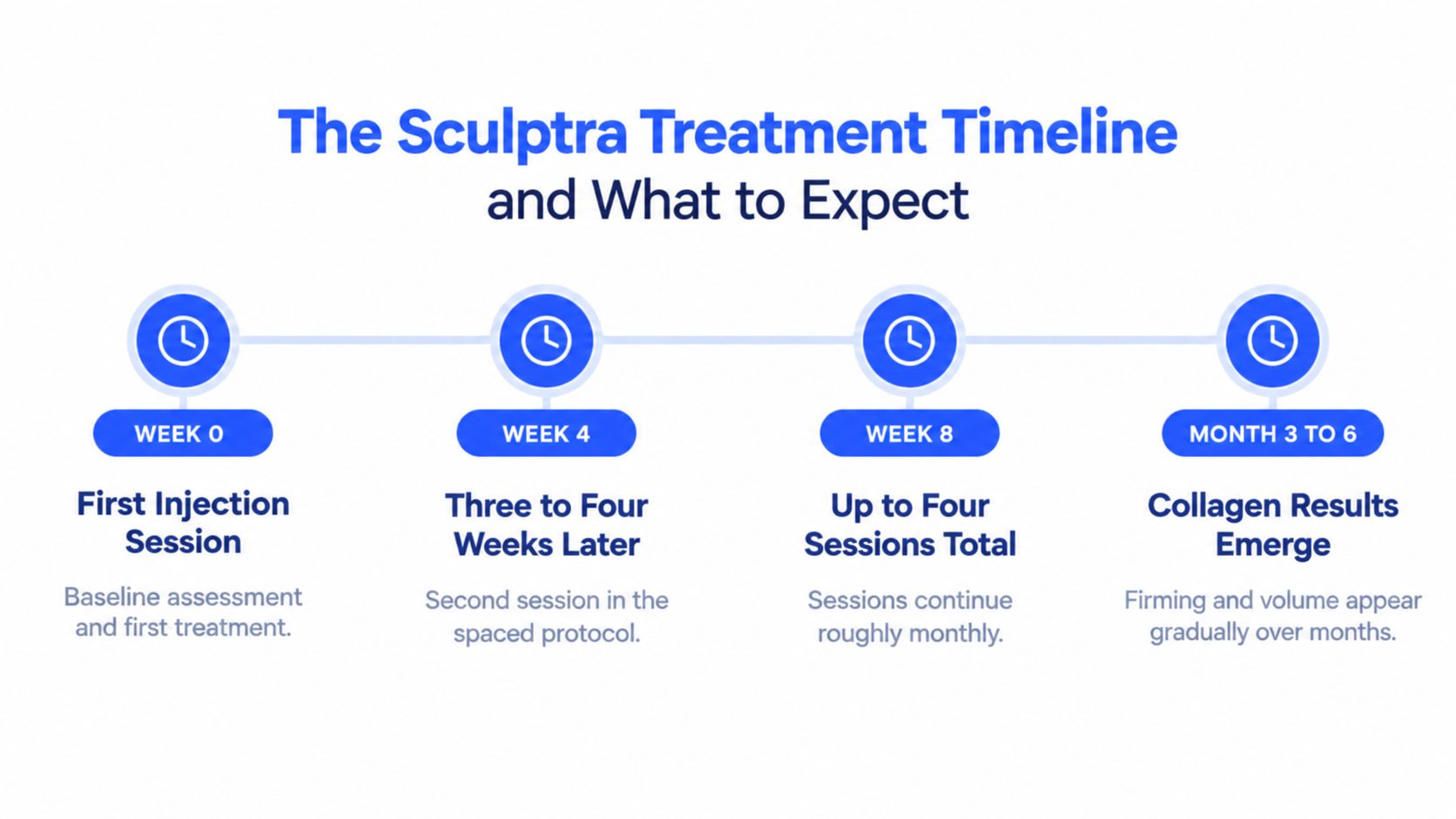
The FDA-approved regimen allows up to four sequential sessions spaced three to four weeks apart for shallow to deep nasolabial fold contour deficiencies and other facial wrinkles in immunocompetent adults, as described in the FDA approval documentation. Your provider may recommend fewer sessions, depending on your anatomy, degree of volume loss, goals, and response after each visit. The interval allows the tissue to settle and gives the provider a chance to assess whether another session is appropriate.
What happens during each phase
At the first appointment, your provider examines facial proportions, skin thickness, existing volume, and areas such as the cheeks or nasolabial folds. The product is reconstituted and injected beneath the skin according to the treatment plan. Temporary fullness can appear immediately, but the collagen response takes longer.
At a follow-up three or four weeks later, the provider reviews how the first session settled, checks for complications, and decides whether additional treatment is justified. Treatment may continue in stages, within the FDA regimen of four sequential sessions.
The preparation also affects how the treatment is evaluated. In the randomized 48-week SCRIPT study, investigators compared Sculptra reconstituted with 8 mL of sterile water with a preparation using 5 mL of sterile water. Nasolabial fold improvement at week 48 was the primary endpoint. The findings show why dilution belongs in the discussion of efficacy, tolerability, and injection technique, as reported in the SCRIPT study.
| Phase | Timeline | What Happens | Expected Outcome |
|---|---|---|---|
| Initial treatment | First visit | Facial assessment, reconstitution, and injection | Temporary fullness may appear |
| Spaced treatment | Three to four weeks between sessions | The provider reviews the response and may continue the protocol | Treatment builds progressively |
| Collagen remodeling | Following weeks and months | The body develops new connective-tissue support | Firmness and volume become more apparent |
| Longer-term follow-up | Through the later follow-up period | The provider evaluates durability and maintenance needs | Results may remain visible as collagen support persists |
Clinical evidence in the FDA approval package included a base study with 149 randomized subjects, with 134 completing the 0- to 12-month phase. The treatment effect was maintained through 24 months, and product references state that results can last up to two years. These findings describe the studied timeline, not a guaranteed duration for every patient. See the FDA approval documentation for the supporting product information.
Sculptra vs Other Facial Treatments Making the Right Choice
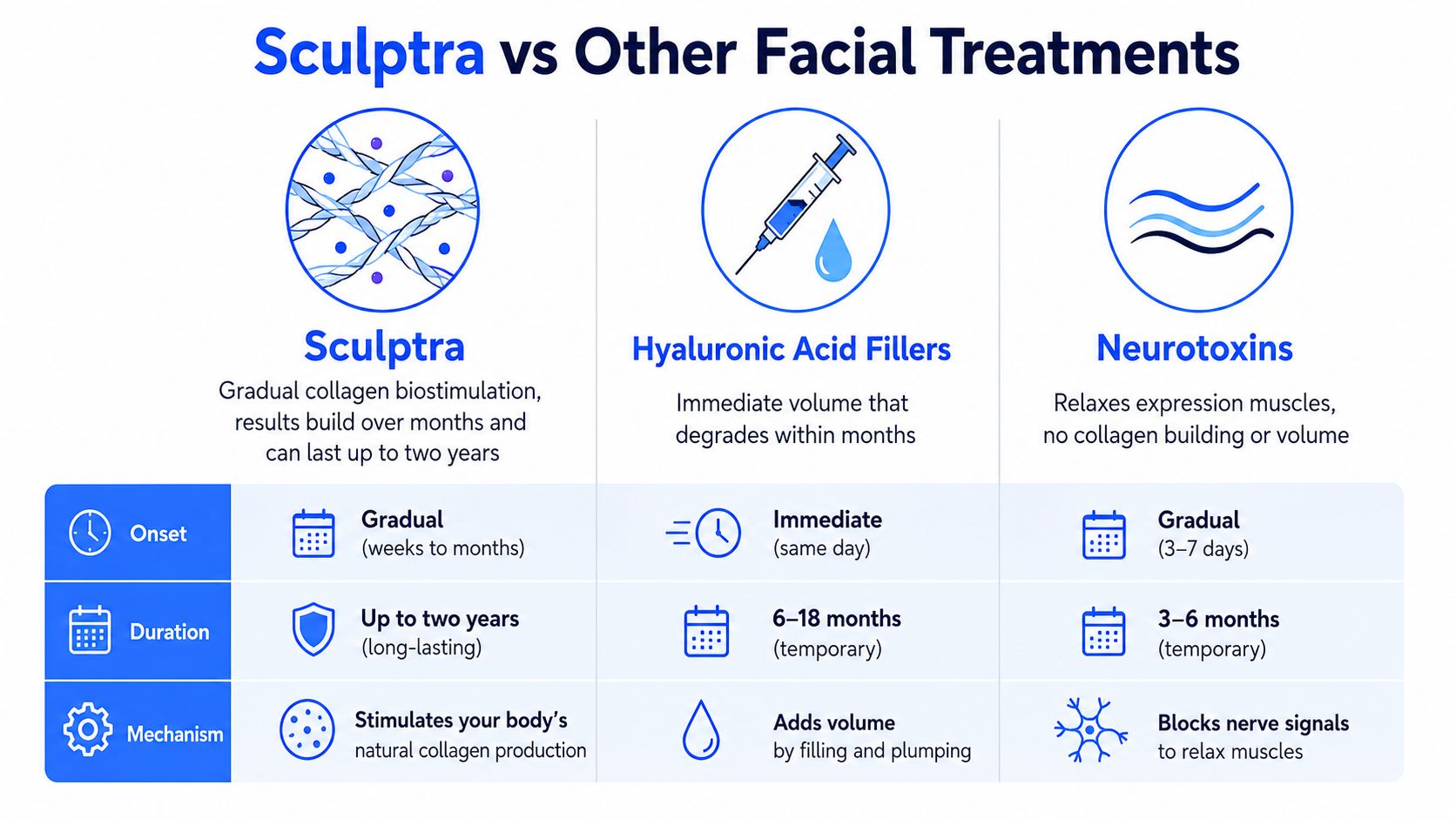
Sculptra, hyaluronic acid fillers, and neurotoxins address different problems. Choosing among them starts with identifying whether your primary concern is lost structure, a targeted lack of volume, or muscle movement.
Sculptra is designed for gradual collagen biostimulation. It may suit someone whose face looks increasingly thin or unsupported and who is comfortable waiting for progressive improvement. Hyaluronic acid fillers provide immediate volume and can be placed with precision in a defined area. Neurotoxins relax selected expression muscles, so they address movement-related lines rather than restoring lost volume or building collagen.
Match the treatment to the goal
Consider these common examples:
- Broad facial thinning: Sculptra may provide a foundational collagen-focused approach.
- Immediate contour refinement: A hyaluronic acid filler may be more appropriate when you want visible volume during the appointment.
- Dynamic expression lines: A neurotoxin may help when repeated muscle contraction is the main cause.
- Several concerns at once: A staged combination plan may address structure, precise contour, and muscle activity separately.
Sculptra results can last up to two years, while the immediate effect of many temporary fillers diminishes sooner. That difference reflects mechanism, not a universal ranking. A longer timeline may be valuable to one patient and frustrating to another.
You can also review the treatment distinctions discussed in Radiesse versus Sculptra for facial filler decisions. The important question isn't which injectable is universally best. It's whether the product's mechanism, onset, and risk profile match your anatomy and expectations.
Who Is a Good Candidate for Sculptra Treatment
A good candidate is typically an immunocompetent adult who wants gradual improvement in facial volume, cheek support, or wrinkle appearance. The person should understand that Sculptra isn't an instant correction and should be willing to follow the aftercare plan closely.
Candidacy depends on more than age or a single photograph. Your provider should review your medical history, previous injections, allergy history, skin thickness, scar response, and treatment goals before recommending PLLA.
Reasons to avoid or postpone treatment
Sculptra shouldn't be used in patients with:
- Keloid or hypertrophic scarring: A personal history of these raised scars can increase concern about an unwanted tissue response.
- Known hypersensitivity: Anyone with a known allergy to the ingredients shouldn't receive the product.
- Severe multiple allergies: This history requires careful medical evaluation.
- Pregnancy or lactation: Safety hasn't been established during pregnancy, lactation, or breastfeeding.
- Age under 18: Safety hasn't been established in patients under 18.
These contraindications and safety limitations appear in the FDA safety information for Sculptra.
Thin skin also deserves a careful discussion. When tissue coverage is limited, visible irregularities or nodules may be more noticeable, particularly if product placement, dilution, or massage isn't managed correctly. That doesn't automatically rule out treatment, but it makes injector experience and conservative planning more important.
Facial injections carry uncommon but serious vascular risks. They can include blindness, stroke, infarction, and permanent scarring, so the provider must understand facial blood-vessel anatomy and know how to respond to an urgent complication. A consultation should feel like a medical assessment, not a quick product selection.
A sound candidacy decision asks two questions: Can your body safely receive the product, and does the treatment's gradual timeline fit what you want?
Aftercare and Maintenance for Lasting Results
Your recovery instructions help determine how evenly Sculptra settles. Follow the massage technique, timing, and pressure prescribed by your provider rather than copying a generic routine. Reconstitution volume and post-injection massage can both affect product distribution, so personalized guidance matters.
Massage helps reduce the chance that product will remain concentrated in one area, where palpable or visible nodules may develop. The published SCRIPT trial report also supports treating preparation and aftercare as connected parts of the protocol. The goal is not to press the product into place aggressively. It is to follow the method your injector selected for your dilution and treatment plan.
A practical recovery approach
- Follow the prescribed massage plan: Use the frequency, duration, and pressure your injector recommends after each session.
- Limit heat and exertion initially: Avoid intense heat exposure and strenuous exercise for the period your provider specifies.
- Avoid unnecessary manipulation: Do not press, knead, or repeatedly examine the treated areas beyond the directed massage.
- Plan around your schedule: Bruising, tenderness, edema, or a hematoma can occur, so allow recovery time before an important event.
Facial studies have reported mild-to-moderate bruising, hematoma, tenderness, nodules, and edema. These effects may occur during recovery and should be discussed during consultation. Worsening pain, marked skin discoloration, vision changes, neurological symptoms, or rapidly increasing swelling requires immediate contact with your provider or emergency evaluation.
Maintenance follows your response, not a fixed calendar. At review visits, your clinician can assess facial structure, collagen remodeling, skin quality, and any new medical considerations before recommending another session. Because Sculptra develops gradually, reassessment helps distinguish an appropriate ongoing response from a concern that needs attention.
Combining Sculptra with Other ProMD Services
Sculptra may serve as the structural layer of a broader facial rejuvenation plan. A provider might use a neurotoxin for movement-related lines, a hyaluronic acid filler for precise contour, and a medical-grade skincare routine to support the skin between visits. These treatments don't perform the same job, so sequencing should follow anatomy and goals rather than a preset menu.
Recent 2026 interim data in menopausal women reported that using Restylane Skinboosters before Sculptra produced the most pronounced hydration gains, particularly on the face and décolletage. Because that evidence concerns a specific population and sequence, it shouldn't be treated as a universal protocol. The 2026 controlled evaluation and related evidence support the broader idea that skin hydration, collagen remodeling, and contour correction may be planned as connected layers.
Think in layers, not isolated procedures
A thoughtful plan may look like this:
- Foundation: Sculptra supports gradual collagen remodeling where diffuse volume loss is present.
- Definition: A conventional filler can refine a feature that needs immediate, precise contour.
- Movement: A neurotoxin can soften lines created by repeated muscle activity.
- Maintenance: Medical-grade skincare and appropriate skin treatments help preserve surface quality.
Other services, such as body contouring, don't replace facial biostimulation. They belong to a separate treatment goal and should be discussed independently. For a broader view of collagen-focused care, see regenerative skin rejuvenation treatment.
The right sequence may involve separate visits, especially when nearby areas require different aftercare. Your provider should explain what will be treated, why the order matters, and how one treatment may affect the next.
Making the Decision for Sculptra Patients
Start with the concern you want to change. If your face has gradually lost fullness and firmness, and you're comfortable with a developing result, Sculptra may be worth discussing. If you need immediate correction in one small area, another treatment may fit better.
During a consultation, expect a review of your facial anatomy, goals, medical history, allergies, scar history, prior injections, and timeline. The provider should explain realistic benefits, alternatives, aftercare, and the uncommon but serious risks of facial injection.
Sculptra deserves consideration because it works with the body's collagen response rather than relying only on immediate space-filling. That makes it a distinct option for gradual, natural-looking facial rejuvenation, but it also means the treatment requires patience and careful candidate selection.
If you're considering treatment, schedule a consultation before choosing a product or treatment date. Bring a list of medications, allergies, prior injectable treatments, and any history of abnormal scarring so the provider can build a plan around your safety.
ProMD Health offers Sculptra consultations and injector-guided facial rejuvenation planning for patients considering gradual collagen support, volume restoration, or a combined aesthetic approach. Visit ProMD Health to learn more and request a consultation that matches your goals and medical history.