
PRP hair treatment is an in-office procedure that draws a small amount of your own blood, concentrates the platelets, and injects them into thinning scalp areas to stimulate dormant follicles. Clinical research suggests PRP can improve hair density, with one randomized-trial meta-analysis reporting a mean difference of 25.6 hairs per square centimeter compared with saline, although the evidence quality was rated low because of inconsistency and potential bias (clinical evidence review).
You may be here because more hair is collecting on your pillow, your part looks wider, or your ponytail feels smaller than it used to. PRP can be a useful part of a hair-restoration plan, but it isn't a transplant, it doesn't recreate follicles that have been permanently destroyed, and it shouldn't be presented as a guaranteed cure. The most useful question isn't only “does PRP work?” It's whether PRP fits your type of hair loss, your follicle activity, and the other treatments that may be needed alongside it.
Table of Contents
- What PRP Hair Treatment Actually Is
- Inside a PRP Session and How the Procedure Works
- Who Is a Good Candidate for PRP
- What Results Look Like and How Long They Take
- PRP Compared to Other Hair Restoration Options
- How ProMD Integrates PRP With Supplements and Other Therapies
- Risks, Recovery, Costs, and Maintenance Essentials
What PRP Hair Treatment Actually Is
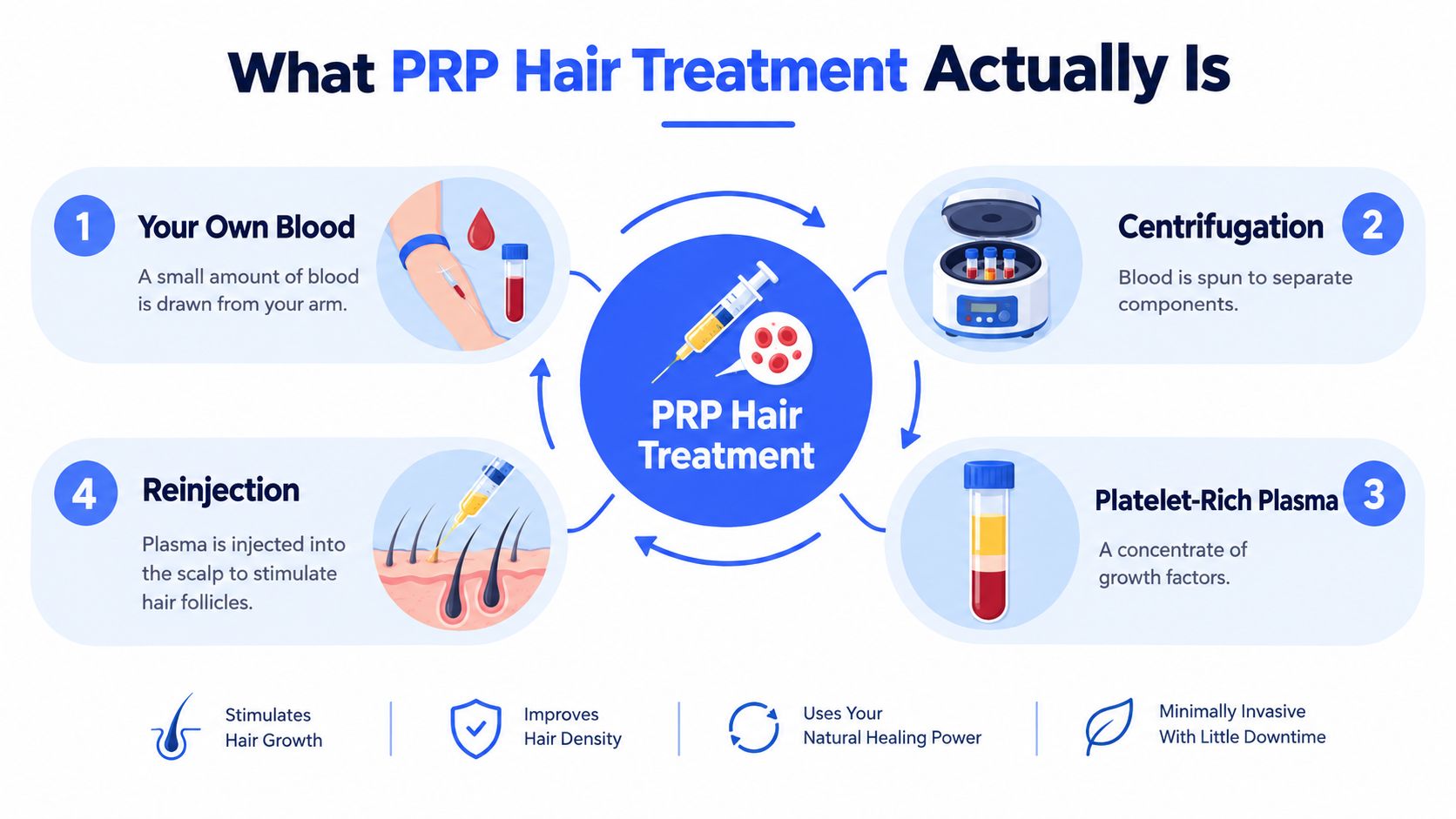
PRP stands for platelet-rich plasma. During treatment, a clinician draws blood from your arm, processes it in a centrifuge to separate and concentrate the platelets, and injects the resulting plasma into areas of scalp where hair is thinning. Because the material comes from your own blood, the treatment is autologous, meaning it uses your own biological material rather than a transplanted follicle or an unrelated substance.
The purpose is to give weakened follicles a regenerative signal. Platelets carry growth factors, including PDGF, VEGF, and TGF-beta, that are involved in tissue repair, blood-vessel signaling, and cellular activity. A simple analogy helps: if a hair follicle is an underperforming worksite, PRP brings a concentrated repair crew to the area. That crew may improve the local environment and encourage a miniaturized follicle to function more actively, but it can't rebuild a follicle that scarring has permanently replaced.
The hair-loss pattern matters
The strongest clinical use case is androgenetic alopecia, also called pattern hair loss. A systematic review of seven randomized trials found favorable pooled results for hair density among 171 analyzed people or half-head treatment areas (systematic review of PRP for androgenetic alopecia). PRP is generally more logical when follicles are still present but producing thinner hairs.
That distinction separates PRP from a hair transplant. A transplant moves follicles from one area to another. PRP attempts to support follicles that remain in the scalp. Scarring alopecia requires a different diagnostic approach because inflammation or scar tissue can damage the follicle structure itself.
PRP hair therapy moved from early clinical experimentation into broader research use during the 2010s. A systematic review found 18 articles on PRP for androgenetic alopecia before 2015, compared with 137 articles published from 2015 through 2019. The first controlled clinical trial appeared in 2011 and involved 26 patients, while a 2015 randomized blinded half-head study was identified as the first of its kind in the literature (PRP research timeline). That history matters because PRP is a relatively modern regenerative procedure, not a decades-old standard treatment with one universally accepted protocol.
Inside a PRP Session and How the Procedure Works
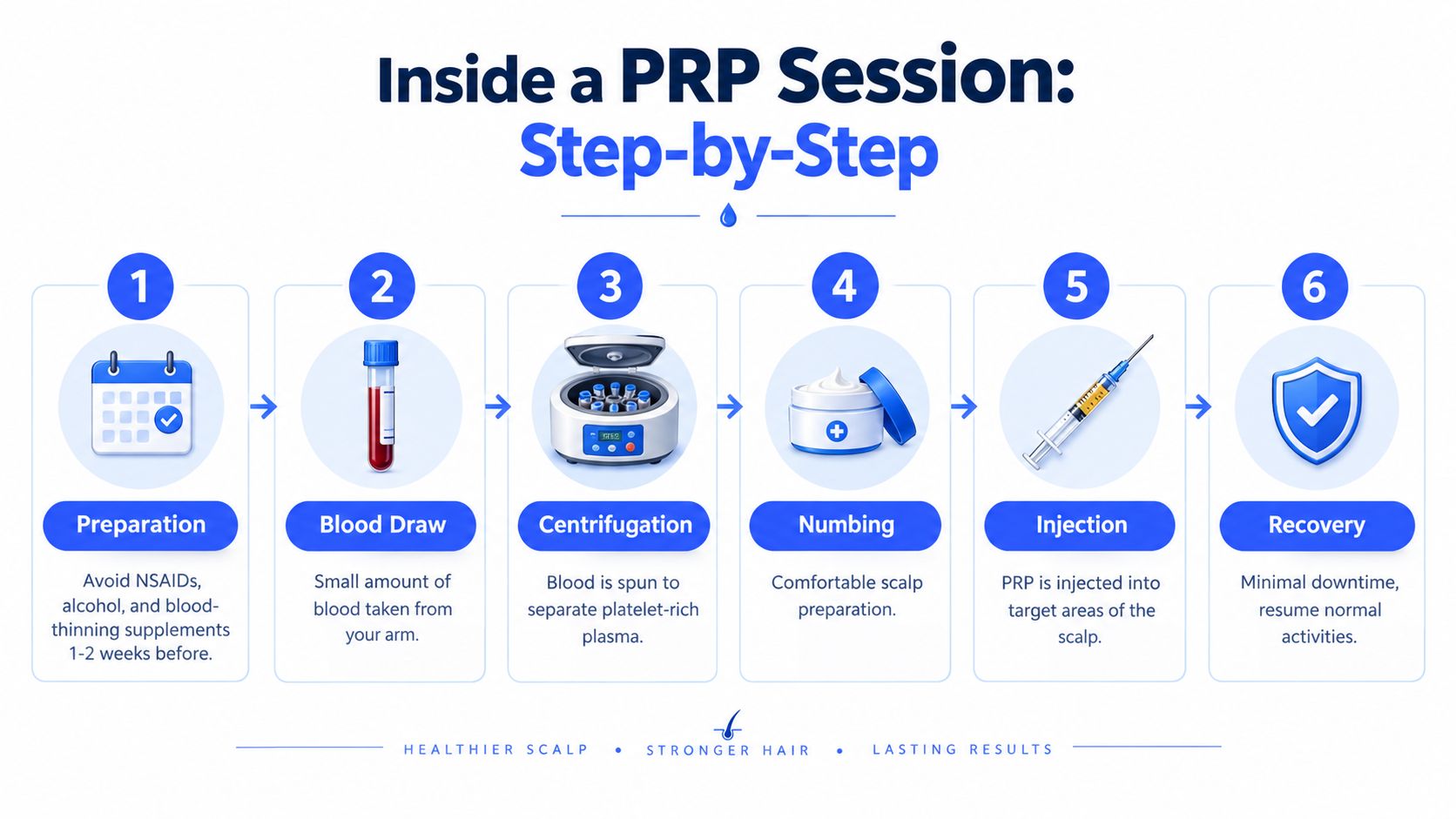
A PRP appointment usually follows a predictable sequence, although preparation, blood volume, platelet processing, and injection technique vary by clinic. Before scheduling, disclose medications, supplements, pregnancy status, bleeding problems, autoimmune conditions, and any active scalp symptoms. Your clinician may ask you to avoid certain anti-inflammatory medicines, alcohol, or blood-thinning supplements before treatment, but you shouldn't stop a prescribed medication without medical guidance.
Arrive with clean hair and avoid styling products on the scalp. Some protocols ask patients to pause topical minoxidil on the treatment day. Follow the instructions from the treating clinician because preparation rules can differ according to your health history and the specific system used.
Draw, spin, and prepare
A phlebotomist or clinician draws a small amount of blood from your arm. The amount depends on the protocol and treatment area, so it should be confirmed during your consultation rather than assumed. The tube then goes into a centrifuge, which spins the blood and separates red blood cells, plasma, and the platelet-concentrated layer.
Some systems activate the platelets before injection, sometimes with an activating substance such as calcium chloride. Activation is intended to encourage the platelets to release growth factors, but preparation methods aren't standardized across all studies. That variation is one reason outcomes differ between protocols, as highlighted by an umbrella review of PRP research (umbrella review of PRP methods and dosing).
The scalp may be cleaned and numbed with topical lidocaine, a local nerve block, or another comfort technique. The clinician then injects small amounts of PRP across thinning zones, often using a mapped or grid-like pattern to distribute treatment through the target area.
Sensation and immediate recovery
You may describe the injections as pinpricks, pressure, or brief stinging. You may notice mild scalp tenderness afterward, along with pinpoint bleeding or temporary sensitivity. A typical appointment can take less than a full morning or afternoon, but the exact duration depends on consultation, blood processing, numbing, and injection time.
Plan for a quiet remainder of the day if your scalp feels sore. Ask your provider when to wash your hair, resume exercise, and restart topical products. The procedure is minimally invasive, but “minimal downtime” doesn't mean every person will feel completely normal immediately.
Who Is a Good Candidate for PRP
Candidacy is a clinical decision, not a simple age or gender label. The first question is whether the scalp still contains miniaturized but active follicles that could respond to supportive signaling. The second is whether the cause of shedding has been identified accurately.
PRP has its strongest evidence in androgenetic alopecia. It can be considered for adults with early or moderate pattern thinning, including diffuse thinning in women and recent recession or crown thinning in men. People with stress-related or postpartum shedding may need evaluation for the underlying trigger before choosing PRP, because temporary shedding can improve when the trigger is addressed.
Practical rule: PRP is more likely to support a struggling follicle than to replace a follicle that no longer exists.
A decision framework
| Profile | Likely Response | Key Caveats |
|---|---|---|
| Early-to-moderate pattern thinning | More reasonable candidate for density support | Expectations should focus on thickening existing hair |
| Diffuse thinning in women | May be appropriate after identifying nutritional, thyroid, hormonal, or inflammatory contributors | The diagnosis matters more than the label “female hair loss” |
| Recent recession or crown thinning in men | May help support remaining miniaturized follicles | It won't permanently stop genetic progression by itself |
| Completely smooth, long-standing bald areas | Limited likelihood of meaningful follicle stimulation | A clinician should discuss whether viable follicles remain |
| Scarring or inflamed scalp conditions | Usually requires diagnosis and control of the underlying disease first | PRP isn't a substitute for treatment of active inflammation |
| Bleeding disorders or significant anticoagulant use | May be unsuitable or require specialist review | Medication changes must be medically supervised |
A clinician may defer treatment for an active scalp infection, unstable platelet or bleeding disorder, pregnancy, uncontrolled autoimmune disease, active cancer, or current systemic steroid use. Heavy anticoagulation also requires careful review. Smoking and advanced diabetes can make healing and treatment response less predictable, so those factors belong in the consultation rather than being ignored.
The evidence base is mainly centered on androgenetic alopecia, so marketing language that promises the same result for every kind of shedding deserves caution. A proper assessment may include scalp examination, photographs, medical history, and laboratory testing when symptoms suggest a nutritional, thyroid, hormonal, or systemic contributor.
What Results Look Like and How Long They Take
Hair does not change overnight after PRP. A patient may complete a session, see little difference for several weeks, and still be following a normal course because follicles grow in cycles. Clinicians should record baseline photographs with consistent lighting, hair position, and magnification. That makes gradual change easier to separate from styling, camera angle, or seasonal shedding.
The clearest goal is hair-density improvement, not guaranteed recovery of every follicle that has been lost. Earlier trial evidence found density gains at 3 and 6 months compared with placebo, while hair count and shaft diameter did not consistently outperform placebo, as noted in the earlier review of PRP outcomes. A later review also described PRP as moderately effective and generally safe for improving density and reducing hair loss, without establishing a consistent benefit for hair thickness, as discussed previously. These findings support realistic expectations rather than a promise of full regrowth.
How clinicians measure change
A clinician may follow hairs per square centimeter, hair shaft diameter, standardized photographs, and the patient's report of shedding. Each measure answers a different question. Density counts how many hairs occupy an area. Diameter shows whether individual hairs are becoming wider. A fuller appearance can result from stronger existing hairs, increased density, or slower shedding.
| Time After First Session | Visible Change | Underlying Metric | Realistic Expectation |
|---|---|---|---|
| Early follow-up | Usually little cosmetic change | Baseline comparison and scalp response | Do not judge the treatment too soon |
| Around 3 months | Density changes may begin to appear | Hair density and shedding pattern | Improvement may remain subtle |
| Around 6 months | A fairer point for assessing response | Density, count, diameter, and photographs | Some patients notice thickening, while others mainly see stabilization |
| Longer-term follow-up | Maintenance becomes the focus | Trends across repeated measurements | Ongoing management may be needed if the underlying cause persists |
One pooled analysis reported hair density rising from 141.9 ± 108.2 to 177.5 ± 129.7 hairs per square centimeter, with p = 0.0004, after treatment. Another pooled estimate found a 27.55 hairs per square centimeter difference versus control (meta-analysis of PRP for androgenetic alopecia). These results show that measurable improvement can occur, but they cannot predict one patient's exact response.
A strong responder may see a meaningful cosmetic difference. An average responder may notice slower thinning or better coverage. Some patients mainly maintain their current density without dramatic regrowth.
PRP works best as one strand of a broader plan. Diagnosis, treatment schedule, adherence, supplements when a deficiency is present, hormone-related care when appropriate, and combination protocols can all affect the visible result. The aim is to match PRP with the cause of hair loss and the follicles that remain responsive, rather than treat it as a standalone cure.
PRP Compared to Other Hair Restoration Options
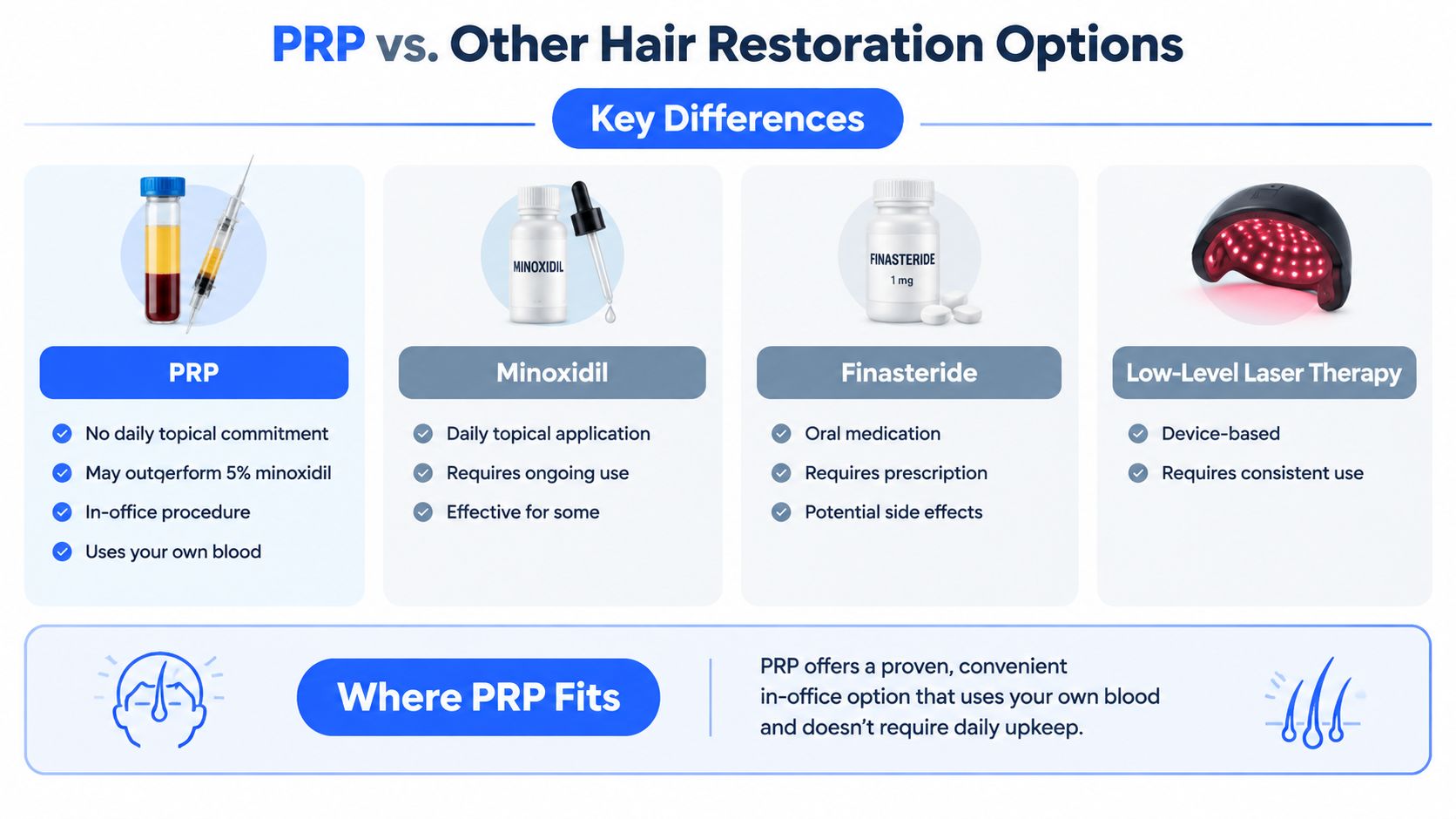
PRP is easier to judge when matched to the job it needs to do. It supports follicles that are still present, so it may suit someone seeking an in-office option without daily topical application. Medication-based approaches address ongoing control, while surgery addresses areas where follicles are no longer producing visible hair. These choices can also form a combination plan rather than competing as isolated treatments.
Minoxidil involves regular topical use and continued adherence. PRP removes that daily application but requires clinical appointments instead. Current evidence does not establish PRP as universally superior, and a recent comparison found no clear advantage over minoxidil on key outcomes. As noted earlier, response varies, so the practical choice should account for the diagnosis, preferences, and ability to maintain treatment.
Microneedling uses controlled micro-injuries to prompt local repair signals. PRP adds a platelet concentrate to that healing environment. Some clinicians use both, but the suitable approach depends on scalp condition, treatment goals, and provider experience.
Finasteride or dutasteride affect hormonal pathways, whereas PRP delivers platelet-derived signals locally through injections. That difference may matter for people who cannot tolerate, do not want, or are not appropriate for systemic or hormone-modulating treatment. A qualified medical professional should review risks, medical history, and alternatives before either category is selected.
Hair transplantation relocates follicles into a recipient area. PRP does not move follicles and cannot create unlimited density, but it may support native hair before or after a surgical plan. Transplantation also does not automatically stop surrounding native hairs from miniaturizing, which is why an ongoing plan may include medication, supplements for documented deficiencies, hormone evaluation when relevant, or combination protocols.
For nutritional background, browse Vitamin Planet on hair loss. For a treatment-focused next step, review hair regrowth treatment options.
How ProMD Integrates PRP With Supplements and Other Therapies
PRP works best when it addresses a defined clinical question rather than serving as a stand-alone cure. Is the scalp environment affecting growth? Could a nutritional deficiency, hormone change, thyroid issue, inflammation, medication, or recent physiological stress be contributing to shedding? Treating visible thinning alone may leave the driving factor active.
An integrative plan can start with medical history, scalp examination, and bloodwork when appropriate. Testing may include ferritin, vitamin D, thyroid markers, and sex hormones when symptoms or history make them relevant. Supplements should correct identified gaps or inadequate intake, not become an unstructured collection of products.
Layering the plan
A clinician may organize care across several layers:
- Nutritional support: Correct documented deficiencies under clinical guidance.
- PRP sessions: Use scalp injections as one regenerative component for suitable thinning patterns.
- At-home care: Follow the prescribed topical or supportive regimen between visits.
- Hormone evaluation: Assess hormone-related factors when a qualified clinician identifies a relevant concern.
- Light-based or procedural support: Add other therapies when they match the diagnosis and clinic protocol.
The layers should support one another. Supplements address a documented internal need, hormone work examines a relevant systemic factor, and PRP delivers platelet-derived signals locally. This approach gives each treatment a defined role instead of treating every form of hair loss the same way.
A review describes PRP signaling through pathways including Wnt/β-catenin, MAPK, Akt/ERK, and Notch, which are associated with follicular activity and shaft-caliber regulation. It also reports that outcomes may improve when PRP is combined with other approaches such as topical treatment, microneedling, or laser therapy. These findings support combination planning, not a guaranteed result (mechanisms and combination approaches in PRP).
Progress photographs and objective measurements help the care team decide whether to continue, modify, or broaden the plan. They also show whether an injection-based treatment is contributing enough to justify its place among the other layers.
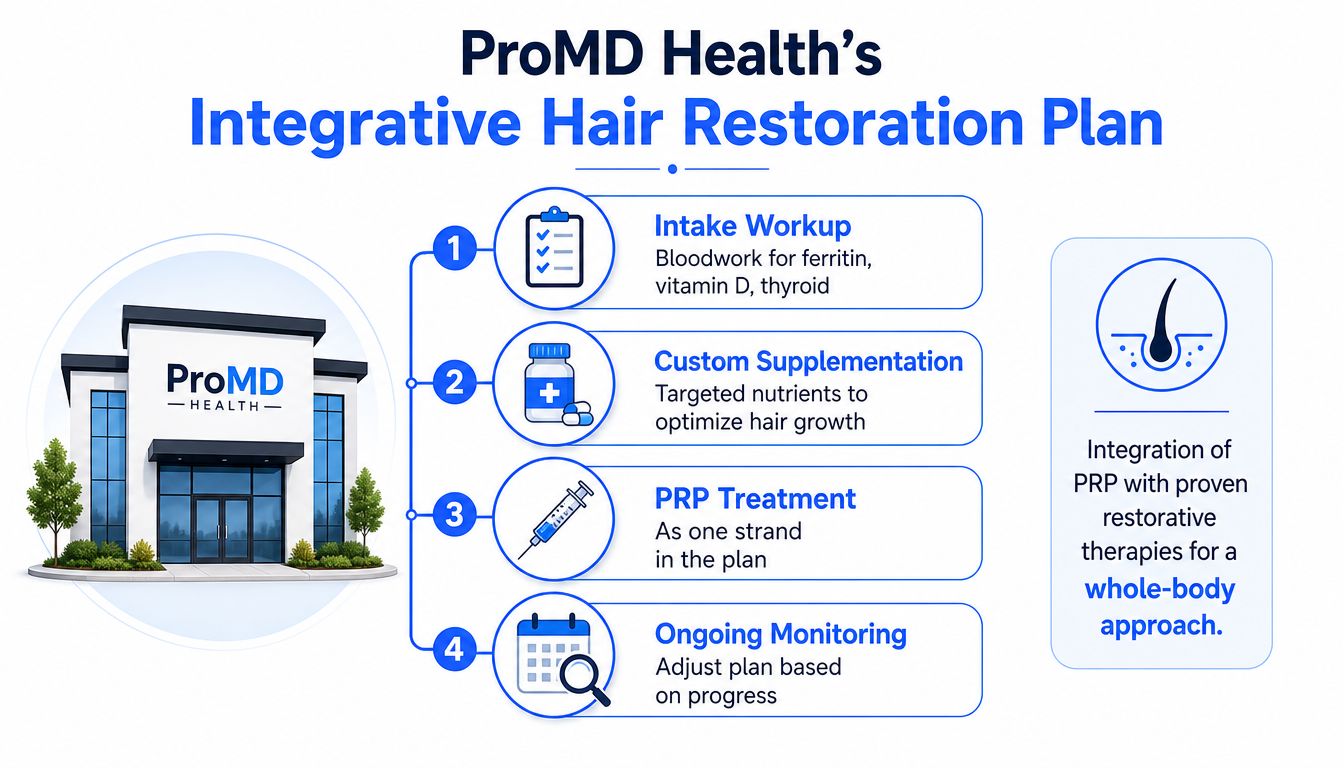
Learn more about ProMD Health's regenerative medicine for hair loss. The right plan may combine PRP, supplements, hormone care, topical therapy, or other procedures, with selection guided by the diagnosis and follow-up findings.
Risks, Recovery, Costs, and Maintenance Essentials
PRP uses your own blood, yet it still carries risks. Common short-term effects include scalp tenderness, mild swelling, pinpoint bruising, headache, and temporary sensitivity around injection sites. Infection, scarring, and vascular injury are less common but more serious. Choose a qualified medical provider, and report worsening pain, spreading redness, drainage, fever, unusual swelling, or neurological symptoms promptly.
The first few days
Aftercare depends on the preparation used and your clinician's instructions. A cautious plan usually includes the following:
- The day of treatment: Keep the scalp clean, avoid rubbing or scratching, and follow instructions about topical products.
- The first day: Ask when gentle washing is appropriate. Avoid harsh shampoos, chemical treatments, and aggressive brushing while the scalp settles.
- The first couple of days: Skip strenuous workouts, excessive heat, swimming, and activities that increase sweating if your clinician recommends it.
- Until tenderness resolves: Avoid tight hats, helmets, or anything pressing on injection sites, except when needed for safety.
- Medication questions: Check before using anti-inflammatory or blood-thinning products for discomfort, particularly if you take prescribed medication.
A universal recovery schedule does not fit every patient. Your clinic should explain the preparation method, dose, injection map, and follow-up criteria rather than present one protocol as suitable for everyone. You can review practical guidance in this guide to what to expect after PRP hair treatment.
Cost and payment expectations
PRP pricing varies with the practice, treatment area, preparation system, clinician, and whether the plan includes evaluation or supportive therapies. Ask for the per-session price, expected treatment course, maintenance fees, and details of follow-up monitoring. A general NYC Laser Hair Removal guide discusses hair-loss treatment pricing, but it cannot replace a direct quote from your chosen practice.
ProMD Health operates on a cash-pay model, so its services are not covered by insurance. Request transparent pricing before treatment, and do not assume that a medical diagnosis makes PRP reimbursable.
A consultation checklist
Bring these questions to your appointment:
- What type of hair loss do I have?
- Are my follicles still active in the thinning areas?
- What preparation and activation method do you use?
- How many sessions do you recommend, and why?
- Which measurements will document progress?
- Should I continue or pause current medications and topical products?
- What are the full cash-pay fees, including maintenance?
- Which supplements or hormone tests are medically appropriate for me?
PRP works best as one layer in a broader plan for hair density. Depending on the diagnosis, that plan may also address nutritional deficiencies, hormone-related contributors, topical care, or other combination treatments. Supplements and hormone support require medical review, because adding them without identifying the underlying problem can distract from the treatment that matters most.
PRP is a strategic density-support treatment, not a standalone cure. Diagnosis, consistent monitoring, and a clear reason for each therapy provide a more realistic path than repeated injections without a defined goal.
ProMD Health offers PRP hair restoration within an integrated approach that can include supplements, regenerative care, and medically supervised hormone or wellness support when appropriate. Visit ProMD Health to learn more and request a consultation focused on your pattern of hair loss, treatment goals, and next steps.


