
You run your fingers through your hair under bright bathroom light and notice more scalp than you remember. Or you see a wider part in photos, more shedding in the shower, or a ponytail that feels thinner than it used to. That moment can be unsettling because hair loss rarely feels purely cosmetic. It often feels personal, sudden, and hard to control.
The good news is that treatment has moved well beyond old assumptions about “just living with it” or jumping straight to surgery. In the right patient, regenerative medicine for hair loss offers a non-surgical path that works by supporting weakened follicles and improving the scalp environment so hair can grow more effectively. At ProMD Health, hair care also doesn't live in a silo. Hair thinning can overlap with hormones, stress, nutrition, and overall wellness, so the most useful plan often looks broader than a single scalp treatment.
Table of Contents
- The Moment You Notice It A Modern Approach to Hair Thinning
- What Is Regenerative Medicine for Hair Health
- Types of Regenerative Hair Treatments We Offer
- Are You a Good Candidate for These Treatments
- Your Treatment Journey at ProMD Health
- Understanding Results Risks and Your Investment
- An Integrated Approach for Superior Hair Restoration
- Your Next Steps and Questions for Your Provider
The Moment You Notice It A Modern Approach to Hair Thinning
Hair thinning usually starts gradually. You don't wake up one day completely different. You notice small signs that keep repeating. More hair on your pillow. Less fullness at the temples. A part line that looks a little wider month after month.
That's often the point when people start searching for answers, and they quickly run into outdated ideas. Many still think the only real options are to wait, buy random products, or consider surgery. That isn't the current reality.
Regenerative medicine for hair loss harnesses the body's natural growth factors to rejuvenate hair follicles and stimulate growth, offering non-surgical solutions that target early to moderate thinning through in-office treatments, as described on ProMD Health's hair loss treatment page. That matters because most patients who ask about hair restoration aren't looking for an extreme intervention. They want a practical way to strengthen the hair they still have.
What makes this approach modern
The shift is simple. Instead of replacing hair from the outside, regenerative care focuses on improving the follicle environment from within. The treatment goal is to support follicles that are miniaturizing, underperforming, or spending too much time in a resting phase.
That approach tends to fit people who:
- Caught thinning early: You still have hair in the area, but it's finer, weaker, or shedding more than usual.
- Want a non-surgical option: You're interested in in-office care with limited disruption to daily life.
- Prefer biologic treatments: You like the idea of using the body's own healing signals to support repair.
Practical rule: The earlier you address thinning, the more options you usually have to preserve and strengthen existing follicles.
Hair loss also isn't one-size-fits-all. For one person, the main issue may be inherited pattern thinning. For another, hormones, stress, inflammation, or nutritional gaps may be driving the problem. That's why a useful plan starts with diagnosis, not guessing.
Modern hair restoration works best when it's selective. Not everyone needs the same protocol, and not every online trend deserves your time. The right treatment is the one that matches the pattern, pace, and cause of your hair loss.
What Is Regenerative Medicine for Hair Health
The term sounds technical, but the concept is easier to understand than it seems. Regenerative care for hair isn't about creating brand-new follicles where none exist. It's about helping struggling follicles function better.
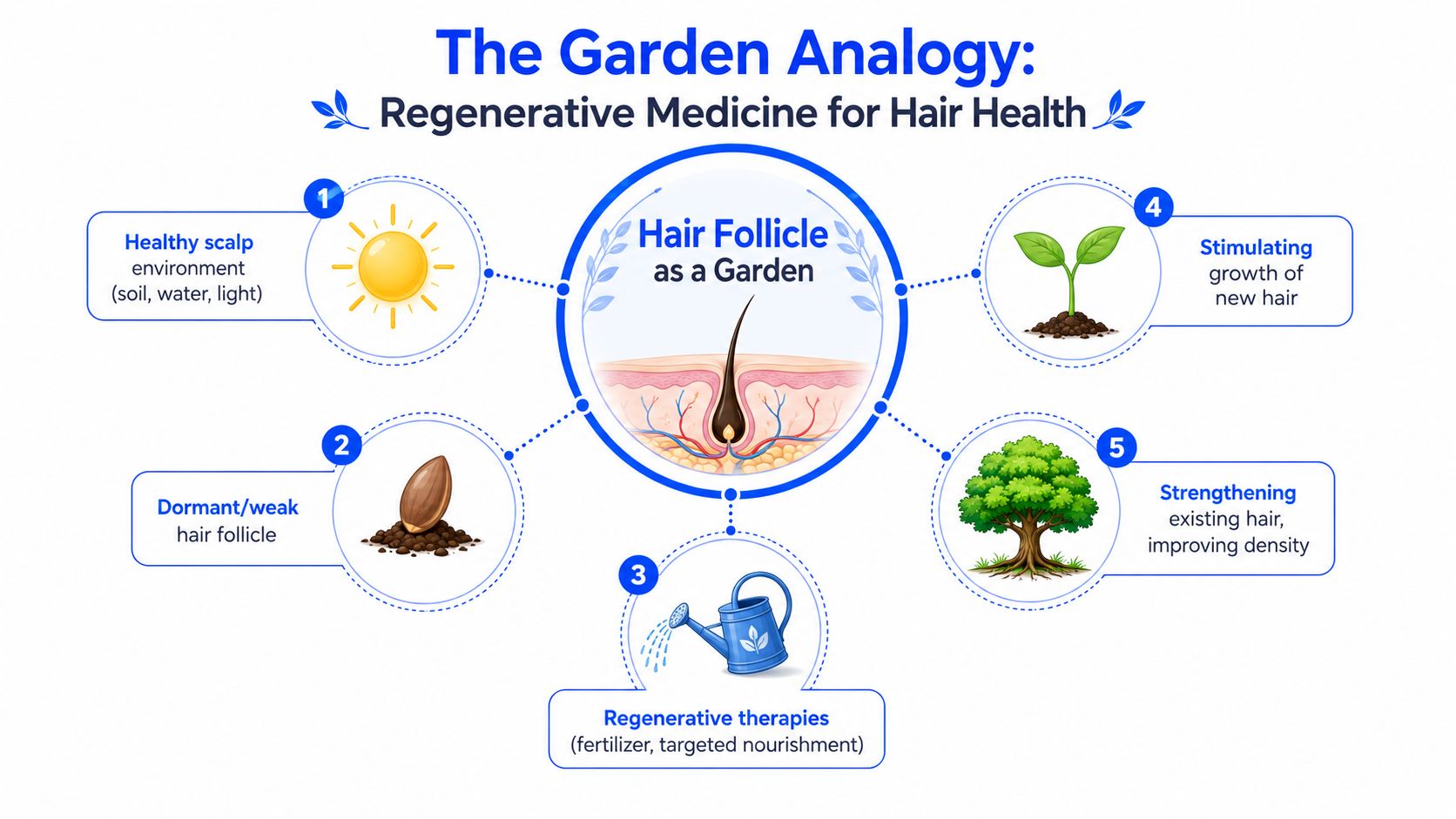
Think of the scalp like a garden
A good analogy is a garden that hasn't been cared for properly. The seeds are still there, but the soil is dry, the nutrients are poor, and growth has slowed. You wouldn't fix that by painting the leaves green. You'd improve the environment so healthy growth can resume.
Hair works in a similar way. The follicle is the living structure. The scalp is the environment around it. Regenerative treatment aims to improve that environment and send helpful biologic signals to follicles that have become weak or dormant.
What growth factors are actually doing
Growth factors are natural signaling proteins. In plain terms, they act like instructions. They help tissues communicate, repair, and respond. In hair restoration, the idea is to place those signals where thinning is happening so follicles get better support.
That support may help with:
- Follicle activity: Encouraging weak follicles to spend more time in a productive growth cycle.
- Scalp health: Improving the local environment around the follicle.
- Hair quality: Supporting thicker, stronger strands rather than only chasing new growth.
Some patients like to read more broadly about supportive regenerative concepts before a consultation. A useful outside resource is this guide to BPC-157 hair regeneration, which helps explain why patients are increasingly interested in biologic approaches to hair support.
A key point often gets missed here. Regenerative medicine for hair loss is usually about revitalizing what is still viable, not reviving areas that have been smooth and inactive for a long time. That distinction matters because it shapes expectations from the start.
Healthier follicles don't just grow more hair. They often grow better hair.
That's why the evaluation matters as much as the treatment itself. If the follicle is present and the surrounding biology can be improved, regenerative strategies may offer meaningful benefit. If the follicle is no longer active, the plan has to change.
Types of Regenerative Hair Treatments We Offer
Hair restoration isn't a single treatment category with one setting and one result. It's a toolkit. The right choice depends on how advanced the thinning is, how quickly it's progressing, and what else may be contributing.
PRP and PRF
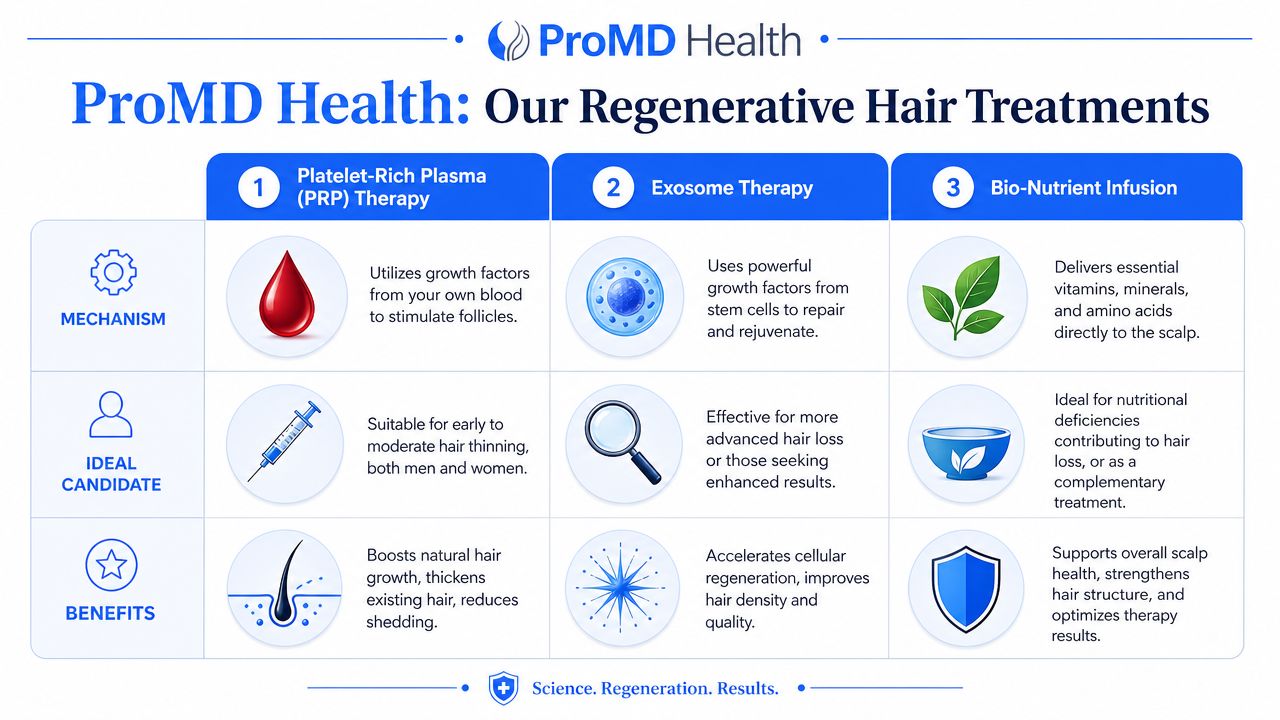
PRP stands for Platelet-Rich Plasma. It uses a sample of your own blood, processes it to concentrate the platelet portion, and then places that concentrate into thinning areas of the scalp. According to ProMD Columbia's overview of non-surgical hair loss solutions, PRP hair restoration involves a blood draw of 20 to 60 mL, centrifugation to create a platelet concentrate at 4 to 6 times baseline, followed by microinjections into areas of thinning, with studies reporting 25% to 30% increases in hair density.
PRF, or Platelet-Rich Fibrin, is another blood-based regenerative option. It also uses your own biologic material and is commonly discussed when patients want scalp support through concentrated blood components rather than synthetic products.
A simple comparison helps:
| Treatment | Source material | Typical role | Best fit |
|---|---|---|---|
| PRP | Your blood, platelet concentrate | Follicle stimulation and scalp support | Early to moderate thinning |
| PRF | Your blood, fibrin-rich concentrate | Similar regenerative support with a different preparation | Patients who are candidates for blood-based regenerative care |
PRP is often where patients start because it is familiar, office-based, and grounded in a straightforward process.
Adipose-derived regenerative options
Some patients need a more advanced conversation. That's where adipose-derived approaches may come in, especially in a practice that also offers regenerative procedures beyond basic scalp injections.
At ProMD Health, regenerative services include regenerative medicine options that may involve adipose-derived techniques such as ADSCG and SVF in appropriate settings. In hair care discussions, these approaches matter because fat-derived regenerative material contains biologic components that may help support repair and follicle health.
These options are not the first answer for everyone. They tend to make more sense when:
- Thinning is more established: Standard supportive treatments may not be enough on their own.
- The plan is broader: The patient is already exploring regenerative care in a more thorough way.
- A provider sees a biologic rationale: The scalp pattern and clinical picture suggest a stronger regenerative push may be appropriate.
Comparison is important. PRP and PRF are usually simpler entry points. Adipose-derived options can be more involved and need more careful candidate selection.
Supportive therapies that strengthen the plan
Hair restoration rarely succeeds on scalp injections alone if the root issue is multi-factorial. Some patients also benefit from supportive medical strategies such as supplements or peptide-based protocols, depending on the clinical picture.
For patients who want a plain-language overview of that side of care, this comprehensive guide on hair restoration peptides can help frame common questions before a visit.
The strongest plan is the one that matches the cause of your thinning, not the one with the most buzz.
That's why treatment planning shouldn't be trend-driven. A patient with early diffuse thinning may do well with blood-based regenerative therapy and supportive care. Someone with hormone-related shedding may need the scalp treated, but also the internal drivers addressed. Someone with long-inactive follicles may need a frank discussion about limits.
Are You a Good Candidate for These Treatments
The best candidates usually aren't the people with the most dramatic hair loss. They're often the ones who noticed change early and decided to act before the follicles became too compromised.
Who tends to do well
Regenerative therapies are generally most useful for patients with early to moderate thinning, not areas of long-standing complete baldness. If you still have visible hair in the target area, even if it's finer or weaker, there may be follicles worth supporting.
A common example is androgenetic alopecia, which is the typical pattern hair loss many men and women experience over time. A well-documented study reported a 29% increase in hair density after 23 weeks of stem cell therapy in patients with androgenetic alopecia, according to this overview of stem cell treatment for hair loss. That doesn't mean every patient gets the same outcome. It does show that regenerative treatment can be a viable option for this common condition.
Patients often fit well when they have:
- Active thinning, not absent follicles: The area still produces hair, but quality and density have declined.
- Reasonable expectations: You're aiming for improvement, not a perfect reset to your teenage hairline.
- Commitment to a plan: Hair responds over time, and most patients need follow-up rather than a one-and-done mindset.
When expectations need adjustment
Not every scalp is equally responsive. If hair loss is very advanced and the area has been smooth or inactive for a long time, regenerative treatment may have less to work with. That doesn't make consultation pointless. It just changes the conversation.
Some people also need a broader medical review before choosing treatment. Hormones, stress, medical history, recent illness, and nutritional issues can all affect hair cycling. That's one reason many patients benefit from reading through who may be a candidate for hair restoration before booking.
A practical self-check is simple:
- Can you see thinning hair in the area? That's more promising than a bare, long-inactive scalp.
- Has the change been gradual? Gradual miniaturization often fits regenerative planning better than severe abrupt loss without evaluation.
- Are you open to combination care? If internal factors are contributing, scalp treatment alone may underperform.
Good candidacy is less about hope and more about biology. The strongest consults start with honesty about what the follicles can still do.
Your Treatment Journey at ProMD Health
Most patients feel better once they know what the process is like. Hair restoration sounds complicated online. In practice, it's usually much more manageable than people expect.

Consultation and planning
The first step is a consultation focused on pattern, timing, scalp condition, and likely drivers. That may happen in clinic at an approved ProMD location such as Annapolis, MD, Arlington, VA, Bethesda, MD, Columbia, MD, Washington, DC, or another listed office, or through ProMD Connect when virtual review makes sense for the broader wellness side of planning.
The conversation usually covers:
- Where thinning is happening: Temples, crown, diffuse shedding, widening part, or postpartum-style change.
- How long it's been going on: Recent acceleration often raises different questions than slow thinning over years.
- What else is changing: Fatigue, sleep disruption, menopause symptoms, weight changes, or stress can all matter.
The consultation is also where a provider separates what's realistic from what's not. That protects patients from wasting time on the wrong protocol.
What treatment day feels like
A regenerative hair appointment is typically an in-office visit. If the plan uses your own blood-based material, there's a blood draw, processing, and then targeted placement into areas of concern. Most patients describe the session as tolerable, with brief discomfort rather than major pain.
What people usually want to know is practical:
- Will I be awake? Yes.
- Can I go back to normal activities? Usually, with guidance based on the exact treatment used.
- Will I look obviously treated? Some temporary scalp sensitivity or visible injection points can happen, but this is not a surgery-style recovery.
Patients usually do best when they treat the appointment as one part of a program, not the whole program.
Follow-up and momentum
Hair grows slowly, so follow-up matters. The first days after treatment are not the measure of success. The scalp needs time to respond, and follicles need time to cycle.
That's why plans often include:
- A treatment series: Many regenerative protocols work best as a sequence rather than a single visit.
- Periodic reassessment: Providers adjust based on shedding, thickness, and how your scalp responds.
- Support outside the treatment room: Hormone optimization, supplements, and home care may influence the result as much as the procedure itself.
Patients who expect instant change usually feel discouraged too early. Patients who understand the timeline tend to stay more consistent, and consistency is often what separates a decent result from a disappointing one.
Understanding Results Risks and Your Investment
This is the section patients care about most, and rightly so. They want to know what kind of improvement is realistic, what can go wrong, and how to think about the financial side without vague promises.
What results usually mean
In regenerative hair care, results usually mean improved density, better thickness, less visible miniaturization, and stronger existing hair. They don't usually mean a dramatic overnight transformation or the return of a hairline that has been absent for years.
Durability is also part of the conversation. Some data shows follicular stem cell therapy can yield a 22% density improvement at 12 months, while long-term data beyond 24 months is still emerging, according to this discussion of stem cells and baldness. That's an important point because maintenance planning matters just as much as initial response.
A smart question isn't only “Will this work?” It's also “How long is this likely to hold if I respond well?”
What to know about risk and downtime
When treatment uses your own biologic material, the safety profile is often appealing to patients who want a non-surgical option. That doesn't mean zero risk. It means the risks are usually more limited and more manageable than people fear.
Common short-term issues may include:
- Tenderness at injection sites: The scalp can feel sore after treatment.
- Temporary swelling or redness: Mild inflammation can happen as part of the process.
- Short-lived sensitivity: Some patients notice tightness or mild discomfort for a brief period.
These treatments still require proper medical screening. If the diagnosis is wrong, even a well-executed treatment may disappoint.
How to think about cost
Hair restoration should be approached like a medical-aesthetic investment, not an impulse purchase. It often involves a series, maintenance, and sometimes coordination with hormone or wellness care. That's why the consultation should include a full plan rather than a narrow price quote on one visit.
It's also important to be accurate about payment. ProMD Health operates on a cash-pay model, so services are not covered by insurance. Patients should plan for out-of-pocket care and ask for clarity on what is included, what may be recommended later, and how maintenance is handled.
A useful consult will answer all three questions at once. What can improve, what recovery looks like, and what the full commitment really involves.
An Integrated Approach for Superior Hair Restoration
Hair thinning often looks like a scalp issue, but it rarely stays confined to the scalp. In many patients, the biology behind hair loss overlaps with hormones, inflammation, stress load, sleep, nutrition, and aging-related change. That's why isolated treatment can fall short.

Why hormones and wellness matter
A patient may respond well to scalp treatment and still plateau if an internal driver is left untouched. Menopause transitions, androgen shifts, chronic stress, low energy, and wellness imbalances can all change how the follicle behaves. In those cases, regenerative treatment helps, but it may not be enough by itself.
That's where coordinated planning becomes more useful than chasing the next standalone procedure. The scalp treatment supports the follicle directly. Hormone optimization may help address a contributing cause. Medical-grade supplements and home support can reinforce the environment you're trying to improve.
Some patients also like to learn more about the broader role of supplements for vitality and overall wellness because hair quality often reflects more than one system at a time.
How coordinated care improves decision-making
An integrated model changes the questions a provider asks. Instead of only asking where you're thinning, the provider also asks why. That often leads to a more durable plan.
A practical integrated plan may include:
- Scalp-based regenerative treatment: For direct follicle support.
- Hormone review: When symptoms suggest endocrine or menopause-related influence.
- Targeted supplementation: To support general wellness and hair quality where appropriate.
- Remote oversight: Virtual follow-up can help keep the plan consistent between visits.
Patients exploring options often benefit from reading PRP and beyond in hair restoration choices because it frames treatment as a decision pathway rather than a single procedure.
Hair restoration works better when you stop treating the scalp like it exists separately from the rest of the body.
This is also where ProMD Health fits most naturally. The practice combines non-surgical aesthetic care with regenerative and wellness services, which can make it easier to coordinate hair treatment alongside hormone optimization and ongoing support instead of patching together disconnected appointments.
Your Next Steps and Questions for Your Provider
The most useful next step isn't buying another product. It's getting specific answers about your pattern of hair loss and whether the follicles are still good candidates for treatment.
Regenerative medicine for hair applications can use concentrated portions of the patient's own blood to support scalp health, as seen in PRF hair restoration at ProMD Health Bethesda. That makes a consultation especially helpful, because candidacy depends on your diagnosis, degree of thinning, and the broader picture behind it.
Bring these questions to your visit:
- Which treatment fits my pattern of thinning? Ask whether your scalp looks better suited to PRP, PRF, a more advanced regenerative option, or combination care.
- Am I treating the symptom or the cause? Ask whether hormones, menopause, stress, nutrition, or overall health may be contributing.
- How many sessions do you expect I'll need? A series is common, and you should know that upfront.
- What kind of timeline should I prepare for? Hair changes gradually, so ask when improvement is usually evaluated.
- What maintenance will matter most? The answer may include follow-up treatments, wellness support, or home care.
- What is the full cash-pay cost of the recommended plan? Get clarity on the complete strategy, not just the first appointment.
The best consultation leaves you with a diagnosis, a plan, and realistic expectations.
If you're ready to discuss a personalized plan for hair thinning, schedule a consultation with ProMD Health. You can start at an approved clinic location or explore virtual guidance through ProMD Connect, depending on your needs and the kind of support your treatment plan requires.


