
Filler is not just for lines. That's the wrong starting point. Non surgical facial contouring with fillers is really about building structure, supporting soft tissue, and balancing proportions so the face reads as shaped rather than "filled." When the plan is good, the result looks like your own face with better definition, not a different face.
That's why the conversation has to start with anatomy, not product names. Jawlines, chins, cheeks, temples, and under-eye hollows all need different depths, different filler behavior, and different amounts of support, and the literature keeps showing that contouring works best when the provider plans the whole face instead of chasing one concern in isolation. Fillers are now a mainstream aesthetic treatment category, with 1,857,339 dermal filler procedures in the U.S. in 2021 and 5.33 million hyaluronic acid filler procedures in 2024 cited in industry reporting, which tells you this is no fringe service (The Aesthetic Society statistics).
Table of Contents
- Why Facial Contouring Is More Than Wrinkle Filling
- Facial Anatomy and Treatment Zones Explained
- Choosing the Right Filler Type for Contouring Goals
- Injection Techniques and Safety Protocols
- Candidacy, Contraindications, and Procedure Timeline
- Understanding Risks and Managing Side Effects
- Comparing Fillers to Alternative Contouring Options
- Choosing a Qualified Provider for Facial Contouring
Why Facial Contouring Is More Than Wrinkle Filling
The biggest misconception about filler is that it only erases lines. That view misses the core job. In facial contouring, filler works as structural support, replacing lost projection where the face has flattened, descended, or stopped holding shape the way it once did.
Structure first, surface second
Cheek filler can restore lift to the midface, which often softens early jowls by giving the lower face better support. Chin filler can improve projection and bring the profile into better balance. Jawline work can sharpen the transition between face and neck, so contouring often changes how the whole face reads rather than just one isolated area.
Facial contouring is a planning problem. The outcome depends on which filler, which depth, and which anatomy you are treating. A careful plan may also combine filler with neuromodulators or other therapies, because one product alone rarely solves every concern in a face that needs both structure and soft-tissue refinement.
Practical rule: if the goal is structure, the conversation should be about support, projection, and layering, not just “how much volume do I need?”
Patient expectations matter. A well-done contour treatment should look cohesive from multiple angles. It will not change bone structure, and it will not correct severe laxity, but it can make the face look more balanced, rested, and defined when the plan matches the anatomy.
Why the same face needs different answers
A fuller cheek does not need the same approach as a weak chin or a hollow temple. Softening one area without strengthening another can leave the face looking incomplete, which is why experienced injectors assess the face as a system. In a clinical overview of dermal fillers, Cleveland Clinic notes that these treatments are used to restore volume and enhance contours in areas such as the cheeks, jawline, chin, temples, and under-eye region.
That broader use case is the point. Contouring is about restoring harmony, not chasing a single wrinkle or crease.
The face responds to balance, not isolated fixes. A treatment plan built only around one line or one hollow can leave the rest of the features looking unchanged, while the stronger plans account for how light falls across the face and how one area supports the next. When the structure is approached that way, filler reads as shape, not bulk.
Facial Anatomy and Treatment Zones Explained
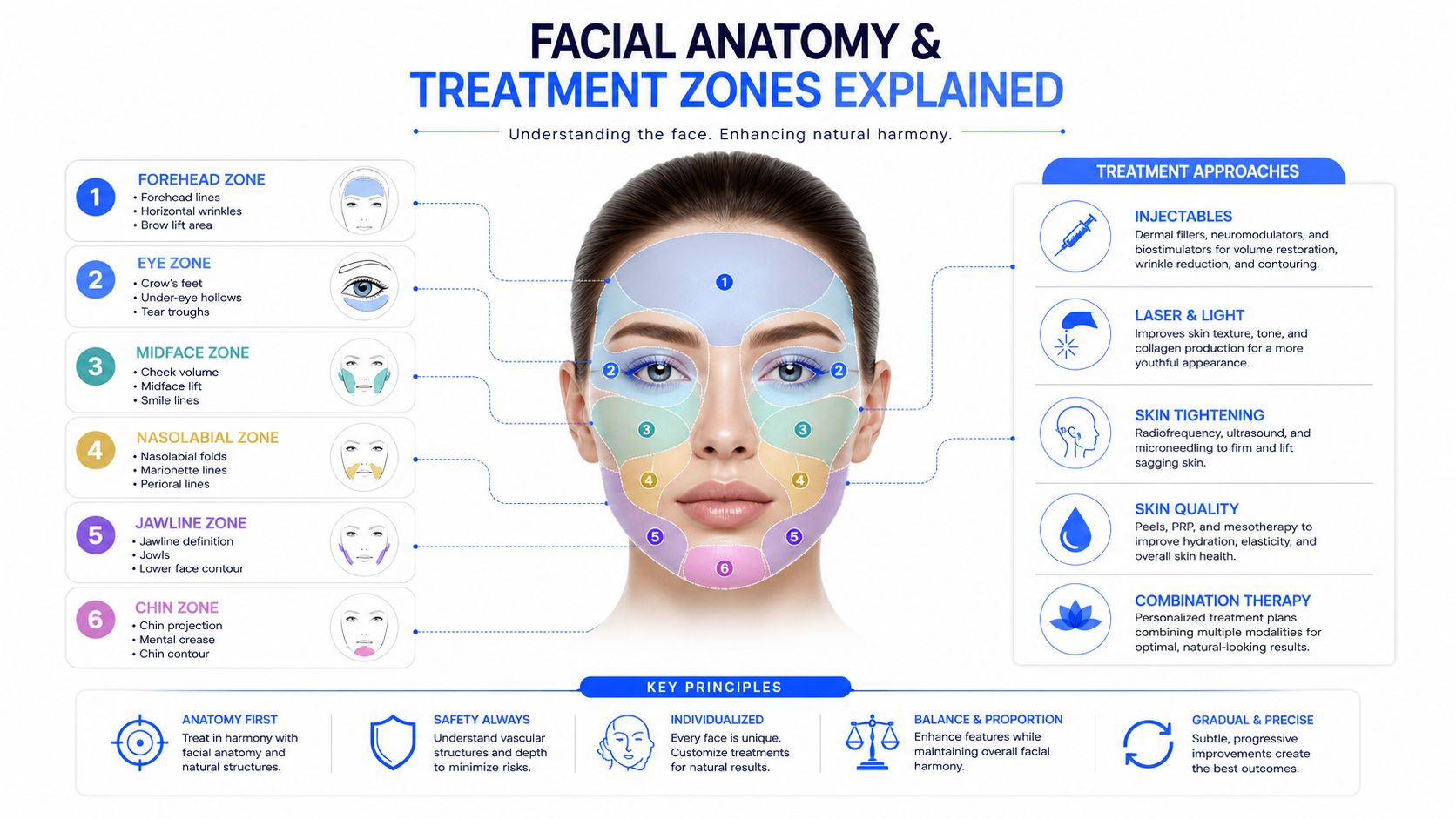
Facial contouring works best when the face is read as a set of connected support zones. The upper face includes the temples and brow area, the midface includes the cheeks and under-eye region, and the lower face includes the chin, prejowl area, and jawline. When support drops in one region, nearby areas can look less balanced even if their own tissue has not changed much.
Upper face, midface, lower face
Temple hollowing is easy to miss, yet it can make the face look narrower and more tired. Midface support is critical, because loss here lets the lower face appear heavier and less lifted. The lower face, especially the jawline and chin, depends on both bone projection and soft-tissue quality, so a weak chin can blur the neck-jaw angle even when the skin itself looks healthy.
That is why midface assessment often comes before treating the area a patient notices first. The cheek projection point, usually judged around the infraorbital rim and the malar eminence, helps determine whether the face reads as lifted or flattened. If support is missing there, adding filler only along the jawline can still leave the profile looking unfinished.
The best treatment plan usually follows the face's structure, not the patient's first guess about the problem.
People often focus on the most visible line or hollow, but the source of the imbalance may sit higher or deeper. A patient may say “I want my jawline sharper,” while the actual issue is under-supported cheeks, a recessed chin, or both. A provider who understands facial anatomy will map the full face before placing anything, including the relationship between the anterior cheek, the prejowl sulcus, and the chin projection point.
Why the whole face gets assessed
Under-eye hollows and temple loss also shape how the face is perceived. Tear trough shadowing can make the face seem tired, while temple hollowing can pull attention upward and create a depleted look. These regions need careful planning because the tissue is thinner and less forgiving than the jawline or chin.
For a fuller overview of common facial treatment zones, the face can be reviewed as a connected set of landmarks rather than isolated targets, and a guide to facial areas treated with dermal fillers helps patients understand how those landmarks are commonly approached in practice. The question is not only where filler can go, but which area is driving the imbalance the patient sees, and which layer needs support first.
Contour planning also depends on depth. A subtle hollow may need placement on bone for structure, while a softer transition may call for a more superficial layer to smooth the contour without adding bulk. That layered approach is what keeps results looking shaped instead of overfilled, especially when more than one zone is part of the same aesthetic problem.
Choosing the Right Filler Type for Contouring Goals
Facial contouring works best when the product, the layer, and the goal all match. A filler chosen for fine line softening can sit too softly for jawline definition, while a structural product placed too superficially can look heavy or uneven. The question is not which filler is strongest, but which one fits the anatomy you are trying to shape.
The product has to fit the job
Hyaluronic acid, or HA, fillers are the most common starting point for facial contouring because they can be reversed with hyaluronidase if correction is needed. That matters when the plan depends on precision. Providers often use them for jawline, chin, cheek, and midface contouring, especially when they want control over projection and adjustment. Calcium hydroxylapatite, or CaHA, offers firmer structural support in deeper planes, while poly-L-lactic acid, or PLLA, builds more gradually by encouraging collagen production.
The material category also matters. Some fillers are resorbable, while others are non-resorbable, and that difference affects how long they remain, how they behave in tissue, and how much flexibility the provider has if the result needs to be changed. For readers who want a plain-language refresher on how HA behaves as a water-binding molecule, ultimate hydration explained is a helpful reference, because that same property helps explain why HA fillers feel and move the way they do. If you want a basic primer on filler types before comparing them to contouring goals, what dermal fillers are is a useful place to start.
| Filler Type | Composition | Longevity | Reversible | Best For |
|---|---|---|---|---|
| Hyaluronic acid | HA gel | Temporary, product-dependent | Yes | Cheeks, chin, jawline, under-eye blending |
| Calcium hydroxylapatite | Calcium-based microspheres in gel | Temporary, product-dependent | No | Deeper structural support, lower-face definition |
| Poly-L-lactic acid | Biostimulatory particles | Temporary, gradual build | No | Collagen support and broader volume restoration |
| PMMA | Non-resorbable filler | Long-lasting | No | Highly selected structural use, with caution |
Why rheology matters
Rheology sounds technical, but the idea is straightforward. A firmer, higher-G' filler holds shape better, which is why jawline and chin contouring often uses products designed for lift rather than soft blending. Softer fillers spread more easily, which helps in delicate transitions where the goal is contour, not stiffness.
Lower-face contouring reviews also note that jawline and chin reshaping often needs high-G' fillers or CaHA for support rather than the same product used for superficial lines (lower-face contouring review). That difference is easy to miss if you only think about fillers as interchangeable gels. In practice, the product choice is tied to layer, movement, and the specific contour problem being corrected.
For patients asking what type of filler fits their face, the best answer is usually not “the newest one.” It is the one whose behavior matches the anatomy, the depth, and the amount of change the face can carry without looking overbuilt.
Injection Techniques and Safety Protocols
A face can look overfilled even when the product choice is correct. The difference often comes down to where the filler sits, how much is placed in each pass, and whether the plan matches the anatomy instead of fighting it.
Depth and delivery
Contouring is a layering problem. The same filler can look supportive in one plane and bulky in another, which is why depth matters as much as product type. For jawline and chin work, the goal is usually to place support where it can reinforce structure without sitting too superficially and blurring the edge.
A jawline and chin review describes hyaluronic acid filler placed deep to the mentalis muscle through a prejowl cannula entry point about 5 mm above the mandibular line, with typical volume of 0.2 to 0.5 mL per side (jawline and chin review). That is a good example of how contouring depends on small, deliberate deposits rather than large boluses. The technique follows the shape of the bone and soft tissue instead of trying to force a new outline into place.
Safe delivery matters just as much as depth. General filler safety guidance recommends using anatomical knowledge, cannulae where appropriate, and slow placement in small amounts to reduce vascular risk and visible irregularity (safety review). For patients, that usually translates to a measured approach, a careful injector, and no pressure to correct everything in one sweep.
Practical rule: the best placement disappears into the anatomy, it does not call attention to itself under the skin.
Thin-skin areas need more restraint. Around the eyelid and other periorbital areas, firmer products are more likely to show through as nodules or color changes under the skin, so delicate zones usually call for softer planning and conservative product selection (safety review). That is one reason facial contouring is rarely one filler decision. It is a set of choices about layer, product behavior, and how much visible change the tissue can support.
Why experience shows up in the outcome
A skilled injector reads the face from multiple angles before touching the syringe. Front view, side view, and slight turns all reveal different contour problems, and the face also changes with expression. That is why a good plan respects motion and light, not just static symmetry.
Tool choice matters, but it is only one part of the picture. Cannulas can help with controlled placement in some areas, while needle technique may fit others better. The more important question is whether the provider understands the relationship between muscle, bone, and soft tissue well enough to place filler where it strengthens structure instead of softening it.
For a broader patient overview, the dermal filler treatment reference from House of Glam HQ is useful because it reflects the same practical principle patients should expect in clinic. Careful placement and conservative dosing matter more than dramatic volume.
If the plan sounds like filler will be added everywhere, the result usually looks like filler was added everywhere. Contouring works best when each decision is made for a reason, with the right product in the right plane and a clear limit on how much change the face should carry.
Candidacy, Contraindications, and Procedure Timeline
Facial contouring works best when the face needs structure, not a full rebuild. The strongest candidates usually have mild to moderate volume loss, reasonably good skin quality, and a clear understanding of what filler can improve. They want refinement in contour, not a substitute for surgery when laxity is the main issue.
Who tends to benefit
The people who usually respond well are those whose facial framework is still intact, but under-supported. They may want more cheek projection, a firmer chin, or a cleaner jawline, while avoiding incisions and a long recovery. That kind of planning often starts with a consultation, because contouring sometimes belongs inside a broader treatment plan instead of standing alone.
A useful candidacy check is whether the change needed is structural or mainly surface-level. If the issue is weak support at the cheeks, chin, or jaw, filler can help restore shape. If the problem is loose skin that hangs despite added volume, the answer may need another modality or a surgical discussion.
There are also clear reasons to delay or avoid treatment. Active infection is a stop sign, and patients with unrealistic expectations or certain medical concerns may need a different conversation before anything is injected. Pregnancy and active inflammatory conditions are common reasons to pause as well, because cosmetic contouring should be done in the right setting, not rushed.
For a practical overview of eligibility questions, the facial filler candidacy guide can help patients understand how providers think through suitability before an in-person visit.
What the timeline usually looks like
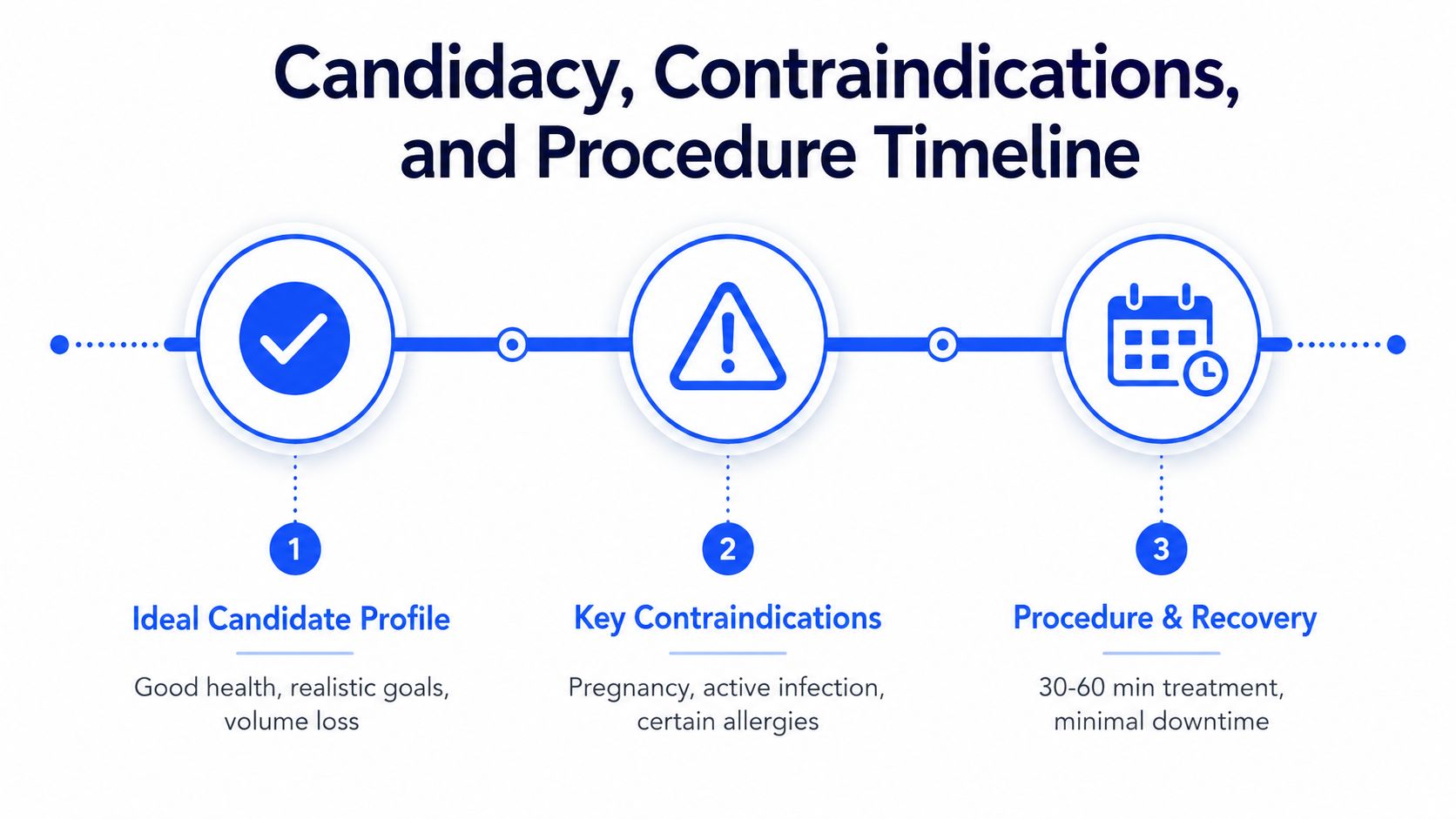
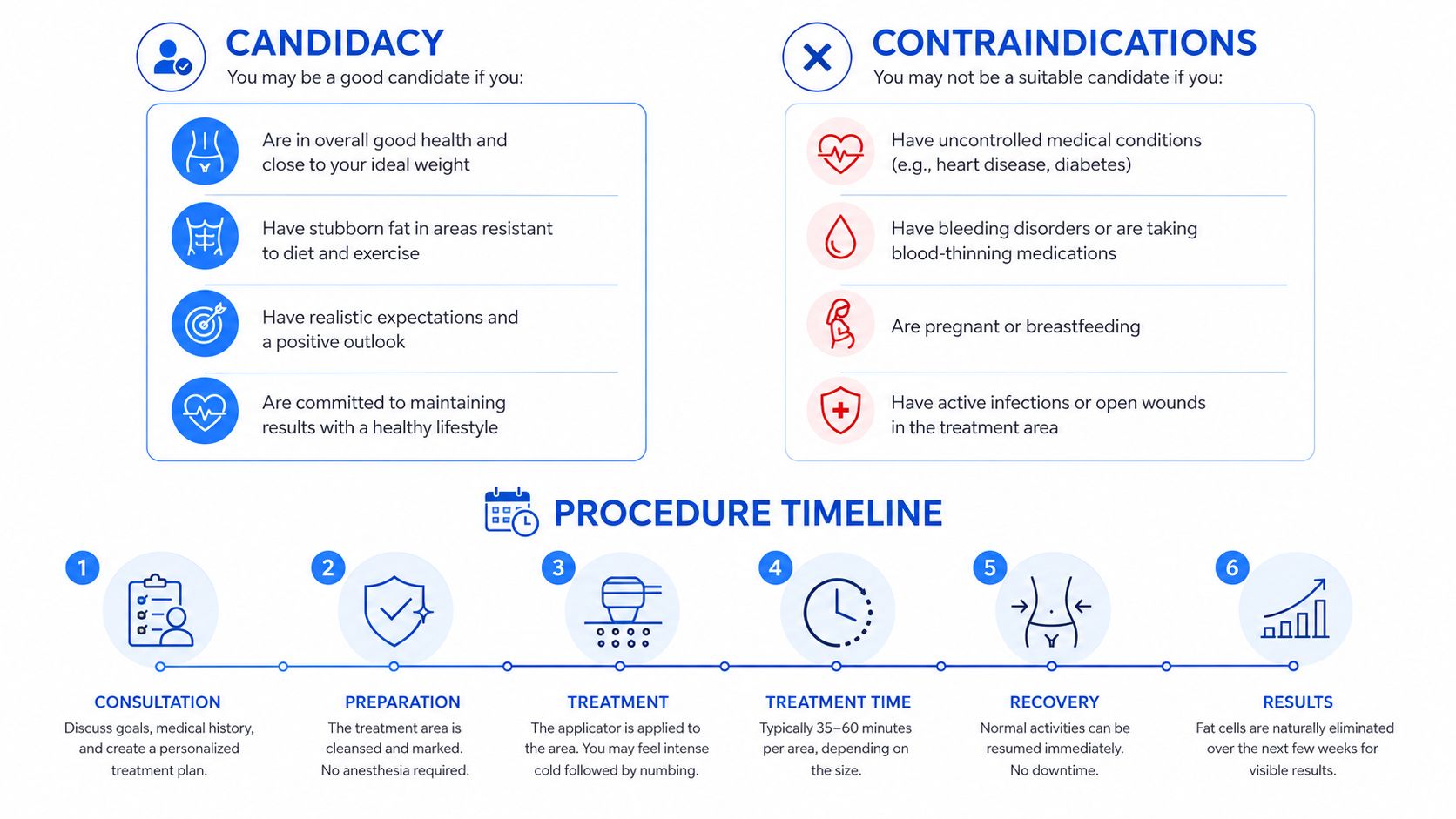
Some change is visible right away, but that does not mean the face has finished settling. Filler can look a little firmer or fuller at first, then soften as swelling resolves and the product integrates with tissue. The procedural timeline infographic also helps show how candidate criteria, contraindications, and early recovery fit together in planning: An infographic detailing candidate criteria, contraindications, and the procedural timeline for non-surgical fat reduction treatments.
Timing matters because the face does not read as static right after treatment. A contour that seems slightly strong on day one may look much more balanced once early swelling calms down. Some patients also need a follow-up visit so the injector can judge whether the initial plan needs a small adjustment rather than a bigger correction.
Layered treatment is often the more realistic approach. Fillers provide structure, neuromodulators can reduce muscle pull, and skin-focused treatments can support texture and firmness over time. The planning question is not only whether filler can create shape, but whether the face also needs help from another layer of treatment to keep the result natural.
A separate review of contouring literature notes that filler effects can settle over time and vary with placement depth and product choice. For that reason, clinicians often think in terms of immediate shape, early integration, and longer-term maintenance rather than one final snapshot. facial contouring review
If a patient wants sharper structure but the skin itself is loose, layered planning usually gives a more believable result than adding volume in one pass.
Understanding Risks and Managing Side Effects
A patient may come in worried that her cheek looks “too full” the morning after filler. That early look can be driven by swelling, product settling, and the way light catches a treated area before the tissues calm down. By the next week, the contour often looks softer and closer to the planned result, which is why early change should be read carefully rather than treated as the final outcome.
Common reactions versus true problems
The most common side effects after filler are bruising, edema, and erythema, and they are usually self-limiting rather than long-lasting (review of nonsurgical facial rejuvenation). Those reactions can be annoying, but they are expected in many cases and usually settle without intervention. Conservative placement usually creates a calmer result than trying to force a dramatic correction in one visit.
Less common issues need closer attention. Nodules, migration, and vascular compromise are recognized complications in the literature, even though they are not the norm (nodules and vascular compromise review). Technique lowers that risk, and the injector has to know the facial vascular map before placing product into deeper contouring zones.
Why HA filler gives many patients extra reassurance
Hyaluronic acid fillers are often preferred for contouring because they can be reversed with hyaluronidase, which gives the injector a way to soften or correct certain outcomes if needed (Cleveland Clinic hyaluronidase guidance). That does not make treatment risk-free. It does mean some outcomes are easier to manage than they would be with a permanent material.
A filler that can be adjusted is helpful, but it does not replace careful planning. If the product is placed too superficially, used in the wrong plane, or chosen without respect for anatomy, even a reversible filler can still create an unattractive result before any correction is considered. Good contouring depends on the right product, the right depth, and the restraint to stop before the face starts to look heavy.
Clinical reality: the safest treatment is still the one that is planned conservatively, placed precisely, and matched to the anatomy.
The provider's role is to reduce surprises. That means slow deposition, respect for tissue depth, and a willingness to stop when the face has enough structure. It also means telling a patient when the concern is better handled by a different approach instead of adding more product to a shape that is already full.
Comparing Fillers to Alternative Contouring Options
Fillers are powerful, but they're not the only way to contour a face. The right answer depends on whether you want immediate change, gradual support, longer-lasting volume, or a structural correction that goes beyond what injectables can do.
How the options differ
Sculptra works as a collagen-stimulating approach, so the improvement builds more gradually. That makes it useful when the goal is broad support over time rather than instant projection. Fat grafting can offer longer-lasting volume restoration because it uses the patient's own tissue, but it's a different procedural commitment and recovery profile.
Surgical options like facelifts or implants are still the better fit for major structural change. They can address laxity or skeletal deficiency in a way fillers can't match. The trade-off is downtime, permanence, and a different risk profile.
| Approach | Main Strength | Main Limitation | Best Fit |
|---|---|---|---|
| Dermal fillers | Immediate contour, adjustability | Temporary | Precision shaping, subtle to moderate change |
| Sculptra | Gradual collagen support | Slower payoff | Patients who prefer progressive change |
| Fat grafting | Uses the patient's own tissue | More involved procedure | Longer-lasting volume restoration |
| Surgery | Strong structural change | Downtime and permanence | Significant laxity or skeletal correction |
Why combinations often make more sense
A patient who wants sharper cheeks today and better collagen support over time may benefit from a layered plan. Another patient may prefer fillers first because they want to test a shape before considering something more permanent. That is often the smartest way to reduce regret.
The point isn't that one option wins every time. It's that the face's needs should drive the method, not the other way around.
Choosing a Qualified Provider for Facial Contouring
The provider matters as much as the product. Two injectors can use the same filler and still deliver completely different results because facial contouring depends on anatomy, restraint, and judgment.
What to look for
Start with training and scope. Board certification in dermatology, plastic surgery, or a related medical field is a strong sign that the provider understands anatomy beyond the surface. Ask to see before-and-after photos of patients with similar facial shapes and goals, not just generic highlight reels.
Then ask how they plan treatment. Good providers explain which area needs support, why they chose that filler, and what depth they're using. They also have a plan for complications, including how they manage bruising, asymmetry, or vascular concerns if they arise.
Red flag: if someone promises a dramatic result quickly, pressures you to decide on the spot, or can't explain the anatomy behind the plan, keep looking.
Telehealth can help with initial screening, and AI simulation tools can be useful for visualizing possibilities, but they don't replace an in-person assessment. They're best used as decision support, not as the final answer.
If you're comparing options, ProMD Health offers non-surgical facial aesthetics, including dermal fillers for facial contouring, along with telehealth through ProMD Connect for broader care planning. For a consultation, visit ProMD Health and ask about a facial balancing plan that matches your anatomy, goals, and comfort level.


