
You're comparing two treatments because you want smoother, brighter skin, but you also want to know what recovery will look like in real life. Perhaps you have a work event approaching, acne scarring that hasn't responded to basic skincare, or pigment changes that make every online before-and-after seem more confusing than helpful.
The laser resurfacing vs chemical peel decision isn't a contest with one universal winner. Both treatments can rejuvenate skin, but they differ in how they create controlled injury, how precisely they target tissue, how many sessions may be needed, and how much redness, discomfort, or pigment risk you're willing to accept. The right choice depends on your concern, skin type, facial area, and recovery plan.
Table of Contents
- Introduction to Laser Resurfacing vs Chemical Peel Decisions
- How Laser Resurfacing and Chemical Peels Work
- Laser Resurfacing vs Chemical Peel Head to Head Comparison
- Downtime Recovery Timeline and What to Expect
- Ideal Candidates Uses and Skin Type Considerations
- Combined and Progressive Strategies for Better Results
- How to Choose Your Best Option at ProMD Health
Introduction to Laser Resurfacing vs Chemical Peel Decisions
Two patients can want smoother skin yet need different treatment plans. One may prefer several lighter sessions that fit around work. Another may accept more visible healing to reduce the number of appointments. The better choice depends on treatment burden, not on a universal winner.
Online comparisons often make peels and lasers seem interchangeable because both create controlled injury and support skin renewal. The practical difference is how much tissue is affected, how precisely treatment can be adjusted, and what recovery requires. A superficial peel is not equivalent to an ablative laser, just as a non-ablative laser does not create the same demands as a deep peel.
A 2026 systematic review and meta-analysis of 38 studies involving 1,695 patients found comparable overall skin-rejuvenation results for laser resurfacing and chemical peels, with no statistically significant difference in overall efficacy. Lasers required about two fewer treatment sessions on average, but also caused more transient erythema and procedure-related pain in that analysis (systematic review and meta-analysis). The decision therefore resembles choosing between a shorter course with stronger individual sessions and a longer course with lower intensity.
The practical question isn't “Which treatment is better?” It's “Which tradeoff fits this person, this concern, and this recovery window?”
The treatment area also matters. Skin around the eyes, mouth, nose, and jawline may require different settings or product choices because thickness, movement, and healing vary by site. Fitzpatrick skin type deserves equal attention: a plan that is reasonable for lighter skin may need lower intensity, more spacing, or closer pigment monitoring for darker skin tones.
This guide examines treatment burden, anatomic site, recovery, and Fitzpatrick-specific safety before addressing staged strategies. ProMD Health offers laser and chemical peel services within a cash-pay care model. Availability can vary by office, so verify the service and device before scheduling.
How Laser Resurfacing and Chemical Peels Work
A patient choosing between these treatments is really choosing how controlled injury will be delivered, how much treatment burden the skin can tolerate, and whether the treated area needs highly localized control. Laser resurfacing applies concentrated light energy to selected skin layers. The provider adjusts wavelength, depth, density, and settings, so treatment can range from a gentler approach with little visible downtime to an ablative procedure that removes damaged tissue and stimulates stronger remodeling.
A chemical peel applies a professionally selected solution that creates a controlled exfoliating injury. The agent, concentration, and application determine how far it acts. Superficial peels affect the surface more gently, while medium and deep peels extend farther into the skin and require more healing.
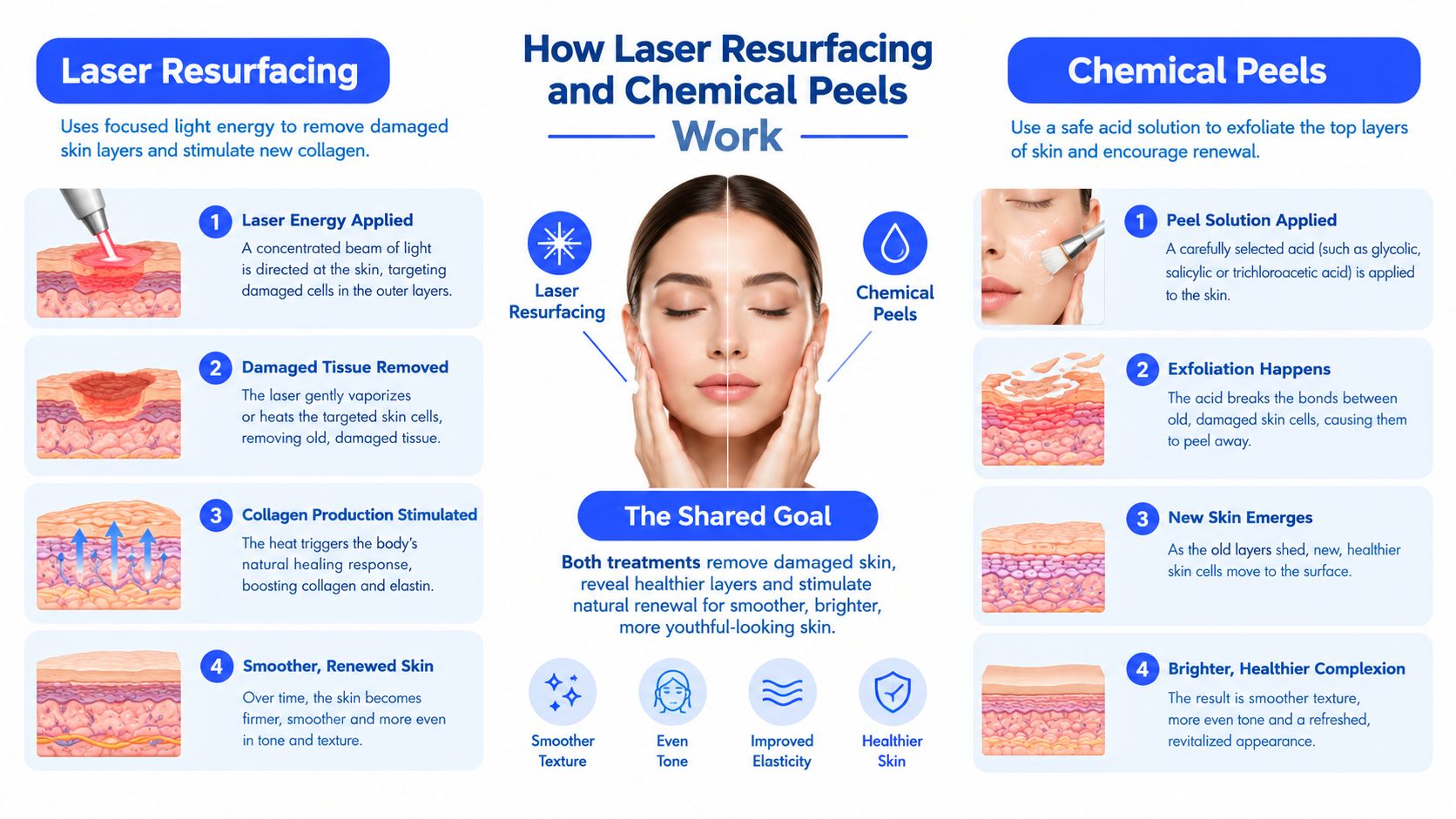
Laser depth changes the treatment experience
Ablative lasers remove the outer skin layer while heating underlying tissue. The stronger remodeling signal can improve established texture and lines, but healing is more visible. Fractional ablative devices treat microscopic columns and leave untreated skin between them, giving surrounding tissue a role in recovery.
Non-ablative lasers heat deeper tissue without removing the surface in the same way. Recovery is usually lower intensity, although improvement may develop more gradually and require multiple visits for some goals.
“Laser” therefore describes a family of approaches, not one fixed procedure. Treatment area matters too. Thin, mobile skin around the eyes and mouth may need different settings from thicker or more mobile areas near the jawline. Fitzpatrick skin type also affects planning. Darker skin tones may require lower intensity, wider spacing between sessions, and closer monitoring for pigment changes.
Peel depth determines how much skin sheds
Chemical peels follow the same depth principle. A superficial peel may address brightness, uneven tone, or mild roughness. Medium-depth treatment causes more noticeable shedding and reaches more established changes. Deep peels create a more intensive injury and require a longer healing plan.
Both methods replace or remodel damaged tissue, but the delivery differs. A laser can concentrate energy in selected areas, while a peel treats the surface according to the agent and application technique. For a treatment-specific overview, review ProMD Health's laser skin resurfacing treatment information. During consultation, ask what depth is proposed, which concern it targets, and why that intensity suits your skin and recovery window.
Laser Resurfacing vs Chemical Peel Head to Head Comparison
A patient choosing between these treatments may be weighing two different forms of burden. One option may aim for stronger change in fewer visits, while the other may use lower intensity with less temporary redness or discomfort. The right comparison depends on the concern, treatment site, skin type, and recovery time the patient can accept.
| Criteria | Laser Resurfacing | Chemical Peel |
|---|---|---|
| Overall rejuvenation efficacy | Comparable overall results to chemical peels in the available meta-analysis | Comparable overall results to laser resurfacing in the available meta-analysis |
| Average treatment burden | About two fewer sessions on average | About two more sessions on average |
| Redness and pain | More transient erythema and procedure-related pain in the meta-analysis | Less transient erythema and procedure-related pain in the meta-analysis |
| Melasma | Performed better for melasma in the meta-analysis | Less effective than lasers for melasma in that analysis |
| Psoriasis | Less effective than chemical peeling in the meta-analysis | Performed better for psoriasis in that analysis |
| Post-inflammatory hyperpigmentation | Rates were similar to chemical peels in the meta-analysis | Rates were similar to lasers in the meta-analysis |
| Precision | Device settings can target depth and treatment density | Depth depends on the selected agent and application |
| Recovery | Ranges from minimal visible downtime to prolonged healing, depending on device and depth | Ranges from light flaking to extended healing, depending on peel depth |
The available evidence does not support choosing one modality as universally better for rejuvenation. The 2025 systematic review and meta-analysis found no significant overall efficacy difference, including outcomes related to acne, acne scarring, and photoaging. It did, however, identify differences that can change the practical decision: lasers were associated with fewer sessions on average, while chemical peels were associated with less transient redness and procedure-related pain.
Lasers may reduce the number of sessions, but they can bring more temporary redness and procedure-related pain. Chemical peels may offer a lower-intensity path, but they are not automatically the safer choice for every concern or skin type.
What the condition-specific findings mean
A patient with melasma may give greater weight to the laser findings for that condition. Someone with psoriasis may have more reason to discuss a chemical peel. These findings guide a conversation rather than replace diagnosis, because pigment and inflammatory disorders can respond differently according to treatment depth, medical history, and Fitzpatrick skin type.
Post-inflammatory hyperpigmentation deserves specific attention. The comparison found similar rates between the two approaches, but similar rates do not mean identical risk for every person. Darker skin tones may require conservative settings, greater spacing between treatments, and closer observation for pigment changes, regardless of which modality is selected.
The treatment site also changes the balance. A comparative facial rhytid study found phenol peels were as effective as laser resurfacing for wrinkles in thin-skinned facial areas, while lasers produced better results in thicker, glandular areas (comparative facial rhytid study). The study also reported more intense hypopigmentation, longer postoperative erythema, and longer discomfort with laser treatment in that comparison.
The practical lesson is simple: the face is not one uniform surface. Thin skin near the eyes or mouth, thicker skin, and areas with different oil-gland characteristics may need different treatment choices and settings. A consultation should connect the selected modality to the anatomic site, Fitzpatrick skin type, target concern, and acceptable treatment burden.
Downtime Recovery Timeline and What to Expect
Recovery is shaped by treatment depth, device type, and the area treated, rather than by the word “laser” or “peel” alone. A non-ablative laser may leave little visible evidence, while an ablative laser or deeper peel can require wound care, schedule changes, and more time away from normal activities. Fewer sessions may appeal to someone who can accept a longer recovery, while lower-intensity treatment may suit someone who needs a lighter burden.
A practical recovery range
Non-ablative laser resurfacing may involve no visible downtime. Temporary warmth or redness can still occur, but this approach generally allows a quicker return to routine than deeper resurfacing.
Fractional ablative laser treatment commonly causes redness, swelling, and a “sunburn plus texture” appearance for about 5 to 7 days. Redness may continue fading over roughly two weeks. Energy settings, treatment density, skin response, and aftercare can shorten or extend that course, so an average timeline should not be treated as a promise.
Medium-depth chemical peels commonly require about 7 to 14 days of recovery. Deep peels may take longer, while TCA peel healing is typically 1 to 2 weeks. Very deep laser settings may require 1 to 12 weeks, depending on the device and depth. Patients considering a peel can review chemical peel recovery and aftercare guidance before scheduling.
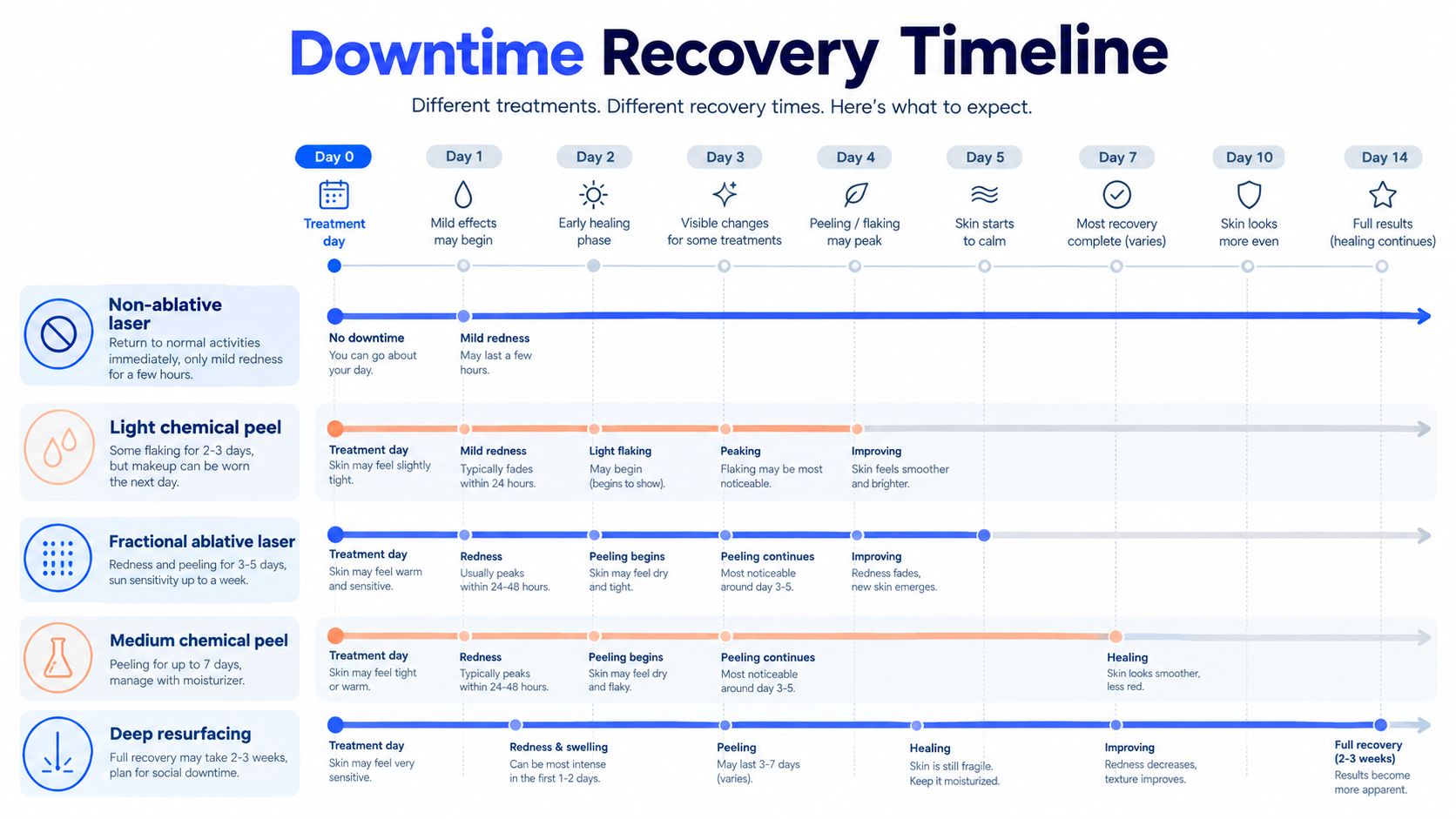
Plan for skin protection, not just visible peeling
A major academic medical center notes that bandaging may remain in place for 5 to 10 days, while new skin typically begins forming about 7 to 10 days after resurfacing (UCSF skin resurfacing guidance). Aftercare can therefore continue after the most obvious peeling or redness has improved.
Ask about cleansing, moisturizing, sun protection, exercise restrictions, makeup, and warning signs that require a call to the office. Schedule around the full healing process, not only the day visible peeling is expected to end. Your provider's proposed depth, treatment site, Fitzpatrick skin type, and history of prolonged redness or pigment changes should shape the calendar.
The treatment burden includes discomfort and lingering erythema, not only time away from work or social activities. A treatment plan that fits your recovery tolerance is more useful than choosing solely by the shortest advertised timeline.
Ideal Candidates Uses and Skin Type Considerations
A patient with fine lines, acne scarring, melasma, or psoriasis may hear “skin rejuvenation” and assume the same procedure applies to every concern. The better starting point is the problem being treated, then the treatment burden, anatomic site, and skin type that shape the decision.
For melasma, the 2026 meta-analysis found better performance with lasers, although pigment-prone skin can respond unpredictably to heat and inflammation. For psoriasis, chemical peeling performed better in that analysis. The recommendation still depends on the lesion pattern, current activity, and overall skin condition. These findings can help frame the discussion, not replace an individual assessment.
Active acne and acne scarring require separate questions. The analysis found no significant overall difference between lasers and peels for acne or acne scarring, so scar type, depth, skin tone, and tolerance for recovery carry more weight than the diagnostic label alone (evidence review of lasers and peels).
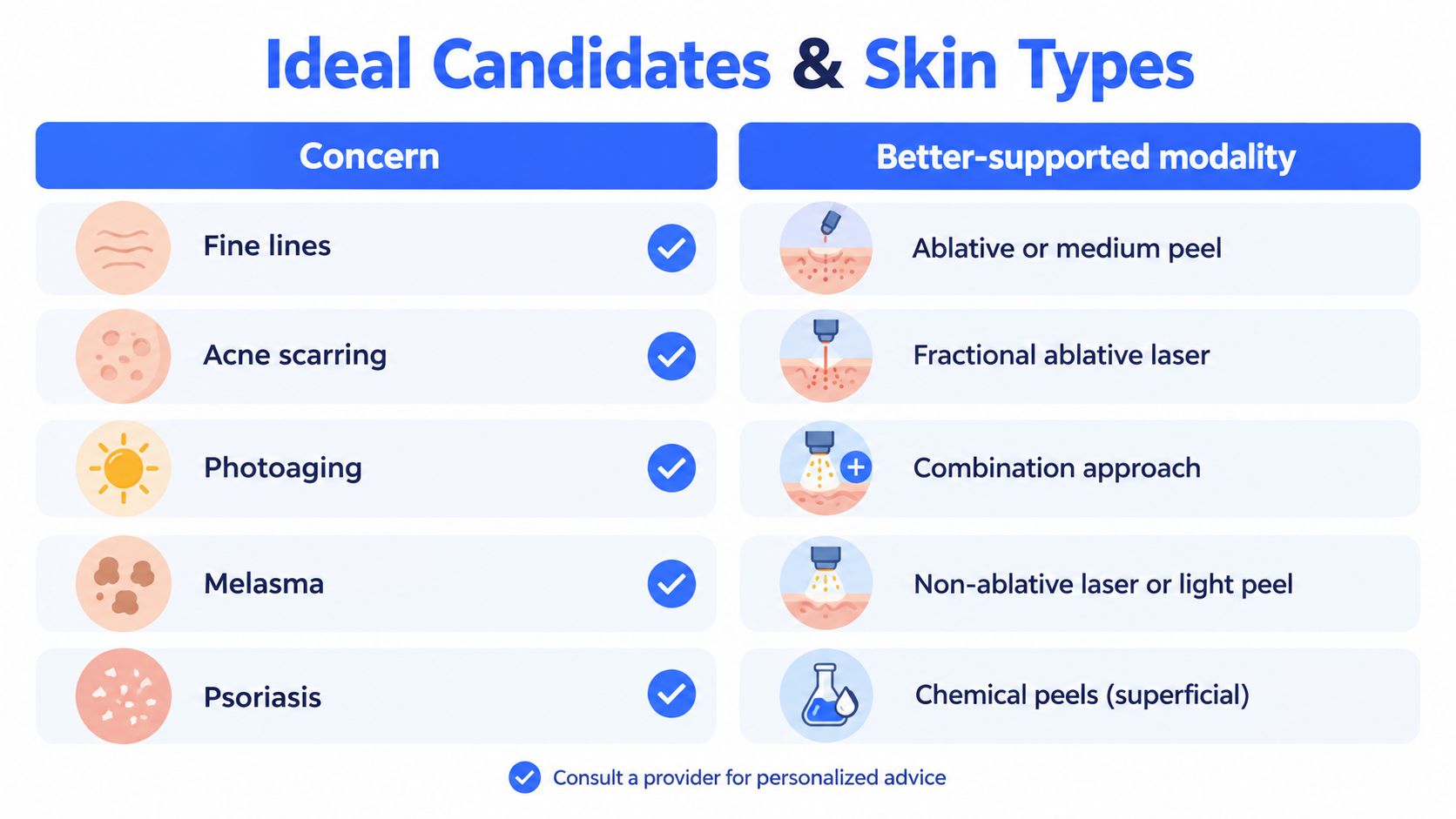
Facial anatomy can change the recommendation
Skin thickness and gland density vary across the face. In a classic comparison, phenol peels matched laser resurfacing for wrinkles in thin-skinned facial areas, while lasers performed better in thicker, glandular areas. One patient may therefore receive different recommendations for different zones.
Ask whether the plan covers the entire face or selected areas, and why the proposed depth and modality fit each site. Treating every area identically may add recovery without addressing the main concern more effectively.
Skin of color needs a more careful evidence discussion
Patients with skin of color often want a clear answer about pigment risk, but the available evidence remains limited. A 2026 scoping review identified only 7 eligible studies out of 473 screened on chemical peels in skin of color, showing how limited the research is for this group (scoping review of chemical peels in skin of color).
Ablative lasers may provide stronger resurfacing effects, but they generally involve longer recovery and greater side-effect risk in skin of color. Non-ablative lasers are generally safer, though the trade-off may be lower intensity or a need for more treatment sessions. Patients can review laser treatment considerations for darker skin and ask about their Fitzpatrick skin type, prior post-inflammatory hyperpigmentation, pretreatment skincare, test spots when appropriate, sun protection, and follow-up. These details help match the treatment burden to the person, not just the condition.
Combined and Progressive Strategies for Better Results
A peel and a laser do not always represent an either-or choice. For a patient concerned about uneven pigment and texture, a clinician may begin with a lighter treatment, observe the skin's response, then decide whether a deeper procedure is justified. The first step acts like a controlled test, not a promise that treatment will continue.
A progressive plan should match the treatment goal, anatomic site, and acceptable treatment burden. A lighter peel or non-ablative laser may address a superficial concern while giving the provider time to assess pigment behavior. A deeper treatment may require fewer sessions, but it can bring more redness, discomfort, or recovery. Lower-intensity treatment may be easier to tolerate, yet require repeated visits.
Sequence according to risk and treatment goal
Before resurfacing, clarify three decisions:
- What needs attention first? Active inflammation, unstable pigmentation, or a weakened skin barrier may need assessment before treatment.
- What depth is justified? Deeper resurfacing should serve a defined purpose, such as established textural change, rather than being chosen because it sounds stronger.
- How will the skin be supported between visits? Provider-selected medical-grade skincare can help maintain a consistent routine, but products should fit the planned procedure and the patient's tolerance.
The treatment site also changes the decision. Facial zones differ in thickness, oil production, and sensitivity, so one modality or intensity may not suit the entire face. Ask whether the plan targets selected areas or the whole face, and why its depth fits each site.
Patients with skin of color need a careful pigment-risk discussion. Evidence on chemical peels in this group remains limited, with a 2026 scoping review identifying 7 eligible studies out of 473 screened (scoping review of chemical peels in skin of color). Ablative lasers may resurface more strongly but generally involve longer recovery and greater side-effect risk. Non-ablative lasers are generally safer, though they may provide lower intensity or require more sessions. Discuss Fitzpatrick skin type, prior post-inflammatory hyperpigmentation, pretreatment skincare, test spots when appropriate, sun protection, and follow-up. More details are available in laser treatment considerations for darker skin.
Treatment availability varies by location. ProMD Health offers lasers, chemical peels, and medical-grade skincare through The Skin Shoppe, but patients should confirm the available modality and options at their office.
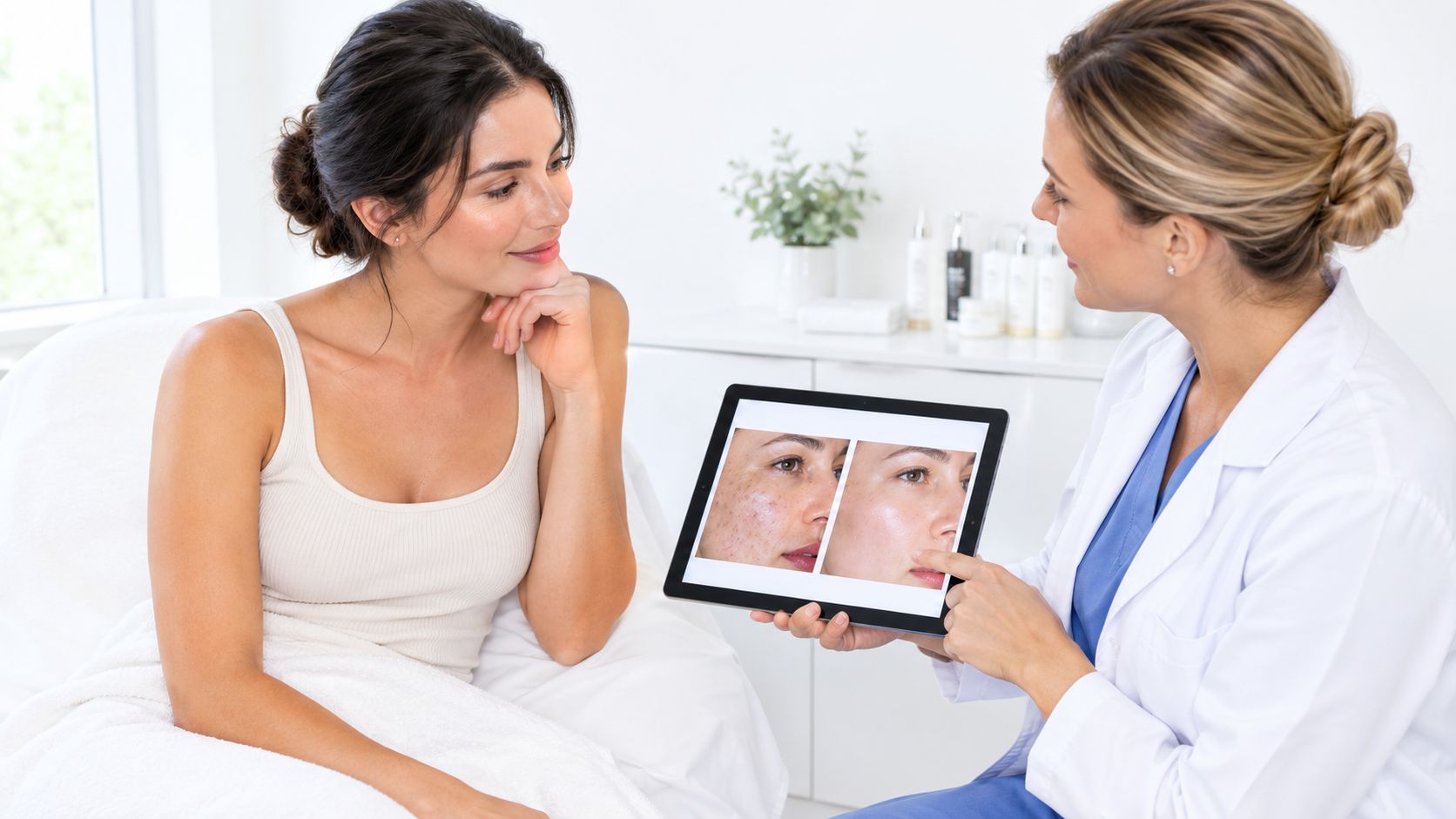
A staged plan also needs stop points. Prolonged redness, unexpected pigment change, or excessive sensitivity may call for adjustment rather than intensification. The safest sequence follows an evaluation of skin type, treatment history, medication use, and the condition being treated.
How to Choose Your Best Option at ProMD Health
At a consultation, start with the result you want and the treatment burden you can manage. The right choice depends on the target, the body site, your Fitzpatrick skin type, and how quickly you need the skin to settle.
- If fewer visits matter most, ask whether laser resurfacing could treat the concern with fewer sessions. Discuss the trade-off, including greater redness, discomfort, or recovery.
- If visible downtime is your main concern, ask about non-ablative laser treatment or a lighter chemical peel. Lower intensity may mean a slower, more gradual result.
- If melasma is the primary concern, ask how pigment sensitivity will be managed and whether laser treatment suits your Fitzpatrick type. Melasma can worsen when inflammation is not carefully controlled.
- If psoriasis is involved, ask whether a chemical peel is suitable and whether the condition is active.
- If the concern is localized, ask how the treatment area and facial anatomy change the recommendation. A small area may not require the same approach as broader resurfacing.
- If you have skin of color, ask about post-inflammatory hyperpigmentation, pretreatment, conservative settings, test spots when appropriate, sun protection, and follow-up.
Choose the modality after identifying the target, the depth required, and the recovery you can safely manage.
ProMD Health operates on a cash-pay model, so services are not covered by insurance. Before booking, confirm the treatment, device availability, office location, preparation, aftercare, and total plan. Approved locations include offices across Maryland, Virginia, Washington, DC, Florida, Texas, Colorado, and Delaware, but availability varies by location.
Bring your treatment history, current skincare products, prior pigment changes, and the date by which you want your skin to look settled. Ask what would prompt the provider to pause, adjust, or change the plan.
ProMD Health offers both laser resurfacing and chemical peel services, with selection based on your concern, tolerance for downtime, and safety considerations. Visit ProMD Health to explore available services, verify your nearest location, and request a consultation about the right resurfacing plan for your skin.


