
You notice the change in the mirror before anyone else does. A patch on the jawline looks darker after a session, the underarms seem shadowed, or the bikini line has a ring of brown where the skin used to look even. That's the moment the worry sets in that laser hair removal hyperpigmentation means something permanent has happened.
It usually doesn't. What you're seeing is often post-inflammatory hyperpigmentation, the skin's pigment response to heat or irritation, and it can range from a brief, mild darkening to a longer-lasting mark that needs treatment. The key is to understand what pattern you're seeing, why it happened, and what to do next so you don't accidentally make it worse.
Table of Contents
- What Hyperpigmentation After Laser Hair Removal Actually Looks Like
- Why Laser Energy Triggers Dark Spots in the First Place
- Matching the Laser to Your Skin Type for Lower Pigment Risk
- Pre- and Post-Treatment Care That Lowers Pigment Risk
- Correcting Existing Dark Spots With Topicals, Peels, and Energy-Based Treatments
- When Hyperpigmentation Is Temporary and When to Seek Professional Care
- Common Misconceptions and Smart Next Steps
What Hyperpigmentation After Laser Hair Removal Actually Looks Like
A patient often describes it the same way. “My skin looked normal that day, then a few days later the treated area was darker than the skin around it.” That darker patch can show up on the face, underarms, bikini line, or legs, and it doesn't always mean injury. Sometimes it's a temporary pigment response that fades on its own, and sometimes it's a more stubborn post-inflammatory hyperpigmentation pattern that needs a plan.
Two looks that matter
The first pattern is diffuse darkening. It follows the shape of the treated area, looks like a soft brown haze or shadow, and usually lightens gradually rather than changing all at once. The second pattern is more specific, a crescent or ring-shaped mark that traces the edge of the treatment zone, which raises concern for uneven energy delivery or cooling.
Practical rule: if the darkening matches the entire treated area and starts to fade, that's more reassuring than a sharply bordered pattern that appears at the edge.
That distinction matters because not every dark patch is the same problem. In prospective studies summarized in a 2023 review, 18% of patients developed mild post-inflammatory hyperpigmentation after laser hair removal, and it typically resolved within 6 to 8 weeks (2023 literature review). That means many cases are temporary, especially when the reaction is mild and caught early.
The practical language patients can use is simple. Ask whether what you're seeing is expected post-treatment darkening, true PIH, or a pattern that suggests device-related injury. That one question helps your provider decide whether to watch, treat, or adjust settings before the next session.
Why Laser Energy Triggers Dark Spots in the First Place
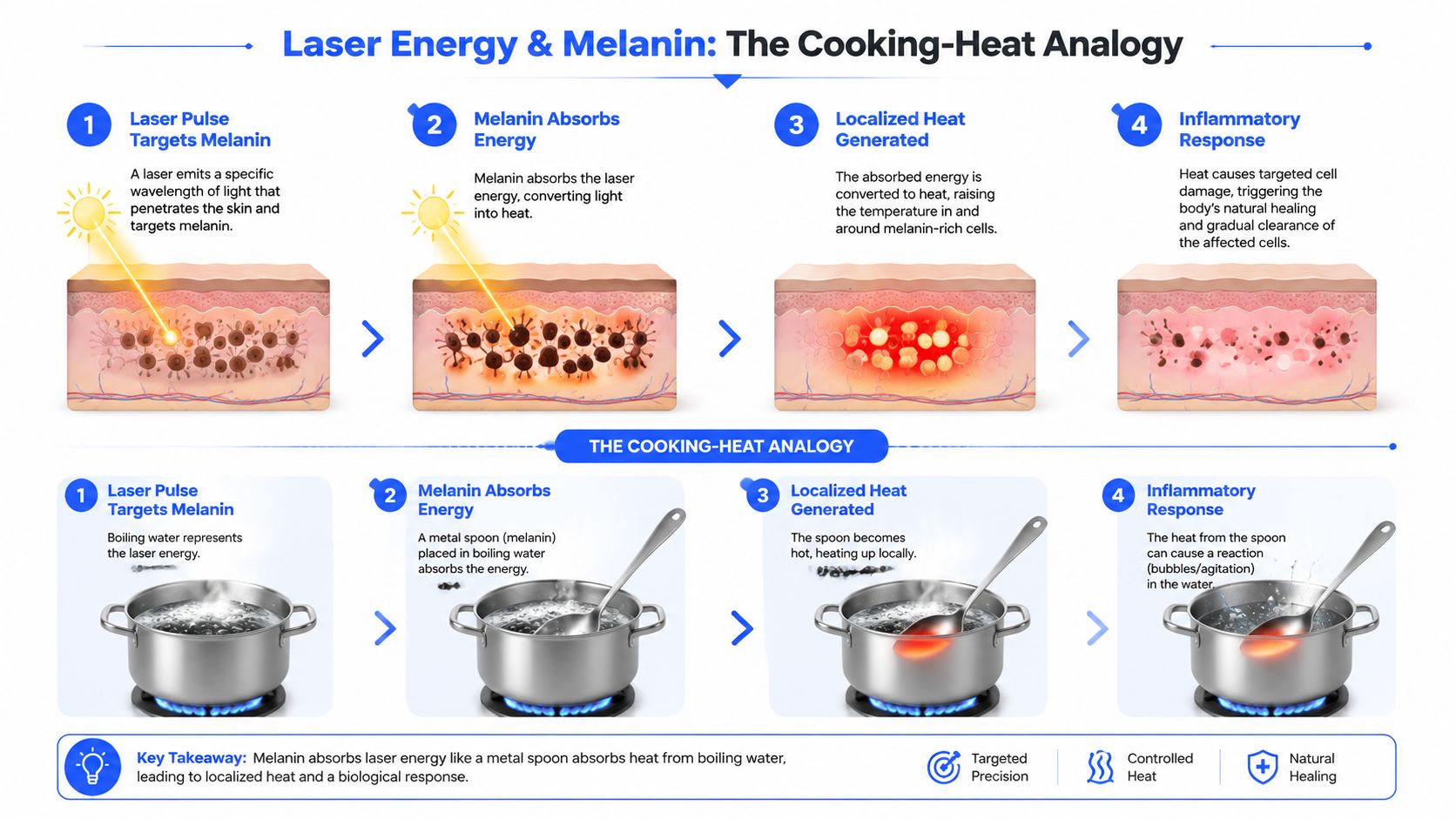
Laser hair removal works by sending energy into melanin. That's the point, but it's also why pigment problems can happen if the skin absorbs too much heat. Leaving a metal spoon in hot water, the spoon itself doesn't cause the boil, but it heats up fast and holds that heat long enough to irritate the tissue around it.
The biology underneath the brown mark
When laser energy is absorbed by melanin, the epidermis can heat up enough to stimulate melanocytes, the pigment-making cells. Your skin then responds as it would after any inflammation, by making more pigment while it heals. That's why laser hair removal hyperpigmentation is really a form of post-inflammatory hyperpigmentation, not a separate mystery condition.
The risk goes up when the energy is mismatched to the person's skin. Recent sun exposure, a naturally darker baseline phototype, and friction-prone areas all increase vulnerability because there's more epidermal melanin competing for the laser's energy. Oral vitamin D use has also been associated with a higher risk of post-laser hyperpigmentation in a clinical study of 508 patients, which is a reminder that patient-level factors matter too.
Device technique matters just as much. In a cryogen-cooled hair removal device, higher fluence with a larger spot size produced crescent-shaped thermal damage at the treatment margins, and angling the handpiece away from perpendicular narrowed the cooling zone and widened injury (experimental study). That's a direct link between delivery technique and pigment injury.
The skin doesn't read the brand name on the machine. It responds to heat, depth, cooling, and fit for the individual patient.
The easiest way to think about this is in two buckets. Patient factors load the gun, things like skin type, tan, friction, and supplements. Device factors pull the trigger, things like fluence, wavelength, spot size, handpiece angle, and cooling.
Matching the Laser to Your Skin Type for Lower Pigment Risk
The safest approach to laser hair removal isn't “one laser for everyone.” It's matching the wavelength and settings to the person in the chair. Fitzpatrick skin typing is the shorthand clinicians use for that decision, but the practical question is simpler, how much epidermal melanin is in the way, and how much heat can the skin tolerate without triggering PIH?
Why phototype changes the answer
Darker skin types need a laser that can reach the follicle while sparing the epidermis as much as possible. That's why long-pulsed Nd:YAG 1064 nm is generally preferred for darker phototypes. Its longer wavelength penetrates more and is less readily absorbed by surface melanin than shorter wavelengths, so the epidermis takes less of the energy burden.
In contrast, shorter-wavelength systems can be very effective in lighter skin, but they carry more pigment risk when the same settings are used on skin of color. In skin type V, pooled odds of dyspigmentation favored long-pulsed Nd:YAG over alexandrite, with an OR of 0.23 (95% CI: 0.12 to 0.44) in a 2023 literature review (review data). That's a meaningful gap, and it's why device choice by phototype is the single highest-value decision.
A helpful way to compare options is below.
| Laser Modality | Best-Fit Skin Types | Relative PIH Risk |
|---|---|---|
| Long-pulsed Nd:YAG | Darker phototypes, especially when pigment risk matters most | Lower when matched correctly |
| Alexandrite | Lighter phototypes | Higher on darker skin if settings aren't adjusted |
| Other shorter-wavelength hair removal systems | Selected lighter skin types | More pigment-sensitive in deeper phototypes |
Before a session, ask three direct questions. What wavelength are you using? How do you adjust fluence and cooling for my skin type? How much experience do you have treating skin like mine? If you want a patient-friendly overview of how darker skin is approached, this laser for darker skin guide is a useful starting point.
Pre- and Post-Treatment Care That Lowers Pigment Risk
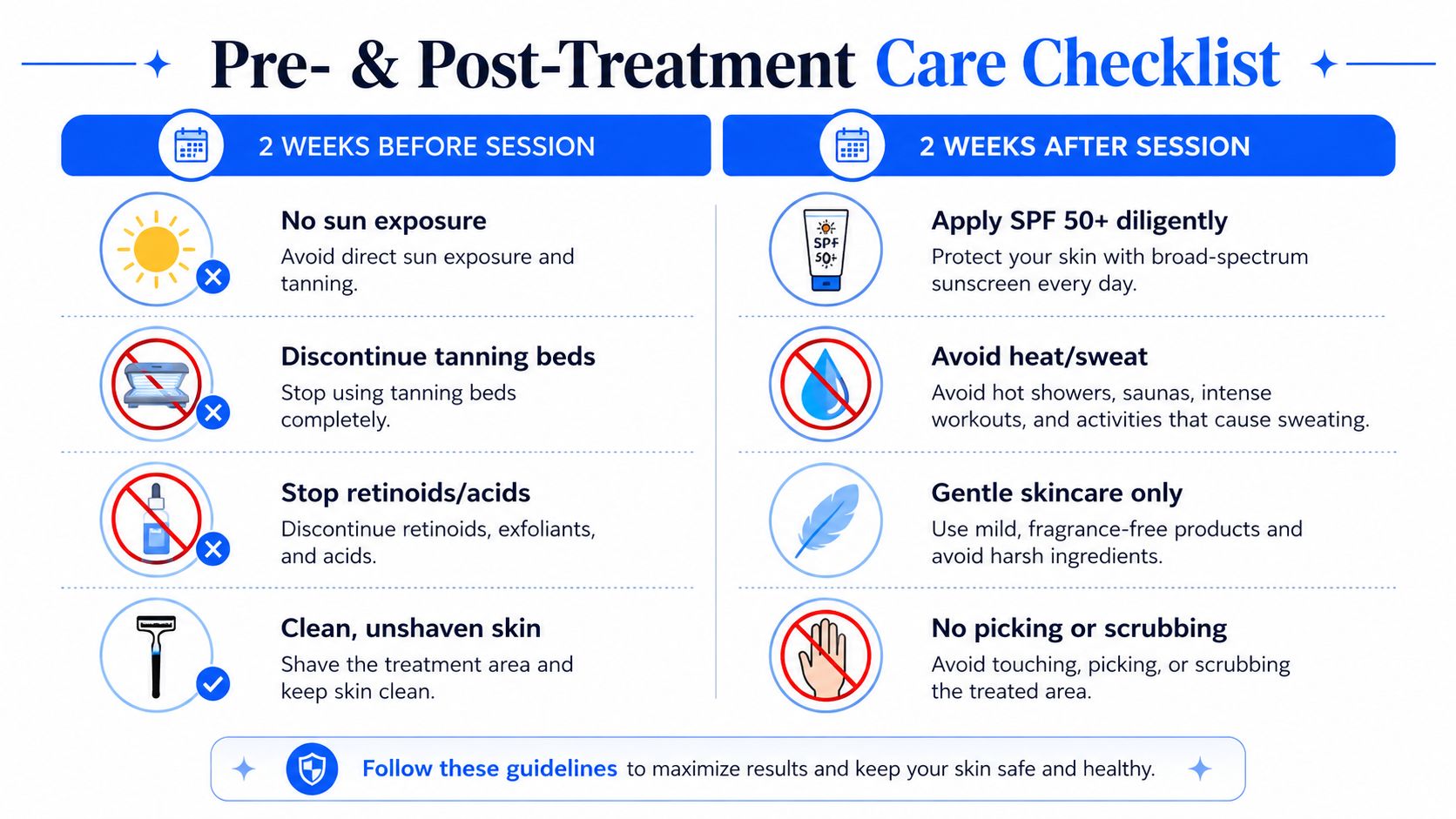
Good aftercare won't rescue a mismatched device, but it can prevent a lot of avoidable darkening. The goal is simple, reduce inflammation, keep heat off the skin, and avoid anything that adds friction or chemical irritation while the treated area is healing. A lot of people undo an otherwise solid session by going back to sweaty workouts, hot showers, or exfoliation too soon.
Before and after the session
Two weeks before treatment, the skin should be calm. Avoid sun exposure and tanning beds, skip retinoids and exfoliants on the area, and shave rather than wax or pluck so the follicle target stays intact. If you take supplements or medications that might affect pigmentation or photosensitivity, talk with your provider before stopping anything.
The day of treatment should be boring. The area should be clean, cool, and free of makeup or deodorant, and you should confirm eye protection and, if offered, document the settings used. That record helps if you need to compare reactions across sessions.
After treatment, think gentle and dry. Use mild cleansing, apply physical sunscreen on exposed skin, avoid hot yoga, tight waistbands, and deodorant on freshly treated underarms, and hold off on active ingredients until the skin settles.
Practical rule: if the area feels hot, red, or tender, your skin is still telling you to back off. Heat, sweat, and scrubbing are the fastest ways to turn a temporary reaction into a longer PIH problem.
Oral vitamin D use was independently associated with higher post-laser hyperpigmentation risk in a study of 508 patients, with an adjusted odds ratio of 2.6 (95% CI: 1.17 to 5.80; P = 0.020) (clinical study). That doesn't mean vitamin D is “bad,” it means the full medication and supplement picture matters before and during treatment.
For a practical prep checklist, the laser hair removal preparation guide is a useful reference. If you're also looking for an at-home overview of pigment calming, this fade hyperpigmentation naturally resource can help frame what gentle maintenance looks like between visits.
Correcting Existing Dark Spots With Topicals, Peels, and Energy-Based Treatments
Once PIH is there, the treatment ladder should match the depth and the sensitivity of the skin. The mildest approach is topical therapy, then light professional resurfacing, then carefully selected energy-based correction when pigment is stubborn or mixed with texture issues. The wrong move is rushing to a stronger device just because the discoloration feels urgent.
What each option does
Topicals work by calming pigment production or speeding cell turnover. Hydroquinone lowers melanin formation, azelaic acid helps quiet excess pigment activity, retinoids speed turnover, and vitamin C supports a brighter tone by reducing oxidative stress. Glycolic and lactic acids can help lift pigment gradually, but they can also irritate if the skin barrier is already reactive.
In-clinic peels are the next step when pigment is lingering. Light chemical peels can speed turnover in a controlled way, and they're often paired with pigment-targeting topicals to keep the skin from rebounding darker after irritation. The main point is that the peel has to be gentle enough not to restart the inflammatory cycle.
Energy-based correction belongs in medical aesthetics, not in a generic, one-setting-fits-all approach. Non-ablative lasers and IPL can be used in corrective mode, but they're a different category from hair removal devices and need their own phototype-specific settings. Used too aggressively, they can make PIH worse instead of better.
A simple way to think about the choices:
- Topicals first: best when the skin is still reactive or the pigment is flat and mild.
- Light peels next: useful when turnover is slow and the skin can tolerate a controlled resurfacing step.
- Energy-based correction last: reserved for persistent pigment, mixed concerns, or cases managed by an experienced medical provider.
In one retrospective study, hyperpigmentation was visible at 1 week in 48.4% of the laser-only treated area and 45.2% of the laser plus topical corticosteroid area after 3-msec alexandrite treatment (study data). That's a reminder that early darkening can be common right after treatment, so a wait-and-see approach often makes sense before escalating.
For readers who want a deeper dive into peel-based management, chemical peel for hyperpigmentation is a reasonable next read. Most topical routines need patience, and meaningful change often takes time rather than force.
When Hyperpigmentation Is Temporary and When to Seek Professional Care
A small amount of darkening right after treatment is not the same as a lasting complication. Mild PIH often fades within 6 to 8 weeks, while more moderate cases can take 3 to 6 months to settle. If the discoloration keeps darkening, spreads, or sticks around beyond that window, it deserves an in-person evaluation.
Signs that point toward simple healing versus a problem
Expected healing usually looks uniform. The color follows the treated area, slowly lightens, and becomes less noticeable as inflammation settles. More concerning patterns include crescent or ring-shaped borders, expanding edges, pain, texture change, or a patch that gets darker even after you've reduced sun exposure and heat.
If you're dealing with darker skin or you've had a reaction after a new session, don't wait too long to ask for help. Persistent discoloration in skin of color benefits from earlier intervention because there's less room for the pigment to lock in and become harder to reverse.
If the color is changing in the wrong direction after the first few weeks, it's time to stop guessing and get eyes on it.
The safest decision point is simple. If the mark is still clearly present after a few months, if the shape suggests device-margin injury, or if the area feels different from surrounding skin, schedule a professional review rather than trying stronger home products on your own. That's especially true when laser hair removal hyperpigmentation is paired with repeated sessions, because the next treatment should not go forward until the skin has stabilized.
A 2023 review found that hyperpigmentation prevalence after hair removal ranged from 0.6% to 10%, with likely underreporting (review data). That spread tells you two things at once, this reaction is real, and the numbers depend heavily on skin type, technique, and how closely people are followed.
Common Misconceptions and Smart Next Steps
The biggest mistake is assuming every dark spot means permanent damage. It doesn't. A documented retrospective clinical study reported post-laser hyperpigmentation in 10.8% of patients, which tells us this is a real-world outcome rather than a freak event, but it also says many patients are dealing with a manageable pigment response, not a lifelong scar (clinical study).
What people get wrong
The first misconception is that any laser is universally safe. Safety is phototype-specific, and the right wavelength for one person can be the wrong one for another. The second is that darker spots always mean lasting damage, when many cases fade with the right support and time.
The third is that stronger products work faster. They often don't. If you irritate the skin barrier with too much acid, retinoid, or friction, you can prolong the very pigment you were trying to erase. The fourth is that corrective work is routinely covered by insurance, which isn't how elective pigment correction is generally approached in aesthetic care.
If you're still researching providers, bring a short checklist to consultation. Ask which wavelength they'll use, how they adjust for your skin type, what cooling method they rely on, how they handle recent sun exposure, and what they do if PIH appears between sessions. If you're mid-treatment and the darkening is mild, the right next step is stabilization, less heat, less friction, more sun protection, and time.
If the pigment is lingering, expanding, or changing shape, ask for a medical aesthetics evaluation rather than trying to out-treat it at home. The issue usually isn't that your skin is “bad at healing.” It's that the skin needed a better device match, more careful aftercare, or earlier escalation.
Laser hair removal hyperpigmentation is common enough to plan for, predictable enough to prevent in many cases, and treatable enough that you shouldn't panic when it shows up. ProMD Health offers laser hair removal and medical aesthetics care across multiple locations, so if you're dealing with post-treatment darkening or want a safer plan before your next session, visit ProMD Health to review options and schedule a conversation with a provider who can match the device, settings, and aftercare to your skin.


