The American Society of Plastic Surgeons reports average physician fees of $715 for hyaluronic-acid dermal fillers and $901 for non-hyaluronic-acid fillers on its dermal filler cost page. These figures offer a national benchmark, not a price for treating sunken eyes. The actual total depends on the product, the amount needed, the injector's fee, consultation and follow-up.
A published average can show the broad range of physician fees, but it cannot predict an individual treatment plan. Under-eye hollows differ, and the quote may include different services or stages of care. Check whether it covers consultation, a symmetry review, any correction or touch-up, and future maintenance.
For a useful comparison, ask for the complete planned cost, including per-eye pricing and follow-up, rather than relying on a headline figure alone. A written plan makes clear which costs are included and which may arise later. The sections ahead distinguish published benchmarks from the details that require an individualized quote.
Table of Contents
- Typical Sunken Eye Filler Costs at a Glance
- What Moves the Price Up or Down
- How Region and Clinic Choice Change the Quote
- Budgeting the Full Treatment, Not Just the Syringe
- What to Confirm at Your Consultation
- Paying and Booking Without Surprises
Typical Sunken Eye Filler Costs at a Glance
The American Society of Plastic Surgeons lists average physician fees of $715 for hyaluronic-acid dermal fillers and $901 for non-hyaluronic-acid fillers on its dermal filler cost page. These figures are national benchmarks across treatment areas, not prices specific to tear troughs. They do not show how much product an individual's under-eye hollows require.
The quoted amount can depend on the product, the amount injected, the injector's qualifications, procedure time and geographic market. Under-eye treatment may be priced by syringe or by session. The amount needed on each side depends on the depth of the hollowing and facial anatomy.
The unit-price trap: A one-syringe quote tells you the unit rate, not the cost to treat both eyes. Ask how many syringes are planned for each side before comparing totals.
For example, a low per-syringe price may initially appear to cover the correction, but the quote may include only one side. If both hollows need treatment, the total can be roughly twice the amount budgeted. Compare the planned cost per eye and the full treatment scope, including follow-up and any correction, rather than relying on the unit rate alone.
The benchmarks clarify what broad filler fees look like, while leaving key details of an under-eye quote unresolved.
| Item | Benchmark | What It Covers | Limit for Under-Eye Quotes |
|---|---|---|---|
| Hyaluronic-acid dermal filler, national average physician fee | $715 | Broad filler average across treatment areas | Not a tear-trough-specific price |
| Non-hyaluronic-acid dermal filler, national average physician fee | $901 | Broad filler average across treatment areas | Not a tear-trough-specific price |
| Under-eye quote per syringe or session | No national average published | Product and injection for one treatment session | Syringe count depends on hollow depth and anatomy |
| Under-eye treatment per eye, full plan | Sum of syringe count, injector fee, consultation and follow-up | Product, injector fee, consultation and follow-up | Compare this figure, not the per-syringe price |
| Health insurance coverage for cosmetic filler | Generally not covered | Cosmetic treatment | Confirm payment terms directly with the clinic |
What to Write Down Before Comparing Quotes
Four details determine whether two quotes describe comparable treatments:
- Product name and concentration: Products differ in firmness and support, and those differences matter under thin eyelid skin and can affect the quote.
- Syringe count: Ask how many syringes are planned for each side. The amounts may differ between eyes.
- Eyes covered: Confirm in writing whether the quote covers one side or both.
- Inclusions: Request itemized costs for the consultation and follow-up, and ask what the clinic's touch-up policy covers.
A ProMD Health consultation can help clarify the proposed treatment and its expected scope. A written plan should state the product, amount for each eye, covered visits and any potential correction costs. Once those details match, the quoted totals are more useful to compare.
What Moves the Price Up or Down
The order of the main cost drivers is product type, syringe count, provider and market, then follow-up. Each affects a different part of the quote, so a per-syringe rate alone cannot show the full treatment cost.
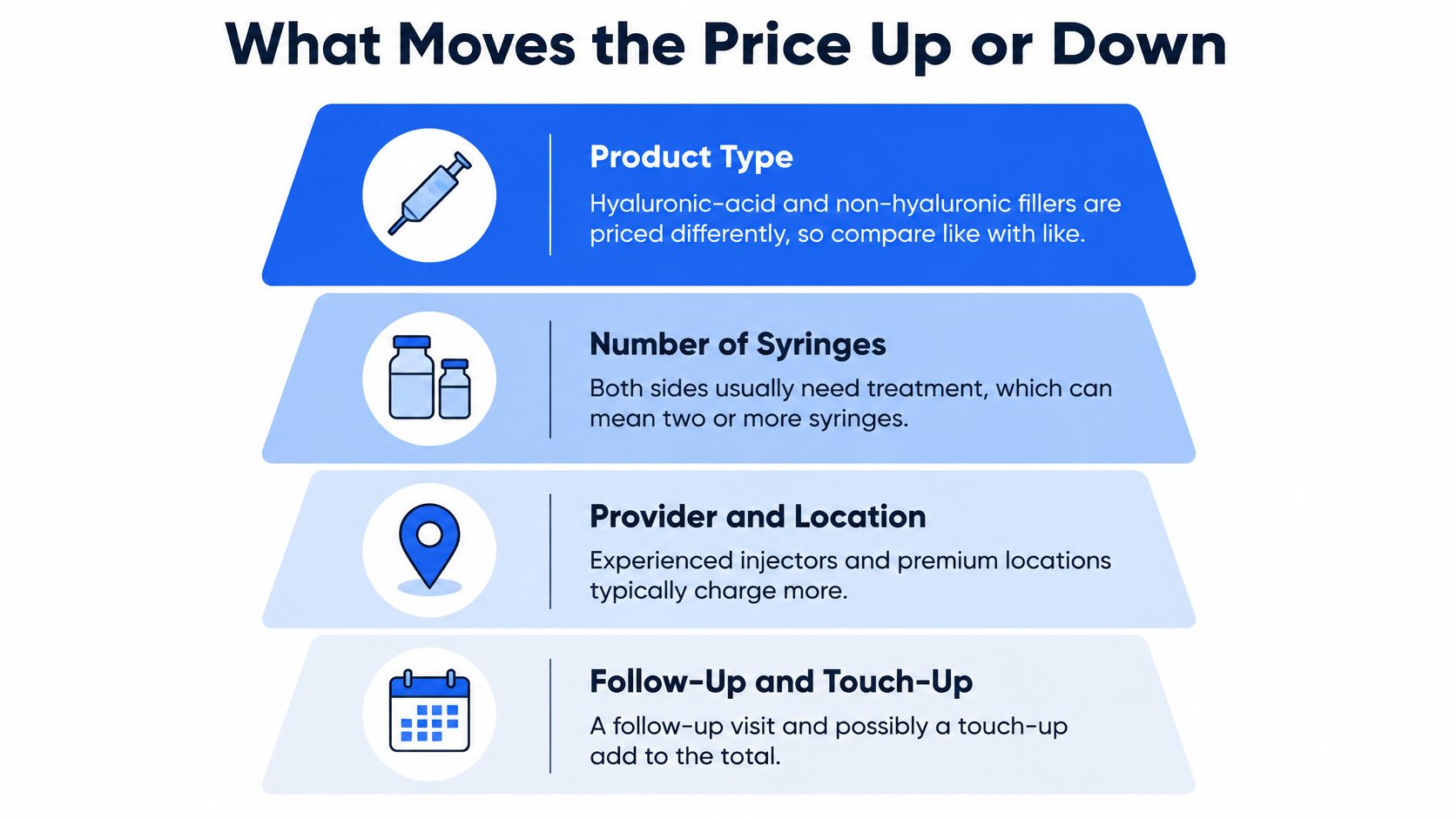
Product type comes first. Hyaluronic-acid and non-hyaluronic-acid fillers have different published cost benchmarks. Compare the same type of product, and check whether it is labeled for infraorbital use, since labeling affects the approval pathway and may influence the fee. ProMD Health offers Voluma, Restylane and Restylane Lyft. The full dermal filler pricing breakdown explains how product choice affects price.
Syringe count comes second. Treating both sides may require two or more syringes, depending on the depth of the hollowing and the patient's anatomy. A fixed single-syringe quote does not account for those differences, so confirm the planned volume for each side before comparing totals.
Provider and market come third. A peer-reviewed economic analysis in the Aesthetic Surgery Journal found regional differences in aesthetic procedure pricing and identified surgeon fees, facility costs and anesthesia-related charges as common parts of bundled prices. Tear-trough filler is usually performed in an office and does not generally require anesthesia. The same cost categories help explain what else may be included, such as consultation time, sterile supplies, clinical staffing, emergency readiness and follow-up. The area near the orbit is technically demanding, so ask who will inject and what the quoted fee covers.
Follow-up and touch-up come last, but still affect the total. An assessment after swelling settles may be included in one quote and billed separately in another. A lower quote often omits consultation or follow-up, so check the itemized terms before judging the headline price.
The bill works like a restaurant check: the filler is the main item, while expertise, sterile supplies, staffing and follow-up are additional costs involved in providing the treatment. Ask which of these are included rather than assuming the per-syringe rate represents the full amount.
The Six Questions Every Quote Should Answer
- Which product and concentration are planned?
- What volume is planned for each side?
- Who will inject, and what are their credentials?
- What is the total fee, and what does it exclude?
- What are the follow-up terms?
- What is the protocol for delayed swelling, vascular compromise or hyaluronidase reversal?
Written answers make it possible to compare the treatment scope as well as the cost. Without them, the quoted figure may not include the same services or planned volume as another quote.
How Region and Clinic Choice Change the Quote
Regional market conditions affect what a clinic charges for the same syringe. Without a verified city or state range, treat a published local figure as something to check, not a dependable budget. The differences can come from how clinics price the appointment: one office may list the consultation separately, while another includes it in the quoted total. Compare quotes within your own area, using the same product and the same per-eye basis.
Request written quotes from two local clinics and compare the product, planned volume per side, and total cost per eye. A syringe rate alone leaves out what the full appointment may cost.
A worked comparison: Quote A lists one syringe at a lower price, with the consultation billed separately. Quote B costs more upfront but includes the consultation, both eyes, and one follow-up visit. The headline rate favors A, but the included services could make B less expensive overall. Compare the full treatment total and per-eye cost before deciding.
Treatment availability can also vary by office, even within the same network. For example, one location may offer under-eye filler while another does not, or they may carry different products. Confirm the service and available products with the office you plan to visit before comparing its quote.
Ask for the total cost per eye, including product, consultation, and follow-up. If the answer is only a per-syringe rate, it is not yet a complete comparison.
Budgeting the Full Treatment, Not Just the Syringe
A patient accepts a quote for one syringe because the price seems manageable. At the appointment, the plan expands: both hollows need treatment, a follow-up checks symmetry after swelling settles, and a touch-up may be needed. The syringe price has not changed, but the total budget has.
Set the full estimate before booking. Count the consultation, product volume, injector fee, follow-up or touch-up visits, and whether unused product is credited or discarded. Include a possible correction or dissolving fee, too. If a hyaluronic-acid result needs revision, that work can add cost, so a low initial quote does not necessarily mean a lower total.

Why Year One Sets the Budget
Under-eye filler is not always a one-time expense. A review of tear-trough hyaluronic-acid filler reports that visible results commonly last about 8 to 12 months, with an average duration of roughly 10.8 months (a review indexed in PubMed Central). It also describes a retrospective study in which meaningful improvement persisted at 18 months for many patients. Duration varies with product, technique, anatomy, metabolism, and how improvement is measured.
Budget for the possibility of repeat treatment rather than assuming a permanent correction. If the plan calls for a session roughly once a year, set aside the quoted amount as a recurring expense. ProMD Health says it provides free touch-ups in most cases, but whether that applies to a particular treatment should be confirmed when reviewing the quote.
Filler restores volume; it does not address every cause of under-eye darkness or hollowness. Pigmentation, skin quality, fat-pad anatomy, edema, and bone structure can also affect appearance. The under-eye rejuvenation options explain what treatment may address and where its limits lie.
| Cost line | What to include in the estimate |
|---|---|
| Consultation | Any fee not included in treatment |
| Initial treatment | Product volume and injector fee |
| Follow-up or touch-up visit | Whether it is included, discounted, or charged separately |
| Repeat treatment at about 8 to 12 months | The expected cost if another session is needed |
| Correction or dissolving | Any fee if results need revision |
Use your own written quote to fill in each row and total the costs. First-year cost equals the initial treatment plus expected repeat sessions plus any corrections. Confirm touch-up terms in writing, and count them in the budget only if they are included. A per-syringe price alone cannot show the likely first-year expense.
What to Confirm at Your Consultation
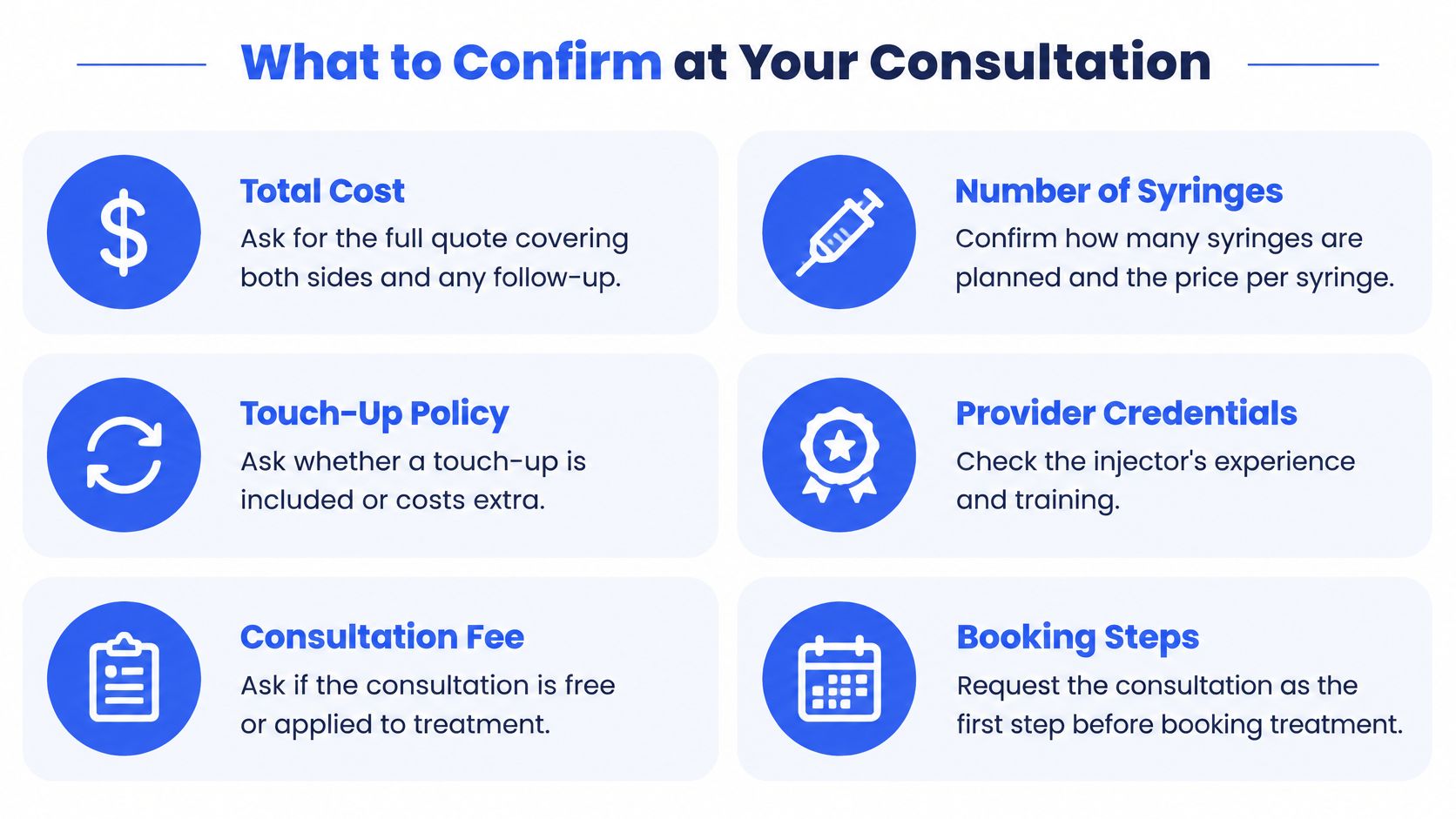
A consultation should resolve five questions before you commit to a treatment. Start with the product: ask for its exact name and whether the proposed under-eye use is included in its labeled indication.
Ask this one first. The U.S. Food and Drug Administration approved a hyaluronic-acid filler for infraorbital hollowing in adults aged 21 and older on May 28, 2021, and a later approval for Belotero Balance in September 2023 expanded the specifically authorized under-eye options, as recorded in the FDA's summary of the approval. The same FDA approval summary describes a supporting study of 144 participants. Participants generally needed one or two treatments involving multiple injections, and results lasted up to 48 weeks.
These details matter because under-eye filler isn't interchangeable with lip or cheek filler. Approved uses, product characteristics, injector expertise and follow-up requirements can differ. Online prices posted before the 2020s may predate dedicated under-eye clearances and may not reflect current practice.
Five Questions Worth Asking Aloud
- Who is injecting, and how often do they treat this area? The FDA recommends that fillers be administered by a licensed health-care professional who understands facial anatomy and product risks, as explained in its consumer guidance on dermal fillers. It also warns that periorbital injection isn't approved for every product or site.
- What is the plan for delayed swelling, vascular compromise or hyaluronidase reversal? Ask for the protocol, not just reassurance. A written plan makes clear what care is available if a complication occurs.
- How many treatments might the plan involve? The Belotero study describes one or two sessions, rather than a single visit for everyone. Ask how the treatment plan affects the total cost.
- What are the treatment's practical limits? If pigmentation or puffiness contributes to a tired appearance, filler may not address it. Ask what the proposed treatment can and cannot change, and review possible dermal filler side effects before deciding.
- Is the consultation free, and does it happen before any commitment? ProMD Health offers a complimentary aesthetic consultation. Use it to discuss the proposed plan and costs before making a payment.
A provider's answers should clarify both the treatment and its limits. Get the plan in writing before you decide.
Paying and Booking Without Surprises
A quote is incomplete if it names only the product or injection fee. Before paying a deposit, get the full treatment plan in writing and check whether follow-up visits, maintenance, touch-ups, correction, or financing are included or charged separately. Financing terms vary, so confirm them directly with the clinic rather than relying on a general website message.
The lowest initial quote may not be the lowest overall cost. A revision, dissolving appointment, or specialist care could add expenses that the original estimate did not include. Ask what the clinic's written terms cover if the result needs adjustment, and whether repeat visits have set prices.
Keep the paperwork specific. It should identify the proposed product and treatment, list the charges included in the quote, and explain the terms for follow-up and any financing. If information is missing, ask for a revised plan before booking.
ProMD Health offers Voluma, Restylane, and Restylane Lyft dermal fillers, as well as a complimentary aesthetic consultation. Touch-ups are free in most cases. The consultation can help determine whether treatment fits your anatomy and goals, and clarify what the quote includes before you commit. Visit ProMD Health to arrange a consultation at a nearby location.