
Functional medicine is a patient-centered, systems-biology model that looks for contributing factors behind symptoms and chronic illness, then pairs lifestyle change with conventional care rather than treating only a disease label.
If you know the name of your condition, do you also know what's contributing to it, or which changes would help? Those are different questions. A diagnosis can guide essential treatment without explaining every influence on your sleep, energy, appetite, or ability to function.
Understanding what functional medicine is means separating its useful questions from its bigger claims. Looking closely at someone's history can improve care planning, but a personalized recommendation still needs evidence, a safety check, and a way to judge whether it's helping.
Table of Contents
- What Functional Medicine Means for a Patient
- How Functional Care Differs From Usual Medicine
- How Interacting Systems Shape Symptoms
- The Whole-Person Factors a Visit Should Cover
- Where Evidence Helps and Where It Stops
- How the Model Looks in Everyday Care
- Decide Whether Functional Medicine Fits You
What Functional Medicine Means for a Patient
Functional medicine treats health and disease as changing processes involving body systems, personal history, and daily life, not only as a diagnosis attached to an organ. A peer-reviewed article on the functional medicine model describes function as a dynamic process and emphasizes assessing physiological, cognitive, emotional, and physical functioning before building an individualized therapeutic program.
Think of a disease label as the destination on a map. Function includes the traffic, fuel, and road conditions that helped someone arrive there. The destination still matters, but it doesn't describe the entire journey.
In everyday language, function means how well you're making energy, sleeping, recovering, regulating mood, and carrying out ordinary activities. A clinician asks not just what hurts, but what you can no longer do comfortably and when that changed.
A framework, not a shopping list
The model became an organized educational framework when Susan Bland and Jeffrey Bland founded the Institute for Functional Medicine in 1991, according to the Institute's history. That background makes it more specific than a casual synonym for nutrition advice, supplements, or alternative medicine.
It also doesn't make every treatment offered under the label equivalent. A clinician might recommend practical meal changes and standard laboratory testing, while another proposes an extensive supplement regimen. Patients need to evaluate those recommendations separately.
Useful distinction: A care model describes how a clinician organizes questions. It doesn't automatically validate every answer.
What the first conversation should accomplish
Expect an extended discussion of your symptom timeline, previous diagnoses, daily routines, and treatments you've already tried. Bring examples of functional changes, such as struggling through an afternoon meeting or waking repeatedly despite enough time in bed.
That conversation should lead to priorities, not an assumption that every symptom has a hidden cause. Standard evaluation remains necessary when symptoms suggest a condition requiring established treatment. Functional medicine doesn't replace emergency care, cancer screening, or proven medication.
How Functional Care Differs From Usual Medicine
Functional medicine and conventional care compared
| Question | Conventional care | Functional medicine |
|---|---|---|
| Main focus | Diagnose and treat a named disease or organ problem | Look for contributing factors across systems while keeping the diagnosis |
| History | Symptom-focused history sized to the visit | Extended history of timeline, lifestyle, environment, and prior treatments |
| Testing | Guideline-based labs and imaging for the suspected condition | Standard tests plus selective labs only when a result would change the plan |
| Treatment | Medications, procedures, and referrals with established indications | Lifestyle and behavior changes alongside medication when indicated |
| Follow-up | Recheck the disease marker or symptom that prompted care | Baseline, a few measurable targets, and stop low-value tests or supplements |
| Urgent illness | Emergency and specialty pathways | Same pathways; functional care does not delay them |
These are differences in emphasis, not exclusive capabilities. Conventional primary care can include detailed lifestyle counseling, prevention, and shared decisions. Functional medicine doesn't own whole-person care, and conventional medicine isn't limited to suppressing symptoms.
Conventional care provides the diagnostic and risk-assessment foundation: What condition is present? How serious is it? Which treatment has an established indication? Functional care adds a deliberate effort to connect the diagnosis with patterns in daily life and symptoms across systems.
What changes in the appointment
A symptom-focused visit might establish that someone has high blood pressure and needs treatment. A functional-style history may spend additional time on sleep, movement, meals, stress, and medication use while preserving that treatment plan.
Testing shouldn't automatically become more extensive. An ordinary laboratory test can be useful when it answers a specific clinical question; a large specialty panel can be unhelpful when its results won't change management. More measurements don't necessarily produce more clarity.
A practical overview of functional medicine implementation distinguishes the evidence for individual interventions from evidence for the integrated model and recommends baseline assessment, measurable endpoints, and reassessment of low-value tests or supplements. That approach makes follow-up a clinical decision rather than an automatic renewal of products.
Coordination matters more than the label
Treatment may combine nutritional changes, movement, sleep support, and stress-management skills with medication when indicated. The clinician should make the responsibilities clear: who prescribes, who reviews laboratory results, and who handles a worsening condition.
Mental health provides a useful comparison. Integrative Psychiatry of America's resource on whole-person care for anxiety and ADHD offers another context for considering daily functioning alongside a diagnosis. Such resources can help you prepare questions, but they don't replace an individual psychiatric assessment.
If someone develops chest pain, severe shortness of breath, or sudden neurologic symptoms, the appropriate response is emergency evaluation, not an expanded wellness history. A suspected cancer finding likewise needs the relevant diagnostic and specialty pathway. Any clinician using a functional approach should preserve those boundaries without hesitation.
How Interacting Systems Shape Symptoms
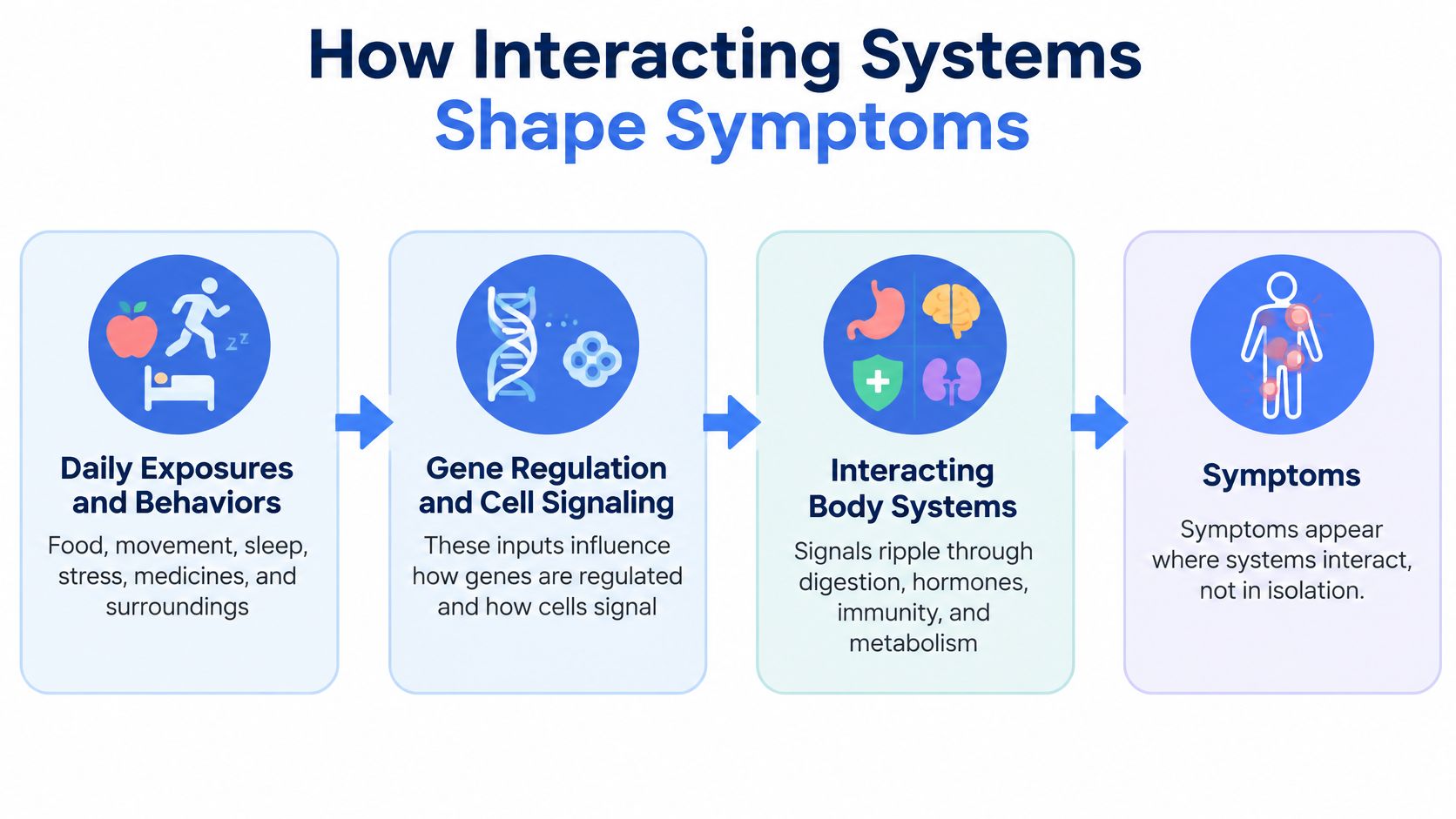
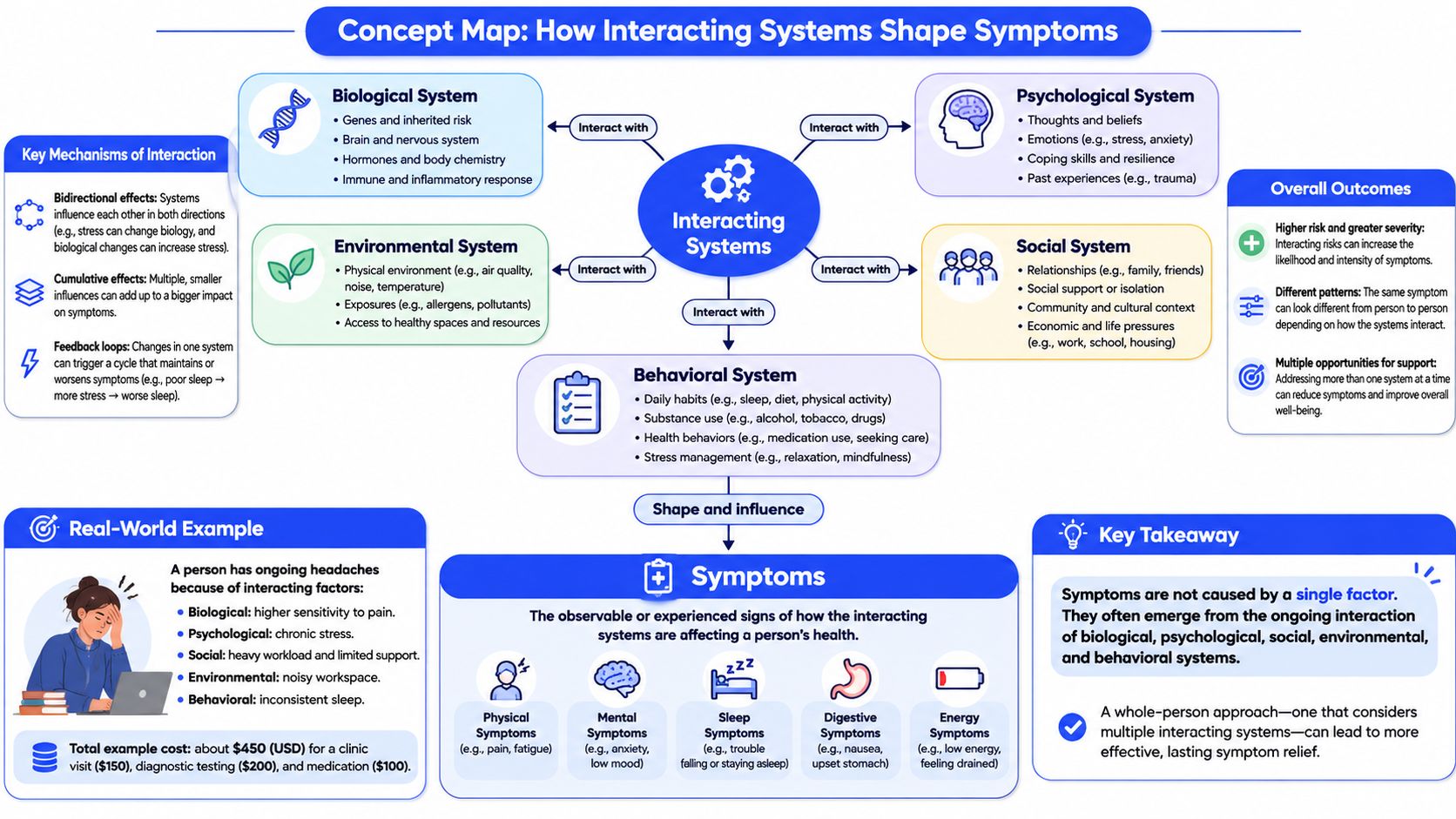
Food, movement, sleep, stress, medicines, and surroundings provide inputs to the body. Those inputs can influence gene regulation and cell signaling, which affect how cells perform their jobs. This isn't the same as changing your inherited DNA or proving that a particular exposure caused your illness.
A peer-reviewed overview of functional medicine and systems biology describes health and disease through interacting biological networks, including energy metabolism, immune defense, tissue repair, waste processing, communication, and structural integrity. The model uses those connections to organize assessment while retaining conventional diagnosis and risk evaluation.
From connected processes to a practical plan
Consider a household electrical problem. A flickering light might need a new bulb. If the lights, heating, and appliances fail together, an electrician also checks the electrical panel.
That analogy explains why a clinician might investigate a cluster of symptoms rather than treat each as unrelated. It doesn't establish that fatigue, weight change, mood shifts, or hair changes all share the same cause. Symptoms are clues, not proof of a single underlying mechanism.
For example, someone with rising glucose still needs appropriate diabetes evaluation and treatment. Alongside that care, the clinician can examine meal patterns, activity, and sleep, then agree on observable changes rather than promising to reverse disease through a generalized systems reset.
The plan might track glucose as clinically appropriate and ask the patient to record sleep timing and movement. If the plan becomes impractical, the clinician can simplify it instead of interpreting difficulty following it as a personal failure.
What came before, what started it, what sustains it
Functional medicine often uses terminology that sounds more complicated than the underlying questions:
- Antecedents are what came before, such as family patterns or an earlier illness.
- Triggers are events that may have started a symptom or flare.
- Mediators are factors that may help keep the problem going.
These categories help build a timeline. They don't establish causation merely because events happened in sequence.
A convincing explanation is a starting hypothesis. A useful care plan must still withstand testing, observation, and revision.
Hormones illustrate that distinction. Reading about hormone imbalance and fatigue can help patients recognize questions worth discussing, but fatigue alone doesn't identify a hormone disorder.
The clinician still needs to ask about sleep, medicines, eating patterns, emotional health, and relevant medical findings. Systems thinking organizes the investigation; it doesn't validate every specialty test or protocol.
The Whole-Person Factors a Visit Should Cover
A whole-person visit should make your situation clearer, not make your intake form longer. Stony Brook Medicine's patient-education document describes looking upstream at interactions among personal history, physiology, lifestyle, genetics, and internal and external environments, including social influences.
Upstream means looking earlier than today's symptom for potentially relevant contributors. It doesn't mean ignoring the symptom while searching indefinitely for a deeper explanation.
Start with your timeline and everyday routines
- Personal history: What changed before the fatigue began? Illnesses, surgeries, pregnancies, and prior treatments help establish sequence and guide the evaluation.
- Family patterns: Which conditions occur in close relatives? Family history informs risk, but it doesn't make a future diagnosis inevitable.
- Diet and eating rhythm: What do you eat during a typical workday, and when? The answer can reveal practical barriers without assuming there's a single ideal diet.
- Movement and strength: What activity can you manage now, and what limits it? A realistic plan starts with current ability rather than an ambitious exercise prescription.
Sleep deserves its own discussion. A clinician may ask whether your main difficulty is falling asleep, staying asleep, working irregular hours, or feeling unrefreshed. Those aren't interchangeable problems, so a generic instruction to sleep more may miss the issue.
Include circumstances that affect what's possible
Emotional load belongs in the history without turning physical symptoms into a psychological dismissal. Questions about stress and trauma should be respectful, relevant, and paced so you can discuss what feels appropriate.
Other practical questions include:
- Environment: Are there relevant exposures at work, smoke at home, or chemicals you handle regularly? The purpose is to identify plausible risks, not encourage fear of ordinary surroundings.
- Social context: Can you afford the proposed food, appointments, and treatment? Poverty, discrimination, caregiving responsibilities, and access to care affect what a workable plan looks like.
- Medicines and supplements: What prescriptions, nonprescription products, and supplements do you take? Reviewing the actual containers can help identify overlapping ingredients and potential interactions.
For readers trying to understand persistent exhaustion, the Pain and Sleep Therapy Center's resource on whole-body care for chronic fatigue offers additional context for discussing overlapping concerns with a clinician.
A thoughtful assessment ends with priorities. You shouldn't leave believing you must overhaul every part of your life immediately. Choose changes that address a plausible contributor, fit your circumstances, and leave enough capacity to continue necessary medical care.
Where Evidence Helps and Where It Stops
A recommendation can have evidence behind it without proving that functional medicine as a whole works better than usual care. Nutrition changes, exercise, better sleep, stress management, and indicated medication each have evidence for particular conditions. Putting them together in a personalized package does not, by itself, establish that the package improves outcomes.
The evidence discussion of functional medicine interventions describes a randomized pilot in adults with type 2 diabetes. Adding a functional medicine program to usual care did not significantly improve glycemic, metabolic, or quality-of-life outcomes. The source also describes a coaching trial in which adherence to an elimination diet improved, while patient-reported health improved in both the coaching and self-guided groups. These results address different questions: support with following a plan is not the same as evidence of better disease outcomes.
Judge the recommendation itself
How to judge a functional medicine recommendation
| Recommendation | What evidence usually shows | Question to ask |
|---|---|---|
| Disease-specific nutrition, activity, or sleep change | Often supported for defined conditions | Which guideline or trial applies to my diagnosis? |
| Standard medication or referral | Established when indicated | Who manages urgent and conventional treatment? |
| Health coaching or behavior support | Can improve adherence; outcomes vary | What result will we measure and when? |
| Broad specialty lab panel | Often weaker or not validated for the claimed use | Will an abnormal result change my plan? |
| Supplement stack | Support is condition-specific and sometimes limited | What interacts with my prescriptions, and when do we stop? |
Start with the recommendation, then ask what supports it. A strong study of exercise does not validate a proprietary laboratory panel. Better adherence to a diet does not show that everyone should follow that diet.
Advice found online can also sound authoritative without fitting your needs. Venus Health Co.’s guide to finding trustworthy diet advice online offers ways to assess nutrition claims before adopting restrictions or buying products.
Agree on a stopping rule
A plan is easier to evaluate when you and your clinician agree on what to track and when to reconsider it:
- Record a baseline. Describe symptoms and relevant clinical findings before changing treatment.
- Choose measurable endpoints. Depending on the concern, track a symptom score, sleep record, weight trend, blood pressure, or glucose measure.
- Set reassessment. Agree on a review date suited to the intervention and condition.
- Revise or remove low-value elements. Stop unnecessary products and avoid repeating tests that will not change care.
Safety check: An abnormal result matters only when the test is appropriate and the finding has a clinically useful interpretation.
A review of functional medicine's practical limitations discusses incomplete reporting of adverse events, the expense of testing and supplements, and the need to coordinate care. When harms are not reported, that absence does not establish safety.
Supplements can interact with prescriptions, while extra tests can add cost and uncertainty. For any recommendation, agree in advance on its purpose, the result you will measure, and the point at which you will stop or revise it.
How the Model Looks in Everyday Care
The clearest way to understand personalization is to see what changes between patients. These examples describe possible clinical reasoning, not guaranteed diagnoses or treatment outcomes.
Fatigue with a possible hormone concern
An adult reports low energy and assumes hormones are responsible. The clinician first checks for concerning symptoms and reviews sleep, medicines, mood, and relevant medical history before ordering tests aimed at a specific clinical question.
If laboratory findings identify an imbalance, treatment should match that finding rather than a generic hormone explanation. At the agreed review appointment, the checkpoint might be a consistent fatigue score or a repeat test that was previously abnormal.
Weight that hasn't responded to generic advice
Someone has repeatedly been told to eat less and move more, without a careful review of their circumstances. Usual medical care still evaluates metabolic risk and treatment eligibility; the functional layer examines medication effects, sleep, meal structure, protein intake, and barriers to activity.
Any prescription treatment needs medical supervision and reassessment of benefit and tolerability. The checkpoint might be a weight or waist trend reviewed at a scheduled check-in, alongside how well the person can sustain the plan.
Personalization means matching the plan to the person's history. It doesn't make every add-on effective.
Menopause symptoms that overlap with other problems
A patient describes hot flashes, disrupted sleep, and mood changes. The clinician considers menopausal symptoms while identifying concerns that need primary-care or gynecologic evaluation, rather than attributing every new symptom to menopause.
Lifestyle measures and hormone options require an individualized discussion of history, suitability, and goals. Learning about functional medicine and menopause can help frame that conversation; a sleep diary reviewed on an agreed date provides a concrete checkpoint.
Hair thinning without a clear explanation
A patient notices more visible scalp and wants a supplement immediately. A medical assessment first considers the pattern and timing of loss, scalp findings, styling or traction, and whether the history supports checking thyroid function, iron status, or hormonal contributors.
Support should follow the likely diagnosis instead of preceding it. Standardized photographs reviewed at a planned interval can provide a more consistent checkpoint than checking the mirror under different lighting each day.
Across these situations, the useful difference is specificity. The clinician connects the complaint to a focused evaluation, chooses an intervention for a reason, and defines what would count as progress. The patient doesn't need to accept an entire theory of health to assess whether a particular recommendation is worthwhile.
Decide Whether Functional Medicine Fits You
Consider this approach if you have persistent symptoms, an established chronic condition already receiving medical care, or a wellness goal that needs more context than a single complaint provides. The fit depends on whether you want a collaborative plan and whether the proposed evaluation can answer useful questions.
Choose urgent evaluation first for new severe symptoms or a suspected emergency. If a diagnosis needs specialist attention now, that appointment takes priority over a broader wellness consultation.
Prepare for a focused conversation
Bring materials that make the visit more useful:
- Your current medicine and supplement list, including doses and nonprescription products.
- Recent laboratory results, so the clinician can review what's already known before considering additional testing.
- A short list of meaningful outcomes, such as sleeping through the night more consistently or having enough energy for ordinary activities.
Avoid arriving with a requirement to order a particular panel. Describe the problem you want solved and the decisions you hope the evaluation will clarify.
What our approach includes
Our longevity and functional medicine care uses a root-cause approach to help patients feel their best long-term. Every ProMD Health wellness treatment is guided by board-certified medical professionals trained in functional and integrative medicine, and our providers use lab work, diagnostics, and clinical evidence to build the plan alongside lifestyle measures.
Related wellness services include weight management, hormone imbalance care, menopause management, and hair loss evaluation. ProMD Connect supports virtual wellness care when that format fits the patient and the clinical need. Confirm the appropriate office and service availability before arranging an in-person visit.
Keep your primary-care clinician and relevant specialists informed. Share laboratory results and medication changes, and clarify who is responsible for monitoring each treatment. If the agreed measures don't improve, revise or stop the relevant parts of the plan rather than continuing automatically.
ProMD Health offers longevity and functional medicine care that connects medical evaluation with your history, daily routines, and long-term goals. Visit ProMD Health to schedule a wellness visit, discuss which tests would change treatment, and agree on the first progress checkpoint before adding anything else.


