If fatigue, weight changes and poor sleep can all come from hormones, how can you tell whether hormones are the cause? A symptom list can help you recognize changes, but it can't distinguish perimenopause from thyroid disease, anemia, depression or a medication effect.
The useful clues are timing, accompanying symptoms and impact on daily life. Notice what changed first, what appeared alongside it and whether the pattern follows your menstrual cycle, a medication change or a life-stage transition. Those details help a clinician decide what to check instead of assuming that every unexplained symptom needs a broad hormone panel.
Table of Contents
- Common Symptoms of Hormonal Imbalance at a Glance
- How Symptoms Differ by Sex, Life Stage and Menopause
- Hair Thinning, Weight and Irregular Periods
- Fatigue, Mood, Sleep and Libido Changes
- Look-Alike Conditions That Mimic Hormone Symptoms
- What a Proper Hormone Evaluation Looks Like
- When to Book an Evaluation and Your Next Step
Common Symptoms of Hormonal Imbalance at a Glance
Hormonal imbalance isn't a single diagnosis. People use the phrase to describe a pattern of symptoms that might involve hormone production, hormone fluctuations or how the body responds to hormones. A single sign rarely establishes the cause.
Common symptoms and the hormones most often linked to them
| Symptom | What it often looks like | Hormones most often linked |
|---|---|---|
| Fatigue | Tiredness that rest does not fix | Thyroid hormone, estrogen, testosterone, cortisol |
| Weight change | Gain around the midsection or unexplained loss | Thyroid hormone, insulin, cortisol, estrogen |
| Mood changes | Irritability, anxiety or low mood without a clear trigger | Estrogen, progesterone, thyroid hormone |
| Low libido | Reduced sexual desire over several months | Testosterone, estrogen |
| Sleep disruption | Waking at night, night sweats or early waking | Estrogen, progesterone, cortisol |
| Hair thinning | Diffuse thinning or increased shedding | Thyroid hormone, androgens, estrogen |
| Irregular periods | Heavier, lighter or skipped cycles | Estrogen, progesterone, androgens |
| Hot flashes | Sudden warmth, flushing and sweating | Estrogen decline |
These are possible associations, not test recommendations. For example, listing cortisol beside fatigue doesn't mean fatigue alone justifies cortisol testing. Likewise, abdominal weight gain doesn't establish an insulin or estrogen disorder.
Read the combination, not just the symptom
Fatigue with heavier periods raises a different question from fatigue with night sweats. The first pattern may warrant checking for blood loss and anemia; the second may prompt a discussion about the menopausal transition and interrupted sleep. Both deserve attention, but the evaluation won't necessarily be the same.
Symptom surveys also need careful interpretation. In a community study of women in Alexandria, Egypt, 96.0% recalled tiredness and 89.1% recalled decreased sexual desire, according to the Eastern Mediterranean Health Journal study. Those were recalled experiences in a specific community, not rates of medically confirmed endocrine disease.
If you'd find a structured prompt helpful, The Axelrad Clinic offers a questionnaire to check symptoms of shifting hormones. Use it to organize observations for an appointment, not to confirm a diagnosis or choose treatment.
Practical rule: A symptom checklist is a starting point for a conversation, not proof that a particular hormone is too high or too low.
Write down which symptoms match your experience, when they began and whether they appeared together. Include what you can no longer do comfortably, such as sleeping through the night, concentrating at work or enjoying sex. That functional detail often communicates more than recording that you feel tired.
How Symptoms Differ by Sex, Life Stage and Menopause
| Group | Typical symptom pattern | Main hormone shift |
|---|---|---|
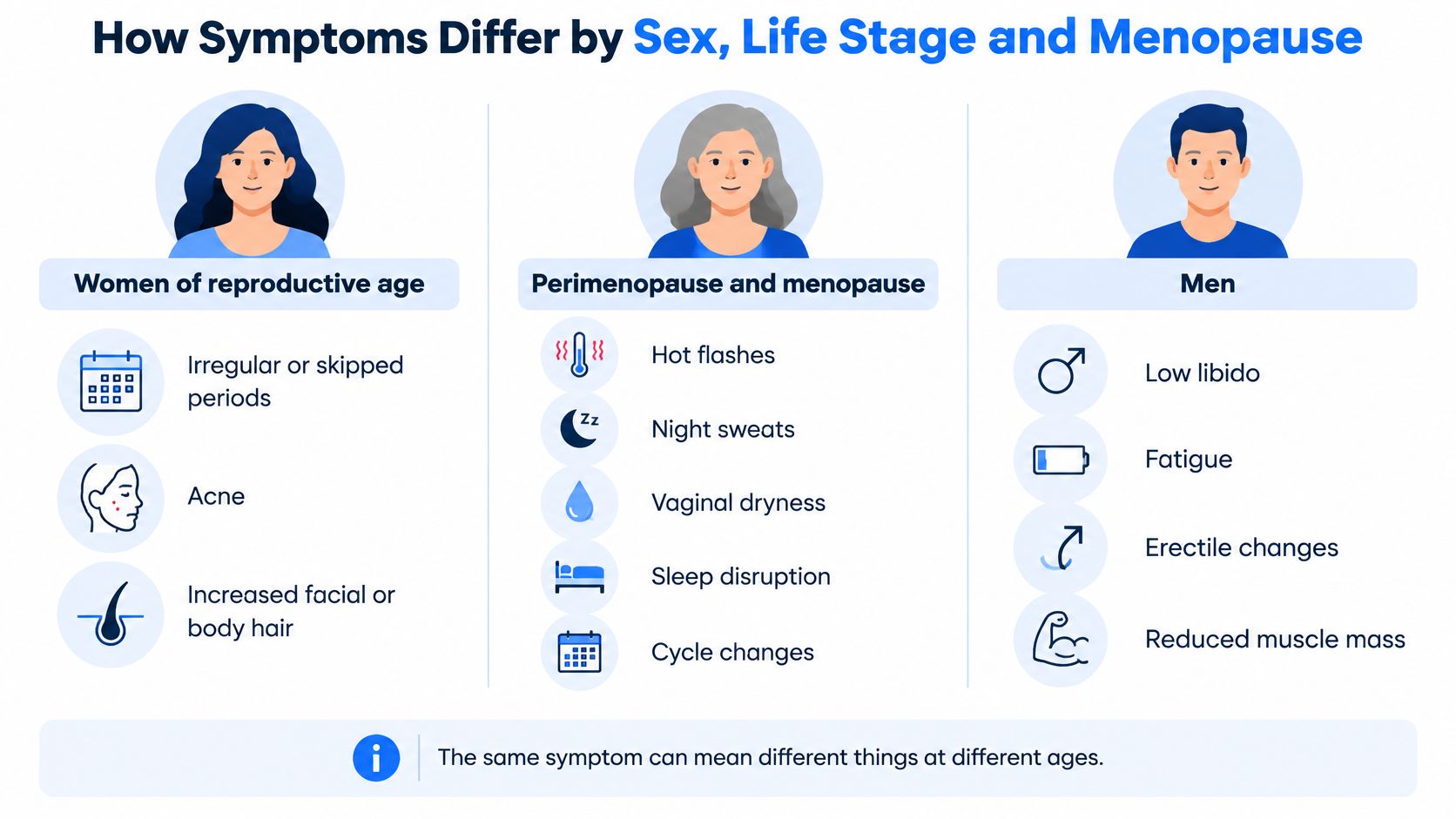
| Women of reproductive age with irregular cycles | Irregular or skipped periods, acne, increased facial or body hair | Raised androgens, often with insulin resistance |
| Women in perimenopause | Irregular cycles, hot flashes, sleep loss, mood shifts | Fluctuating estrogen and progesterone |
| Women after menopause | Vaginal dryness, urinary symptoms, sleep changes, lower mood | Sustained low estrogen |
| Men | Low energy, reduced libido, mood change, reduced muscle strength | Declining testosterone, with other causes to rule out |
The table describes patterns worth investigating, not changes everyone will experience. The same complaint can lead to different clinical questions depending on reproductive history, age and other symptoms.
Reproductive-age symptoms and PCOS
Irregular periods alongside acne or increased facial hair can suggest polycystic ovary syndrome, usually shortened to PCOS. Androgens are hormones that include testosterone; excess androgen activity can affect hair growth, skin and ovulation. However, unwanted hair or an irregular cycle alone doesn't establish PCOS.
The National Institutes of Health PCOS overview explains that many diagnostic approaches require at least two of three features:
- Irregular or absent ovulation, often reflected in skipped or irregular periods.
- Androgen excess, identified through laboratory findings or clinical signs such as increased facial or body hair.
- Characteristic ovarian follicles, identified on ultrasound.
A clinician also checks for alternative explanations. That matters because thyroid problems, medications and other reproductive conditions can produce overlapping complaints. An ultrasound finding by itself isn't a complete diagnosis, either.
Perimenopause is a changing pattern
During perimenopause, estrogen, progesterone and testosterone can fluctuate before settling at lower levels. Symptoms may therefore come and go rather than worsen in a straight line. NHS menopause and pain guidance gives a typical menopause age range of 45–55 and notes that approximately 1% of women experience menopause before age 40.
Menopause symptoms can be grouped into useful categories:
- Vasomotor symptoms include hot flashes and night sweats.
- Psychological symptoms include anxiety, irritability and low mood.
- Cognitive symptoms include forgetfulness and difficulty concentrating.
- Genitourinary symptoms include vaginal dryness, painful intercourse and bladder complaints.
Muscle and joint pain, reduced strength and weight changes may also accompany the transition. A hot flash can last from several minutes to approximately 30 minutes, sometimes with palpitations or chills, according to University College London Hospitals' menopause guidance.
Consider a hypothetical woman whose sleep worsens over six months, whose periods then become heavier and who subsequently develops hot flashes. That sequence supports considering perimenopause, but the heavier bleeding still needs its own assessment. A plausible hormone explanation shouldn't end the investigation prematurely.
For more detail about overlapping complaints, our guide to low estrogen and progesterone symptoms explains the reproductive-hormone connection. Readers researching treatment terminology can also consult Sunridge Medical's guide to bioidentical hormone options for perimenopause; a treatment label alone doesn't establish suitability or safety.
Men need a different assessment
In men, low energy, reduced libido, erectile changes and reduced muscle strength can prompt evaluation for low testosterone. Sleep problems, depression, medication effects and chronic illness can produce similar changes, so symptoms shouldn't automatically lead to testosterone treatment.
Before comparing yourself with any list of symptoms of hormonal imbalance, record your life stage and reproductive context. Include pregnancy possibility, menstrual changes, menopause history or current hormone use where relevant.
Hair Thinning, Weight and Irregular Periods
Hair loss can come from genetics, hormonal imbalances, aging, stress and medical conditions. More than one factor may be involved. The first useful distinction is whether you're seeing gradual thinning, increased shedding, broken hairs or discrete bald patches.
Weight and menstrual changes add context. Hair shedding after an illness suggests a different starting point from gradual scalp thinning accompanied by new facial hair and skipped periods. A clinician needs the whole pattern, not just a photograph of your part line.
When hair and cycle changes appear together
In a 2024 study of 249 women with PCOS, 72.3% reported menstrual irregularity and 54.2% reported hair loss, according to the study published in Revista da Associação Médica Brasileira. These findings show that hair and cycle complaints can coexist in people with PCOS. They don't mean that someone with those complaints necessarily has the condition.
Unexplained weight change deserves equally careful attention. Thyroid disease can alter metabolic activity, insulin resistance can affect weight regulation, and cortisol excess can produce a recognizable clinical pattern. Medication effects may also contribute, so weight change alone shouldn't be assigned to estrogen or testosterone.
A thorough hair-loss assessment usually includes:
- Family history and distribution, including gradual thinning at the crown or a widening part.
- Timing and triggers, such as recent illness, major stress, dietary restriction or a medication change.
- Scalp examination, looking for inflammation, patchy loss or evidence of breakage.
- Selected laboratory tests, when appropriate, to investigate thyroid disease, anemia or hormone-related causes.
Our expert team conducts evaluations to find the root cause of hair loss before creating a treatment plan. Our explanation of hormone imbalance and hair loss can help you describe the changes you're noticing.
Separate hair care from medical evaluation
Hair-shaft care and follicle health aren't interchangeable. ArtNaturals' guide to keeping hair color vibrant without sulfates addresses a cosmetic care question, not the diagnosis or treatment of hormonal shedding. A shampoo change shouldn't replace an assessment when hair loss accompanies systemic symptoms.
Record when thinning started, whether periods changed and whether weight moved without an intentional change in eating or activity.
Bring that record to a clinical visit within weeks rather than postponing for months if you have progressive thinning with skipped periods, new coarse facial hair or unexplained weight change. Sudden patchy loss, scalp pain or inflammation deserves prompt review because the cause may be unrelated to reproductive hormones.
Fatigue, Mood, Sleep and Libido Changes
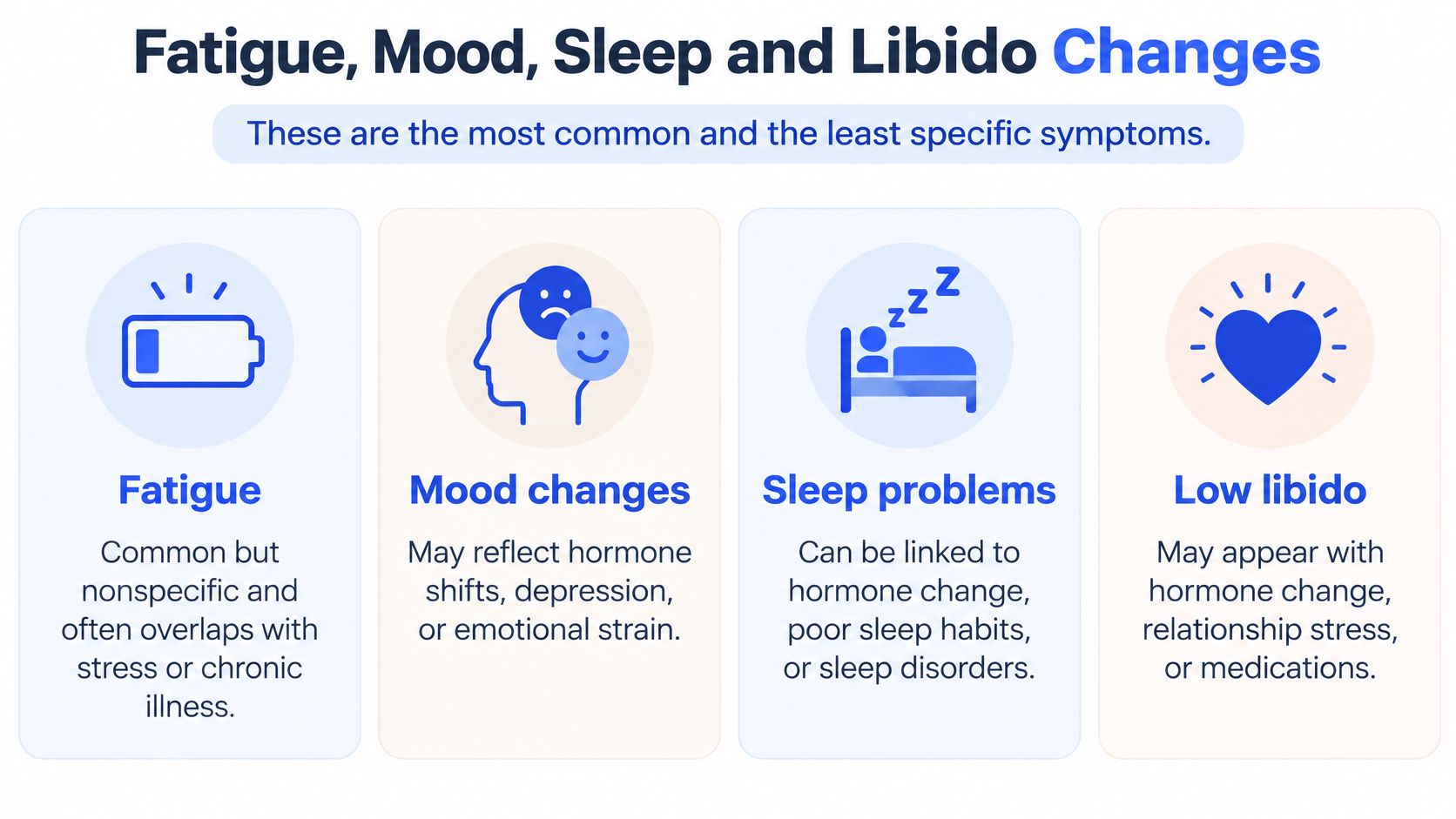
Could fatigue, mood shifts, poor sleep or reduced libido point to a hormone change? They can, but these symptoms are particularly nonspecific, so the details and timing matter more than any single symptom.
Distinguish fatigue from sleepiness
Fatigue means ongoing low energy or reduced stamina. Sleepiness is the urge to doze off. You may have one or both, and that difference helps clarify what to assess. Fatigue that persists despite time to rest, especially when it interferes with usual activities, is worth discussing with a clinician. It does not by itself establish low thyroid hormone or low testosterone.
Mood changes also need description, not just a label. Note whether you feel newly irritable, anxious, emotionally flat or less confident, and whether the change follows a cycle or continues throughout the month. Record when it began and how it affects daily life.
Identify what interrupts sleep and intimacy
Trouble falling asleep differs from waking drenched in sweat. The first describes difficulty getting to sleep; the second may be relevant when considering vasomotor symptoms at an appropriate life stage. Loud snoring, observed pauses in breathing or marked daytime sleepiness are also useful details to report.
For libido, separate desire, arousal and pain. Reduced desire means less interest in sex. Arousal concerns the body's response, while pain can make intimacy uncomfortable. Low testosterone may contribute to reduced desire, and estrogen-related vaginal dryness can make sex uncomfortable and lower interest indirectly. Identifying which change is present helps guide the evaluation: avoiding sex because of pain calls for assessment of discomfort, rather than an approach aimed only at increasing desire.
Check whether the symptoms cluster
A daily record can make a pattern easier for a clinician to see. Track when each symptom begins, how long it lasts and whether it recurs alongside cycle changes or another life-stage change. Include medication adjustments, too. If fatigue begins after a medication change but sleep disruption appears later, the timing may help distinguish one developing pattern from symptoms with separate onsets.
- Energy and mood: Note the effect on ordinary activities and whether symptoms come and go.
- Sleep: Record difficulty falling asleep, waking, night sweats or daytime sleepiness.
- Sexual changes: Distinguish reduced interest, arousal changes and discomfort.
- Cycle and life-stage context: Record bleeding changes and relevant medication adjustments.
Look for shared timing rather than a perfect match among symptoms. These notes cannot identify a hormone condition on their own, but they can help make an evaluation more focused. Other conditions can produce overlapping signs; the next table compares common look-alikes and the clues that help distinguish them.
Look-Alike Conditions That Mimic Hormone Symptoms
Thyroid dysfunction is a useful example of why symptom matching isn't enough. Excess thyroid hormone tends to accelerate bodily processes, producing weight loss, sweating, a fast heart rate and sometimes high blood pressure. Insufficient thyroid hormone can cause fatigue, weight gain, cold intolerance, dry or thinning hair, menstrual irregularity and depressed mood.
Thyroid disease is itself a hormonal disorder, but it requires a different evaluation from suspected ovarian hormone changes. The usual starting test is thyroid-stimulating hormone, or TSH, followed by free T4 and selected additional testing when indicated, consistent with the diagnostic approach described in ACOG's menopause-related clinical update.
Use a test to answer a specific question
A low TSH generally supports considering hyperthyroidism, while a high TSH generally supports primary hypothyroidism. These patterns still need interpretation alongside thyroid hormone levels, medications and the clinical situation. A result outside the reference range isn't a stand-alone treatment instruction.
For example, unexplained weight loss with heat intolerance and a racing pulse makes thyroid evaluation more relevant than an isolated estrogen measurement. Fatigue with cold intolerance and constipation suggests a different thyroid pattern. Both examples show why accompanying symptoms matter.

Look-alike conditions and the checks that separate them
| Look-alike condition | Overlapping symptoms | Check that helps |
|---|---|---|
| Thyroid disease | Fatigue, weight change, hair thinning, mood change | TSH first, then free T4, with T3 or antibodies when indicated |
| Anemia | Fatigue, hair thinning, breathlessness on exertion | Complete blood count and iron stores such as ferritin |
| Depression | Low mood, fatigue, sleep change, reduced libido | Clinical screening questionnaire and mood history |
| Sleep disorders | Fatigue, mood change, weight gain | Sleep history, with a sleep study when suspected |
| Medication effects | Fatigue, weight change, reduced libido, mood change | Full medication and supplement review |
Don't overlook a more direct explanation
Heavy menstrual bleeding with exertional breathlessness should prompt consideration of anemia. A complete blood count checks for anemia, while ferritin helps assess iron stores. Iron supplementation shouldn't be treated as a universal answer to hair loss or fatigue without understanding whether deficiency is present.
Depression also deserves direct assessment rather than being treated as a diagnosis of exclusion. A clinician can ask about enjoyment, motivation, concentration, sleep and safety while investigating possible medical contributors. Hormone changes and depression can coexist, so identifying one doesn't erase the other.
Medication review should include prescriptions, nonprescription sleep aids and supplements. Bring the actual list, including doses and start dates, rather than relying on memory. Don't stop prescribed medication abruptly to test a theory about its effects.
Decision guide: If your symptoms fit another condition more closely than a reproductive-hormone pattern, begin with the check that can distinguish that condition.
The goal isn't to rule out every possible illness at once. It's to prioritize the explanations that best fit your history and examination, then expand the investigation if needed.
What a Proper Hormone Evaluation Looks Like
A sound evaluation starts with your story, not a laboratory package. Your clinician needs to understand what changed, what else was happening and which findings would alter care. More testing isn't automatically more informative.
Build the evaluation in a useful order
Create a symptom timeline. Record approximate start dates, menstrual links and triggers such as illness or a change in work schedule. Timing helps separate a gradual life-stage transition from a new medical problem.
Review medications, supplements and recent illnesses. Include hormonal contraception, prescribed hormones and products marketed for energy or hormone support. These can affect symptoms, laboratory interpretation or both.
Check heart rate and blood pressure. These measurements can identify findings that need attention beyond a discussion of fatigue or menopause. The physical examination can also guide thyroid, scalp or bleeding-related assessment.
Choose targeted laboratory tests. Thyroid tests, a blood count or reproductive hormone measurements may be appropriate when they answer a specific question. When timing matters, the clinician should explain how the menstrual cycle, time of day or current treatment affects collection.
Interpret results alongside symptoms before treatment. An isolated result may not explain your complaint, particularly when hormone levels fluctuate. Agree on what the findings mean and how improvement or side effects will be assessed.
For hormone imbalance evaluations, our providers order detailed lab work to identify specific imbalances and build a targeted treatment plan. A thorough evaluation should still mean clinically purposeful testing, not assuming that every available hormone measurement is necessary.
Why typical menopause care may not need hormone levels
ACOG's menopause management guidance states that most patients with typical menopause symptoms don't require ancillary serum hormone testing, and treatment dosing should generally follow symptom relief and individualized risk assessment. During perimenopause, a single measurement may capture a temporary fluctuation rather than explain the overall experience.
If systemic menopausal hormone therapy is being considered, the assessment includes age, time since menopause, cardiovascular risk, blood-clot risk, breast-cancer history, uterine status and contraindications. These are treatment-safety questions, not just questions about whether estrogen is low.
People with a uterus generally need an appropriate progestogen alongside systemic estrogen to protect the uterine lining. People without a uterus generally use estrogen alone. The distinction doesn't mean every local vaginal estrogen treatment follows the same prescribing rules, so the exact formulation matters.
Each of our offices offering wellness services is staffed by providers trained in functional medicine, hormone optimization and weight management. Our guide to hormone imbalance and fatigue offers additional context for discussing persistent low energy.
Laboratory tests are tools within an evaluation. They're most useful when the clinician can explain what question each test answers and what would change based on the result.
When to Book an Evaluation and Your Next Step
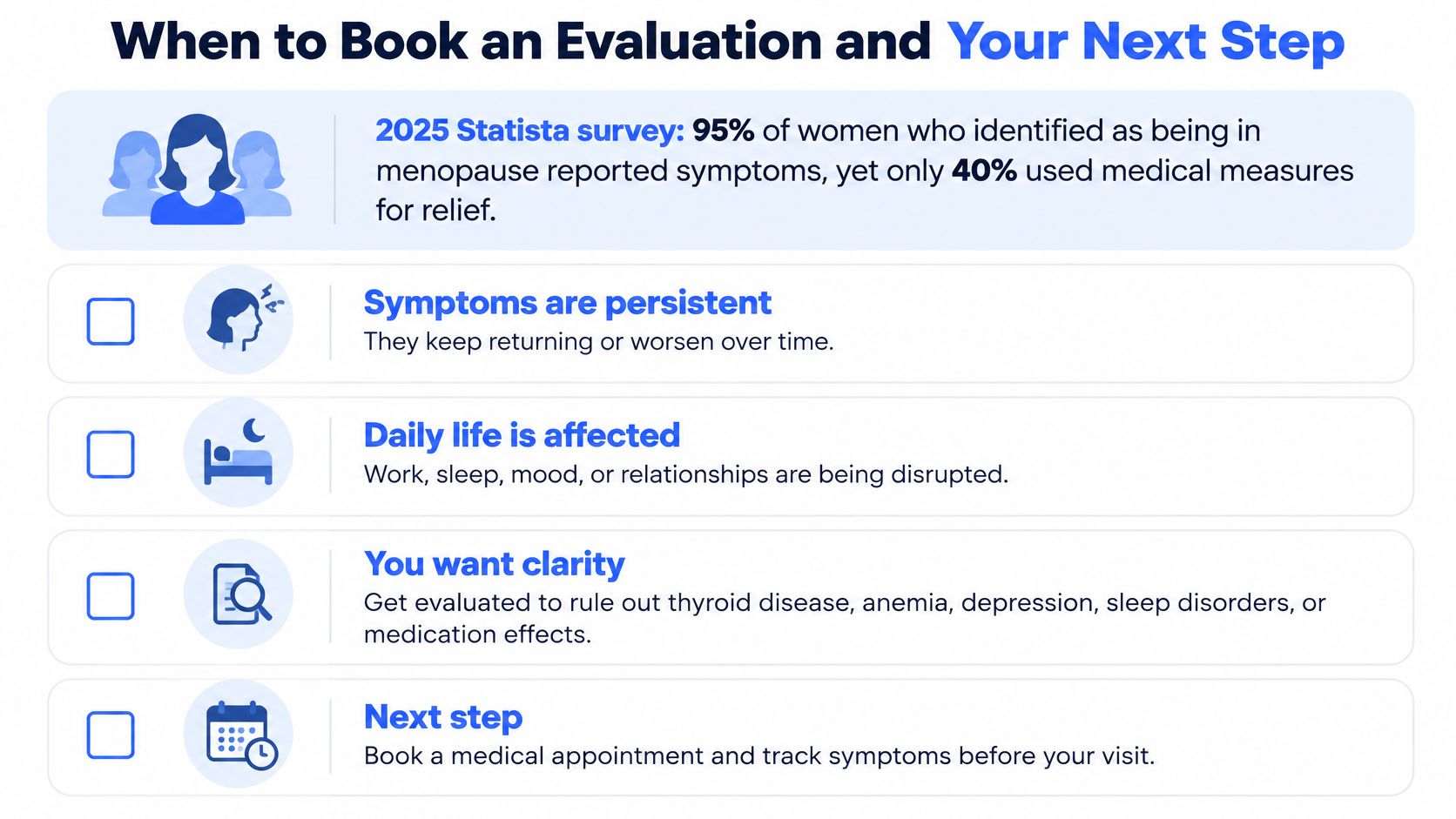
You don't have to wait until symptoms become intolerable to seek help. A 2024 survey published by Statista in 2025 found that 95% of women who self-identified as being in a phase of menopause reported symptoms, while only 40% used medical measures for relief, according to Statista's menopause symptom-relief summary. If symptoms keep disrupting daily life, an evaluation can help distinguish a hormone-related pattern from another cause.
Signs that deserve timely attention
- Disrupted daily life, including symptoms affecting work, sleep or relationships for several weeks.
- Rapid unexplained weight change, especially with weakness, thirst, sweating or other new symptoms.
- Heavy bleeding or any bleeding after menopause, which needs assessment rather than an assumption that it's hormonal.
- Sudden hair loss in patches, particularly with scalp pain, redness or inflammation.
- A fast or irregular heartbeat, especially if it's new or recurrent.
- Persistent low mood, loss of interest or difficulty functioning.
Some symptoms need urgent care rather than a routine appointment. Seek immediate help for thoughts of self-harm, chest pain, fainting, severe breathlessness or heavy bleeding accompanied by dizziness or weakness. A new rapid heartbeat with these symptoms also needs urgent assessment.
Your background shouldn't determine whether you receive care
The Society for Women's Health Research menopause factsheet reports that average vasomotor symptom duration differs across populations: about 10 years among African American women, 8.9 years among Hispanic women and 6.5 years among non-Hispanic White women. These figures don't explain any one person's symptoms. Social stress, discrimination, working conditions and unequal access to care may also contribute.
Your symptoms deserve attention regardless of your background or whether they match someone else's experience. For a useful appointment, note how symptoms affect your daily activities and ask what follow-up is appropriate if they continue. Persistent sleep disruption, mood changes, hot flashes, vaginal symptoms or cognitive complaints are reasons to start that conversation.
Arrive with the information that helps
Bring a symptom timeline, medication and supplement list, and any recent laboratory results. Choose the change that matters most to you, such as disrupted sleep or new bleeding, so the clinician can focus the discussion.
ProMD Health offers Hormone Optimization Therapy, Menopause Management, Weight Management and Hair Loss services. Providers order lab work to identify specific hormone imbalances and build a targeted treatment plan. Confirm which services are available at your chosen office before booking. The complimentary aesthetic consultation is a separate offer, so ask whether it applies to the evaluation you need.
A clear next step is to arrange an evaluation and bring your notes, medication list and questions. Visit ProMD Health to check the appropriate service at your preferred office.