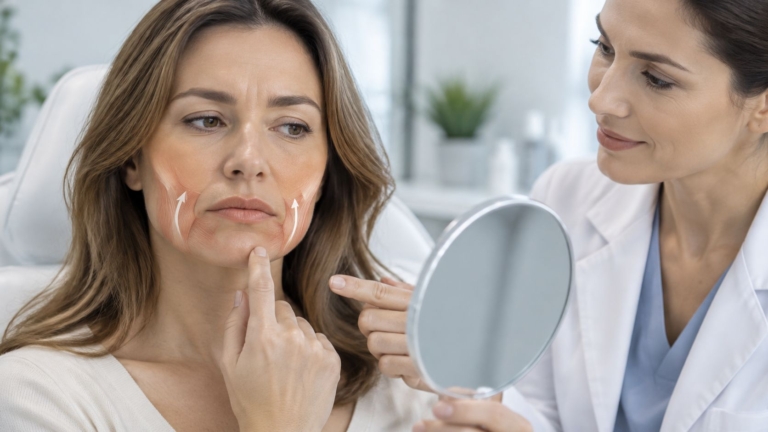
Crow's feet Botox lasted a median of 120 days, about four months, before wrinkle severity returned to baseline in a large placebo-controlled trial. Treat that as a planning benchmark. The effect usually fades like a dimmer switch: movement returns first, etched lines later.
So define “lasting” before counting days. You may see the outer-corner muscle move while the skin still looks smoother, or notice a fixed crease even though the treated area stays relaxed. Track movement and line visibility separately, and a quick mirror check becomes more useful than one expiry date.
Table of Contents
- Typical Crow's Feet Botox Duration at a Glance
- Aftercare Habits That Help Results Last
- Week-by-Week Timeline From Injection to Fade
- Factors That Shorten or Extend Your Results
- Judging Whether Your Lines Are Coming Back
- Plan Your Next Treatment Around the Four-Month Mark
Typical Crow's Feet Botox Duration at a Glance
Behind the four-month benchmark sits a specific measurement. A multicenter, randomized, placebo-controlled study of 162 participants receiving 24 units of onabotulinumtoxinA for crow's feet, also called lateral canthal lines, found a median return to baseline severity of 120 days, about 17 weeks.
Two words in that finding carry most of the meaning. "Median" is the midpoint of the measured results, not a personal guarantee. And the endpoint was a full return to pretreatment severity, a stricter bar than the first hint of movement returning or a faint crease reappearing in your mirror.
Other trials and professional bodies measured the effect differently, so reported durations form a range rather than a single number.
Reported Botox duration for crow's feet by source
| Source or study | What it measured | Typical duration |
|---|---|---|
| Multicenter randomized placebo-controlled study, 24 units onabotulinumtoxinA, 162 participants | Median return of crow's-feet severity to baseline | 120 days, about 17 weeks |
| A second clinical study of onabotulinumtoxinA | Median response, scored by investigators and by participants | A similar median span |
| Follow-up data, investigator assessment | Response duration across studies and line types | Roughly four months |
| Follow-up data, patient assessment | Response duration as judged by participants | Longer than the investigator-judged span |
| American Academy of Dermatology | Typical improvement | Several months, sometimes longer |
| American Academy of Ophthalmology | Typical effect | Several months |
Read the table as different yardsticks, not competing promises. An investigator may grade photographs on a standardized wrinkle scale, while a participant judges whether their eyes still look smoother in daily life. Patients tended to credit their results for longer than clinicians did. Studies also score two separate things: lines that appear while you smile, called dynamic lines, and lines that remain when your face is relaxed, called static lines. A simple home check borrows that logic. Note when squinting or smiling first brings the crinkling back, then note when the creases stay visible at rest.
Onset isn't the same as duration
When treatment starts working and how long the improvement lasts are separate questions. For a plain-language introduction to that distinction, Bonna Beauty's explanation of when wrinkle treatment results appear offers useful context.
Botox reduces muscle contraction temporarily; it does not erase skin aging. As nerve-muscle signaling recovers, expression returns gradually, more like a dimmer fading up than a switch flipping. The surrounding skin then folds more readily again.
Use the four-month mark to plan a review, not to grade your result. Your injector can shift that window based on your movement, line depth, past response, and goals.
Aftercare Habits That Help Results Last
Good aftercare protects the treated area and helps you recognize problems promptly. It shouldn't be sold as a proven way to add extra months to Botox's effect.
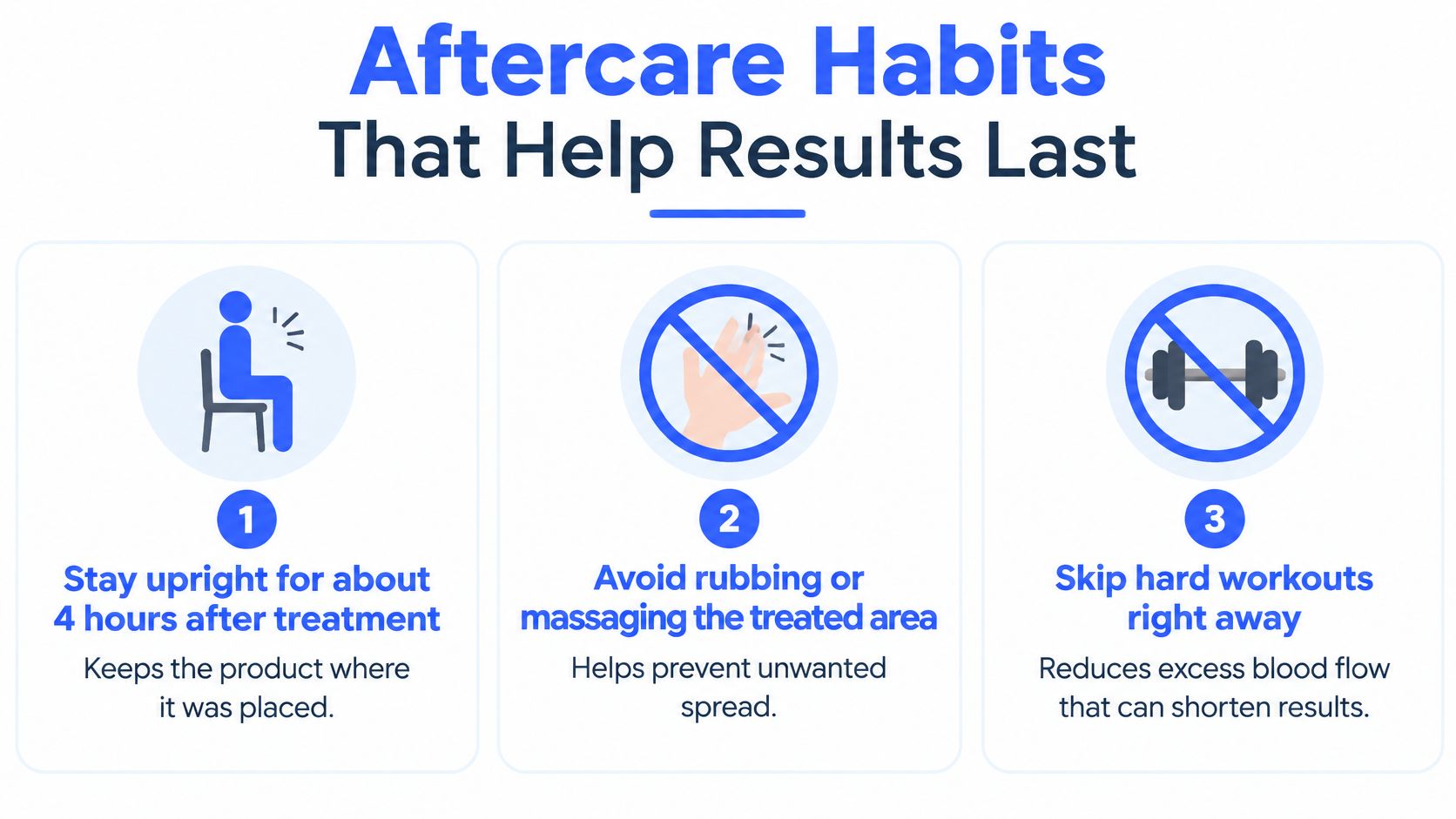
Your injector's written instructions take priority over general advice. Practices differ in their recommendations about posture, exercise, and heat, and the clinical duration studies don't establish that these restrictions prolong crow's-feet results.
Follow a gentle post-treatment routine
- Follow posture instructions. If your injector advises remaining upright and avoiding lying flat after treatment, follow the interval they give you rather than adopting a different schedule online.
- Leave the injection sites alone. Avoid rubbing, massaging, or pressing the treated area while following your provider's aftercare plan.
- Ask about exercise and heat. Confirm when you can resume strenuous workouts, saunas, hot tubs, and very hot baths; don't assume that sweating automatically makes Botox wear off.
- Protect the surrounding skin. Use daily sun protection and a gentle moisturizer to support skin quality, recognizing that skincare doesn't control nerve-muscle recovery.
- Keep your follow-up arrangements. A review lets your injector assess your response rather than leaving you to decide whether an uneven result needs treatment.
For everyday skincare habits, the skincare mistakes explained by Skinsation Aesthetics can help you review your routine without confusing skin maintenance with neurotoxin longevity.
Know when to contact your provider
Tell your injector promptly about eyelid drooping, brow heaviness, or an uneven smile. These changes need assessment, not additional massage or an attempt to correct the result yourself.
The practice's Botox safety guidance is another resource to review before treatment. Seek urgent medical care for difficulty swallowing or breathing.
Aftercare perspective: Gentle habits support recovery and skin appearance. They can't guarantee a longer biological response to Botox.
Week-by-Week Timeline From Injection to Fade
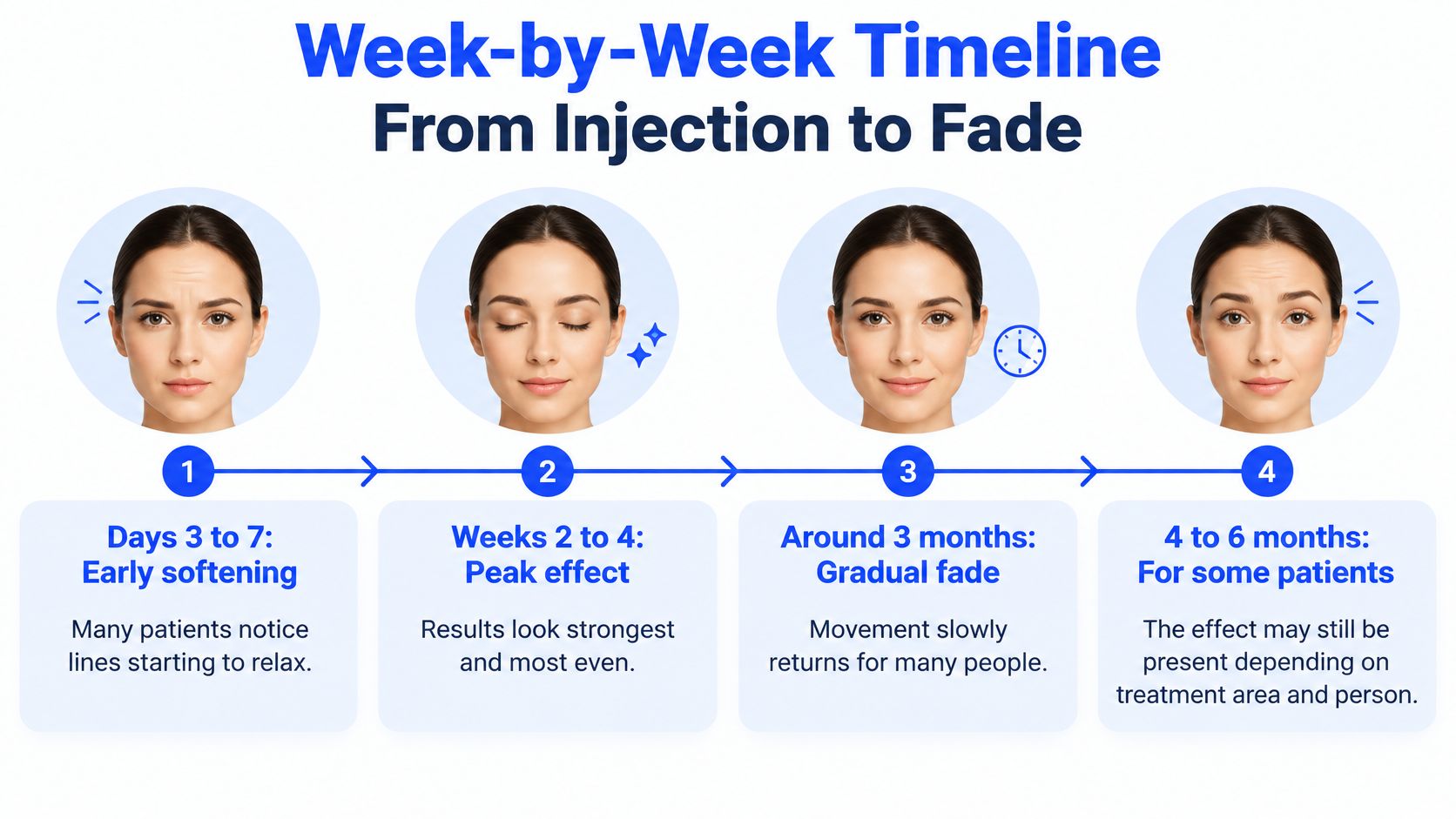
On day 3 after crow's-feet treatment, the mirror rarely shows a dramatic difference. Early changes are subtle, and comparing today's face with your memory of yesterday's is an unreliable way to measure progress. A better method is a pair of photos: one at rest, one smiling, taken in the same light each week.
The gap between first softening and full effect showed up clearly in a randomized, controlled dose-response study, where the strongest measured response occurred at approximately 2 weeks with 15 or 30 units, compared with approximately 4 weeks with 45 units. Those doses were chosen to measure response under trial conditions; your injector selects a dose suited to your anatomy.
Botox crow's feet timeline from injection to fade
| Time after injection | What you typically notice | What to do |
|---|---|---|
| Days 3 to 7 | Early softening; many patients notice change | Take comparison photos at rest and while smiling, ideally alongside pretreatment photos |
| Days 10 to 14 | Reassessment point for under-response or asymmetry | Arrange a check-in if results look uneven |
| Weeks 2 to 4 | Peak-response window; measured peak timing differed by dose in the trial | Avoid declaring the final result too early |
| Weeks 4 to 8 | Sustained strongest-effect period in the randomized trial | Compare the settled result with your baseline |
| Weeks 16 to 17 | Approximate median return to baseline in the placebo-controlled trial | Assess whether another treatment is appropriate |
| Months 4 to 6 | Some patients retain benefit; movement may return unevenly | Base retreatment on assessment, not a fixed expiration date |
Interpret the changes in order
Early on, look for softer folding when you smile rather than an entirely motionless eye area. A natural smile still involves movement, and some remaining motion does not mean the treatment failed.
Once the result settles, compare both sides under the same expression. If one side looks different, contact your injector; facial anatomy and baseline asymmetry can mimic under-treatment.
Fading follows the same gradual pattern. Small changes in line visibility usually appear before your face resembles its pretreatment photos, which is why treatment can feel finished while part of the benefit remains. Judging by movement and visible lines gives a clearer signal than counting weeks on a calendar.
The practice's explanation of how long Botox takes to work can help separate an early response from a settled outcome. Let that timeline inform your expectations, and leave dose decisions to your injector.
Factors That Shorten or Extend Your Results
Dose and placement shape how long your result lasts. In the dose-response trial covered in the timeline, higher-dose groups reached stronger measured responses at the comparison visit, yet that finding does not establish that a larger dose produces a proportionate increase in personal duration.
Your injector balances wrinkle softening against eyelid function, natural expression, and your anatomy. Near the eyes, precise placement matters as much as the amount selected.
Factors that change how long crow's feet Botox lasts
| Factor | Effect on duration | What it means for you |
|---|---|---|
| Dose and placement | Higher study doses produced stronger response rates at the comparison visit, not a guaranteed personal duration | Ask your injector to explain the planned dose and injection sites |
| Muscle strength and squinting | Strong or frequent contraction can make residual movement noticeable sooner | Observe squinting rather than assuming the product has disappeared |
| Metabolism and recovery | Individual nerve-muscle recovery can produce shorter or longer benefit | Use your treatment history rather than a predicted expiration date |
| Age | Controlled trials reported higher response rates in younger adults | Discuss age-related expectations without treating age as a countdown |
| Line depth at rest | Static creases can remain after muscle activity decreases | Separate residual skin creasing from returning muscle movement |
| Injection technique | Anatomically precise placement helps limit unwanted spread | Choose a qualified medical injector |
Separate visible fading from biological recovery
The ring-shaped muscle around the eye, the orbicularis oculi, contracts during smiling and squinting. Strong contraction can make remaining movement easier to see; it doesn't prove that you've metabolized the treatment unusually quickly.
Recovery works like a dimmer switch rather than an on-off switch. The systematic review of randomized trials that placed peak benefit between weeks 4 and 8 describes a gradual fade, the same settling pattern the week-by-week timeline walks through. A little returning movement is part of that slope, not evidence of a sudden failure.
Individual neuromuscular recovery also matters. There isn't a routine consultation test that can tell you the exact day your result will fade, so keep notes on your own response instead of relying on claims about having a fast metabolism.
Dose discussion: Ask what the injector is trying to achieve with the proposed placement and amount, rather than how many units will last longest.
Product choice deserves a separate conversation. The practice's overview of the difference between Botox and Dysport can help you prepare questions, but don't transfer a dose or duration estimate from one product directly to another.
Of the factors you can observe yourself, squinting and visible muscle activity are especially useful. Record what you see and let your injector interpret it alongside the treatment plan.
Judging Whether Your Lines Are Coming Back
A crease in the mirror can appear for several reasons, so treat it as a prompt to check pattern and movement before deciding that Botox has worn off. The better test combines your expression, your relaxed face, and a fair comparison with how you looked before treatment.
The duration table near the start separates investigator-assessed and patient-assessed endpoints. That difference matters at home: a clinician may detect a small return of muscle activity while you still look smoother in ordinary light, and your own satisfaction can remain high during that early shift.

Use a three-signal home check
- Check movement during a normal smile. Look for renewed folding at the outer eye during the expression you make in photos, instead of forcing an exaggerated squint.
- Relax your face completely. Notice which lines remain without expression and whether they have changed since your settled treatment result.
- Compare pretreatment severity. Use photographs taken from the same angle, in the same light, with the same expression.
Repeat the comparison every few weeks and keep the setup boringly consistent: same camera distance, same window or lamp, no smoothing filter, same smile. A useful clue is whether the same lines are returning in the same places, like tracks reappearing along a familiar path, while nearby skin still looks smoother.
Understand what each signal means
Dynamic lines appear with movement. Static lines remain at rest because the skin itself has developed persistent creasing.
For example, someone with deeper etched-in lines may still see them after smiling becomes less forceful. Botox reduces muscle activity; it does not fully reverse collagen loss, photodamage, or pigmentation. If only squinting creases are returning while rested skin stays relatively smooth, that points toward recovering movement. If the resting crease itself is deepening, skin quality may be contributing as well.
Age and starting line depth therefore affect what a satisfying result looks like. Compare like with like: your relaxed face with your relaxed face, your smile with your smile, and your current photos with pretreatment photos rather than someone else's expression.
Fading shows up as returning movement and line visibility, which you can track over time.
Bring your photo comparisons to your appointment. They give your injector something more specific than “I think it stopped working” and help separate returning muscle activity from a skin-quality concern that calls for a different plan.
Plan Your Next Treatment Around the Four-Month Mark
A useful maintenance plan leaves room for your actual response. Schedule a review near the expected fading window, then decide with your injector whether returning movement and lines justify another treatment.
The professional guidance summarized alongside the FDA BOTOX Cosmetic prescribing information supports a planning range of approximately 12 to 16 weeks: the American Academy of Dermatology describes 3 to 4 months, sometimes longer, while the American Academy of Ophthalmology gives a broader 3 to 6 months. Plan around the shorter end and treat any extra persistence as a bonus.
Make the booking decision specific
Walk into the review knowing which of four situations describes you. If the result still looks satisfactory, ask whether treatment can wait instead of rebooking on calendar autopilot. If movement and lines are clearly back, arrange an assessment and bring your comparison photos. If the first result looked uneven, use the early reassessment window rather than holding out for routine maintenance. If you develop heaviness or drooping at any point, contact your provider promptly, because that pattern differs from ordinary fading.
Your injector should also separate a maintenance request from a request for a stronger result. A maintenance request sounds like "the lines that disappeared are back," and it usually calls for repeating what worked. A stronger-result request sounds like "I want this deep crease erased completely," and it needs a different conversation, since a crease that stays visible at rest reflects changes in the skin itself that more units of neurotoxin will not fix.
Budget for a personalized schedule
ProMD Health provides neurotoxin treatment for crow's feet as a cash-pay service. Ask for your proposed treatment cost before proceeding, and budget per visit without assuming that every future appointment will involve an identical plan.
When asking "how long does Botox last for crow's feet," aim for an answer that includes your expected response, how you'll assess fading, and when your provider wants to review you. That combination serves you better than a duration estimate alone.
ProMD Health offers neurotoxin treatments including Botox, Dysport, and Daxxify, with consultation to assess crow's-feet movement and line visibility. Visit ProMD Health to arrange a provider consultation, bring your comparison photos, and discuss an individual maintenance schedule and cash-pay treatment plan.