Could the crease itself be the cause, or is it a clue to the movement beneath your skin? Bunny lines often appear where facial movement pulls skin across a muscle-free gap, so treating the visible fold alone may miss what creates it. The movement pattern matters: it helps explain why a treatment aimed at muscle activity, skin quality, or both may change the lines differently. That distinction is a useful starting point for understanding bunny lines.
Table of Contents
- What Bunny Lines Are and Where They Appear
- Muscles, Skin and the Gap Between Them
- Why Bunny Lines Deepen With Age
- Treatment Options and What Each One Targets
- How a Neuromodulator Treatment for Bunny Lines Is Planned
- Laser and Skin-Care Options for Etched Bunny Lines
- Aftercare and What to Expect Week by Week
- Confirm Your Plan Before You Book
What Bunny Lines Are and Where They Appear
Bunny lines are short creases beside the nasal bridge, running vertically or diagonally. They're named for the way a rabbit twitches its nose. You'll find them between the inner corner of the eye and the bridge of the nose, which makes them distinct from frown lines between the brows and crow's feet at the outer eye.
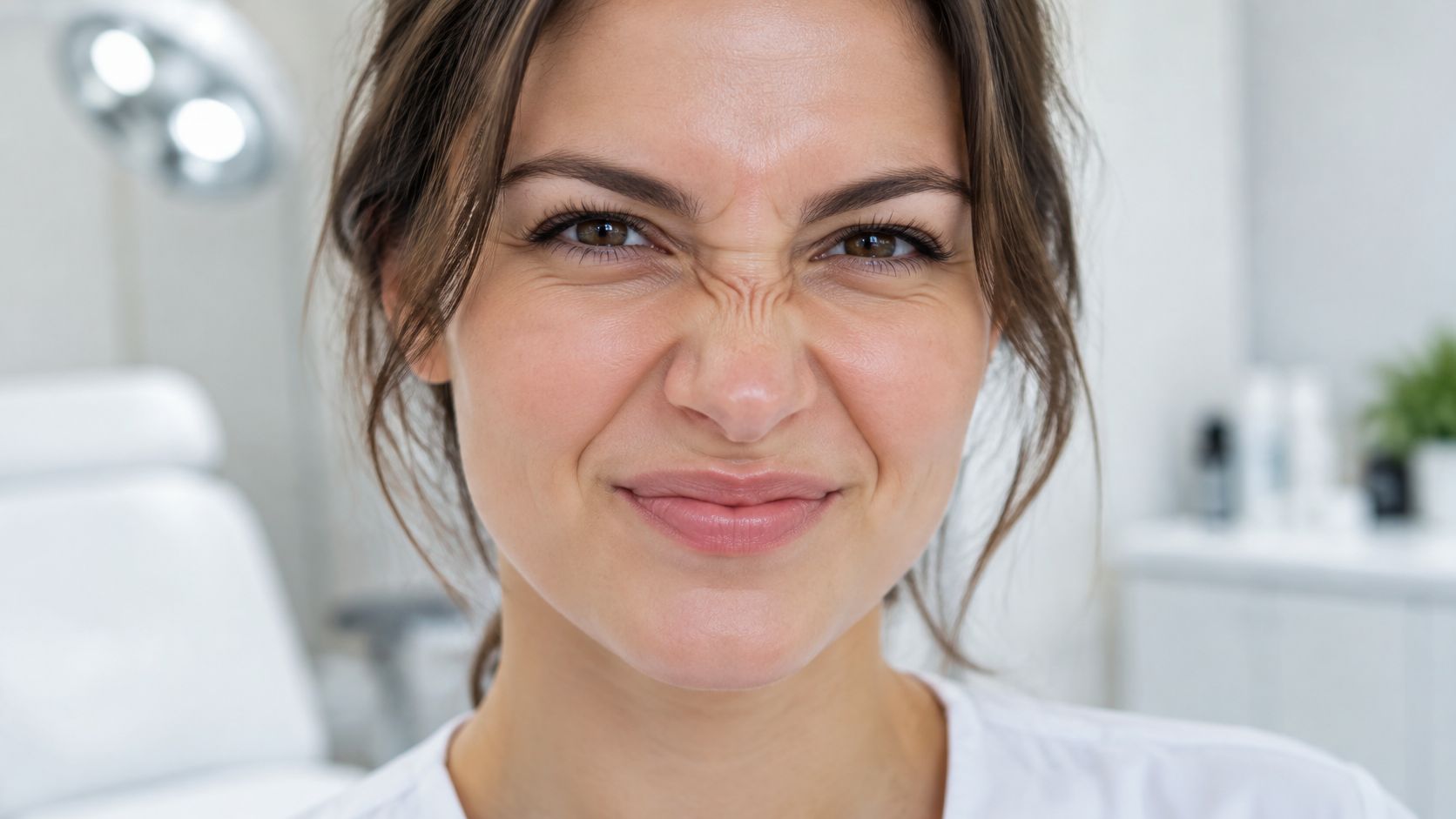
They don't all look alike. A 2025 consensus on dynamic nasal wrinkles identified three components, midline vertical lines, lateral oblique lines, and horizontal radix lines. Some people show one form clearly, others show a mix.
Think of cloth pinched between your fingers. The fold appears where the pull meets, not necessarily where your fingers are. Skin works in a similar way here. Anatomical research in the 2025 Wiley study of the bunny triangle used ultrasound in 13 adult volunteers and dissections on 39 cadavers and consistently identified a muscle-free area between the medial eye corner and nasal bridge.
A quick mirror check
Scrunch your nose and note where lines appear. Then relax completely.
- Lines fade at rest: These are dynamic lines, visible mainly during movement.
- Lines stay at rest: These are etched lines, and they behave differently.
That simple distinction shapes every treatment decision that follows.
Muscles, Skin and the Gap Between Them
Bunny lines form through a chain of events, not a single contraction. Several muscles around the nose contract during smiling, sneering, squinting, or scrunching. Those muscles pull the nearby skin toward them. The fold then forms over the space between them.
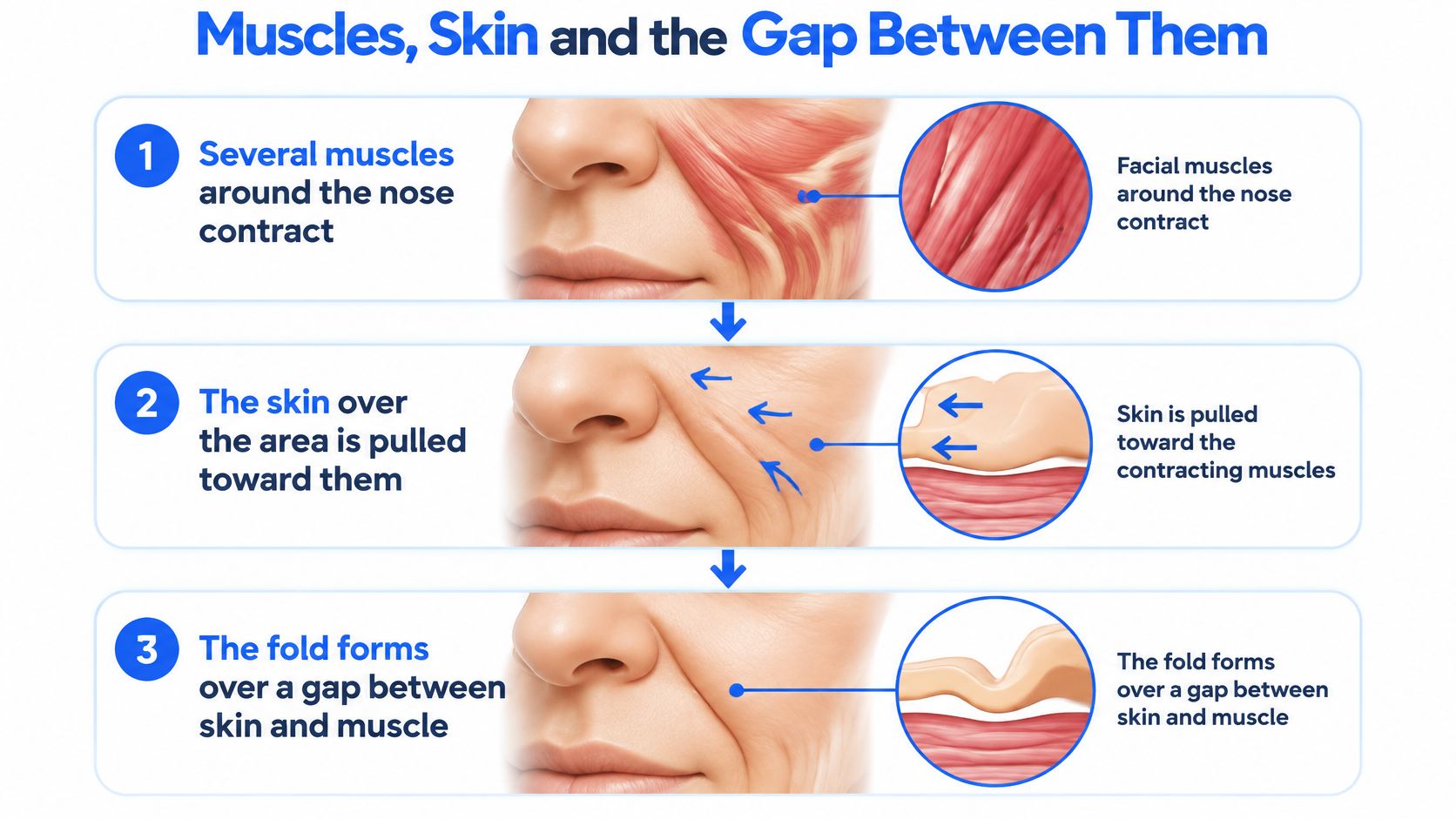
That space is the bunny triangle, a non-muscular interval bordered by muscles on each side. Its size and shape change with the width of the procerus and nasalis, so two people can make the same expression and produce lines in slightly different places. One person's crease sits higher, another's angles more steeply.
Older teaching blamed the transverse nasalis alone. That muscle does matter, but it doesn't explain every pattern. An anatomical review of nasal dorsum wrinkles describes oblique wrinkles extending along both sides of the nasal dorsum at approximately a 45-degree angle, with the levator labii superioris alaeque nasi (LLSAN) considered a primary contributor and the medial orbicularis oculi a secondary contributor.
Facial motion work adds another wrinkle. In some people there's little skin displacement directly over the nasalis, with greater movement coming from the LLSAN. The dominant muscle varies, so assuming a nasalis-only cause leads to a one size plan for a problem that isn't one size.
Watch the direction of the pull while the nose is moving, not just where the crease sits when the face is still.
A useful assessment is therefore dynamic. A provider asks you to scrunch, smile, and squint, then observes which borders tighten and which way the skin travels. That observation, rather than the resting photo, tells them where treatment would need to act and which nearby structures to leave alone.
Muscles and Structures Involved in Bunny Lines
| Structure | Role in bunny lines | Why it matters for treatment |
|---|---|---|
| Transverse nasalis | Compresses the nostrils and pulls nasal skin medially | Major contributor and a common target for treatment |
| Levator labii superioris alaeque nasi (LLSAN) | Lifts the upper lip and nasal wing, pulling skin on the sidewall | Can be a primary or secondary contributor; injections too close to the nasolabial fold can affect it |
| Medial orbicularis oculi | Closes the eye and pulls skin near the inner corner | Contributes to diagonal lines; spread of toxin can affect eyelid position |
| Procerus | Pulls the skin between the brows downward | Contributes to midline vertical lines |
| Bunny triangle | Muscle-free zone between the inner eye corner and nasal bridge | The visible crease may sit over this area, so injecting the crease itself can give less predictable results |
Why Bunny Lines Deepen With Age
Fold a letter, unfold it, and the crease remains faintly visible. Fold it in the same place hundreds of times and the line becomes permanent. Skin responds in a similar way when the same expression repeats for years.
Facial muscles don't just sit under the skin. A peer-reviewed review of facial aging notes that facial mimetic muscles insert into the dermis, where they influence the suspension and structural integrity of the soft-tissue envelope. Because the attachment is direct, repeated contraction shapes the surface and the structure beneath it.
From movement line to etched line
Early on, the crease appears only while you're scrunching or smiling. The skin still springs back. Over time, cumulative contraction, loss of elasticity, and reduced collagen support mean it doesn't fully smooth out. The line begins to show at rest.
Several factors speed that transition:
- Years of repeated expression: More folding in the same place deepens the groove.
- Sun exposure: Ultraviolet light damages collagen that helps skin rebound.
- Smoking: Reduced blood flow and protein damage weaken skin quality.
- Dry, thinning skin: Less plump skin shows surface lines more readily.
Don't assume this is only a later life issue. Younger adults who scrunch habitually, squint in bright light, or animate strongly when they laugh can develop noticeable lines early. Age makes lines more persistent, but habit and anatomy decide who gets them first. The key point is that a line that disappears at rest is a movement problem, while a line that stays is partly a skin structure problem.
Treatment Options and What Each One Targets
Which treatment fits depends on what is creating the line, what you want to change, and whether other facial areas are part of the same plan. Three questions help narrow the choice: Does the crease appear only with movement, or remain at rest? Is skin texture also a concern? Are you considering treatment for the forehead, brows, or crow's feet as well? Each option works at a different level, much like choosing whether to address a moving hinge or the surface around it.
Bunny lines often appear alongside other expression lines. In a 2020 single-center retrospective review, 189 patients received full-face and neck treatment with onabotulinumtoxinA. Across 394 treatment sessions, bunny lines were treated in 283 cases, or 71.8% of sessions. This shows they can be considered as part of a broader treatment plan, rather than in isolation.
Treatment response can vary. A review of 250 patients who each received 3 units of Botox Cosmetic on both sides of the nasalis found that 40% had satisfactory improvement from the initial injections at one month, according to the review of bilateral nasalis treatment. When a neighboring muscle contributes to the crease, treating the visible line alone may leave it largely unchanged. The movement pattern matters because the crease can form over a muscle-free gap.
For broader context on how lines change with age, Mesoderm RX on visible skin aging discusses changes in visible lines. A comparison of Botox and dermal fillers can also clarify why a treatment that changes muscle movement is not interchangeable with one that adds volume.
Bunny Line Treatment Options Compared
| Option | Best for | Downtime | Main limitation |
|---|---|---|---|
| Neuromodulator injections (Botox, Dysport, Daxxify) | Dynamic lines that appear with nose-scrunching | Usually none; minor bruising possible | Softens movement but does not refill etched creases |
| Medical-grade skincare (retinoids, antioxidants) | Surface texture and early etching | None | Modest effect on deep static creases |
| Chemical peels and microneedling | Fine lines and uneven texture | Mild redness; duration varies | Limited effect on deep, static creases |
| Laser resurfacing | Etched lines and texture | Depends on laser type; redness and peeling may last for days | Results depend on skin type and line depth |
How a Neuromodulator Treatment for Bunny Lines Is Planned
Good planning starts before any injection. Your provider should screen for pregnancy or breastfeeding, neuromuscular conditions, eyelid or upper lip concerns, and current medications. These factors determine whether treatment proceeds at all and how conservatively it's dosed.
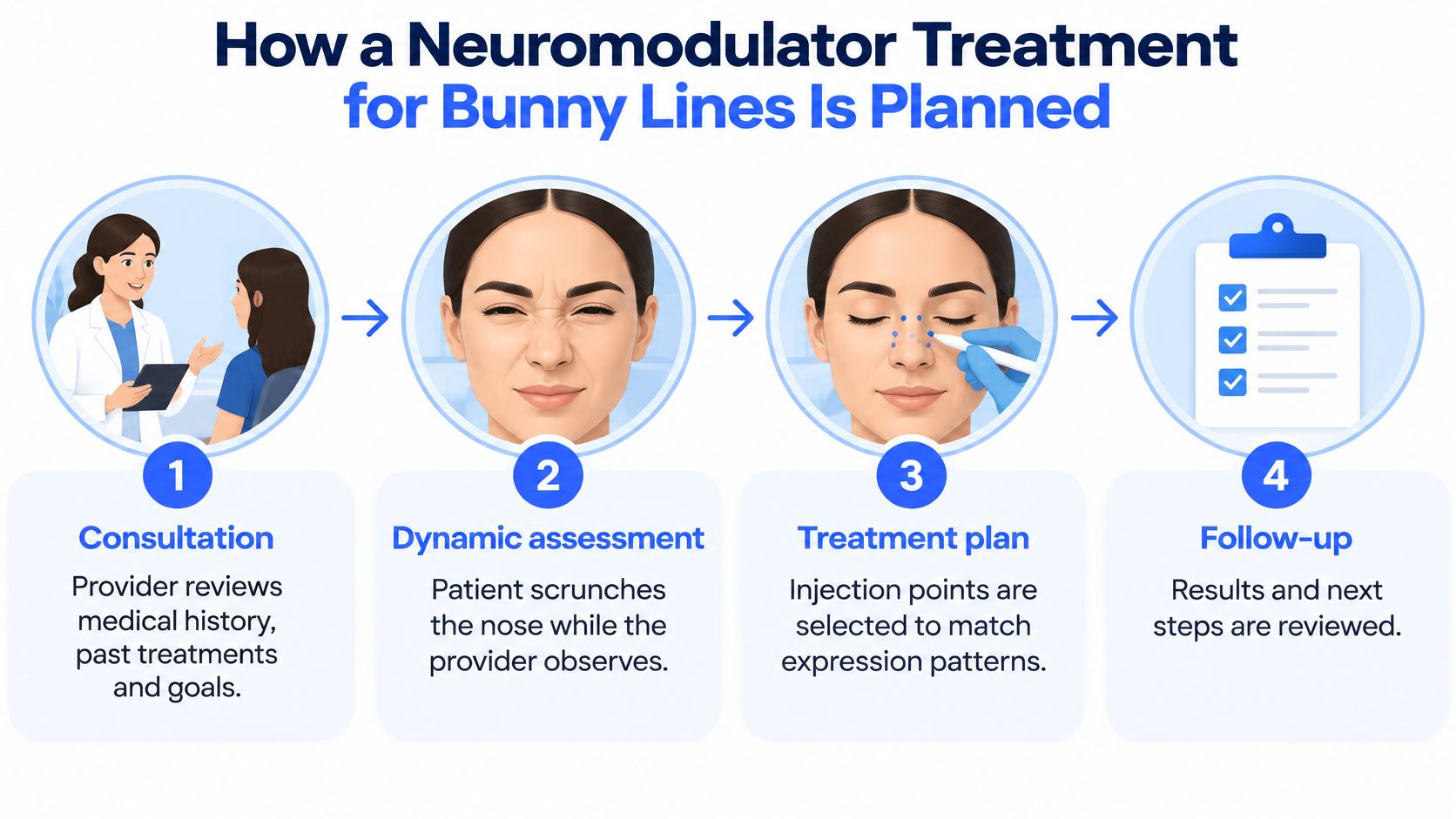
- Consultation: Your provider reviews medical history, past treatments, and goals. Bring notes on previous products and how long results lasted, since that history informs product choice.
- Dynamic assessment: You scrunch your nose while the provider observes direction and depth. This step identifies which muscle borders are driving your fold.
- Landmark mapping: The provider marks the lateral nasal sidewall, nasofacial groove, and nasolabial fold. Mapping keeps product away from the upper lip elevator.
- Conservative dosing: A published treatment discussion in Cosmoderma reports that approximately 2 to 5 units may be placed superficially on the lateral nasal sidewall, medial to the nasofacial groove. Starting low protects normal expression.
- Injection technique: Placement stays superficial, with careful depth and distance from the nasolabial fold. Injections too close to that fold can affect the LLSAN and cause upper lip ptosis.
- Follow-up: You review the result at about two weeks and discuss a touch-up if needed. Book this review at your treatment visit rather than arranging a separate check later.
Dosing caution: Units aren't interchangeable across toxin products, so a number quoted for one formulation can't be copied to another.
If it's your first appointment, reading about what to expect at a first Botox visit helps you prepare sensible questions. The aim throughout is softer lines during movement, not a frozen nose or a changed smile.
Laser and Skin-Care Options for Etched Bunny Lines
Why can a line remain after the muscle relaxes? A bunny line can form where skin repeatedly folds over a gap between muscles, so treating the visible crease alone may leave the underlying movement pattern unchanged. When the crease has become etched into the skin, treatment may also need to address texture and collagen.
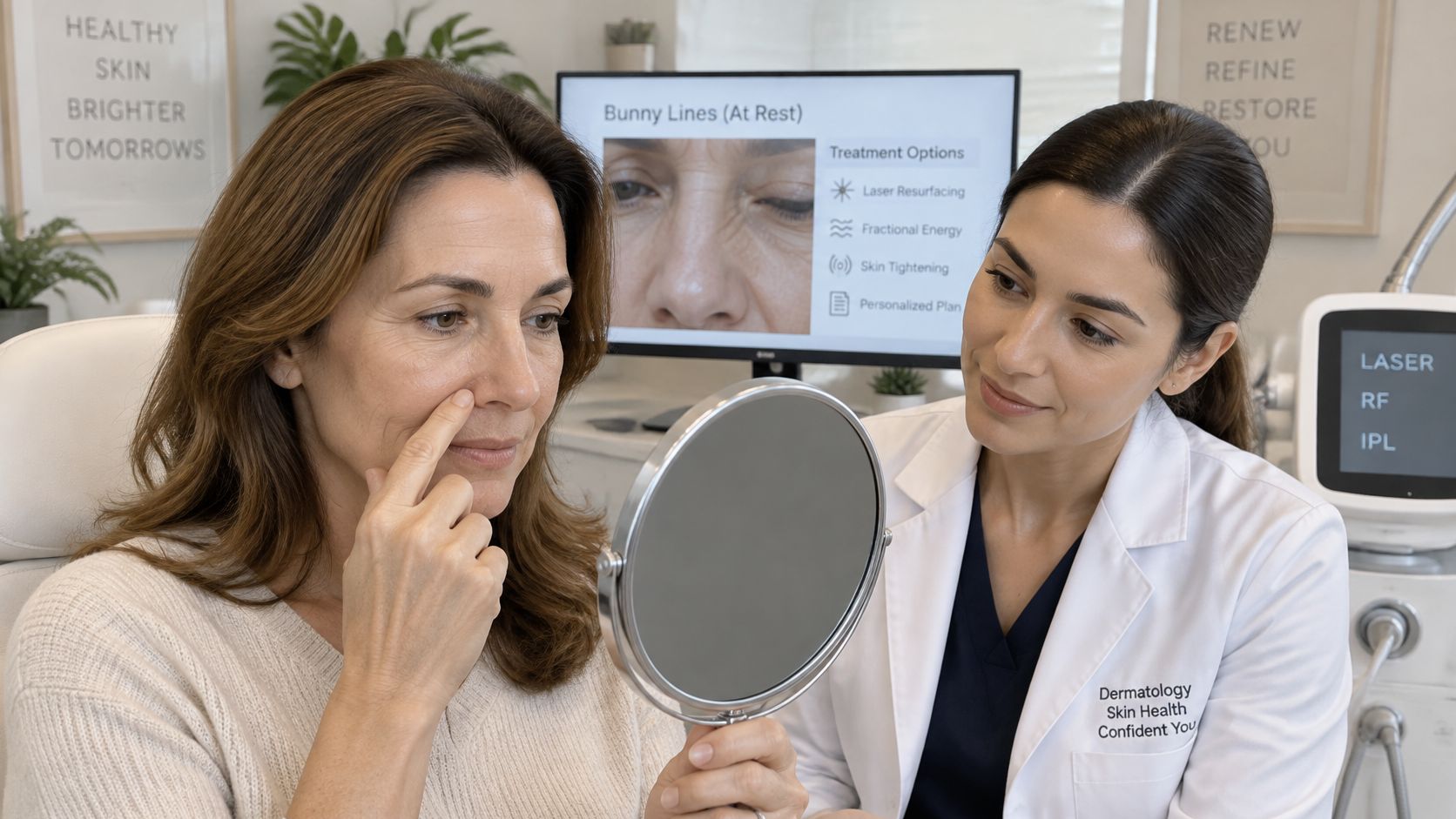
Laser resurfacing and other energy-based treatments encourage collagen remodeling and gradually smooth surface texture, sometimes over several sessions. Chemical peels and microneedling work more shallowly, targeting fine lines and uneven texture around the nose. These treatments improve skin, while neuromodulators target the muscle activity that folds it. If both texture and movement contribute to the crease, each may need attention.
Signs your lines are etched
Use these skin-focused signs to discuss whether resurfacing or another texture treatment may help:
- Uneven surrounding texture: Skin near the nose appears rough or crepey.
- Fine surface lines: Smaller lines accompany the main crease.
- Limited skin smoothness: The area still looks textured even when the nose is not scrunched.
The right device or procedure depends on skin type, pigmentation risk, line depth, and how much downtime you can tolerate. A provider can examine your skin and recommend an option suited to those factors. Retinoids and antioxidants can support surface quality and early etching, while daily sun protection helps limit further collagen damage. These measures support skin quality over time; their effect on a deep groove may be limited.
When both movement and skin texture matter, treatment can be sequenced: injections soften the muscle pull, then laser resurfacing, a peel, or microneedling addresses the skin folded by that movement. The visible crease is only part of the picture. Matching treatment to both the skin and its movement pattern helps set realistic expectations.
Aftercare and What to Expect Week by Week
Most neuromodulator results develop over about two weeks and last several months, while laser and skin-care improvements build more gradually. Neither approach is permanent. Repeat treatment is how the effect is maintained, and spacing is set by how quickly your movement and texture changes return.
Aftercare Timeline After Bunny Line Treatment
| Timing | Neuromodulator injections | Laser or resurfacing |
|---|---|---|
| Day 0 | Stay upright and avoid rubbing the treated area; follow the provider's written aftercare instructions | Follow the provider's cleansing and sun-protection instructions |
| Days 1-3 | Small bumps or redness at injection points usually fade | Redness and mild swelling are common |
| Days 3-14 | Effect builds; full result usually near 2 weeks | Peeling or crusting may occur; follow makeup guidance |
| Weeks 2-4 | Review result; schedule a touch-up if needed | Skin texture may still be improving |
| Months 3-4 | Movement returns gradually; repeat treatment as planned | Results may continue improving over several sessions |
Mild reactions are expected. Injection points can look pink or slightly raised for a short time, and small bruises happen. After resurfacing, redness, swelling, and peeling are part of normal healing, and a day-by-day account of Halo laser recovery gives a realistic picture of that process.
When to contact your provider
Call promptly if you notice any of these:
- Severe or worsening pain: Pain that increases rather than settles needs review.
- Vision changes: Any change after treatment near the eye is urgent.
- Drooping eyelid or upper lip: New heaviness can signal unintended spread.
- Trouble breathing: Seek urgent care and inform your provider.
Follow written instructions on makeup, sun protection, exercise, and skincare actives, even if your skin feels fine early. Timelines shift with the product used, the dose, your metabolism, and your skin's healing speed. Success here looks understated. Lines soften when you scrunch, texture looks smoother over time, and your expressions still look like yours.
Confirm Your Plan Before You Book
A short checklist makes your consultation far more productive:
- Record a brief video: Film yourself scrunching, smiling, then relaxing so you can compare movement and rest lines together.
- List other areas: Note brows, forehead, or crow's feet concerns so the plan covers your full face.
- Ask about classification: Ask how the provider will decide whether your lines are dynamic or etched.
- Get specifics in writing: Confirm product, planned dosing approach, follow-up timing, and expected duration.
- Verify the office: Confirm your chosen treatment is offered at that location, since laser availability can vary by office.
- Confirm payment directly: ProMD Health operates on a cash-pay model and its services aren't covered by insurance, so don't assume reimbursement.
With those answers, book a consultation to review your movement pattern in person. You'll leave knowing whether you need movement treatment, skin treatment, or a considered combination.
If bunny lines bother you when you smile or scrunch, ProMD Health offers neuromodulator treatment for this area alongside laser, peel, microneedling, and medical-grade skincare options for etched texture. Book a consultation to have your movement pattern assessed and a conservative, anatomy-based plan mapped out at ProMD Health.