
You have a wedding coming up, your skin looks dull, and your pores seem more noticeable than usual. You want an immediate glow for photographs, but you also want clearer texture, less congestion, and better tone over the next several months. That's where the HydraFacial vs chemical peel decision becomes more complicated than a simple “gentle versus aggressive” comparison.
These treatments solve different problems. A HydraFacial is primarily a device-based cleansing, extraction, exfoliation, and hydration treatment. A chemical peel creates controlled injury at a selected depth, which can produce stronger resurfacing but also demands more recovery and risk management. Your skin tone, sensitivity, season, event date, and corrective goal matter more than the treatment's marketing label.
If you're still deciding what a facial treatment should accomplish, this guide to choosing the right facial provides useful context. For the choice itself, use three filters: how the treatment works, how much downtime you can tolerate, and how much correction you need.
Table of Contents
- Why the Hydrafacial vs Chemical Peel Decision Is Not What You Think
- How Each Treatment Actually Works on Your Skin
- Side-by-Side Comparison at a Glance
- Which Skin Concerns Each Treatment Targets Best
- Who Is the Ideal Candidate for Each Option
- Risks, Downtime, and What Recovery Really Looks Like
- Can You Combine Hydrafacial and Chemical Peel Treatments
- How to Choose the Right Treatment for Your Skin
Why the Hydrafacial vs Chemical Peel Decision Is Not What You Think
The popular shorthand is easy to remember. HydraFacial equals gentle glow. Chemical peel equals intense correction. The shorthand is also incomplete.
A patient with sensitive, darker, or easily irritated skin may be an excellent HydraFacial candidate, particularly before an event when visible peeling would be a problem. But that doesn't mean a HydraFacial is automatically risk-free, or that every chemical peel is too aggressive. Peel depth changes the treatment completely. A superficial peel and a deep phenol peel belong to the same broad family, but their effects and recovery are very different.
The more useful question is: what does your skin need right now, and what can your schedule support?
Start with your actual goal
Choose a HydraFacial when your priority is clean pores, hydration, surface smoothness, and a fresh appearance without meaningful social downtime. Choose a chemical peel when you're trying to change pigmentation, acne marks, uneven texture, or other concerns that require controlled resurfacing.
Season matters too. A peel can make your skin more vulnerable to irritation and pigment changes during periods of significant sun exposure, while a HydraFacial can fit more easily into year-round maintenance. That doesn't eliminate the need for sun protection after either treatment.
Practical rule: If you need to look polished this week, choose the treatment with the smaller recovery burden. If you want deeper correction over time, plan a properly selected peel instead of expecting a maintenance facial to remodel scarred or heavily pigmented skin.
The history of chemical peeling shows why the category can't be treated as one procedure. Reviews trace exfoliant use to ancient Egypt around 1550 BC, later medical descriptions in classical antiquity, and modern dermatologic developments beginning in 1871. By 1882, several peeling ingredients had been described, and a recognized phenol formula emerged in 1961. You can read the historical and clinical review of chemical peels for the full timeline.
HydraFacial is much newer and has a narrower evidence base. In a prospective study of acne-prone patients, six treatments were used over a standardized 12-week protocol, with improvement measured through investigator and patient assessments in the published acne study. That supports HydraFacial as a useful treatment for maintenance and congestion, not as a substitute for every resurfacing procedure.
How Each Treatment Actually Works on Your Skin
A HydraFacial and a chemical peel may both include exfoliation, but they ask very different things of the skin.
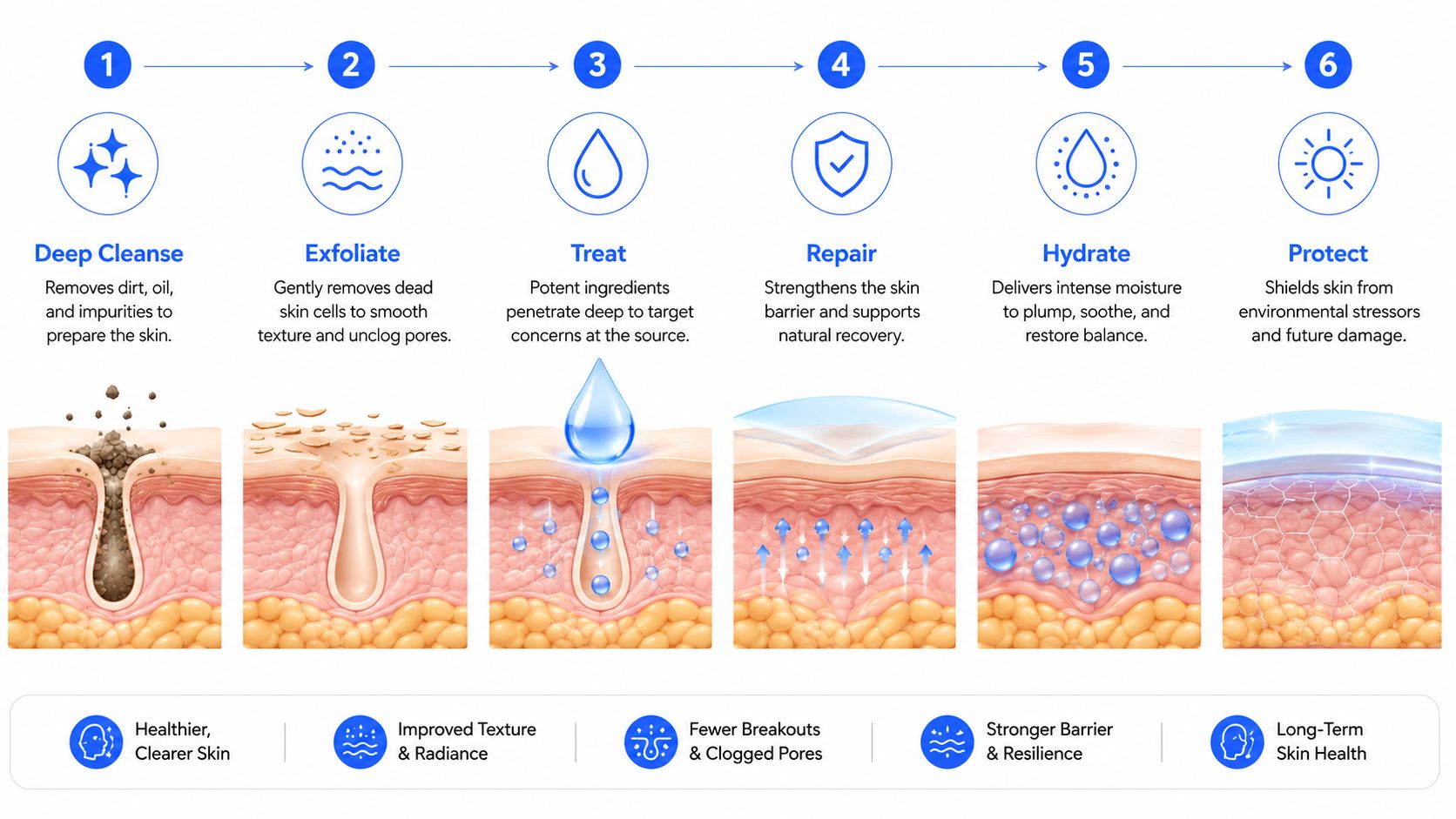
HydraFacial clears, loosens, and replenishes
A HydraFacial uses a specialized device with vortex-style action. The first phase cleanses the surface and uses suction to help remove pore debris. The next phase applies a mild acid solution to loosen dead cells and congestion. The final phase infuses the freshly treated skin with a serum blend that may include antioxidants, peptides, and hyaluronic acid.
The suction and infusion are the defining features. The acid component supports loosening and exfoliation, but the treatment isn't designed to create a substantial wound or force the skin to shed in the way a medium or deep peel does. That's why most patients can return to ordinary activities quickly, provided their provider hasn't added another treatment that changes the recovery plan.
The treatment has also been studied in acne-prone skin. In the small prospective study cited above, 18 of 20 enrolled patients completed all six treatments, and investigator ratings of no acne or almost clear skin increased from 20% to 65%. Patient self-report increased from 5% to 55%. The investigator Global Acne Severity Score fell from 2.10 to 1.33, a 37% decrease, while the mean patient score fell from 2.45 to 1.61, a 34% decrease. Those figures come from a small sample, so they're useful evidence, not a universal promise.
See ProMD Health's explanation of how HydraFacial cleanses, exfoliates, extracts, and hydrates for a treatment-focused overview.
Chemical peels create controlled injury
A chemical peel applies an acid or blended solution to the skin. Depending on the formulation and application, it can separate the bonds between surface skin cells and produce a controlled injury that encourages renewal and remodeling.
Peels are classified by depth of injury, not just by product name. Superficial peels affect the epidermis. Medium-depth peels reach the papillary dermis. Deep peels extend into the reticular dermis, as described in this clinical classification of peel depth.
That distinction drives both the result and the recovery:
- Superficial peels focus on surface exfoliation and usually have the lightest recovery.
- Medium-depth peels provide more meaningful correction for selected pigmentation, texture, and acne-related concerns, with visible healing.
- Deep peels create the greatest injury and require the most careful medical selection and recovery planning.
The central difference is straightforward: HydraFacial clears and hydrates without deliberately wounding the skin, while a chemical peel deliberately wounds the skin to produce resurfacing. Neither mechanism is universally better. The right mechanism depends on the change you want.
Side-by-Side Comparison at a Glance
You want a clear glow before an event, or you want pigmentation and texture to improve over several months. Those goals call for different treatments. Skin type, season, and recovery tolerance matter more than the label “gentle” or “strong.”
HydraFacial vs Chemical Peel at a Glance
| Criteria | HydraFacial | Chemical Peel |
|---|---|---|
| Mechanism | Device-based cleansing, vortex suction, mild exfoliation, extraction, and serum infusion | Controlled acid injury that separates surface cells and promotes renewal |
| Depth of action | Primarily surface-level cleansing and exfoliation | Superficial peels affect the epidermis, medium peels reach the papillary dermis, and deep peels extend to the reticular dermis |
| Downtime | Usually minimal, with possible temporary pinkness | Superficial peels often have little downtime. Medium peels commonly require about 3 to 7 days, while deep peels can require roughly 14 to 21 days of recovery, according to this clinical comparison |
| Comfort | Generally comfortable, with suction and a cleansing sensation | May involve warmth, tingling, stinging, redness, tightness, or peeling |
| Session pattern | Works best as part of a maintenance plan, with frequency set according to congestion, hydration, and skin response | Frequency depends on depth, formulation, skin response, and the corrective plan |
| Ideal role | Maintenance, congestion management, hydration, and pre-event polish | Corrective resurfacing for pigmentation, acne marks, uneven texture, and selected aging concerns |
| Results onset | Surface smoothness and radiance can appear immediately | Results develop as the treated skin heals and renews |
| Longevity | Best maintained through repeated treatments and consistent skincare | Can produce longer-lasting correction, but results depend on concern, depth, sun exposure, and aftercare |
| Best fit | Patients wanting low-disruption skin maintenance | Patients willing to accept recovery for stronger correction |
| Best concerns | Dullness, dehydration, clogged pores, and mild congestion | Pigmentation, acne marks, melasma, uneven texture, and selected scars |
| Risk profile | Irritation, temporary redness, extraction-related breakouts, or sensitivity | Persistent redness, post-inflammatory hyperpigmentation, crusting, infection, herpes reactivation, and scarring are possible |
| Cost per session | Varies by practice and protocol | Varies by formulation, depth, provider, and protocol. No universal price should guide the decision |
The practical verdict is direct. Choose HydraFacial for maintenance, hydration, congestion, and an immediate polished appearance. Choose a chemical peel for corrective resurfacing when pigmentation, acne marks, or uneven texture justify planned recovery. A consultation still matters if you have pigment changes, scarring, active inflammation, or sensitivity.
Seasonality should guide timing. HydraFacial suits frequent maintenance when you need minimal interruption. Chemical peels require stricter aftercare and sensible scheduling around sun exposure, so they fit a planned corrective program rather than a last-minute refresh. The goal determines the treatment, not the treatment menu.
Which Skin Concerns Each Treatment Targets Best
A treatment should earn its place by addressing the concern you have, not the concern featured in its advertisement.
Acne and congestion
HydraFacial is the stronger first choice for visible congestion, blackheads, and surface buildup because extraction is part of the treatment. The procedure can physically remove material from pores while the exfoliating step loosens debris. That makes it useful for patients who want cleaner-looking pores without a peeling phase.
A superficial peel containing an appropriate exfoliating acid may be a better option when dead-cell buildup and oil contribute to recurring congestion. It won't replicate the mechanical extraction component, but it can address the surface environment that contributes to clogged pores. For active acne, the provider must distinguish mild congestion from inflamed lesions and decide whether extraction or acid exposure is appropriate.
Pigmentation and melasma
Established pigmentation usually needs more than a temporary glow. Medium-depth peels may outperform HydraFacial for selected sun spots, acne marks, melasma, and uneven tone because they reach beyond simple surface hydration and polishing. The trade-off is greater irritation and a higher need for disciplined sun avoidance.
HydraFacial can support brightness and skincare penetration, but it isn't the treatment I'd choose as the primary correction for stubborn melasma or pronounced post-inflammatory marks. Pigment is also where skin tone and personal history matter most. A darker skin tone or previous tendency toward hyperpigmentation calls for conservative selection and close aftercare.
Texture and fine lines
HydraFacial improves how the surface feels and reflects light. You may see smoother-looking skin after the appointment, but that doesn't mean the treatment has changed scar depth or created substantial structural remodeling.
Chemical peels are better suited to texture concerns that require resurfacing. The deeper the selected peel, the greater the potential correction and recovery burden. This isn't a reason to choose the deepest possible treatment. It's a reason to match peel depth to the actual problem.
Quick reference
| Skin Concern | Better Option | Why |
|---|---|---|
| Dehydration and dullness | HydraFacial | Hydration and serum infusion produce a fresh surface appearance |
| Blackheads and congestion | HydraFacial | Suction and extraction address pore contents directly |
| Mild acne-related buildup | HydraFacial or superficial peel | The better choice depends on whether extraction or exfoliation is the priority |
| Melasma and established pigmentation | Carefully selected chemical peel | Peels offer stronger resurfacing, but pigment risk must be managed |
| Acne marks and uneven tone | Chemical peel, often staged conservatively | Controlled exfoliation can address discoloration more directly |
| Rough texture and fine lines | Chemical peel | Greater corrective potential through controlled resurfacing |
| Immediate pre-event glow | HydraFacial | Minimal disruption and rapid visible polish |
Who Is the Ideal Candidate for Each Option
Candidate selection starts with skin behavior, not age. A younger patient with stubborn pigment may need more planning than a mature patient seeking hydration, while a patient with reactive skin may be a poor candidate for a peel regardless of the concern.
HydraFacial candidates
A HydraFacial generally suits patients across Fitzpatrick skin types, including darker skin tones, when the protocol is properly adjusted. It's a sensible starting point for someone with sensitive or reactive skin, someone trying an in-office treatment for the first time, or anyone who can't accommodate visible peeling.
It also fits event-driven goals. If you're preparing for a wedding, photo shoot, vacation, or important presentation, the low-disruption profile makes it easier to schedule. The treatment can improve surface radiance and congestion without asking you to plan around a substantial healing period.
Chemical peel candidates
A chemical peel suits patients with an established corrective concern and enough schedule flexibility to follow recovery instructions. That includes selected cases of acne scarring, melasma, post-inflammatory pigmentation, photodamage, and uneven texture. The patient must accept that visible peeling, tightness, redness, or flaking may be part of the process.
Seasonality matters. Many patients find fall and winter easier for peel planning because daily sun exposure may be lower, but a peel still requires sun protection in every season. A provider should also consider Fitzpatrick type, recent tanning, previous pigment response, skin barrier health, and the exact peel depth.
When to postpone
Postpone treatment and request medical guidance if you have:
- Active infection or significant inflammation: Treating compromised skin can worsen irritation and healing.
- Recent sunburn: Sun-damaged skin may react unpredictably to exfoliation or acid exposure.
- Recent or current isotretinoin use: Your provider needs to review timing and skin recovery before considering a peel.
- Pregnancy: Chemical peel ingredients and treatment plans require specific medical review, so don't proceed without provider clearance.
- Unclear scarring or pigment history: Previous hypertrophic scarring, atrophic scarring, or pronounced hyperpigmentation changes the risk calculation.
A HydraFacial isn't automatically appropriate during active inflammation either. Gentle does not mean universally suitable. The provider should decide whether the skin is calm enough for suction, extraction, and exfoliation.
Risks, Downtime, and What Recovery Really Looks Like
You have an event tomorrow and want a brighter complexion tonight. A HydraFacial may fit that schedule. A chemical peel may not. The right choice depends on whether you need maintenance glow now or corrective resurfacing that unfolds over months, along with your skin type and the season.
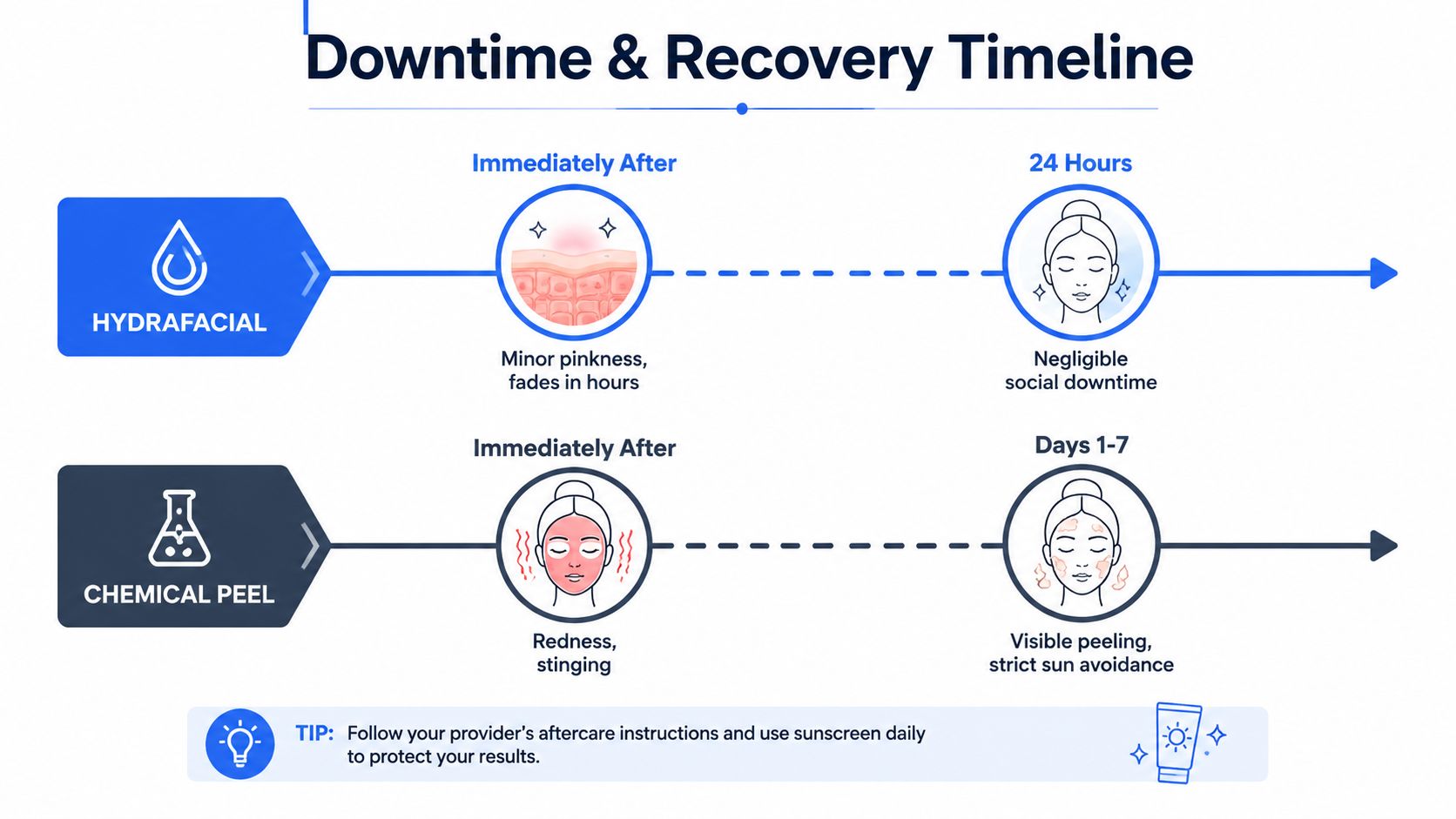
A HydraFacial usually involves limited recovery, but “gentle” does not mean risk-free. Suction, extraction, and exfoliation can irritate reactive skin or cause temporary breakouts. Mild pinkness often settles within hours, and many patients resume normal activities the same day. Follow aftercare instructions rather than treating the appointment as consequence-free.
Chemical peel recovery is tied to depth. Superficial peels often cause little or no downtime. Medium peels commonly involve about 3 to 7 days of flaking, while deep peels can require roughly 14 to 21 days of recovery. Formulation, application, baseline sensitivity, and individual healing change how recovery looks. Review chemical peel service information before choosing a treatment plan.
Pigment risk deserves direct discussion
Post-inflammatory hyperpigmentation matters, especially for patients with darker skin tones or a personal history of discoloration. One retrospective study of superficial chemical peels in darker skin reported a 3.8% complication rate, with post-inflammatory pigmentation and crusting among the common events (study and clinical discussion).
That figure cannot predict an individual result, but it does rule out treating superficial procedures as automatically risk-free. Clinical complications can include persistent erythema, hyperpigmentation, hypertrophic or atrophic scarring, infection, and herpes reactivation.
Protect the result
After either treatment:
- Use broad-spectrum SPF: Sun exposure can worsen irritation and pigment changes.
- Don't pick or pull: Let flaking skin shed naturally.
- Pause irritating actives: Stop retinoids and other exfoliants if your provider directs you to do so.
- Use gentle skincare: Avoid unapproved acids, scrubs, and home peel products.
- Report unusual symptoms: Severe pain, spreading redness, blistering, or persistent swelling requires prompt clinical attention.
A provider should match the procedure and recovery plan to your skin's behavior, not just your desired finish.
Can You Combine Hydrafacial and Chemical Peel Treatments
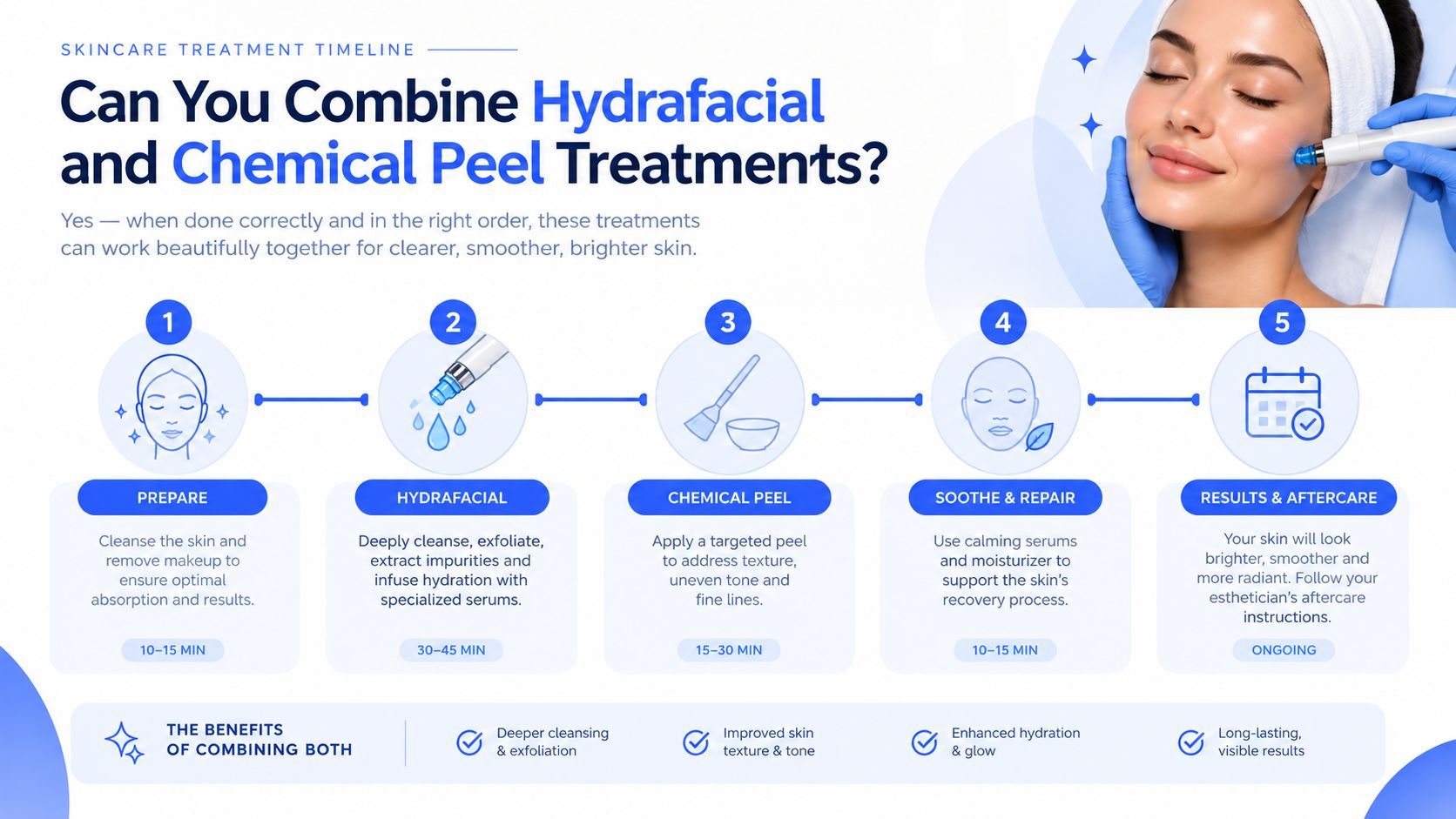
Yes, but I don't recommend stacking them casually. Combining treatments can make sense when each procedure has a distinct job, but sequencing affects irritation, penetration, and pigment risk.
Same-visit treatment
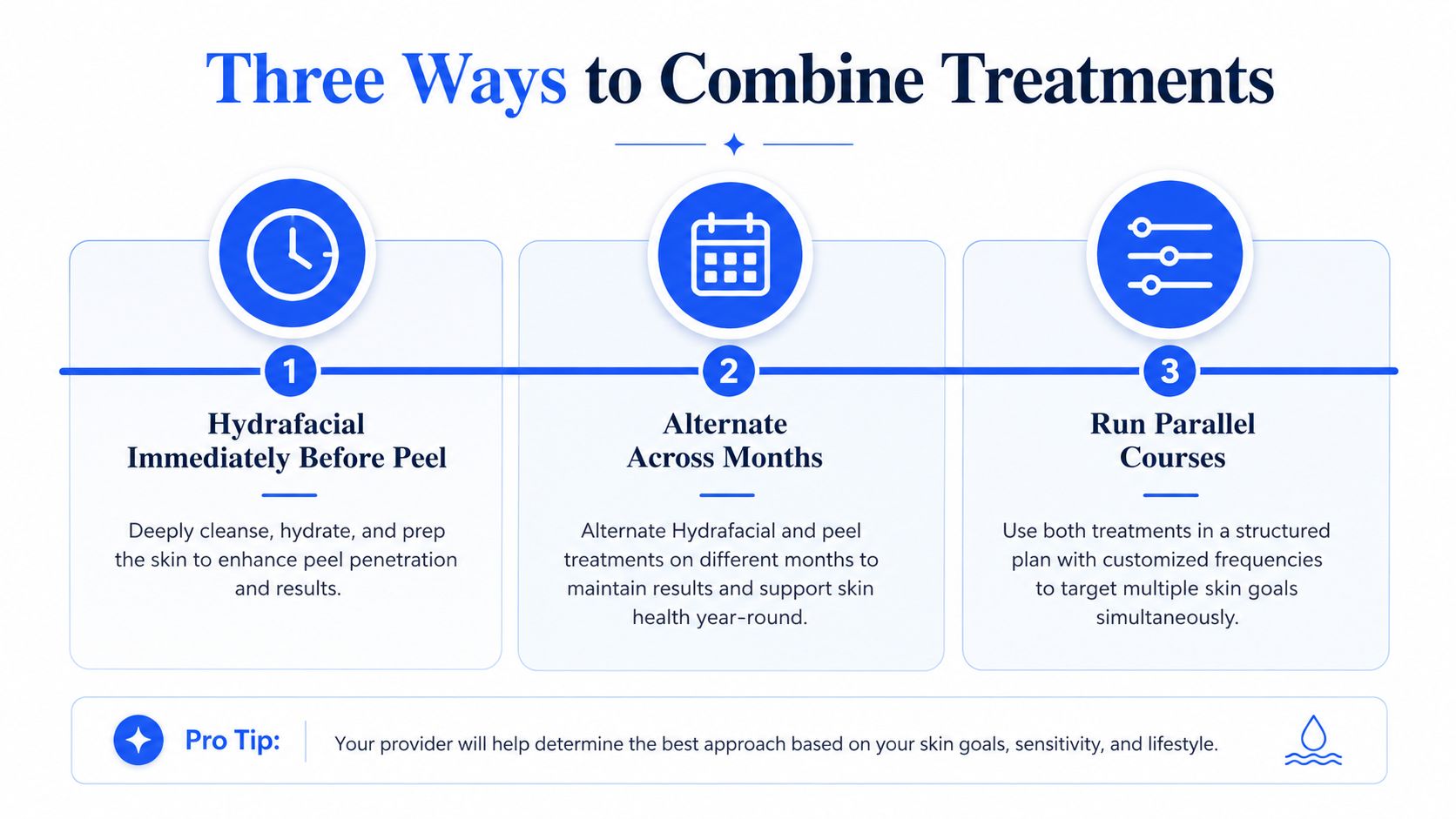
A HydraFacial immediately before a chemical peel may seem logical because the skin has been cleansed and exfoliated. In practice, suction and exfoliation can leave the skin more reactive, and the added treatment may change how evenly the peel penetrates. If a provider recommends a same-visit combination, it should be a deliberately designed protocol, not an improvised add-on.
For many patients, separating the treatments is safer. A provider may prefer a two-week buffer when sequencing a HydraFacial and a peel, but the appropriate interval depends on the peel depth, skin response, home products, and medical history.
Alternating treatments
A maintenance-focused patient may alternate treatments across months. HydraFacial can support hydration and congestion control, while a planned peel addresses pigmentation or texture at a separate appointment. This approach avoids asking the skin to tolerate two exfoliating interventions at once.
A common clinical logic is to complete a corrective peel plan first, then use HydraFacial as a pre-event polish once the skin has fully recovered. Another option for acne-prone skin is to pair a conservative peel course with carefully timed extractions, but the provider must decide whether the skin can tolerate both.
Who shouldn't combine them
Avoid combination scheduling without medical direction if you're using retinoids, recently used isotretinoin, have active inflammation, or have a history of difficult pigment changes. Home peel products create another variable. Layperson misuse has caused documented skin injuries, so treatment timing and home-care behavior belong in the safety discussion, not in the fine print.
The evidence around combinations remains less developed than the evidence for each treatment separately. The safest plan is individualized, spaced appropriately, and based on the actual condition of your skin on the day of treatment.
How to Choose the Right Treatment for Your Skin
Stop choosing based on which treatment sounds more advanced. Choose based on the result you want, the recovery you can accept, and the risk your skin can reasonably tolerate.
If your event is close
Choose a HydraFacial when you want a polished, hydrated appearance before a wedding, photo shoot, or social event. It's the practical option when you can't afford visible peeling or unpredictable redness. If you also have significant pigmentation or texture concerns, treat those separately and earlier rather than trying to force correction into a last-minute appointment.
If congestion is your main problem
Choose HydraFacial when clogged pores, blackheads, and surface buildup dominate your concern. A superficial peel may become the better maintenance tool if recurring congestion responds more to exfoliation than extraction, but don't assume stronger is better. Persistent inflammatory acne requires a broader medical assessment.
If pigmentation or acne marks bother you most
Choose a carefully selected chemical peel when discoloration is established and you're prepared for recovery. Patients with melasma, darker skin tones, or a history of post-inflammatory hyperpigmentation should prioritize conservative planning and provider experience over intensity.
If you want remodeling
For mature skin, pronounced roughness, or selected scars, a peel offers more corrective ambition than a HydraFacial. The right depth depends on the concern. A deeper peel isn't automatically the right peel, particularly when the risk of pigment change or scarring is significant.
Use these three questions
- Do I need visible improvement for an upcoming event, or am I pursuing correction over months? Immediate presentation favors HydraFacial. Long-term correction favors a peel or staged plan.
- Can I follow strict sun protection and accept peeling or redness? If not, don't choose a treatment whose success depends on recovery compliance.
- Have I had pigment changes, scarring, active inflammation, recent isotretinoin use, or a compromised skin barrier? If yes, stop self-selecting and arrange an in-person assessment.
ProMD Health offers both HydraFacial and chemical peel services, allowing a provider to evaluate whether your priority is hydration and congestion management, corrective resurfacing, or a staged approach. Visit ProMD Health to review the available skin treatments and request a consultation suited to your skin type, timing, and goals.


