
What if the biggest mistake in under eye rejuvenation is treating every dark circle, hollow, or bag as the same problem? The under-eye area looks small from a distance, but the anatomy is layered, and the cause changes the treatment. A hollow needs a different plan than pigment, thin skin, or true fat-pad bulging, and that distinction is where good results start.
Table of Contents
- Why Under Eye Rejuvenation Starts With the Right Question
- The Anatomy Beneath Your Under-Eye Concerns
- Matching the Treatment to the Actual Cause
- Non-Surgical Treatment Options Explained
- How Treatment Planning Works From Consultation to Recovery
- Candidacy, Risks, and When Surgery Is the Better Answer
- Maintenance, Skincare, and Long-Term Results
- Putting It All Together and Common Patient Questions
Why Under Eye Rejuvenation Starts With the Right Question
Many begin by asking, “What treatment gets rid of this?” The better question is, “What's creating the shadow, puffiness, or texture change under my eyes?” That shift matters because under eye rejuvenation is a category of treatments, not one treatment.
A patient with a hollow tear trough often needs volume support. Another person with brown discoloration may need pigment-focused care. Someone with crepey skin needs a different plan again, and a person with bulging fat pads may not be a filler candidate at all.
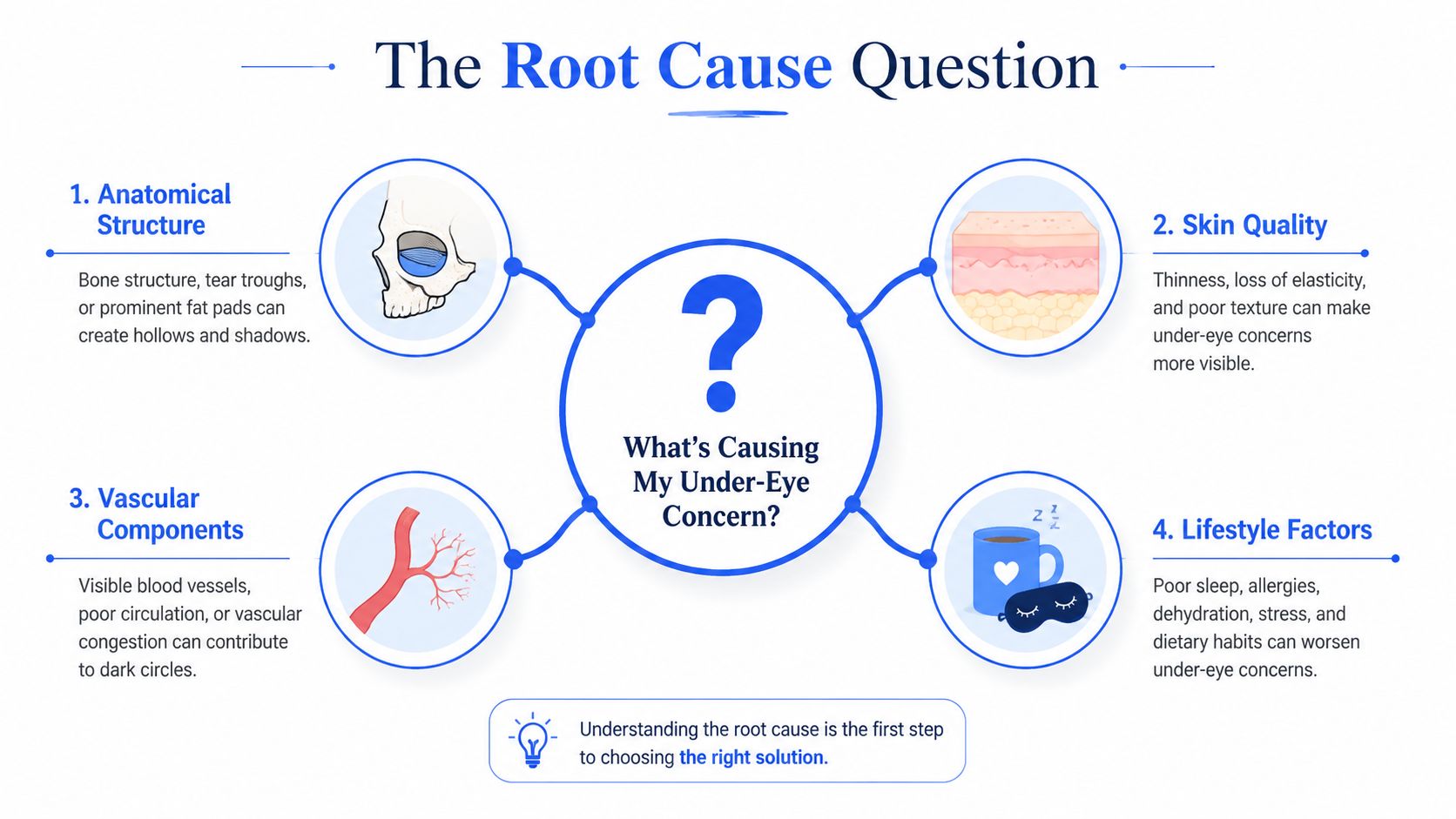
The practical way to think about it is simple. The under-eye result can come from volume loss, pigmentation, skin-quality change, or fat-pad herniation. Those causes can overlap, which is why two people can describe the same “dark circles” and end up with completely different treatment plans.
Practical rule: if the concern changes when you stretch the skin, smile, or tip your head, the cause is probably not the same in every case.
The other reason to start with the cause is that under-eye treatment is easy to overdo. Adding filler to a shadow caused by pigment won't solve the issue. Chasing laser for a true structural hollow won't replace missing support. A good plan starts with diagnosis, then layers the right tools in the right order.
The Anatomy Beneath Your Under-Eye Concerns
Think of the under-eye area like a thin layered sandwich. The top layer is delicate skin, the middle includes muscle and fat compartments, and the bottom is bone that shapes support. When one layer changes, the whole area can look tired, shadowed, puffy, or crepey.
The skin itself is often the first place people notice aging. It's thin, so small changes in collagen and hydration show quickly. Under that sits the orbicularis oculi muscle, which helps with blinking and smiling, and can contribute to fine creases when it stays active.
Why hollows and bags look so different
A tear trough ligament helps create the groove many people call a hollow. When the lower eyelid transitions sharply into the cheek, that groove catches light and creates a shadow. If the nearby fat pads shift forward instead of sinking, the same area can look puffy rather than hollow.
That's why “dark circles” can mean very different things. A shadow from structure is not the same as brown pigment. A bag from protruding fat is not the same as loose skin. The visible problem sits on top of anatomy, but the fix has to respect the anatomy underneath.
If you want a focused overview of hollow-based correction, this resource on under eye volume loss remedies is helpful because it keeps the discussion centered on structural support rather than one-size-fits-all treatment.
What each layer tends to do
- Skin: shows thinness, crepiness, and fine lines first.
- Muscle: contributes to movement-related creasing, especially near the outer eye.
- Fat pads: create either hollowing when volume is lost or puffiness when they protrude.
- Bone support: affects how deep the tear trough looks and how smooth the eyelid-cheek transition appears.
The under-eye region is often blamed for “dark circles,” but the visible color can be a shadow, visible vessels, pigment, or all three at once.
When patients can identify which layer seems dominant, treatment conversations get a lot easier. A good consult doesn't start with product names, it starts with anatomy.
Matching the Treatment to the Actual Cause
The cleanest way to plan treatment is to match the modality to the problem. That sounds obvious, but under-eye care gets messy fast because people often assume a single treatment should fix volume, color, and texture at once. It usually doesn't.
| Modality | Volume Loss | Pigmentation | Skin Quality | Fat-Pad Herniation |
|---|---|---|---|---|
| Hyaluronic acid filler | Strong fit | Limited role | Limited role | Usually not the right answer |
| Biostimulatory agents | Useful in select cases | Limited role | Helpful indirectly | Usually not the right answer |
| Micro/nano fat grafting | Useful in select cases | Limited role | Helpful indirectly | Usually not the right answer |
| Laser-based treatment | Limited role | Strong fit | Strong fit | Limited role |
| Topical pigment care | Limited role | Helpful | Supportive | No |
| Microneedling | Limited role | Limited to moderate | Strong fit | No |
| Surgical referral | No | No | No | Strong fit |
Volume loss needs support, not just surface work
When the issue is a hollow, the goal is to rebuild contour. Hyaluronic acid fillers, biostimulatory agents, and micro or nano fat grafting all aim to restore lost support in different ways. The key is subtlety, because the tear trough can look overfilled quickly if the plan ignores the natural slope of the cheek.
Pigment needs a different strategy
If darkness comes from pigment, the most useful tools are laser-based treatments and pigment-correcting skincare. A recent meta-analysis of periorbital hyperpigmentation found that laser-based treatments achieved the strongest pooled response, with 82% of patients reaching an excellent or good improvement, defined as more than 50% improvement (Wiley review). The same analysis found 75% reached that threshold with combination approaches, which supports layered care rather than single-modality thinking.
Skin quality needs collagen support
When the concern is crepey texture, thinness, or fine wrinkling, collagen-stimulating lasers, microneedling, and topical actives make more sense. Recent under-eye literature also shows that newer approaches are expanding beyond hollows alone, which fits what clinicians see in daily practice, the under-eye area often needs texture work even after contour is corrected.
Fat-pad herniation is a structural issue
If the concern is true fat-pad bulging, filler is often the wrong direction. That's the part many patients find frustrating, because the visible problem looks cosmetic, but the fix may be surgical. In those cases, a referral is usually more appropriate than trying to camouflage the contour with more volume.
For patients comparing regenerative options and planning a layered approach, the internal guide on PRP under eye treatment is a useful companion because it sits in the middle of the conversation between volume correction and skin-quality support.
Non-Surgical Treatment Options Explained
Each non-surgical option works on a different layer, so the timing, maintenance, and results vary. The strongest plans do not stack treatments at random, they sequence them around the anatomy and the actual cause of the concern.
What each option does
Neurotoxins such as botulinum toxin type A relax movement from the orbicularis oculi muscle. That helps soften crow's feet and some lower-lid creasing, especially when expression is part of the problem. The trade-off is simple, neurotoxins do not fill hollows or fix pigment.
Hyaluronic acid fillers restore lost support in the tear trough and palpebromalar groove. The FDA summary for Restylane Eyelight states that it showed a favorable safety and effectiveness profile for improving infraorbital hollows in patients over age 21 (FDA summary referenced in the clinical review). A multicenter randomized evaluator-blinded study in the same review reported correction sustained through Month 12 for most patients, and up to Month 18 for those retreated at 12 months. For patients comparing contour correction options, the internal guide on tear trough fillers keeps the discussion centered on volume restoration and the limits of that approach.
Biostimulatory agents like Sculptra work more slowly. They are not an instant fix, they are a collagen-building strategy for select patients whose anatomy can tolerate gradual change. That slower onset is an advantage when the goal is subtle structural improvement without a large immediate volume jump.
Laser treatment helps pigment, texture, and photodamage. A 2024 systematic review of recent under-eye treatments noted that a 1064-nm Nd:YAG laser protocol was reported as painless and downtime-free in one study, with improvement in both under-eye wrinkles and dark circles (laser study). For someone whose main issue is color and texture, that difference matters.
Regenerative and topical support can fill gaps
Regenerative treatments such as PRP and PRF are used to support tissue quality, especially when the concern is thin skin rather than major hollowing. A real-world study of TEOSYAL PureSense Redensity 2 reported 136 subjects, 958 initial injections, 84.3% satisfaction, and a treatment effect lasting up to 12 months (study). Those numbers do not make one method universally right, but they do show why clinicians often think in layers instead of single fixes.
For readers exploring polyneucleotides as another regenerative category, aesthetic clinic polyneucleotide options provide a broader context for how regenerative under-eye work is evolving. This category is usually considered when the goal is tissue support and refinement, not dramatic reshaping.
Topical medical-grade skincare also matters. A clinical under-eye serum study reported a 47.94% average reduction in hyperpigmentation after 6 weeks with twice-daily use, while another periocular formulation showed 6.8% lower under-eye bag volume, 15.8% lower wrinkle depth, and 10.4% higher skin elasticity over 28 days (topical data). That is a reminder that the skin barrier and extracellular matrix are part of the plan, not an afterthought.
Clinical takeaway: the right tool is the one that matches the dominant cause, not the one with the most dramatic before-and-after photo.
For many patients, the best plan is layered. A hollow may need filler, crepey skin may need laser or regenerative support, and pigment may need targeted topical care, with follow-up through ProMD Connect to adjust the plan as the under-eye area settles.
How Treatment Planning Works From Consultation to Recovery
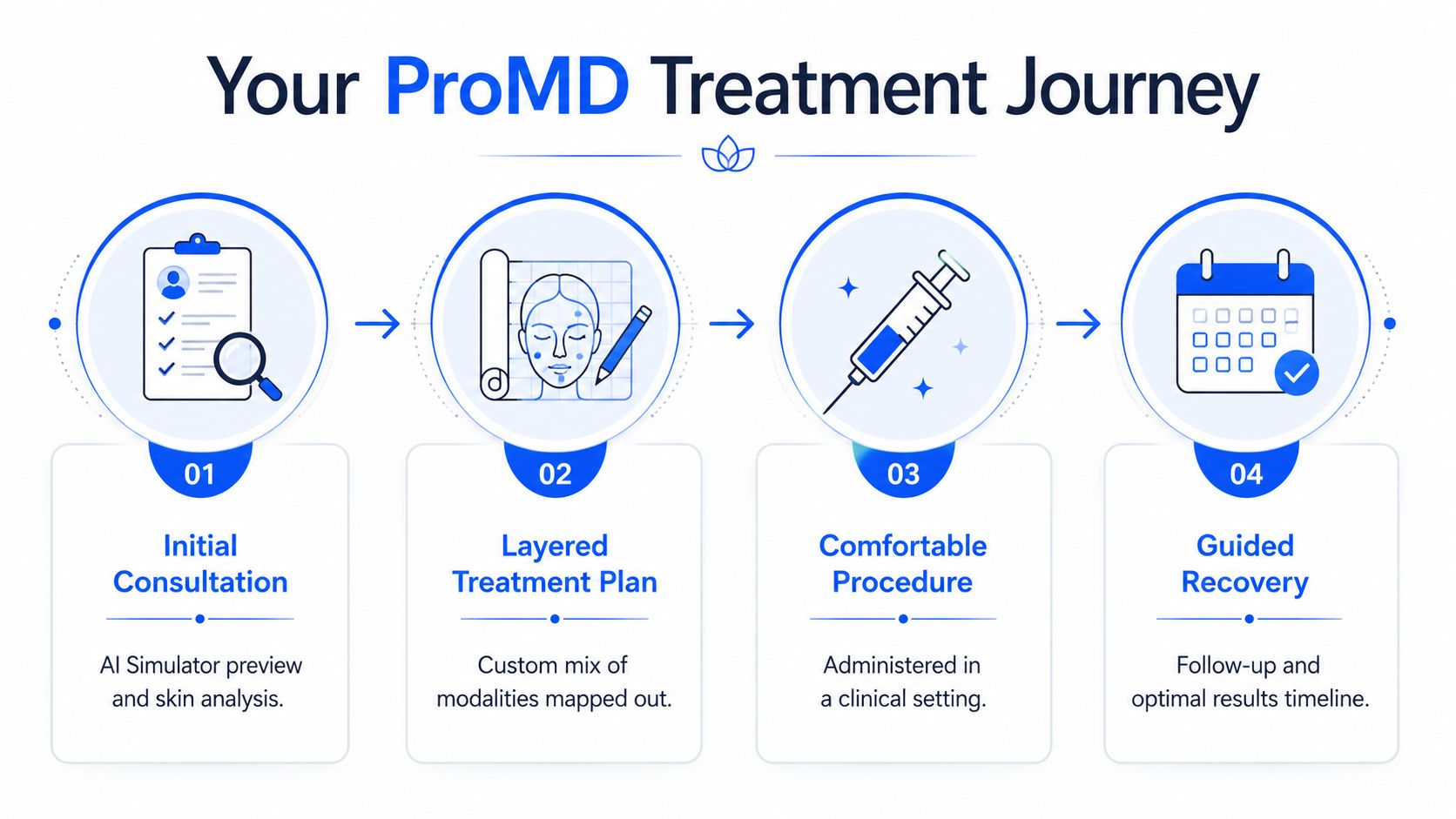
A real under-eye plan starts with assessment, not procedure selection. The provider looks at shadowing, skin thickness, muscle movement, pigment, swelling, and previous filler history before deciding which layer needs attention first. That's also where an AI preview can help patients see the difference between softening a hollow and changing the overall contour.
At ProMD Health, the consultation can include the AI Simulator from Entity Med, which helps visualize how a layered plan may look before treatment begins. That matters because under-eye work is easy to misunderstand when you only look at one close-up photo, and a preview gives patients a more realistic sense of balance and subtlety. ProMD Connect telehealth then extends follow-up for patients who travel or prefer remote check-ins between visits.
What recovery usually feels like
Neurotoxins usually have minimal downtime. People can return to normal routines quickly, though they may notice brief tenderness or small pinpoint marks.
Fillers often come with a few days of mild swelling or visible fullness before settling. That doesn't always mean something is wrong, it often reflects normal tissue response in a delicate area.
Laser treatments vary by intensity. Some protocols produce light redness and dryness, while more aggressive settings can need a longer home-care window.
Regenerative treatments generally sit in the middle. There may be a short downtime period, but the timeline depends on whether the goal is skin quality, volume support, or both.
A good treatment plan also includes home instructions. Sleep position, cold compress use when appropriate, and gentle cleansing can make the early period easier to manage. The clinic should explain what's expected, what's normal, and what needs a call back.
Patients do better when they know the timeline before they walk out the door. Vague expectations create unnecessary anxiety.
That's where follow-up matters just as much as the first visit. Under-eye treatment often changes gradually, so the patient and provider need a way to reassess the plan after swelling settles and the skin response becomes clearer.
Candidacy, Risks, and When Surgery Is the Better Answer
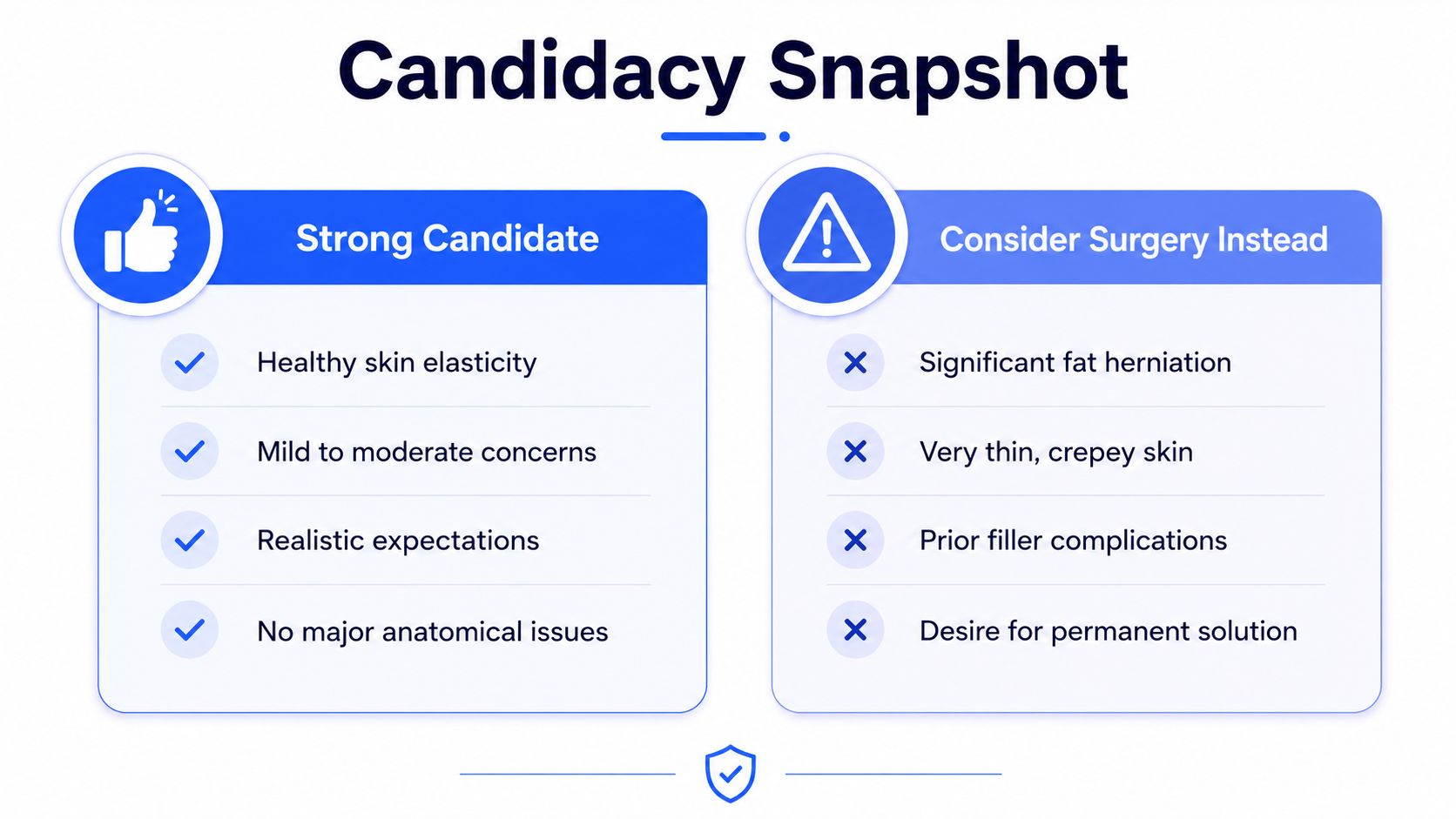
Not everyone is a strong candidate for non-surgical under-eye rejuvenation, and that's a good thing. The periorbital area is anatomically delicate, so the safer answer sometimes is to pause, modify the plan, or refer for surgery. Thin skin, prior filler complications, and significant fat-pad herniation all push the conversation in that direction.
Who tends to do well with non-surgical care
Patients with healthy skin elasticity, mild to moderate hollowing, realistic expectations, and no major anatomical distortion usually fit the non-surgical lane best. They're the people most likely to benefit from conservative contour correction plus skin-quality support.
Patients with very thin, crepey skin can still be treated, but the plan has to be careful. In some cases, a laser or regenerative approach may make more sense than injecting more volume. That caution matters because too much filler in thin tissue can show through.
What the real risks are
The under-eye region has a vascular network that demands precision. Superficial filler can cause the Tyndall effect, which is a visible bluish-gray discoloration when product sits too close to the surface. Contour irregularity, bruising, and vascular complications are also real concerns, even though they're not the usual outcome.
A candid medical history is essential. Prior filler, current medications, swelling history, and the patient's tolerance for downtime all shape the plan. If someone has already had trouble in the tear trough, the next step is often more conservative, not more aggressive.
When to think about surgery instead
If the issue is significant fat herniation, a lower-blepharoplasty consult often makes more sense than trying to camouflage the contour with filler. The same is true when the patient wants a permanent structural fix rather than a maintenance-based plan. Non-surgical treatment can improve many cases, but it can't replace anatomic correction when the anatomy is the problem.
A helpful rule is simple. If the concern is mostly skin quality, non-surgical options can usually help. If the concern is mostly structure and bulging, surgery deserves a serious look.
Maintenance, Skincare, and Long-Term Results
Under-eye treatment lasts longer when the aftercare matches the anatomy. Fillers need periodic review, biostimulatory plans often run in a series, and laser-based care usually works best in cycles rather than one-off visits. Maintenance isn't a flaw in the plan, it's part of how under-eye medicine stays natural.
Medical-grade skincare can stretch the benefit between visits. The Skin Shoppe and provider-curated routines support barrier health, pigment control, and texture maintenance, which matters because the skin under the eye reacts quickly to poor sleep, sun, and irritation. For patients who like structured home care, the internal guide on eye products for under-eye rejuvenation is a useful complement to in-office treatment.
Lifestyle still counts. Sleep position, allergies, smoking, and sun exposure all affect how long the result looks fresh. A practical reference on sleep-related stress and recovery is this cortisol and sleep overview, which helps explain why restorative sleep habits matter more than people often realize.
A simple maintenance framework
- Schedule touch-ups intentionally: don't wait until every improvement is gone before checking in.
- Protect the skin daily: use sunscreen, avoid rubbing, and keep the under-eye area hydrated.
- Track changes over time: pigment, puffiness, and hollowing don't age at the same rate.
- Use telehealth for follow-up: ProMD Connect can help adjust home routines and coordinate refill or review visits without forcing every check-in to be in person.
The goal is steady upkeep, not constant correction. When patients combine office treatment with a consistent home routine, the result usually looks more stable and more believable over time.
Putting It All Together and Common Patient Questions
Real under-eye rejuvenation works when the plan matches the cause. Hollowing, pigment, thin skin, and fat-pad herniation are different problems, so the treatment has to be different too. That's the core of the decision, and it's why layered plans usually outperform a single “fix.”
FAQ, insurance: ProMD Health operates on a cash-pay model, so under-eye services aren't covered by insurance.
FAQ, surgery: If the under-eye problem is dominated by significant fat bulging or a structural lower-lid issue, a surgical consult is often the more appropriate next step than adding more filler.
FAQ, telehealth: ProMD Connect supports remote follow-up, which is useful for patients who want guidance on recovery, skincare, or maintenance without always coming back in person.
FAQ, longevity: Realistic results vary by treatment type, but maintenance is normal, especially for filler, lasers, and regenerative care.
If you're trying to decide whether your concern is hollowing, pigment, skin quality, or true under-eye bags, ProMD Health offers in-office aesthetic treatment planning, medical-grade skincare, and telehealth follow-up through ProMD Connect. Visit ProMD Health to book a consultation and bring cause-specific questions, not just a treatment name.


