
You may be looking in the mirror thinking, “My acne is finally calmer, so why does my skin still look uneven?” That's a common turning point. The breakouts may be gone, but the marks and indentations they left behind can keep your skin from feeling like your own.
Many people arrive at laser treatment after trying skincare, peels, or time itself. Sometimes those steps help tone and brightness, but deeper texture changes often need a different approach. An acne scar treatment laser can be one of the most effective options for improving atrophic scars, especially when the treatment matches your scar type, skin tone, and tolerance for downtime.
This guide is for the person who wants a responsible answer, not hype. You'll learn what kind of scars lasers treat best, how the technology works, what recovery feels like, and why skin tone matters more than many people realize.
Table of Contents
- The Battle After the Breakouts Understanding Your Acne Scars
- How Laser Treatments Rebuild Your Skin
- Choosing Your Laser A Guide to Different Technologies
- Are You a Good Candidate for Laser Scar Treatment
- Your Treatment Journey From Consultation to Recovery
- Realistic Expectations Timeline Costs and Combined Therapies
- Common Questions and Your Next Steps with ProMD Health
The Battle After the Breakouts Understanding Your Acne Scars
A patient once described acne scars to me this way: active acne felt temporary, but scars felt like they moved in and stayed. That's what makes this stage so frustrating. Your skin is calmer, yet every bathroom mirror, video call, or bright overhead light seems to highlight the texture.
That reaction is valid. Acne scars can affect how makeup sits, how light reflects off your skin, and how confident you feel without filters. The good news is that scars are treatable, and laser technology is often part of the conversation because it can target texture in ways creams usually can't.

The three scar types most people notice
Most facial acne scars that respond to lasers fall into the atrophic category, which means they sit below the level of the surrounding skin.
- Ice pick scars are narrow and deep. They look like tiny punctures.
- Boxcar scars have more defined edges and a wider, scooped-out shape.
- Rolling scars create soft waves or dips because the skin is tethered underneath.
If you're unsure which one you have, that's normal. Many people have a mix. A single cheek can have shallow rolling scars, a few boxcar scars near the temples, and isolated deeper marks along the jawline.
Practical rule: If your concern is texture that catches light from the side, you're usually dealing with a structural issue in the skin, not just leftover discoloration.
Why scar type changes the plan
Lasers don't treat every scar the same way because each scar is built differently. A shallow rolling scar may respond well to collagen stimulation. A deep, sharply defined scar may need a stronger resurfacing approach or a combination plan.
That's why a good consultation starts with looking closely, not rushing to a device. The right acne scar treatment laser isn't chosen by trend. It's chosen by matching the tool to the pattern in your skin.
How Laser Treatments Rebuild Your Skin
Laser treatment sounds technical, but the basic idea is simpler than it seems. Think of scarred skin like a wall with dents, rough patches, and uneven paint. You can't fix that wall by wiping the surface. You need controlled renovation.
Some lasers resurface. They remove damaged outer layers so the skin can heal smoother. Others work deeper by heating the dermis without removing the top layer, which signals your body to make fresh collagen. That rebuilding process is called collagen remodeling, and it's a big reason laser results continue to improve after the appointment.
Two jobs lasers can do
The first job is surface correction. If the top layer of skin is rough, dull, or irregular, certain lasers can remove tiny portions of it in a controlled way. That helps soften visible texture and can improve the way skin reflects light.
The second job is support from underneath. Scarred skin often lacks the smooth internal framework that healthy skin has. Laser energy can trigger a wound-healing response that encourages the skin to lay down new collagen in the treated areas.
Why improvement takes time
Many patients expect immediate smoothness. That's understandable, but it's not how collagen works. The early phase is often about healing, redness, swelling, and a rougher feel while the skin turns over. The more meaningful change comes as the skin remodels itself.
Laser scar treatment is partly a resurfacing procedure and partly a rebuilding project. The second part takes patience.
Why “fractional” matters
You'll hear the word fractional often. It means the laser treats the skin in a pattern of tiny columns instead of removing or heating the entire surface evenly. Picture aerating a lawn instead of digging up the whole yard. The untouched skin between the treated spots helps speed healing.
That design is one reason modern acne scar treatment laser protocols can improve texture while reducing downtime compared with older fully ablative approaches. It also gives providers room to adjust intensity based on scar depth and skin sensitivity.
Choosing Your Laser A Guide to Different Technologies
Once you understand the rebuilding concept, the next question is practical. Which laser is used for acne scars?
The answer usually falls into two categories. Ablative lasers remove portions of the skin surface while heating deeper tissue. Non-ablative lasers leave the surface intact and work below it. Both can be useful, but they serve different patients and different goals.
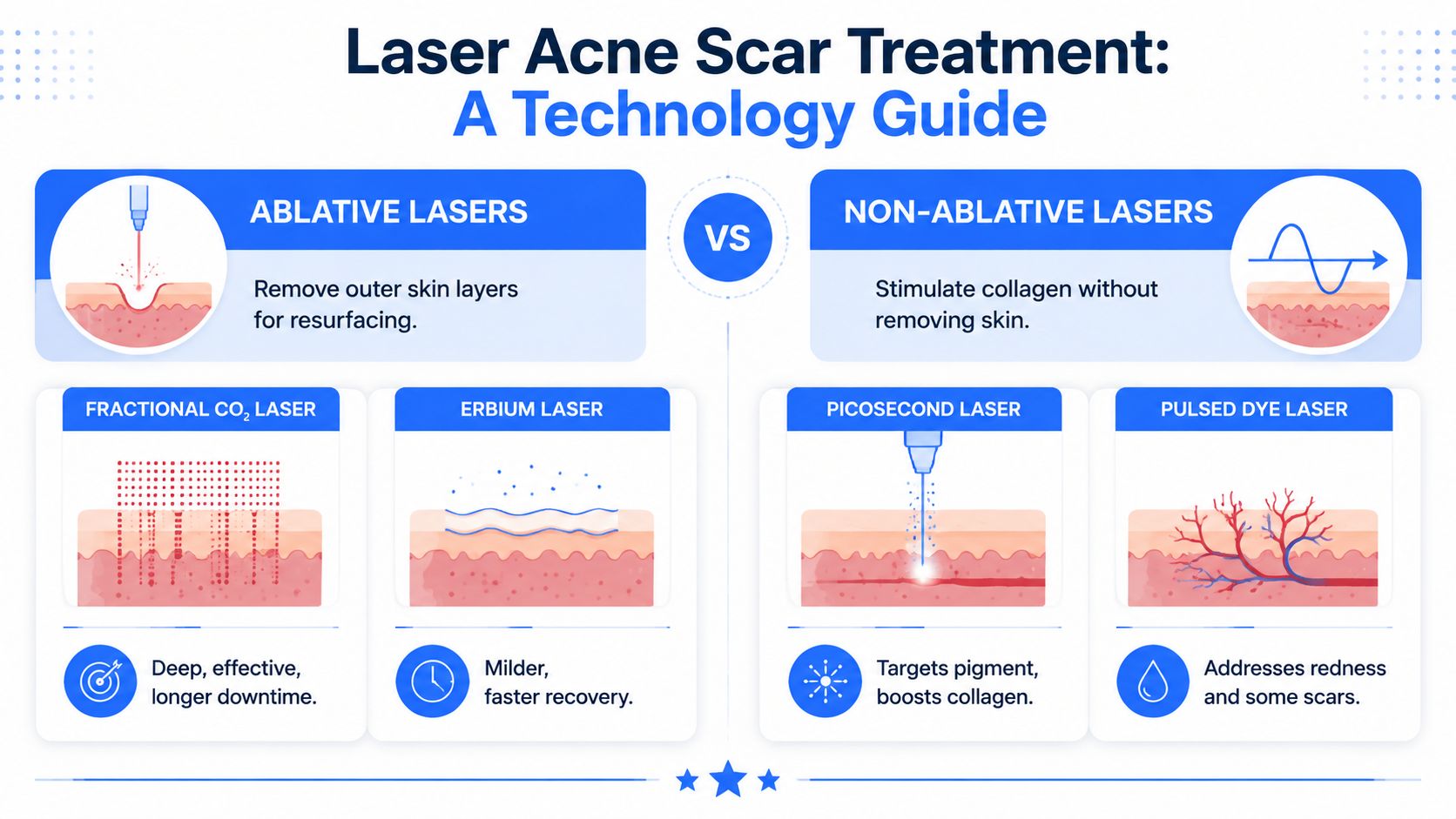
Clinical literature shows that ablative laser resurfacing, particularly CO2 and Er:YAG lasers, can achieve overall efficacy rates of up to 90% for atrophic acne scars. In the same body of literature, a study of patients with pitted facial scars and dark skin types found excellent results in 36% and good results in 57% after multiple passes with long-pulsed Er:YAG laser treatment, as summarized in this medical review of laser treatment for acne scars.
Ablative lasers
These are the more intensive resurfacing tools. They remove targeted skin tissue and create a stronger healing response. That often makes them a good fit for deeper depressed scars and more significant textural change.
Fractional CO2 is one of the best-known examples. It's clinically established for acne scar resurfacing, with 30 to 70% improvement in scar appearance reported across reviews. It works by ablating microscopic channels in the epidermis and creating precise thermal injury in the dermis, which stimulates new collagen. Most patients who are good candidates see meaningful visual improvement over a series of sessions.
Erbium lasers are also ablative, but they're often considered a bit more controlled at the surface. In practice, they may be chosen when a provider wants resurfacing with a different balance of intensity and recovery.
If you've been researching hybrid resurfacing, you may also come across treatments like HALO laser skin resurfacing, which combine different depths of treatment in one session.
Non-ablative lasers
Non-ablative options stimulate the dermis without removing the outer skin. They're generally chosen when a patient wants less downtime, has milder scarring, or needs a safer pathway because of skin tone or lifestyle.
A useful example is the 1,064 nm Nd:YAG family. Clinical data validate Q-switched and long-pulsed 1,064 nm Nd:YAG lasers as safe and effective for mild-to-moderate post-acne scarring, with 40 to 50% clinical improvement and minimal downtime with no post-procedure recovery period. These devices are especially relevant for patients with phototype IV skin and for those who can't step away from work or caregiving for a longer healing window.
Picosecond technology may also be considered in some treatment plans, especially when texture and pigment both matter. It usually enters the conversation when a provider wants dermal stimulation without the same level of surface injury as ablative resurfacing.
Laser acne scar treatment comparison
| Laser Type | How It Works | Best For | Downtime | Sessions Needed |
|---|---|---|---|---|
| Ablative CO2 | Removes microscopic portions of surface skin and heats deeper tissue | Deeper atrophic scars, more dramatic texture concerns | Longer downtime | Often multiple sessions |
| Erbium | Resurfaces with controlled surface removal | Atrophic scars, selected patients needing resurfacing | Moderate downtime | Often multiple sessions |
| Non-ablative Nd:YAG | Heats the dermis without removing surface skin | Mild-to-moderate scars, darker skin tones, busy schedules | Minimal to none | Often multiple sessions |
| Fractional platforms | Treat skin in micro-columns rather than one uniform field | Patients who need a balance between results and healing | Varies by device and settings | Often multiple sessions |
The strongest laser isn't automatically the right laser. The right choice depends on scar depth, skin tone, schedule, and how much recovery you can realistically manage.
Are You a Good Candidate for Laser Scar Treatment
People often ask whether they're a “good candidate” as if there's a simple yes or no. In reality, candidacy sits on a spectrum. You may be an excellent candidate for one acne scar treatment laser and a poor candidate for another.
That's why professional evaluation matters. A provider needs to look at scar shape, depth, active acne, skin sensitivity, melanin level, and how your skin has healed from past injuries.
What matters most in candidacy
A few factors carry the most weight:
- Scar pattern: Rolling and boxcar scars often respond differently than very narrow deep scars.
- Skin tone: Melanin changes risk, especially when heat and inflammation are part of treatment.
- Current skin health: If you still have inflamed breakouts, eczema, infection, or an impaired skin barrier, treatment may need to wait.
- Lifestyle: Downtime isn't theoretical. If you have a public-facing job, frequent travel, or can't avoid sun, that changes the plan.
A consultation for scar revision and management is where these details get translated into a real treatment strategy.
Why darker skin needs a more careful plan
This is the part many online guides gloss over, and they shouldn't.
Ablative lasers can be highly effective, but they also create more inflammation. For patients with Fitzpatrick skin types IV to VI, that inflammation can trigger post-inflammatory hyperpigmentation, or PIH. A review focused on this issue notes that CO2 lasers carry a 20 to 30% risk of PIH in Fitzpatrick IV to VI skin, which is one reason providers often shift toward safer, though sometimes less aggressive, approaches in ethnic skin. That risk discussion is summarized in this review on laser selection for different acne scar types and skin tones.
This doesn't mean darker skin can't be treated. It means the plan must be more deliberate. Settings may need to be adjusted. Prepping the skin may matter more. A non-ablative path may be the wiser first step in some cases.
For deeper skin tones, “more aggressive” doesn't always mean “better.” A safer treatment that protects your pigment may be the smarter route.
That safety-first approach is especially important because some patients with ethnic skin have been under-treated out of fear, while others have been over-treated with protocols that didn't respect their risk profile. Neither serves the patient well.
Your Treatment Journey From Consultation to Recovery
The unknown is often the hardest part. Most anxiety about laser treatment comes from not knowing what the process looks like. Once you understand the sequence, it becomes much easier to prepare.
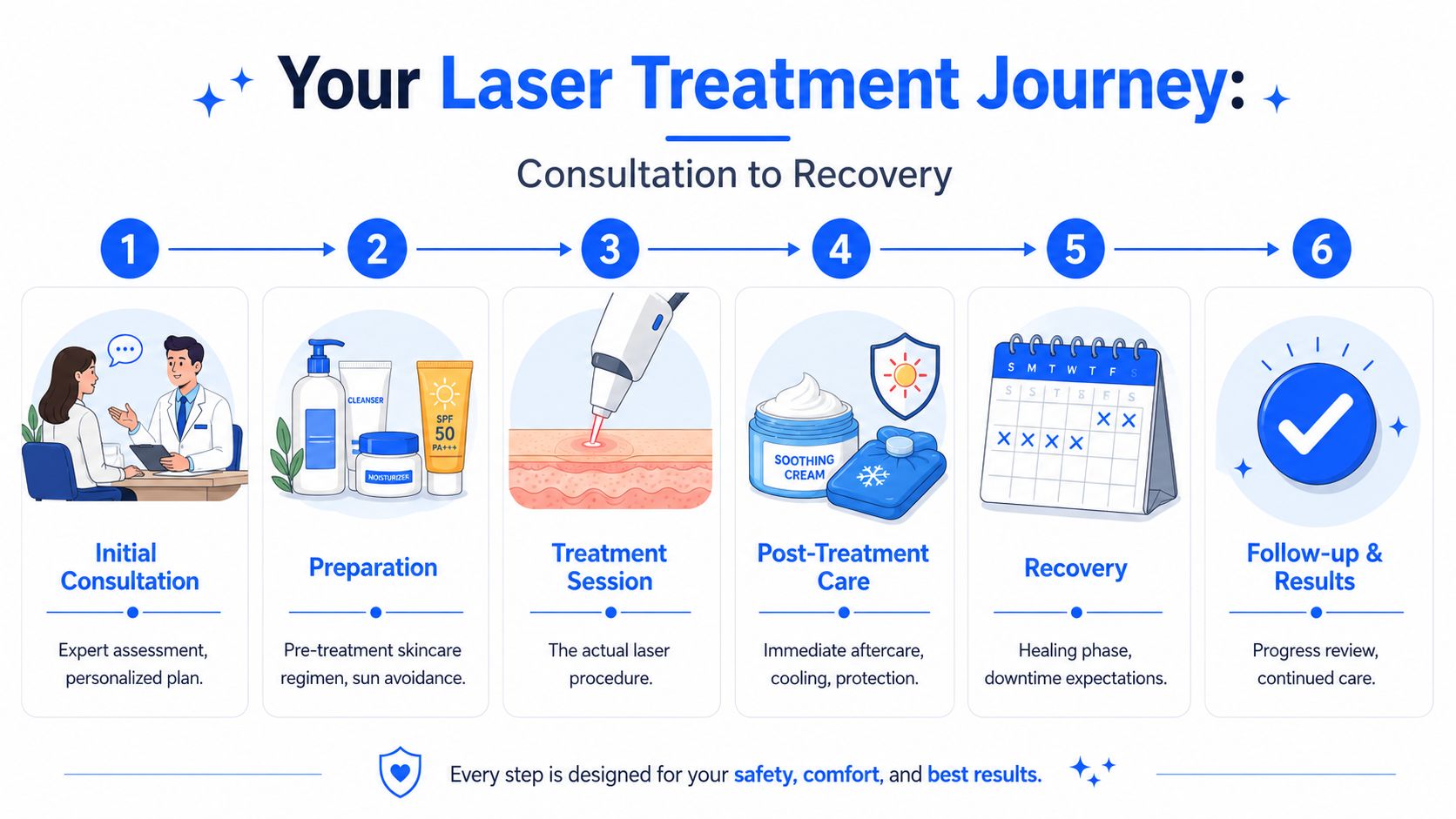
Before treatment
The consultation is where your provider examines scar type, discusses your goals, reviews your skin history, and decides whether laser is the right first move. Sometimes the answer is yes. Sometimes the better sequence is to calm active acne, strengthen the barrier, or combine laser with another treatment later.
You'll also get pre-care instructions. These usually involve simplifying skincare, avoiding sun exposure, and pausing products that make skin more reactive. The exact instructions vary by laser and by patient, so it's important not to copy someone else's routine from social media.
What treatment day feels like
Most patients receive topical numbing before treatment. During the procedure, the sensation depends on the device and settings. Some describe heat and prickling. Others feel a snapping or stinging sensation in concentrated areas where scars are deeper.
The appointment itself is usually more manageable than people expect because the visit is structured and monitored. Your provider can adjust settings, cooling, and treatment density based on how your skin responds in real time.
Recovery and aftercare
Expectation-setting is particularly important. Fractional CO2 laser therapy is associated with 30 to 70% improvement in acne scars, but the tradeoff is recovery. Reported adverse events include transient erythema, edema, and post-inflammatory hyperpigmentation, typically resolving within 2 to 4 weeks, with downtime ranging from 5 to 21 days.
That healing window can feel dramatic if you weren't warned about it. Redness, swelling, rough texture, and a bronzed or grid-like look can all be part of the normal process after more intensive resurfacing.
A simple way to think about recovery:
- Early phase: Skin feels hot, tight, and visibly red.
- Middle phase: Swelling settles, texture becomes rougher or flaky as skin turns over.
- Later phase: The surface looks calmer, but collagen remodeling is still happening beneath.
Healing is not the same as final results. Your skin may look socially presentable before the deeper remodeling is finished.
Good aftercare usually focuses on gentle cleansing, barrier support, sun protection, and leaving the skin alone long enough to recover properly. Patients get into trouble when they restart harsh skincare too early or judge results before healing is complete.
Realistic Expectations Timeline Costs and Combined Therapies
Laser treatment goes better when your expectations are grounded in reality. Most disappointment doesn't come from “bad” treatment. It comes from expecting one session to erase years of structural change.
What kind of timeline to expect
Fractional CO2 data indicate that most patients achieve significant visual reduction after 3 to 5 treatment sessions, and collagen stimulation can continue for 2 to 3 months after the procedure. That means results build. They don't appear all at once.
If you have several scar types, the timeline can feel uneven. One area may soften faster, while another holds onto deeper tethering. That doesn't always mean the laser failed. It may mean the scar architecture differs from spot to spot.
What laser scar treatment costs
Cost is another place where people need a plain answer. Laser acne scar removal is usually considered cosmetic, so insurance typically doesn't cover it.
According to a GoodRx review of acne treatment costs and laser pricing, prices generally range from $200 to $3,000 per session. The same review notes an average fee of $2,509 for ablative laser skin resurfacing and $1,445 for non-ablative treatments.
Those numbers explain why planning matters. A lower-downtime option may have a different total pathway than a more intensive resurfacing plan. The cheapest session is not always the most efficient route, but the most aggressive session is not always the safest one either.
Why combination care often works better
Some scars don't just need resurfacing. They need release, support, or a different kind of stimulation. That's why providers often combine lasers with other modalities rather than relying on one tool.
A few examples:
- Tethered scars: These may need subcision so the skin can lift more freely.
- Volume loss: Fillers or biostimulatory options can help selected scars look less sunken.
- Texture support: Some patients do well when laser is paired with collagen-focused treatments such as PRP microneedling.
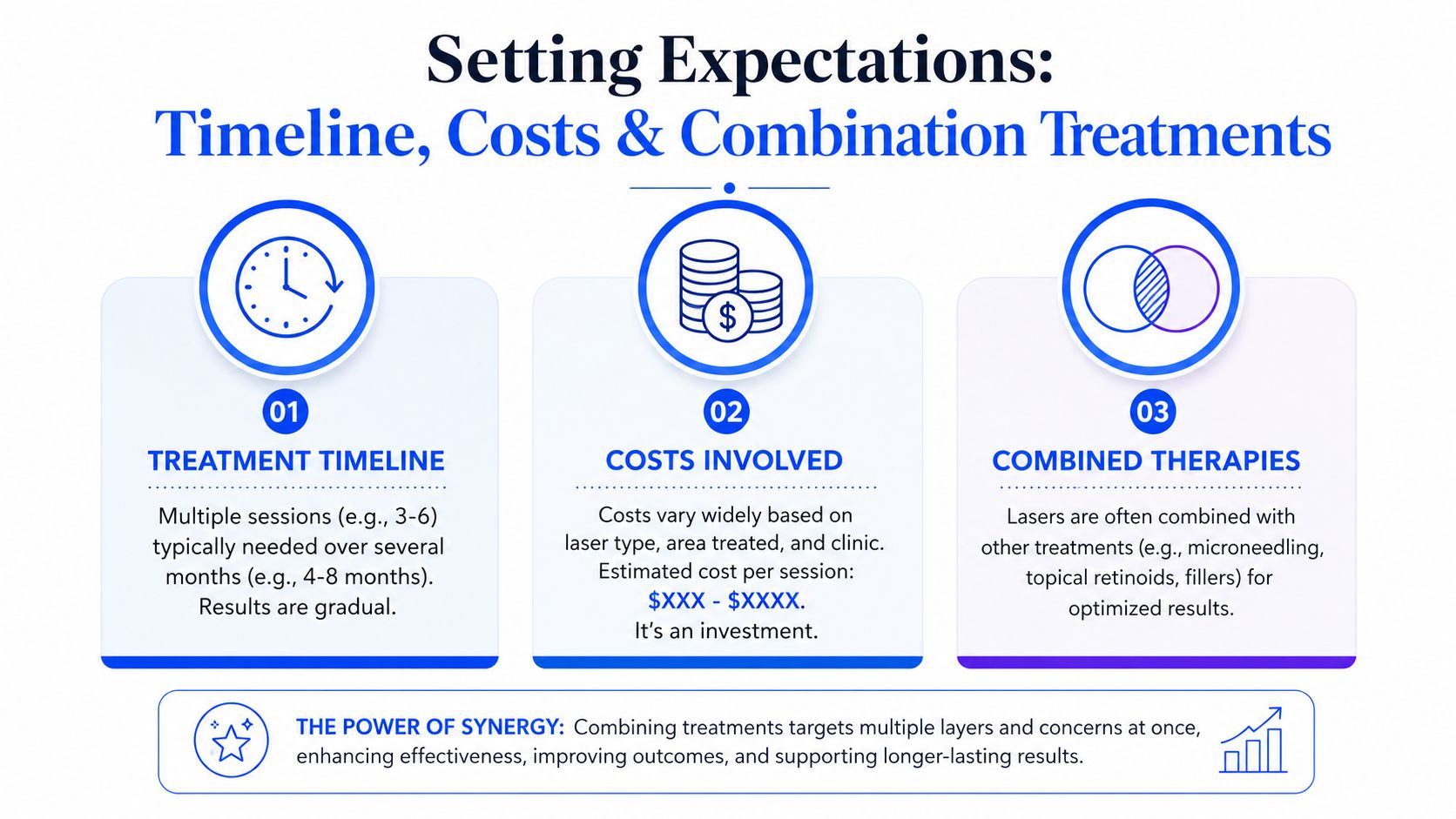
The most satisfying plans often treat the scar from more than one angle. Surface texture, deep tethering, pigment, and ongoing inflammation can all exist at once. One device rarely solves all of that by itself.
Common Questions and Your Next Steps with ProMD Health
By this point, individuals often have fewer fears and better questions. That's a good sign. It means you're moving from “I hope this works” to “I want the right plan for my skin.”
Common questions
Is laser treatment painful?
It can be uncomfortable, especially with stronger resurfacing treatments, but numbing and careful technique make a big difference. Most patients tolerate it better than they expected.
How long do results last?
Improvement in scars can be long-lasting because treatment changes skin structure. Your skin will still keep aging, and new breakouts can create new marks, so maintenance and acne control still matter.
Can I do laser treatment if I still break out?
Sometimes, but it depends on the kind of acne and how inflamed your skin is. Many providers prefer to stabilize active acne first so the scar plan has a better foundation.
What if I have darker skin and want minimal downtime?
That's often where non-ablative approaches become useful. Q-switched and long-pulsed 1,064 nm Nd:YAG lasers offer 40 to 50% clinical improvement with minimal downtime and no post-procedure recovery period, and they're considered suitable for phototype IV skin.
Your next step
A thoughtful consultation is where all of this becomes personal. Scar type, skin tone, healing history, schedule, and goals need to be assessed together. In a medical aesthetics setting, that conversation can include resurfacing options, pigment-safe pathways, and whether laser should stand alone or be part of a broader scar strategy.
If you're ready to get a clearer answer about your scars, schedule a consultation with ProMD Health. A provider can evaluate your skin in person or help you start with a virtual assessment through ProMD Connect, then map out a treatment plan that fits your skin tone, scar pattern, and recovery comfort level.


