
You've tried consistent sunscreen, pigment creams, and perhaps a retinoid, yet a stubborn patch on the cheekbone still shows through makeup. Or maybe you're dealing with a cluster of sunspots and wondering whether a YAG laser can remove them without creating a new pigmentation problem. Those are reasonable questions, especially because the phrase YAG laser pigmentation describes several different treatment approaches, not one universal protocol.
YAG treatment can fragment pigment so the body can gradually clear it, but clearance, recovery, and rebound vary by diagnosis, wavelength, energy settings, and skin tone. The sections below explain how the laser works, which conditions may respond, what treatment planning involves, why melasma can return, how darker skin changes the risk calculation, and what to ask before booking.
Table of Contents
- What YAG Laser Pigmentation Treatment Actually Involves
- How the Nd-YAG Laser Breaks Up Pigment
- Pigmentation Conditions YAG Lasers Can Treat
- What a YAG Pigmentation Treatment Plan Looks Like
- YAG Lasers and Skin Type Suitability
- Recurrence Risks and the Honest Trade-Offs
- YAG vs Other Pigmentation Treatments
- Who Should Consider YAG and What to Ask First
What YAG Laser Pigmentation Treatment Actually Involves
A patient may present with a melasma patch that persisted despite hydroquinone, retinoids, and daily SPF. Another may have one sharply defined sunspot after years of ultraviolet exposure. Both might request “a YAG laser,” yet the first clinical question is what kind of pigment is present and where it sits.
Nd:YAG, often operated in Q-switched mode, has a long history in pigment treatment. A 2023 review described the 1064 nm Q-switched laser as a therapeutic gold standard for pigmentation in Asia review of Q-switched laser treatment. That description refers to clinical experience, not a universal prescription. Sunspots, post-inflammatory hyperpigmentation, melasma, and dermal pigment can respond differently, and melasma-prone skin may experience recurrence after apparently successful treatment.
Before choosing settings, the clinician should establish:
- The diagnosis: Is the pigment epidermal, dermal, vascular, hormonal, or mixed?
- The skin type: Fitzpatrick types I through VI differ in epidermal melanin and post-inflammatory hyperpigmentation risk.
- The treatment objective: Is the aim to lighten one lesion, even diffuse tone, or gradually remove tattoo ink?
- The maintenance plan: Melasma and pigment-prone skin commonly require topical care and consistent photoprotection, whether or not laser is used.
YAG energy can fragment pigment into smaller particles that immune cells gradually clear. It does not switch off the biological tendency to produce excess melanin, so combination treatment and maintenance may matter more than repeated laser sessions alone.
Temporary whitening, redness, crusting, or darkening can occur before the area settles. The Omega Lasers clinical YAG guide outlines common device modes and uses, but an examination is still needed to select the wavelength, energy, and treatment plan.
How the Nd-YAG Laser Breaks Up Pigment
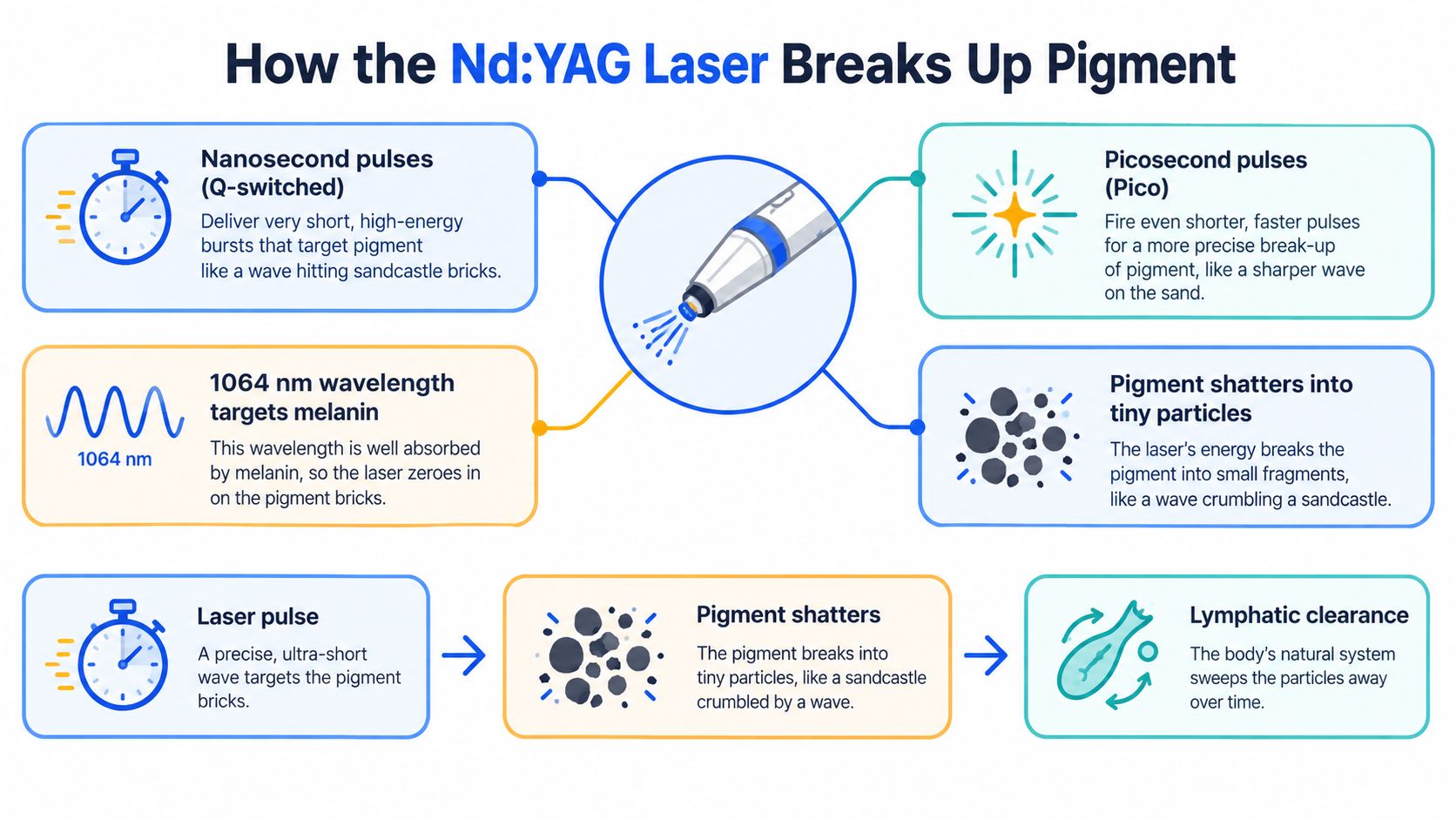
Think of melanin as a group of tightly packed bricks. A Q-switched laser delivers a very short, powerful pulse that acts more like a precise wave striking the bricks than a heater warming the whole wall. The pigment fragments, and the body gradually processes and clears those smaller particles.
Why wavelength changes the treatment
The 1064 nm wavelength travels relatively far and is absorbed less aggressively by epidermal melanin. That allows it to reach dermal pigment while sparing more of the surface pigment, which is why it's repeatedly used for darker skin types and deeper dyschromia clinical review of 1064 nm Nd:YAG. Guidance for skin of color states that 1064 nm can be used across Fitzpatrick types I through VI, while 532 nm is generally reserved for more superficial lesions skin-of-color laser guidance.
The 532 nm wavelength, created by frequency doubling, is absorbed strongly by superficial epidermal pigment. That can make it useful for selected surface lesions, but the same strong absorption raises the risk of unwanted epidermal injury and post-inflammatory hyperpigmentation, particularly in darker skin.
Why pulse duration and settings matter
Q-switched systems use extremely short pulses, commonly in the nanosecond range, to create a photoacoustic effect. Newer picosecond devices use even shorter pulses. Long-pulsed Nd:YAG systems work differently, delivering heat over a longer period for applications such as hair reduction or selected vascular treatments.
“YAG” therefore identifies a laser family, not a single treatment. Fluence, spot size, pulse duration, repetition rate, passes, and cooling all affect how much energy reaches the target and how much heat reaches surrounding tissue. A recent mechanistic report described a low-fluence 1064 nm approach using 1.0 J/cm², delivered as two passes and four turns, that suppressed melanin synthesis through effects on tyrosinase and pigment-related genes without triggering melanocyte apoptosis mechanistic report. That supports a gentler, repeated-pass strategy, but it doesn't make every low-fluence protocol safe for every patient.
Pigmentation Conditions YAG Lasers Can Treat
A clearly defined brown spot is usually easier to assess and treat than diffuse facial pigmentation. A solar lentigo or selected superficial lesion may respond well when the diagnosis is secure. Melasma behaves differently because ultraviolet exposure, heat, hormones, inflammation, and vascular changes can all influence pigment production.
Matching the concern to the approach
Solar lentigines and freckles may respond to selected 532 nm Q-switched or short-pulsed Nd:YAG treatment when pigment is superficial. The 532 nm wavelength is absorbed strongly by epidermal melanin, which helps target surface pigment but can also increase post-inflammatory hyperpigmentation risk in darker skin.
Dermal pigment, including nevus of Ota and acquired bilateral nevus of Ota-like macules, is more commonly treated with 1064 nm Q-switched energy over several sessions. The longer wavelength reaches deeper pigment with less absorption by surface melanin, although it still requires careful parameter selection.
Melasma requires restraint and realistic expectations. Low-fluence 1064 nm treatment may reduce visible pigment and improve clinical scores, but it does not permanently remove the triggers that drive recurrence. One cited study treated 50 patients with 15 weekly sessions at 2.8 J/cm² and reported a 50% to 74% reduction in pigmentation after treatment. Another study reported an average mMASI reduction of 54.23%, with 75% of patients achieving excellent, good, or sufficient improvement 2023 review. These results support improvement, not a guarantee of durable control. Melasma-prone skin may need maintenance and combination treatment rather than YAG monotherapy.
Post-inflammatory hyperpigmentation can improve with an individualized 1064 nm protocol, but added inflammation can also deepen it. Tattoos, particularly black and dark blue ink, remain a common indication for Q-switched pigment fragmentation. Fading is gradual and depends on ink composition, depth, and the skin's response.
| Condition | Preferred YAG wavelength or variant | Typical response |
|---|---|---|
| Solar lentigines | Selected 532 nm Q-switched treatment | Often responsive when superficial and well defined |
| Freckles | Carefully selected short-pulsed treatment | May lighten, with possible ultraviolet-related recurrence |
| Melasma | Low-fluence 1064 nm Q-switched treatment | Improvement is possible, but relapse and maintenance concerns remain |
| Post-inflammatory hyperpigmentation | Individualized 1064 nm protocol | Variable response, with a risk of worsening |
| Dermal pigment | 1064 nm Q-switched treatment | Often requires multiple sessions and may clear partially |
| Dark tattoo ink | Q-switched pigment treatment | Progressive fading over a treatment series |
A 2015 study of 20 patients reported 55.0% had an excellent response after two sessions, with average improvement of 72.25%. A 2024 study of 30 patients using 1064 nm and 532 nm Nd:YAG lasers found 53% achieved excellent clearance and 30% achieved good to moderate clearance published Nd:YAG study. These figures illustrate potential, not a predictable result for melasma or post-inflammatory pigmentation. Patients can review laser treatment for hyperpigmentation before and after, while remembering that photographs cannot replace diagnosis.
What a YAG Pigmentation Treatment Plan Looks Like
A patient with facial pigmentation may arrive expecting one laser session to solve the problem. A responsible plan begins earlier, with diagnosis, risk assessment, and a strategy for judging whether the colour is changing safely.
The consultation and examination
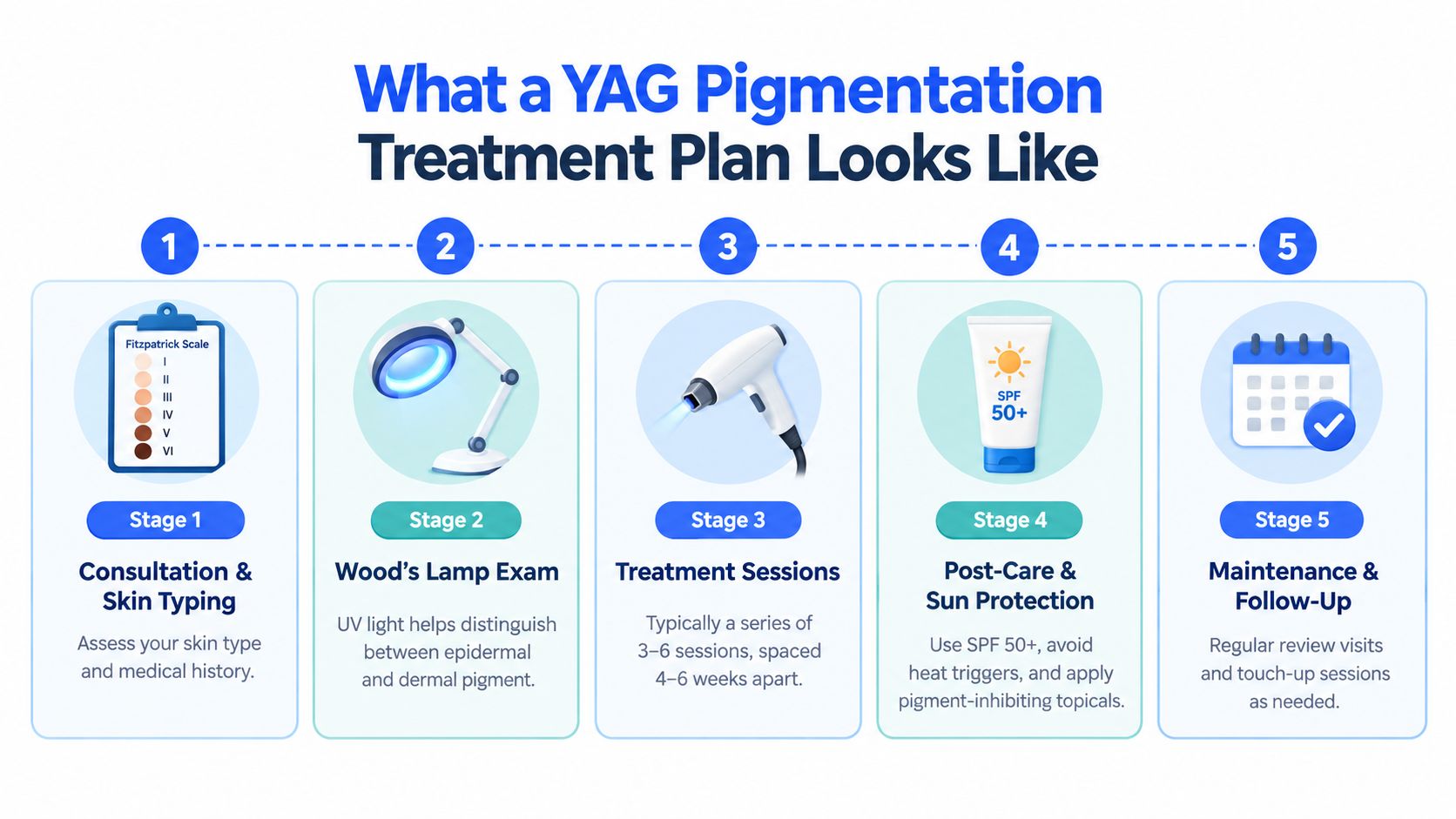
The clinician first considers whether the pigment is mainly epidermal or dermal, reviews Fitzpatrick skin type, medications, recent sun exposure, and any history of melasma or post-inflammatory hyperpigmentation. Baseline photographs under consistent lighting make later comparisons more useful.
A Wood's lamp can show how pigment behaves under ultraviolet illumination, but it cannot replace clinical assessment. For skin types IV and higher, a test spot may be appropriate. Treating a small area first provides information about inflammation, darkening, and healing before the same settings are applied across the face.
Ask which wavelength and mode are proposed, and why. A 1064 nm Q-switched session generally requires protective eyewear. Each pulse may feel like a quick snap or an elastic-band flick. A full-face treatment may take 15 to 30 minutes, depending on the area and protocol. Immediate whitening, or a grey-frosted appearance, can occur as the target absorbs energy.
Sessions and recovery
The number and spacing of sessions depend on the diagnosis, pigment depth, fluence, pulse settings, and the skin's response. Published protocols include 15 weekly sessions, while other treatment series have produced meaningful clearance sooner, so a fixed schedule cannot be promised. The earlier review of Q-switched treatment provides context for this variation. A cautious clinician usually reassesses after each treatment and changes the plan if inflammation or rebound darkening develops.
Aftercare commonly includes:
- Cooling: Apply cool compresses if the area feels warm or tender.
- Sun protection: Use broad-spectrum SPF 50 or higher and limit direct exposure.
- Pigment control: Continue clinician-approved pigment-stabilising topicals when suitable.
- Heat avoidance: Reduce hot environments and strenuous activities that raise skin temperature during early recovery.
- Medication pause: Follow instructions for retinoids and other irritating products, which may need to be withheld for 48 to 72 hours.
Visible improvement can be gradual. A treated spot may crust or look darker before fading. With melasma-prone skin, the clinician must assess the overall pattern and plan maintenance or combination treatment, because clearing one patch does not guarantee durable control.
YAG Lasers and Skin Type Suitability
A patient with medium to deep skin may have the same brown spot as someone with fair skin, yet the treatment risk can differ considerably. Fitzpatrick classification helps describe ultraviolet sensitivity, but it does not predict everything. A complete assessment also considers tanning, previous PIH, melasma, active inflammation, medication use, and how the skin healed after earlier procedures.
Why 1064 nm is often selected
For Fitzpatrick types I through III, clinicians may consider superficial or deeper pigment approaches according to the diagnosis. In types IV through VI, 1064 nm is often chosen because its longer wavelength reaches deeper targets while interacting less with epidermal melanin. That can provide more room for safe parameter selection than a shorter wavelength, especially for pigment located below the surface.
The safety margin remains limited. A five-year review of 2,010 facial laser cases found PIH was the most frequently reported complication overall, with greater concern in Fitzpatrick IV through VI skin. Q-switched Nd:YAG treatment was also associated with PIH and rebound pigmentation in that review five-year review. Guidance on laser treatment for darker skin likewise helps explain why darker skin requires conservative settings and careful monitoring.
| Fitzpatrick type | Wavelength often considered | PIH risk | Main caution |
|---|---|---|---|
| I | 532 nm or 1064 nm, diagnosis dependent | Lower relative risk, not zero | Confirm the lesion before treatment |
| II | 532 nm or 1064 nm, diagnosis dependent | Lower relative risk, not zero | Protect treated skin from ultraviolet exposure |
| III | Individualized 532 nm or 1064 nm | Moderate consideration | A test spot can help guide settings |
| IV | Usually cautious 1064 nm selection | Meaningful risk | Use conservative energy and watch for rebound |
| V | Usually cautious 1064 nm selection | Meaningful risk | Avoid aggressive treatment during inflammation |
| VI | Usually cautious 1064 nm selection | Meaningful risk | Specialist experience and test-spot assessment matter |
The wavelength is only one part of the decision. Fluence, pulse duration, spot size, cooling, passes, and treatment intervals all affect how much heat reaches surrounding skin. A cautious plan starts with settings suited to the diagnosis, may test a small area, and allows the response to guide later treatment.
Ask how often the clinician treats your skin tone, how PIH would be managed, and whether the plan accounts for melasma or other conditions that can reactivate pigment. A device label alone cannot answer those questions.
Recurrence Risks and the Honest Trade-Offs
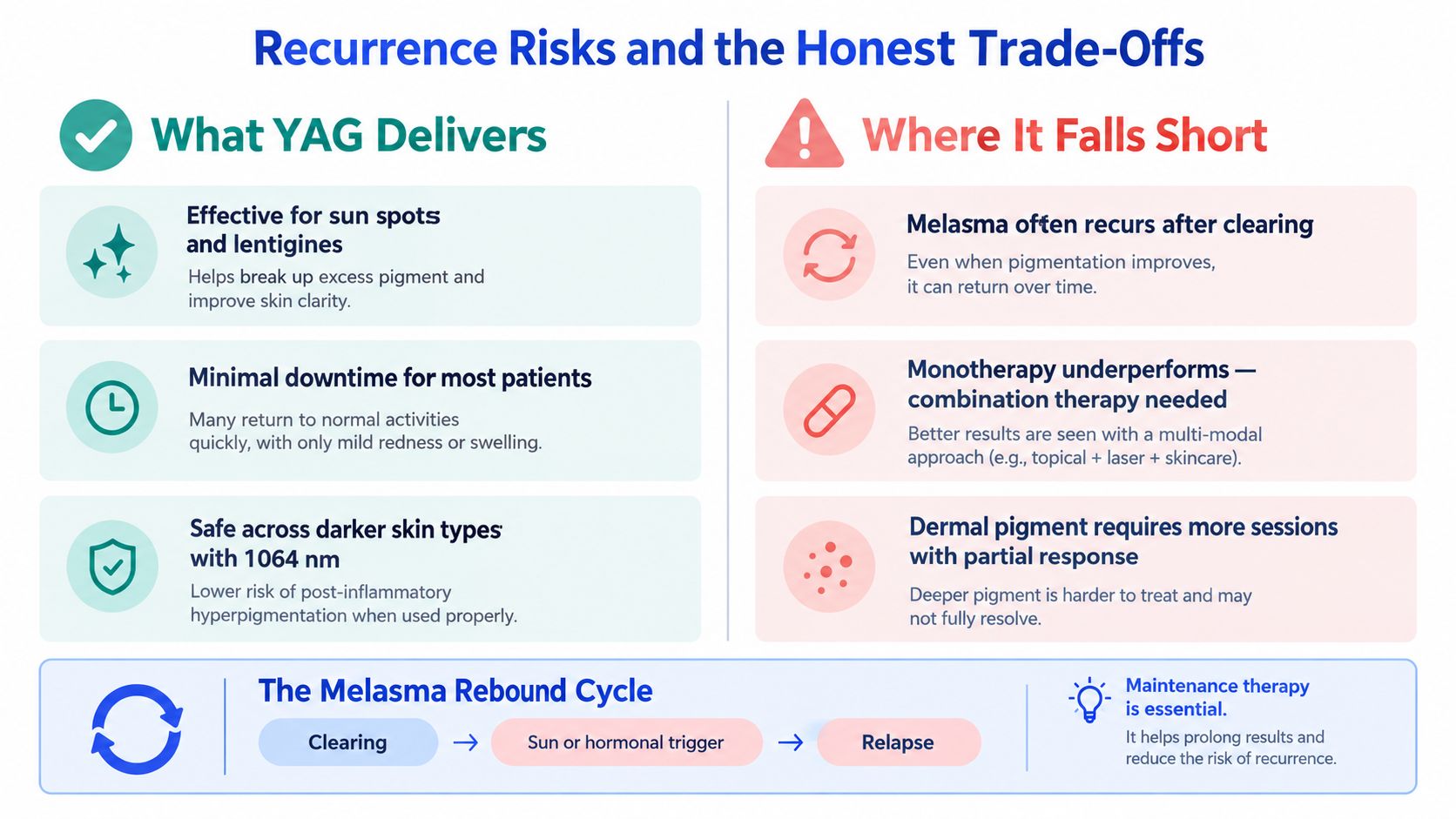
A dark patch can fade after treatment, then gradually return during a period of sun exposure, heat, hormonal change, or skin inflammation. The laser can reduce visible pigment without removing the biological signals that keep melanocytes active. This distinction is especially important for melasma-prone skin.
Why melasma can return
Reviews describe low-fluence 1064 nm Nd:YAG as an option for refractory melasma, but they also report three-month recurrence rates of 64% to 81% after treatment melasma recurrence review. A successful first result therefore does not guarantee durable clearance. Maintenance skincare, ultraviolet protection, trigger reduction, and carefully selected follow-up treatment may remain part of the plan.
Repeated low-fluence passes raise a separate concern: cumulative heat. If energy builds across multiple passes or sessions, the resulting thermal stress may stimulate melanocyte activity and contribute to rebound pigmentation. This mechanism does not mean every low-fluence treatment causes recurrence. It means the clinician must manage total heat, spacing, and response rather than treating melasma like one isolated sunspot.
What darker skin adds to the decision
In darker skin, post-inflammatory hyperpigmentation and rebound pigmentation are meaningful treatment risks. Facial laser reviews identify pigmentary complications in skin of color, including after Q-switched treatment five-year facial laser review. Hypopigmentation and punctate leukoderma can also occur, particularly when treatment is aggressive or energy is concentrated in small areas.
These trade-offs help explain the shift toward combination therapy rather than routine YAG monotherapy. Fractional 1064 nm treatment paired with intradermal tranexamic acid has shown greater melasma improvement than either approach alone in a 2026 study. A 2024 meta-analysis also found that combination treatment may improve outcomes, while noting that further research is needed. Other emerging work has reported greater improvement with a fractional 675 nm diode laser than with Q-switched 1064 nm Nd:YAG, alongside mild, temporary adverse events.
The safer question is not “Which laser is strongest?” It is “Which diagnosis, wavelength, and maintenance plan offer this skin the best balance between benefit and recurrence risk?”
YAG vs Other Pigmentation Treatments
There isn't a universal winner because each modality interacts with pigment at a different depth and carries a different recovery burden. The useful comparison is between your actual problem and the tool's behavior.
How the options differ
YAG versus IPL: Broad-spectrum light may suit diffuse sun damage in carefully selected lighter skin, while 1064 nm Nd:YAG can be more useful when deeper pigment or darker skin changes the risk calculation. IPL isn't a laser, and its broad output makes diagnosis and skin-tone selection especially important.
YAG versus fractional non-ablative resurfacing: Fractional non-ablative approaches create controlled microscopic treatment zones to address diffuse pigment and texture. They may be preferable when the concern extends beyond isolated pigment, although a series is usually part of the plan.
YAG versus picosecond pigment treatment: Both approaches use short pulses, but device wavelength and pulse duration vary. The decision depends on ink or pigment depth, skin type, and whether the clinician can control heat and energy distribution.
YAG versus chemical peels: A peel acts primarily at the surface and may suit selected epidermal pigment. It can be useful as part of a broader plan, but inflammation itself can worsen PIH in susceptible skin.
YAG versus tranexamic acid: Tranexamic acid, topical or oral when medically appropriate, addresses pigment biology rather than fragmenting existing pigment. It may serve as an adjunct or alternative, particularly in melasma, where the trigger is ongoing.
| Modality | Best for | Sessions | Downtime | PIH risk in Fitzpatrick IV to VI | Approx. cost per session |
|---|---|---|---|---|---|
| 1064 nm Q-switched Nd:YAG | Dermal pigment and selected melasma | Individualized series | Usually limited, diagnosis dependent | Meaningful, especially with poor settings or rebound | Varies by clinic and area |
| 532 nm Q-switched Nd:YAG | Selected superficial lesions | Individualized series | Short recovery with possible crusting | Higher concern in darker skin | Varies by clinic and area |
| IPL | Diffuse sun-related pigment in selected skin | Individualized series | Usually short | Greater concern as epidermal melanin increases | Varies by clinic and area |
| Fractional non-ablative treatment | Diffuse pigment with texture concerns | Individualized series | Mild to moderate | Depends on energy and skin type | Varies by clinic and area |
| Picosecond treatment | Selected pigment and tattoo ink | Individualized series | Usually limited to short recovery | Diagnosis and settings determine risk | Varies by clinic and area |
| Chemical peel | Selected superficial pigment | Individualized series | Peeling and sensitivity vary | Can be meaningful in darker skin | Varies by clinic and area |
| Tranexamic acid | Melasma support or adjunctive care | Clinically determined | No laser downtime | Depends on route and medical suitability | Varies by treatment plan |
For home support, readers can review this educational resource on brightening products for dark spots, then discuss ingredients with a clinician rather than layering multiple irritants independently. A practical explanation of how light-based approaches differ is also available in this comparison of IPL versus laser treatment. ProMD Health offers laser treatments for pigmentation concerns, including protocols that address hyperpigmentation, but availability and device selection should be verified with the specific office.
Who Should Consider YAG and What to Ask First
YAG may be worth considering when the pigment is clearly diagnosed, the target is appropriate for the wavelength, and you're prepared for staged treatment. Stronger candidates often include people with discrete solar lentigines, café-au-lait macules, Becker's nevi, selected tattoos, or PIH that has stopped improving with topical care.
Poor timing includes an active melasma flare, recent ultraviolet exposure, and isotretinoin use within the previous six months. A clinician may also defer treatment when you can't commit to strict photoprotection or when your expectation is complete clearance after one session.
Questions that reveal the quality of the plan
Bring these questions to your consultation:
- What is the diagnosis, and is the pigment epidermal, dermal, or mixed?
- Which wavelength will you use, 1064 nm or 532 nm, and why?
- Will the device operate in Q-switched, picosecond, fractional, or long-pulsed mode?
- What pulse duration, fluence, and spot size will you start with?
- Will you perform a test spot before treating a larger area?
- How often do you see PIH or rebound pigmentation in patients with my skin type?
- How do you photograph results using standardized lighting or imaging such as VISIA or a comparable system?
- What happens if my melasma darkens after treatment?
- What topical or medical plan will support the laser treatment?
- How will you handle maintenance if the pigment returns?
The best plan may not begin with a laser. It may start with sunscreen, antioxidants, condition-specific topicals, and trigger control, then add carefully selected energy only when the skin is stable. That approach treats the pigment you can see while also addressing the biology that keeps producing it.
If you're considering treatment, ProMD Health can assess pigmentation concerns and discuss laser-based options, skincare, and related non-surgical treatments as part of an individualized plan. Visit ProMD Health to explore available services and request a consultation at an approved location.


