
For a small tattoo in the U.S., expect roughly $200–$500 per session, with a realistic total often landing between $1,000 and $4,000 once the required sessions are counted. A simple black design may cost less, but tattoo removal is usually a multi-session plan, not a one-visit purchase.
You may be looking at a small wrist tattoo from college, perhaps a two-inch black design you want gone before a wedding. The online price looks manageable until you multiply it by the number of appointments, add the time between treatments, and account for how your ink and skin respond. That's where the tattoo removal cost for small tattoo becomes clear.
Table of Contents
- What Small Tattoo Removal Actually Costs in 2026
- The Key Factors That Change Your Final Number
- Comparing Removal Methods and Their Price Tags
- Sessions, Spacing, and the Real Timeline
- Your Consultation Visit and Aftercare Routine
- Estimating Total Cost and Exploring Payment Options
- Hidden Costs to Watch For Before You Commit
What Small Tattoo Removal Actually Costs in 2026
A small tattoo commonly falls into a $200–$500 per-session range in the U.S., while the American Society of Plastic Surgeons reports an average cost of $697 for laser skin treatments such as laser tattoo removal. Size-based pricing can be lower, with one major provider listing extra-small tattoos under one square inch at $221 per session and small tattoos under four square inches at $328 per session. These figures are per appointment, not the full cost of clearance. The American Society of Plastic Surgeons cost guide explains why a single headline number rarely tells the whole story.
Small tattoos often need 6–12 sessions, so a course can reach a four-figure total even when the design looks tiny. A pricing reference also describes simple black tattoos needing about 8–12 treatments, with final session count affected by color, density, and placement. This small-tattoo pricing guide provides useful context for comparing per-session prices with the broader treatment plan.
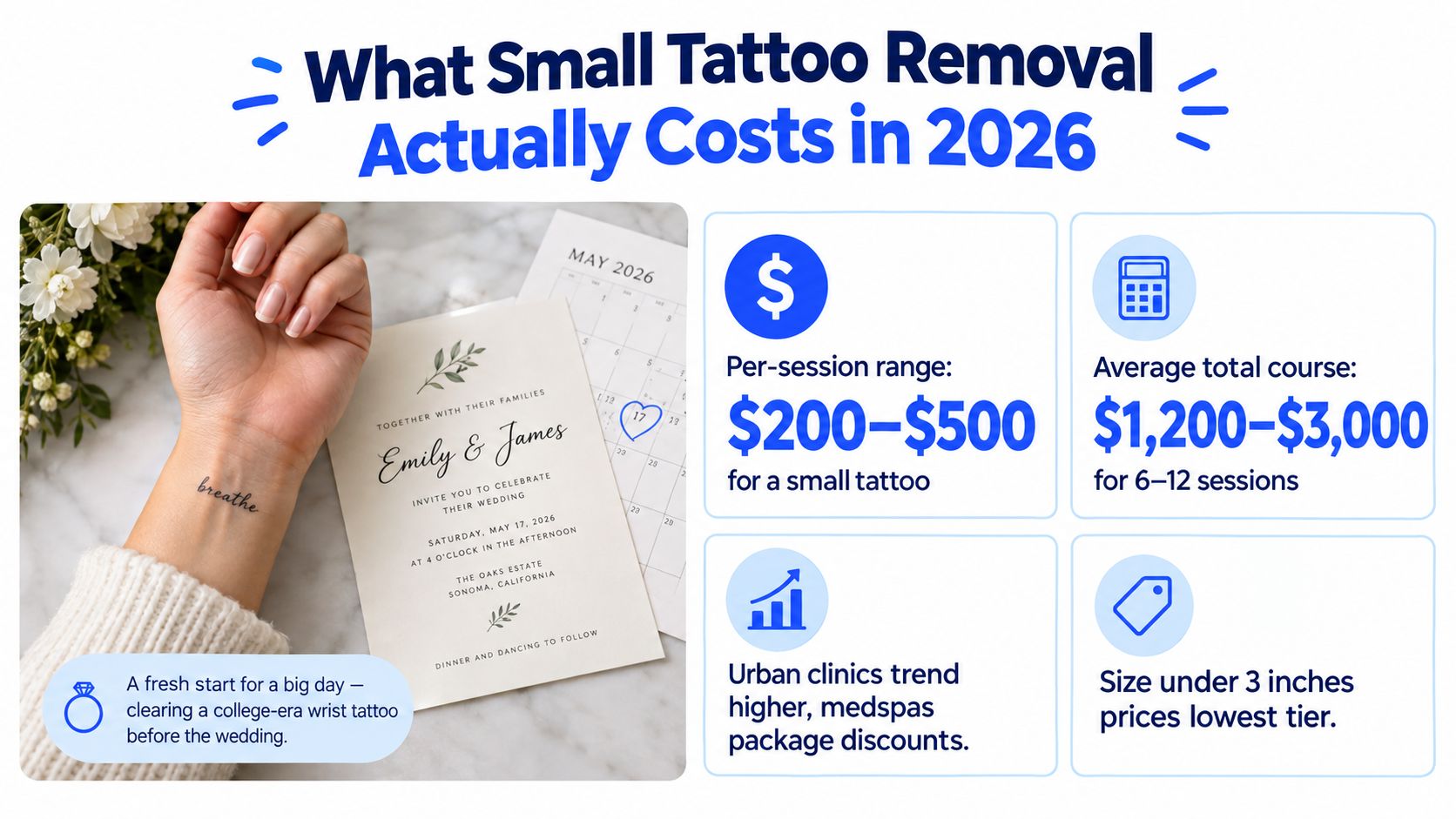
Those $75–$150 mini-tattoo advertisements can look attractive, but they may apply only to an especially small treatment area or a single appointment. A low quote also becomes less useful if the plan needs substantially more visits. Clinics price the treated area, laser time, equipment, and clinical oversight, rather than just how small the tattoo appears at a glance. A thin one-inch symbol and a dense design covering several square inches won't receive the same treatment.
Practical rule: Never compare two clinics using the session price alone. Compare the estimated session range, what the quote includes, and the likely total course.
Four factors move the final number more than anything else:
- Ink and color complexity: Black ink is generally more straightforward than layered or difficult colors.
- Body location: Areas with different circulation and skin characteristics can respond at different speeds.
- Skin type and healing response: Treatment settings must be selected conservatively and adjusted to the individual.
- Provider model: Medical clinics, specialist practices, and medspas may structure fees and packages differently.
For regional context, readers comparing treatment approaches can also review tattoo removal options Bournemouth 2026, while keeping in mind that local pricing doesn't transfer directly to the U.S. The defensible budget comes from matching your tattoo's characteristics to a realistic session range, then asking for the full arithmetic in writing.
The Key Factors That Change Your Final Number
A clinic shouldn't quote a small tattoo from a photograph alone. The image helps start the conversation, but the provider needs to assess the actual treated area, ink saturation, placement, and skin.
Size sets the starting tier
Clinics commonly price by the square inches of treated skin. A one-inch symbol and a three-inch script may both be described as small, but the larger design covers roughly three times the area. That affects laser passes, appointment time, and the amount of ink being targeted.
The difference isn't cosmetic. A tattoo that looks small from across the room may occupy a larger treatment rectangle once spacing around the design is included. Ask whether the quote is based on the ink itself or the full area the provider plans to treat.
Color and saturation determine the work
Dense black ink is often easier to address than a design built from several colors. Layered color, pastels, and white ink can require a more complex plan and may increase treatment demands by 30–50%, according to the pricing information provided for this topic. This consumer cost overview also emphasizes that color and treatment characteristics can make the total vary widely.
Ink depth matters, too. Professionally applied tattoos often place pigment at greater depth and more evenly than amateur work. Cover-ups can be particularly demanding because the provider may be treating multiple layers of pigment rather than one consistent line of ink.
Placement changes response
The same tattoo can behave differently on an arm, ankle, finger, or rib area. Circulation-rich areas such as the arms and chest may respond more readily, while fingers, ankles, and ribs can be slower or more difficult to treat. That doesn't mean a difficult location makes removal impossible. It means the provider may need a longer interval or a more conservative approach.
Skin type affects settings and timing
Providers often evaluate skin using the Fitzpatrick I–VI scale. Higher melanin levels require careful wavelength selection and conservative settings to reduce the risk of unwanted pigment changes. That can extend the treatment timeline, even when the tattoo itself is small.
| Factor | Low-Impact Scenario | High-Impact Scenario | Typical Cost Effect |
|---|---|---|---|
| Size | Tiny symbol with limited treated area | Dense design covering several small square inches | Lower or higher session tier |
| Color | Lightly saturated black ink | Layered colors, pastels, or white ink | More complex treatment plan |
| Ink depth | Faded or lightly placed amateur ink | Deep, dense professional work or cover-up | Potentially more sessions |
| Location | Arm or chest placement | Finger, ankle, or rib placement | Slower response may raise total |
| Skin type | Settings allow a straightforward treatment approach | Conservative settings and pigment monitoring required | Longer timeline may increase course cost |
Treat this table as a sorting tool, not a promise. The most useful quote explains why your tattoo belongs in a particular range and what would cause the estimate to change.
Comparing Removal Methods and Their Price Tags
For many seeking complete removal of a small tattoo, laser treatment is the practical default. Q-switched and picosecond systems break pigment into smaller particles that the body can gradually clear, but the treatment remains a process rather than an instant eraser.
Laser treatment typically costs $200–$500 per session and commonly requires 6–12 sessions for a small tattoo. The advantage is control. A provider can adjust settings as the ink fades, treat different colors appropriately, and monitor the skin between visits. The drawback is the calendar. You pay across multiple appointments and wait for healing between them.
Surgical excision takes a different approach. A clinician removes the tattooed skin in one procedure, then closes the area. For a small area, the procedure may fall around $150–$350, but the trade-off is a permanent surgical scar and limited suitability for many locations or designs. It can make sense only in carefully selected cases where the tattoo is very small and the patient accepts the scar.
Dermabrasion is the legacy option. It removes or abrades upper layers of skin, but healing can be unpredictable and the method doesn't offer the same pigment-specific precision as modern laser treatment. Its cost can approach laser treatment without providing the same control, which is why many clinics no longer recommend it as a first choice.
Creams and acid products deserve a blunt warning. They don't provide a reliable method for clearing tattoo pigment in the deeper skin and can irritate, burn, or scar the surface. Spending less upfront doesn't make a method economical if it creates another problem to treat.
| Method | Typical Cost Range | Sessions Needed | Scarring Risk | Best Fit |
|---|---|---|---|---|
| Laser removal | $200–$500 per session | 6–12 commonly | Lower when properly selected and performed | Most patients seeking gradual fading or removal |
| Surgical excision | $150–$350 per procedure | One procedure | Permanent surgical scar expected | Select very small tattoos where scarring is acceptable |
| Dermabrasion | Comparable to laser in some settings | Multiple or staged care may be needed | Less predictable healing | Rare cases where a clinician specifically recommends it |
Patients researching how different clinics explain the process can review Aloha Tattoo Waikiki clients for additional perspective, but treatment suitability still depends on an in-person assessment. ProMD Health focuses on laser-based tattoo removal, with the specific approach and price discussed during consultation. Its overview of how technology has changed tattoo removal can help patients understand why equipment and treatment planning affect the quote.
Sessions, Spacing, and the Real Timeline
The treatment calendar is where many small-tattoo budgets go wrong. A small design often needs 6–12 laser sessions, and providers commonly space visits 6–8 weeks apart. This treatment-planning guide describes how size, age, placement, and other tattoo characteristics influence price and session needs.
The interval isn't an inconvenience a clinic adds to sell more appointments. After the laser fragments pigment, the body needs time to clear it and the skin needs time to recover. Shortening the gap doesn't force faster clearance. It can expose healing skin to unnecessary stress and increase the chance of complications.
A typical small-tattoo visit includes:
- Skin check: The provider assesses healing, fading, redness, and any pigment changes.
- Settings review: Treatment parameters are adjusted according to the tattoo's response.
- Laser pass: The provider treats the design, often within a short appointment for a small area.
- Aftercare instructions: The treated skin is protected and the next visit is scheduled only when appropriate.
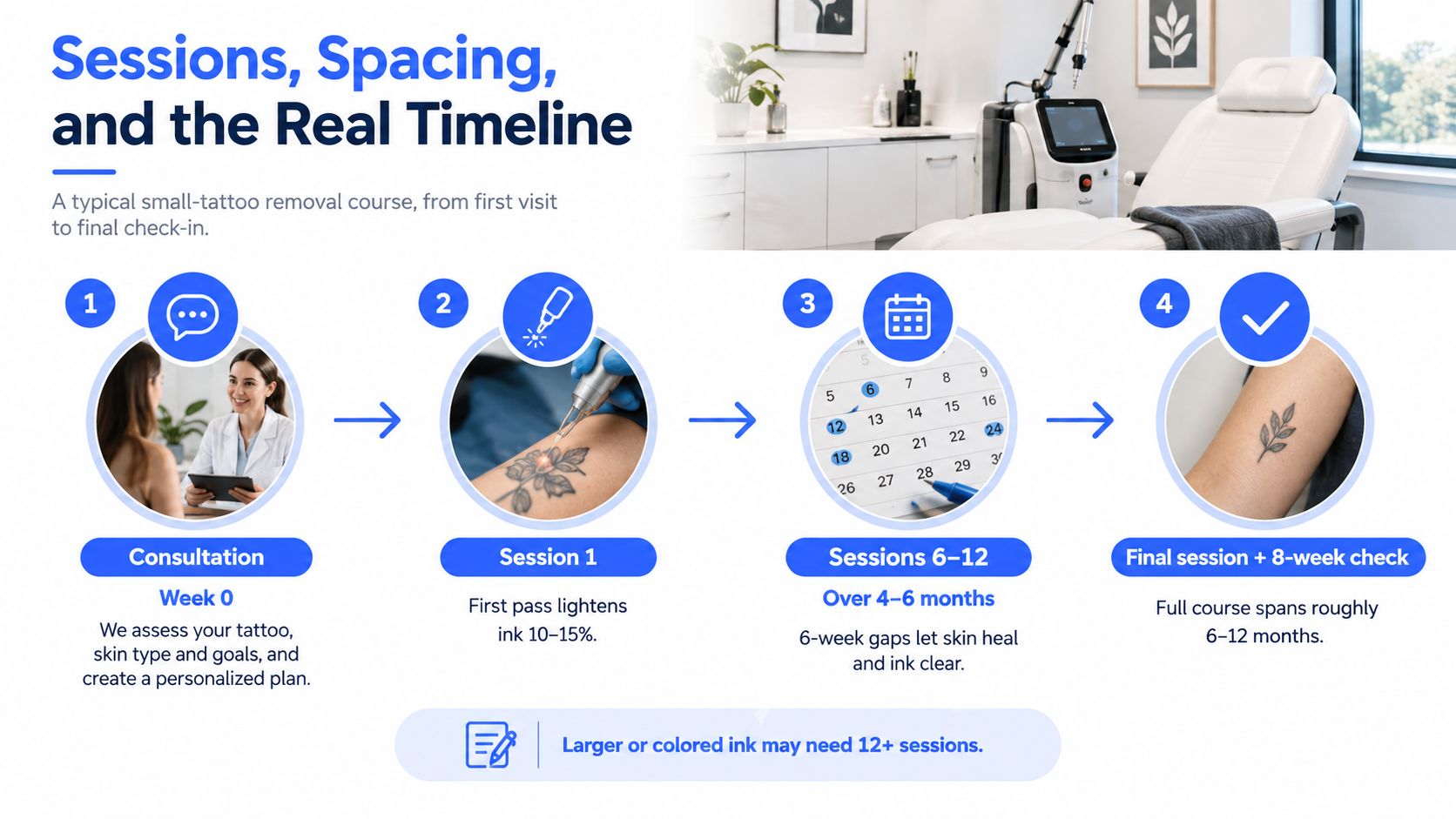
For an eight-session plan, you might attend the consultation in week zero, receive the first treatment shortly afterward, and return at intervals of roughly six to eight weeks. The course then unfolds across many months, with later visits based on healing and visible fading rather than a rigid promise. Dense ink or stubborn colors can push the plan toward the upper end of the range.
A source focused on treatment planning, 3D Aesthetics Leamington Spa tattoo removal, also illustrates why session count should be discussed as an estimate rather than a guarantee. ProMD Health provides further guidance on laser tattoo removal sessions for patients evaluating the process.
Your Consultation Visit and Aftercare Routine
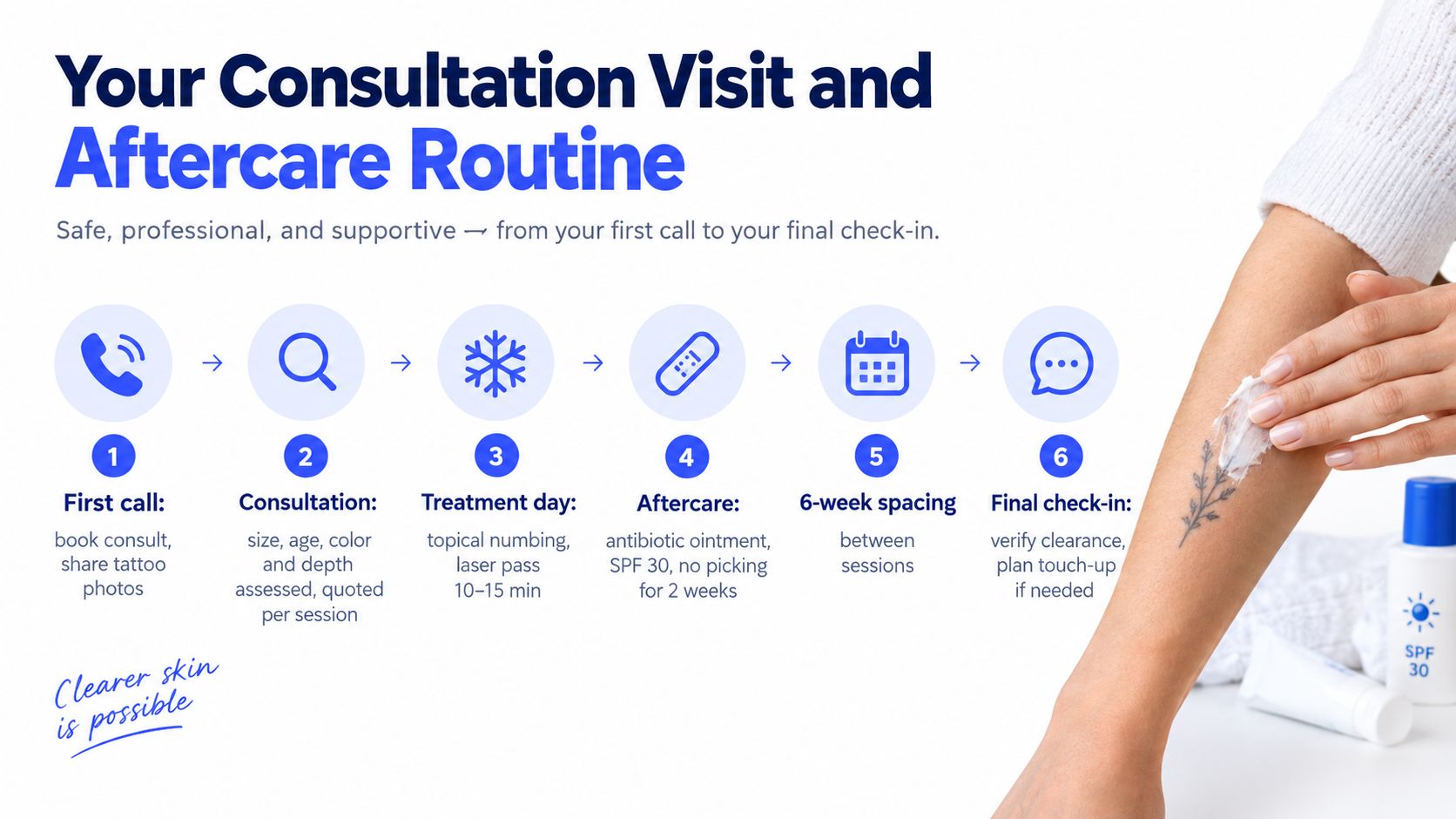
The first call is usually simple. You share the tattoo's location, approximate size, age, and color, then send clear photographs if the clinic accepts preliminary images. That information helps the team decide whether to schedule a consultation, but it shouldn't replace a proper skin assessment.
At the consultation, a provider examines the tattoo's size, age, color mix, ink depth, and location. They may assess your skin using the Fitzpatrick scale, photograph the tattoo for baseline comparison, and provide a written quote with an estimated session range. A responsible estimate leaves room for the skin and ink to determine the final pace.
Comfort is part of the plan
Small tattoos often need minimal numbing, but sensitivity varies by location and person. A clinic may offer a topical anesthetic cream, cooling with ice or cold air, and, for particularly sensitive areas such as ribs or fingers, a local injection when clinically appropriate.
The goal isn't to pretend treatment feels like nothing. The goal is to make the appointment manageable while protecting the skin. Ask what numbing is included, what you need to purchase separately, and whether you should apply anything before arriving.
Aftercare protects the result
A representative routine begins with cooling the area during the first 24 hours, following the provider's instructions. Keep the site clean and covered with non-stick gauze, use the recommended ointment, and avoid soaking, sun exposure, and friction for at least two weeks.
Do not pick at blisters or scabs. Wear clothing that won't rub the area, and ask before applying products that weren't included in your written instructions. A practical aftercare checklist looks like this:
- Cool the skin: Use the provider's recommended cooling method during the initial period.
- Protect the area: Use clean, non-stick gauze as directed.
- Avoid exposure: Skip soaking, direct sun, and friction while the skin heals.
- Call promptly: Report blistering that concerns you, signs of infection, or unexpected darkening or lightening of the surrounding skin.
Patients who want a fuller explanation of comfort management can review ProMD Health's guidance on tattoo removal pain. Your provider should give you instructions specific to your skin and treatment response, not a generic product list.
Estimating Total Cost and Exploring Payment Options
Build the budget from the treatment course, not the promotional session fee. The basic formula is:
Per-session price × expected session count = treatment subtotal
Then ask whether the quote includes consultation, numbing, aftercare supplies, follow-up checks, and possible touch-ups. A transparent clinic should identify each item instead of leaving you to discover it at checkout.
Consider two hypothetical quotes:
- $300 per session × 8 sessions = approximately $2,400
- $475 per session × 6 sessions = approximately $2,850
The lower session price doesn't automatically produce the lower total. The higher quote may reflect a more efficient plan, a different provider model, or more complete services. The important comparison is the estimated course and the assumptions behind it.
| Scenario | Per-Session Price | Estimated Sessions | Estimated Total |
|---|---|---|---|
| Straightforward small black tattoo | $300 | 8 | About $2,400 |
| Higher session fee with fewer visits | $475 | 6 | About $2,850 |
| Small tattoo with broader session range | $328 | 6–12 | About $1,968–$3,936 |
The third example uses the $328 per-session small-tattoo benchmark listed by a major provider, while the overall range reflects how much the total changes when session count changes. The provider's price-per-session guide shows why size-based pricing is only one part of the calculation.
ProMD Health operates on a cash-pay model, so patients shouldn't assume insurance reimbursement. Elective tattoo removal is generally treated as cosmetic care, and any claim about coverage must be verified directly with the plan and provider. Medical credit lines, in-house payment plans, health-savings accounts, and package pricing may help with cash flow, but eligibility and terms vary.
Ask these questions before paying a deposit:
- What is included: Confirm whether consultation, numbing, aftercare, and follow-up are included.
- What happens after the estimate: Ask how additional sessions are priced if fading stalls.
- What packages mean: Check whether a bundle expires, transfers, or remains useful if the treatment plan changes.
- What you owe today: Get the deposit, cancellation terms, and payment schedule in writing.
Hidden Costs to Watch For Before You Commit
The cheapest quote often omits the costs that appear later. A small tattoo may need a touch-up when fading slows, a revised plan when a color responds differently, or additional care when the skin takes longer to settle.
Aftercare products can also accumulate across visits. Budget for medical-grade ointment, non-stick dressings, gentle cleanser, silicone scar sheets when recommended, and high-protection sunscreen for exposed treated skin. Travel to a specialist, time away from work, and clothing changes that prevent rubbing can matter just as much as the products.
A sensible budget should sit 15–25% above the quoted treatment total to account for these variables, as advised in the provided cost planning guidance. That isn't a prediction that every patient will spend the full buffer. It's protection against anchoring your decision to a number that assumes perfect fading and no extra care.
Be cautious when a provider promises an unusually low total without explaining:
- The session assumption: How many visits does the price cover?
- The treatment area: Is the quote based on the ink or the full treated footprint?
- The follow-up policy: Are stalled fading and touch-ups included?
- The aftercare plan: Which supplies are provided, and which must you buy?
- The provider's experience: Can the clinic explain how it will adapt settings to your skin and ink?
Schedule a ProMD Health consultation to turn these variables into a written, itemized estimate for your specific tattoo rather than relying on a generic sticker price. ProMD Health offers laser tattoo removal with consultation-based treatment planning, so you can compare the expected course, payment structure, and aftercare requirements before committing.
For a personalized estimate, visit ProMD Health and request a tattoo removal consultation. Bring clear photographs or arrange an in-person assessment so the team can evaluate your tattoo's size, color, placement, and skin type, then discuss a realistic session plan and cash-pay cost.


