
You look in the mirror and notice several changes at once. Your forehead moves more than it used to, your cheeks seem flatter, and your skin looks dull even after a good night's sleep. Treating only one of those concerns can leave the face feeling visually unbalanced, because each change comes from a different layer of facial aging.
Non-surgical facial rejuvenation offers a way to address those layers without surgery. The approach may include neurotoxins for muscle-driven lines, fillers or biostimulators for structure and volume, and lasers, peels, or other skin treatments for tone and texture. The most natural plans don't try to freeze every expression or add volume everywhere. They identify what has changed, choose the appropriate tool, and stage treatment so the face still looks like you.
Table of Contents
- Introduction to Non-Surgical Facial Rejuvenation Today
- How Facial Aging Happens Across Different Layers
- Neurotoxins Fillers and Biostimulators Compared
- Lasers Peels and Skin Quality Treatments Explained
- How Combined Protocols Create Natural Long Lasting Results
- Planning Your Treatment Journey and Maintenance Schedule
- Choosing Your Next Step With Confidence
Introduction to Non-Surgical Facial Rejuvenation Today
A patient may ask for “just a little filler” because the midface looks tired. In consultation, the fuller picture often includes expression lines, uneven pigmentation, and a slow loss of skin firmness. Adding volume alone can soften one area while leaving muscle movement and surface quality unchanged. Better planning starts by separating those concerns instead of treating the face as one undifferentiated problem.
That broader approach reflects how aesthetic medicine has changed. The ISAPS global survey recorded 20,523,396 non-surgical procedures worldwide in 2024, compared with 17,414,384 surgical procedures. The same survey also identified botulinum toxin, hyaluronic acid fillers, hair removal, non-surgical skin tightening, and chemical peels among popular categories.
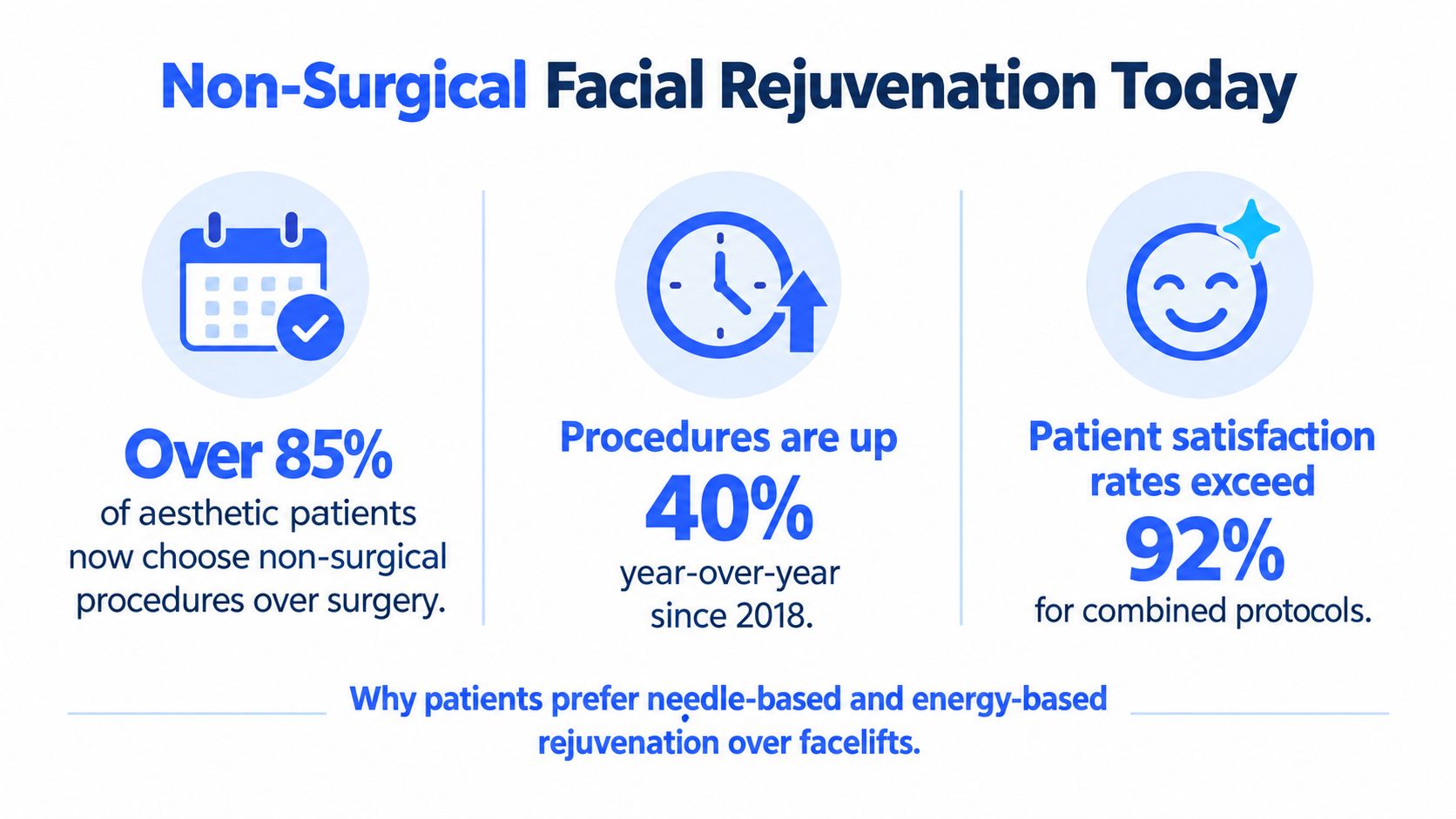
Those numbers show scale, not a promise that every procedure suits every patient. Non-surgical care has become a routine part of aesthetic medicine because many treatments are office-based, repeatable, and designed around limited downtime. Earlier reporting in the same survey noted 4,405,599 total non-surgical procedures in 2023, which points to steady demand across facial rejuvenation and related categories.
A useful expectation: Non-surgical treatment can soften, restore, resurface, and support. It cannot recreate every effect of surgery, and it works best as a planned maintenance strategy rather than a single dramatic event.
Readers researching gentle options may also find this overview of non-surgical skin care useful when thinking about daily support between professional treatments. The practical question stays simple. Which layer is creating the concern, and which treatment acts on that layer?
How Facial Aging Happens Across Different Layers
Facial aging follows several connected tracks, so one visible concern may have more than one cause. The skin is the outer finish, the dermis is its supportive framework, subcutaneous fat provides padding, and muscle creates movement that repeatedly folds the surface. Deeper connective structures help hold these parts in position.
Each layer changes differently. A line caused by repeated muscle contraction is not the same as a hollow caused by volume loss, and neither is identical to roughness from sun exposure or reduced collagen. Effective planning starts by identifying the layer involved, then choosing treatment that matches its mechanism.
The surface and dermis
The skin layer shapes what you notice first: pigmentation, dryness, enlarged pores, fine texture, and unevenness. Chemical peels, Hydrafacial treatments, microdermabrasion, selected lasers, and medical-grade skincare work mainly near this surface level. They can improve the finish, but they do not replace lost structural support.
The dermis contains collagen and elastin, which help the skin resist creasing and maintain firmness. A review of facial aging describes collagen decline at approximately 1% per year after age 25, as shown in the supplied facial-aging infographic and discussed in the evidence review of cosmetic procedures. As this framework weakens, fine lines can remain visible even when the face is relaxed.
Volume and movement
Subcutaneous fat creates soft transitions between facial regions. Its loss or redistribution can change the cheeks, temples, lips, and areas around the eyes. Fillers and biostimulators may support selected structural concerns, but adding volume everywhere can make the face look heavy rather than refreshed.
Muscles create expression lines. Repeated brow movement, squinting, or frowning can gradually make dynamic lines visible at rest. Neurotoxins reduce excessive muscle activity, so they suit movement-driven wrinkles. They cannot fill a hollow or repair rough texture.
Why the layer model matters
A smoother surface cannot replace missing support, and added volume cannot correct sun-damaged texture. Treatment planning may therefore sequence muscle relaxation, structural support, collagen stimulation, and skin-quality work instead of asking one procedure to solve every concern. The face should be assessed at rest, in motion, and from multiple angles, with the patient's goals guiding each decision.
Chairside shortcut: Lines suggest a movement question. Hollows suggest a support question. Roughness or discoloration suggests a skin-quality question. Many faces have all three, so they need separate decisions and a coordinated plan.
Neurotoxins Fillers and Biostimulators Compared
Injectables are often grouped together because they're delivered with a needle, but they don't perform the same job. A neurotoxin changes muscle activity. A filler occupies space or restores contour. A biostimulator encourages a gradual remodeling response rather than providing the same immediate structural effect as a traditional filler.
The clinical review of nonsurgical facial rejuvenation identifies botulinum toxin as the strongest evidence-based option for crow's feet, glabellar lines, and other expression-related rhytides. It also distinguishes neurotoxins from fillers, which are better suited to volume restoration.
Matching Concern to Injectable Mechanism
| Modality | Primary Mechanism | Best For | Onset and Duration |
|---|---|---|---|
| Neurotoxins, such as Botox, Dysport, and Daxxify | Temporarily reduces overactive muscle contraction | Forehead lines, glabellar lines, crow's feet, and other motion-related wrinkles | Develops over time and requires repeat maintenance as muscle activity returns |
| Hyaluronic acid fillers | Adds volume and can provide contour support | Cheek structure, lips, selected hollows, and deeper folds associated with volume loss | Offers a relatively direct structural change, with longevity depending on product, area, and individual factors |
| Biostimulators, such as Sculptra | Encourages gradual collagen support | Diffuse loss of firmness or volume where a progressive result is appropriate | Builds gradually, so assessment and planning should account for delayed change |
Product selection isn't a popularity contest. A person bothered by a frown line may need a movement-focused treatment, while someone concerned about a flattened cheek may need structural support. Treating a muscle-driven line with more filler can add weight without addressing the cause.
Where combination treatment fits
A coordinated plan may use a neurotoxin in the upper face, a conservative amount of filler for structural balance, and a biostimulator when gradual support is appropriate. The purpose isn't to use more products. It's to avoid asking one product to solve several unrelated problems.
ProMD Health's Botox and dermal filler comparison can help patients prepare for a consultation by separating wrinkle relaxation from volume restoration. A provider still needs to assess anatomy, prior treatment, medical history, and the patient's preferred degree of change before recommending a plan.
Natural results depend on restraint as much as technique. Preserving expression, respecting facial proportions, and allowing swelling to settle before making further decisions can prevent the familiar overfilled appearance.
Lasers Peels and Skin Quality Treatments Explained
A person may have relaxed expression lines yet still look tired because uneven tone, rough texture, or lax skin remains. Skin-quality treatments address that surface layer. They improve how light reflects from the skin and, depending on the method, stimulate collagen remodeling below it.
Treatment depth shapes both the result and the recovery period. A stronger resurfacing procedure can create more visible remodeling, while a gentler option may suit someone who needs less disruption to work or social plans. The best choice depends on the skin concern, sensitivity, and how the treatment fits into a broader plan.
Resurfacing by depth
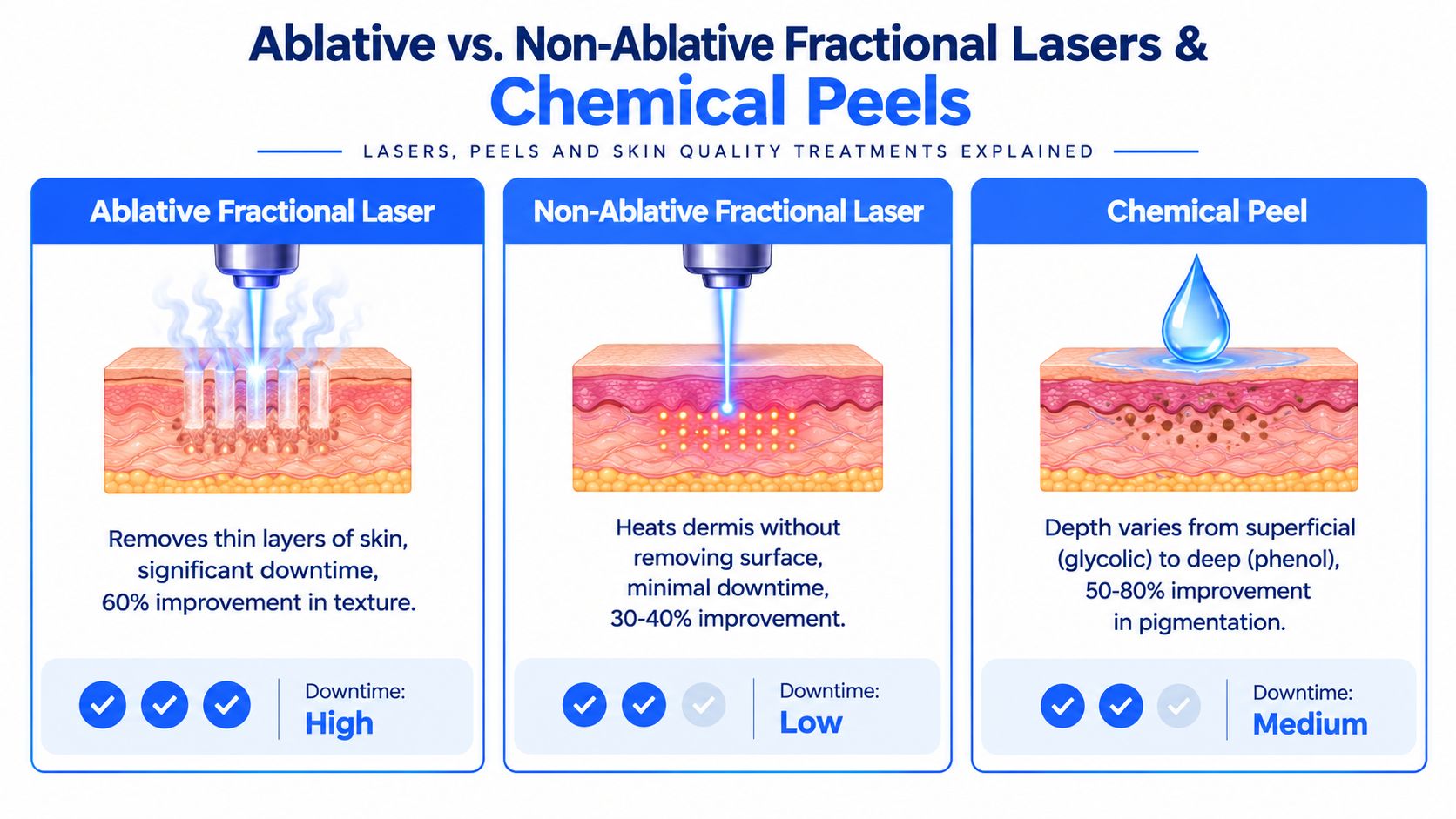
Fractional ablative lasers create controlled columns of injury and remove portions of the surface. They can produce substantial change for photoaging and scarring, but the trade-offs include more recovery and careful aftercare.
Non-ablative fractional lasers, including wavelengths such as 1550 nm and 1927 nm, heat the dermis while causing less surface disruption. They are often better suited to mild-to-moderate photoaging when shorter downtime matters. The choice is similar to sanding and refinishing a surface: deeper work may change more, but it also requires more healing time.
Radiofrequency tightening uses controlled heating rather than removing the surface. Evidence reports improvements in skin texture and firmness, with high patient satisfaction and a favorable safety profile. Comparative evidence suggests moderate laxity improvement in about 80% to 92% of patients, with results lasting up to about one year. That duration is shorter than the result from a surgical facelift, so maintenance planning matters.
Peels and supportive treatments
Chemical peels differ in depth and formulation. Superficial options refresh the outer layer, while deeper treatments create more injury and recovery. They may improve selected pigmentation and texture concerns, but assessment should include skin type, sensitivity, active conditions, and the risk of unwanted pigment changes.
Microneedling creates controlled micro-injuries that prompt a healing response. Hydrafacial and microdermabrasion work more at the surface. These methods can improve skin quality alongside injectables, but they do not replace muscle relaxation or structural volume support.
Topical and regenerative care can support the treatment plan. This background on evidence-backed peptide anti-aging explains how peptide products fit into a broader skincare discussion. ProMD Health's skin rejuvenation treatments can then be considered according to the main concern, skin condition, and available technology, keeping the skin layer coordinated with muscle and volume decisions rather than treating one layer in isolation.
How Combined Protocols Create Natural Long Lasting Results
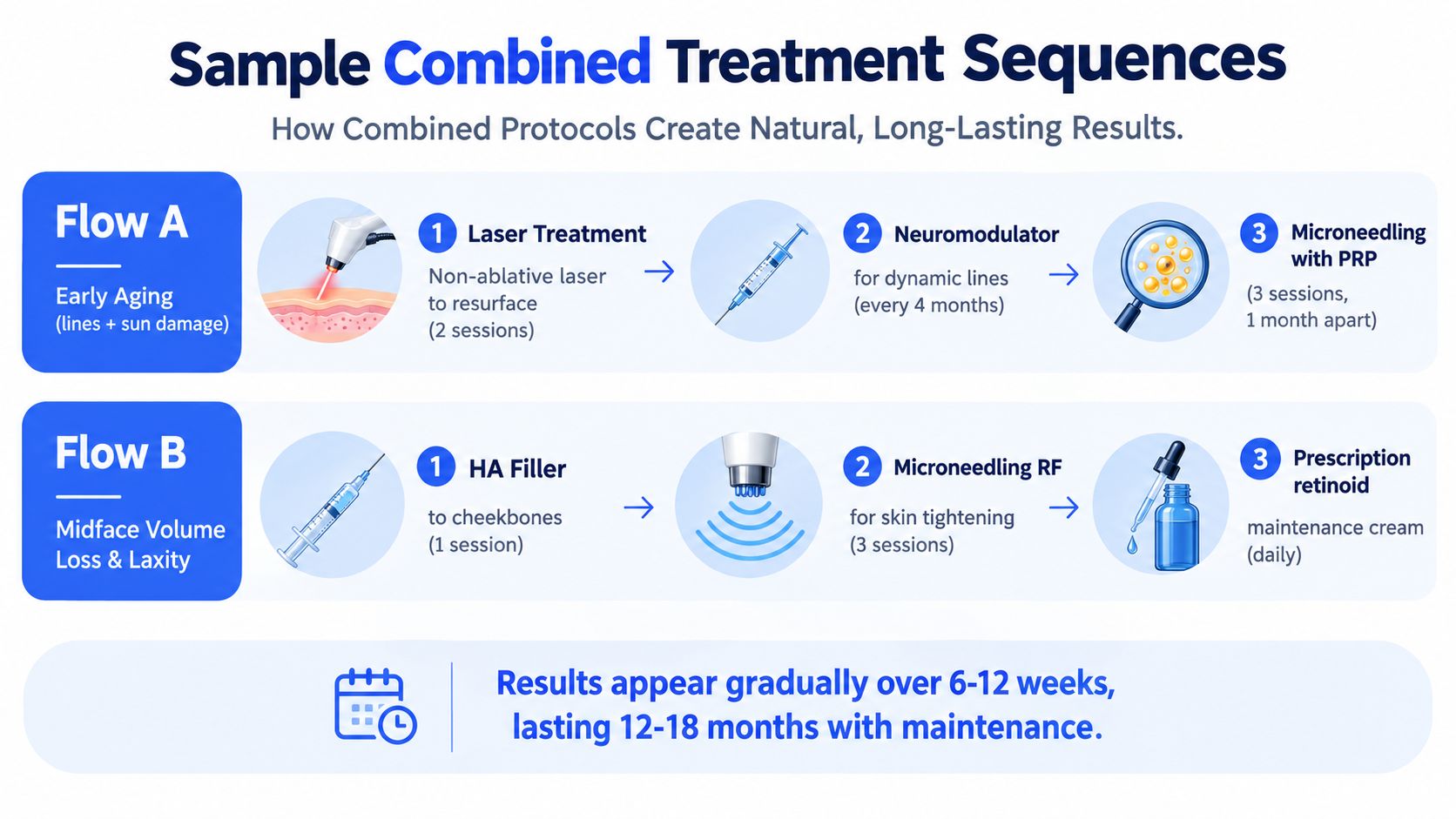
A natural result usually comes from solving smaller problems in the correct order. Consider someone with early expression lines and sun-related unevenness. Relaxing the lines may improve movement-related creasing, but the complexion can still look weathered. A skin-focused treatment may improve tone and texture without changing the way the brows move.
A provider might therefore prioritize the surface first or coordinate both concerns carefully, then reassess before adding anything else. The point isn't to follow a universal sequence. It's to make each decision after the previous treatment has had time to settle.
Scenario one for early visible change
A person with mild lines, uneven tone, and generally preserved facial volume may benefit from a restrained plan that addresses different layers without adding unnecessary fullness.
- Surface first: A suitable laser or peel can target tone and texture.
- Movement second: A neurotoxin can address expression-driven lines while preserving appropriate facial animation.
- Collagen support later: Microneedling or another collagen-focused treatment may improve the skin's overall feel and appearance.
The order may change based on skin sensitivity, schedule, and treatment availability. What shouldn't change is the reasoning. Don't add filler because the skin looks tired if the main issue is surface quality.
Scenario two for midface change
Someone with cheek volume loss and mild laxity may need structural planning before surface refinement. Conservative hyaluronic acid filler can restore selected support, while a biostimulator may suit a patient who prefers gradual change. Energy-based tightening can address skin laxity, but it can't substitute for every type of lost volume.
Spacing matters because swelling can temporarily disguise the true result. Waiting for tissues to settle gives the provider a clearer basis for refinement and reduces the temptation to keep adding product.
The natural-looking sequence is often less dramatic at each visit. Over time, separate modest improvements can create a more balanced result than one aggressive intervention.
A 2023 patient-choice study cautions that nonsurgical rejuvenation can still look unnatural or overdone, sometimes with scarring, despite the common assumption that these treatments are automatically subtle. Current reviews emphasize combining modalities according to the aging pattern rather than expecting one treatment to correct every layer. The safest plan is the one that leaves room to reassess.
Planning Your Treatment Journey and Maintenance Schedule
Start with a consultation that identifies your primary concern and separates it from secondary concerns. Bring a complete history of prior injectables, fillers, lasers, medications, allergies, skin conditions, and healing problems. Tell the provider whether your priority is movement, contour, skin quality, downtime, or a combination.
Ask to review the plan in stages. A useful consultation should clarify what will be treated first, what can wait, how progress will be assessed, and what signs would require follow-up. Photos taken under consistent conditions can help you and your provider compare changes more accurately than memory can.
Confirm the practical details
ProMD Health operates on a cash-pay model, so its services aren't covered by insurance. Pricing, treatment availability, and the exact device used can vary by office, so confirm those details before booking rather than assuming every location offers every laser or procedure.
Approved ProMD Health locations include:
- Maryland: Annapolis, Bel Air, Bethesda, Columbia, Easton, Timonium, and Westminster.
- Virginia and Washington, DC: Arlington, Ashburn, Tysons Corner, and Washington, DC.
- Other approved markets: Fort Lauderdale and Wellington in Florida, Hutto in Texas, Lafayette in Colorado, Lewes in Delaware, and Tox Bar in Baltimore City.
The practice's dermal filler results guide can help you form realistic questions about contour, expectations, and follow-up.
Build maintenance around your face
Maintenance isn't a fixed topping-off schedule. Neurotoxin follow-up depends on the return of muscle activity. Fillers and biostimulators need reassessment based on the remaining support, facial balance, and the presence of any prior product. Skin treatments may be coordinated with seasonal exposure, recovery needs, and daily skincare.
A provider-curated routine from The Skin Shoppe may support the period between visits, but home care doesn't replace sun protection, medical assessment, or procedural aftercare. Choose a clinic that uses real, approved imagery and gives you a clear explanation of who performs the treatment, which products or devices are used, and how complications are handled.
Choosing Your Next Step With Confidence
Non-surgical facial rejuvenation becomes easier to understand when you stop asking, “Which treatment is best?” and start asking, “What layer is responsible for the change I want to improve?”
Movement-related lines may call for a neurotoxin. Volume loss may call for carefully selected filler or a biostimulator. Uneven tone, texture, or laxity may benefit from a laser, peel, microneedling, radiofrequency treatment, or supportive skincare. Many patients need more than one category, but that doesn't mean they need everything at once.
Safety counseling should match the procedure. A 2025 systematic review reported treatment-related adverse events highest for hyaluronic acid fillers at 63.0%, followed by thread lifts at 20.0% and upper-face botulinum toxin at 18.0%, with confidence intervals reported in the systematic review. Common issues include bruising, redness, swelling, and pain. Rare but serious complications include vascular occlusion, tissue necrosis, infection, scarring, and very rarely vision loss or neurological injury.
Write down your main concern, your acceptable downtime, and the result you want to preserve. Then arrange a consultation at an approved location or through ProMD Connect so a qualified provider can evaluate your anatomy and create a staged plan.
ProMD Health offers non-surgical facial rejuvenation through neurotoxins, dermal fillers, Sculptra, lasers, chemical peels, Hydrafacial, microneedling, and medical-grade skincare, with availability confirmed by location. Visit ProMD Health to explore treatment options and request a consultation focused on natural, layer-by-layer planning.


