
You're probably here because the lines you see in the mirror don't always match how rested or calm you feel. Maybe it's the crease between your brows that lingers after work, or crow's feet that stay visible even when you're not smiling. For many adults considering Botox in Katy, the main question isn't whether they've heard of it. It's whether it makes sense for their face, their goals, and their comfort level.
A good Botox decision starts with clarity. You should understand what Botox does, what it doesn't do, how long it takes to work, how to judge injector quality, and how to think about value instead of chasing the lowest price. That's where most local searches fall short. They describe the service, but they don't help patients make a careful decision.
Table of Contents
- Understanding How Botox Smooths Wrinkles
- Benefits Risks and Who Is a Good Candidate
- Your Botox Appointment from Start to Finish
- Navigating Botox Costs and Units in Katy
- How to Choose a Qualified Botox Provider in Katy
- Frequently Asked Questions About Botox
Understanding How Botox Smooths Wrinkles
Individuals often first notice dynamic wrinkles. These are the lines that show up when you frown, raise your brows, or smile hard. Botox works well in this setting because it targets the muscle activity creating those repeated folds in the skin.
In Katy practices, Botox is used most often for forehead lines, glabellar “11s,” and crow's feet. It is an FDA-approved neuromodulator that works by inhibiting acetylcholine release at the neuromuscular junction, which temporarily reduces contraction in targeted facial muscles, as described by this Katy-area treatment overview.
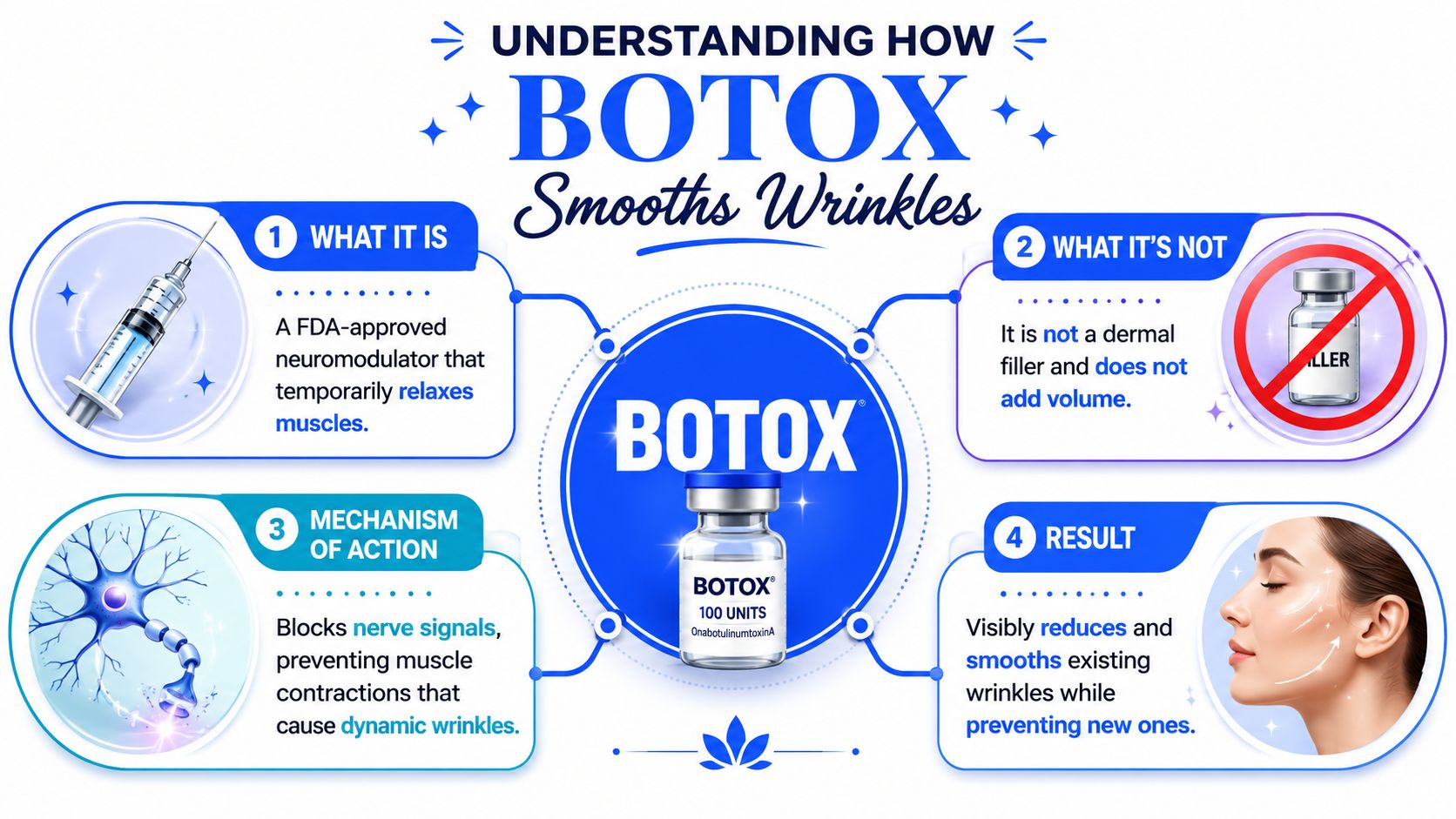
Why dynamic wrinkles respond to Botox
A simple way to think about Botox is as a dimmer switch for muscle activity. It doesn't fill a crease. It doesn't resurface the skin. It reduces the strength of selected muscle contractions so the overlying skin stops folding as aggressively.
That distinction matters. If a line appears mainly when you animate your face, Botox is often a strong fit. If a line is strongly etched and present at rest, Botox may soften it, but it may not erase it completely.
Practical rule: Botox treats motion-driven lines best. The more a wrinkle is tied to expression, the more likely a neuromodulator will help.
Patients often ask whether Botox “paralyzes” the face. In a quality treatment plan, the answer should be no. The goal is controlled relaxation in the right muscles, at the right depth, with the right placement. That's why injector judgment matters as much as the product itself.
For a closer explanation of what Botox can and can't do for lines that are already visible, this guide on whether Botox can erase existing wrinkles is useful.
What Botox does not do
Botox is often confused with filler, but they solve different problems. Botox reduces muscle pull. Filler adds structure or volume where the face has hollowed or deflated.
That's one reason some disappointing outcomes happen. The patient isn't necessarily a poor candidate for aesthetic treatment. They may just be asking Botox to solve a problem it wasn't designed to fix.
Here's the practical takeaway:
- If the problem is movement: Botox may help.
- If the problem is volume loss: another treatment category may be more appropriate.
- If the problem is skin texture: a skin-focused treatment plan usually makes more sense.
A careful injector won't force every concern into a Botox syringe.
Benefits Risks and Who Is a Good Candidate
The appeal of Botox is easy to understand. It's non-surgical, it targets common expression lines, and it can make a face look more rested without changing its identity. That said, a smart decision requires a balanced view. Cosmetic injectables are still medical treatment, not a casual beauty purchase.
Where Botox helps most
Patients usually like Botox for one of two reasons. First, they want to soften lines that make them look tired, tense, or stern. Second, they want to slow how strongly those lines keep setting in over time.
A well-done treatment can help with:
- A smoother brow area: This is often the first place people notice a difference.
- A more relaxed look around the eyes: Crow's feet can soften without taking away a natural smile.
- A less tense frown pattern: The glabellar area often creates the “angry” or “stressed” expression patients mention in consultation.
Botox also appeals to patients who don't want downtime or surgery. That convenience is part of why interest remains so strong in everyday practice.
Risks and trade-offs to weigh
The biggest mistake patients make is assuming Botox is risk-free because it's common. Common doesn't mean casual. Outcomes depend heavily on anatomy, dosage strategy, and injector precision.
Possible downsides can include bruising, temporary asymmetry, an overtreated look, or movement changes that don't match the patient's goals. Rarely, placement errors can create a heavy brow or affect nearby muscles in a way the patient didn't expect.
Natural results usually come from restraint, not from chasing every line in one visit.
The other trade-off is that Botox isn't permanent. Some patients love that flexibility. Others find recurring maintenance inconvenient. That's not a flaw. It's part of the treatment model.
If you're weighing safety questions, this overview of Botox safety considerations can help frame a better consultation discussion.
A practical candidate checklist
A good candidate usually looks less like a demographic profile and more like a decision profile.
You may be a good fit if the following sound true:
- Your main concern is dynamic wrinkling: The lines deepen when you animate.
- You want softening, not perfection: You're aiming for refreshed, not airbrushed.
- You value medical assessment: You want someone to study your movement pattern instead of selling by area alone.
- You're comfortable with maintenance: Botox works best when treated as ongoing care, not a one-time reset.
- You care about natural expression: You want movement preserved where it matters.
You may need a more nuanced discussion if your lines are mostly static, your brows already sit low, your eyelids feel heavy, or your goals depend on changing facial shape rather than muscle activity.
The best consultations are honest enough to say, “Yes, but with limits,” or “No, this isn't the right tool for that concern.”
Your Botox Appointment from Start to Finish
You book your first Botox visit because the lines bother you in photos, then the practical questions start. Will it hurt, how long will you be there, and how do you know the plan is built for your face rather than copied from a menu? A good appointment answers those questions before treatment starts.
The visit should begin with assessment. I want to see your face at rest, in motion, and in conversation. Forehead lines, frown strength, brow position, eyelid weight, and side-to-side differences all matter because injection placement is a medical decision, not just a cosmetic one.
Your goals matter just as much. “Softer but natural” calls for a different plan than “I want almost no movement.” The best consultations get specific about trade-offs, including where a lighter dose protects expression and where treating one area too aggressively can affect brow balance. If you want a clearer sense of what a medically guided treatment plan looks like, this overview of a Botox consultation and treatment approach in Katy is a useful reference point.

The treatment itself is usually brief. You'll stay awake, seated or slightly reclined, while the injector identifies the treatment points based on your movement pattern. The injections are small and quick. Many first-time patients describe the sensation as a series of short pinches.
Aftercare is usually simple, but it still matters. Follow the office instructions you were given, keep the rest of the day low-key, and avoid judging the result too early. The mirror right after treatment does not show the endpoint.
What treatment day feels like
A smooth visit usually follows a clear sequence:
- Review the plan: Confirm the areas being treated and what degree of movement reduction you want.
- Cleanse and map: The skin is cleaned, then the injector marks or visually maps the points.
- Inject with precision: Small amounts are placed into selected muscles based on your anatomy.
- Go over aftercare: You leave with instructions on what to do and when to check back in.
Many patients return to normal daily activity the same day. That convenience is real, but it should not distract from the part that matters most, which is accurate assessment and careful dosing.
When you'll see results
Botox does not work instantly. Early changes can start within several days, and the full effect is usually judged at about two weeks, based on this local Botox care page.
That waiting period prevents a lot of unnecessary worry.
A face can look slightly uneven during the settling phase. One side may relax faster than the other, or a patient may focus on a line that has started to soften but has not finished responding. Those early shifts do not automatically mean something is wrong. The two-week mark is usually the right time to assess the result and decide whether any adjustment is appropriate.
The best Botox follow-up is timed to the biology of the treatment, not to day-two anxiety.
If you like the result, expect maintenance rather than a one-time fix. Botox works best when patients understand the cycle, keep expectations realistic, and choose a provider who treats the whole pattern of movement instead of chasing isolated lines.
Navigating Botox Costs and Units in Katy
A common Katy consultation starts the same way. A patient asks, “How much is Botox?” The useful answer is, “How much treatment does your face need to get a balanced result safely?”
Botox is priced by units because faces do not need identical dosing. Muscle strength, resting lines, brow position, and treatment goals all affect how much product makes sense. Someone with strong frown muscles may need a different plan than someone treating early crow's feet. The forehead also cannot be priced responsibly as a stand-alone area if the brow and glabella have not been assessed with it.
That is why very low advertised pricing deserves a closer look. The number itself is only part of the decision. Patients should ask whether the quote is per unit, per area, or for a limited package, and whether that amount is likely to match their anatomy.
Why units matter more than the headline price
Units are the language of dosing. They help tie cost to the amount used instead of forcing every patient into the same template.
That matters for safety and for results.
Too little product can leave uneven movement or a result that fades sooner than expected. Too much in the wrong pattern can flatten expression or affect brow position. Good Botox planning is not about buying the cheapest visit. It is about paying for a dose and placement strategy that fits how your muscles work.
Treatment timing affects budgeting too. Botox is a maintenance treatment, not a one-time purchase, so the better question is often what your plan may look like over time rather than what one appointment costs.
Estimated Botox Units by Treatment Area
The exact number varies by anatomy and injector approach, so the table below is for orientation only, not a quote.
| Treatment Area | Typical Unit Range |
|---|---|
| Forehead | Varies by muscle strength and brow mechanics |
| Glabellar “11” lines | Varies by frown strength and treatment goal |
| Crow's feet | Varies by smile pattern and muscle activity |
A trustworthy quote usually comes after facial assessment, not before it. For patients who want to see how local practices may present pricing, this Botox special and pricing page can help frame the right questions.
What low prices can hide
Lower pricing is not automatically a problem. It does call for clearer questions before booking.
- How is pricing structured? Ask whether the office charges per unit, per area, or through an introductory package with limits.
- Who is doing the injections? Experience affects dosing judgment, technique, and how well asymmetry is managed.
- How is the plan decided? A proper assessment looks at muscle movement, brow support, and the result you want.
- What happens after treatment? Offices should explain their follow-up process and when reassessment makes sense.
In practice, the best value usually comes from careful dosing, honest expectations, and a provider who can explain why your plan costs what it does.
How to Choose a Qualified Botox Provider in Katy
If you only remember one part of this guide, make it this one. In Botox, product matters, but provider judgment matters more. The same category of injectable can produce polished, natural-looking softening or an unbalanced result depending on who evaluates the face and how carefully they inject.
Qualifications that matter
Start with medical credentials. Your injector should be a licensed medical professional working within a practice that treats Botox as medicine, not as a quick retail add-on.
Then look deeper:
- Facial aesthetics experience: Experience should include pattern recognition, not just injection volume.
- An eye for balance: Good Botox respects brow shape, eyelid weight, and asymmetry.
- Conservative planning: The safest injector isn't the one who promises the smoothest face. It's the one who knows when to do less.
- Clear informed consent: Risks, limitations, and alternatives should be discussed without pressure.

Choose the person who studies your expressions before quoting your forehead.
Questions worth asking at a consultation
The best patient questions are practical, not performative. You don't need to sound like an expert. You just need to hear whether the answers are thoughtful.
Consider asking:
How do you decide where to inject?
You want to hear about facial movement, symmetry, and muscle balance.What result do you think is realistic for me?
Strong injectors don't promise perfection.What would you avoid in my face?
This answer reveals whether they recognize brow heaviness, eyelid dynamics, or overcorrection risk.What happens if I want a natural result with some movement left?
That's a common goal, and the injector should know how to plan for it.
A provider who welcomes those questions usually works more carefully than one who rushes past them.
What a quality local experience looks like
A good Botox experience in Katy should feel medically grounded and straightforward. The consultation should be individualized. The treatment should be efficient. The aftercare should be clear. Follow-up should be available if you need it.
One option patients may come across is ProMD Health, a multi-location medical practice that offers Botox along with broader aesthetic and wellness services, including virtual care through ProMD Connect. What matters most, regardless of practice, is that your treatment is planned by qualified medical professionals who prioritize anatomy, realistic expectations, and safety.
A polished office matters less than a careful injector. Friendly staff matter less than clinical judgment. Convenience matters, but not more than technique.
Frequently Asked Questions About Botox
Does Botox hurt
Most patients say it's brief and tolerable. The injections are small and fast. Anxiety before a first visit is usually worse than the treatment itself.
Will I look frozen
Not if the treatment is planned well. The “frozen” look usually comes from overtreatment, poor placement, or a mismatch between the patient's goals and the injector's approach. If you want a softer, more natural result, say that clearly during consultation.
How can I make results last longer
You can't force Botox to last beyond your own muscle activity and metabolism, but you can improve your overall experience by staying on a consistent maintenance schedule and avoiding the cycle of waiting until everything fully wears off before returning.
Can Botox be used for more than wrinkles
Yes. An overlooked part of Botox in Katy is its medical use beyond aesthetics. Local search pages often focus on forehead lines and crow's feet, but patients also ask about jaw tension, migraine, and excessive sweating.
A Katy-area overview notes this gap clearly, pointing out that search results often give limited practical guidance on Botox for masseter hypertrophy or TMJ-related clenching, chronic migraine, or hyperhidrosis, as discussed in this local service page. Those uses require a different evaluation than cosmetic wrinkle treatment, and insurance questions may also enter the conversation depending on the indication.
Is Botox a filler
No. Botox relaxes targeted muscles. Filler restores or adds volume. They're often confused, but they solve different problems.
How do I know if Botox is right for me
If your concern is movement-based wrinkling and you want a non-surgical option with realistic maintenance, Botox may be a good fit. If your concern is volume loss, skin texture, or sagging, you may need a different treatment strategy or a combination approach.
If you're considering Botox in Katy and want a medically guided consultation, ProMD Health offers Botox for cosmetic concerns like forehead lines, crow's feet, and frown lines, as well as medical uses such as migraines, excessive sweating, TMJ jaw pain, neck spasms, and masseter reduction.


