
Why do so many laser clinics ask about your skin tone first when the ink colors sitting inside your dermis determine which wavelength will work? Most online guides for tattoo removal for dark skin treat complexion as the sole obstacle and promise that one newer laser solves every risk. That framing leaves patients guessing about the tradeoff between fading unwanted ink and protecting natural pigment.
Safe removal on richly pigmented skin starts with a clearer sequence. You match the laser wavelength to every color in the tattoo, account for how surface melanin competes for that light, test a small area conservatively, and adjust based on how your skin heals. Walking through those clinical steps turns a vague sales pitch into a plan you can evaluate before a handpiece ever touches your arm.
Table of Contents
- Why Dark Skin Changes Tattoo Removal Planning
- Matching Laser Wavelength to Each Ink Color
- Why Melanin and Ink Chemistry Drive Pigment Risk
- How to Run a Safe Test Spot and First Session
- How Many Sessions Dark Skin Really Needs
- Warning Signs That Mean Pause and Reassess
- Confirm Your Plan With a Qualified Provider
Why Dark Skin Changes Tattoo Removal Planning
Consider a patient with a dense dark-blue tattoo on deep brown skin who visits a studio and hears that the same laser protocol works on everyone. Weeks after treatment, her results look nothing like the smooth before-and-after photos online. Instead of clean fading, the area develops dark haloing around the lines and faint light patches where the ink used to sit.
That gap comes down to basic light physics. Removal lasers fire concentrated light meant to shatter dark ink particles below the surface, yet the skin's own epidermal melanin absorbs many of those same wavelengths. When surface pigment absorbs too much energy, the heat meant for the tattoo can irritate pigment-producing cells, leaving surrounding skin noticeably darker or lighter than before.
Finding clear, honest preparation online isn't easy either. A 2024 analysis in Lasers in Medical Science found that only 43% of online laser-tattoo-removal websites directly addressed complications for patients with skin of color. Clinical research itself still has gaps, too. As a 2022 case series on phototypes IV to VI and subsequent clinical literature point out, dark-skin removal is primarily a risk-management and wavelength-selection problem, and studies still underrepresent the darkest Fitzpatrick skin types V and VI.
Seeking dermatology-informed oversight matters whenever melanin and medical lasers intersect. For patients researching broader clinical skin care while traveling or comparing medical standards, resources such as physician-led dermatology in Los Cabos from Longevity Medical Institute show how structured skin evaluations prioritize pigment safety alongside aesthetic outcomes.
Because of those stakes, planning for Fitzpatrick skin types IV to VI works best when ink clearance, pigment protection, and provider evaluation stay connected inside one strategy. Mapping each ink color to a wavelength, understanding why pigment shifts happen, running a cautious test spot, setting realistic session timelines, spotting early warning signs, and preparing a consultation checklist all reinforce each other. By working through each piece, you'll know the exact questions to ask before any laser touches your skin.
Matching Laser Wavelength to Each Ink Color
Before anyone adjusts an energy dial, every color inside the tattoo needs a wavelength match. The table below outlines how common ink groups pair with standard laser wavelengths on darker skin tones and where extra caution applies.
| Ink color | Typical wavelength | Melanin risk and planning note |
|---|---|---|
| Black or blue-black | 1,064 nm Q-switched Nd:YAG | Lowest melanin absorption; preferred starting point |
| Red, orange or yellow | 532 nm | Higher melanin absorption; greater dyschromia risk, use with caution |
| Yellow or green | 532 nm (select yellow); limited Nd:YAG response for green | Often respond poorly; set expectations early |
| Cosmetic, white or flesh-toned ink | Wavelength chosen only after pigment check and test spot | May contain titanium dioxide or iron oxides; confirm pigments before treatment |
Thinking about laser choice solely by skin tone is like picking a key by looking at the door instead of the lock. Your skin sets the safety boundaries, while the tattoo ink acts as the lock that requires a specific wavelength to open. If a clinic uses the wrong wavelength for a color, turning up the power won't force clean clearance; it only pushes extra heat into the upper skin layers.
Why 1,064 nm Leads for Dark Inks
For black and blue-black tattoos on darker complexions, dermatology reviews such as this clinical overview of laser tattoo removal identify the 1,064-nm Q-switched Nd:YAG laser as the mainstay, or "workhorse," wavelength. Its longer wavelength travels deeper into the dermis and interacts less strongly with epidermal melanin than shorter wavelengths do. Reduced absorption doesn't mean zero absorption, so providers still rely on conservative parameters and careful monitoring, which aligns with broader principles behind choosing a safe laser for darker skin.
Navigating Warm Colors and Complex Inks
Warm and multi-layered inks complicate the plan quickly. According to a clinical review on wavelength selection, 532-nm light targets red, orange, and some yellow pigments, yet epidermal melanin absorbs 532 nm much more readily, raising the risk of unwanted pigment change. In practice, a prospective study in Indian patients with Fitzpatrick types IV and V noted that dual-wavelength Q-switched Nd:YAG systems combining 1,064 nm and 532 nm can treat darker skin when clinicians reserve 532 nm selectively for responsive colors.
Yellow and green pigments present a different hurdle because they commonly respond poorly to Nd:YAG wavelengths, making early, candid counseling about incomplete clearance essential. Cosmetic, white, flesh-toned, and permanent-makeup inks add another variable since they may contain titanium dioxide or iron oxides that can darken or shift shade under laser light.
A single tattoo with black outlines, red shading, and green highlights often requires more than one wavelength over the course of treatment. Before your consultation, write down every visible color in your tattoo, including faded cover-ups or white highlights, and match each shade to its row in the table above.
Why Melanin and Ink Chemistry Drive Pigment Risk
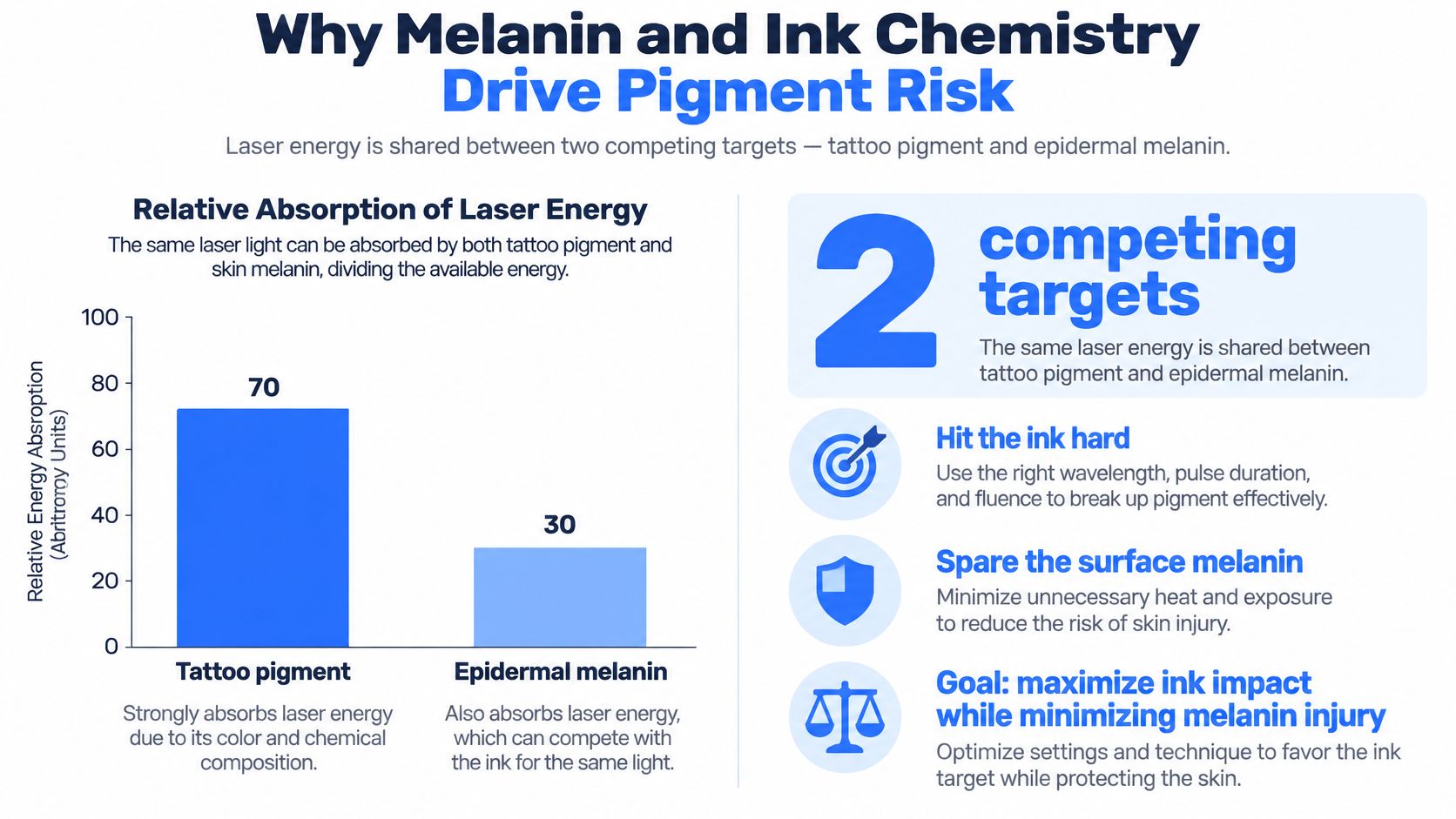
Is a faster laser always safer for darker skin? Many marketing pages imply that switching from a nanosecond laser to a picosecond laser automatically removes that concern. Published clinical numbers tell a more nuanced story. A picosecond laser can shatter ink with shorter pulses and less heat. Melanin still competes for energy, and ink chemistry still shapes the reaction.
That competition explains why pigment change remains a planning problem, even with longer wavelengths. The figures below keep the study results in one place, with each row linked to its source.
| Study | Laser | Post-inflammatory hyperpigmentation | Paradoxical darkening |
|---|---|---|---|
| 2020 prospective comparison of Asian patients | 1,064 nm picosecond | 21.6% | 5.4% (across laser groups) |
| 2020 prospective comparison of Asian patients | 1,064 nm nanosecond | 24.3% | 5.4% (across laser groups) |
| multicolor tattoo clinical study | 532 nm nanosecond | 35.1% | 5.4% (overall cohort) |
| multicolor tattoo clinical study | 1,064 nm picosecond | 21.6% | 5.4% (overall cohort) |
Those results show that wavelength and ink color matter alongside pulse duration. Shorter wavelengths can raise pigment risk because the epidermis absorbs more of the energy. The multicolor tattoo clinical study recorded a higher mild-to-moderate post-inflammatory hyperpigmentation rate with 532 nm nanosecond treatment than with 1,064 nm picosecond treatment. That contrast matters when a tattoo contains red, orange, yellow, or cosmetic shades that may need shorter wavelengths.
Why does 532 nm treatment struggle so noticeably on richly pigmented skin? Each pulse behaves like a split stream, with energy divided between dermal tattoo pigment and surface epidermal melanin. Melanin absorbs 532 nm light strongly, so part of the energy is taken up before it can break down yellow pigment reliably. The epidermis also receives extra exposure. A 2025 study published in Photochemical & Photobiological Sciences confirmed that melanin significantly absorbs 532 nm laser light, hindering degradation of yellow tattoo pigments while exposing the epidermis to extra energy.
Four Risks Every Patient Should Recognize
Knowing the device name isn't enough when complications take different forms on darker skin tones. Four distinct reactions account for most setbacks during treatment:
- Post-inflammatory hyperpigmentation: Dark brown or gray-brown patches that develop after laser irritation stimulates excess melanin production in the healing skin.
- Hypopigmentation: Pale or washed-out spots caused when excessive laser energy damages or depletes natural melanocytes, sometimes leaving a light outline of the tattoo.
- Paradoxical darkening: An abrupt color shift where light, flesh-toned, cosmetic, or mixed inks turn dark gray or black right after laser exposure due to chemical changes in metal oxides.
- Blistering or scarring: Thermal tissue injury from aggressive energy settings, a danger that peaks during early sessions when tattoo ink is densest and escalates further if you have a personal history of keloids.
Clinical reality check: Published percentages describe study cohorts, not personal guarantees. Your real risk depends on how your provider adjusts wavelength, spot size, and fluence to your specific skin rather than on a machine's brand label alone.
Ink color can steer risk as much as skin tone. Black often responds well to longer wavelengths, while brighter shades may pull the plan toward wavelengths that melanin absorbs more readily. Cosmetic, white, flesh-toned, and permanent-makeup inks add another variable because they may contain titanium dioxide or iron oxides that can darken or shift shade under laser light.
A practical plan starts by listing every visible color in the tattoo, including faded cover-ups and white highlights. That list helps your clinician match each shade to a wavelength, then judge where pigment-change risk is highest before treatment begins.
How to Run a Safe Test Spot and First Session
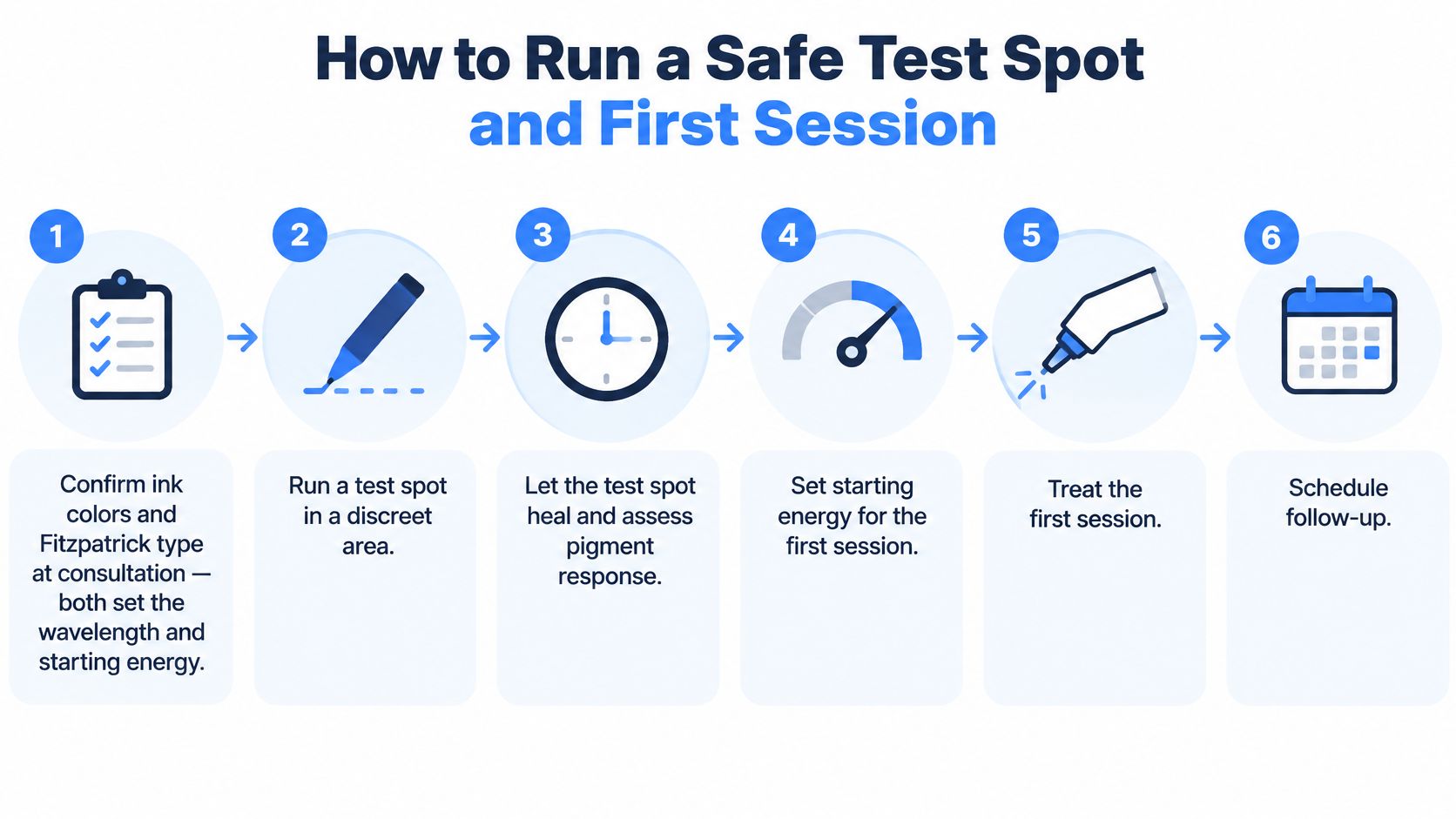
Start with a test spot, then scale energy only after the skin proves it can tolerate the first pass. A careful evidence-based parameter review supports documenting each setting and response instead of using one fixed protocol for every skin tone. The test area works like a small preview of the full treatment. It shows how pigment, ink, and heat interact before the entire tattoo receives laser energy.
The table below shows conservative starting settings drawn from a clinical study in pigmented Indian skin, where lower baseline energy was used as melanin levels increased.
| Skin type | Starting fluence | Spot and approach |
|---|---|---|
| Fitzpatrick III to IV | 5 J/cm² | Larger spot size; test spot first |
| Fitzpatrick V to VI | 3 J/cm² | Larger spot size; lower radiant exposure; test spot first |
Eight Steps for a Controlled First Pass
Confirm ink colors and Fitzpatrick skin type during consultation. Both variables guide wavelength and baseline energy. Guessing either one changes every setting that follows, especially when darker skin and cosmetic inks raise pigment-shift risk.
Perform a test spot in a discreet edge of the tattoo and log the result. A small zone shows how the epidermis and ink react without placing the whole design at risk of widespread discoloration or paradoxical darkening.
Begin with conservative fluence and a larger spot size. Use the lower starting settings in the table as a framework, not a fixed prescription. A broader spot spreads energy across the skin surface while the laser still delivers acoustic shockwaves to deeper pigment.
Look for controlled whitening or "frosting" as the immediate endpoint. Brief chalky frosting shows gas bubbles forming around shattered ink particles. Pinpoint bleeding or tissue disruption suggests too much thermal force, which raises the chance of scarring.
Let the test area heal completely before treating the full tattoo. Delayed pigment shifts can surface weeks later. Healing time gives the provider a clearer picture than the immediate reaction alone.
Increase fluence only in small steps on future visits. Higher energy makes sense only after prior passes heal without blistering, lasting hyperpigmentation, or hypopigmentation. Think of each visit as a small adjustment rather than a fresh start.
Keep recently tanned skin strictly out of the laser beam. Fresh UV exposure adds active melanin to the epidermis. A setting that looked reasonable before sun exposure can become an injury risk after it.
Record every parameter and delayed response in your chart. Your provider should log wavelength, pulse duration, spot size, fluence, immediate frosting endpoint, and healed pigment appearance at every appointment. That record turns each session into useful evidence for the next one.
A controlled first session often looks modest. Mild redness, temporary swelling, and subtle frosting may appear, then settle as the skin heals. The useful sign is steady healing without heavy blistering or raw skin, because pigment stability matters more than a dramatic day-one reaction.
How Many Sessions Dark Skin Really Needs
Patients often ask for an exact session count on day one, yet clinical outcomes vary widely even when skin type and ink color look similar. Comparing two published benchmarks makes that range clear.
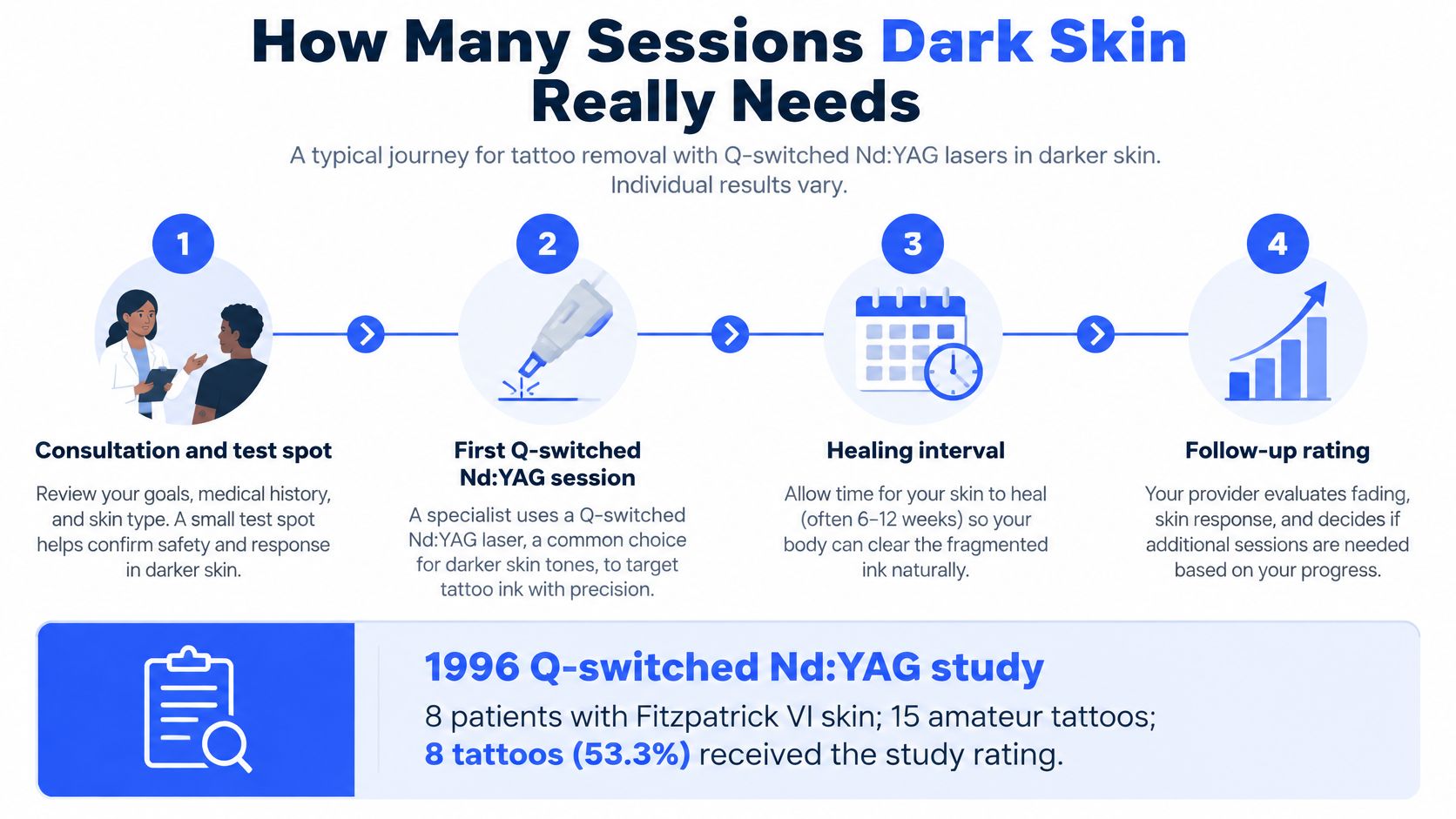
In a foundational 1996 Q-switched Nd:YAG study evaluating eight patients with Fitzpatrick type VI skin and 15 amateur tattoos, eight tattoos (53.3% of the total) reached 75% to 95% clearance after treatment. Nearly three decades later, a 2024 prospective study in Lasers in Medical Science followed 20 patients with predominantly Fitzpatrick skin type IV and professional black tattoos; after two picosecond Nd:YAG sessions, mean improvement reached 61% ± 24.6%, with 40% of patients showing excellent improvement. Notice the wide spread around that average, even on straightforward black ink.
Why Timelines Stretch Beyond the Laser Room
Lasers don't vacuum ink out of your skin during an appointment. They fracture pigment granules so immune cells called macrophages can slowly clear the debris away over weeks. Several biological and technical factors decide how many visits you'll ultimately need:
- Ink density and layering: Heavy professional saturation or cover-up tattoos pack far more pigment into the dermis than light amateur linework.
- Pigment depth and color mix: Deep dermal ink and multicolored shading demand staged passes and sometimes separate wavelengths.
- Tattoo age and body location: Older tattoos and areas with stronger circulation generally clear faster than fresh ink on ankles, wrists, or hands.
- Epidermal recovery pace: Darker skin benefits from wider gaps between sessions so surface melanin settles completely before the next pulse.
Because total session count directly shapes your budget over months of care, reviewing how providers structure multi-visit pricing helps avoid surprises. Guides like the TattoosAI breakdown of removal costs can help you frame realistic budgeting questions alongside clinical advice on planning laser tattoo removal sessions.
Mapping Your Treatment Timeline
Instead of chasing a rigid calendar promise, structure your expectations around four repeating checkpoints. Start with a test-led first session, allow full healing intervals set by your skin's recovery rather than a fixed rush schedule, review pigment stability with your clinician at each follow-up, and then decide together whether to continue, adjust settings, or stop once the tattoo reaches your goal.
Keep in mind that temporary lightening or darkening can take months to fade and often stands out more sharply on richly pigmented skin than faint leftover ink. Between visits, shield the treated area from UV exposure, skip tanning before and after every appointment, and contact your clinic right away if new pigment changes appear instead of waiting until your next scheduled session. Ask your provider for a color-by-color fading estimate rather than a guaranteed session number.
Warning Signs That Mean Pause and Reassess
Even a cautious plan requires active monitoring after you leave the treatment room. The most common early red flag is blistering or crusting that goes beyond mild, routine healing, which usually tells you the starting fluence was too aggressive or the tattoo ink was too dense for an early pass. Understanding normal tattoo removal healing time makes it much easier to tell routine soreness apart from a reaction that warrants a pause.
Use the reference table below to connect specific post-treatment symptoms with their likely clinical cause and the next step your provider should take.
| Symptom | Likely cause | What to do |
|---|---|---|
| Blistering or crusting beyond normal healing | Energy too high or ink too dense early | Pause, lower energy and extend the interval |
| Light patches after a session | Melanin loss from excessive energy | Reassess fluence and wavelength; protect from sun |
| Dark patches after irritation | Post-inflammatory hyperpigmentation | Stop until resolved; provider review before next session |
| Ink that darkens or changes color | Paradoxical darkening or ink chemistry such as titanium dioxide | Confirm pigments and revise the plan |
| Raised or thickened scar tissue | Keloid tendency or excessive heat | Do not continue without a qualified evaluation |
Acting Early Protects Long-Term Tone
Each symptom calls for a sequenced clinical adjustment rather than waiting it out or powering through. If blisters or heavy crusts form, pausing treatment lets the epidermis rebuild intact skin so your provider can lower fluence and lengthen the gap before attempting another pass. When pale spots appear, stepping back to reconsider both wavelength and energy while keeping the site strictly out of the sun prevents temporary melanin suppression from becoming permanent.
Dark patches from post-inflammatory hyperpigmentation need time to calm completely before another laser pulse hits the same zone; firing into inflamed skin almost always deepens the discoloration. Similarly, ink that suddenly turns darker shouldn't be blasted harder at the next visit. That shade shift points toward paradoxical darkening from titanium dioxide or iron oxides, which means stopping to verify pigment makeup and changing strategy. Any firm, raised, or spreading scar tissue requires an in-person medical evaluation before another laser session is even considered, especially if you've ever formed keloids elsewhere on your body.
Never push through blistering to stay on schedule, and never apply unprescribed bleaching creams or harsh exfoliants to treat post-laser pigment shifts on your own. Document changes with clear photos in consistent lighting and report them to your provider before your next appointment.
Confirm Your Plan With a Qualified Provider
A good consultation turns a tattoo from a vague “remove this” request into a plan built around ink, skin response, and pigment risk. Bring organized details, then ask the clinician to explain how those details change the first session. ProMD Health uses an Astanza Duality laser for tattoo removal services for men, so availability and parameters should be confirmed with the clinic you choose.
Use this six-point checklist to keep the conversation concrete:
- Ink behavior notes: Describe how the tattoo looks in different light, including faded edges, cloudy areas, and any color that has changed shade.
- Tattoo age and application type: Note how old the piece is and whether an amateur or professional artist applied it.
- Layering and cosmetic history: Flag cover-ups, previous laser attempts, or permanent makeup in the treatment zone.
- Scarring and pigment history: Share any history of keloids, hypertrophic scars, vitiligo, melasma, or prolonged dark marks after minor scrapes.
- Recent sun or tanning exposure: Be direct about vacations, outdoor sports, or self-tanners from the past several weeks, since current pigmentation affects how cautiously the skin should be treated.
- Prior laser reactions: Mention how your skin responded to earlier laser hair removal, resurfacing, or tattoo sessions, especially if blistering, prolonged redness, or dark marks followed.
During the exam, ask the clinician to state your Fitzpatrick skin type, explain the starting energy, and describe how test spots and healing checks will guide later sessions. Ask what would cause them to pause treatment, because pigment shifts often need time to settle before more laser energy is applied. A careful plan should account for the way darker skin and tattoo ink can both absorb light, with the goal of clearing ink while limiting unnecessary injury to surrounding pigment.
A useful question is, “What signs would make you change this plan?” Strong answers should include clearer skin boundaries, controlled test-spot review, and realistic expectations about color response. Bring photos taken in consistent lighting so the provider can compare your baseline with later healing.
Your next step is simple: complete the checklist, book a consultation, and have a qualified provider confirm the treatment plan before the first pass. If you want individualized guidance, ProMD Health offers consultations and may confirm tattoo removal availability at your nearest location. Ask about the clinical plan first, then review session structure and any payment details directly with the clinic.


