
The most popular advice treats hormonal weight gain as a single problem with a single fix: replace the hormone, and the scale will reverse. That advice skips the harder question. A hormone shift can move fat and muscle without moving the number much, and a number that does move is often aging, sleep, medicine, or a less common endocrine disease. The label is a hypothesis to test, not a diagnosis you can assume.
A stable reading can still mean a larger waist, less muscle, and higher cardiometabolic risk. The useful work is separating those changes, then matching a response to the driver you find.
Table of Contents
- What Hormonal Weight Gain Really Means
- How Much Weight Midlife Women Typically Gain
- Separating Hormones From Aging and Lifestyle
- When Weight Gain Points to a Thyroid or Cortisol Problem
- Medications, Sleep and Other Causes to Rule Out
- How Clinicians Evaluate Hormonal Weight Gain
- Management Options That Target Body Composition
- Confirm the Cause Before You Choose a Treatment
What Hormonal Weight Gain Really Means
Say your weight has held steady for a year, yet your jeans close only if you leave the button open. Nothing dramatic happened on the scale. The load inside your body moved.
Think of a suitcase that still weighs the same at the airport counter. If you shove the heavy items to one side, the bag tips, the handle strains, and the shell wears in a new place. Total weight never changed. Distribution did.
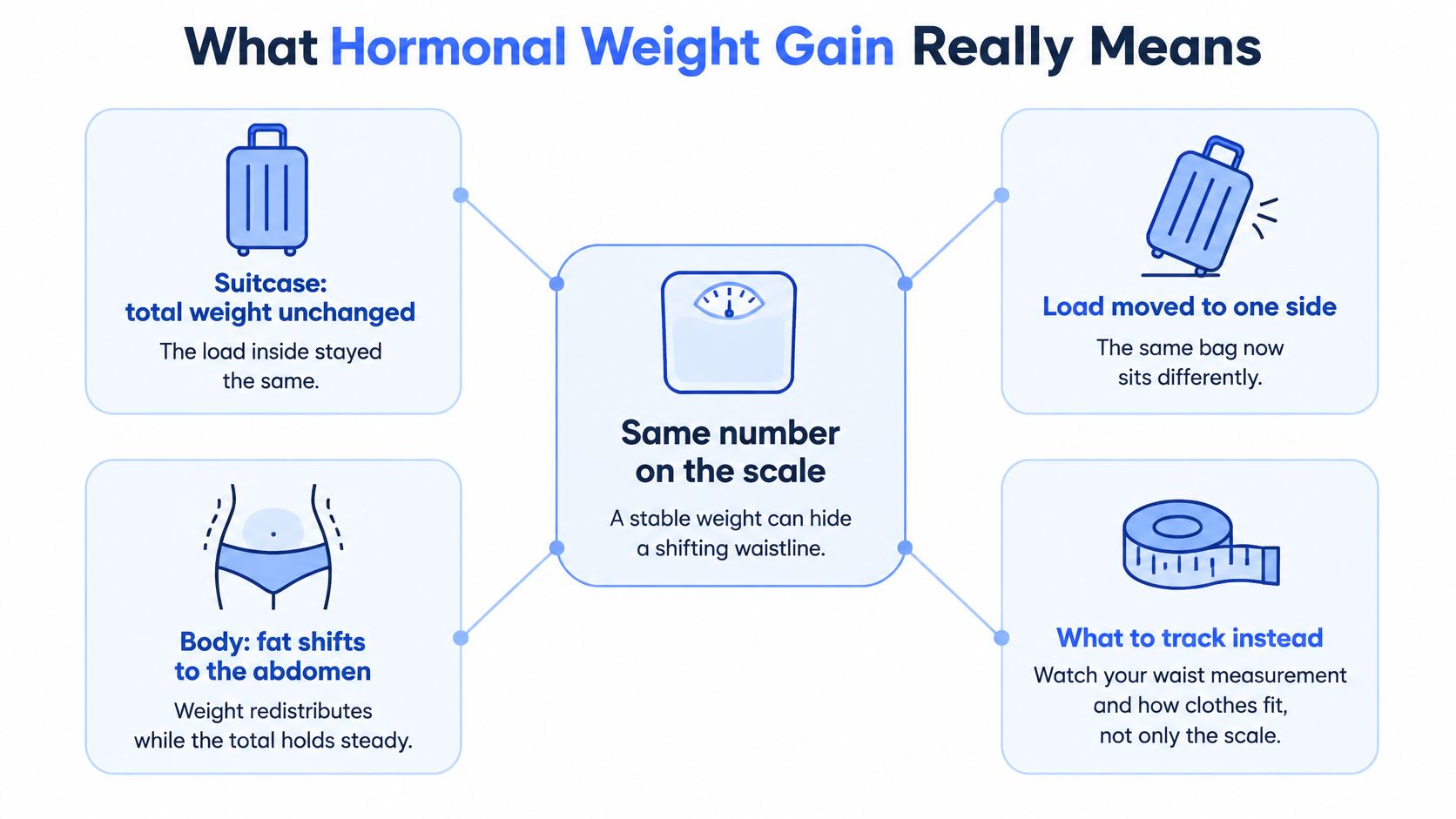
Declining estradiol changes how fat tissue handles fat storage. A clinical review of menopausal body composition describes shifts in lipoprotein-lipase activity and adrenergic-receptor signaling that favor moving fat from the hips and thighs toward the abdomen and the visceral compartment, and longitudinal evidence from the Study of Women's Health Across the Nation ties faster fat-mass gain, faster fat-free-mass loss, and rising visceral fat to falling estradiol during the perimenopausal transition, as summarized in this Springer review of menopausal body composition.
Lean tissue and resting energy expenditure tend to fall at the same time. You can eat the meals you ate at 40 and still store more of that energy around the organs, because the body spending those calories is smaller and less metabolically active.
What the Scale Misses
Hormones shape where fat settles and how energy is regulated. They are one input, not the whole ledger. Waist circumference and cardiometabolic risk can move while the scale barely budges, because an unchanged weight can conceal worse insulin sensitivity.
A steady number is not proof that body composition held still.
For a closer look at signs that a changing waistline may track with midlife hormone shifts, the weight gain guidance from Pause Medical pairs well with the measurements below.
Track three things instead of weight alone:
- Waist circumference: Measure at the same spot, in the morning, before a meal. A rising waist with a flat scale is the suitcase tipping.
- Strength or muscle trends: Note what you can lift, how stairs feel, or a simple body-composition check over months. Falling lean mass is the part of the load you want to keep.
- Blood pressure plus fasting glucose or A1C: These show whether the new fat pattern is affecting metabolic risk, not only clothing size.
Hormonal change, in this sense, is a change in body composition. Composition is what you should measure.
How Much Weight Midlife Women Typically Gain
Across studies, women typically gain about 5–7 pounds (2–3 kilograms) during the menopause transition, and a separate review reports that weight gain is experienced by roughly 60%–70% of midlife women and averages about 1.5 pounds per year between ages 50 and 60, independent of starting body size, race, or ethnicity, according to a review of Study of Women's Health Across the Nation data.
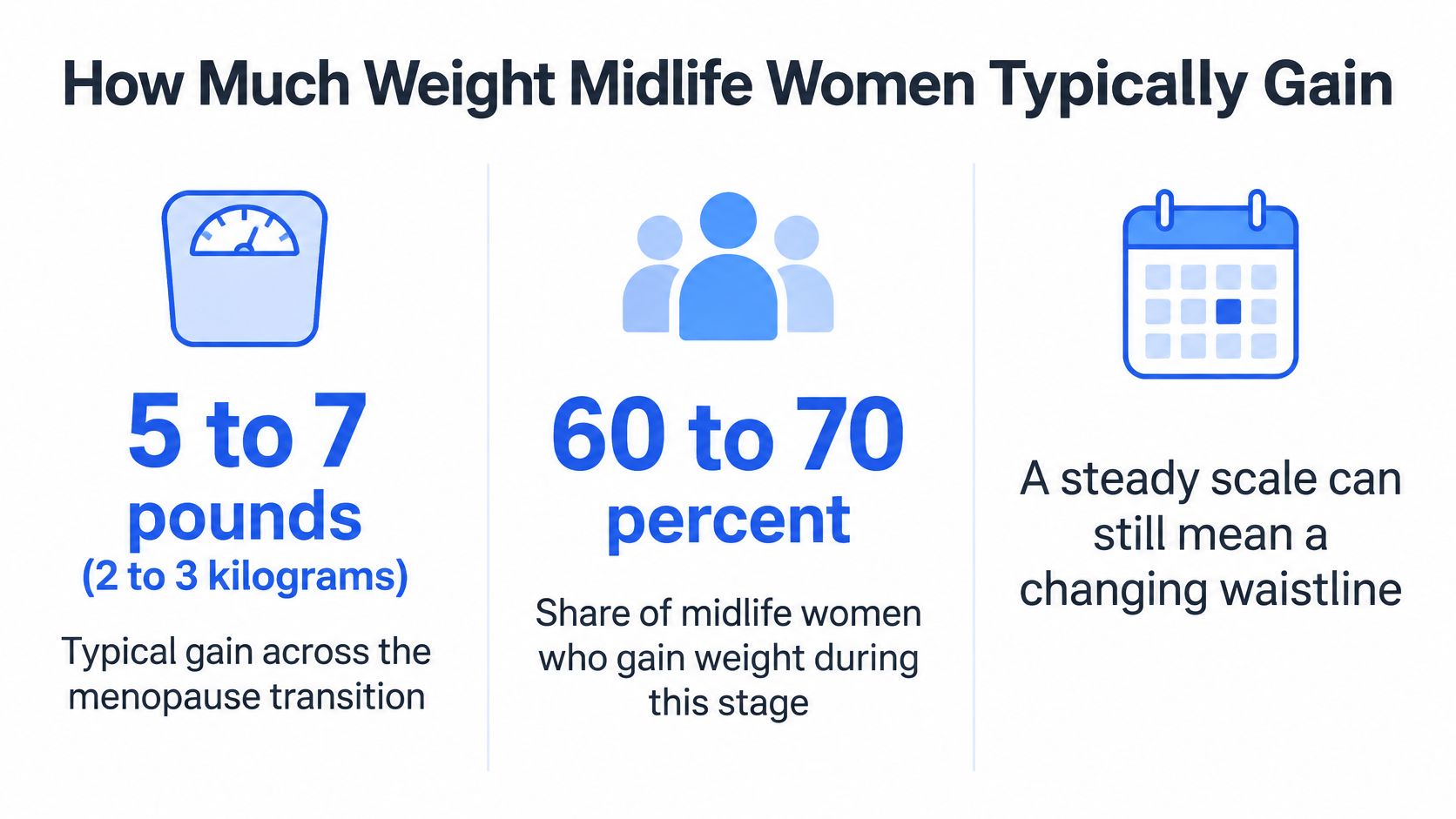
That same review found menopause-related changes independently produced a 2.5-fold increase in fat-mass gain and a 3-fold increase in lean-mass loss compared with the pre-transition pattern, after accounting for age. The scale change can stay modest while the mix of fat and muscle shifts harder than age alone would predict.
How to Read the Averages
Averages describe a crowd, not your year. The rows below put the common pace next to the spread inside one cohort.
| Source | Population | Average Change |
|---|---|---|
| SWAN cohort | Women aged 40-55 | 4.5 pounds over three years |
| Prospective study of 485 women | Initially premenopausal, aged 42-50 in 1983-1984 | 2.25 kg (about 5.0 pounds) over three years; 20 percent gained at least 4.5 kg and 3 percent lost that much |
| Same 485-woman study, stayed premenopausal | Subgroup during follow-up | 2.07 kg over three years |
| Same 485-woman study, natural menopause | Subgroup during follow-up | 1.35 kg over three years |
| Healthy Women's Study | Women in the fifth and sixth decades | About 0.7 kg (1.5 pounds) per year |
| Menopause transition review | Women across studies | Typically 5-7 pounds (2-3 kg) |
| Midlife review | Midlife women | 60-70 percent gain weight; about 1.5 pounds per year between ages 50 and 60 |
In that prospective group, 20 percent gained at least 4.5 kilograms (9.9 pounds) over three years, while only 3 percent lost that amount. Most women landed near a few pounds. A minority gained much faster. Using only the average would hide both.
Gains were similar whether women stayed premenopausal or reached natural menopause during follow-up. Age and the habits that travel with it carry a large share of the scale change. Menopause adds a body-composition effect on top.
A few pounds over a few years fits this common midlife pattern. It is not, by itself, proof of a hormone disorder. A faster climb, or gain packed into the abdomen with new symptoms, is the pattern that deserves a closer look.
Separating Hormones From Aging and Lifestyle
If women who remain premenopausal gain about as much on the scale as women who reach natural menopause, what does menopause change?
It changes composition more than it changes the total. Chronological aging, plus the lifestyle and metabolic shifts that come with it, accounts for a substantial share of the pounds. The transition itself is more specific: fat redistributes, and lean tissue is easier to lose. A prospective study of 485 middle-aged women helped establish that split, and the same record of population data notes that WHO reported more than 1 billion people were living with obesity in 2022 and that 43% of adults were overweight. Midlife gain sits inside a much wider weight pattern, not only inside ovarian change.

Three Kinds of Driver
Estrogen is not the only hormone in the story. During the transition, circulating estradiol decreases substantially while follicle-stimulating hormone rises, and those endocrine changes are associated with altered energy expenditure and energy intake that can create a positive energy balance, as described in NIH-indexed reviews of midlife fat mass. Declining basal metabolic rate, less activity, loss of muscle, dietary change, and lower estrogen and androgen levels arrive together.
You cannot pull them apart into one cause. A clear companion explanation of menopausal hormonal shifts and weight is worth reading beside the table, because it keeps intake, burn, and fat location in the same frame.
| Contributor | What It Changes | Main Driver |
|---|---|---|
| Declining estradiol | Shifts fat toward abdominal and visceral depots | Hormonal |
| Rising follicle-stimulating hormone | Associated with altered energy expenditure and intake | Hormonal |
| Loss of lean mass | Lowers resting energy expenditure | Age-related, influenced by hormones |
| Falling basal metabolic rate | Reduces daily calorie burn at rest | Age-related |
| Reduced physical activity | Lowers total daily energy expenditure | Lifestyle |
| Sleep disruption | Affects appetite regulation and recovery | Lifestyle, often with hormonal symptoms |
| Dietary changes | Alters total energy intake | Lifestyle |
Why the Waist Can Change First
Someone can keep the same breakfast, the same dinners, and the same step count and still see the waist move. Fat distribution and energy balance shift together. A smaller engine burns less at rest. A night of broken sleep makes the next day's appetite harder to steer. Neither of those requires a new diet to show up in clothing.
A few pounds over several years fits the common midlife pattern. A rapid or strongly central gain is the signal to look for a separate cause.
Group the rows before you blame one hormone. Hormonal rows change where fat sits and how intake and burn line up. Age-related rows shrink the engine. Lifestyle rows decide how many calories come in and how many you spend on your feet. All three can be true in the same person.
When Weight Gain Points to a Thyroid or Cortisol Problem
Consider an endocrine disease when the gain is disproportionate, rapid, paired with characteristic physical findings, or resistant to an otherwise credible eating and activity plan. The Endocrine Society clinical guidance names hypothyroidism and Cushing syndrome as important secondary causes of obesity, and it recommends targeted screening from the history and exam, not a routine panel for everyone who has gained weight.
These conditions are uncommon causes of obesity. The Endocrine Society's patient library on obesity draws that line on purpose, separating diagnosable endocrine disease from the much more common mix of aging, less activity, genetics, illness, pregnancy, and menopause.
Two Patterns Worth Knowing
Hypothyroidism can lower thermogenesis and energy expenditure. It also commonly causes fluid retention, so a modest rise on the scale may be water rather than new fat. Fatigue, cold intolerance, and constipation are the company that finding usually keeps. If low drive or sexual symptoms sit alongside those clues, the Tecton Ketones™ hypothyroidism guide lays out how an underactive thyroid can show up beyond the scale. Persistent tiredness with a changing weight is also one reason to read about hormone imbalance and fatigue before assuming the gain is only fat.
Cushing syndrome looks different. Cortisol excess tends to put fat in the trunk while the arms and legs stay relatively thin. Proximal muscle weakness, easy bruising, wide purple striae, high blood pressure, glucose intolerance, or osteoporosis can travel with it. One random cortisol blood draw is not enough to make or exclude that diagnosis. Suspected Cushing syndrome needs validated biochemical testing.
| Clue | Possible Condition | Targeted Check |
|---|---|---|
| Weight gain with fatigue, cold intolerance or constipation | Hypothyroidism | Thyroid-stimulating hormone testing when clinically indicated |
| Weight gain with a small scale rise and swelling | Fluid retention linked to hypothyroidism | Examination and thyroid testing; avoid assuming the gain is fat |
| Central fat with thin arms and legs, plus proximal muscle weakness | Cushing syndrome | Validated biochemical testing, not a single random cortisol |
| Easy bruising or wide purple striae | Cushing syndrome | Same validated testing plus clinical review |
| High blood pressure, glucose intolerance or osteoporosis alongside central gain | Cushing syndrome | Blood pressure, glucose and bone assessment with specialist input |
What Not to Do
Treating a confirmed disorder can improve the metabolic driver underneath the weight. Adjusting thyroid hormone or cortisol on a guess, without that diagnosis, is unsafe and is not evidence-based.
If several clues in the table cluster, take the timeline to a clinician. If none of them apply, do not force a thyroid or cortisol story onto an ordinary midlife change.
Start with a medication review, the order of symptoms, and an exam. Add thyroid-stimulating hormone testing when the history points there. Leave cortisol testing to a validated pathway when the body pattern fits.
Medications, Sleep and Other Causes to Rule Out
Hormonal weight gain is often a label, not a diagnosis. A broad hormone panel can feel thorough and still miss the thing that changed your appetite in March.
The 2025 VA/DoD obesity guideline recommends evaluating weight-promoting medications and considering alternatives when appropriate. It lists menopause, hypothyroidism, acromegaly, hypogonadism, hypercortisolism, neurologic conditions, sleep apnea, depression, eating disorders, and food insecurity among factors that may contribute to excess weight. The Endocrine Society describes obesity the same way: genetic, physiological, hormonal, environmental, developmental, and tied to medication, diet, activity, and sleep.
Start With the Medicine Cabinet
Write down every prescription, supplement, and over-the-counter product, including the month you started each one. Some medicines increase appetite or fluid retention. A clinician can judge whether a substitute is reasonable. Do not stop a prescribed drug on your own because a forum blamed it for weight.
Sleep Apnea Is a Weight Cause You Can Treat
Snoring, daytime sleepiness, and morning headaches are practical clues. Untreated sleep apnea can drive both fatigue and weight gain, and it will not show up on a sex-hormone panel. Ask for a sleep evaluation when those clues are present, even if you already know your estrogen is lower than it was at 35.
Other Drivers That Masquerade as a Hormone Problem
- Mood and eating patterns: Depression and eating disorders change intake and energy. They need their own care, not a hormone prescription standing in for them.
- Access to food: Food insecurity changes what is available, not what a lab slip says about estradiol.
- Neurologic disease and rare endocrine disease: Acromegaly and other neurologic conditions belong on the list when features fit. They are not the default explanation.
- Low testosterone in men: Hypogonadism is a specific question when symptoms and labs support it, not a label for every man whose waist grew in his forties.
- Muscle loss without new fat: Strength falling while weight stays flat can be less lean mass, not a mystery storage hormone.
Recent 2025 obesity guidance reports insufficient evidence for unestablished hormonal treatment strategies or compounded medications outside recommended therapies. Self-directed hormone treatment is not a workaround for an unfinished differential.
Match the test to a clue. A vague sense that "hormones are off" is not a clue.
How Clinicians Evaluate Hormonal Weight Gain
A useful visit has an order. Skipping ahead to a large lab panel answers questions nobody asked and misses the ones that matter.
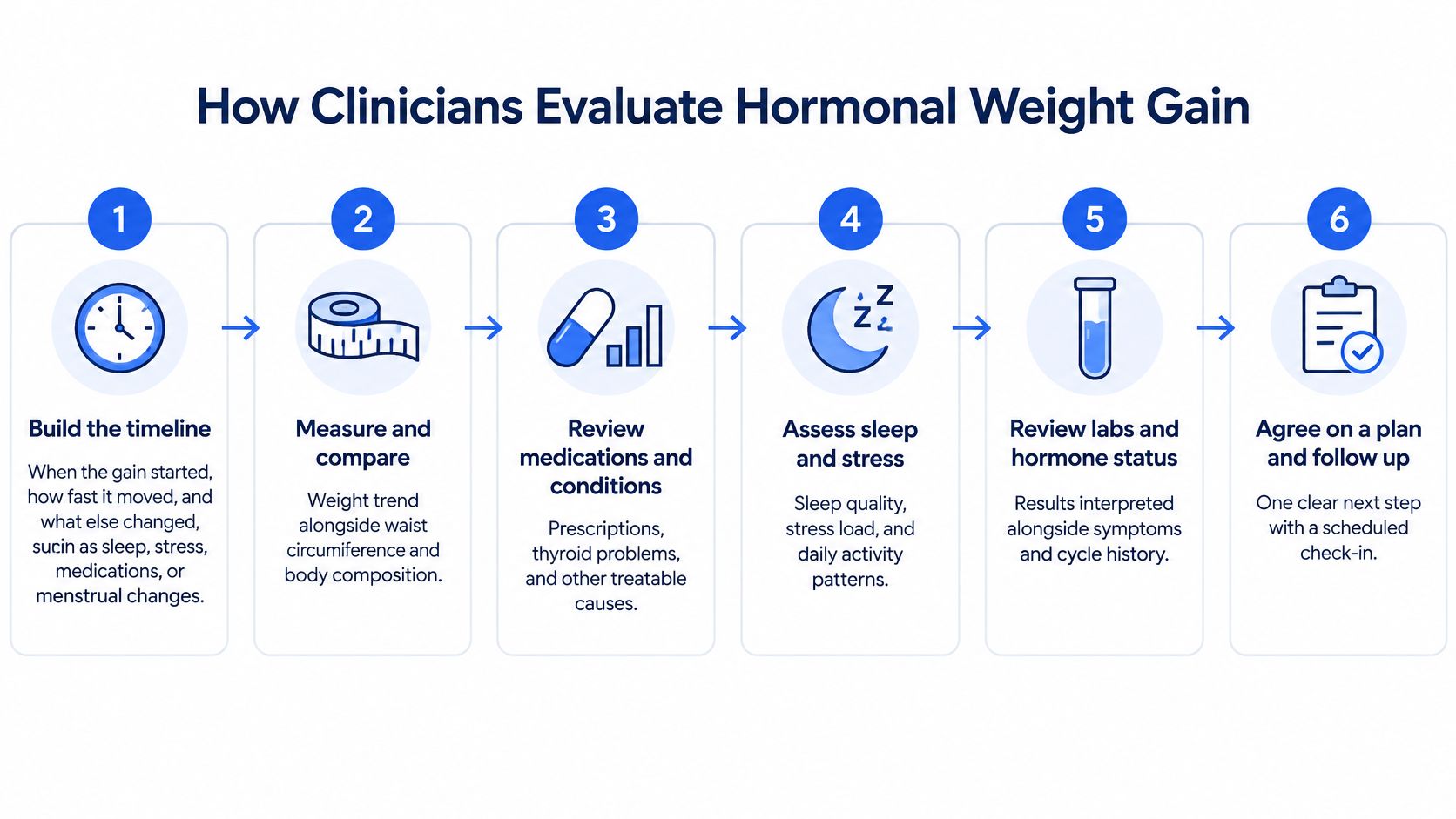
The Six Steps
1. Build the timeline. Note when the gain started, how fast it moved, and what else changed: sleep, stress, medications, menstrual pattern. Timing is what separates a gradual midlife shift from a new driver. A gain that began the month a steroid or an antidepressant started is a different problem from a gain spread over four years.
2. Measure and compare. Record the weight trend next to waist circumference and, when you have it, a body-composition measure. One number cannot show whether you gained fat, lost muscle, or held fluid.
3. Review medicines and conditions. Every prescription, supplement, and pharmacy product gets a look. So do thyroid symptoms and the cortisol pattern described earlier. One drug can explain a change that a hormone story would only obscure.
4. Assess sleep and stress. Ask about snoring, unrefreshing sleep, night waking, stress load, and how much of the day is spent sitting. Broken sleep changes appetite and recovery even when ovarian hormones are already being treated.
5. Review labs chosen for the clues. Thyroid testing when the history supports it, glucose or A1C, and lipids are common anchors. Hormone tests should match the story and the cycle history, not arrive as a default bundle. For hormone imbalance, our providers order detailed lab work to identify specific imbalances and build a targeted treatment plan. A list of symptoms of hormonal imbalance can help you walk in with a clearer history, which makes that lab choice sharper.
6. Agree on a plan and a recheck date. Leave with what is ruled in, what is ruled out, and when you will compare waist, strength, and labs again. A plan without a date is a suggestion.
What a Finished Evaluation Looks Like
You should be able to say, in plain language, which causes were considered and which remain. The next step should attach to those findings: a sleep study, a medication change, a strength plan, a glucose follow-up, or a hormone discussion that was indicated.
If the visit ends with a stack of results and no statement of what they rule out, the evaluation is not finished.
Management Options That Target Body Composition
Each option below aims at a different driver. Picking from the bottom of a trending list, before you know which row applies, is how people collect treatments that cannot touch their actual problem.
| Option | Main Target | Main Limit |
|---|---|---|
| Resistance training | Lean mass and body composition | Needs consistency; does not replace medical evaluation |
| Adequate protein and sleep assessment | Lean mass, appetite and recovery | Needs are individual; screen for sleep apnea |
| Medically supervised weight management | Total weight and metabolic risk | Involves prescriptions, lab work and regular check-ins |
| Menopausal hormone therapy | Central fat and body composition in appropriate patients | Not a primary weight-loss treatment; needs individualized risk review |
| Treatment of a confirmed thyroid or cortisol disorder | The underlying metabolic driver | Only after diagnosis; empiric treatment is unsafe |
The Basics That Apply to Almost Everyone
Resistance training two or three times a week is the direct answer to losing lean mass. You do not need a perfect program. You need a repeatable one that loads the major muscle groups and gets slightly harder over months.
Protein needs are individual. Many older adults do well near 1.0 to 1.2 grams per kilogram of body weight per day, adjusted with a clinician if kidneys or other conditions change the target. Spread it across meals so the muscle signal is not saved for dinner only.
Sleep assessment belongs in the same tier. If snoring or daytime sleepiness is present, screen for apnea before you decide the missing piece is another supplement.
When the Plan Needs a Clinician
Our weight management programs are medically supervised and may include prescription medications, nutritional guidance, lab work, and regular check-ins with a provider. Every plan is personalized to metabolism, health history, and goals. That structure fits people whose gain, glucose, or waist risk is larger than training and protein will cover alone. Women comparing options can start with our overview of weight loss programs for women over 50.
Menopausal hormone therapy is a different tool. A recent systematic review found that most hormone-therapy regimens did not produce significant weight gain compared with nonusers, only some specific formulations showed weight increases, and others were associated with weight reduction, as reported in this systematic review of hormone therapy and weight. Therapy may attenuate central fat accumulation and help preserve body composition in appropriate patients. It is not a primary weight-loss treatment. The decision needs an individual look at cardiovascular, clot, cancer, and symptom risk.
Thyroid or cortisol treatment applies only after a confirmed diagnosis. No row in the table fixes every cause, and stacking them "just in case" adds risk without adding a target.
Confirm the Cause Before You Choose a Treatment
A label helps only when it points to a target. “Hormonal weight gain” works the same way. It can describe a real pattern, but it is not a diagnosis on its own.
Use two steps in order. Confirm what changed, then choose a treatment that fits that change. A scale increase alone gives too little information. Two people can gain the same five pounds while one loses muscle and gains fat around the waist, and the other keeps strength and shifts fluid or glycogen. That is why waist measurement, strength, sleep, glucose markers, and prior labs often tell a more useful story than scale weight alone.
- Book a clinician visit when the gain is rapid, unexplained, or resistant to a credible eating and activity plan, or when thyroid or cortisol clues are present.
- Bring a timeline of when weight changed and what else changed, including sleep, stress, periods, or new medicines. Add the full list of prescriptions, supplements, and over-the-counter products, a recent waist measurement, and any prior labs.
- Leave with causes ruled in or ruled out, and a plan tied to those findings. A blanket hormone prescription is not that plan.
- Match the treatment to the driver. Use resistance training and enough protein to protect muscle. Get a sleep evaluation when snoring or daytime sleepiness is present. Consider menopausal hormone therapy only after a personal review of cardiovascular, clot, and cancer risk, and not as a weight-loss drug. Use thyroid or cortisol treatment only after a confirmed diagnosis.
Think of the visit as a sorting process. One branch checks hormone patterns through lab work. Another looks at medicines, sleep, stress, and health history. The goal is to avoid treating a guess. When hormone imbalance is suspected, ProMD Health providers order lab work to identify specific imbalances and build a targeted treatment plan. That matters because midlife weight change can involve several drivers at once, and each one calls for a different response.
Readers who want ongoing support can ask about weight management, hormone optimization, or menopause care. ProMD Connect is a virtual wellness platform offering guided weight loss, hormone optimization, peptide therapy and more, with prescription options shipped directly to the patient's door. Each office offering wellness services is staffed by providers trained in functional medicine, hormone optimization, and weight management.
If your waist, strength, or glucose trend matches the patterns above, book an evaluation and bring your timeline, medication list, waist measurement, and prior labs. The next step is a plan built around what those findings show. Confirm the cause first, then choose the option that fits it.


