
Botox Cosmetic is approved for the temporary improvement of moderate-to-severe glabellar lines. Its role is to relax the corrugator and procerus muscles, which draw the brows inward and crease the skin between them. As those muscles move less forcefully, the lines may look softer. The treatment does not erase every crease, and its effects wear off.
That distinction helps set realistic expectations: Botox changes the muscle activity that contributes to the lines; it does not remove the skin itself. A careful consult can assess whether relaxing those muscles fits your facial movement and goals.
Table of Contents
- How Botox for Glabellar Lines Works and Wears Off
- Who Sees a Clear Result and Who May Not
- The Five-Site Dose and How Muscles Relax
- What Happens During a Treatment Visit
- Side Effects and the First Week After
- Frequently Asked Questions About Glabellar Botox
- Decide If a Glabellar Consult Fits
How Botox for Glabellar Lines Works and Wears Off
The lines between your brows form as two muscles repeatedly pull the skin into a crease. The corrugator supercilii draws the inner brows toward the nose, while the procerus pulls the skin down between them. Botox temporarily reduces the muscles' ability to contract, so the crease can soften while the effect lasts. The FDA approved BOTOX Cosmetic in April 2002 for the temporary improvement of moderate-to-severe glabellar lines associated with corrugator and procerus activity in adults younger than 65, as recorded in the FDA review of the Botox Cosmetic clinical program.
The labeled evidence comes from two phase 3 studies that enrolled 405 adults aged 18 to 75 with at least moderate lines at maximum frown. At the primary assessment on Day 30, investigators rated 80 percent (325 of 405) of treated participants as having absent or mild lines at maximum frown, compared with 3 percent of placebo recipients. By their own assessment, 89 percent of treated participants reported at least moderate improvement, compared with 7 percent on placebo. The FDA prescribing information describes the benefit as temporary, with reduced line severity demonstrated for up to 120 days.
The schedule a result follows
| Checkpoint | What changes | Labeled finding |
|---|---|---|
| Days 1 to 4 | The treated muscles begin to relax | The chemical effect typically begins within 1 to 2 days |
| Day 7 | Lines may look softer at maximum frown | FDA label: investigators rated 74 percent (299 of 405) absent or mild; 83 percent of patients reported at least moderate improvement |
| Day 30 | Primary efficacy assessment in the trials | FDA label: investigators rated 80 percent (325 of 405) absent or mild, versus 3 percent with placebo; 89 percent of patients reported at least moderate improvement, versus 7 percent |
| Up to about 120 days | Muscle movement and line visibility gradually return | FDA label: benefit was shown for up to about four months versus placebo |
| Next treatment | Consider another treatment as movement returns | The safety and effectiveness of dosing more often than every 3 months have not been clinically evaluated |
The effect builds over the first days. Some movement can remain early on, especially when you frown hard. A result is better judged after the treatment has had time to take effect, rather than immediately after the appointment.
As the nerve signal to the muscle returns, the muscle gradually regains movement and the crease may become more visible. This is the expected temporary course of treatment. For a broader explanation of how long Botox lasts, see how duration can vary by treatment area.
Retreating as soon as movement first appears is not automatically better. The FDA prescribing information says dosing more frequently than every 3 months has not been clinically evaluated. A clinician can help determine whether the lines and muscle movement have returned enough to consider another treatment.
Who Sees a Clear Result and Who May Not
Start with a test you can do at your own bathroom mirror. Frown as hard as you can, relax your face completely, then press two fingertips on either side of the 11 lines and gently spread the skin apart. How much of the line survives that move tells you what kind of line you have, and it tells your injector something useful before a needle ever comes out.
Three faces, three different answers
Consider a 42-year-old whose lines vanish when the skin is spread. The moment the frown stops, the crease mostly goes. This is the classic dynamic pattern, a habit of the corrugator and procerus pulling the skin into the same fold, and relaxing those muscles can make the frown look absent or mild.
Now consider someone whose crease stays deep at rest, even with the skin spread flat. That groove has been etched into the dermis over years. Botox can quiet the movement that keeps deepening it, and the fold may soften, but a visible line can remain after the muscle stops pulling.
A third reader arrives with a heavy upper lid, a brow that already sits unevenly, or very thick, oily skin between the brows. Here the same dose can shift brow position rather than deliver a cleaner result, and the smoothing response is less predictable. Caution belongs in the conversation before the syringe.
| What you see | Fit for Botox alone | Planning note |
|---|---|---|
| Lines mainly when frowning, and they spread away at rest | Strong fit | Classic corrugator and procerus movement lines |
| Lines still deep when the face is relaxed | Partial | Softens the pull but may not erase an etched crease |
| Cannot substantially flatten the crease by spreading the skin | Limited | Label advises caution; discuss other options |
| Deep scarring, very thick oily skin, or marked asymmetry | Cautious fit | Response and symmetry are less predictable |
| Existing lid droop or a large amount of extra eyelid skin | Cautious fit | Brow position matters more than a stronger dose |
The FDA labeling is direct about this. It advises caution in patients with deep dermal scarring, thick sebaceous skin, marked asymmetry, ptosis, excessive eyelid skin, or an inability to substantially reduce the lines by manually spreading them apart, according to the Botox Cosmetic labeling. That list is not a rejection notice. It is a signal that the plan may need more than one tool.
Muscle relaxation handles the movement-driven part of a line. Texture, laxity, and pigment are a different job, and they may be planned for later with skincare, resurfacing, or another treatment your physician selects.
What you should aim for is a softer frown and a steady brow, not a forehead that cannot move at all. Maximal immobility is easy to produce and hard to live with, especially in photos where the middle of your face looks smooth and the rest looks surprised.
Bring two photos to the consult: your face fully relaxed, and your strongest frown. Those two frames tell your injector more about your anatomy than any questionnaire.
The Five-Site Dose and How Muscles Relax
Think of the muscle between your brows as several curtain cords running to the same curtain. Pull one and the fabric bunches in a predictable place. For FDA-labeled onabotulinumtoxinA treatment of moderate-to-severe glabellar lines, the standard map places 20 Units total into the glabellar complex, using 4 Units in 0.1 mL at each of five intramuscular sites: two sites in each corrugator muscle and one in the procerus, as specified in the FDA label for onabotulinumtoxinA.
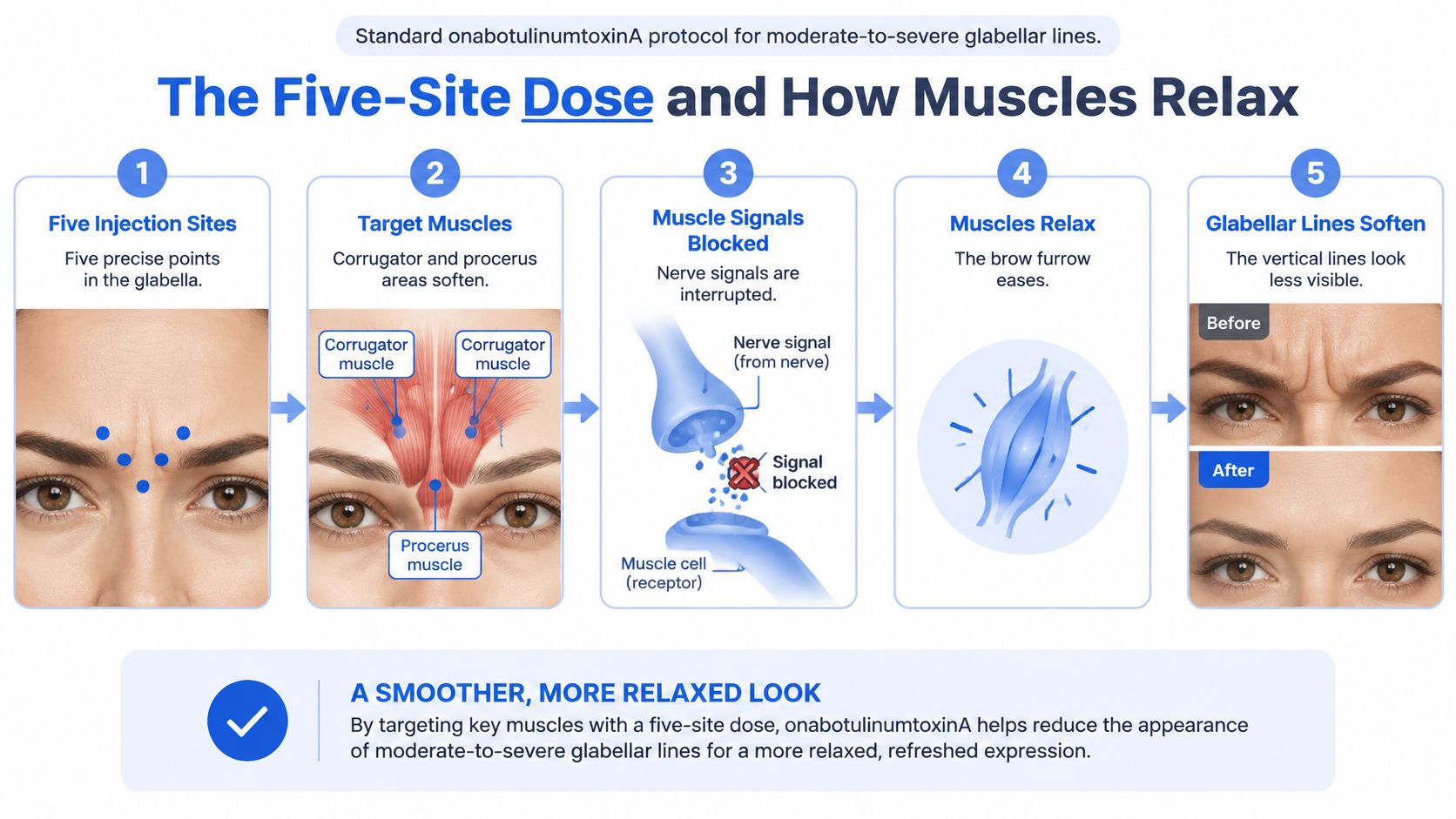
Where the 20 units go
- Two sites in the right corrugator: the muscle that pulls the right inner brow toward your nose.
- Two sites in the left corrugator: the matching pull on the other side, which is why symmetry starts with a balanced map.
- One site in the procerus: the muscle that drags the skin down between the brows and creates the horizontal crease at the top of the nose.
- A 30 to 33 gauge needle: fine enough that the injection is a pinpoint rather than a wound.
- Into muscle, not onto skin: this is an intramuscular injection, not a product smoothed over the surface like a serum.
The mechanism is easier to picture than the name suggests. The nerve ending releases a signal that tells the muscle fiber to contract, and the toxin interrupts that release. The muscle goes quiet where it was injected. Sensation in the skin stays intact, and muscles you did not treat keep working, which is why the outer brow can still lift.
Spreading the dose across five points is deliberate. A single large deposit could over-weaken one muscle and leave the rest of the complex pulling, and the result reads as a heavy or uneven brow rather than a smooth one. Five smaller aliquots share the work.
The timeline starts slowly. Chemical denervation typically begins within 1 to 2 days and intensifies across the first week, so a mirror check on the way home tells you almost nothing. The labeled duration of effect is approximately 3 to 4 months, which is the interval to plan your reassessment around rather than booking an automatic early return.
Placement is where skill shows. Depth, individual anatomy, and how strong your muscles are at baseline all change the plan, because product that sits too low or diffuses where it isn't wanted can alter brow shape or eyelid position. A very strong frowner and a delicate one can receive the same total dose and get very different results. Expect a customized map, and judge it by one standard: a softer frown with a brow that still sits where it belongs.
What Happens During a Treatment Visit
The visit begins with an assessment of how your frown muscles move. Your provider observes your face at rest and during a full frown, then discusses the result you want, such as a softer frown while keeping a natural brow. Photos may help document your starting point.
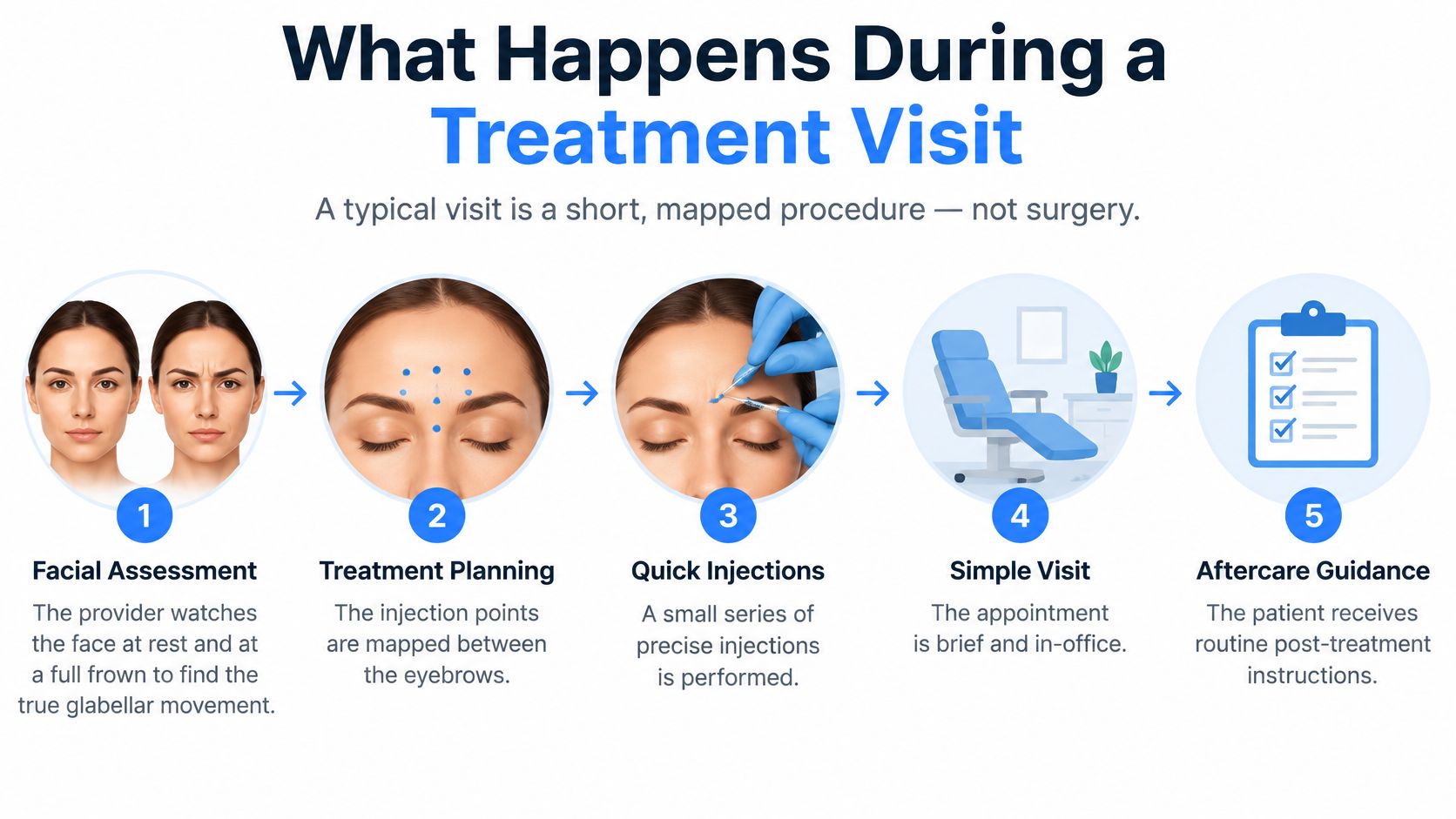
After the assessment, the skin between the brows is cleansed. Makeup can be removed at the visit, but arriving without foundation in the area may make preparation simpler. Numbing cream is optional; some patients prefer it, while others choose to proceed without it.
The provider then identifies the injection sites and gives the treatment. You may feel brief pinches or stings. If a pinpoint of blood appears, it can be dabbed away; avoid rubbing the area unless your provider gives different instructions.
Before you leave, you can review aftercare and discuss when to return for an assessment. The visit also gives you time to raise questions or mention concerns about injections. The first-time Botox guide explains what a first visit may involve.
If you have an event coming up, allow time for the result to develop and for a possible small bruise to fade. A dot of bruising can occur after an injection, so a buffer of days is more practical than scheduling treatment just before a photo or on-camera appearance.
Before treatment, tell your provider if you are pregnant or breastfeeding, have a neuromuscular condition, or have had a prior reaction to botulinum toxin. Bring your medication list as well. Your provider can use that information to discuss whether treatment is appropriate and how to proceed.
Side Effects and the First Week After
The Botox Cosmetic prescribing information reports eyelid ptosis in 3 percent of treated subjects in the glabellar safety population of 405 adults aged 18 to 75. The same prescribing information lists headache, respiratory infection, flu syndrome, eyelid ptosis, and nausea among the most frequently reported events. It also reports facial pain, injection-site redness, tingling, and muscle weakness in fewer than 3 percent of patients.
A pinpoint bump, pink spot, mild tenderness, or small bruise can appear at an injection site. Most injection-site effects settle within the first week. A mild headache may also occur. These effects are different from changes that need prompt medical attention.
Ordinary and expected
Minor injection-site effects usually resolve on their own. A small bruise can take longer to fade than redness or tenderness, so its appearance may change over the first few days.
Worth a same-day call
Call the office the same day if: one eyelid sits noticeably lower than the other, your vision changes, you have trouble swallowing or breathing, a rash spreads, or weakness appears in muscles far from your frown.
Eyelid ptosis means the upper lid droops. It can happen if product affects the muscle that lifts the lid. The prescribing information reports this effect, and its duration can vary. Tell your provider about prior eyelid surgery or heavy lids before treatment, and contact the office if you notice a change afterward.
For the first few hours, stay upright and avoid rubbing the glabella. On the day of treatment, skip strenuous exercise, saunas, and face-down massage. Ask your provider when to resume facials over the injection sites. Makeup can usually cover a pinpoint once the skin has closed.
Discuss blood thinners and your headache plan with the clinician who manages your medication. Aspirin and similar products can worsen bruising, but do not stop a medication on your own. Read ProMD Health's Botox safety guidance for more about safety questions and follow-up.
Many people return to work after treatment, though a bruise or other visible effect may affect individual plans. The first few days are too early to judge the final result. Give the effect time to develop, then review it with your provider.
Frequently Asked Questions About Glabellar Botox
Will Botox make my face look frozen?
Botox temporarily relaxes the corrugator and procerus muscles, which draw the brows together. A carefully customized treatment can soften frown lines while leaving facial expression intact. Placement and dose also matter because they can affect brow or eyelid position. Ask how the proposed dose fits your brow shape.
What if one side looks uneven or my brow feels heavy?
Give the effect time to develop before judging the result. Early unevenness may settle as the treatment takes effect, and adding more product too soon can limit your options. Your provider can assess symmetry and brow position when the effect is established and discuss whether an adjustment makes sense.
Can it be combined with other treatments?
Yes, if each treatment addresses a different concern. Dermal fillers add or restore volume, while microneedling can improve skin texture, tone, and the appearance of fine lines and acne scars. They work differently from Botox, which relaxes the muscles that cause expression lines. Discuss which concerns matter most and how to sequence treatments.
Does glabellar Botox also treat forehead lines?
Forehead lines and lines at the outer eyes involve different treatment zones and muscle patterns. A consult can assess each area and determine whether it belongs in your plan. Treating the glabella alone may make nearby untreated lines more noticeable, so your provider should consider how the areas relate to one another.
Decide If a Glabellar Consult Fits
A consult may fit if the 11 lines bother you in photos or video calls, or if people often read your expression as anger. It is also a reasonable option if you are comfortable with a temporary change that needs periodic reassessment.
Consider discussing other options first if the crease remains deep when your face is relaxed, if one eyelid already droops, or if you have an event within the next week and need a guaranteed result. These details help shape the conversation and the treatment plan.
Bring a short list of medicines and supplements, any previous toxin or filler treatments and when you had them, pregnancy or breastfeeding status, and any neuromuscular history. Then ask: Which sites would you treat? How would you account for my brow position? What result would tell you that adding more product is not appropriate?
ProMD Health customizes Botox to each patient's aesthetic needs and offers Botox, Dysport, and Daxxify for lines around the brows, eyes, and mouth. Because services may vary by clinic, confirm which treatments are available at your location.
At the consult, bring photos of your face relaxed and frowning. The visit can end with a dose plan and a clear understanding of what to expect. Visit ProMD Health to book a glabellar line consult at the clinic nearest you.


